Introduction
Coffee berry borer (CBB), Hypothenemus hampei (Ferrari) (Coleoptera: Curculionidae), is the main pest of coffee worldwide (Le Pelley, Reference Le Pelley1968; Waterhouse & Norris, Reference Waterhouse and Norris1989). Males are smaller and less numerous than females (ratio 1:10); they have atrophied wings (Waterhouse & Norris, Reference Waterhouse and Norris1989; Damon, Reference Damon2000), and remain most of their life span inside the berry and only participate in the reproduction process, in which they do not express or transmit their paternal genes, a phenomena know as functional haplodiploidy (Brun et al., Reference Brun, Borsa, Gaudichon, Stuart, Aronstein, Coustau and Ffrench-Constant1995; Mathieu et al., Reference Mathieu, Brun and Frérot1997). Females bore irregular galleries in the endosperm, where they oviposit and their offspring will develop (Barrera, Reference Barrera1994; Jaramillo et al., Reference Jaramillo, Borgemeister and Baker2006). After adult emergence, females mated with their male siblings, and then females leave the coffee berry and fly off to colonize new host berries (Waterhouse & Norris, Reference Waterhouse and Norris1989; Baker et al., Reference Baker, Ley, Balbuena and Barrera1992; López-Guillén et al., Reference López-Guillén G., Valdez-Carrasco, Cruz-López, Barrera, Malo and Rojas2011). These females are known as ‘colonizing females’ because they have three features: they have been inseminated, they can disperse and they have the ability to colonize berry. However, inseminated females that remain and oviposit in berries where they were born cannot be called colonizing females (Mathieu et al., Reference Mathieu, Brun and Frérot1997; Reference Mathieu, Gaudichon, Brun and Frérot2001).
Colonizing females survive the inhospitable climate of the inter-harvest season inside residual infested berries on the ground or those hanging from branches. After emergence, colonizing females, mainly from the residual berries of the ground, tend to take refuge in the residual berries of the branches when they do not find suitable host to reproduce (Mathieu et al., Reference Mathieu, Brun and Frérot1997; Dufour et al., Reference Dufour, Franco Franco, Hernández, Barrera, García, Domínguez and Luna2007). It is assumed that these females remain in a reproductive diapause state (Barrera et al., Reference Barrera, Herrera, Villacorta, García, Cruz, Barrera and Montoya2006) and provide a focus for the new infestations (Ticheler, Reference Ticheler1961; Barrera et al., Reference Barrera, Herrera, Villacorta, García, Cruz, Barrera and Montoya2006; Dufour et al., Reference Dufour, Franco Franco, Hernández, Barrera, García, Domínguez and Luna2007).
Some authors have mentioned and discussed the question if the insemination of young H. hampei females by males take place inside infested berries, as well as the ability of these young females for dispersal flying. Mathieu et al. (Reference Mathieu, Brun and Frérot1997) determined, using the indirect method of egg viability, that more than 90% of females leaving berries had viable offspring, while Giordanengo (Reference Giordanengo1992) found a higher percentage. In the same way, Bergamin (Reference Bergamin1943) had previously stated that all colonizing females were fertilized before leaving their natal berries. Nevertheless, based on meticulous microscopic observations of colonizing females’ spermathecae, Lopez (Reference Lopez1993) estimated an insemination rate of only 61.7%, but he obtained a rate of 78.3% for all females present inside berries. All these results are the product of different techniques applied under distinct experimental conditions. They cannot therefore formally confirm that the insemination of colonizing females is a necessary step in the context of their dispersal, as predicted by Bergamin (Reference Bergamin1943). Neither do they indicate whether this state is stable over time or dependent on a precise stage of the phenology of the coffee tree. Likewise, it was mentioned that virgin females were not fit to fly and could therefore not take on the status of colonizers (Giordanengo, Reference Giordanengo1992), but this affirmation is only based on a single experiment which it would be important to test. In the context of this study, we proposed to observe the physiological status of H. hampei colonizing females caught with traps at different times of the year, as well as that of females present inside infested berries.
Materials and methods
Biological material
This study focused on three kinds of H. hampei females: colonizing females caught with traps, adult females obtained from infested coffee berries and virgin females obtained from isolated pupae reared in the laboratory.
The H. hampei colonizing females and adult females used in the experiments were obtained from coffee crops near Soconusco, Chiapas, Mexico, during the inter-harvest period, from January to June, 2014 and 2015, more precisely in the first and second week of each month. Colonizing females were caught with ECOIAPAR traps baited with an alcohol mixture (methanol–ethanol mixture, 3:1), and adult females were obtained from residual infested dry coffee berries on branches. These berries were blackish-brown and very dry and generally contained only CBB adults. All insects were stored in 96% ethanol until use. The pupae used to obtain virgin females (control) were obtained from infested coffee berries collected during the fructification period, from August to September 2016. The pupae were placed individually in Petri dishes covered with a piece of aluminium and kept under laboratory conditions (25 ± 2°C; 50–70%) until the adults emerged (Silva et al., Reference Silva, Moreira and Bento2014).
Dissection of females
The females were dissected to allow microscopic examinations of their spermatheca. The samples were analysed in the Integral Pest Management laboratory at ‘El Colegio de la Frontera Sur (ECOSUR)’, Tapachula, Chiapas, Mexico. Each specimen was positioned in dorsal view inside 1 ml of 70% ethanol for handling. With the help of a wild Heebrugg stereomicroscope, entomological forceps and a dissecting needle (No. 00) were used to remove the elytra and abdomen, and then remove the spermatheca. At least 50 females/month/treatment were dissected.
Spermatheca clarification technique
Clarification technique was only used for virgin females to facilitate the fixation of the dye. It consisted of immerse spermatheca in 10% KOH for 15 min, then in distilled water for 15–20 min, and lastly in 95% ethanol for 15 min (Roman-Ruiz et al., Reference Roman-Ruiz, Michel, Dufour, Rojas, Cruz-Lopez and Barrera2017).
Spermatheca staining technique
The staining technique described by Roman-Ruiz et al. (Reference Roman-Ruiz, Michel, Dufour, Rojas, Cruz-Lopez and Barrera2017) allowed to better observe the spermatheca and the sperm stored. Briefly, 1 µl of glycerol + 1 µl of Giemsa dye was deposited on a slide and mixed, and the spermatheca was positioned on it after 1 min. The samples were cut transversally into two or three parts to release the sperm and prepare a sperm suspension. After 30 min, all the samples were observed under a DIALUX 20 EB, Leitz Wetzlar microscope.
Recognition of mating status of females
Microscopic observations were used to identify the physiological status of H. hampei females. The observations focused on the degree of spermatheca coloration intensity, the absence or presence of sperm (Roman-Ruiz et al., Reference Roman-Ruiz, Michel, Dufour, Rojas, Cruz-Lopez and Barrera2017), concealment of the wall delimitation of the cuticle (channel), the form of the abdomen (thin or bulging), as this characteristic indicated whether the samples came from virgin, females mated with males and recent insemination (spermatheca full of sperm), and older females mated with males and fertilized (dark coloured spermatheca containing some sperm).
Flight tests of CBB virgin females
Once the pupae became adults, females were fed with pieces of coffee berries until the complete melanization of their cuticle and development of their wing muscles (Silva et al., Reference Silva, Moreira and Bento2014) which took about 11 days. Flying ability was evaluated first. Single females were placed in a plastic jar 13 × 5 cm in diameter, closed with perforated caps, fitted with a piece of fine nylon mesh. Fifty females were evaluated and these tests were performed in August–September 2016, under laboratory conditions (24–28°C and 60–75% RH) with complete lighting (800–1000 lux). The take-off, or flying females, was observed and recorded for 20 min.
After that time, the females were removed and stored pending dissection of the spermathecae. After five evaluations, the containers were washed with neutral soap and dried to eliminate possible insect odours.
Statistical analysis
To compare insemination data and dates, we performed a generalized linear model (GLM) using a binomial distribution and a logit link function. Analysis were performed using R (R Core Team, 2017) and Rpackage lme4 (Bates et al., Reference Bates, Maechler, Bolker and Walker2015).
Results
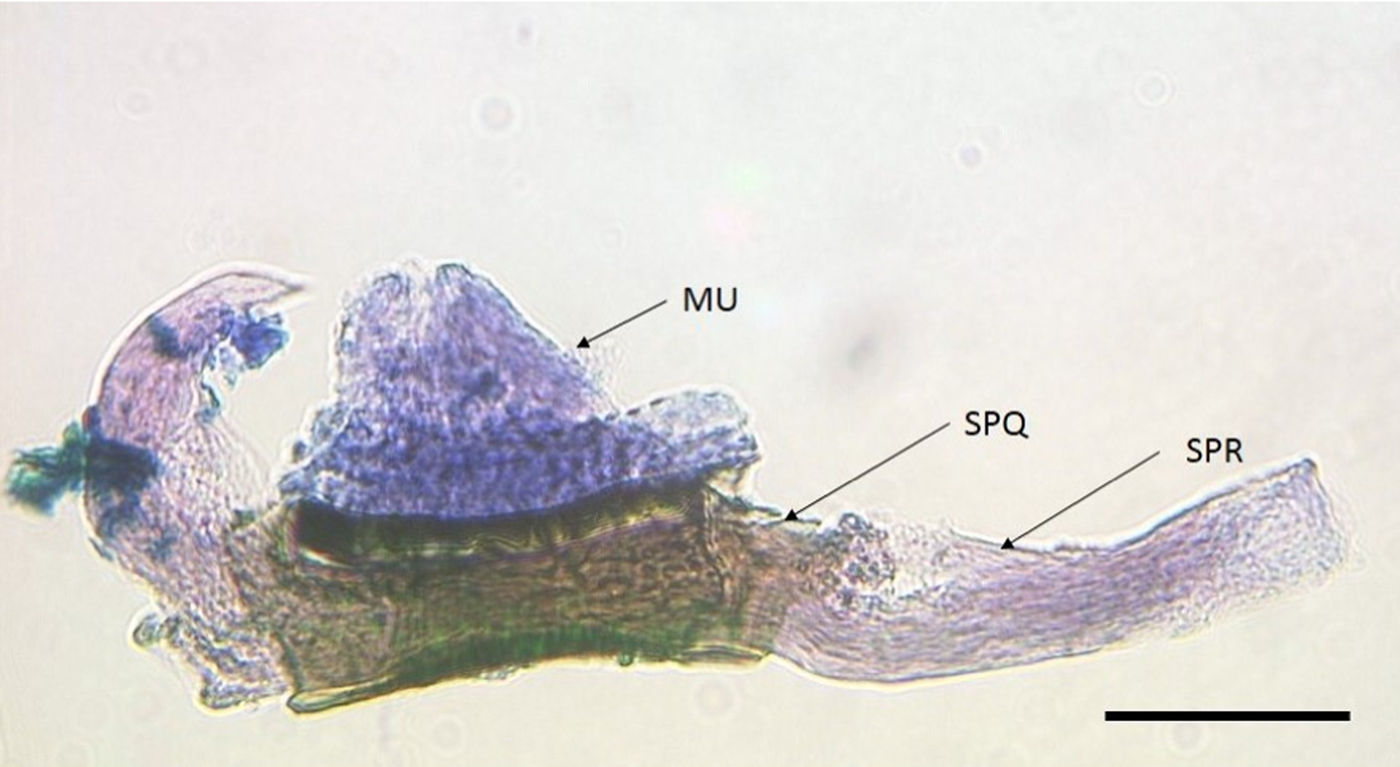
Out of a total of 490 CBB females caught with traps in both years, an average of 98.4% had a clearly inseminated spermatheca, i.e. spermatheca completely filled with sperm (figs 1 and 3a). The sperm contained was found to be in abundance, with similar tiny and flimsy filaments stained lilac (fig. 1). On the other hand, in 1.6% of remaining females, the presence of sperm was detected on the contrasted wall of the spermatheca of old females, as well as near the area of the spermathecal gland from recent insemination observed in the samples from April, May and June 2014 (fig. 3b). Sperm was also detected near the connection of the common oviduct of older females in the samples from February 2015.
Spermatheca from colonizing H. hampei female cut and stained with Giemsa. MU = spermathecal muscle; SPQ = spermatheca; SPR = sperm. Scale bar = 100 µm.

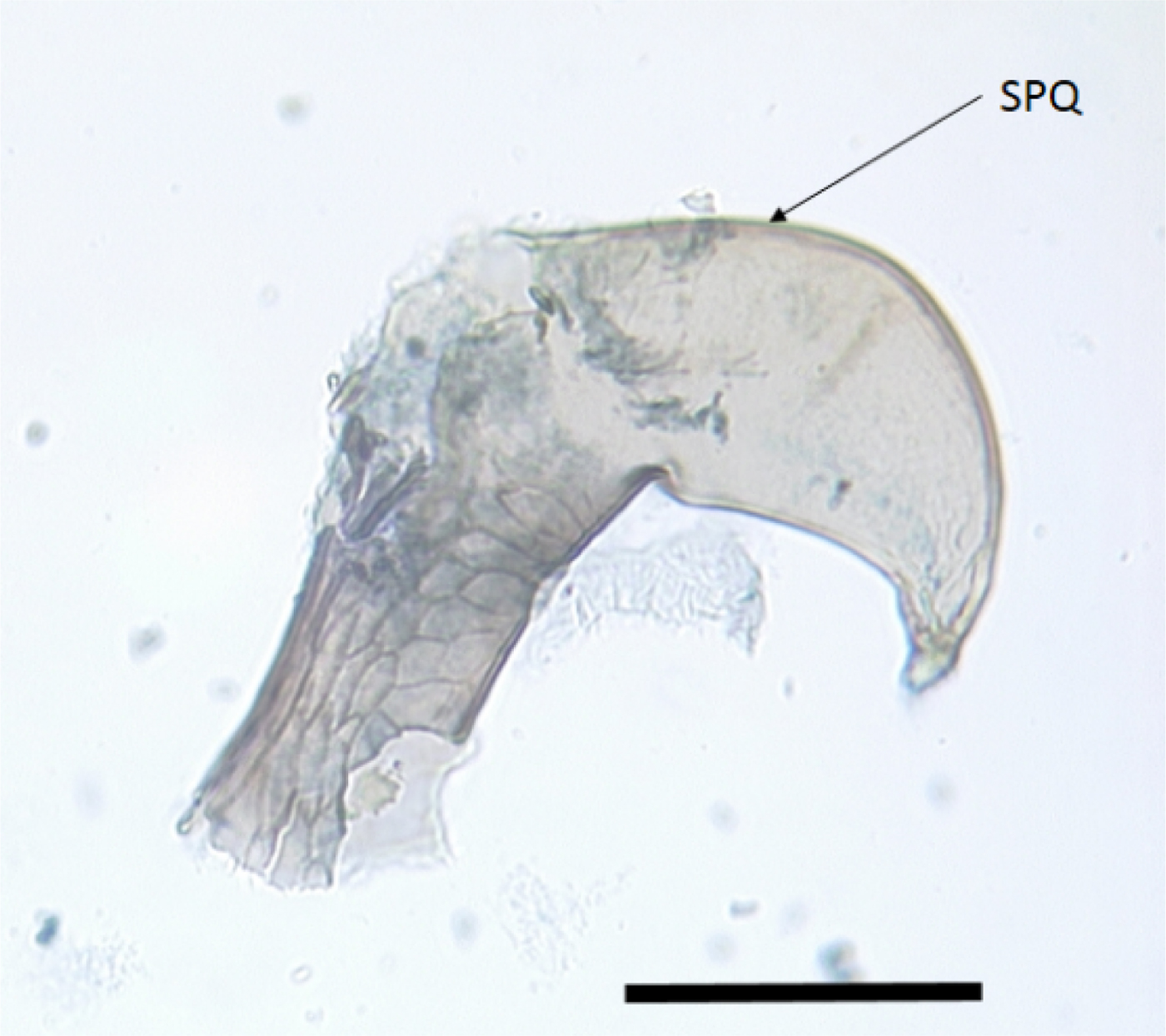
All the virgin females studied showed no trace of sperm in their spermatheca and were quickly identified because of the pale characteristic coloration of their spermatheca when stained with Giemsa and the absence of canal inside of the spermatheca (figs 2, 3b, c) (Roman-Ruiz et al., Reference Roman-Ruiz, Michel, Dufour, Rojas, Cruz-Lopez and Barrera2017).
Spermatheca from virgin H. hampei female cut and stained with Giemsa. SPQ = spermatheca. Scale bar = 100 µm.

Characteristics of spermathecae from H. hampei stained with Giemsa. (a) Spermatheca from colonizing females; (b) spermatheca from old females; and (c) spermatheca from virgin females. HO = binding between spermathecal and spermathecal gland; ID = internal duct; MU = spermathecal muscle; SD = spermathecal duct; SGL = spermathecal gland; SPR = sperm. Scal bar = 100 µm.

Observations of mated females at the end of the dry period (February to April 2015) and the beginning of the wet period (April to June 2014) showed that insemination was not significantly different according to the dates (P = 1, binomial GLM) and recent insemination rates were significantly higher than old insemination rates (**P < 0.01, binomial GLM) (table 1).
Physiological status of H. hampei females caught with traps after their emergence from residuals coffee berries (GLM binomial: date P = 1; insemination <0.01).

Out of a total of 150 females extracted from residual and dry berries in 4 months, February to May 2016, an average of 84.5% were recently inseminated, 5% inseminated for longer and 10.5% still virgin (table 2). As previously, recent insemination rates were significantly higher than non-insemination rates (**P < 0.01, binomial GLM) and were significantly higher than those of old inseminations (*P < 0.05, binomial GLM). For the virgin flying tests, females showed some mobility on the walls of the container, but it was not possible to stimulate flight in the 50 samples.
Physiological status of H. hampei females inside residual coffee berries (GLM binomial: date P = 1; insemination <0.01).

Discussion
Our study of the physiological status of H. hampei females emerging from residual berries and caught with traps in the inter-harvest season showed that all females examined had been inseminated. Generally, sperm storage implies a temporal separation between mating/insemination and fertilization (Pascini & Martins, Reference Pascini and Martins2016). In all, 98.4% showed a spermatheca full of sperm, which suggested that insemination took place in the berries, before the female left the native fruit. Moreover, no virgin females were found in the traps. This characteristic of the life cycle is far from common in all insects and especially in Curculionidae. Thus, in the bark beetle Dentroctonus ponderoseae Hopkins, the mating rate is only 3–12% before their emergence of pine bark (Bleiker et al., Reference Bleiker, Heron, Braithwaite and Smith2013). In Tomicus piniperda L., a pest of several species of conifers and Ips typographus L., which is particularly dependent on spruce, mating is later; it occurs after emergence, at the time of colonization of the plant (Lévieux et al., Reference Lévieux, Lieutier and Delplanque1985; Janin & Lieutier, Reference Janin and Lieutier1988).
Our results reinforce the conclusions of previous studies regarding the physiological status of females leaving berries which can qualify as colonizing females (Bergamin, Reference Bergamin1943; Giordanengo, Reference Giordanengo1992; Mathieu et al., Reference Mathieu, Brun and Frérot1997). These females are fit for flying as their wing muscles are perfectly developed (López-Guillén et al., Reference López-Guillén G., Valdez-Carrasco, Cruz-López, Barrera, Malo and Rojas2011).
The remaining 1.6% corresponded to two types of females: (a) females with traces of old insemination, i.e. samples from February 2015, with tiny and flimsy filaments near the common oviduct, which indicated that females were old and had started the fecundation and procreation process, (b) females with traces of recent insemination (samples from April, May and June 2014) with tiny and flimsy filaments near the spermathecal gland.
However, as there were small amounts of filaments in both cases, we focused on observing the feature of inseminated females for which the walls of the spermatheca were contrasted and the spermatheca was dark in colour (Roman-Ruiz et al., Reference Roman-Ruiz, Michel, Dufour, Rojas, Cruz-Lopez and Barrera2017). These features can also be observed in Tribolium sp and Dendroctonus ponderosae during the insemination process and at the beginning of fertilization (Fedina & Lewis, Reference Fedina and Lewis2008; Bleiker et al., Reference Bleiker, Heron, Braithwaite and Smith2013). In the present study, the performance of old inseminated females for flying was not verified, but it is known that it is gradually altered with degeneration of the wing muscles (López-Guillén et al., Reference López-Guillén G., Valdez-Carrasco, Cruz-López, Barrera, Malo and Rojas2011). However, if they did not move by flying, it can be assumed that they accidentally fell into the traps, given that coffee plants carry many infested berries.
Since all females that emerged from berries were inseminated, one might ask why the insemination rate proposed by Lopez (Reference Lopez1993) does not exceed 61.7%. Either the study sample imported from Colombia had temporarily suffered from inadequate containment conditions, subsequently affecting the natural behaviour of the species, or the dissection technique and observation methodology were disrupted.
In our study, the comparison of insemination rates obtained at the end of the dry season of the second year (February to April 2015), and the beginning of the wet season of the first year (April to June 2014) indicated that the value was stable over time. These results reinforced the hypothesis that insemination is an intrinsic feature of colonizing females and it is associated with being fit to fly, a feature that allows them to effectively colonize new berries and coffee plants.
When the population of females was observed inside residual dry berries, the three physiological statuses previously described were found (table 2). Amounting to 84.3%, the proportion of recently inseminated females approached the figure reported by Lopez (Reference Lopez1993). Nevertheless, it is difficult to know whether all females were born inside the dissected berry or whether some originating from other berries took refuge there (Mathieu et al., Reference Mathieu, Gaudichon, Brun and Frérot2001; Silva et al., Reference Silva, Moreira and Bento2014). However, the heterogeneous physiological status of this population is exactly the dynamics at a given time because, recently inseminated females will emerge, virgin females will mate if they find males and older females will stay inside berries.
As demonstrated in the 50 flight tests, the virgin females did not try to fly, which confirm previous observations (Giordanengo, Reference Giordanengo1992). From a behavioural point of view, it seems natural that these females remain inside the berry until their physiological maturity allows them to acquire colonizing status, i.e. they are inseminated and can fly to locate their host.
In conclusion, out of the females that had started their dispersal process from residual berries in the inter-harvest season, all were inseminated, prepared for oviposition and able to fly. This dispersal strategy is enhanced with the ability of the species to detect olfactory signals emitted by new berries during the ripening process. The dry berries that harbour these females do not have all the food reserves necessary for the development of new generations, so they only serve as a refuge. Thus, in the context of integral CBB management, the trapping of colonizing females and complete harvesting of residual berries on branches are two essential activities for stopping the dispersal of this pest.
Acknowledgements
We should like to thank the Centre de Coopération Internationale en Recherche Agronomique pour le Développement (CIRAD), the Institut de Recherche pour le Développement (IRD) (grant no 777606C) and Consejo Nacional de Ciencia y Tecnologia (CONACyT) (grant no 293465) for financial support through the doctoral scholarship to A.K.R.R. We also thank Enrique López and Maria de Los Angeles Palomeque-Rodas, both from ECOSUR, for their technical support. Finally, we thank Fabienne Ribeyre for her contribution in statistical analysis and Peter Biggins for his valuable help in revising the English of this manuscript.