Kenya and Tanzania share a border and a number of demographic and geographical characteristics. Yet when it comes to the political salience of ethnicity, they are poles apart. While mainland Tanzania has never experienced sustained ethnic clashes, intercommunal violence has undermined political stability in Kenya three times since the reintroduction of multi-party politics (Branch and Cheeseman Reference Branch and Cheeseman2009). Similar differences have also been identified in the relationship between ethnic diversity and the provision of public goods, which appears to be negligible in Tanzania but significant and negative in Kenya (Barkan Reference Barkan1984; Reference Barkan1994; Burbidge Reference Burbidge2013; Miguel Reference Miguel2004). These variations have tended to be explained on the basis of the different kinds of leadership that the two countries experienced after independence. In Tanzania, President Julius Nyerere focused on nation-building and promoting a common language, while in Kenya President Jomo Kenyatta (Reference Kenyatta1938) adopted a “survival of the fittest” approach to managing a diverse population (Barkan Reference Barkan1984; Reference Barkan1994; Miguel Reference Miguel2004). However, these findings have typically been demonstrated using aggregate or survey data; the greater political salience of ethnicity in Kenya has never been tested through the use of trust games that can provide valuable insights into citizen-on-citizen interaction.Footnote 1 This paper provides such a test, but also goes further to consider the ways in which knowledge of both ethnicity and honesty shape economic behavior.
Trust is by nature interpersonal, and cannot be divorced from relationships and relational knowledge. Whether someone is disposed to trust or not depends a great deal on whether these dispositions are likely to be reciprocated, an area of study that game theory specializes in. One tool for tracking the dynamics of trust that previous studies have found great profit in is the trust game, first developed by Berg, Dickhaut, and McCabe (Reference Berg, Dickhaut and McCabe1995).Footnote 2 Here we deploy the trust game in a laboratory setting with 486 participants to measure the dynamics and levels of trust among citizens of Nairobi, Kenya, and Dar es Salaam, Tanzania, and to explore how particular areas of common knowledge influence trust. We operationalise the established trust game in a two-round format with two additional variations: the first to accommodate common knowledge of ethnic similarity or difference between playing partners, and the second to accommodate common knowledge of participants' integrity. For the latter, we ask participants whether or not they are willing to lie during the game, and disclose this information to gaming partners. The aim is to provide a controlled environment in which to compare the citizen dynamics at the heart of the relationship between ethnic diversity and trust in Kenya and Tanzania.
What does it mean to treat ethnicity and integrity as areas of “common knowledge”? The experimental study of ethnicity has often investigated subjective dispositions by revealing ethnic identities subtly, alongside participants' involvement in other activities that instead take center stage (Habyarimana et al. Reference Habyarimana, Humphreys, Posner and Weinstein2007; Reference Habyarimana, Humphreys, Posner and Weinstein2009; Lowes et al. Reference Lowes, Nunn, Robinson and Weigel2015). By contrast, political science literature often discusses the politicization of ethnicity in terms of the direct galvanization of coethnics by political actors, for example campaign rhetoric, or decisions to invest public money in coethnic areas (Burgess et al. Reference Burgess, Jedwab, Miguel, Morjaria and Miquel2013; Lynch Reference Lynch2011). Such public manifestations have an effect on ethnic politicization in terms of mutual, social expectations, not just subjective or private dispositions (Burbidge, Reference Burbidge2015). To meet a growing need to understand the intersection between the subjective dispositions of individuals and mutual expectations of members of ethnic communities within society, we suggest that it is necessary to study ethnic politicization through the lens of common knowledge.
Common knowledge can be defined as occurring when every person knows what every other knows, and knows that they know it (Rasmusen Reference Rasmusen2001, 47). Why is this important for the study of trust? Due to trust's quintessential social dynamic, it is not sufficient to only take into account how people are disposed to act as individuals operating in isolation. Rather, to understand the dynamics of societal cooperation we need to look at how people act in response to others' likely actions. Private interests of course matter, but how these interests are best pursued depends on what others know and how they can be expected to behave. If something is a matter of common knowledge, all actors are able to take into account their mutual awareness of this information. By introducing aspects of common knowledge to the standard trust game, we are able to probe deeper into the social dynamics that generate the willingness to trust, and so gain more realistic insights into how trust develops in the real world.
The first area of common knowledge we explore, ethnicity, has already been analyzed through application of the trust game (Burns Reference Burns2006; Chuah, Fahoum, and Hoffman Reference Chuah, Fahoum and Hoffman2013; Criado et al. Reference Criado, Herreros, Miller and Ubeda2015; Fershtman and Gneezy Reference Fershtman and Gneezy2001; Fershtman, Gneezy, and Verboven Reference Fershtman, Gneezy and Verboven2005; Johansson-Stenman, Mahmud, and Martinsson Reference Johansson-Stenman, Mahmud and Martinsson2009; Reference Johansson-Stenman, Mahmud and Martinsson2013; Robinson Reference Robinson2013; Willinger et al. Reference Willinger, Keser, Lohmann and Usunier2003). We build on this existing work by using the trust game to affect a direct comparison between two countries that share similar socioeconomic profiles and yet have exhibited divergent political trends. Based on the work of scholars such as Miguel (Reference Miguel2004), who argues that ethnicity has historically been more salient in Kenya, acting as a more powerful driver of public goods provision in homogeneous areas and a more effective barrier to interethnic coordination in heterogeneous areas, we hypothesize that overall levels of trust will be higher in Tanzania than in Kenya. We also expect that common knowledge of coethnicity will lead to comparatively more “trusting” relations between partners in Kenya, but that knowledge of ethnicity will have no significant effect in Tanzania. Finally, we hypothesize that common knowledge of integrity will have a positive impact on trust, and that this effect will be higher in the case of Tanzania, where levels of intercommunal trust are said to be higher, and the salience of ethnicity lower.
The article begins with an outline of the trust game and its two-round format. Following this, we situate our analysis within the wider literature on East Africa before explaining the variations we make to the trust game to account for common knowledge of coethnicity and participant integrity, and subsequently describe results. Confirming other studies' use of the Kenya–Tanzania comparison, we find higher levels of trust among Tanzanians as compared with Kenyans. We also find that coethnicity has a more positive effect in Kenya than Tanzania, as expected. However, less intuitively, both coethnicity and non-coethnicity are found to have negative effects in Tanzania as compared with Kenya, which contradicts our initial hypothesis. We suggest that these results may reflect both the taboo around discussing ethnic identities in Tanzania, and the willingness of Kenyan respondents to broadcast tolerance for non-coethnics in the wake of the 2007/8 ethnic clashes. In terms of last round reciprocity, we find common knowledge of integrity to have a greater effect than ethnicity and to have a stronger impact on trustworthiness in Tanzania than in Kenya, as hypothesized. These results provide a new way of thinking about the way in which ethnicity is shaped by political and historical contexts, and demonstrate the value of exploring the intersection between subjective dispositions and mutual expectations of communal identities.
TRUST IN EAST AFRICA
East Africa has perhaps been subject to more studies of trust and ethnicity than almost any other region in Africa. In part, this is due to the obvious differences between Tanzania and Kenya. Despite the two country's proximity and similarities in terms of their economic base at the point of independence, they have followed very different political paths during the one-party era. Most notably in Tanzania, the combination of the promotion of Kiswahili as a lingua franca, combined with a program of civic education under the left-leaning government of Julius Nyerere, encouraged Tanzanians to shed their ethnic identities and to embrace a common national identity. There was no such attempt at nation-building in Kenya, where President Jomo Kenyatta (Reference Kenyatta1938) encouraged communities to compete for access to state resources, stating that the government would only help those who had already helped themselves. This “winner-takes-all” approach to politics, combined with the fact that ethnic groups in Kenya tend to be larger than their counterparts in Tanzania, and thus more effective as voting blocks, helped to promote the political salience of ethnicity (Mueller Reference Mueller2008).
More recently, the two countries' paths have diverged again, as a result of the varied impact of multiparty politics. In Tanzania, a one-party state has given way to competitive politics, but the ruling party has remained the dominant player. In Kenya, by contrast, President Kenyatta's successor, Daniel arap Moi, came close to defeat in the “founding” multiparty elections of 1992. His government's strategy to retain power included not only gerrymandering and ballot box stuffing, but also the use of ethnic clashes to displace rival supporters and create an atmosphere of distrust. This period served to heighten interethnic suspicion and strengthen ethnic stereotypes and divisions. Worse was to come in 2007, when the combination of a flawed election, intercommunal distrust, and struggles over land led to three months of violence in which over 1,000 people died and 600,000 more were displaced (Branch and Cheeseman Reference Branch and Cheeseman2009).
The variation in these two historical pathways has encouraged political scientists to use the cases of Kenya and Tanzania as a way to investigate the impact of political history on ethnic identities. One of the best-known such studies is Miguel's (Reference Miguel2004) investigation into whether more ethnically diverse communities are less successful in providing public goods. In the Kenyan case, Miguel found that the relationship between ethnic diversity and poor public goods provision held. Ethnically homogeneous communities were relatively more successful at raising money to provide school facilities than more diverse communities. But Miguel found that this relationship did not hold in Tanzania. Thus, “while Kenyan communities at mean levels of ethnic diversity have 25% less primary school funding per pupil than homogeneous areas on average, the comparable figure for the Tanzanian district is near zero and statistically insignificant” (Reference Miguel2004, 328). His explanation was essentially that the significance of ethnicity depends on historical context. Kenya's political history, with exclusive governments and periodic ethnic clashes, has heighted the salience and hence the negative impact of ethnicity. By contrast, Nyerere's efforts to promote a common set of national symbols effectively contained and demobilized ethnic tensions in Tanzania.
Although persuasive, Miguel's analysis was based on comparing the impact of levels of ethnic diversity on aggregate public goods provision. This means that the findings are based on community averages, rather than individual-level data. Miguel's work therefore tells us about outcomes but not processes and causal pathways. As a result, it does not shed light on the interpersonal dynamics at play in the development of social trust. Instead of considering how people go about trusting one another, his research design took levels of public goods provision as the dependent variable, which were assumed to indicate a society's level of cooperation. This more top-down aggregate focus meant that Miguel's analysis did not look at the varying significance of coethnicity or non-coethnicity within a particular setting. In other words, his study compares outcomes between more and less diverse areas, but does not investigate how a shared (different) ethnic identity changes the way in which individuals engage with each other within more or less diverse communities. By providing treatments for both types of scenario in our study, we are able to explore the dynamics at play in the diverse situations actors face as they go about their day-to-day lives, and to then compare these individual scenarios across countries.
Our research design further builds on a number of single-case experimental studies that have been conducted in the region. For example, experimental games have also been applied to specific communities of rural Kenya and Tanzania as part of a general effort to understand pre-industrial societies (Ensminger Reference Ensminger, Henrich, Boyd, Bowles, Camerer, Fehr and Gintis2004; Henrich et al. Reference Henrich, Boyd, Bowles, Camerer, Fehr, Gintis, McElreath, Alvard, Barr, Ensminger, Henrich, Hill, Gil-White, Gurven, Marlowe, Patton and Tracer2005, 812; Marlowe Reference Marlowe, Henrich, Boyd, Bowles, Camerer, Fehr and Gintis2004; McElreath Reference McElreath, Henrich, Boyd, Bowles, Camerer, Fehr and Gintis2004). Ensminger describes her results from experimental games with members of the Orma community in Kenya as “consistent with the general finding from the overall cross-cultural project that shows fairness increasing with market integration” (Reference Ensminger, Henrich, Boyd, Bowles, Camerer, Fehr and Gintis2004, 380; Henrich et al. Reference Henrich, Boyd, Bowles, Camerer, Fehr, Gintis, McElreath, Alvard, Barr, Ensminger, Henrich, Hill, Gil-White, Gurven, Marlowe, Patton and Tracer2005, 808). In Marlowe's application of games to the Hadza hunger-gatherers of Tanzania, he found that larger camps displayed greater norms of sharing than smaller camps (Reference Marlowe, Henrich, Boyd, Bowles, Camerer, Fehr and Gintis2004, 179).
Greig and Bohnet (Reference Greig and Bohnet2008; Reference Greig and Bohnet2009) conducted a series of games—including trust games—with just under 300 residents of the Embakasi slum in Nairobi, focusing on gendered decisions in a single-blind environment. The authors found that women gave less in public goods games when placed in mixed sex groups, and that for decisions on whether to trust in general, the average amounts sent were “substantially lower than the standard results in investment games run in developed countries”, with trust in Nairobi slums “among the lowest ever reported” (Reference Greig and Bohnet2008, 79). In a 2014 article considering ethnic diversity and cooperative behavior in rural Malawi, Dionne (Reference Dionne2014) finds that the question of whether or not information on ethnicity was shared between participants did generally not influence trusting decisions, but it did matter if participants were socially connected. These various findings point to the way in which experimental research designs deployed in the region help capture and analyze contextual diversity.
One limitation of much of the experimental work that has been carried out is that it has not sought to identify the different mechanisms through which ethnicity operates. An influential study of Uganda by Habyarimana et al. (Reference Habyarimana, Humphreys, Posner and Weinstein2007; Reference Habyarimana, Humphreys, Posner and Weinstein2009) attempted to put this right by testing the impact of three potential mechanisms through which ethnic diversity may affect the cooperative provision of public goods: preferences, technology, and social sanctioning. Preference mechanisms are based on the idea that certain communities might have different preferences regarding the goods that they would like to be provided. If this is the case, different communities will find it harder to agree on what public goods to provide, which would help to explain low provision. Technology mechanisms instead refer to the greater ease with which members of the same ethnic group work. Such advantages may arise because coethnics share a common language, history, and culture that enable them to work more efficiently or because more homogeneous areas suffer less “free-riding” if coethnics more easily find and punish those who do not cooperate. Finally, social sanctioning mechanisms are based on the idea that a group may develop norms for sanctioning members that simply do not apply to non-group members. If such a logic holds at the level of ethnic groups, more cooperation would be seen among members of the same group as a result of entrenched social practices.
Of course, these mechanisms are not mutually exclusive: ethnic diversity could undermine cooperation through a combination of them. Indeed, Habyarimana et al. find evidence for all three mechanisms in the existing literature. To advance the study of public goods provision, they investigate which mechanism is the most important by playing a series of games designed to simulate different collective action problems with randomly selected individuals in the Mulago-Kyebando section of a slum in Kampala. They find no evidence to support the preference hypothesis or the argument that coethnics are more efficient at working together (one of the technology mechanisms). Instead, echoing much of the case study work on ethnicity and development, they find that the greater productivity of more homogeneous communities is based on the fact that members are better able, and more willing, to sanction each other.
In explaining their findings, Habyarimana et al. argue that members of the same communities are able to identify and monitor coethnics through social networks, and so are better placed to prevent free riding. The authors also find coethnics more likely to be motivated by norms of reciprocity. In other words, people of the same community have greater expectations that others will contribute to group endeavors, and are more likely to feel a duty to contribute themselves. Combining these insights, they conclude that “the positive impact of ethnic homogeneity on collective action stems directly from the ability of ethnic ties to induce more cooperative behavior among those individuals who, absent the social connection provided by ethnicity, would be least likely to cooperate” (Reference Habyarimana, Humphreys, Posner and Weinstein2007, 724).
Habyarimana et al.'s analysis is important because it provides new insights into the way in which ethnicity impacts on economic behavior, and presents further evidence that coethnicity is likely to lead to higher levels of reciprocity in the context of the trust game. However, it is also limited for our purposes because their approach considers “why ethnic diversity leads to collective action failure and poor public goods provision, rather than whether” (Burbidge Reference Burbidge2013, 466). The implicit assumption is that the mechanisms that they identify in a small part of Uganda are likely to be generalizable. Yet as we have seen, research on Kenya and Tanzania calls this assumption into question. Indeed, in a comprehensive review of the numerous deployments of the trust game around the world, Johnson and Mislin find that “on average, subjects send less and return less in Africa than in other regions” (Reference Johnson and Mislin2011, 871). This geographically sensitive approach is supported further by Nunn and Wantchekon's findings that those ethnic groups in Africa most exposed to the slave trade show lower levels of trust today (Reference Nunn and Wantchekon2011, 3222).
Again, this suggests the importance of deploying the trust game comparatively. This has not yet been done within East Africa, but has been done for other comparisons. For example, a 2005 article by Holm and Danielson (Reference Holm and Danielson2005) compared a large number of undergraduates of both Sweden and Tanzania by running survey questions, trust games and dictator games. They found that survey responses on willingness to trust bore predictive power for in-game trust behavior in Sweden but not in Tanzania. To the best of our knowledge, no such comparison has ever been conducted on Kenya and Tanzania. Building on the existing literature, we play identical trust games in Kenya and Tanzania in order to assess the impact of ethnicity and integrity within each country, and comparatively. Given Miguel's finding that the significance of ethnicity is not set, but is rather shaped by historical factors, we are more interested in the variation between our cases than within them. Based on extant analysis of the greater salience and significance of ethnicity in Kenya as opposed to Tanzania, and reports of particularly low levels of interpersonal trust in Kenya, we expect ethnicity to have a greater impact in Kenya (both positively for coethnicity and negatively for non-coethnicity), leading to the following hypotheses:
H1: Overall levels of trust will be higher in Tanzania than Kenya.
H2: Common knowledge of coethnicity will lead to more “trusting” outcomes in Kenya as compared to Tanzania.
H3: Common knowledge of non-coethnicity will lead to less “trusting” outcomes in Kenya as compared to Tanzania.
H4: Common knowledge of “integrity” will lead to more “trusting” outcomes in Tanzania as compared to Kenya.
THE TRUST GAME
The practicalities of the trust game are as follows: two persons are partnered in separate rooms and their identities kept anonymous. The first player, player A, is given a sum of money (traditionally 10 US$). She can choose to send as much of this as she likes to player B and will keep what she does not send. The money that is sent (“invested” in the other) is tripled before arriving to player B, and this second player then makes a decision as to how much of the tripled money she would like to send back to player A. Both players know the full workings of the game, and so should see that both stand to gain more if player A “trusts” player B with all of the money and player B sends back a good amount of the tripled amount to player A (i.e. more than $10).
The suboptimal Nash equilibrium dictates that in the trust game participant A should give nothing to B as there is no way of forcing B to return anything. According to assumptions of self-interested, “rational” behavior, if A was to give something to B, B would keep all that was sent to her and then tripled, giving nothing back to A. Backward induction therefore dictates that because B has no reason to give anything to A, so A should give nothing in the first place to B. In reviewing actual human decisions made in the game, anything A gives has been viewed as evidence of trusting behavior, and anything B gives back to A has been taken as evidence of reciprocation and trustworthiness.Footnote 3 Berg, Dickhaut, and McCabe developed the trust game to measure trust actions and trustworthy reciprocation isolated from the complexities of social contexts. By measuring levels of trust and trustworthiness in a laboratory setting, environmental specifics can be controlled for such that stronger inference can be made on those factors left to play themselves out alone. Studying trust through a controllable investment game allowed Berg, Dickhaut, and McCabe to “double blind” participants from seeing who it was they were interacting with (Reference Berg, Dickhaut and McCabe1995, 123).
In a 2008 working paper by, among others, two of the same authors of the original Berg, Dickhaut, and McCabe piece, Dickhaut et al. (Reference Dickhaut, McCabe, Lunawat and Hubbard2008) expanded the game to two rounds of investment, with participants keeping to the same partners between rounds. The aim of this addition was to “study the value of reputations, as trusting or trustworthy types, in promoting first mover investment in sequential exchange” (Dickhaut et al. Reference Dickhaut, McCabe, Lunawat and Hubbard2008, 2). Apart from repeating play a second time with the same partner, the game remains the same, with fresh endowments provided to participants at each stage. The two-stage game has the same suboptimal Nash equilibrium of non-cooperation. As can be expected, because a two-stage game puts pressure on participants' need to build cooperative relationships if they are to do well, levels of trusting and trustworthy behavior were higher, especially in the game's first round (Dickhaut et al. Reference Dickhaut, McCabe, Lunawat and Hubbard2008, 17).
The advantage of a two-round game is that it allows us to begin to analyze the relational behavior between partners in a game in which cooperation is required for the “dilemma” to be optimally solved. As Hardin explains, in one-shot trust games it is impossible to distinguish between normative and material motivations for decisions to trust among player As because they are not given any information upon which to discriminate the motivation of their partners (Reference Hardin, Ostrom and Walker2003, 84). We therefore seek to complement findings from one-shot studies of trust with findings from a two-round study conducted on the same lines as Dickhaut et al.'s adaptation. Nevertheless, we accept that the difference in experimental design means that comparing results of our analysis to studies of one-shot games can be indicative only. We believe that this trade-off is well worth making, because our main focus here is on the comparison between Kenya and Tanzania, not to compare our findings to those generated by other scholars.
EXPERIMENTAL DESIGN
The cities of Nairobi and Dar es Salaam were selected as sites for our trust game experiments because they represent contexts that typically make it difficult to develop interpersonal trust, namely multi-ethnic urban areas. Both cities are the largest in each country and, while Dar es Salaam is no longer the political capital of Tanzania, it is widely considered the country's economic center. In order to avoid the need to rely on an unrepresentative set of participants, such as students, recruitment was conducted on the streets of the cities' respective central business districts because these were areas frequented by a broad diversity of urban residents. In Nairobi, recruitment took place in the four locations of Moi Avenue, Uhuru Park, Taifa Road/Kenya Power, and Haile Selassie Avenue/Railways, while in Dar es Salaam recruitment was in the four locations of Morogoro Road, Mosque Street/Chagga Street, Sokoine Drive/Mission Street, and Zanaki Street/India Street/Mkwepu Street.
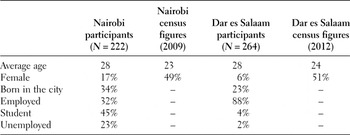
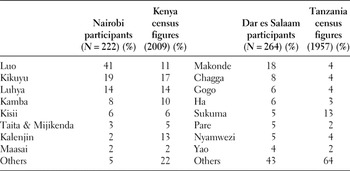
To reduce the possibility of bias in our selection, potential participants were counted by recruiters and every tenth such candidate approached and invited to play the game. If the potential participant agreed to one of the possible times, an entry ticket for that session was given with the person's name written on and it was explained that the ticket was for their use only. In Nairobi, the acceptance rate of those citizens approached on the street was 47%, with those who rejected mostly citing other plans preventing them from attending.Footnote 4 Those who accepted were therefore less likely to be employed, and more likely to come from lower socioeconomic groups. Of those who did accept in Nairobi, a large proportion, 85%, made it to the venue for their scheduled time. In Dar es Salaam, a higher proportion of 67% agreed to participate when approached on the street, and of these 80% came to the venue on time.Footnote 5 Tables 1 and 2 respectively display the socioeconomic and ethnic characteristics of participants, and how these compare to figures on the general population.
Socioeconomic breakdown of all trust game participants

Ethnic breakdown of trust game participants

The socioeconomic breakdown shows that the average age of participants was highly comparable between the two cities, but there was a severe underrepresentation of women in both cases and in particular in Dar es Salaam. Interviews with potential participants on the street suggest that this imbalance was due to wariness among females of coming to a previously unknown location without being allowed to bring a companion, a requirement upheld to ensure the experiment's laboratory conditions. To avoid the effect of this discrepancy for interpreting differences between Nairobi and Dar es Salaam, gender was included in statistical regressions as a control variable.
In both cases, the majority of participants had originally been born outside the city, something that gives confidence in the similarity between the population samples. By contrast, however, the number of employed participants reveals a major discrepancy. However, this is most likely due to reporting bias. Many Dar es Salaam respondents recorded their occupation as being employed in “business” or “small business” (“biashara” or “biashara ndogondogo”), which strongly suggests self-employment in the informal sector. Kenyan participants were more likely to instead categorize this as “unemployed” due to the national trend of associating “real” employment with formal sector work. Nevertheless, the higher number of student participants in Nairobi is probably an accurate reflection of the greater expanse of Kenya's educational institutions (Knight and Sabot Reference Knight and Sabot1990, 9–10), and it is also likely that the proportion of respondents from this category was boosted by their greater confidence in the value of research and the likelihood that participating would deliver the promised payments. In any case, Exadaktylos, Espín, and Brañas-Garza (Reference Exadaktylos, Espín and Brañas-Garza2013) find evidence in favor of student subject pools responding to experimental games in a similar manner to participants drawn from wider society.
Although recent figures for ethnic composition are not available for Nairobi and Dar es Salaam, the ethnic affiliation of participants described in Table 2 are similar to national figures and capture the greater ethnic heterogeneity generally found in Tanzania as compared with Kenya. Nevertheless some discrepancies are apparent, most notably the high numbers of Luo and relatively low numbers of Kikuyu in Nairobi (especially unrepresentative given that Nairobi lies near to the Kikuyu heartlands and so should exhibit a higher proportion of Kikuyu than the national average). This bias is probably due to the fact that on average Luos tend to be located in a lower-income bracket than Kikuyus in Nairobi, and so were more willing to give up their time to participate in a research game involving monetary payoffs. It is likely that the recruitment in Taifa Road further exacerbated this bias as bus routes sourced at this road head towards Kibera, an area of Nairobi heavily populated by those of Luo ethnicity.
In Dar es Salaam, the lower proportion of Sukuma among our participants as compared with 1957 national figures (the last time a national ethnic census was conducted) is understandable given that the Sukuma heartlands lie to the north of the country in the areas surrounding Mwanza. Similarly, the relative proximity of the coastal ethnic group, the Makonde, accounts for their greater representation. In order to check if regression results were robust to the influence of particular ethnic identities, the forthcoming analyses were repeated with independent dummy variables for all ethnicities representing more than 10% of participants. No ethnic group showed up as affecting outcomes in a statistically significant manner, except for the Makonde of Tanzania who acted more trustingly as player As in some games. Inserting or removing the Makonde as an independent variable does not, however, affect the results described with regard to the significance of other variables. Regressions were additionally tested for the employment status of participants' and these were found to be insignificant, which suggests that the higher number of “employed” participants in Tanzania has not influenced results.
In total, 222 Nairobi citizens (111 pairs) played the two-stage trust game, providing 444 in-game decision points given that each game involved two rounds. In Dar es Salaam, 264 citizens (132 pairs) played the two-stage game, providing 528 in-game decision points. Together, therefore, the study takes evidence from a quasi-random selection of 486 citizens of East Africa and 972 monetized decision points. Laboratory sessions were split over three experimental days in Nairobi and two experimental days in Dar es Salaam, each of which occurred on a Saturday to maximize the likelihood of participants' availability.
The trust game has often worked with 10 US$ as the monetary incentive. Player A may use her endowment to make a within-game investment (sent to player B and tripled), after which B decides how much she wishes to return to player A. At this point, players keep their winnings, and go through the process again in the case of a second round. By using real monetary incentives, such games aim to imitate some of the risk participants would have to bear in real-life decisions to trust. To achieve a similar incentive, player As were given 100 Kenyan Shillings (KSh) or 1,500 Tanzanian Shillings (TSh) per round, of which they could invest any proportion in their partner. Player Bs did not start the game with any additional amount to what they would receive from player As, which is not the most common version of the trust game but nevertheless a design followed by other comparable studies (Baran, Sapienza, and Zingales Reference Baran, Sapienza and Zingales2010, 10; Glaeser et al. Reference Glaeser, Laibson, Scheinkman and Soutter2000, 820; Johansson-Stenman, Mahmud, and Martinsson Reference Johansson-Stenman, Mahmud and Martinsson2013, 288; McCannon Reference McCannon2014, 5).
The endowment given to each player A was roughly the equivalent of a dollar, or half of the daily average wage in these countries. Thus, although this is lower than the standard 10 US$ amount, it was equivalent in terms of local purchasing power,Footnote 6 with round endowments twice as large as the 50 KSh used in Greig and Bohnet's trust game deployment in a Nairobi slum (Reference Greig and Bohnet2008, 78). Indeed, the fact that in both countries the likely earning was enough to attract extremely high levels of participation from randomly approached members of the public suggests the payoff amounts within the game acted as economic incentives at least comparable with deployments of the trust game elsewhere. Players were also given a small, uniformly distributed payment that they were allowed to pocket before the start of the game as general compensation for the time they invested in the research. All players therefore received an out of game payment of 300 KSh in Kenya or 4,000 TSh in Tanzania, again equivalent in terms of purchasing power at the time. The provision of a guaranteed payment, especially one that exceeded the 200 KSh or 1,600 TSh that participants typically earned through the game, may have encouraged some player As to adopt riskier strategies, a possibility we return to later.
The procedure of how the games were run was as follows. Participants were met upon entrance, their admission tickets accepted and a show-up fee of 300 KSh or 4,000 TSh given immediately. They were then provided with a different numbered ticket not associated with their name and accompanied by a moderator to one of the two rooms, depending on whether they had been randomly assigned as a player A or B. A further moderator for each of the two rooms showed participants to seats and waited for others to arrive. By separating participants into different rooms and only ever using a number to track their decisions, the games fulfilled double-blind conditions. Once registration had been completed, each session was closed to latecomers. In the case of an odd number of participants, the last person to register was given their attendance fee and told they were free to leave. In order to guarantee complete anonymity, at no point were the names provided at registration linked to the numbered tickets used to keep track of players and their decisions in the game.
At the close of registration, a moderator in each room distributed instructions of the game and oversaw participation. In Kenya, these two moderators were both male Kenyan students, one of Kikuyu ethnicity and the other of Luo ethnicity. In Tanzania, the two moderators were also both male Tanzanian students, with one of Bena ethnicity and the other of Haya ethnicity. Although the identities of moderators have the potential to affect outcomes, the fact that we find no statistically significant differences in the behaviors of players of these ethnicities suggests that there was no meaningful impact in this case. In Kenya, instructions were offered in either English or Kiswahili depending on the participants' preference, while in Tanzania instructions were offered in Kiswahili only (Tanzanians almost universally use Kiswahili whereas some Kenyans prefer English).
The instructions were based closely on those of Dickhaut et al. with changes made only where necessary for the game's implementation in Kenya and Tanzania. Translation into Kiswahili of the instructions and game sheets was made by the authors and then checked and reviewed by one Kenyan and one Tanzanian, each fluent in both languages (see Appendixes 1 and 2 for the game instructions in English and Kiswahili, respectively).Footnote 7 Once distributions of these had been made, moderators in both countries read out loud the instructions in Kiswahili and the session began without any talking permitted. After all gaming decisions had been made and related back, participants were invited to complete a questionnaire where they gave personal details excluding their name (producing the demographic information of Tables 1 and 2), and answered three questions about how they found the game and why they made the decisions they did (for copies of the questionnaire in English and Kiswahili see Appendixes 3 and 4, respectively).
In addition to a standard two-stage trust game, two additional game types were played, each with fresh participants. The standard two-stage game thus acted as a benchmark through which to help measure differences in the other two. The first variation to the game involved common knowledge of ethnicity, labeled the “ethnicity game”, where participants were given a sheet asking them to write down their ethnicity. Sheets from both rooms were collected and given to a central moderator who then noted pairs as of the same ethnicity or not. Information on coethnicity or non-coethnicity was then sent back through written sheets. In this way, the double-blind conditions of the experiment were maintained while common knowledge was provided on whether partners were coethnics or not. Although being told if the other was, for example, a non-coethnic was not as detailed as knowing the others' exact ethnicity, the approach better fit the definition of common knowledge as both players knew that the other player had been given exactly the same information. This experimental design bore the added advantage of separating out two comparable groups: one with common knowledge of coethnicity and the other with common knowledge of non-coethnicity. After each pair learns whether they share ethnicity or not, the rest of the game proceeded in the same manner as the standard two-stage game.
In our deployment, knowledge of coethnicity and non-coethnicity was arbitrarily assigned. The reason for this was the inability of randomly generating a large enough number of coethnics for statistical analysis, given the study's sample size (most especially in the context of Tanzania's ethnic diversity). Among participants of the ethnic game, only 22% of the randomly drawn pairs from Nairobi and 10% of the randomly drawn pairs from Dar es Salaam matched coethnically by coincidence. However, it is important to note that in terms of experimental design, the procedure for informing players of their common or divergent ethnicity nevertheless remained the same as if sufficient pairs had coincidentally aligned coethnically. Indeed, passing players a note on whether their pair was of the same ethnicity or not—rather than having partners meet each other in person—was in any case a necessary method of maintaining double-blind conditions. Although a larger sample size that would naturally generate sufficient coethnic matches would be preferred, this was not financially or logistically feasible. Moreover, one advantage of our approach was that those of minority ethnicities were not less likely to play as coethnics.
In Fershtman and Gneezy's use of the trust game for exposing ethnic stereotypes between undergraduates in Israel, the authors wrote the name of each participant's gaming partner at the bottom of the instructions sheet as a way of indicating the ethnicity of one's partner without alerting participants to the fact that ethnic biases were being researched (Reference Fershtman and Gneezy2001, 358–59). Such a strategy was feasible there because participants were first selected as either of Ashkenazic or Eastern Jewish ethnicity, and because names were a sure sign of subliminally revealing ethnicity. For urban Kenya and Tanzania, an equivalent methodology would be undermined by the existence of a more numerous set of interethnic possibilities, and it is not a guarantee that all participants would be able to know each other's ethnicity on the basis of a name (especially in Tanzania). Among a randomized selection of citizens, participants would also be fearful of the use of their real name, forfeiting the game's assurance against the possibility that partners could be tracked after the session.
In order to examine the effect of integrity alongside that of ethnicity, knowledge of players' honesty or dishonesty was also made an object of common knowledge in the trust game's third variation. Labeled the “integrity game”, this gave participants commonly held information on their partner's integrity before two-stage play began.Footnote 8 As with the inclusion of common knowledge of ethnicity, an additional paragraph in the instructions described the piece of information one would know about one's partner and one's partner would know about oneself—namely, whether the person was someone willing to lie (see again Appendix 1 and 2). After reading the instructions and before the game began, participants answered a sheet asking them, “Uko tayari kudanganya kwenye huu mchezo (ndiyo/la)?” (“Are you a person ready to lie in this game (yes/no)?”) As was made clear in the instructions, an answer of “yes” would give the participant an extra stand-alone payment of 100 KSh in Kenya or 1,500 TSh in Tanzania, while the answer of “no” would give the participant nothing.
As the instructions made clear, the point of the exercise was merely to “inform your partner about whether you are a person ready to lie in this game or not” (“utamweleza kama uko tayari kudanganya kwenye huu mchezo au la”)—with the Kiswahili word “tayari” meaning being someone “ready” or “prepared” to do something (Johnson Reference Johnson1939, 458). The emphasis that was placed on the fact that this willingness to lie referred to the game only intended to relax those participants who might have feared long-term repercussions for answering yes. By including a monetary payoff for being someone prepared to lie—equivalent to one round's endowment in the game—we ensured that those who desired to indicate they had an honest character had to back this up by foregoing a payment, demonstrating their resolve. If a playing partner says they are honest, therefore, they are perhaps taking a cost to signal an aspect of their character they think will have resonance over the other's perceptions (and, in turn, likelihood of cooperating), or else acting in this way out of the view that it is the right thing to do. In total, some 60% of Kenyans and 85% of Tanzanians refused the payment.
Of course, the test of whether honesty acts as a social virtue for forming trusting–trustworthy relationships therefore lies in whether declarations of honesty subsequently translated into higher levels of cooperative behavior in the trust game, or whether participants instead use an honesty signal to take advantage of their partner. This is a discussion to which we return below.
ETHNICITY, INTEGRITY, AND TRUST
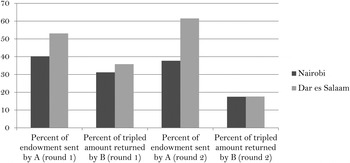
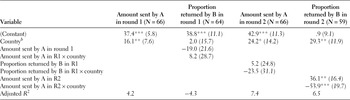
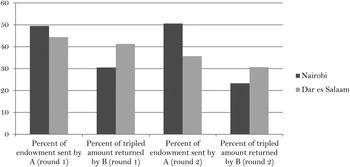
Figure 1 shows the average results of the standard trust game involving no areas of common knowledge, and Table 3 the statistical significance of behavioral differences. We find strong statistical support for greater willingness to trust in Dar es Salaam over Nairobi, with player A Tanzanians sending 16% more of their endowment in the first round (p = .039) and 24% more in the second round (p = .093). This confirms H1. In addition to this, although we do not find significant differences in first round reciprocal action among player Bs by country, higher trustworthiness is apparent in Dar es Salaam over Nairobi in the game's second round. This seems a strange finding at first because in percentage terms second round reciprocity was almost the same in both cities. However, the multiple regression takes into account the amount sent by A in that round, and so isolates the effect the absolute sum may be having on player B responses. Taking the amount sent by partnered player As into consideration, Tanzanians sent back 29% more of the amount they had received in round two than Kenyans (p = .017), which is evidence of urban Tanzanians acting normatively rather than simply responding proportionately to the amount that had been sent.
Average results comparison in the standard trust game between Nairobi and Dar es Salaam

Multiple regression of the standard trust game in Nairobi and Dar es Salaam a

Standard errors in parentheses; * Comparisons significant at 10%; ** significant at 5%; *** significant at 1%.
a Regression includes a variable for gender whose results are insignificant and not displayed.
b Impact of Tanzania over Kenya as a dummy variable of Tanzania = 1, Kenya = 0.
For the second round actions of player B, Table 3 shows also that the amounts sent by As in the second round had an opposite effect in the two countries. While in general there was a positive correlation between amounts sent by As and the proportion returned by Bs (at p = .032), any effect of this was likely outweighed in Tanzania by a country-specific, large and significantly negative relationship between the amount received and the proportion reciprocated (p = .009). While Kenyans played “rationally” such that they closely tied responses to the way they had been treated by their partner, Tanzanians' levels of reciprocity, though greater, came irrespective if not inversely related to the amount they had been entrusted with. This suggests trustworthiness in Tanzania to be guided by different motives to expected material gain. Overall, the results of the standard trust game strongly support the findings of Miguel (Reference Miguel2004) that Tanzanians act with higher levels of trust as compared with Kenyans.
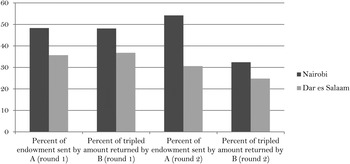
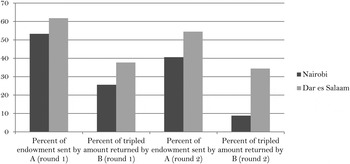
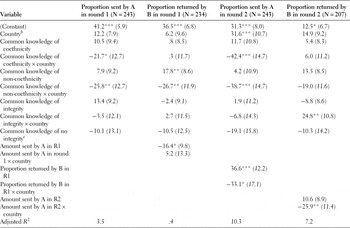
Figures 2–4 present the decisions made in the ethnic and integrity trust games of Nairobi and Dar es Salaam, showing the outcomes for each kind of common knowledge. Table 4 then describes the effects of these areas of common knowledge through a multiple regression performed on each stage of the game. The figures are presented together for the sake of brevity. It is generally assumed in political science and economics literature that coethnicity plays a supportive role for relationships of trust. However, by isolating common knowledge of ethnicity through the use of double-blind trust games, we find that coethnic effects are country-specific and should not be taken for granted. Common knowledge of one's partner being of the same ethnicity (or not) is statistically significant in three of the four stages of our trust games and almost invariably affects decisions differently depending on the country within which the games are being played.
Average results comparison of common knowledge of coethnicity in trust games of Nairobi and Dar es Salaam

Average results comparison of common knowledge of non-coethnicity in trust games of Nairobi and Dar es Salaam

Average results comparison of common knowledge of integrity in trust games of Nairobi and Dar es Salaam

Multiple regression of two-stage trust games in Nairobi and Dar es Salaam a

Standard errors in parentheses; * Comparisons significant at 10%; ** significant at 5%; *** significant at 1%.
a Regression includes variables for gender and whether one was born in the city; results for these two variables are insignificant and not displayed. Also included but not displayed here is a variable for those pairs where only one player signaled integrity.
b Impact of Tanzania over Kenya as a dummy variable of Tanzania = 1, Kenya = 0.
c Such cases occurred in Kenya only.
In terms of decisions to trust by player As, we find no significant impact attributable to knowledge of coethnicity in general, but when accounting for country-level interaction its strong effects become apparent. In-line with H2, coethnic player As in Tanzania proved to be less willing to trust each other as compared with similar pairs in Kenya, and the gap is significant: 22% in the first round (p = .090) and 42% in the second round (p = .004). The impact caused by common knowledge of non-coethnicity also makes itself felt in the country interaction terms, reducing the willingness of player As to trust in Tanzania as compared with Kenya by 26 percentage points in round one (p = .044) and 39 percentage points in round two (p = .009). This contradicts H3, which predicted that non-coethnicity would have a stronger negative effect in Kenya than in Tanzania.
In terms of the levels of trustworthiness of player Bs, the story is similar, though it applies only to non-coethnics and is more significant in round one than round two. In round one, common knowledge of non-coethnicity generated a difference of 27 percentage points between Kenyan and Tanzanian participants (p = .025). The extent to which non-coethnics in Kenya were, in general, surprisingly trustworthy in the first round (at p = .039) again contradicts H3 and is an observation we find difficult to explain. A possible reason for the finding is that by selecting players from the central business district area of Nairobi, we recruited more educated citizens from one of the less segregated parts of the country, which meant players were perhaps determined not to fulfill the stereotype of ethnic rivals. In this way, the result supports the findings of Kasara (Reference Kasara2013), who combines survey data on Kenya to find higher levels of reported interethnic trust in places of ethnic diversity, so long as residency is not segregated. It also seems likely that those Kenyan non-coethnics who desired to coordinate with their partners in order to reap larger gains felt the need to make a bigger symbolic demonstration of their intent in the first round in order to overcome the “ethnic” barrier to effective partnership, given the backdrop of a sharp rise in interethnic tension following the clashes of 2007/8 (Cheeseman, Lynch, and Willis Reference Cheeseman, Lynch and Willis2014). Interpreted in this way, our results suggest that under certain circumstances—namely low segregation and the opportunity to gain through effective coordination—the potential barrier of non-coethnicity can be overcome.
Overall, the importance of the country interaction terms demonstrates that for the first three stages of the trust game common knowledge of both coethnicity and non-coethnicity had a damaging effect on the formation of trusting–trustworthy relationships in Tanzania as compared with Kenya. In other words, common knowledge of the ethnic relationship of participants in Kenya yields comparatively higher levels of cooperation than in Tanzania, whatever that relationship. What explains this strong aversion to acting cooperatively in Tanzania when ethnic identities are revealed? As described more comprehensively elsewhere (Branch and Cheeseman Reference Branch, Cheeseman, Branch, Cheeseman and Gardner2010, 245; Brennan Reference Brennan2012; Hunter Reference Hunter2013), Tanzanian political culture has throughout its history been exposed to a counter-narrative running against ethnic attachments or loyalties, going so far as to view them as uncivic—a trend with strong contrasts to Kenya. Political equality was an integral part of first independence leader Julius Nyerere's vision, and was used alongside an “African socialist” concept of familyhood, which worked to weaken ethnic ties and instead promote a republican spirit of citizenship (Yeager Reference Yeager1982). It therefore appears that the political and social taboos that developed about explicitly invoking ethnicity during the Nyerere government have left a legacy that renders Tanzanians unwilling to publicly act on ethnic queues—even when these reveal coethnicity. In contrast, the politicization of ethnicity in Kenya through district zoning according to ethnicity (Parsons Reference Parsons2011; Reference Parsons2012), the distribution of political goods in line with ethnic connection to those in power (Burbidge Reference Burbidge2014; Burgess et al. Reference Burgess, Jedwab, Miguel, Morjaria and Miquel2013; Lynch Reference Lynch2011), and periodic ethnic violence (Boone Reference Boone2011; Klopp Reference Klopp2001; Mueller, Reference Mueller2014) has produced lower levels of trust overall, but has also meant that Kenyans display higher levels of trust when they engage with coethnics.
In the integrity game, 60% of Kenyans refused 100 KSh rather than appear a person without integrity, providing common knowledge gaming scenarios that varied according to the four possible combinations (both players honest; only A honest; only B honest; and neither player honest). Interestingly, as many as 85% of Tanzanian participants refused the 1,500 TSh so as to appear someone of integrity, which meant there happened to be no examples in Dar es Salaam of a pair where both players simultaneously chose to appear dishonest. In of itself, the fact that a majority of Nairobi and Dar es Salaam participants held it to be of such importance to a trust scenario that they would rather refuse money than appear willing to lie to an anonymous, randomly selected stranger, calls into question the homo economicus model of self-seeking rational actors.
However, it is important to remember that the integrity question does not identify social virtue on its own. It may be that citizens in Dar es Salaam were merely more “crafty” when portraying themselves so as to take advantage of their partners in the two-stage game. After all, one may lie about not being a liar (indeed, the integrity game works on the basis that although one may lie about not being a liar, one cannot lie about being a liar). In order to investigate the broader meaning and impact of these attitudes, therefore, it is necessary to explore the comparative nature of in-game interactions among those professing to be honest. In this regard, we find common knowledge of integrity to have less of an impact than ethnicity on decisions to trust or be trustworthy in the first round but to nevertheless be extremely influential for final round reciprocity.
In the last stage of the game, when the incentive framework for player B operates as a dictator-based decision to send back or not, with no prospect of future repercussions for one's actions, common knowledge of integrity had significant and yet opposite effects in Kenya and Tanzania (at p = .023). More specifically, common knowledge of integrity is a positive force for the development of trusting–trustworthy relationships in Tanzania only, confirming H4. Given the importance of this last stage of the game for detecting the factors that have influence regardless of any chance of future payback, this is an important finding and helps unpack further the social norms at play in the comparatively more trustful relationships found in Tanzania. In particular, the considerable willingness among participants to appear as persons of honesty before starting the integrity game encourages the view that honesty plays an important role in Tanzanian citizens' understandings of good character.
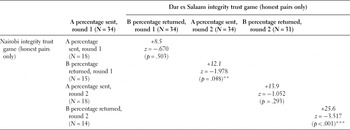
The greater level of reciprocity in the last round of a two-stage game confirms the salience of this social virtue for trusting relationships in Tanzania. While in Nairobi honest pairs showed low levels of reciprocity, their equivalent citizens in Dar es Salaam returned large amounts to their player A investors, especially in the game's last round. Table 5 gives data on the statistical significance of the differences in average behavior between Nairobi and Dar es Salaam integrity games as played by self-professing honest pairs only, and reports measures of two-tailed significance obtained through application of the Wilcoxon rank-sum test (as used in Berg, Dickhaut, and McCabe Reference Berg, Dickhaut and McCabe1995, 134; and Dickhaut et al. Reference Dickhaut, McCabe, Lunawat and Hubbard2008, 20). Indeed, considering our findings about the impact of common knowledge of integrity on the behavior of player Bs in the second round (Table 4), we would go so far as to describe integrity as a coordinating social virtue in Tanzania but not in Kenya. It appears that Kenyan players use signals of honesty opportunistically to get ahead in the game, while Tanzanian players use it genuinely, and so the signal facilitates higher levels of mutual confidence and cooperation. These findings highlight the importance of common knowledge variables in explaining the formation of trusting–trustworthy relationships, and invite further research on the way in which these kinds of factors play out in different contexts.
Statistical comparison of differences between Nairobi and Dar es Salaam for honest pairs of the integrity game a

*Comparisons significant at 10%; ** significant at 5%; *** significant at 1%.
a Differences in means show Tanzania minus Kenya; z = normalized Wilcoxon Z; p = probability of accepting the null hypothesis of no effect.
CONCLUSION
This article has provided fresh insights into the relationship between ethnicity, integrity and trust by deploying two-round trust games in the economic capitals of Kenya and Tanzania with a selection of 486 citizens. Our findings identify a number of significant differences in the influence of ethnicity and integrity in Kenya and Tanzania. More specifically, we were able to confirm three hypotheses: that Tanzanian players are more trusting than their Kenyan counterparts; that common knowledge of ethnicity leads to comparatively more trusting relationships in Kenya; and that common knowledge of integrity leads to comparatively more trusting relationships in Tanzania. However, our results contradict H3, which predicted that non-coethnic pairs would be comparatively less trusting in Kenya. Further research is required to explain this finding, but we have suggested that it results from the combination of awareness among Kenyan participants of the need to signal a willingness to overcome the “ethnic” barrier to productive partnerships, and a social taboo around any invocation of ethnic identities in Tanzania.
Taken together, these research findings act as a check on universalist assumptions of the relationship between ethnicity and trust, and confirm that Tanzania enjoys a higher level of interpersonal trust than Kenya, where coethnicity proves to be more salient. This builds on existing studies of the relationship between trust and ethnicity in the region, and demonstrates the degree of variation that exists within sub-Saharan Africa, highlighting the extent to which country-specific factors shape how ethnicity and integrity relate to the formation of trust. While it has not been possible to give a full account of the complementary political, historical, and anthropological literature that helps describe these differences, our findings verify these approaches and demonstrate the value of closer collaboration between behavioral economists and regional experts.
Much experimental work on ethnicity and cooperation makes the false assumption that through laboratory-like environmental controls, a singular, fixed picture of human nature can be revealed. Rather, our findings support the growing body of evidence that shows that the signaling of social virtues such as integrity, ethnic identities, and resultant levels of social cooperation are thoroughly political processes; they diverge significantly between countries and are amenable to re-engineering through interpersonal posturing and dialog. At the core of these dynamics are areas of common knowledge—those elements of social life we take for granted, and that we assume others also understand. To move this debate forward, we need to leave behind the notion that preference formulation only occurs subjectively and in private. Instead, we must consider how political concepts and narratives shape the way in which social signals are interpreted at the interpersonal level. For social coordination, the intersubjective matters just as much as, if not more, than the subjective.
ACKNOWLEDGEMENTS
Burbidge would like to gratefully acknowledge a supporting research grant from the Department of Politics and International Relations, University of Oxford. We would also like to thank Claire L. Adida, Jean Ensminger, Shane MacGiollabhui, Amanda L. Robinson and Áron Székely for their helpful comments and suggestions, as well as two anonymous reviewers.
APPENDIX 1 – ENGLISH INSTRUCTIONS FOR THE TRUST GAME
{Instructions for Nairobi room A participants; changes made where appropriate for player B participants.}
INSTRUCTIONS FOR ROOM A
Welcome! You have been asked to participate in an economics experiment. These instructions are being read out and you have been given a copy which you will keep throughout the session. We will not answer questions during this experiment. If you have any questions, you should read back through these instructions. Now that we have begun, we ask that you do not talk at all until we are finished.
In this experiment, each of you are paired with a different person who is in another room. This person has also volunteered for the experiment. You will not be told who this person is either during or after the experiment, and they will not be told who you are. This room we are in is room A. The other participants are in room B. Because you are in room A, you are called player A. Those in room B are each called player B.
The person who is reading this out is the monitor for this room. He will be giving out and collecting sheets during the game. In addition, the monitor will check that these instructions have been followed. Each person in room A and each person in room B has been given 300 shillings for coming. There is extra money that can be won, depending on how one plays the game.
How the game works: Everyone in room A is paired anonymously with someone in room B. Persons in room A receive an extra 100 shillings. They then decide how much they would like to send to their pair in room B. The amount of shillings player A sends to their pair in room B will be tripled. For example, if player A writes down that he or she wants to send 20 shillings, player B will receive 60 shillings. If player A writes down 90 shillings, player B will receive 270 shillings. After the money has been sent, player B then writes down how much of the tripled money he or she wants to send back to player A.
The monitors record how much is being received by each person, and everyone will receive their total amount in cash at the end.
This game will be played twice and both times it will start with player A receiving 100 shillings. The person that you are paired with in the other room will be the same for the two rounds of the game. Since your decisions in this game are private we ask that you do not tell anyone your decisions either during or after the experiment.
{Additional paragraph submitted for the second type of game, introducing common knowledge of ethnicity.}
Just before we start the game, there is one piece of information you will share with your pair. This information will not be linked to you personally. This information is whether you are of the same ethnicity or not.
{Additional paragraph submitted for the third type of game, introducing common knowledge of virtue.}
Just before we start the game, there is one piece of information you will share with your pair. This information will not be linked to you personally. You will inform your partner about whether you are a person ready to lie in this game or not. They too will inform you whether they are ready to lie in this game or not. Whoever says they are ready to lie in this game will receive an extra 100 shillings.
APPENDIX 2 – KISWAHILI INSTRUCTIONS FOR THE TRUST GAME
{Instructions for Nairobi room A participants; changes made where appropriate for player B participants.}
MAAGIZO KWA CHUMBA A
Karibu sana! Umeulizwa kushiriki kwenye jaribio la kiuchumi. Maagizo haya yanasomwa na pia umepokea nakala moja ambayo utatumia katika hiki kikao. Hatutajibu maswali wakati wa jaribio hili. Kama una swali lolote, unahitaji kusoma maagizo haya tena. Kwa sababu tumeanza, tunakuomba kwamba usiongee hadi tumalize.
Katika jaribio hili, kila mtu hapa amewekwa ashirikiane na mtu mwingine aliye kwenye chumba kingine. Mtu huyu amejitolea kwa jaribio hili pia. Hutaambiwa mtu huyu mwingine ni nani tunapoendelea ama tunapomaliza, naye pia hataambiwa wewe ni nani. Chumba hiki tulichoko ni chumba A. Washiriki hao wengine wako chumba B. Kwa sababu umo chumba A, unaitwa mshiriki A. Kila aliye chumba B anaitwa mshiriki B.
Mtu ambaye anasoma maagizo haya ndiye msimamizi wa chumba hiki. Atakupa na atachukua karatasi tunapoendelea na mchezo. Pia, msimamizi atacheki maagizo haya yamefuatwa vizuri. Kila mtu katika chumba A na kila mtu katika chumba B amepokea shillingi 300 kwa kuja. Kuna pesa za ziada ambazo unaweza kupata, inategemea mchezo unacheza vipi.
Mchezo unachezwa vipi: Kila aliye chumba A amewekwa ashirikiane na mtu mwingine asiyemjua katika chumba B. Kila mmoja katika chumba A anapokea shillingi 100 zaidi. Halafu, anachagua anataka kutuma pesa ngapi kwa mshiriki B anayeshirikiana naye. Idadi ya pesa mshiriki A anatuma kwa B zitafanywa mara tatu zaidi. Kwa mfano, kama mshiriki A anaandika kwamba anataka kutuma shillingi 20, mshiriki B atapokea shillingi 60. Kama mshiriki A ataandika shillingi 90, mshiriki B atapokea shillingi 270. Baada ya pesa kufanywa mara tatu, zinatumwa kwa mshiriki B ambaye ataandika ni pesa ngapi kati ya hizi anataka kurudisha kwa mshiriki A.
Wasimamizi wataandika ni pesa ngapi zinapokewa na kila mtu, na watu wote watapokea idadi yote ya pesa tunapomaliza.
Mchezo huu utachezwa mara mbili. Kila mara, mchezo utaanza na mshiriki A akipokea shillingi 100. Mtu wako wa chumba kingine hatabadilishwa kwa hiyo mara mbili ya mchezo. Kwa sababu maamuzi yako kwenye mchezo ni ya kibinafsi, tunakuuliza kwamba usimwambie mtu mwingine yeyote maamuzi yako tunapoendelea ama tutakapomaliza jaribio hili.
{Additional paragraph submitted for the second type of game, introducing common knowledge of ethnicity.}
Kabla ya tuanze, kuna ujumbe ambao mtabalidishana na mnaye husiana naye aliye chumba B. Ujumbe huu hautatumiwa kukutambulisha wewe ni nani. Mtajulishana kama mnaye shirikiana naye ni wa kabila lako au la.
{Additional paragraph submitted for the third type of game, introducing common knowledge of virtue.}
Kabla ya tuanze, kuna ujumbe ambao mtabalidishana na mnaye husiana naye aliye chumba B. Ujumbe huu hautatumiwa kukutambulisha wewe ni nani. Utamweleza kama uko tayari kudanganya kwenye huu mchezo au la. Naye atakueleza pia kama yuko tayari kudanganya kwenye mchezo huu au la. Atakayesema ako tayari kudanganya kwenye huu mchezo atapata shilingi 100 ya ziada.
APPENDIX 3 – ENGLISH PERSONAL INFORMATION QUESTIONNAIRE
Dear participant,
Thank you very much for coming and taking part in this economics game. The objective of this research was to understand decision-making. We hope you found it interesting. Please fill in the information form below. There are also a few questions at the end. This information will not be given to anyone else.

APPENDIX 4 – KISWAHILI PERSONAL INFORMATION QUESTIONNAIRE
Mpendwa mshiriki,
Ahsante sana kwa kuja na kushiriki kwenye jaribio hili la uchumi. Tumefanya utafiti huu ili kuelewa watu wanavyofanya uamuzi. Tunarajia uliufurahia. Tafadhali jaza fomu hii. Pia, kuna maswali machache hapo mwisho. Taarifa hii haitapewa watu wengine.