Implications
This paper outlines an approach to defining breeding goals, based on stakeholder engagement, as a complement to traditional methods of estimation of relative weights. The approach presented can support European Forum of Farm Animal Breeding guiding principles by helping to balance scientific knowledge and professional judgement with consideration of both ethical and societal values. Widespread implementation of this complementary approach will have significant implications for how breeding goals will be defined, and, more importantly and fundamentally, in determining who will/should be involved in the decision-making process.
Introduction
Animal breeding programmes have been responsible for approximately half the observed changes in animal performance (Berry, Reference Berry2008). Such changes in animal performance include favourable changes as observed for milk yield in dairy cattle (Berry, Reference Berry2008) or unfavourable changes as observed for reproductive performance in dairy cattle (Berry et al., Reference Berry, Kearney, Twomey and Evans2014). Once heritable animal characteristics are included in a breeding goal with sufficient emphasis and accuracy of selection, genetic gain in those characteristics is possible without necessarily causing deterioration in genetic merit for other important traits.
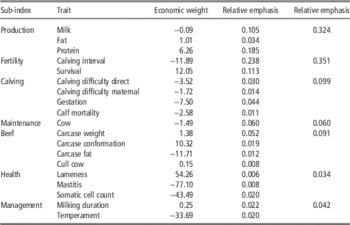
This paper is concerned with establishing animal breeding goals to improve milk quality without detrimentally affecting other traits. Improved milk quality is of interest as it could result in benefits for many stakeholders in the milk supply chain; it could return higher prices to producers, higher product yields to processors and potentially healthier products to consumers through, for example, changes in fat content and composition. It is particularly focused on the Irish dairy sector, a sector that is of significant importance to the overall Irish agri-food sector. The sector is also an important supplier of calves as inputs to the beef sector, a relationship that is reflected in the importance given to beef characteristics in the current economic breeding index (EBI) (see Table 1). One of the key characteristics of production is that it is grass based, resulting in a seasonal pattern of production (Berry et al., Reference Berry, Wall and Pryce2013) and one of the lowest cash costs of production within Europe (Donnellan et al., Reference Donnellan, Hennessy and Thorne2011). The product mix comprises liquid milk (10%), butter (~54%), cheese (~27%), and cream, whole milk powder and chocolate crumb (~9%). In addition, over 80% of skim milk is converted into skim milk powder and casein. This product mix has evolved in recent years with an increase in cheese production for example, and whey has emerged as an important ingredient for the infant milk formula industry. Removal of production restrictions following the removal of the milk quota on 1 April 2015, and a national goal to increase milk production by 50% places further attention on the sector (DAFM, 2010).
Economic values and relative emphasis on the seven sub-indexes and component traits in the Irish dairy cow national breeding goal, the Economic Breeding Index

Detailed milk quality traits are currently not explicitly included in most national dairy cow breeding goals due to a combination of both a lack of phenotypic data from which to undertake genetic evaluations as well as knowledge on the relative importance that should be placed on individual milk quality traits. Milk mid-IR spectroscopy is known to be able to predict some milk quality attributes with reasonable to high accuracy (Soyeurt et al., Reference Soyeurt, Dardenne, Dehareng, Bastin and Gengler2011 and Reference Soyeurt, Bastin, Colinet, Arnould, Berry, Wall, Dehareng, Nguyen, Dardenne, Schefers, Vandenplas, Weigel, Coffey, Theron, Detilleux, Reding, Gengler and McParland2012); heritable genetic variation in these detailed milk quality traits is also known to exist (Soyeurt et al., Reference Soyeurt, Dardenne, Gillon, Croquet, Vanderick, Mayeres, Bertozzi and Gengler2010). Because milk mid-IR spectral data are available on all milk samples taken on individual cows, the generation of accurate genetic evaluations for several detailed milk quality traits is now possible. Thus, the relative importance that should be placed on detailed milk quality parameters remains the only gap in knowledge hindering the inclusion of milk quality attributes in national breeding goals.
A range of methods have been used to define breeding goals for the livestock sector. Traditionally bio-economic models based on the prevailing or future expected market value and costs of production have been used (Veerkamp et al., Reference Veerkamp, Dillon, Kelly, Cromie and Groen2002). Bio-economic models are useful where the futuristic profit accruing from a one-unit change in the trait can be accurately quantified; this is relatively easy for most agro-economic traits (e.g., milk yield, fertility) but can be more difficult for novel traits where no explicit value currently exists (e.g., detailed milk quality characteristics). Desired gains selection indexes or restriction selection indexes (i.e. a form of desired gains index) can also be used to achieve an, a priori, defined theoretical gain in these traits. Nielsen et al. (Reference Nielsen, Olesen, Navrud, Kolstad and Amer2005) applied such approaches to deriving a breeding goal for traits with a non-market value. Restricted selection indexes are, however, known to be sub-optimal unless the index weighting on the constrained trait in the unrestricted selection index is zero (Mrode, Reference Mrode2005). Gibson and Kennedy (Reference Gibson and Kennedy1990) reported that restricted indexes cause severe losses in genetic gain and stated that restriction indexes should not be used when the goal is to improve economic merit.
The long-term effects of adopting optimal breeding programmes for efficiency will be more than just improved profit for the breeders and farmers themselves; it can result in reduced costs for the consumer and greater overall consumption rates (Harris, Reference Harris1970). Therefore approaches, such as the preference-based approaches have also been proposed in the derivation of weightings to place on traits in breeding goals (Byrne et al., Reference Byrne, Amer, Fennessy, Hansen and Wickham2012). One further alternative approach to aid in determining the relative emphasis that should be placed on a trait where no explicit economic value can be defined, which is elaborated on in this study, is to undertake a survey of stakeholders to gauge their perceived importance of alternative traits. Moreover, the suggested emphasis on a trait from such a survey can also be very useful for comparison with more objective approaches to estimating the apparent optimal relative emphasis and, if large disparity exists, the approaches re-examined. Furthermore, rationales originating from the survey on how the proposed stakeholder emphasis was decided upon can also help guide the more mathematical approaches (e.g., identify the economic consequences of a change in the trait which had not already been thought of).
Management literature views stakeholders as groups or organisations as well as individuals (Parmar et al., Reference Parmar, Freeman, Harrison, Wicks, de Colle and Purnell2010) that are affected by, or affect something (Bjugn and Casati, Reference Bjugn and Casati2012). These stakeholders can be numerous and diverse with multiple and sometimes conflicting purposes, priorities and expectations (Donaldson and Preston, Reference Donaldson and Preston1995). It is important to engage with these stakeholders for several reasons including improved decision making (Bryson, Reference Bryson2003), conflict avoidance, resource allocation and value creation (Parmar et al., Reference Parmar, Freeman, Harrison, Wicks, de Colle and Purnell2010). Ultimately, effective stakeholder engagement is crucial for the long-term success of any change process (Dearden and Hunter, Reference Dearden and Hunter2012).
In the context of setting dairy breeding objectives, stakeholders include producers, dairy processing companies, breeding companies, advisors, researchers, representative organisations and public bodies. All of these are affected by, or affect, decisions regarding breeding goals. While none of these stakeholders are fully in charge of making such decisions, all have some partial responsibility to act. Thus, it is desirable in implementing a breeding strategy for the sector to achieve consensus, or at least a shared vision, among stakeholders on the most appropriate breeding objectives.
The objective of this study was to assess the suitability of the Delphi technique as an approach to gathering stakeholder perspectives to support decision making regarding breeding objectives. The objective was achieved by undertaking a survey using the Delphi technique to (a) identify the quality attributes that stakeholders consider important to include in the national dairy cow breeding goal; (b) obtain an understanding of the rationales given for their responses; and (c) direct them towards consensus on the quality attributes that they consider should be incorporated into the national breeding goal. The suitability of the approach is assessed by considering (a) whether consensus can be achieved through the approach; (b) if the technique can reveal the underlying assumptions and knowledge used by stakeholders to make their judgements; (c) if stakeholders are prepared to review their decisions based on consideration of the viewpoints of others; and (d) the extent to which the results obtained from this approach align with a possible alternative approach (based on selection index theory in this instance).
Material and methods
The Delphi method
The Delphi method is an anonymous and iterative process undertaken over a series of survey rounds to systematically gather and aggregate the opinion of a panel of experts with the aim of reaching consensus (Hsu, Reference Hsu2007). Hasson et al. (Reference Hasson, Keeney and McKenna2000) argue that the Delphi is based on the assumption that several people are less likely to give a wrong answer than a single individual and that reasoned argument (which occurs when rationales are fed back to respondents between rounds) strengthen decisions, by challenging assumptions.
Anonymity is an important feature of the process as it means that experts work in isolation, avoiding distortions from dominant personalities and higher status members, and interactions/interpersonal affiliations (Dalkey and Helmer, Reference Dalkey and Helmer1963). This is achieved through the use of e-mail questionnaires. Given the different numbers involved in each stakeholder category, this feature of the Delphi was important for the present study. Anonymity can also help to ensure the voices of less vocal stakeholders are heard, thus helping to fulfil the role of stakeholder engagement in relation to requirements for democracy and social justice (Bryson, Reference Bryson2003).
Iteration means that the expert panel is consulted more than once, with results of their colleagues’ opinions provided following each round. This feature differentiates Delphi from ordinary opinion surveys, and this additional learning can be important as identification and subsequent consideration of the concerns and interests of stakeholders can lead not only to improved decision making (Bryson, Reference Bryson2003) but can also help to avoid or resolve any conflict or opposition to a project/idea (Bourne and Walker, Reference Bourne and Walker2005). It may provide a forum for dialogue to facilitate mutual social learning (Mathur et al., Reference Mathur, Price and Austin2008).
Consensus in a Delphi process is viewed as being akin to agreement, which can be determined by:
-
1. the aggregate of judgements by the group,
-
2. a move to a subjective level of central tendency over time,
-
3. confirmation of stability, that is, consistency in responses between successive rounds (Ward et al., Reference Ward, Stebbings, Sherman, Cherkin and Baxter2014).
However, consensus per se is not always required; even without consensus the process can help ‘to clarify the issue, crystallise the reasoning process and increase the accuracy of participants’ understanding of the position of others’ (Henchion et al., Reference Henchion, McIntyre and Commins2002).
The Delphi experts
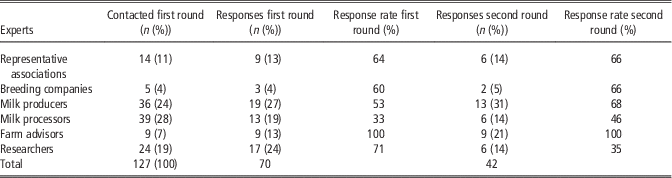
Selection of suitable experts is fundamental to the success of Delphi (Henchion and McIntyre, Reference Henchion and McIntyre2005). Experts selected for this study were required to be knowledgeable on the topic and to represent a range of stakeholder perspectives. Review of the initial list of experts by the project advisory group (comprising members of dairy industry representative bodies, researchers and managers/coordinators of extension officers or producer groups) and external stakeholders helped to ensure that the panel was not biased and contained representation from the main stakeholder groups concerned. Given the impact of any decisions regarding breeding goals on producers and processors, experts who act as representatives of producers and processors as well as individual producers and processors themselves were invited to participate. These ‘supply chain experts’ were complimented by experts from the research and extension community (i.e. ‘technical experts’). Thus, participants were purposively selected, on the basis of their knowledge, experience and their interest in the issue. Importantly, participants were not required to be experts in all areas addressed in the survey as through the feedback process they had the opportunity to gather new information. The number of stakeholders in each group is presented in Table 2. As the aim was not to conduct a survey involving a representative sample (the emphasis was on seeking appropriate experts), the numbers in each group were not the same.
Number of experts contacted and responses in the first and second round of the Delphi study

Producers were identified in two ways: they were office holders of producer associations/representative organisations and/or participants in extension programmes specifically targeted at progressive dairy farmers (participants in such programmes are identified by specialist dairy advisors). Processors were identified from three sources: membership of their representative body, clients of the national food market promotion agency (this information is available from a public website) and from an in-house database of one of the research institutions involved in this research. Technical experts included researchers and specialist dairy advisors. Researchers were, in general, principal investigators working at internationally recognised Irish research organisations and were identified on the basis of having received competitive public funding awards or having published scientific studies in the area of milk quality, dairy husbandry, dairy processing and/or animal breeding. The specialist dairy extension officers were farm level business and technology advisors employed by the Irish agriculture and food development authority (Teagasc) or extension officers employed as joint Teagasc/dairy processor advisorsFootnote 1 . Of the list of potential experts, a total of 127 were approved by the advisory board.
The Delphi survey
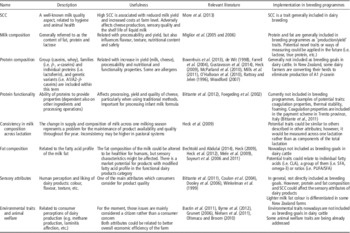
Typically three rounds of questionnaires are sent to the expert panel, with round 1 often presented as an open-ended questionnaire. While an open-end round 1 questionnaire gives panel members freedom of expression in identifying quality attributes, this method can produce a vast quantity of poorly phrased and ambiguous items, which can reduce the validity and reliability of the data and make responding to items in subsequent rounds difficult (Hardy et al., Reference Hardy, O’Brien, Gaskin, O’Brien, Morrison-Ngatai, Skews, Ryan and McNulty2004). In this study nine milk quality attributes/traits of importance were identified from a review of the literature (see Table 3), and consultation with specialists in dairy production and food science, specialist dairy extension officers, and both producer and processor representative organisations. Survey respondents were asked to rate the importance of including these nine potential traits in a quality sub-index of the national breeding goal on a 7-point likert scale ranging from 1 (not important at all) to 7 (very important). This approach ensured content validity of the list of attributes presented to respondents and obviated the need for an open-ended round 1. In addition, participants were asked their opinion on incorporating a milk quality sub-index in the breeding goal (scale 1 to 7 where 1=strongly disagree and 7=strongly agree) and the weighting to be given to this potential milk quality sub-index, relative to the current sub-indexes within the national breeding goal (Table 1). Finally, participants were asked to indicate and provide a rationale for what they believed were the three most and least important attributes/traits from the nine presented. Since it was expected that some of the pre-selected traits would be unfamiliar to participants (i.e. they may have only recently been identified/based on an emerging market or new scientific knowledge), the response ‘unknown’ was also permitted.
Characteristics of potential traits to be included in the quality sub-index of the national breeding goal

SCC=somatic cell count.
Following pilot testing, each of 127 identified Irish experts was sent an e-mail of introduction outlining the purpose of the study, the nature of the Delphi technique, and their expected time contribution, as well as requesting their commitment to participate in the study. To encourage participation, this first e-mail was sent (3 March 2014) on the project researchers’ behalf by a ‘gatekeeper’ or ‘figure-head’. Having confirmed willingness to participate, the survey was administered by the research team, thus ensuring participants were anonymised. Experts were invited to complete the web-based survey (Survey Monkey: http://www.surveymonkey.com), which was sent to each expert via e-mail with an individual link to the questionnaire. Standard procedures, such as personalised e-mails and reminders, were used to enhance the response rate. In round 2, respondents to round 1 were given a report which included their individual round 1 ratings, along with those of the total sample, presented as the median and interquartile range; also provided was a summary of the range of explanations given for these ratings. The median, as a measure of central tendency is taken to represent the group opinion, and the interquartile range the amount of disagreement within the panel. The median is the preferred measure of central tendency used for Delphi type studies. This reflects the use of likert-type scales whereby potential responses may not be delineated at equal intervals. It also reflects an expectation of skewed responses with the median being less sensitive to the effect of outliers (Murphy et al., Reference Murphy, Black, Lamping, McKee, Sanderson, Askham and Marteau1998). The round 2 survey, posing the same questions as round 1, invited respondents to review their original responses in light of the round 1 report. Only panellists who completed round 1 were included in round 2.
The Delphi process ceases when consensus (within certain limits) has been achieved (Hasson et al., Reference Hasson, Keeney and McKenna2000). Smith et al. (Reference Smith, Torrance, Ferguson, Bennett, Serpell and Dunn2012) argue that the decision on the number of rounds is largely pragmatic and partly depends on the quality and rate of response. Evaluation of the responses to rounds 1 and 2 on the basis of fall-off in response rate (Hasson et al., Reference Hasson, Keeney and McKenna2000), extent of consensus, and breadth and depth of rationales indicated that a third round was not required or warranted. Stability in responses between rounds, as well as a narrow interquartile range (IQR) (the IQR for responses following round 2 was typically <2 from a scale of 1 to 7) meant that a further significant shift towards consensus was unlikely.
Along with the descriptive analysis of the ratings data, content analysis was undertaken on the qualitative data. Categorising responses in a coherent and parsimonious manner allowed for a systematic interrogation of the rationale underpinning ratings and preferences. A coding frame emerged as the text was reviewed and new codes were added as required. This allowed for compressing a variety of explanations of a similar phenomenon into fewer content categories, the importance of which could then be understood. The initial coding was undertaken by one researcher and to enhance the trustworthiness of the emerging themes was verified by the other authors. This was then cross-checked with the guiding principles laid down in the European Forum of Farm Animal Breeders (EFFAB) code (EFFAB, 2014).
Selection index
For comparison purposes with the results from the Delphi study, selection index theory was used to quantify the relative weighting that should be placed on a milk quality attribute to achieve a pre-determined desired gain in product quality. The economic weights (Table 1) and genetic covariance matrix between traits in the Irish national breeding goal (Supplementary Table S1) were used in the calculations. Two milk quality traits were considered in the selection index analysis: saturated milk fatty acid and percentage cheese yield (Bittante et al., Reference Bittante, Penasa and Cecchinato2013). Variance components for saturated milk fatty acid content were taken from Soyeurt et al. (Reference Soyeurt, Dehareng, Gengler, McParland, Wall, Berry and Coffey2008) and Bastin et al. (Reference Bastin, Berry, Coffey, Strandberg, Urioste, Veerkamp and Gengler2012). The genetic correlation between milk fatty acid content and the three yield traits in the Irish national breeding index the EBI (Berry et al., Reference Berry, Kearney, Twomey and Evans2014; milk yield, fat yield and protein yield) were assumed to be −0.5 (Soyeurt et al., Reference Soyeurt, Dehareng, Gengler, McParland, Wall, Berry and Coffey2008). The genetic correlation between milk saturated fatty acid content and calving interval was assumed to be 0.4 based on the correlation between milk saturated fatty acid and days open; because calving interval and survival are strongly negatively genetically correlated in Ireland (Berry et al., Reference Berry, Wall and Pryce2013) a correlation of −0.4 was assumed between milk saturated fatty acid content and survival. Owing to a paucity of estimates, zero genetic correlations were assumed between milk saturated fatty acid content and the remaining traits in the EBI; there is no biological rationale as to why the remaining traits (i.e. calving performance and beef performance) should associate, at least strongly, with milk quality and these remaining traits constitute only a small relative emphasis within the entire EBI. Variance components for percentage cheese yield were from Bittante et al. (Reference Bittante, Penasa and Cecchinato2013); only genetic correlation with milk yield, fat yield and protein yield were considered due to a lack of correlation with other traits in the EBI. The accuracy of selection on all traits was assumed to be 0.99; assuming a progeny group size of 100 animals/trait did not greatly impact the results. The relative emphasis of the milk quality traits in a breeding goal was calculated as the product of the genetic standard deviation times the economic weight of that trait divided by the sum of the same calculation for all traits in the breeding goal:
 $${\rm Emphasis}_{i} ={{{\rm \,\mid\,}a_{i} {\times}\sigma _{i} {\rm \,\mid\,}} \over {\mathop{\sum}\limits_{j={\rm 1}}^n {{\rm \,\mid\,}a_{j} {\times}\sigma _{j} {\rm \,\mid\,}} }}$$
where a i and a j is the economic value for trait i and j, respectively, and σ i and σ j is the genetic standard deviation for trait i and j, respectively.
Results
Participation levels for each category of expert in each Delphi survey round are presented in Table 2. The response rate was 55% for round 1 and 60% for round 2. This was somewhat consistent across categories. However, all nine specialist farm advisors responded to both rounds of the questionnaire while milk processors were the poorest responders with only 15% of the 39 originally contacted representatives responding to both rounds. Nonetheless, the processors who responded are responsible for almost two-thirds of the national milk pool (Donnellan et al., Reference Donnellan, Hennessy, Keane and Thorne2015).
The extent of agreement in response to the proposition to include an explicit sub-index for milk quality traits in the Irish national dairy cow breeding goal was stable between rounds with a median score of 5 and IQR of 4 to 6 in both rounds. Thus, the overall group opinion and disagreement level (which was low) remained relatively unchanged between rounds 1 and 2. This indicates stability in responses and suggests that individuals’ opinions did not change following reflection and consideration of other perspectives. There was general support for the inclusion of an explicit milk quality sub-index in round 2, with 62% support, 24% dissent and 14% remaining neutral.
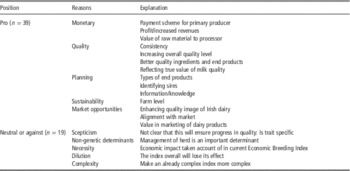
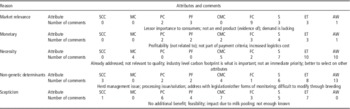
Profit maximisation, improving product quality, exploiting market opportunities or benefits associated with improved planning (as a result of better knowledge) were cited as the main reasons for supporting such a sub-index (Table 4). Some of those who supported the sub-index cautioned the economic benefit, the heritability of the milk quality traits and the feasibility of delivering on expectations as well as the fact that ‘consumer market demands are changing in that field’ should be considered in the final decision. Reasons for not supporting the inclusion of an explicit milk quality sub-index related to a view that other (non-genetic) factors were greater contributors to quality, scepticism on whether the incorporation of quality into the index could actually result in quality improvements, and a view that such a step would be detrimental to the current breeding index; making it more complex than necessary or diluting the effect of selection for other traits (Table 4).
Rationales for supporting or rejecting the inclusion of an explicit sub-index for milk quality traits

Specific traits
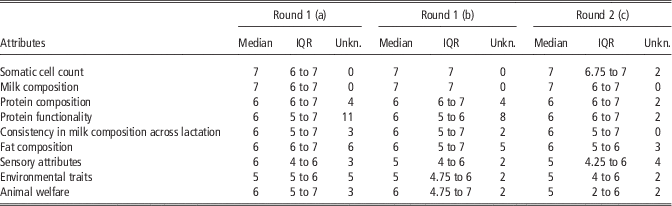
Table 5 summarises the level of importance respondents attached to a range of quality attributes, assuming a new sub-index for detailed milk quality was created. It presents the results from all respondents in round 1 (column a), round 1 respondents who also responded to round 2 (column b) (i.e. it removed drop-outs) and results from respondents from round 2 (column c). This is because there is no clear indication in the literature on whether a and c or b and c should be compared. While the authors are conscious of non-response bias, the literature regarding the Delphi generally argues that drop-outs are to be expected between rounds but that so long as an equivalent diversity of respondents takes part in round 2 (based upon area of expertise or geographic location for example), and there is an acceptable sample size, one can still be confident in the results (Ribeiro and Quintanilla, Reference Ribeiro and Quintanilla2015; Vigani et al., Reference Vigani, Parisi, Rodriguez-Cerezo, Barbosa, Sijtsma, Ploeg and Enzing2015). Table 1 shows that a diversity of experts exists in both rounds 1 and 2 and that the number existing after round 1 is higher than in many other Delphi studies. Hence, the authors argue that a and c should be compared and the discussion and conclusion is framed by this view. Figures in column b are provided for those who take an alternative perspective. There was, in general, stability in responses over both survey rounds with a slight reduction in the IQR in round 2 (i.e. a convergence towards consensus). Animal welfare, however, was an exception with the IQR extending considerably from rounds 1 to 2. Overall, the group opinion (as indicated by the median score) was that all of the identified traits were at least somewhat important in terms of being incorporated into a sub-index for milk quality, with somatic cell count (SCC) and milk composition being judged to be very important. Respondents in round 2 were generally more familiar with the attributes being discussed as evidenced by a lower number of respondents who ticked the ‘unknown’ option.
Perceived importanceFootnote * of specific quality attributes to 2025

a=results from all respondents in round 1 (n=70); b=round 1 respondents who also responded to round 2 (n=42); c=results from respondents to round 2 (n=42); IQR=interquartile range; Unkn.=number of unknown responses.
* Measured on a 7-point likert importance scale from 1=not important at all to 7=very important.
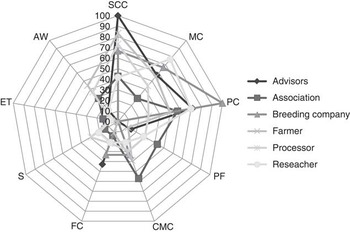
As evident from the radar diagram (Figures 1 and 2) the prioritisation of attributes by respondent category highlights some area of common emphasis and some divergences. SCC was the most frequently ‘top three’ ranked attribute by advisors (100%), farmers (83%) and processors (73%). In the case of associations (43%) and researchers (42%) SCC was less likely to be in their top three. For researchers, milk composition was the attribute most frequently ranked (77%), followed closely by protein composition (70%). Along with SCC, a majority of advisors (71%) ranked protein composition in their top three. Associations were more mixed in their rankings; however, protein composition and consistency in milk composition across lactation were the most frequently referred to at 57% each. Along with an emphasis on SCC (67%) and milk composition (67%) breeding companies placed a particular emphasis on protein composition (100%). The second and third most frequently ranked attributes by processors were milk composition and animal welfare at 44% and 37%, respectively.
The three most important quality attributes by stakeholder group (% of mentions). SCC=somatic cell count; MC=milk composition; PC=protein composition; PF=protein functionality; CMC=consistency in milk composition across lactation; FC=fat composition; S=sensory; ET=environmental traits; AW=animal welfare traits.

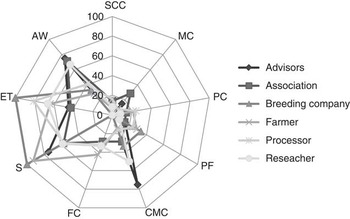
The three least important quality attributes by stakeholder group (% of mentions). SCC=somatic cell count; MC=milk composition; PC=protein composition; PF=protein functionality; CMC=consistency in milk composition across lactation; FC=fat composition; S=sensory; ET=environmental traits; AW=animal welfare traits.

When examining the three least important attributes, sensory and environmental traits were frequently mentioned by all stakeholders (Figure 2). Animal welfare was also dominant in the rankings of advisors (75%), associations (71%) and researchers (67%) while consistency in milk composition across lactation was judged as less important by a majority of advisors (75%) and half of the researcher cohort. Interestingly, processor views with regard to animal welfare were mixed with 37% ranking this as one of the most important attributes and 41% judging it as one of the least important attributes.
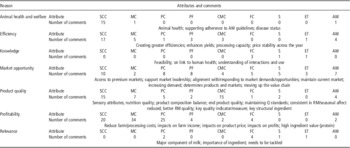
The rationales respondents gave for their ranking of the selected nine quality attributes are reported in Tables 6 and 7. Table 6 presents the rationales given for rating attributes as highly important (i.e. as one of the three most important) and Table 7 presents the rationales given for rating attributes as of low importance (i.e. one of the three least important). Respondents considered a wide range of factors in their decision-making process, including for example financial aspects, technical feasibility and market perspectives. Furthermore, respondents were able to consider some individual factors from a range of perspectives. For example, market opportunities were considered in terms of accessing premium markets, maintaining current markets, developing new products and adding value (particularly to Ireland’s grass-based production system).
Summary of reasons cited for ranking attribute as one of three most important

SCC=somatic cell count; MC=milk composition; PC=protein composition; PF=protein functionality; CMC=consistency in milk composition across lactation; FC=fat composition; S=sensory; ET=environmental traits; AW=animal welfare traits; RM=raw material.
Summary of reasons cited for ranking attribute as one of three least important

SCC=somatic cell count; MC=milk composition; PC=protein composition; PF=protein functionality; CMC=consistency in milk composition across lactation; FC=fat composition; S=sensory; ET=environmental traits; AW=animal welfare traits.
In relation to attributes rated as important (Table 6), multiple rationales were given for some attributes while other attributes that may have been regarded as of similar importance (Table 5), were argued for on the basis of a more limited number of perspectives. For example SCC was justified on the basis of five of the seven broad rationales presented whereas milk composition was supported most strongly on the basis of profitability.
Reasons for considering attributes to be of low importance related to concerns regarding the potential to deliver benefits, necessity, the availability of other (non-genetic) approaches to achieving improvements in specific quality attributes and feasibility. Environmental and sensory traits in particular are discounted for a range of reasons. Arguments against animal welfare primarily relate to the potential to address the issue through other (mainly management) means and a feeling that it is not necessary to address animal welfare through this means. Practical implementation issues relating to current milk collection methods, involving the pooling of milk from several farmers for each collection, and as a consequence the challenge in incentivising individual farmers through price-based mechanisms to select for such attributes were highlighted as a challenge to implementation. This type of information helps to provide insight into the motivations of stakeholders that could hinder/support changes to the breeding goals.
Relative emphasis on milk quality sub-index within breeding goal
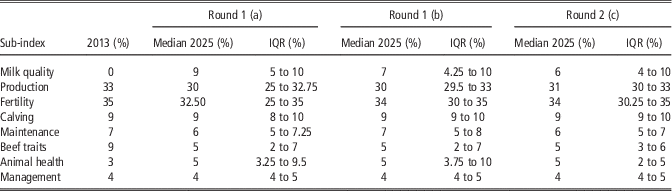
The respondents’ views on how the milk quality sub-index should be weighted if it were to be incorporated into the overall index, and how the weightings of the other traits should change accordingly, are presented in Table 8. Most traits had a lower relative emphasis in rounds 1 and 2 than was currently the case, in order to accommodate inclusion of the milk quality sub-index. Management and calving, however, did not change in emphasis, neither from the current situation nor between rounds as measured by the median.
Current (2013) and preferred weightings of sub-indices within the Irish dairy breeding index in 2025

a=results from all respondents in round 1 (n=70); b=round 1 respondents who also responded to round 2 (n=42); c=results from respondents round 2 (n=42); IQR=interquartile range.
The median emphasis proposed for milk quality reduced from 9% to 6% from rounds 1 to 2, possibly indicating reflection and consideration of the views of others. Median scores for the proposed relative emphasis on the other traits did not change between rounds with the exception of fertility and production, which both increased back up in the direction of the current weighting.
Based on the genetic parameters used in the present study the deterioration per generation in milk saturated fatty acid content and cheese yield percentage based on selection on the current EBI is expected to be 0.601 and 0.06 genetic standard deviation units, respectively. A relative emphasis of 16% on both traits combined would be required to halt any deterioration in these milk quality traits.
Discussion
Results from the present study illustrate the utility of the Delphi method to identify attributes of importance to stakeholders (Table 5), to obtain an understanding of the rationales given for their responses (Tables 6 and 7) and guide them towards consensus on the quality attributes that they consider should be incorporated into the breeding index (Tables 5 and 8). They also show that stakeholders are generally in agreement regarding the importance of specific quality attributes, as indicated by low IQRs in both rounds 1 and 2 in Table 5, and that they can move towards even greater consensus on some but not all attributes over time (the IQR remained unchanged for four attributes in Table 5, reduced for three attributes and actually increased for two attributes). Nonetheless, differences within stakeholder groups can also be identified in terms of the attributes they view as most/least important (Figures 1 and 2). Stakeholders are willing to give reasons for identifying particular attributes as being most or least important (Tables 6 and 7). This helps to uncover their key assumptions and levels of knowledge. Social learning is also evident, with stakeholders changing their views on some issues after considering others’ perspectives (see e.g. changes in the relative importance in milk quality in Table 8).
Comparison of the results from the Delphi survey and selection index theory shows that while they are in broad agreement they are sufficiently different to be complementary. In this instance, the lower score for relative importance of a quality sub-index from the Delphi study (IQR 4% to 10%) in comparison with the calculations based on selection index theory (16%) suggests a downwards revision of the results of selection index calculation should be contemplated. A decision on the extent of this revision can be supported by consideration of the rationales presented by the stakeholders in the Delphi study. The Delphi study complements selection index approaches in other ways also. For example, it provides insights into a relatively broad range of traits that should be included in the sub-index (nine traits were considered in this study (Table 5) in comparison with two that were used for the selection index calculations), highlights areas where knowledge transfer and extension initiatives may be needed with various members of the supply chain (based on Tables 6 and 7, e.g. initiatives may be needed to address a lack of understanding about the extent of genetic variation in milk quality) and indicates traits that have limited perceived value for supply chain actors (Table 5) and thus may warrant development of a communication campaign. Key messages for the communication campaign can be identified from the rationales given for stakeholders views (Tables 6 and 7).
The discussion to follow reflects on the process of implementing the Delphi study primarily, highlighting the quality of the process and the nature of its outcomes that position the Delphi approach as a complement to alternative approaches. Some qualitative researchers argue that the same criteria to determine quality in quantitative research should not be applied to qualitative research. Hasson et al. (Reference Hasson, Keeney and McKenna2000) suggested that Lincoln and Guba’s (1985) criteria for qualitative studies could be applied to Delphi; these criteria are collectively termed ‘trustworthiness’. In effect, quality is achieved by implementing strategies during the research process and evaluating trustworthiness and utility once a study is completed. Ultimately, this means a Delphi study’s success largely depends on the selection criteria and quality of the expert panel (Dimitrow et al., Reference Dimitrow, Mykkänen, Leikola, Kivelä, Lyles and Airaksinen2014), the design and execution of a systematic process (Quinn Patton, Reference Quinn Patton2002), and also on the skills, experience and research philosophy of the researcher who designed the data collection and analytic approach. Regarding the latter, ‘an exercise in reflexivity, which involves the provision of a methodologically self-critical account of how the research was done’ (Seale, Reference Seale1999) is important.
The various steps taken throughout the process ensured that the collective expert panel provided comment from all stakeholder groups. The high response rate (taking account of commitment involved in completing two rounds and the generally low response rates of online surveys) indicates engagement and commitment by the panellists, and also underpins the trustworthiness of the results. Initiatives undertaken to reduce attrition included engaging with gatekeepers to stakeholder groups to promote commitment, obtaining commitment to participate in advance, ensuring the questionnaire was as short, clear and easy to respond to as possible and sending out reminder e-mails between rounds.
In terms of quality of the expert panel, the generally narrow IQRs indicate that stakeholders from a range of perspectives can hold common opinions on the importance of including milk quality traits in the breeding index. More qualitative analysis of the responses revealed that stakeholders are capable of considering a range of factors in their deliberative processes. Rationales for supporting a sub-index for milk quality traits are strongly oriented towards profit maximisation, with product quality also being considered. However, discussion regarding the merits of including specific traits in the index indicate a broader range of perspectives including factors such as efficiency, animal health and welfare, and environmental impact, subjects identified by EFFAB as issues to be considered in responsible breeding programmes, and being conducive to sustainable breeding (EFFAB, 2014). One factor identified as important by EFFAB, genetic diversity, was not mentioned by the panellists as this is more related to the operation of the breeding programme rather than the establishment of breeding goals. The involvement and commitment of the experts to continue the process was also significant and an indication of the value they placed on the exercise.
A three-tiered consultative approach was deployed for the data collection and analysis stages that ensured multiple perspectives from a variety of people with differing expertise were obtained. These inputs ensured a broader evaluative and analytic lens was used to support the reflective exercise necessary to ensure trustworthiness. While one author took the lead in designing the approach including drafting the questionnaire, establishing selection criteria and proposing a list of experts, all co-authors provided critical comment at each stage. In addition, a broader multidisciplinary project team, and an international advisory committee to the project, provided comment on these issues as well as the initial results.
Equal weighting was given to each respondent’s answer, which effectively means that a farmer with an average herd size had the same input as one of the large scale milk processors. This helped to ensure equity from an individual perspective in evaluating the results. This is important as effective stakeholder management is also somewhat of ‘a moral endeavor because it concerns questions of values, choice, and potential harms and benefits for a large group of groups and individuals’ (Parmar et al., Reference Parmar, Freeman, Harrison, Wicks, de Colle and Purnell2010).
Differences in the size of groups could bias responses in favour of those groups that had a larger number of representatives. Considerable differences in the size of the populations from which the experts were drawn (e.g. 17 500 dairy farmers v. five processors that process 70% of the milk pool) means that it is unlikely to be practicable to have the same number of experts in each group at the end of the process. Furthermore, while Figures 1 and 2 show that based on the background of the expert their position on some attributes varied there is a propensity towards rating common attributes at the top and bottom ends. This highlights the value of having a range of stakeholders. If consensus was the primary objective of the exercise (as opposed to uncovering underlying motivations, assumptions and knowledge to contribute to improved decision making) consideration could be given to weighting group responses within the context of their motivations (e.g. farmers have a strong focus on current pricing criteria) and to rebalance the responses of minority groups (e.g. the two breeding companies in this instance).
While the stakeholders were able to consider a diverse range of factors and perspectives in their decision making, some of the reasons given for not including a milk quality sub-index in the national breeding goal are without merit. For example, the perceived lack of genetic variation in milk quality is not substantiated by the scientific literature (Soyeurt et al., Reference Soyeurt, Dehareng, Gengler, McParland, Wall, Berry and Coffey2008; Bastin et al., Reference Bastin, Berry, Coffey, Strandberg, Urioste, Veerkamp and Gengler2012; Bittante et al., Reference Bittante, Penasa and Cecchinato2013). From a review of the literature Bittante et al. (Reference Bittante, Cipolat-Gotet and Cecchinato2012) documented a mean heritability of 0.26 to 0.36 for milk coagulation properties from up to 19 different populations. Therefore, once accurate phenotypic or genomic information is available then genetic gain is indeed possible if the relative weighting on these traits within an overall breeding index is sufficient to negate any antagonistic genetic correlations with traits already included in the national breeding goal. The statement that the economic impact of milk quality is already included in the breeding goal was not true since the selection index calculations revealed that genetic merit in both milk saturated fatty acid content and cheese yield percentage are deteriorating with selection on the Irish national breeding goal; in fact a relative emphasis of 16% would have to be placed on both traits combined to avoid any deterioration based on the derived restriction selection index. Results from the selection index calculation should, however, be treated with some caution as (1) only two milk quality traits were considered while the term milk quality encompasses a plethora of different milk attributes, (2) the variance components for the traits were based on international studies and variance components differ among populations and (3) the correlations between the milk quality traits and the other traits within the breeding goal were either not available or taken from scientific literature in international studies; moreover, the latter also varies between populations.
Conclusion
This study has contributed to the discourse on the determination of appropriate breeding goals for the Irish dairy industry. It does not claim to have arrived at the ‘correct’ answer as to which quality traits should be included in the breeding index. It was stressed in the questionnaire that respondents should consider their importance regardless of their technical feasibility. Furthermore, evaluation of some of the rationales given by respondents shows that some of their rationales may not be scientifically based so that while their perspectives should be considered they should not be used as the sole decision making criterion.
The value given from the selection index approach (16%) and the value given from the Delphi study (median of 6% and IQR of 4% to 10% after round 2) are in broad agreement yet sufficiently different to suggest that a clear ‘correct’ answer cannot be found from a single approach. Thus, the authors recommend the Delphi method as an efficient and effective process of obtaining stakeholder input, as a complement to traditional approaches to defining breeding goals. In particular, the rationales provided to justify the proposed weightings should at least be considered when evaluating alternative approaches. Moreover, if considerable disparity exists between the stakeholder perception of what emphasis should be placed on the traits v. what was calculated using alternative approaches then the alternative approaches may need to be re-evaluated or acceptance by stakeholders may not be forthcoming. At the very least a strong justification as to why the disparity exists should be devised. The Delphi approach can support EFFAB guiding principles by helping to balance scientific knowledge and professional judgement with consideration of ethical and societal values (e.g. relating to animal welfare), particularly if a broader range of stakeholders that can encompass the consumer and societal perspective more directly are part of the process.
Acknowledgements
The authors acknowledge the financial support of the Irish Department of Agriculture Food and Marine for funding through their Research Stimulus Fund for the project entitled ‘Genetic selection for improved milk and meat product quality in dairy, beef and sheep’: Project reference no: 11/SF/311. They also acknowledge the input of the project advisory group, participants in the pilot process and the gatekeepers to various stakeholder groups who promoted participation in the survey rounds.
Supplementary Material
For supplementary material/s referred to in this article, please visit http://dx.doi.org/10.1017/S1751731115002165