Introduction
Decision-making in social situations is fundamental for human development and survival as they influence many aspects of our everyday lives ranging from family relationships and caring for children to vocational achievement. While an individual considers the choices, probabilities, and outcomes of each option before making a decision, in our day-to-day lives, most of the important decisions are made in the context of social situations. The social context adds an additional dimension to the logical choice made by an individual as it also depends on the choice made by another interacting individual (Sanfey, Reference Sanfey2007). Trusting others and returning the trust placed in oneself with trustworthy actions are important aspects of everyday interactions (Balliet & Van Lange, Reference Balliet and Van Lange2013). Impairment in this fundamental ability can lead to poor functioning in everyday life.
However, examining trust behavior in a lab setting is difficult considering the interactive nature of the construct. Through experimental paradigms, neuro-economic games have enabled researchers to assess complex social interactions (Camerer, Reference Camerer2003; King-Casas et al., Reference King-Casas, Tomlin, Anen, Camerer, Quartz and Montague2005). The trust game (Berg, Dickhaut, & McCabe, Reference Berg, Dickhaut and McCabe1995) is a widely used experimental paradigm to analyze individuals' ability to trust and trustworthiness, as well as factors influencing the trust behavior. The traditional form of the game entails a sequential exchange with no contract to enforce agreements. Subjects are typically endowed with 10 units of money and assigned to either the sender or receiver roles. At the start of the game, the sender has the option of passing nothing or any portion x of the endowment (0 ⩽ X ⩽ 10) to the receiver. The sender then keeps the remaining amount (10 – X), and the experimenter multiplies the money by a certain number (usually 3X) before passing it onto the receiver. In stage two, the receiver may either pass nothing or pass any portion y of the money received (0 ⩽ Y ⩽ 3X) back to the sender. The amount passed by the sender is said to capture trust, ‘a willingness to bet that another person will reciprocate a risky move (at a cost to themselves)’, and the amount returned to the trustor/investor by the trustee to capture trustworthiness.
The use of a neuro-economic game like the trust game has several advantages over traditional neuropsychological tests measuring decision-making. The game allows a direct involvement of the participant in the first person and places the participant's reasoning within an interactive context. The iterative administration of the task allows the participant to dynamically change the behavior based on the behavior of the partner, and hence has better ecological validity and real-life applicability (Chan & Chen, Reference Chan and Chen2011). However, several factors could influence the outcome of the trust game and unless carefully designed, these factors could potentially confound the findings. Several attributes of the trustee such as ethnicity, emotional expression, facial attractiveness and resemblance, and group belongingness have been reported to influence the outcome (Chen et al., Reference Chen, Zhong, Zhang, Li, Zhang, Tan and Li2012; DeBruine, Reference DeBruine2002; Tortosa, Lupiáñez, & Ruz, Reference Tortosa, Lupiáñez and Ruz2013). While multi-round trust games involve learning and adaptation and allow one to examine the influence of the reputation of the trustee, single round administration does not allow these measurements (King-Casas et al., Reference King-Casas, Tomlin, Anen, Camerer, Quartz and Montague2005; Tzieropoulos, Reference Tzieropoulos2013). Another drawback is the considerable inter-individual variations seen in the task performance. Several individual factors such as variation in the oxytocin receptor gene, level of oxytocin, phase of menstrual cycle, sex of the participant, economic status of the individual influence the amount of money invested (Alesina & La Ferrara, Reference Alesina and La Ferrara2002; Ball et al., Reference Ball, Wolf, Ocklenburg, Herrmann, Pinnow, Brüne and Güntürkün2013; Kéri, Kiss, & Kelemen, Reference Kéri, Kiss and Kelemen2009; Krueger et al., Reference Krueger, Parasuraman, Iyengar, Thornburg, Weel, Lin and Lipsky2012). Finally, cross-cultural differences in the concept of fairness, trust reciprocity, and trust behavior pose a challenge to compare studies globally (Johnson & Mislin, Reference Johnson and Mislin2011). One needs to consider these factors while interpreting the findings. Also, as these variations in the study design, task administration, and participant characteristics can considerably influence the outcome, it is difficult to compare different studies (Tzieropoulos, Reference Tzieropoulos2013). A meta-analysis reported expectation of other's behavior, the likelihood that the partner will cooperate in a social dilemma and not take advantage of one's own cooperation, to considerably influence the trust behavior of an individual (Balliet & Van Lange, Reference Balliet and Van Lange2013).
Patients with psychosis have paranoia manifested as trust deficits in another person (Gromann et al., Reference Gromann, Heslenfeld, Fett, Joyce, Shergill and Krabbendam2013). Patients have impairments in daily social functioning (Couture, Penn, & Roberts, Reference Couture, Penn and Roberts2006) possibly influenced by trust deficits. In the last decade, a few studies have examined trust behavior and its clinical correlates in individuals with psychosis using the trust game. Recently, studies have also examined trust behavior in clinical high risk (CHR) individuals (Lemmers-Jansen, Fett, Hanssen, Veltman, & Krabbendam, Reference Lemmers-Jansen, Fett, Hanssen, Veltman and Krabbendam2019; Wisman-van der Teen, Lemmers-Jansen, Oorschot, & Krabbendam, Reference Wisman-van der Teen, Lemmers-Jansen, Oorschot and Krabbendam2021). However, the findings from these studies are heterogeneous making it difficult to draw definitive conclusions; while a few studies have reported significantly lower trust (Fett et al., Reference Fett, Shergill, Joyce, Riedl, Strobel, Gromann and Krabbendam2012; Gromann et al., Reference Gromann, Heslenfeld, Fett, Joyce, Shergill and Krabbendam2013; Lemmers-Jansen et al., Reference Lemmers-Jansen, Fett, Hanssen, Veltman and Krabbendam2019), others have reported absence of a difference (Fett et al., Reference Fett, Mouchlianitis, Gromann, Vanes, Shergill and Krabbendam2019; Hanssen, van Buuren, Van Atteveldt, Lemmers-Jansen, & Fett, Reference Hanssen, van Buuren, Van Atteveldt, Lemmers-Jansen and Fett2022). A major limitation is inclusion of small number of subjects in individual studies.
Considering the central role trust plays in everyday social interactions and the poor functioning associated with its impairment, it is worthwhile to analyze the studies which have examined trust behavior in patients with a psychotic disorder. However, to date, no meta-analysis has examined the trust behavior in patients with psychosis. Hence, in this systematic review and meta-analysis, we aimed to compile the evidence in the field and to assess (a) whether patients with psychosis have trust deficits compared to healthy controls, (b) to analyze the factors affecting trust deficits, (c) whether relatives of patients with psychosis and those at high risk for psychosis also have impairments in trust.
Methods
Study selection
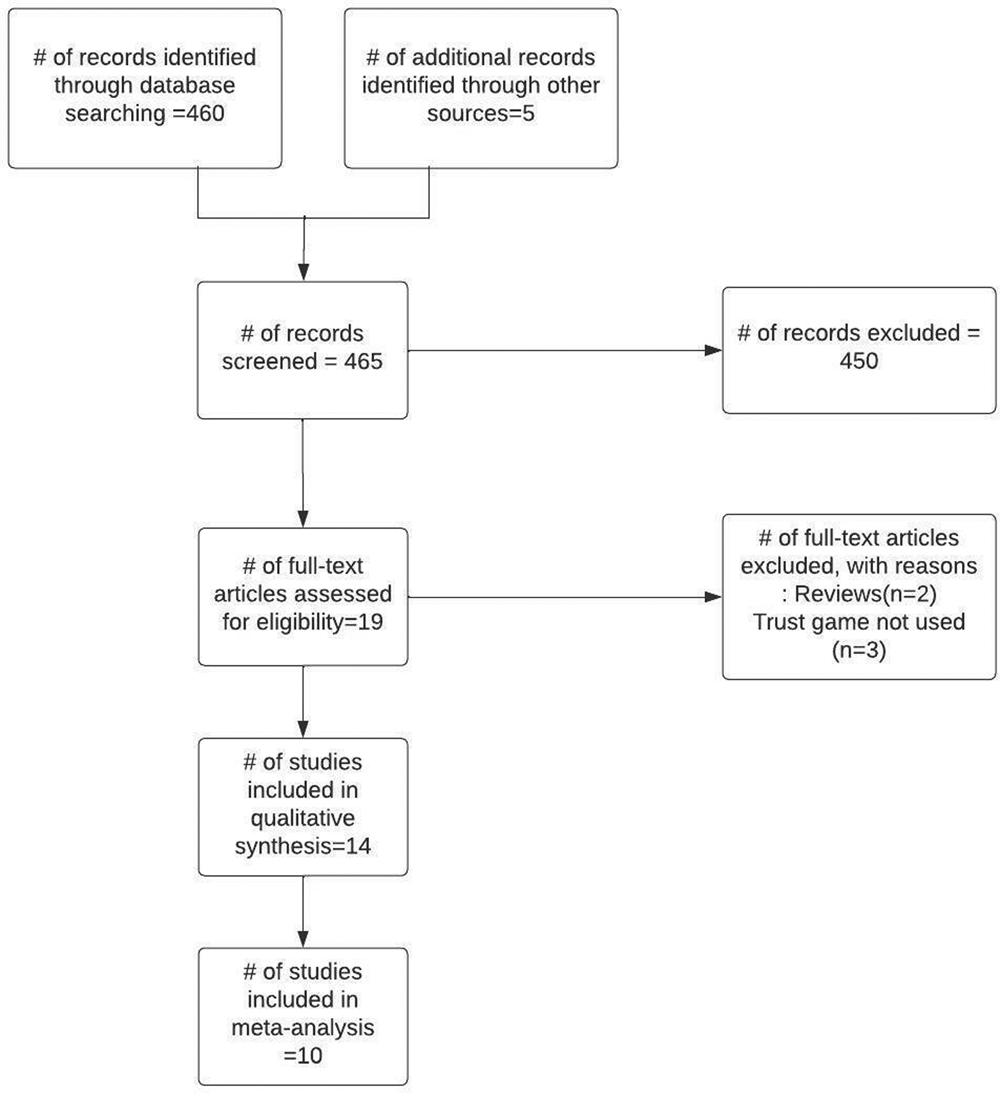
We included studies that were published in the English language and met the following inclusion criteria: (a) studies that compared the trust between healthy controls and subjects with a diagnosis of a psychotic disorder, clinically high risk for psychosis (CHR), or first-degree relatives of subjects with psychosis, (b) subjects and healthy controls aged 13 years or older, (c) trust assessed using classical or modified trust game. Studies that had assessed trust in patients with psychosis were included, regardless of treatment status. Studies with just limited data were excluded. Studies that did not strictly meet the criteria for inclusion in quantitative analysis, but nevertheless report important findings with regards to trust and psychosis, are described qualitatively. This systematic review and meta-analysis were performed according to the Preferred Reporting Items for Systematic Reviews and Meta-Analysis statement (Moher, Liberati, Tetzlaff, & Altman, Reference Moher, Liberati, Tetzlaff and Altman2009). The PRISMA flow diagram is given in Fig. 1. The study was registered in the PROSPERO database (number-CRD42021295266).
PRISMA flow diagram of database search.

Data sources
The studies were identified through PubMed search using the keywords – ‘“Trust game” AND schizophreni*’, ‘“Trust game” AND psycho*’, ‘Trust AND game AND psycho*’ ‘Trust game AND CHR’, ‘Trust game AND psycho* AND relatives’. The exact keywords were used to search the Cochrane library and the initial pages of Google Scholar. The databases were searched for articles from their dates of inception to 20 October 2021. Titles and abstracts from the search results were examined to ascertain whether they fulfilled the inclusion criteria. The selected articles were also scanned for cross-references that fulfilled our inclusion criterion. Two authors independently screened the titles and/or abstracts of the studies retrieved using the search strategy. The full texts of potentially relevant studies were also retrieved and independently assessed for eligibility.
Outcome measures, data extraction, and meta-analysis
The primary outcome measure was baseline trust. Baseline trust refers to the initial amount invested by an investor without any prior information or other experimental designs, and it reflects an unbiased estimate of the basic trust of an individual. In most studies, the money invested in the first trial of the trust game was considered the baseline trust. In one study (Fett et al., Reference Fett, Shergill, Joyce, Riedl, Strobel, Gromann and Krabbendam2012), the mean of trials before feedback was considered as baseline trust. In another study (Hanssen, Krabbendam, Robberegt, & Fett, Reference Hanssen, Krabbendam, Robberegt and Fett2020), the mean investment in all the trust trials was considered as baseline trust. The primary outcome measures were the means and standard deviations of baseline money invested by patients with psychosis and controls. If these variables were not mentioned in the articles, the data were collected either by extracting it from the figures or by contacting the authors. Data from each included study were independently extracted by a set of two authors. Discrepancies were identified and resolved through discussion (with a third author wherever necessary). A standardized, pre-piloted form was used to extract data from the included studies for evidence synthesis.
We used the statistical package Review Manager version 5.4 (RevMan 5.4) and comprehensive meta-analysis version 3 (CMA3) (Borenstein, Reference Borenstein, M., J. P. and G. D.2022) to do the meta-analysis. The meta-analysis was performed if at least three data sets of control and subject groups were available for that particular measure/design. For each study, we calculated the standardized mean difference (SMD) with a 95% confidence interval using the means and standard deviations of the patient and control groups. Meta-analytic methods were applied to obtain the combined effect size. SMD with 95% confidence interval was used to combine studies that measured the same outcome even if different methods were used. The outcome measure was calculated using a random-effect model. The results are described narratively wherever meta-analysis was not possible. Assessment of heterogeneity was conducted using the I 2 score with scores greater than 25, 50, and 75% corresponding to low, moderate, and high heterogeneity respectively, and I 2 score <25% was considered acceptable (Higgins, Thompson, Deeks, & Altman, Reference Higgins, Thompson, Deeks and Altman2003). A study was considered an outlier if the study's confidence interval did not overlap with the confidence interval of the pooled effect size (Harrer, Cuijpers, Furukawa, & Ebert, Reference Harrer, Cuijpers, Furukawa and Ebert2021). Sensitivity analysis was conducted using leave-one-out analysis to assess whether a single study influenced summary effect size. The potential publication bias was evaluated using Egger's test with a p value less than 0.05 suggesting significant publication biases.
Results
The searches across the databases, including cross-references, yielded 465 publications of which 10 were included in the final quantitative analysis (Fig. 1). One study had an exclusive adolescent sample (Fett et al., Reference Fett, Shergill, Korver-Nieberg, Yakub, Gromann and Krabbendam2016) and two studies had mixed samples of adults and adolescents (Lemmers-Jansen et al., Reference Lemmers-Jansen, Fett, Hanssen, Veltman and Krabbendam2019, Lemmers-Jansen, Fett, van Os, Veltman & Krabbendam, Reference Lemmers-Jansen, Fett, van, Veltman and Krabbendam2020). The rest of the studies had exclusive adult samples. All the studies included had samples with a diagnosis of non-affective psychosis, but one study (Fett et al., Reference Fett, Shergill, Korver-Nieberg, Yakub, Gromann and Krabbendam2016) had a sample containing a proportion of subjects with affective psychosis. All the studies included in the meta-analysis were conducted in developed countries and had used the trust game with three times the repayment by the trustee.
The data from these 10 studies (Fett et al., Reference Fett, Shergill, Joyce, Riedl, Strobel, Gromann and Krabbendam2012, Reference Fett, Shergill, Korver-Nieberg, Yakub, Gromann and Krabbendam2016, Reference Fett, Mouchlianitis, Gromann, Vanes, Shergill and Krabbendam2019; Gromann et al., Reference Gromann, Heslenfeld, Fett, Joyce, Shergill and Krabbendam2013, Reference Gromann, Shergill, De Haan, Meewis, Fett, Korver-Nieberg and Krabbendam2014; Hanssen et al., Reference Hanssen, Krabbendam, Robberegt and Fett2020, Reference Hanssen, van Buuren, Van Atteveldt, Lemmers-Jansen and Fett2022; Lemmers-Jansen et al., Reference Lemmers-Jansen, Fett, Hanssen, Veltman and Krabbendam2019, Reference Lemmers-Jansen, Fett, van, Veltman and Krabbendam2020; Wisman-van der Teen et al., Reference Wisman-van der Teen, Lemmers-Jansen, Oorschot and Krabbendam2021) yielded six datasets to assess baseline trust in patients with psychosis (Fett et al., Reference Fett, Shergill, Joyce, Riedl, Strobel, Gromann and Krabbendam2012, Reference Fett, Shergill, Korver-Nieberg, Yakub, Gromann and Krabbendam2016; Gromann et al., Reference Gromann, Heslenfeld, Fett, Joyce, Shergill and Krabbendam2013; Hanssen et al., Reference Hanssen, Krabbendam, Robberegt and Fett2020, Reference Hanssen, van Buuren, Van Atteveldt, Lemmers-Jansen and Fett2022; Lemmers-Jansen et al., Reference Lemmers-Jansen, Fett, Hanssen, Veltman and Krabbendam2019), three datasets assessed baseline trust in relatives of patients with psychosis (Fett et al., Reference Fett, Shergill, Joyce, Riedl, Strobel, Gromann and Krabbendam2012; Gromann et al., Reference Gromann, Shergill, De Haan, Meewis, Fett, Korver-Nieberg and Krabbendam2014; Hanssen et al., Reference Hanssen, Krabbendam, Robberegt and Fett2020), and three datasets assessed trust in co-operative and unfair contexts (Fett et al., Reference Fett, Mouchlianitis, Gromann, Vanes, Shergill and Krabbendam2019; Gromann et al., Reference Gromann, Heslenfeld, Fett, Joyce, Shergill and Krabbendam2013; Wisman-van der Teen et al., Reference Wisman-van der Teen, Lemmers-Jansen, Oorschot and Krabbendam2021) (see online Supplementary material for details of the studies included).
Baseline trust in patients with psychosis
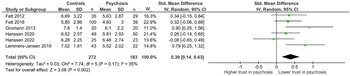
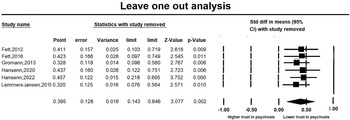
All the studies selected measured baseline trust in terms of investment from 10 units of money endowed. After excluding repeated sample population, six studies (Fett et al., Reference Fett, Shergill, Joyce, Riedl, Strobel, Gromann and Krabbendam2012, Reference Fett, Shergill, Korver-Nieberg, Yakub, Gromann and Krabbendam2016; Gromann et al., Reference Gromann, Heslenfeld, Fett, Joyce, Shergill and Krabbendam2013; Hanssen et al., Reference Hanssen, Krabbendam, Robberegt and Fett2020, Reference Hanssen, van Buuren, Van Atteveldt, Lemmers-Jansen and Fett2022; Lemmers-Jansen et al., Reference Lemmers-Jansen, Fett, Hanssen, Veltman and Krabbendam2019) were selected for the meta-analysis. From these six studies, 272 controls were compared with 183 patients with psychosis. Baseline trust was significantly lower in patients with psychosis compared to controls (SMD 0.39, 95% CI 0.14–0.64, p = 0.002) (Fig. 2). An I 2 value of 35% indicated a low heterogeneity. Egger's test did not suggest publication bias (p −0.37). One study (Fett et al., Reference Fett, Shergill, Korver-Nieberg, Yakub, Gromann and Krabbendam2016) had a sub-sample of patients (11/39) with affective psychosis. This study also had an exclusive adolescent sample with a mean age of 17 ± 1.21 years. Another study (Lemmers-Jansen et al., Reference Lemmers-Jansen, Fett, Hanssen, Veltman and Krabbendam2019) had a mixed sample of adolescents and adults with a mean age of 19.88 years (s.d. −1.54). We calculated baseline trust using mean investment from two studies (Fett et al., Reference Fett, Shergill, Joyce, Riedl, Strobel, Gromann and Krabbendam2012; Hanssen et al., Reference Hanssen, Krabbendam, Robberegt and Fett2020) while investment in the first trial was considered from the rest of the studies. One of these studies (Fett et al., Reference Fett, Shergill, Joyce, Riedl, Strobel, Gromann and Krabbendam2012) did not give feedback in repeated interactions and hence was not affected by the trustworthiness of the trustee allowing us to use mean investment. Sensitivity analysis by leave-one-out analysis revealed that none of these studies had a significant influence on the summary effect size (Fig. 3). Though the study by Hanssen et al. (Reference Hanssen, Krabbendam, Robberegt and Fett2020) reported mean trust across trials, sensitivity analysis by leaving out this study did not have an influence on the overall results.
Meta-analysis of baseline trust in patients with psychosis.

Leave one out analysis of the studies included in the meta-analysis of baseline trust in psychosis.

Baseline trust in relatives of patients with psychosis
Three studies (Fett et al., Reference Fett, Shergill, Joyce, Riedl, Strobel, Gromann and Krabbendam2012; Gromann et al., Reference Gromann, Shergill, De Haan, Meewis, Fett, Korver-Nieberg and Krabbendam2014; Hanssen et al., Reference Hanssen, Krabbendam, Robberegt and Fett2020) examined baseline trust in relatives of patients with psychosis and compared it with the healthy controls. In total, 117 controls were compared to 94 relatives of patients with psychosis. No significant difference in baseline trust was found between the two groups (SMD 0.08, 95% CI −0.20 to 0.36, p −0.58) (Fig. 4). There was no observed heterogeneity (I 2 = 0) and Egger's test showed no publication bias (p = 0.65). Two of these studies (Fett et al., Reference Fett, Shergill, Joyce, Riedl, Strobel, Gromann and Krabbendam2012; Hanssen et al., Reference Hanssen, Krabbendam, Robberegt and Fett2020) also compared baseline trust between relatives and patients with psychosis. However, there was no significant difference in baseline trust between the two groups (p > 0.05).
Meta-analysis of baseline trust in relatives of patients with psychosis.

Baseline trust in CHR individuals
Two studies (Lemmers-Jansen et al., Reference Lemmers-Jansen, Fett, Hanssen, Veltman and Krabbendam2019; Wisman-van der Teen et al., Reference Wisman-van der Teen, Lemmers-Jansen, Oorschot and Krabbendam2021) examined baseline trust in individuals at CHR for psychosis. Both studies found that CHR individuals had significantly lower baseline trust than controls, but no significant difference compared to patients with psychosis. As there were only two studies, we could not do a meta-analysis of these studies.
Trust behavior in repeated interactions with co-operative and unfair contexts
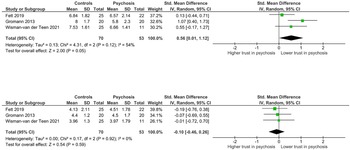
Three studies (Fett et al., Reference Fett, Mouchlianitis, Gromann, Vanes, Shergill and Krabbendam2019; Gromann et al., Reference Gromann, Heslenfeld, Fett, Joyce, Shergill and Krabbendam2013; Wisman-van der Teen et al., Reference Wisman-van der Teen, Lemmers-Jansen, Oorschot and Krabbendam2021) examined the effect of context wherein participant's trust was reinforced with either higher repayments (fair/cooperative/trustworthy context) or lower payments (unfair/uncooperative/untrustworthy context). Patients with psychosis (n = 53) showed lower trust compared to controls (n = 70) in co-operative context (SMD 0.56, 95% CI 0.01–1.12, p = 0.05) (Fig. 5a). There was moderate heterogeneity (I 2 = 54%). There was no publication bias on Egger's test (p −0.45). On the other hand, there was no significant difference between the trust shown by patients with psychosis or controls in an un-cooperative context (SMD −0.10, 95% CI −0.46 to 0.26, p = 0.59). There was neither an observed heterogeneity (I 2 = 0) nor a publication bias (p −0.69) (Fig. 5b). We further analyzed the means according to the context between patients and controls across all studies; when repayments were positive, although there was a slight increase in investment in patients, it continued to be significantly lower compared to controls reflecting the reduced trust patients had compared to controls. On the other hand, when repayments were negative, both patients and controls invested less with no significant difference between the two in terms of amount invested (online Supplementary Fig. S1). Two studies were not included in the meta-analysis as they did not measure baseline trust (Campellone, Fisher, & Kring, Reference Campellone, Fisher and Kring2016; Campellone, Truong, Gard, & Schlosser, Reference Campellone, Truong, Gard and Schlosser2018). In a modified trust game, predetermined to result in cooperative or unfair outcomes, authors examined trust behavior in schizophrenia patients while the partners displayed different emotions. These studies also reported that schizophrenia patients placed less trust in both co-operative and unfair partners compared to controls in the initial interactions. Further, one of the studies (Campellone et al., Reference Campellone, Fisher and Kring2016) also found that schizophrenia patients had difficulty in changing their decisions when their partners went from untrustworthy to trustworthy but had no difficulty when the change was from trustworthy to untrustworthy.
Meta-analysis of trust in co-operative (upper figure) and unfair context (lower figure) in patients with psychosis.

Trust behavior given a priori information on trustworthiness
One study examined the level of trust wherein the participants were informed about the trustees' trustworthiness (based on the amount of repayment) before the game (Fett et al., Reference Fett, Shergill, Joyce, Riedl, Strobel, Gromann and Krabbendam2012). Controls showed a significant increase in their trust in the case of prior positive information, while the same increase was not observed in patients with psychosis. A similar observation was noted in another study in which controls altered investments in positive and negative contexts but not patients with schizophrenia (Hanssen et al., Reference Hanssen, van Buuren, Van Atteveldt, Lemmers-Jansen and Fett2022). Another study (Sutherland et al., Reference Sutherland, Rhodes, Williams, Connaughton, Ewing, Caruana and Langdon2020) examined trust based on the level of trustworthiness of the faces of trustees seen before the game. The study found that schizophrenia patients changed their investments in the trust game in a manner similar to controls based on facial appearance. However, the same study found impaired decision-making in the trust game based on the actual behavior of the trustees in the game. The authors concluded that patients with schizophrenia were more reliant on facial appearance than actual partner fairness.
Influence of variations in trust game administration on trust behavior
All studies included in the analysis used a multi-round trust game, with participants endowed with 10 monetary units and investment being tripled on transfer to trustee. All the studies except one (Fett et al., Reference Fett, Shergill, Joyce, Riedl, Strobel, Gromann and Krabbendam2012) involved participants playing against a computer but with the participants being instructed that they were playing against human counterparts. However, all the studies except one (Gromann et al., Reference Gromann, Heslenfeld, Fett, Joyce, Shergill and Krabbendam2013) reported an assessment of the manipulation using questionnaires and found that the participants who did not believe the deception was considerably less (varying between 6% to 21%) (See online Supplementary material). Two studies (Lemmers-Jansen et al., Reference Lemmers-Jansen, Fett, Hanssen, Veltman and Krabbendam2019; Wisman-van der Teen et al., Reference Wisman-van der Teen, Lemmers-Jansen, Oorschot and Krabbendam2021) did not find any difference in results on excluding the subjects who did not believe in the manipulation. Two studies (Hanssen et al., Reference Hanssen, Krabbendam, Robberegt and Fett2020, Reference Hanssen, van Buuren, Van Atteveldt, Lemmers-Jansen and Fett2022) statistically analyzed and found no impact of the manipulation on investment in the trust game. Of the studies included in the final analysis, participants were paid a random amount from one of the rounds in three studies (Fett et al., Reference Fett, Shergill, Joyce, Riedl, Strobel, Gromann and Krabbendam2012, Reference Fett, Shergill, Korver-Nieberg, Yakub, Gromann and Krabbendam2016, Reference Fett, Mouchlianitis, Gromann, Vanes, Shergill and Krabbendam2019) while other studies paid a fixed amount to the participants. Two studies (Gromann et al., Reference Gromann, Heslenfeld, Fett, Joyce, Shergill and Krabbendam2013, Reference Gromann, Shergill, De Haan, Meewis, Fett, Korver-Nieberg and Krabbendam2014) did not report the mode of payment.
Influence of symptoms and other factors on trust behavior
Although no study has specifically looked at the influence of symptoms on trust in detail, most studies have described associations between trust and symptoms. Fett and colleagues (Fett et al., Reference Fett, Mouchlianitis, Gromann, Vanes, Shergill and Krabbendam2019) reported that higher PANSS positive and negative symptoms were associated with lower trust in baseline and co-operative conditions, while higher negative symptom scores were associated with lower trust in unfair conditions. The same group (Fett et al., Reference Fett, Shergill, Korver-Nieberg, Yakub, Gromann and Krabbendam2016) had previously reported similar findings with negative symptoms, but not with positive symptoms. On the other hand, one study (Hanssen et al., Reference Hanssen, Krabbendam, Robberegt and Fett2020) did not find any association with investment in trust game and symptoms. However, it is to be noted that the subjects in this study had minimal symptoms. In another study (Lemmers-Jansen et al., Reference Lemmers-Jansen, Fett, Hanssen, Veltman and Krabbendam2019), severe negative symptoms were associated with impaired learning in response to positive feedback in the cooperative condition in FEP, but not in CHR. On the contrary, positive symptoms were associated with impaired learning from negative feedback in the unfair condition in both FEP and CHR. A couple of studies examined other factors that might influence trust behavior. In one study, interactions based on trust were associated with increased oxytocin levels in controls but not in schizophrenia patients, and lower oxytocin levels were significantly related to negative symptoms (Kéri et al., Reference Kéri, Kiss and Kelemen2009). In another study, no relationship was found between urbanicity and investment in trust games in patients with psychosis (Lemmers-Jansen et al., Reference Lemmers-Jansen, Fett, van, Veltman and Krabbendam2020).
Discussion
The findings of the meta-analysis suggest that patients with psychosis have significantly decreased baseline trust compared to healthy controls. The decreased trust is more pronounced in ‘co-operative’ contexts but not in ‘unfair/uncooperative’ contexts. On the other hand, relatives of patients did not differ from healthy controls. While we could not do a meta-analysis due to a limited number of studies, the preliminary evidence suggested that CHR also have lower baseline trust compared to controls but did not differ from patients with psychosis. The main finding of our study revealed that patients with psychosis trust significantly less than controls. These findings remained significant on sensitivity analysis and excluding studies that had exclusive adolescent samples or had patients with affective psychosis.
The current meta-analysis shows that psychotic patients invested less despite positive reinforcement from their partners. On the other hand, patients did not differ from controls in their investments when they were unfairly or negatively reinforced. That is, while controls were more sensitive and changed their investments in response to repayments, patients did not change their investments when the partner was cooperative. Several cognitive processes might contribute to this altered trust behavior seen in patients with psychosis. As intact social cognition is critical in decision-making and modification of trust behavior (Frith & Singer, Reference Frith and Singer2008; Koenig & Harris, Reference Koenig and Harris2005), it is possible that social cognitive deficits contribute to the decreased trust behavior.
Social cognitive deficits can lead to impaired top-down processing and inflexible a priori beliefs. It has also been shown that patient's judgment of trustworthiness can be influenced by presenting negative affective primes but not by positive or neutral primes. Furthermore, this judgment was influenced by the severity of the positive symptoms, especially suspiciousness (Hooker et al., Reference Hooker, Tully, Verosky, Fisher, Holland and Vinogradov2011). The authors propose that negative primes might provoke negative affects like fear, which in turn are associated with specific cognitive appraisals (like uncertainty and loss of control) and schemas that influence patients' judgment on trustworthiness. Deficits in cognitive control skills like evaluation and attentional control which are seen in psychosis might also lead to impaired regulation of effects of negative affect on judgment, leading to erroneous judgments on trustworthiness (Henry et al., Reference Henry, Green, de Lucia, Restuccia, McDonald and O'Donnell2007). Like social cognitive deficits, neurocognitive deficits can also contribute to the altered trust behavior as increasing cognitive load is reported to decrease social trust (Samson & Kostyszyn, Reference Samson and Kostyszyn2015). As patients with psychosis are known to have impairments in social cognition domains of the theory of mind (ToM) and emotion recognition (Green, Horan, & Lee, Reference Green, Horan and Lee2015) and several neurocognitive domains (Bora, Binnur Akdede, & Alptekin, Reference Bora, Binnur Akdede and Alptekin2017), future studies need to examine the impact of social cognitive and neurocognitive deficits on trust behavior in psychosis.
In addition to these cognitive deficits, the presence of paranoia, and impairments in processing contextual information seen in psychosis could also contribute to the decreased trust behavior; patients might exaggerate perception of threats and may take appropriate precautions against such threats, in this case by investing less in the trust game (Freeman, Reference Freeman2016; Servan-Schreiber, Cohen, & Steingard, Reference Servan-Schreiber, Cohen and Steingard1996). Finally, previous studies have reported that patients with psychosis have cognitive errors such as jumping to conclusions (Veckenstedt et al., Reference Veckenstedt, Randjbar, Vitzthum, Hottenrott, Woodward and Moritz2011), impaired ability to integrate disconfirmatory evidence (Woodward, Moritz, Menon, & Klinge, Reference Woodward, Moritz, Menon and Klinge2008), and impaired error-dependent updating of beliefs about the world (Fletcher & Frith, Reference Fletcher and Frith2009) that may also contribute to decreased trust behavior.
Abnormalities in reinforcement learning (Waltz & Gold, Reference Waltz and Gold2007) may also play a significant role in decreased trust behavior. Studies have also shown that patients with schizophrenia exhibit deficits in learning from positive outcomes but intact learning from negative outcomes (Gold et al., Reference Gold, Waltz, Matveeva, Kasanova, Strauss, Herbener and Frank2012; Strauss et al., Reference Strauss, Frank, Waltz, Kasanova, Herbener and Gold2011; Strauss, Waltz, & Gold, Reference Strauss, Waltz and Gold2014). This is supported by neuroimaging literature wherein patients show intact activation of the ventral striatum in response to negative reward prediction errors (Waltz et al., Reference Waltz, Schweitzer, Gold, Kurup, Ross, Salmeron and Stein2009, Reference Waltz, Schweitzer, Ross, Kurup, Salmeron, Rose and Stein2010). Positive prediction errors on the other hand show reduced activation in areas including the ventral striatum and the insula (Murray et al., Reference Murray, Corlett, Clark, Pessiglione, Blackwell, Honey and Fletcher2008; Waltz et al., Reference Waltz, Schweitzer, Ross, Kurup, Salmeron, Rose and Stein2010). Thus, patients with psychosis may have difficulty in learning from positive repayments and alter their behavior accordingly which led to lower trust compared to controls. On the other hand, intact learning from negative outcomes might have led to modification in behavior like healthy individuals during unfair repayments. Further research is required to explore the cause for differential trust in the above two contexts.
Few studies have examined the neural correlates of trust behavior in psychosis and found that the controls had greater activation in caudate than in patients when they received co-operative repayments. However, there was no difference in unfair conditions (Gromann et al., Reference Gromann, Heslenfeld, Fett, Joyce, Shergill and Krabbendam2013; Hanssen et al., Reference Hanssen, van Buuren, Van Atteveldt, Lemmers-Jansen and Fett2022). Similar findings were reported in first-degree relatives (Gromann et al., Reference Gromann, Shergill, De Haan, Meewis, Fett, Korver-Nieberg and Krabbendam2014) as well as in adolescents with first-episode psychosis (FEP) (Fett et al., Reference Fett, Mouchlianitis, Gromann, Vanes, Shergill and Krabbendam2019). The striatum is involved in social reward processing and greater caudate activation in situations where benevolence or cooperation is experienced than in unfair experiences (Bhanji & Delgado, Reference Bhanji and Delgado2014; King-Casas et al., Reference King-Casas, Tomlin, Anen, Camerer, Quartz and Montague2005). This differential activation seems to be impaired in psychosis, which is also in line with studies showing intact sensitivity to negative reward prediction errors but impaired sensitivity to positive reward prediction errors (Murray et al., Reference Murray, Corlett, Clark, Pessiglione, Blackwell, Honey and Fletcher2008; Waltz et al., Reference Waltz, Schweitzer, Gold, Kurup, Ross, Salmeron and Stein2009, Reference Waltz, Schweitzer, Ross, Kurup, Salmeron, Rose and Stein2010). Studies have also reported reduced activation of right temporo-parietal junction (TPJ) and insula in patients with psychosis but found no difference in medial prefrontal cortex activation (Fett et al., Reference Fett, Mouchlianitis, Gromann, Vanes, Shergill and Krabbendam2019; Gromann et al., Reference Gromann, Heslenfeld, Fett, Joyce, Shergill and Krabbendam2013). Considering the critical role of TPJ in ToM functions, these findings suggest impaired mentalizing may be one of the factors responsible for decreased ability to trust. On the other hand, CHR individuals had greater TPJ activation than controls or FEP patients in unfair conditions (Lemmers-Jansen et al., Reference Lemmers-Jansen, Fett, Hanssen, Veltman and Krabbendam2019) suggesting either more effort expended to respond adequately or due to inefficient TPJ.
The meta-analysis also showed CHR individuals to have impairments in baseline trust like patients with psychosis, while the relatives of patients with psychosis were unimpeded in their ability to trust. Previous studies have shown that CHR individuals have similar social cognitive deficits as patients with psychosis albeit of lower severity (Bora & Pantelis, Reference Bora and Pantelis2013; Piskulic et al., Reference Piskulic, Liu, Cadenhead, Cannon, Cornblatt, McGlashan and Addington2016). As the level of trust in CHR was not associated with the severity of symptoms, a previous study proposed low baseline trust as a trait marker for psychosis rather than a state marker (Lemmers-Jansen et al., Reference Lemmers-Jansen, Fett, Hanssen, Veltman and Krabbendam2019). Whether the low baseline trust in CHR could predict the conversion to psychosis needs to be examined in future longitudinal studies. On the other hand, the current meta-analysis revealed no difference in baseline trust in relatives compared to controls. It is interesting to note that while a few studies have observed social cognitive deficits in relatives of patients with psychosis (Bora & Pantelis, Reference Bora and Pantelis2013; Eack et al., Reference Eack, Mermon, Montrose, Miewald, Gur, Gur and Keshavan2010), others have reported absence of such deficits (Kelemen, Kéri, Must, Benedek, & Janka, Reference Kelemen, Kéri, Must, Benedek and Janka2004). However, it should be noted that a couple of studies (Fett et al., Reference Fett, Shergill, Joyce, Riedl, Strobel, Gromann and Krabbendam2012; Hanssen et al., Reference Hanssen, Krabbendam, Robberegt and Fett2020) reported absence of significant difference in baseline trust between patients with psychosis and their relatives. Hence, further studies examining trust in relatives and CHR are needed to examine whether it is an endophenotype (Gottesman & Gould, Reference Gottesman and Gould2003). At the same time, lack of trust could serve as a diagnostic marker if it is exclusively found in CHR and psychotic individuals, but not in relatives.
A few methodological issues warrant further discussion for future studies. The studies included had uniformity in terms of the trust game having multiple rounds, an initial endowment of subjects, and multiplication of the amount sent. The previous meta-analysis in healthy volunteers has shown that participants invest less if they are playing against simulated opponents and if they are paid randomly after the trust game (Johnson & Mislin, Reference Johnson and Mislin2011). However, it should be noted that most of the studies involved in the analysis performed a manipulation check which revealed that most (approximately >80%) of the participants believed that they were playing against real opponents. On the other hand, the finding of lower investment with random or a fixed hypothetical payment rather than real payments based on the subject's performance has had conflicting evidence (Locey, Jones, & Rachlin, Reference Locey, Jones and Rachlin2011; Madden, Begotka, Raiff, & Kastern, Reference Madden, Begotka, Raiff and Kastern2003). Hence, further studies are needed to assess trust in psychotic patients when they receive real payments.
In the current meta-analysis, we focused on baseline trust as it reflects an unbiased estimate of the basic trust of an individual. In the absence of feedback and a priori information, this reflects the ability of an individual to trust another individual. However, iterative administration of the task allows one to examine the effect of reputation, inherent biases based on groups/race/gender, amount invested, and the probability of returns that are not possible with an examination of baseline trust only. As trust in another individual is critical for societal functioning, impairment of which could affect the social functioning of patients, novel treatments could improve trust behavior in patients with psychosis and in turn social functioning and community integration. Considering the potential beneficial effect of neuropeptides oxytocin and vasopressin on trust and cooperative behavior (Baumgartner, Heinrichs, Vonlanthen, Fischbacher, & Fehr, Reference Baumgartner, Heinrichs, Vonlanthen, Fischbacher and Fehr2008; Kéri et al., Reference Kéri, Kiss and Kelemen2009; Purushothaman et al., Reference Purushothaman, Jacob, Kumar, Varambally, Venkatasubramanian and Rao2020, Reference Purushothaman, Jacob, Kumar, Varambally, Venkatasubramanian and Rao2021), further studies need to examine the effect of these hormones on trust behavior in schizophrenia and related psychosis.
The type and severity of the symptoms also influence trust in psychosis. The current review suggests that negative symptoms are significantly associated with reduced trust in psychosis, especially with regard to responding to feedback. However, the association with positive symptoms is inconsistent. Considering the broad range of patients in the studies included in this review and the absence of studies that have specifically examined the impact of symptoms at different severities on trust behavior in psychosis, future research is needed to draw more conclusive evidence on the impact of symptoms on trust.
The main limitation of existing literature is the low number of studies. As less than 10 studies were included in the current meta-analysis, we were not able to do a meta-regression (Higgins et al., Reference Higgins, Thomas, Chandler, Cumpston, Li, Page and Welch2019). All studies included in the current meta-analysis were from developed countries. A meta-analysis of studies examining trust behavior in healthy individuals reported a robust geographic variation with participants from Africa sending less money compared to those from North America (Johnson & Mislin, Reference Johnson and Mislin2011). Moreover, it has also been pointed out that claims based on samples drawn entirely from Western, Educated, Industrialized, Rich, and Democratic (WEIRD) societies may not be applicable to the rest of the world (Henrich, Heine, & Norenzayan, Reference Henrich, Heine and Norenzayan2010). Hence, our study results need cautious interpretation and require further research before extrapolating to patients from developing countries. There is an acute need for studies from non-WEIRD countries across cultures. It should also be noted that none of the studies included in the meta-analysis make specific mention of the socio-economic status (SES) of the individuals. Studies have shown that individuals with higher SES show a corresponding increase in trust, with one explanation being their ability to tolerate the risks of trust due to the availability of more resources (Hamamura, Reference Hamamura2012; Qi, Li, & Du, Reference Qi, Li and Du2018). Considering that many of the participants living with a schizophrenia spectrum diagnosis are on disability payments and surviving on much less money than their peers (Knapp, Mangalore, & Simon, Reference Knapp, Mangalore and Simon2004), SES could have partly influenced the trust behavior in patients. Further studies are needed to assess the impact of SES on trust in psychosis and possibly control for the same statistically or by matching the control population. Our study also included all patients with psychosis, i.e. those with affective and non-affective psychosis, adolescents, and adults with psychosis. Although we tried to do a sensitivity analysis excluding the above groups, the individuals included had a diverse range in terms of diagnosis, age and severity of the illness. Considering the slightly varied findings in adolescents with psychosis (Fett et al., Reference Fett, Shergill, Korver-Nieberg, Yakub, Gromann and Krabbendam2016; Lemmers-Jansen et al., Reference Lemmers-Jansen, Fett, Hanssen, Veltman and Krabbendam2019) more studies are needed to firmly establish the differences in trust and its correlates between those with early and chronic psychosis. As mentioned previously, most of the studies selected involved interaction with a computer and individuals being made to believe that they are playing with an actual partner. Although most individuals believed that they were playing with a real partner on post-game analysis, the influence of playing face-to-face on trust in patients v. controls is not clear.
Conclusions
To conclude, the current meta-analysis suggests that patients with psychosis and at risk for psychosis have significantly less baseline trust compared to healthy controls. Patients with psychosis also showed impairment in context-dependent modification in trust behavior, unlike controls who modify the behavior based on the social context. Considering the fundamental importance of trust behavior in day-to-day social interactions, these impairments could contribute to poor social functioning in patients with psychosis. Future studies need to examine the relationship between trust behavior, symptom domains, and community functioning. Studies from different cultures and developing countries are needed in the future. The temporal stability of these impairments needs to be examined in longitudinal studies.
Supplementary material
The supplementary material for this article can be found at https://doi.org/10.1017/S0033291722002562.
Acknowledgements
None.
Author contributions
AP and VK were involved in literature search, data extraction, data analysis, interpretation of results, and manuscript preparation. NPR was involved in conceptualization, data extraction, interpretation of results, and manuscript preparation. All authorsapproved the final manuscript.
Financial support
Partly supported by the Departmentof Science and Technology, Government of India – (PI-DrNaren P Rao: ECR/2016/001823).
Conflict of interest
None.
Disclosures
None.