Introduction
From 2000 to 2004 in the Sinhá Mariana Lagoon, Mato Grosso State, Pachyurus bonariensis (Boulenger, 1895) and Plagioscion ternetzi (Steindachner, 1879) (Perciformes: Scianidae) commonly known as ‘corvinas’, were among the species of fish with the highest abundance of larvae (Universidade Estadual de Maringá, Nupélia/Furnas Centrais Elétricas, Reference Agostinho, Bialetzki, Suzuki, Latini, Gomes, Fugi and Domingues2005).
Pachyurus bonariensis are relatively small, but with some commercial value (Casatti, 2003) in the basins of the Paraná (Agostinho et al., Reference Agostinho, Mendes, Suzuki and Canzi1993), Paraguay and Uruguay rivers (Montero & Fuentes, Reference Montero, Fuentes, Montero and Fuentes1997). Their larvae can be categorized as zooplanktivorous (Santin, Reference Santin2007), while juveniles and adults are benthivorous (Fugi et al., Reference Fugi, Hahn, Novakowski and Balassa2007).
Plagioscion ternetzi reach a considerable size and their weight may exceed 5 kg (Severi, Reference Severi1997). They are known in the region as ‘corvina’ or ‘surubina’, occurring from Rio Grande do Sul (Paraguay River) to the State of Amazonas (Amazonas River). They are zooplanktivorous (personal observation), while the young and the adults are piscivorous (Universidade Estadual de Maringá, Nupélia/Furnas Centrais Elétricas, Reference Agostinho, Bialetzki, Suzuki, Latini, Gomes, Fugi and Domingues2005).
According to Ahlstrom & Ball (Reference Ahlstrom and Ball1954), modified by Nakatani et al. (Reference Nakatani, Agostinho, Baumgartner, Bialetzki, Sanches, Makrakis and Pavanelli2001), what separates a fish larva from a juvenile fish is that the former does not present morphological differentiation regarding the formation of the fins, while juveniles present all fins fully formed, including the segmentation of the rays. When larvae become juveniles, the recruitment length is about 10.01 mm for P. ternetzi (Nakatani et al., Reference Nakatani, Agostinho, Baumgartner, Bialetzki, Sanches, Makrakis and Pavanelli2001) and 26.5 mm for P. bonariensis (Santin, Reference Santin2007).
In the few studies on parasites of fish larvae, the protozoa is the only group found, and in artificial environments only (Ferraz de Lima et al., Reference Ferraz de Lima, Reis and Ceccarelli1991; Ceccarelli et al., Reference Ceccarelli, Alcântara Rocha and De Melo1993; Meneses & Vendrell, Reference Meneses and Vendrell2002). There are no records of endoparasites in fish larvae in natural environments in Brazil; however, there are for ectoparasites in adults of P. bonariensis (Fehlauer, Reference Fehlauer2005). Among the few studies that recorded endoparasites in fish larvae are those of Dauvin & Dodson (Reference Dauvin and Dodson1990), who noted a high incidence of parasitism (92%) of unidentified cestodes in Osmerus mordax (Michill, 1814) in an estuary near Quebec, Canada; Mackenzie (Reference Mackenzie1974), who recorded on the east coast of Scotland, immature digeneans Opechona sp. in the stomach, intestine and pyloric caeca of haddock Melanogrammus aeglefinus (Linnaeus, 1758); Cooper (Reference Cooper1996), who found in Roanoke River (from North Carolina) cestodes (plerocercoids) and metacercariae in the striped bass Morone saxatilis (Walbaum, 1972); and Cribb et al. (Reference Cribb, Pichelin, Dufour, Bray, Chauvet, Faliex, Galzin, Cédrik, Alain, Morand, Rigby and Sasal2000) who found 13 species of parasites (none of them nematodes or acanthocephalans) in the larvae of 38 species of fish from the coral reefs in New Caledonia, Australia. No information exists as to what happens to the transmission of parasites at that stage.
The aim of this study was to record for the first time the presence of nematodes and acanthocephalans parasitizing fish larvae, as well as to relate parasitism indexes to the standard length of hosts.
Materials and methods
Samples were taken in the Sinhá Mariana Lagoon, in the State of Mato Grosso (16°20′342″S/55°54′172″W), which is permanently connected to the Mutum River in the upper Paraguay Basin and located on a flood plain.
From March 2000 to March 2004 larval fish were collected using a plankton net, and then fixed in 4% formalin buffered with calcium carbonate. In the laboratory, the standard length of each larva was obtained and larval fish were necropsied. Parasites were processed following the methodology of Eiras et al. (Reference Eiras, Takemoto and Pavanelli2006). Identifications of helminths were based on Machado (Reference Machado1959), Thatcher (Reference Thatcher1991), Amin (Reference Amin2002) and Moravec (Reference Moravec1998).
Representative specimens of parasites numbered 36999 to 37002 were deposited at the ‘Coleção Helmintológica do Instituto Osvaldo Cruz’ (CHIOC) in Rio de Janeiro, Brazil. Fish larvae deposited at ‘Laboratório de Ictioplâncton’, ‘Núcleo de Pesquisa em Limnologia, Ictiologia e Aquicultura’ (Nupélia), Maringá, Brazil, are being incorporated to the ‘Seção de Ictioplâncton’ of ‘Coleção Ictiológica do Nupélia’.
Parasitism indexes proposed by Bush et al. (Reference Bush, Lafferty, Lotz and Shostak1997) were used and variance/abundance ratios were calculated to inform about the distribution of parasites in their hosts. The distribution is considered random when the variance/abundance ratio is close to 1, aggregated when higher than 1 and regular when lower than 1 (Combes, Reference Combes2001). Spearman's rank correlation coefficient, rs, was used to check the relationship between the standard length of hosts and parasite abundances (number of individuals) of each species of parasite. To test correlations between the standard length and the prevalence of infection of each species of parasite (percentage of parasitized in relation to the examined hosts), Pearson's correlation coefficient, r, was used, with angular processing of prevalence data (arc sine √x) (Zar, Reference Zar1996) and separation of hosts into six classes of standard length for P. bonariensis and into four classes for P. ternetzi.
Results
One hundred larvae of each species were analysed, with standard length varying from 2.1 to 13.2 mm for P. bonariensis and from 2.1 to 9.8 mm for P. ternetzi. The smallest infected fish larvae were 5.25 mm (P. bonariensis) and 4.70 mm long (P. ternetzi). The same species of endoparasites were found infecting larvae of the two species: nematodes (larvae) in the mesentery and acanthocephalans (adults) in the terminal portion of the stomach and intestine. Nematodes were identified as Contracaecum sp. Type 2 (larva) Moravec, Kohn & Fernandes, 1993 (Nematoda: Anisakidae), with length between 1.4 and 2.0 mm, while acanthocephalans were identified as adults of Neoechinorhynchus (Neoechinorhynchus) paraguayensis Machado, Reference Machado1959 (Acanthocephala: Neoechinorhynchidae), length between 0.4 and 1.2 mm.
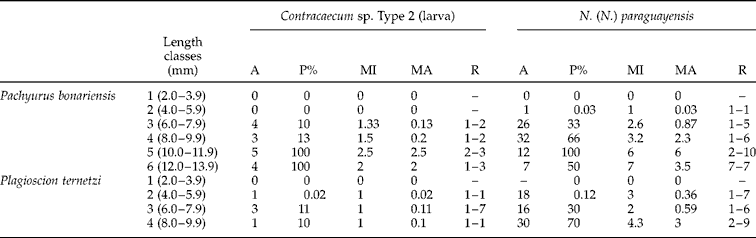
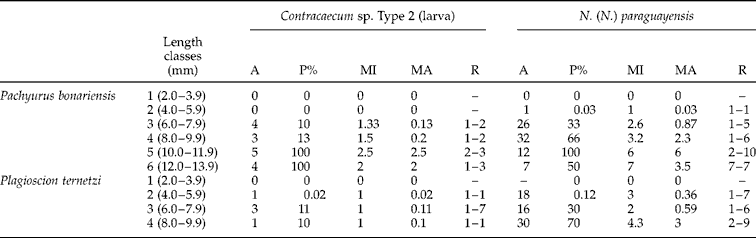
Variance/abundance ratio and distribution are shown in table 1. Parasitism indexes were higher in classes 4–6 in P. bonariensis and 3 and 4 in P. ternetzi (table 2).
Variance/abundance ratio (V/A) and distribution (D) of the parasites Contracaecum sp. Type 2 (larva) and Neoechinorhynchus (Neoechinorhynchus) paraguayensis in larvae of Pachyurus bonariensis and Plagioscion ternetzi collected from March 2000 to March 2004 in Sinhá Mariana Lagoon, Mato Grosso State, Brazil.

Abundance (A), prevalence (P%), mean intensity (MI), mean abundance (MA) and range (R) by length classes of parasites Contracaecum sp. Type 2 (larva) and Neoechinorhynchus (Neoechinorhynchus) paraguayensis in larvae of Pachyurus bonariensis and Plagioscion ternetzi collected from March 2000 to March 2004 in Sinhá Mariana Lagoon, Mato Grosso State, Brazil.
Spearman's rank correlation coefficient indicated a positive correlation between the standard length of hosts and the parasitic abundance of N. (N.) paraguayensis and Contracaecum sp. Type 2 (larva) in larvae of the two species studied (table 3). Pearson's correlation coefficient showed that the prevalence of Contracaecum sp. Type 2 (larva) was positively correlated with the standard length of the two species of hosts.
Values of Spearman's rank correlation coefficient (rs) and Pearson's correlation coefficient (r) obtained in relations between standard length, prevalence and abundance of parasites Contracaecum sp. Type 2 (larva) and Neoechinorhynchus (Neoechinorhynchus) paraguayensis in larvae of Pachyurus bonariensis and Plagioscion ternetzi collected from March 2000 to March 2004 in Sinhá Mariana Lagoon, Mato Grosso State, Brazil.

P = level of significance, * = significant values.
Discussion
Adults of Contracaecum are widely distributed throughout Central and South America. Unfortunately, the taxonomy of larvae is relatively poor, based only on morphology. Larvae are characterized by the presence of a cuticle with transverse striations, one ventral cuticular tooth on the head, a short posterior ventricular appendix and three small unicellular rectal glands. According to Moravec (Reference Moravec1998), Contracaecum sp. Type 2 (larva) has already been reported as infecting more than 20 species of fish in Brazil, Venezuela, Argentina, Cuba and Mexico.
Neoechinorhynchus Stiles & Hassall, 1905 is a cosmopolitan genus and one of the largest within Acanthocephala, with 88 valid species, 48 belonging to the subgenus Neoechinorhynchus Stiles & Hassall, 1905 (Amin, Reference Amin2002). Neoechinorhynchus (Neoechinorhynchus) paraguayensis is characterized by having anterior hooks much larger than the median and the posterior, with basal series with a considerable space between them, and eggs with tube-shaped internal ornamentation (Amim, Reference Amin2002). Nickol & Padilha (1979) found N. (N.) paraguayensis in Geophagus brasiliensis (Quoy & Gaimard, 1824) in Rio de Janeiro, Brazil, and according to them, Masí-Pallares (1979) found the same species in Hoplias malabaricus (Bloch, 1794) in Paraguay.
Species of parasites recorded in the present study have never been reported in adults of P. bonariensis and P. ternetzi. Specimens collected presented measures of length lower than the ones found in previous studies, possibly because the hosts were larvae.
This is the first record of nematodes and acanthocephalans infecting larval fish in the natural environment, as well as the first occurrence of endoparasites in fish larvae in Brazil. Moreover, it adds one more locality and two more species of hosts for the parasites found.
In the research area, there are no studies concerning parasitism of fish. However, several studies comparing the levels of parasitism to the standard length of fish hosts have already been done in the southern region of Brazil, specifically in the flood plain of the upper Paraná River. Some authors found a positive correlation between the size of the fish and the abundance of cestodes (Takemoto & Pavanelli, Reference Takemoto and Pavanelli1994), and the intensity and prevalence of digeneans (Isaac et al., Reference Isaac, Guidelli, Takemoto and Pavanelli2000; Machado et al., Reference Machado, Takemoto and Pavanelli2005).
Distribution was regular for all parasites and hosts, which is not typical of parasites in wild hosts. According to Poulin (Reference Poulin1996), density-dependent parasite mortality and parasite-induced host mortality, are forces acting to decrease aggregation. It is possible that these factors are responsible for the regular distribution of parasites, since larval fish are smaller and probably cannot support a high parasite density.
Higher length classes presented higher parasitism indexes. Positive correlations between the standard length of P. bonariensis and P. ternetzi and the abundance of Contracaecum sp. Type 2 (larva) and N. (N.) paraguayensis indicate that the number of specimens of parasites is greater as the standard length of larvae increases. The same occurs between the standard length of larvae and the prevalence of Contracaecum sp. Type 2 (larva), which indicates that the number of infected fish is higher as the standard length increases. Larvae from both species are zooplanktivorous (Santin, Reference Santin2007). As these parasites are transmitted through the feeding of larvae, these results can be explained by a cumulative process where larger larvae fed on a greater range of potential intermediary hosts (zooplanktonic microcrustaceans), and thus are more liable to infection (Luque et al., Reference Luque, Amato and Takemoto1996). Future studies are needed to investigate the epithelial damage to hosts caused by these parasites, considering that the length of a parasite can reach 11% of the length of larval fish.
Acknowledgements
The authors would like to thank Nupélia for logistic support and Furnas Centrais Elétricas for their financial support. A.C.F.L. and M.S. were supported by CAPES (Masters scholarship); R.M.T., G.C.P. and A.B. were supported by CNPq (productivity grant); F.C.T. was supported by Fundação Araucária (undergraduate scholarship).