If a mother experiences extreme emotional turbulence, intense unstable relationships, and confusion in her sense of self, and if she engages in impulsive behavior (e.g., with alcohol or drugs), suicidal gestures, self-mutilation, and inappropriate outbursts of anger, how may these affect her child's development? Because borderline personality disorder (BPD) has been characterized as a disorder of attachment, self-development, and emotion regulation, domains conceptually similar to the developmental tasks of early childhood (Sroufe, Egeland, Carlson, & Collins, Reference Sroufe, Egeland, Carlson and Collins2005), a mother who has BPD may present a uniquely challenging context for her child's development (Macfie, Reference Macfie2009). It is unlikely that BPD develops spontaneously in early adulthood so we need to understand developmental precursors (Crick, Murray-Close, & Woods, Reference Crick, Murray-Close and Woods2005). Precursors may include mental representations carried forward from early childhood (Carlson, Sroufe, & Egeland, Reference Carlson, Sroufe and Egeland2004), which increase the possibility of the development of BPD in early adulthood. The current study examines representations of the caregiver–child relationship and of the self, and emotion regulation in the stories of children age 4–7 whose mothers have BPD.
Developmental Psychopathology
From a developmental psychopathology perspective (Cicchetti, Reference Cicchetti1984; Sroufe & Rutter, Reference Sroufe and Rutter1984), an understanding of pathways toward and away from disorder may inform adaptive development and preventive interventions (Cicchetti & Hinshaw, Reference Cicchetti and Hinshaw2002; Cicchetti & Toth, Reference Cicchetti and Toth1992, Reference Cicchetti, Toth, Renninger and Sigel2006). To examine these pathways we need to study children at high risk of developing the disorder. Offspring of mothers with BPD comprise one of several high-risk groups for developing BPD (Lenzenweger & Cicchetti, Reference Lenzenweger and Cicchetti2005). Indeed, children are at high risk of developing their mothers' disorder (Downey & Coyne, Reference Downey and Coyne1990; Mednick & McNeil, Reference Mednick and McNeil1968) because of a transaction between environmental and biological factors (Sameroff & Chandler, Reference Sameroff, Chandler and Horowitz1975). There is a very large body of research on children of depressed mothers that has informed successful preventive interventions (Cicchetti, Rogosch, & Toth, Reference Cicchetti, Rogosch and Toth2000; Cicchetti, Toth, & Rogosch, Reference Cicchetti, Toth and Rogosch1999; Toth, Rogosch, Manly, & Cicchetti, Reference Toth, Rogosch, Manly and Cicchetti2006). There are, by contrast, only six studies of children whose mothers who have BPD, reviewed below (Barnow, Spitzer, Grabe, Kessler, & Freyberger, Reference Barnow, Spitzer, Grabe, Kessler and Freyberger2006; Crandell, Patrick, & Hobson, Reference Crandell, Patrick and Hobson2003; Feldman et al., Reference Feldman, Zelkowitz, Weiss, Vogel, Heyman and Paris1995; Hobson, Patrick, Crandell, Garcia-Perez, & Lee, Reference Hobson, Patrick, Crandell, Garcia-Perez and Lee2005; Newman, Stevenson, Bergman, & Boyce, Reference Newman, Stevenson, Bergman and Boyce2007; Weiss et al., Reference Weiss, Zelkowitz, Feldman, Vogel, Heyman and Paris1996).
BPD
A BPD diagnosis cannot be made officially until early adulthood (American Psychiatric Association, 1994), but it may be possible in adolescence (Ludolph et al., Reference Ludolph, Westen, Misle, Jackson, Wixom and Wiss1990). BPD requires five or more of symptoms grouped here under the domain of dysfunction. First, BPD has been characterized as a disorder of attachment (Fonagy, Target, & Gergely, Reference Fonagy, Target and Gergely2000; Gunderson, Reference Gunderson1996; Liotti & Pasquini, Reference Liotti and Pasquini2000), with symptoms including fear of abandonment, volatile relationships, and inappropriate angry outbursts. Second, BPD has been characterized as a disorder of self-development (Westen & Cohen, Reference Westen, Cohen, Segal and Blatt1993), with symptoms including an unstable sense of identity, feelings of emptiness, and brief paranoid or dissociative states. Third, BPD has been characterized as a disorder of emotion regulation (Posner et al., Reference Posner, Rothbart, Vizueta, Thomas, Levy and Fossella2003), with symptoms including self-damaging impulsivity, suicidal behaviors and/or self-injury, emotional reactivity, and inappropriate displays of anger. A diagnosis of BPD thus includes symptoms that reflect relationship and identity disturbance that may be more experience based and symptoms that reflect poor emotion regulation that may be more biologically based (Lenzenweger & Cicchetti, Reference Lenzenweger and Cicchetti2005).
In a large nationally representative study, 5.9% of the population were found to have BPD (Grant et al., Reference Grant, Chou, Goldstein, Huang, Stinson and Saha2008), a prevalence that is twice as high as formerly reported (American Psychiatric Association, 1994; Swartz, Blazer, George, & Winfield, Reference Swartz, Blazer, George and Winfield1990). Moreover, functioning in these individuals is as low as it is for those with schizophrenia (Gunderson, Carpenter, & Strauss, Reference Gunderson, Carpenter and Strauss1975). Furthermore, although equally prevalent in men and women (not more common in women as previously thought), BPD is associated with more severe mental and physical disability in women (Grant et al., Reference Grant, Chou, Goldstein, Huang, Stinson and Saha2008). Completed suicide occurs in 8–10% of individuals with BPD (American Psychiatric Association, 1994; Paris, Reference Paris1993; Stone, Reference Stone1990).
BPD is thought to develop from an interaction between an emotionally vulnerable child and an emotionally unsupportive environment (Heard & Linehan, Reference Heard, Linehan, Segal and Blatt1993). Emotional vulnerability may lie in BPD's large hereditary component (Torgersen et al., Reference Torgersen, Lygren, Oien, Skre, Onstad and Edvardsen2000), perhaps in temperamental variables such as impulsivity and affective instability (Siever & Davis, Reference Siever and Davis1991). An emotionally unsupportive environment may include child maltreatment and separation from or loss of caregivers (Herman, Perry, & Kolk, Reference Herman, Perry and Kolk1989; Laporte & Guttman, Reference Laporte and Guttman1996; Weaver & Clum, Reference Weaver and Clum1993; Zanarini, Reference Zanarini2000) and invalidating reactions to the child's needs and feelings (Heard & Linehan, Reference Heard, Linehan, Segal and Blatt1993).
Success or failure at negotiating early developmental issues of attachment in the first year, self-development (autonomy) in the toddler period, and self-regulation (of emotion and behavior) in the preschool period (Sroufe & Rutter, Reference Sroufe and Rutter1984) may make the development of BPD more likely. Success or failure at each developmental issue depends in part upon success or failure at the previous one, so initial failure may have a cascading effect (Cicchetti, Reference Cicchetti1984).
Prior Research on BPD Offspring
Mothers with BPD are more intrusively insensitive when their infants are 2 months, and their infants look more dazed and more depressed than do normative comparisons (Crandell et al., Reference Crandell, Patrick and Hobson2003). At 13 months, these mothers with BPD are still more intrusively insensitive and infants are still more depressed, plus 80% are classified as disorganized in their attachment (Hobson et al., Reference Hobson, Patrick, Crandell, Garcia-Perez and Lee2005). In similar findings, mothers with BPD of infants aged 3–36 months are less sensitive, and their infants are less eager to interact than are normative comparisons (Newman et al., Reference Newman, Stevenson, Bergman and Boyce2007).
For children sampled between the preschool period and adolescence whose mothers had BPD, families are more unstable and more unhappy (Feldman et al., Reference Feldman, Zelkowitz, Weiss, Vogel, Heyman and Paris1995), and children have more impulse control disorders compared with a normative sample (Weiss et al., Reference Weiss, Zelkowitz, Feldman, Vogel, Heyman and Paris1996). Furthermore, for children age 11–18 whose mothers have BPD, mothers are more overprotective and the children demonstrate more emotional and behavioral problems than do normative and clinical comparisons (Barnow et al., Reference Barnow, Spitzer, Grabe, Kessler and Freyberger2006).
Internal Working Models
Internal working models are theorized to develop within the attachment relationship between infant and caregiver such that representations of others and of the self are used to guide expectations and behavior in future relationships (Bowlby, Reference Bowlby1969/1982; Bretherton & Munholland, Reference Bretherton, Munholland, Cassidy and Shaver2008). If the caregiver is sensitive and responsive, attachment is classified as secure and the infant is thought to develop an internal working model of others as trustworthy and of the self as worthy of care; if the caregiver is unavailable or inconsistently available, attachment is classified as insecure, and the infant is thought to develop an internal working model of others as rejecting or ambivalent and of the self as not worthy of care (Ainsworth, Blehar, Waters, & Wall, Reference Ainsworth, Blehar, Waters and Wall1978). If the caregiver is frightening, the child is unable to develop an organized attachment and is classified as disorganized (Hesse & Main, Reference Hesse and Main2006; Main & Solomon, Reference Main and Solomon1990). A child disorganized in infancy may develop an internal working model of others as frightening, and of the self as bad and incongruent.
For early experience to affect development beyond heritable variables and the current environment, experience has to be internalized and carried forward (Carlson et al., Reference Carlson, Sroufe and Egeland2004). Internal working models may provide the process. Although internal working models cannot be viewed directly, following the development of language they may be assessed at the level of representation using semiprojective measures such as the completion of the beginnings of stories (Bretherton & Munholland, Reference Bretherton, Munholland, Cassidy and Shaver2008; Bretherton, Ridgeway, & Cassidy, Reference Bretherton, Ridgeway, Cassidy, Greenberg, Cicchetti and Cummings1990; Main, Kaplan, & Cassidy, Reference Main, Kaplan and Cassidy1985). Indeed, representations assessed in each developmental period between preschool and adolescence were significantly correlated with each other and with previous, current, and subsequent teacher-rated behavior (Carlson et al., Reference Carlson, Sroufe and Egeland2004).
Internal working models carried forward from early childhood may contribute to the development of BPD. We know that representations of adults with BPD are more malevolent and less empathic than are those of comparisons (Nigg, Lohr, Westen, Gold, & Silk, Reference Nigg, Lohr, Westen, Gold and Silk1992). Did these representations originate in early childhood? We also know that infant–mother attachment tends to be disorganized when the mother has BPD (Hobson et al., Reference Hobson, Patrick, Crandell, Garcia-Perez and Lee2005), and that disorganized attachment develops if the caregiver is frightening (Hesse & Main, Reference Hesse and Main2006; Main & Solomon, Reference Main and Solomon1990). The infant is unable to find security in the relationship, and is caught between approach and avoidance and disorganizes under stress. To gain some feeling of security in the relationship, this child may develop a parent–child role reversal that has thus far been observed both in the toddler period (Macfie, Fitzpatrick, Rivas, & Cox, Reference Macfie, Fitzpatrick, Rivas and Cox2008) and at age 6 (Main et al., Reference Main, Kaplan and Cassidy1985). Moreover, role reversal in the toddler period in turn predicts behavior problems in kindergarten (Macfie, Houts, McElwain, & Cox, Reference Macfie, Houts, McElwain and Cox2005) and is transmitted intergenerationally (Macfie, McElwain, Houts, & Cox, Reference Macfie, McElwain, Houts and Cox2005).
Narrative Story-Stem Completions
A story-stem completion measure (Scarlett & Wolf, Reference Scarlett and Wolf1979) has been utilized to assess narrative representations in children age 3–7. Children complete the beginnings of stories presented to them by an examiner about conflictual or other emotionally charged themes in family life. The stories are presented in a dramatic fashion with family figures and props, and because this is consistent with developmentally appropriate play, children enjoy completing them. The resulting narratives may be coded for representations of the caregiver–child relationship and of the self-thought to reflect internal working models (Bretherton, Ridgeway, et al., Reference Bretherton, Ridgeway, Cassidy, Greenberg, Cicchetti and Cummings1990; Macfie et al., Reference Macfie, Toth, Rogosch, Robinson, Emde and Cicchetti1999; Toth, Cicchetti, Macfie, Maughan, & VanMeenen, Reference Toth, Cicchetti, Macfie, Maughan and VanMeenen2000).
In addition to assessing representations, creating and transmitting a narrative in the face of challenging emotional themes may reflect important aspects of emotion regulation (Oppenheim, Reference Oppenheim2006; Oppenheim & Waters, Reference Oppenheim and Waters1995). Emotion regulation allows for flexible and adaptive ways to meet challenges that individuals with BPD often lack (Putnam & Silk, Reference Putnam and Silk2005), and that contributes to resilience in at-risk children (Curtis & Cicchetti, Reference Curtis and Cicchetti2007). Emotion regulation is thought to originate in the attachment relationship, specifically in how well the caregiver communicates with the child (Bowlby, Reference Bowlby1988; Main et al., Reference Main, Kaplan and Cassidy1985). Thus, the attachment relationship is thought to be the source of not only internal working models but also of emotion regulation, both of which may be assessed in children's narratives.
One component of emotion regulation in the context of completing story stems is the ability to maintain boundaries around the narrative frame, boundaries that are newly developed in the preschool period and may be temporarily lost if the child experiences strong feelings such as excitement and fear (Scarlett & Wolf, Reference Scarlett and Wolf1979). These include the ability to distinguish between what is real and what is fantasy, and the ability to stay outside the story rather than becoming an actor in it. Another is the child's ability to create coherent narratives that address the issues presented (Oppenheim, Nir, Warren, & Emde, Reference Oppenheim, Nir, Warren and Emde1997; Oppenheim & Waters, Reference Oppenheim and Waters1995), and that do not veer off into irrelevant fantasy or disorganize into chaotic traumatic themes.
Validity of the Narrative Story-Stem Measure
What do narrative representations from story-stem completions reflect? There is considerable evidence that narratives reflect internal working models of what actually happens in the child's life. In the review that follows, children are sampled in the preschool period unless otherwise stated.
Representations of caregivers
In normative samples, narrative representations of caregivers reflect attachment classifications assessed in infancy, suggesting continuity of internal working models (Bretherton, Ridgeway et al., Reference Bretherton, Ridgeway, Cassidy, Greenberg, Cicchetti and Cummings1990; Main et al., Reference Main, Kaplan and Cassidy1985; Solomon, George, & DeJong, Reference Solomon, George and DeJong1995). Narrative representations of caregivers also correspond to maternal distress (Oppenheim, Emde, & Warren, Reference Oppenheim, Emde and Warren1997) and to children's independence, self-esteem (Oppenheim, Nir et al., Reference Oppenheim, Nir, Warren and Emde1997), anxiety (Warren, Emde, & Sroufe, Reference Warren, Emde and Sroufe2000), prosocial behavior, and conduct problems (Stadelmann, Perren, Wyl, & Klitzing, Reference Stadelmann, Perren, Wyl and Klitzing2007).
In at-risk samples, narrative representations of caregivers distinguish between maltreated and nonmaltreated children on responses to child distress (Macfie et al., Reference Macfie, Toth, Rogosch, Robinson, Emde and Cicchetti1999). Narrative representations of caregivers are also associated with child depression (Belden, Sullivan, & Luby, Reference Belden, Sullivan and Luby2007), and become more positive and less negative following child–parent psychotherapy (Toth, Maughan, Manly, Spagnola, & Cicchetti, Reference Toth, Maughan, Manly, Spagnola and Cicchetti2002). Moreover, exposure to domestic violence is associated with aggression and avoidance in narratives (Grych, Wachsmuth-Schlaefer, & Klockow, Reference Grych, Wachsmuth-Schlaefer and Klockow2002), which varies according to the severity of mothers' post traumatic stress symptoms (Schechter et al., Reference Schechter, Zygmunt, Coates, Davies, Trabka and McCaw2007). Furthermore, maternal depression in the toddler period predicts an increase of negative and a decrease of positive representations of parents between age 3 and age 4, controlling for recent and concurrent depressive symptoms (Toth, Rogosch, Sturge-Apple, & Cicchetti, Reference Toth, Rogosch, Sturge-Apple and Cicchetti2009).
Representations of self
In normative samples, narrative representations of children reflect the child's hostility, hyperactivity (Zahn-Waxler, Schmitz, Fulker, Robinson, & Emde, Reference Zahn-Waxler, Schmitz, Fulker, Robinson and Emde1996), and externalizing problems (Warren, Oppenheim, & Emde, Reference Warren, Oppenheim and Emde1996). In at-risk samples the experience of having been maltreated is associated with negative child representations (Toth, Cicchetti, Macfie, Maughan, et al., Reference Toth, Cicchetti, Macfie, Maughan and VanMeenen2000), more conflictual themes, fewer moral-affiliative themes (Toth, Cicchetti, Macfie, Maughan, 2000), fewer child responses to the distress of other children, and more responses to the distress of parents in a role reversal (Macfie et al., Reference Macfie, Toth, Rogosch, Robinson, Emde and Cicchetti1999). Furthermore, antisocial boys demonstrate more aggression and less understanding of the feelings or motives of others (Hill, Fonagy, Lancaster, & Broyden, Reference Hill, Fonagy, Lancaster and Broyden2007), whereas social competence in school is associated with prosocial themes (vonKlitzing, Stadelmann, & Perren, Reference vonKlitzing, Stadelmann and Perren2007). Moreover, in middle childhood disorganization in narratives is associated with externalizing symptoms (Green, Stanley, & Peters, Reference Green, Stanley and Peters2007), and a composite of maltreated children's representations and behavior reflects more putative precursors to BPD than for comparisons (Rogosch & Cicchetti, Reference Rogosch and Cicchetti2005). Finally, and perhaps most importantly, maltreated children's representations of conflictual themes partially mediate the relationship between maltreatment and externalizing symptoms (Toth, Cicchetti, Macfie, Rogosch, et al., Reference Toth, Cicchetti, Macfie, Rogosch and Maughan2000), supporting a theory of internal working models as the process.
Emotion regulation in narratives
In normative samples, narrative coherence is predicted both by secure infant–mother attachment (Bretherton, Ridgeway, et al., Reference Bretherton, Ridgeway, Cassidy, Greenberg, Cicchetti and Cummings1990), and by emotional coherence in the mother–child relationship, and it is negatively correlated with externalizing symptoms (Oppenheim, Nir, et al., Reference Oppenheim, Nir, Warren and Emde1997). In addition, children who were classified as disorganized in infancy display deficits in emotion regulation with the intrusion of traumatic or bizarre themes in their narratives (Cassidy, Reference Cassidy1988). Narrative coherence also has biological correlates. Children with lower vagal tone, when responding to an emotionally laden story stem versus a neutral story stem, tell more coherent stories than do those with increased vagal tone; and stories involving separation/reunion lead to cardiac responses that reflect increased emotional load (Bar-Haim, Fox, VanMeenen, & Marshall, Reference Bar-Haim, Fox, VanMeenen and Marshall2004).
In at-risk samples, maltreated children confuse self and fantasy, confuse reality and fantasy, display fantasy proneness, and the intrusion of traumatic material. All are associated with dissociation, an ineffective means of emotion regulation (Macfie, Cicchetti, & Toth, Reference Macfie, Cicchetti and Toth2001). Furthermore, children age 4–7 exposed to domestic violence display lower narrative coherence (Schechter et al., Reference Schechter, Zygmunt, Coates, Davies, Trabka and McCaw2007). Moreover, maltreated children in middle childhood demonstrate low narrative coherence in a maladaptive composite that is associated with emotional dysregulation and peer rejection (Shields, Ryan, & Cicchetti, Reference Shields, Ryan and Cicchetti2001).
The Current Study
What might we expect in the narratives of children whose mothers have BPD under the stress of completing stories with emotionally charged family themes? Because most of these children have a history of disorganized attachment (Hobson et al., Reference Hobson, Patrick, Crandell, Garcia-Perez and Lee2005), representations of the caregiver–child relationship may include role reversal (Macfie et al., Reference Macfie, Fitzpatrick, Rivas and Cox2008; Main et al., Reference Main, Kaplan and Cassidy1985), fear of abandonment, and negative parent–child relationship expectations. A composite of these maladaptive caregiver–child relationship representations may be associated with those maternal features of BPD that affect relationships: identity disturbance, negative relationships, and self-harm.
Corresponding self-representations may be more incongruent in the context of the mother's own inconsistent behavior (Bezirganian, Cohen, & Brook, Reference Bezirganian, Cohen and Brook1993) and more negative and shameful in the context of a mother who may have grown up feeling that her own emotional reactions were invalid (Heard & Linehan, Reference Heard, Linehan, Segal and Blatt1993). A composite of maladaptive self-representations may be associated with those maternal features of BPD that relate to hurting oneself: self-harm.
Emotion regulation develops ideally in the context of a secure attachment (Bowlby, Reference Bowlby1988; Main et al., Reference Main, Kaplan and Cassidy1985). Because offspring of women with BPD are likely to have been disorganized in their attachment, and because mothers with BPD themselves display severe emotional dysregulation, their children may display emotion dysregulation also. Under stress they may not be able to maintain boundaries around the narrative frame, confusing both self and fantasy and reality and fantasy (Scarlett & Wolf, Reference Scarlett and Wolf1979). They may also not be able to tell a coherent story, and veer off instead into unrelated fantasy or chaotic traumatic themes. A composite of maladaptive emotion regulation may be associated with those features of maternal BPD that reflect poor emotion regulation: affective instability, identity disturbance, negative relationships, and self-harm.
In the current study, research on narrative representations of the caregiver–child relationship and of the self, together with emotion regulation, was extended to children age 4–7 whose mothers have BPD. Because of widespread comorbidity of BPD with major depressive disorder (MDD; Zanarini et al., Reference Zanarini, Frankenburg, Dubo, Sickel, Trikha and Levin1998), and because MDD exerts such a large negative effect on child development (Cicchetti & Toth, Reference Cicchetti and Toth1998; Downey & Coyne, Reference Downey and Coyne1990), the effect of MDD was assessed as a covariate. We hypothesized that BPD offspring age 4–7 versus normative comparisons would (a) portray more maladaptive caregiver–child relationships in terms of more role reversal, more fear of abandonment, more negative mother–child and father–child relationship expectations; (b) portray more maladaptive self-representations in terms of more negative, more incongruent, and more shameful representations of children; and (c) demonstrate poorer emotion regulation in terms of more reality/fantasy confusion, more self/fantasy boundary confusion, more fantasy proneness, more intrusion of traumatic material and less narrative coherence.
In addition to assessing BPD categorically, BPD features were derived from maternal self-report and their association with children's narratives was assessed. It was hypothesized that in the sample as a whole, (d) a maladaptive child–caregiver relationship composite would correlate significantly with maternal identity disturbance, negative relationships, and self-harm; (e) a maladaptive self-composite would correlate significantly with maternal self-harm; and (f) a maladaptive emotion regulation composite would correlate significantly with maternal affective instability, identity disturbance, negative relationships, and self-harm.
Method
Participants
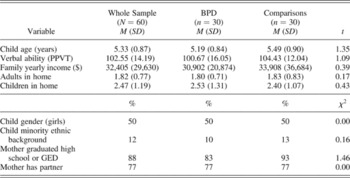
A low socioeconomic status (SES) sample consisted of a total of 60 children: 30 children whose mothers had BPD, and 30 children whose mothers did not. There were 15 boys and 15 girls in each group, and 12% of the sample had a minority ethnic background (8.5% Hispanic, 3.5% African American). Their average age was 5 years, 4 months (SD = 10 months, range = 4 years, 0 months to 6 years, 11 months). The two groups were matched on child age and child verbal ability. Groups were also matched on demographic variables: family income, presence of partners, number of adults and number of children in the home, and maternal education. See Table 1 for descriptive statistics and tests of group differences.
Child age, child verbal abilities, and demographic differences between the BPD and normative comparison groups

Note: BPD, borderline personality disorder; PPVT, Peabody Picture Vocabulary Test (Dunn & Dunn, Reference Dunn and Dunn1997).
Participants were recruited from a five-county region that included both urban and rural areas. Mothers with BPD were recruited from two sources: clinicians in mental health settings and directly from the community. The clinicians included therapists, psychiatrists, nurse practitioners, case managers and other professionals from local hospitals, community outpatient clinics, homeless shelters, professional organizations, and private practice. Clinicians were notified about the study through presentations on BPD, newsletters, and continuing education seminars. They were provided with brochures to hand to their clients. Mothers with BPD were also recruited directly from the community with flyers posted throughout the five-county region. These flyers listed questions about symptoms of BPD and invited those with children age 4–7 to apply. Questions included the following: “Do you fear abandonment in relationships? Do you find it difficult to control your anger? Are you very impulsive? Do your relationships have extreme ups and downs? Have you hurt yourself or threatened to do so?”
Comparison participants were also recruited from two sources: programs for children and directly from the community. Programs included preschools, Head Start and Boys' and Girls' Clubs. Comparison mothers were also recruited directly from the community with flyers. These flyers asked mothers if they had a child aged 4–7 and would like to take part in a study on parent–child interactions.
Procedures and measures
Overall
After a phone screen, two research assistants went to the participant's home or an alternative meeting place requested by the participant. Informed consent, maternal self-report of BPD symptoms, and demographic information were obtained at this initial visit. If eligible, the participant and her child were then invited to the university for one approximately 3-hr visit. Transportation and babysitting for siblings were provided. At this visit maternal psychopathology was assessed in a clinical interview, and the child was filmed completing stories begun for him or her by an examiner. Individuals who administered the clinical interview were different from those who administered the story-stem completions.
Psychiatric diagnoses
BPD
BPD was assessed first on the home visit with a preliminary self-report screen, which was followed up with the Structured Clinical Interview for the Diagnostic and Statistical Manual of Mental Disorders—Fourth Edition (DSM-IV; American Psychiatric Association, 1994) Axis II disorders (SCID-II; First, Gibbon, Spitzer, Williams, & Benjamin, Reference First, Gibbon, Spitzer, Williams and Benjamin1997).
Current MDD
MDD was also assessed as a control variable with SCID for DSM-IV Axis I disorders (SCID-I; First, Gibbon, Spitzer, & Williams, Reference First, Gibbon, Spitzer and Williams1996). MDD was only found in the BPD group, where 13% (n = 4) mothers currently had MDD.
Borderline features
Borderline features were assessed as part of a self-report measure that assesses psychopathology and personality traits, the Personality Assessment Inventory (PAI; Morey, Reference Morey1991). The PAI was designed to reflect the multifaceted nature of BPD as revealed in factor analytic studies and has shown high internal consistency in census, college, and clinical samples (Morey, Reference Morey1991). There are four subscales: affective instability, assessing intense and unmodulated emotional experiences especially anger; identity disturbance assessing confusion about identity and lack of an integrated sense of self; negative relationships assessing acute dependence, fear of abandonment and distrust; and self-harm, assessing impulsivity and tendencies to hurt the self when distressed characteristic of individuals with BPD. In the current sample, BPD diagnosis (yes/no) was significantly correlated with affective instability (r = .55, p < .001), identity disturbance (r = .56, p < .001), negative relationships (r = .43, p < .01), and self-harm (r = .59, p < .001).
Verbal ability
Because narrative creation may depend in part on the child's verbal ability, receptive language was assessed with the Peabody Picture Vocabulary Test, Third Edition (Dunn & Dunn, Reference Dunn and Dunn1997). Standard scores were calculated for each child.
Narrative story-stem completions
Each child was individually told the beginning of 10 stories, 1 at a time, with the examiner moving figures and props around as though in a play. The figures represented family members and a dog, and props included household items such as a table with dinnerware, a large rock, a bed, and a car. The ethnic background and gender of the child were matched with those of family figures. The examiner presented each story stem about a challenging family situation by moving the figures around and speaking for them with dramatic inflections. The child was then asked by the examiner to complete the stories in the same way: “Show me and tell me what happens now.” An initial story about a birthday party, not included in coding or analyses, was used to familiarize the child with the procedure. The narrative stems were always administered in the same order in a session lasting approximately 30 min. All sessions were filmed through a one-way mirror.
The child was asked to complete 10 story stems: 5 story stems designed to activate the attachment system, the attachment story completion task (ASCT; Bretherton, Ridgeway, et al., Reference Bretherton, Ridgeway, Cassidy, Greenberg, Cicchetti and Cummings1990) and 5 story stems taken from a larger set (which also includes the ASCT) designed in part to assess moral development, the MacArthur Story Stem Battery (Bretherton, Oppenheim, Buchsbaum, Emde, & The MacArthur Narrative Group, Reference Bretherton, Oppenheim, Buchsbaum and Emde1990).
The five ASCT story stems elicit responses concerning the attachment relationship in increasingly stressful situations: (a) parent as authority figure, in which a child spills his or her juice at dinner and mother disciplines him or her (Spilled Juice); (b) parent as comforter, in which a child falls off a rock and hurts his or her knee (Hurt Knee); (c) parent as protector, in which the child calls for his or her parents at night having seen a monster (Monster in the Bedroom); (d) separation of the child from his or her parents as the parents leave for a trip, leaving the children with grandma (Departure); and (e) reuniting of child and parents the next day (Reunion).
The five additional MacArthur Story Stem Battery story stems present further challenging situations: (f) parents fighting, in which parents argue over who lost Mom's keys (Lost Keys); (g) an injured child, where the child's hand is burnt when the child takes the pot off the stove to taste the gravy (Hot Gravy); (h) competition between children in which children fight over who gets to ride the toy horse (Horsie); (i) a lost dog, in which the family dog is lost and found (Barney); and (j) a child is left out as the parents send the child to his or her room to play so they can have some time alone, sit on the couch and kiss (Exclusion).
Narrative coding
Narrative emotion coding (Warren, Mantz-Simmons, & Emde, Reference Warren, Mantz-Simmons and Emde1993) was utilized to code role reversal and fear of abandonment. The Child Narrative Coding System (Bickham & Fiese, Reference Bickham and Fiese1999) was utilized to code mother–child and father–child expectations. The Narrative Coding Manual, Rochester Version (Robinson, Mantz-Simmons, Macfie, & The MacArthur Narrative Group, Reference Robinson, Mantz-Simmons and Macfie1996) was utilized for the remaining codes. Both child verbalizations and behavioral enactments were included in coding directly from film.
Caregiver–child relationship
Four codes were included: role reversal (e.g., child tells fighting parents to: “Stop that! Go to your room!”); fear of abandonment (a loss is resolved or attempted to be resolved immediately; e.g., when presented with the Departure story in which mother and father leave the children with grandma for a weekend to go on a trip, the participant insists that the parents change their mind and stay home or take the children with them instead); mother–child relationship expectations and father–child expectations. The parent–child expectation codes were coded on 5-point scales. A score of 1 reflects the parent–child relationship is almost always portrayed as dissatisfying, dangerous, and/or unpredictable, with serious and/or willful harm portrayed. A score of 5 reflects the parent–child relationship is consistently portrayed as safe, reliable, rewarding, and fulfilling, and the relationship provides opportunities for success and satisfaction. Intermediate scores were also given. Three codes were utilized for self-representations: negative child (e.g., child hits mom), incongruent child (e.g., child cleans up his room then trashes it), and shameful child (e.g., child says he is bad).
Emotion regulation
Five codes were included: reality/fantasy confusion (e.g., child participant fears that she has killed her parents in reality by killing them in the story), self/fantasy confusion (e.g., child participant confuses himself with the fantasy characters in his story and insists that he get a Band-Aid for the child figure, rather than have one of the story characters get it), fantasy proneness (e.g., the family floats up into the sky quite unrelated to the story at hand), intrusion of traumatic material (e.g., as mom and dad are arguing about who lost mom's car keys, a robber comes into the house and throws everyone into the ocean where they are eaten by alligators), and narrative coherence.
Narrative coherence is scored on a 10-point scale based on how well the child confronts the issue raised in the story and how well the child tells the story. A zero denotes failure to respond or “I don't know.” A score of 3 denotes that a child exhibits an understanding of the conflict but does not offer any resolution. A score of 5 denotes that a child exhibits an understanding of the conflict but handles it indirectly by offering an easier solution. A score of 7 denotes that child demonstrates understanding of the conflict, offers a coherent resolution without any story embellishment. A score of 10 denotes that a child exhibits a very logical, coherent, sequential series of events that demonstrate an understanding of and resolution to the conflict with a lot of embellishment. Intermediate scores are also given.
Scoring
Presence or absence of the above codes (except narrative coherence and mother–child and father–child relationship expectations) were scored once for each narrative and then summed across the ten narratives, giving a possible minimum of 0 and maximum of 10 for each code. Scores for narrative coherence, which were scored for each narrative, were averaged across the 10 narratives. Scores for mother–child and father–child relationship expectations were each scored once across all 10 narratives.
Composites
In addition to analyzing each code separately, maladaptive composites of the caregiver–child relationship, the self, and emotion regulation were calculated by standardizing each of the individual codes, then summing negatively valenced codes and subtracting positively valenced codes. For example, the maladaptive caregiver–child relationship composite consisted of role reversal plus fear of abandonment minus mother–child relationship expectations minus father–child relationship expectations.
Reliability
Narratives were coded by one of the MacArthur manual's authors. Reliability was established on 25% of the sample with a second coder with an additional 5% of the sample for low base-rate codes. Neither coder was involved in administering the narratives and neither knew the child's group status. Reliability was conducted at the level of each individual narrative rather than summing across narratives. Categorical codes were assessed with kappas to correct for chance agreement (Cohen, Reference Cohen1960): role reversal, κ = .67 (96% agreement); fear of abandonment, κ = .69 (96% agreement); negative child, κ = .76 (94% agreement); incongruent child, κ = .66 (98% agreement); shameful child, κ = .96 (99% agreement); reality/fantasy confusion, κ = .81 (98% agreement); self/fantasy boundary confusion, κ = .76 (98% agreement); fantasy proneness, κ = .79 (98% agreement); intrusion of traumatic material, κ = .61 (94% agreement). Continuous codes were assessed with intraclass correlation coefficients (Winer, Brown, & Michels, Reference Winer, Brown and Michels1991): mother–child relationship expectations, ri = .74; father–child relationship expectations, ri = .93; narrative coherence, ri = .81.
Results
Preliminary analyses
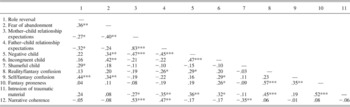
There were no significant group differences on child age, child verbal ability, or on demographic variables. See Table 3 for means, standard deviations, and tests of significance. We first conducted two-tailed Pearson bivariate correlations among the narrative variables in the sample as a whole. For caregiver–child representations, role reversal, fear of abandonment, mother–child and father–child relationship expectations were all significantly correlated with each other. For self-representations, negative and incongruent child were significantly correlated. For emotion regulation, fantasy proneness was significantly correlated both with reality/fantasy confusion and self/fantasy boundary confusion, and narrative coherence was significantly correlated with mother–and father–child relationship expectations and (negatively) with shameful child. See Table 2 for correlation coefficients for narrative variables.
Intercorrelations among narrative variables in the whole sample (N = 60)

* p < .05. **p < .01. ***p < .001.
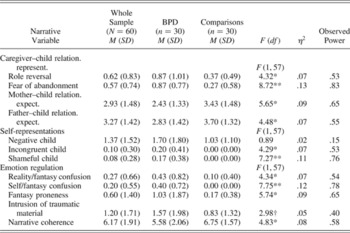
Group differences in narrative variables: Univariate F tests, effect size, and observed power

† p < .10. *p < .05. **p < .01.
Hypothesis testing
Prior to testing the first three hypotheses, we conducted three overall multivariate analyses of covariance (MANCOVAs) to assess the effect of maternal BPD on caregiver–child relationship representations, self-representations, and emotion regulation, controlling for maternal MDD. To examine the multivariate effects in more detail and to test each hypothesis, we conducted follow-up univariate analyses. In addition to p values, we report observed power and effect size (partial eta squared [η 2p], the equivalent of ΔR 2 from multiple regression models).
Hypothesis 1
To examine the effect of maternal BPD on caregiver–child relationship representations, we conducted a MANCOVA with maternal BPD status (BPD, no BPD) as the independent variable and MDD as the covariate. Dependent variables included role reversal, fear of abandonment, mother–child relationship expectations, and father–child relationship expectations. There was a significant overall main effect for BPD, Wilks' approximate F (4, 54) = 3.10, η 2p = .19, observed power = .78. Univariate F tests for the effect of BPD status revealed significant differences as hypothesized. Children whose mothers had BPD portrayed significantly more role reversal, more fear of abandonment, and more negative mother–child and father–child relationship expectations than did comparisons. See Table 3 for group means, univariate F tests, effect sizes, and observed power.
Hypothesis 2
To examine the effect of maternal BPD on self-representations, we conducted a MANCOVA with maternal BPD status (BPD, no BPD) as the independent variable and MDD as the covariate. Dependent variables included: negative child, incongruent child, and shameful child. There was a significant overall main effect for BPD, Wilks' approximate F (3, 55) = 4.65, p < .01, η 2p = .20, observed power = .87. Univariate F tests for the effect of BPD status revealed two out of three significant differences as hypothesized. Children whose mothers had BPD portrayed significantly more incongruent child and shameful child (but not negative child) representations than did comparisons. See Table 3 for group means, univariate F tests, effect sizes, and observed power.
Hypothesis 3
To examine the effect of maternal BPD on emotion regulation, we conducted a MANCOVA with maternal BPD status (BPD, no BPD) as the independent variable and MDD as the covariate. Dependent variables included reality/fantasy confusion, self/fantasy boundary confusion, fantasy proneness, intrusion of traumatic material, and narrative coherence. There was a significant overall effect for BPD, Wilks' approximate F (5, 53) = 3.76, p < .01, η 2p = .26, observed power = .91. Univariate F tests for BPD status revealed significant differences as hypothesized. Children whose mothers had BPD demonstrated more reality/fantasy confusion, more self/fantasy boundary confusion, more fantasy proneness, lower narrative coherence, and marginally more intrusion of traumatic material than did comparisons. See Table 3 for group means, univariate F tests, effect sizes, and observed power.
To test the remaining hypotheses, we conducted two-tailed Pearson bivariate correlations.
Hypothesis 4
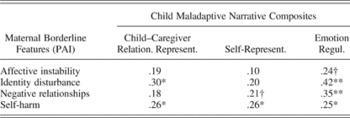
As hypothesized, the child's maladaptive child–caregiver relationship composite was significantly correlated with maternal identity disturbance and self-harm, but, contrary to hypothesis, not with maternal negative relationships.
Hypothesis 5
As hypothesized, the child's maladaptive self-composite was significantly correlated with maternal self-harm.
Hypothesis 6
As hypothesized, the child's emotion regulation composite was significantly correlated with maternal identity disturbance, negative relationships, and self-harm, and marginally significantly correlated with maternal affective instability. See Table 4 for correlation coefficients.
Correlations between child maladaptive narrative composites and maternal borderline features (PAI) in the sample as a whole (N = 60)

Note: PAI, Personality Assessment Inventory (Morey, 1991).
† p ≤ .10. *p < .05. **p < .01.
Discussion
We assessed representations of the caregiver–child relationship and of the self, and emotion regulation in children age 4–7 whose mothers have BPD versus normative comparisons using a narrative story-stem completion measure. The study extended developmental research on offspring of mothers with BPD from infancy to early childhood, from the level of sensorimotor functioning to the level of representation. Maladaptive representations and poor emotion regulation may increase a child's own likelihood of developing BPD in early adulthood.
Findings suggest problems for the children whose mothers have BPD, controlling for maternal MDD. First, children whose mothers have BPD told stories in which the caregiver–child relationship was characterized by more role reversal, more fear of abandonment, and more negative mother–child and father–child relationship expectations. Second, children whose mothers have BPD told stories in which the child's self was represented as more incongruent and shameful. Contrary to hypothesis, representations of the self were not more negative, however. Negative representations have been associated with the experience of maltreatment (Toth, Cicchetti, Macfie, & Emde, Reference Toth, Cicchetti, Macfie and Emde1997; Toth, Cicchetti, Macfie, Maughan, et al., Reference Toth, Cicchetti, Macfie, Maughan and VanMeenen2000). Although many adults with BPD report having been maltreated themselves (Zanarini, Reference Zanarini2000) not all will maltreat their own children (Egeland, Jacobvitz, & Sroufe, Reference Egeland, Jacobvitz and Sroufe1988). Third, children whose mothers have BPD demonstrated impaired emotion regulation. They were less able to maintain a distinction between fantasy and reality and between self and fantasy, more likely to veer away from the issue presented into fantasy proneness, were less coherent, and were marginally more likely to bring intrusive traumatic themes into their stories.
Fourth, in the sample as a whole, maladaptive composites of the child's caregiver–child relationship representations, the child's self-representations and the child's emotion regulation were each significantly correlated with maternal borderline features. Specifically, the child's maladaptive caregiver–child relationship composite was associated with his or her mother's confusion about her identity and her self-harming behaviors. Moreover, a child's maladaptive self-composite was also associated with his or her mother's self-harming behaviors. Furthermore, a child's maladaptive emotion regulation composite was associated with his or her mother's confusion about her identity, negative relationships, self-harming behavior, and was marginally significantly associated with affective instability.
Putative precursors to BPD
Do results suggest that young children whose mothers have BPD are at risk of developing BPD themselves in early adulthood? Not all or even most children of mothers with BPD will develop BPD. Indeed, only 11.5% of first-degree relatives of individuals with BPD also have BPD (Nigg & Goldsmith, Reference Nigg and Goldsmith1994). However, exposure to risk factors associated with BPD: a vulnerable temperament, and failure at tasks of attachment, self-development, and emotion regulation may increase the likelihood of developing BPD.
Adults with BPD do not report histories of being in treatment as children (Zanarini, Frankenburg, Khera, & Bleichmar, Reference Zanarini, Frankenburg, Khera and Bleichmar2001), so it is important to examine possible precursors to BPD that do not necessarily imply psychopathology in childhood but may develop into psychopathology in early adulthood. Heterotypic continuity may underlie development such that the same construct may look dissimilar in different developmental periods but carry the same meaning from the past into the present via internal working models (Carlson et al., Reference Carlson, Sroufe and Egeland2004).
Thus, a young child who demonstrates fear of abandonment in his or her narratives may grow up to demonstrate the same fear of abandonment as a young adult in relationships. This same young adult may still cling to transitional objects such as teddy bears on arrival at the hospital diagnosed with BPD (Gunderson, Reference Gunderson2001). In addition, a young child who demonstrates negative expectations of both mother–child and father–child relationships in his or her narratives may carry both anger and mistrust about others into new relationships and later develop intense, unstable relationships marked by inappropriate angry outbursts as an adult. Furthermore, a young child who demonstrates a shameful and incongruent self in his or her narratives may grow up to use self-injurious behavior as a way to temporarily relieve feelings of shame and create a unified sense of self (Yates, Reference Yates2004). Moreover, a young child who demonstrates poor emotion regulation in his or her narratives may grow up to experience the same inability to draw upon an internalized self-soothing process as a young adult in times of emotional distress (Adler & Buie, Reference Adler and Buie1979) and turn instead to drugs, alcohol, or food to soothe the self (Bradley & Westen, Reference Bradley and Westen2005).
Findings also include associations between maternal borderline features and maladaptive narrative composites. Importantly, a mother's self-harming behavior was associated with her child's maladaptive relationship, self, and emotion regulation composites. This is particularly significant because pathways to self-harming behavior are thought to include failure to experience relationships as reliable or rewarding, the self to be worthy of care, and failure to modulate emotion and arousal. Failure with stage-salient issues of attachment, self, and self-regulation may then lead to the development of compensatory maladaptive strategies including self-harm to find a way to continue to address future stage-salient issues in adolescence (Yates, Reference Yates2004). Children whose mothers have BPD may therefore be at high risk of developing self-harming behaviors in early adulthood.
Emotion regulation, dissociation, and disorganized attachment
Problems with emotion regulation found in the current study overlap with those reflecting dissociation in maltreated children (Macfie et al., Reference Macfie, Cicchetti and Toth2001). Dissociation, which refers to disruptions in the normal integration of memories, perception, and identity, is a symptom of BPD (American Psychiatric Association, 1994). Dissociation has been conceptualized as a failure of information processing in the face of trauma, a breakdown in emotion regulation because of flooding of the sympathetic nervous system with stress hormones and neurotransmitters (Bower & Sivers, Reference Bower and Sivers1998). One pathway to dissociation is from disorganized attachment (Carlson, Reference Carlson1998; Ogawa, Sroufe, Weinfield, Carlson, & Egeland, Reference Ogawa, Sroufe, Weinfield, Carlson and Egeland1997), and most infants whose mothers have BPD are classified as disorganized (Hobson et al., Reference Hobson, Patrick, Crandell, Garcia-Perez and Lee2005). Moreover, children disorganized as infants become more vulnerable to posttraumatic stress disorder in childhood (MacDonald et al., Reference MacDonald, Beeghly, Grant-Knight, Augustyn, Woods and Cabral2008). This difficulty with emotion regulation in the face of stress may also have implications for the development of BPD. Indeed, dissociation mediates the relationship between the experience of childhood sexual abuse and self-harming behavior in adults (Yates, Carlson, & Egeland, Reference Yates, Carlson and Egeland2008). Furthermore, children whose mothers have BPD may be at risk of sexual abuse because many women with BPD report sexual abuse as children (Zanarini et al., Reference Zanarini, Williams, Lewis, Reich, Vera and Marino1997).
There are three known pathways to disorganized attachment: the experience of maltreatment (Carlson, Cicchetti, Barnett, & Braunwald, Reference Carlson, Cicchetti, Barnett, Braunwald, Cicchetti and Carlson1989), mothers' unresolved experience of loss or trauma (Main & Hesse, Reference Main, Hesse, Greenberg, Cicchetti and Cummings1990), and mothers' disrupted affective communication that stems from hostile/helpless states of mind (Lyons-Ruth, Bronfman, & Atwood, Reference Lyons-Ruth, Bronfman, Atwood, Solomon and George1999; Lyons-Ruth, Melnick, Patrick, & Hobson, Reference Lyons-Ruth, Melnick, Patrick and Hobson2007; Lyons-Ruth, Yellin, Melnick, & Atwood, Reference Lyons-Ruth, Yellin, Melnick and Atwood2005). Each pathway may be relevant for infants whose mothers have BPD. Disorganized attachment is associated with negative expectations of others, a negative sense of self, and disrupted emotion regulation. Thus, disorganized attachment may be a necessary but not sufficient precursor for the development of BPD, an inability to handle stress underlying both, leading to faulty emotion regulation including self-harming behavior.
Preventive interventions
Given the size of the public health problem presented by BPD, research to inform prevention is warranted. In addition to being responsible for chronically high levels of individual distress, individuals with BPD impose a severe burden on the health care system. Individuals with BPD utilize mental health services at higher rates than does any diagnostic group other than schizophrenia (Swartz et al., Reference Swartz, Blazer, George and Winfield1990). Seventy to 90% of individuals with BPD repeatedly attempt suicide or make suicidal gestures (Gunderson & Ridolfi, Reference Gunderson and Ridolfi2001; Linehan & Heard, Reference Linehan, Heard, Miller and Magruder1999), which involve intensive utilization of mental health services (Roy, Reference Roy2001). Although great strides have been made in treatment (Bateman & Fonagy, Reference Bateman and Fonagy1999, Reference Bateman and Fonagy2001, Reference Bateman and Fonagy2008; Gunderson, Reference Gunderson2001; Levy et al., Reference Levy, Meehan, Kelly, Reynoso, Weber and Clarkin2006; Linehan, Reference Linehan1993), BPD remains a disorder from which many mental health practitioners recoil. More needs to be known about the development of BPD to inform preventive interventions. Results of the current study suggest the importance of interventions with children whose mothers have BPD: interventions that are designed to alter representational models of the caregiver–child relationship and of the self, and improve emotion regulation.
Dyadic child–parent psychotherapy (Fraiberg, Adelson, & Shapiro, Reference Fraiberg, Adelson and Shapiro1975; Lieberman, Reference Lieberman1992) is an attachment-based therapy that has been successful in altering representational models. A mother and her young child (infant, toddler, or preschooler) meet together with the therapist. The mother feels understood by the therapist and learns more about her own and her child's feelings, beliefs, and needs, so that the mother–child relationship becomes a greater source of security to the child. Indeed, child–parent psychotherapy leads to an increase in attachment security in depressed mother–toddler pairs (Cicchetti et al., Reference Cicchetti, Toth and Rogosch1999; Toth et al., Reference Toth, Rogosch, Manly and Cicchetti2006) and an increase in positive, and a decrease in negative, representations in maltreated children's stories (Toth et al., Reference Toth, Maughan, Manly, Spagnola and Cicchetti2002). Both a mother with BPD and her child may benefit, and development for both may return to a more adaptive pathway. Dyadic therapy may also help mother and child construct a narrative that is coherent about traumatic experiences, the coherence both reflecting and contributing to emotion regulation skills (Oppenheim, Nir, et al., Reference Oppenheim, Nir, Warren and Emde1997). Interestingly, an attachment-based intervention that focuses on the caregiver of children in foster care has been shown to improve the child's ability to cope with stress at the level of cortisol in the hypothalamus–pituitary–adrenal axis (Dozier, Peloso, Lewis, Laurenceau, & Levine, Reference Dozier, Peloso, Lewis, Laurenceau and Levine2008). Moreover, attachment mediated the relationship between maternal symptoms of depression and narrative representations (Toth et al., Reference Toth, Rogosch, Sturge-Apple and Cicchetti2009). Interventions designed to improve attachment in the caregiver–child relationship may be warranted for young children whose mothers have BPD.
Strengths and Limitations
The study's strengths include filmed and reliably coded observational data of children rather than relying on adult observer report measures. Moreover, larger numbers of children were sampled in the same developmental period compared with previous studies of children whose mothers have BPD. Furthermore, in addition to categorical diagnoses of BPD assessed in a clinical interview, continua of borderline features were assessed in a self-report measure. Categorical diagnoses are meaningful to clinicians, whereas symptoms on a continuum have more statistical power and they can be assessed for all participants. In addition, because mothers with BPD were recruited both from clinician referrals and directly from the community, the sample has greater generalizability to the population as a whole than it would if referred solely from women in treatment. Furthermore, mothers were recruited from low SES backgrounds. Because BPD is more often found in individuals from low SES backgrounds, this also increases generalizability to the population as a whole (Cohen et al., Reference Cohen, Chen, Gordon, Johnson, Brook and Kasen2008; Grant et al., Reference Grant, Chou, Goldstein, Huang, Stinson and Saha2008).
Limitations of the current study include the fact that risk factors for the development of BPD such as the experience of maltreatment, loss of caregiver, and temperamental factors were not assessed. Also, MDD was controlled for statistically. It would be better to have a second comparison group of depressed mothers and their children in addition to a normative comparison group.
Conclusion
A developmental psychopathology perspective makes it possible to study development in an at-risk sample and learn more about not only psychopathology but also about normal development. Children whose mothers have BPD shed light on representational development and the development of emotion regulation in all children. Moreover, the usefulness of the narrative story-stem completion measure is extended to offspring of women diagnosed with BPD. Finally, following these children over time will help us to better understand problems with early stage-salient issues of attachment, self-development and emotion regulation, and under what circumstances such problems lead to BPD.