Introduction
Based on 2005 cancer statistics, head and neck cancer is the fifth most common cancer worldwide, with an estimated global incidence of 644 000 cases per year.Reference Jemal, Murray, Ward, Samuels, Tiwari and Ghafoor1 In Europe, the annual incidence of new head and neck cancer cases is 76 000.Reference Saunders and Rojas2 More than 90 per cent of head and neck cancers are squamous cell carcinomas (SCCs), mainly originating in the larynx, pharynx and oral cavity.
Over the past decade, the incidence of cancer at the base of the tongue and the tonsils has increased especially in younger patients.Reference Shiboski, Schmidt and Jordan3 Besides alcohol and tobacco, various DNA types of human papilloma virus have changed the risk profile, and have recently emerged as an important aetiological factor for oral carcinogenesis.Reference Watts, Brewer and Fry4 In the USA, the data registries of the Surveillance, Epidemiology, and End Results Program and the National Cancer Data Base have been useful for evaluating these changes.
At the time of diagnosis, more than 50 per cent of all head and neck SCC cases present with advanced stage III or IV disease, and 15 per cent are already inoperable.Reference Dimery and Hong5 Until recently, various studies had reported five-year survival rates of less than 30 per cent for patients with stage IVA/B tumours, and of 40 per cent for patients with locally advanced stages.Reference Vokes, Weichselbaum, Lippman and Hong6–Reference Carvalho, Nishimoto, Califano and Kowalski8
In the past, surgery represented the accepted standard of care for the curative management of advanced head and neck SCC, followed by adjuvant radiotherapy in cases with advanced tumour (T) stages or positive lymph nodes. Laser surgery has helped to facilitate organ and function preservation, even though overall survival rates have hardly improved significantly.
However, the past three decades have witnessed a change in the treatment of head and neck SCC, with increased use of non-operative treatment modalities and a corresponding decrease in the use of primary surgery.Reference Gourin and Johnson9 Many authors attribute this trend to the publication of a randomised, controlled, clinical trial by the US Veterans Affairs Laryngeal Cancer Study Group.10 This landmark study launched the sequential combination of induction chemotherapy followed by either irradiation or surgery, and demonstrated that organ preservation can be obtained in patients with advanced laryngeal cancer by the use of chemoradiotherapy (CRT), without reducing survival; these patients would otherwise have undergone total laryngectomy. This study has had a major impact on clinical practice, and the use of CRT has increased for all head and neck SCC patients.Reference Gourin and Johnson9, Reference Wong and Shah11 Nowadays, CRT is widely accepted as a primary treatment option for advanced head and neck SCC, in an attempt to achieve organ preservation.
However, a review of laryngeal cancer data from the US National Cancer Data Base, published in 2006 by Hoffman and co-workers, indicated that this uncritical approach requires serious scrutiny and re-analysis.Reference Hoffman, Porter, Karnell, Cooper, Weber and Langer12 These data revealed a decrease in laryngeal cancer patient survival in the years immediately preceding the study, coinciding with an observed trend towards increased use of non-operative treatment modalities, which was not due to an increased incidence in advanced-stage disease. Thus, the legitimate role of surgery in the management of head and neck SCC needs to be re-evaluated.
The current paper presents a contemporary review of the literature based on the essential practice guidelines set out by the US National Comprehensive Cancer Network, which suggest an evidenced-based treatment algorithm for the management of early- and advanced-stage head and neck SCC.13
Practice guidelines of the National Comprehensive Cancer Network
According to the National Comprehensive Cancer Network guidelines, early-stage head and neck SCC (i.e. stages I and II) is best treated by one modality alone: either surgery or radiotherapy.13, Reference Sassler, Esclamado and Wolf14 Surgery has the advantages of: (1) providing the treatment team with a precise tumour histology; (2) achieving effective local tumour control, even if there is possible compromise in function and aesthetics; and (3) avoiding irradiation in cases with recurrence.Reference Gourin and Johnson9, Reference Wong and Shah11 Primary radiotherapy might be equally effective, especially in early-stage laryngeal tumours. However, the surgeon must seriously consider the risk of long-lasting side effects such as xerostomia, dysgeusia, tissue fibrosis and osteoradionecrosis.
For more advanced head and neck SCC (i.e. stages III and IV) with regional spread or aggressive growth, a combination of surgery and CRT is recommended. Such multimodality treatment is nowadays considered the accepted standard of care for advanced-stage head and neck SCC.13 The impact of surgery on organ function is related to the tumour size and the primary tumour site; some cases require reconstruction after extensive resection. The surgeon's decision of whether to pursue primary surgery (with or without reconstruction) followed by CRT, versus induction CRT with the option of salvage surgery for treatment failures, remains controversial, and depends on many factors such as resectability, local expertise, goals of organ preservation and patient preference.Reference Gourin and Johnson9 Various studies have reported poor outcomes for salvage surgery undertaken following the failure of primary concomitant CRT, with complications including wound breakdown or necrosis, mucocutaneous fistula, and dysphagia.Reference Sassler, Esclamado and Wolf14
However, a review of the literature suggests that, even in the current era of organ preservation, surgery plays an essential part in multimodality treatment. It enables (1) significantly better local tumour control, (2) rehabilitation of function after surgical reconstruction, and (3) reduced CRT toxicity even in cases of tumour debulking.Reference Gourin and Johnson9 In contrast, although concomitant CRT might have the advantage of better long-term control, this comes at the cost of early and late toxicity.
Oral cavity and oropharynx
Early stage (I and II)
In most centres, primary surgery remains the accepted standard of care for most patients with cancer of the oral cavity or oropharynx.
In 2007, a large, retrospective study of the outcome of surgery in oral cavity cancer patients was published in Finland by Mäkitie et al. Reference Mäkitie, Koivunen, HarriKeski-Säntti, Törnwall, Pukkila and Laranne15 Between 1995 and 1999, these authors analysed data on 235 patients, including results from a five-year follow-up period. In their literature review, these authors concluded that, especially in early-stage disease, surgery remained the standard treatment, providing the treatment team with precise histological information including depth of tumour infiltration.Reference Sessions, Spector, Lenox, Haughey, Chao and Marks16, Reference Wolfensberger, Zbaeren, Dulguerov, Müller, Arnoiux and Schmid17
Similar surgical results have been described by Walvekar et al. for oropharyngeal cancer treated with primary surgery, namely, a general local control rate of 88 per cent and a five-year overall survival rate of 83 per cent.Reference Walvekar, Li, Gooding, Gibson, Heron and Johnson18 The number of failures depended on local and regional metastasis at the time of diagnosis.
According to the National Comprehensive Cancer Network guidelines, early-stage oropharyngeal cancer can be treated with equal efficacy by single treatment alone – either primary surgery or radiotherapy – with adjuvant radiation therapy reserved for advanced pathological features such as loco-regional failure, nodal involvement, second primary tumours or perineural invasion.
O'Hara and McKenzie assessed surgical versus non-surgical procedures in the treatment of early-stage oropharyngeal cancer.Reference O'Hara and MacKenzie19 Bearing in mind the shift towards primary chemoradiation, these authors aimed to determine whether surgery was still indicated for early-stage oropharyngeal disease. In their study, the surgery group had a five-year overall survival rate of 60 per cent and a disease-specific survival rate of 69 per cent, whereas the primary radiotherapy group had a five-year overall survival rate of 50 per cent and a disease-specific survival rate of 60 per cent. Even though there was no statistically significant difference in disease-specific survival between the surgery and radiotherapy groups, the authors regarded primary surgery as a more favourable option in early-stage, node stage (N) 0 cases which could be treated by a single modality therapy.
As Gourin and Johnson have pointed out, the main drawback of primary surgery is post-operative morbidity with regard to speech and swallowing; however, such surgery has the advantage of avoiding radiation and CRT, and of permitting reduced radiation doses in the post-operative setting.Reference Gourin and Johnson9
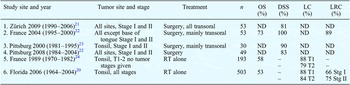
Table I summarises published findings on surgical and non-surgical outcomes for early-stage oropharyngeal disease.Reference Mendenhall, Morris, Amdur, Hinerman, Malyapa and Werning20, Reference Cosmidis, Rame and Dassonville22, Reference Lusinchi, Wibault, Marandas, Kunkler and Eschwege24–Reference Liao, Chang, Wang, Ng, Hsueh and Lee28 Primary external radiation or brachytherapy has not been recommended as the treatment of choice for early oral cavity carcinoma, as it usually causes long-term morbidity and carries the risk of major side effects such as lifelong xerostomia, temporary or permanent dysgeusia, advanced dental caries, soft tissue fibrosis, and osteoradionecrosis.Reference Palme, Gullane and Gilbert25 Moreover, in most cases radiotherapy can be offered only once at radical therapeutic doses of 66–72 Gy, and significant functional morbidity may also occur because of acute and late toxicity associated with radiotherapy or CRT.Reference Walvekar, Li, Gooding, Gibson, Heron and Johnson18
Overview of recent studies on the surgical (1–4) and non-surgical (5–6) outcome of early-staged oropharyngeal cancer.

OS (%): 5-years overall survival rate, DSS (%): disease-specific survival rate, LC: local control rate, LCR: locoregional control rate, ND: no data, RT: radiotherapy, Stg: stage
Advanced stage (III and IV)
In patients with more advanced tumour stages (i.e. T3 or T4 plus N0, or any T stage plus N+), the five-year overall survival rate varies between 30 and 60 per cent. In patients with distant metastasis, the five-year survival rate drops to 5 to 10 per cent.Reference Marur and Forastiere26 In general, surgery should be considered to be the accepted standard of care for advanced oral cancer, with concurrent CRT.Reference Cooper, Pajak, Forastiere, Jacobs, Campbell and Saxman27 The risk of occult cervical metastasis increases at advanced tumour stages. Therefore, the patient requires not only local tumour resection but also elective neck dissection for occult cervical lymph node metastasis. In a multimodality treatment setting, surgery is highly effective in achieving loco-regional control compared with CRT alone, which might be able to control distant metastasis but has worse outcomes as regards local control, and which does not necessarily reduce the incidence of severe dysphagia in patients with oropharyngeal cancer.Reference Liao, Chang, Wang, Ng, Hsueh and Lee28, Reference Udoff, Elam and Gourin29 Bernier et al. have suggested that the use of combined CRT after surgery offers improved progression-free survival and reduced loco-regional relapses, compared with adjuvant radiation alone.Reference Bernier, Domenge, Ozsahin, Matuszewska, Lefèbvre and Greiner30 It is important to consider that the risk of early and/or late toxicity is greater for patients receiving radiation doses of 70 Gy or more as their primary CRT regimen, compared with an adjuvant CRT regimen with a radiation dose of 60 Gy.
Hypopharynx
Early stage (I and II)
Hypopharyngeal cancer is associated with the poorest survival of all head and neck cancers, as tumours in this region generally remain silent until the disease has reached an advanced stage. At the time of diagnosis, neck metastasis is seen in more than 65 per cent of patients, and more than 75 per cent present at a locally advanced stage. Occult nodal disease is generally present in 30–40 per cent.Reference Carvalho, Nishimoto, Califano and Kowalski8, Reference Marur and Forastiere26, Reference Lang, Wollenberg, Dellian, Steuer-Vogt, Schwenzer and Sautier31 Patients with early-stage disease (i.e. T1–T2 and N0–N1) have a five-year overall survival rate of 70–90 per cent.Reference Marur and Forastiere26, Reference Steiner, Ambrosch, Hess and Kron32
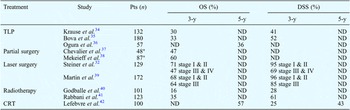
In 2010, members of the International Head and Neck Scientific Group published a study on recent trends in the management of hypopharyngeal cancer.Reference Takes, Strojan, Silver, Bradley, Haigentz and Wolf33 Although emphasis has shifted to non-surgical treatments over the past few years, surgical procedures still play a key role in hypopharyngeal cancer therapy, not only as an option for initial treatment but also for salvage, tumour surveillance, and management of complications and functional impairment. As indicated by our literature review (see Table II) and recommended by the National Comprehensive Cancer Network guidelines, early stage I or II hypopharyngeal disease can be treated either with surgery or with radiation therapy.13, Reference Kraus, Zelefsky, Brock, Huo, Harrison and Shah34–Reference Wei43 Regarding perilymphatic invasion and angioinvasion, surgery has the advantages of providing exact histological information and assisting the decision on whether adjuvant treatment is necessary or not.Reference Gourin and Johnson9 Local control rates for early-stage disease range from 77 to 89 per cent, with five-year disease-specific survival rates of up to 69 per cent.Reference Kraus, Zelefsky, Brock, Huo, Harrison and Shah34, Reference Hoffman, Karnell, Shah, Ariyan, Brown and Fee44–Reference Gourin and Terris46 Gourin and Terris have advocated surgery as a primary treatment option in early-stage hypopharyngeal cancer as second primary tumours are seen in 10 per cent of cases, often necessitating non-operative treatment which cannot be used if applied initially as primary therapy.Reference Gourin and Terris46
Treatment outcomes for hypopharyngeal cancer: recent studies

*Tumour stage I and II. Pts = patients; OS = overall survival; DSS = disease-free survival; y = year; TLP = total laryngopharyngectomy; ND = no data; CRT = chemoradiotherapy
Advanced stage (III and IV)
Patients with advanced hypopharyngeal cancer have the poorest survival of all head and neck SCC patients, and advanced hypopharyngeal disease is associated with a high incidence of medical comorbidity and poor nutrition.Reference Marur and Forastiere26, Reference Takes, Strojan, Silver, Bradley, Haigentz and Wolf33 In the literature, the reported five-year overall survival rate for T2 to T4 disease plus any N stage varies between 15 and 30 per cent.Reference Marur and Forastiere26, Reference Godballe, Jørgensen, Hansen and Bastholt40 The poor survival of hypopharyngeal cancer patients is attributed to their late presentation with usually advanced disease, but is also due to the disease's higher affinity for regional lymph node metastasis.
In the 1970s and 1980s, the accepted standard of care for advanced hypopharyngeal carcinoma was radical resection and reconstruction followed by post-operative radiotherapy.Reference Arriagada, Eschwege, Cachin and Richard47, Reference Mirimanoff, Wang and Doppke48 Overall survival rates reported from different centres worldwide ranged from 20 to 48 per cent.Reference Hoffman, Karnell, Shah, Ariyan, Brown and Fee44 In recent years, organ preservation programmes (including sequential or concomitant chemoradiation) have had a major impact on the treatment of hypopharyngeal carcinoma.13 Various studies have shown that, with chemoradiation, laryngeal preservation is feasible.Reference Zelefsky, Kraus, Pfister, Raben, Shah and Strong49 In patients who responded to chemotherapy and who were given post-operative radiotherapy, 60 per cent had their larynx preserved.Reference Adelstein, Saxton, Lavertu, Tuason, Wood and Wanamaker50 However, as stated by Wei, a laryngeal preservation protocol is only applicable when the patient responds to chemotherapy and completes the entire treatment regimen.Reference Wei43 In hypopharyngeal cancer patients for whom organ preservation fails, salvage surgery is associated not only with an increased complication rate and low success rate, but also with an extremely low chance of larynx preservation.
When considering the issue of organ preservation, one should especially bear in mind the findings of the only randomised, prospective, phase III trial to investigate the role of CRT in hypopharyngeal cancer, which was conducted by the Head and Neck Cancer Cooperative Group of the European Organization for Research and Treatment of Cancer.Reference Lefebvre, Chevalier, Luboinski, Kirkpatrick, Collette and Sahmoud42 In this study, patients with T2–T4 disease who required total laryngectomy were randomised to receive either induction chemotherapy followed by definitive radiotherapy, or surgery followed by post-operative radiotherapy. The study found no significant difference between the CRT arm and the surgery–radiotherapy arm in regard to local or regional recurrence or five-year disease-free survival. The larynx preservation rate at five years was low, with only 17 per cent of patients treated with CRT alive and laryngectomy-free.
A critical issue is the fact that the terms ‘organ preservation’ and ‘larynx preservation’ are not always defined clearly. Organ preservation should not be confused with function preservation. In hypopharyngeal cancer, function includes both voice and swallowing. According to Takes et al., function may even be better preserved after removal of the larynx, as this facilitates aspiration-free deglutition and the use of a prosthetic voice, rather than leaving intact a functionless, ‘frozen’ larynx.Reference Takes, Strojan, Silver, Bradley, Haigentz and Wolf33 Samant et al. reported that up to 30 per cent of their patients with pyriform sinus carcinoma were unable to swallow after the completion of aggressive CRT.Reference Samant, Kumar, Wan, Hanchett, Vieira and Murry51
Another important concern regarding concomitant CRT is toxicity.Reference Lee, Ho, Hsiao, Hwang, Lee and Hung52 Adelstein et al. reported a 74 per cent incidence of moderate to severe acute toxicity in patients receiving combined modality treatment, with a higher incidence of acute grade 3 and 4 toxicity, significant mucositis, and myelosuppression.Reference Adelstein, Saxton, Lavertu, Tuason, Wood and Wanamaker50, Reference Lee, Ho, Hsiao, Hwang, Lee and Hung52 In contrast, Pearson et al. have demonstrated that surgical reconstruction, even after extensive resection involving total laryngopharyngectomy, enables the restoration of solid or soft diet in over 90 per cent of patients.Reference Pearson, DeSanto, Olsen and Salassa53
Larynx
Early stage (I and II)
Laryngeal cancer at the glottis has a different metastatic behaviour from cancer affecting the supraglottis, oral cavity and pharynx. Glottic cancer is well differentiated, grows slowly and metastasises late. This is due to the limited lymphatic drainage of the true vocal folds. Whereas supraglottic cancer has a metastasis prevalence of up to 50 per cent in neck levels II to IV, glottic cancer has a metastasis rate of only 10 per cent.Reference Marur and Forastiere26
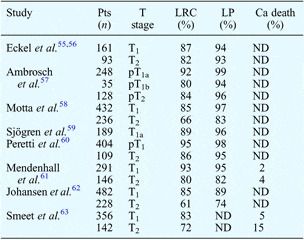
Early stage (i.e. I or II) laryngeal cancer responds well to either surgery or radiation alone, with similar functional and oncological outcomes.13 Surgical techniques for supraglottic and glottic cancer comprise partial laryngectomy or minimally invasive laser surgery. Published results indicate that surgery can obtain local tumour control in 82–100 per cent of patients, with larynx preservation in 87–100 per cent of those. Following primary radiation therapy, local tumour control rates of 61–93 per cent and larynx preservation rates of 73–98 per cent have been reported.Reference Ambrosch and Fazal54 Tumour control and overall survival tend to be significantly better after surgery than after radiotherapy; however, voice rehabilitation is reported to be better after radiation (Table III).Reference Eckel55–Reference Smee, Meagher, Williams, Broadley and Bridger63
Treatment outcomes for early-stage glottic cancer: recent studies

Pts = patients; T = tumour; LRC = loco-regional control; LP = larynx preservation; Ca death = cancer-related death; ND = no data; p = pathologically determined
Advanced stage (III and IV)
Over the past few decades, the treatment regimens for pharyngeal and laryngeal cancer have shifted from traditional, radical surgery to less destructive, larynx-preserving surgery.13 The latter approach was notably launched by a landmark study from the US Veterans Affairs Laryngeal Cancer Study Group.10 This randomised, controlled, clinical trial demonstrated that, in patients with advanced laryngeal cancer (who would otherwise have undergone total laryngectomy and post-operative radiotherapy), organ preservation with CRT could be performed without reducing survival. The authors emphasised that the rate of larynx preservation was much higher in the chemoradiation arm (64 per cent) than in the surgery arm. The local recurrence rate was worse in patients receiving CRT compared with those receiving surgery plus radiotherapy, but the distant recurrence rate was much better.
In 2003, another landmark study, involving 547 patients, was published by Forastiere et al. of the Radiation Therapy Oncology Group.Reference Forastiere, Goepfert, Maor, Pajak, Weber and Morrison64 This three-armed treatment study evaluated the effect of (1) concurrent CRT, versus (2) induction chemotherapy followed by radiotherapy, versus (3) radiotherapy alone, as regards organ preservation in advanced laryngeal cancer. Two years after treatment, larynx preservation was best in the concurrent CRT group (88 per cent), compared with 75 per cent in the induction chemotherapy plus radiation group and 70 per cent in the radiotherapy group. Similar results were obtained for local control rates. Based on the results of trial 91-11 of the Radiation Therapy Oncology Group, induction CRT regimes were replaced by concurrent CRT regimes, and became a widely accepted primary treatment regime for advanced head and neck SCC.Reference Weber, Berkey, Forastiere, Cooper, Maor and Goepfert65
However, according to the 2006 American Society of Clinical Oncology clinical practice guidelines, this larynx-preservation approach is only appropriate for advanced T3 and T4 cancers without tumour invasion into the cartilage or adjacent soft tissue structures.Reference Pfister, Laurie, Weinstein, Mendenhall, Adelstein and Ang66 Special expertise and multidisciplinary team input (including head and neck surgeons) are necessary to estimate the likely advantages and disadvantages of larynx-preservation options.Reference Wong and Shah11, 13, Reference Wei43, Reference Pfister, Laurie, Weinstein, Mendenhall, Adelstein and Ang66
Furthermore, non-surgical treatment regimes increase the rate of early and late toxicity. Totti et al. demonstrated that, in patients receiving CRT for head and neck cancer, mucositis was an inevitable and severe form of acute toxicity, with consecutive weight loss causing substantial morbidity and necessitating hospitalisation for feeding tube placement and intensive supportive care.Reference Trotti, Bellm, Epstein, Frame, Fuchs and Gwede67 The mere presence of a preserved larynx after non-surgical treatment does not always ensure laryngeal function. Machtay and co-workers rightly emphasised that exposure to chemotherapeutic agents and radiation produces many co-factors for severe late toxicity, depending on patient age, tumour stage and tumour site.Reference Machtay, Moughan, Trotti, Garden, Weber and Cooper68 Their study analysed a subset of three previously reported Radiation Therapy Oncology Group trials of concurrent CRT for locally advanced head and neck SCC, with special emphasis on severe late toxicity effects. Typical radiation-related toxic effects were xerostomia, osteoradionecrosis and continued speech disturbance, with post-treatment oedema and fibrosis resulting in dysphagia and hoarseness. The most common chemotherapy-related toxic effects were ototoxicity, nephrotoxicity, neurotoxicity and lung fibrosis, necessitating prolonged hospitalisation.Reference Trotti, Bellm, Epstein, Frame, Fuchs and Gwede67, Reference Machtay, Moughan, Trotti, Garden, Weber and Cooper68
Conclusion
There is a definite need to apply more rigorous standards to the use of organ preservation strategies for head and neck SCC treatment, and to re-evaluate the role of surgery. Despite the increasing popularity of non-surgical treatment regimes, primary surgery plays an important role in head and neck SCC therapy. The surgeon remains a key figure in the multidisciplinary team, along with the radiation oncologist, the medical oncologist and the speech and swallowing therapist. Even when non-operative treatment is successful, the risk of early and late toxicity (including laryngeal dysfunction and ‘frozen larynx’) must be taken into serious consideration. When non-operative organ preservation approaches fail, salvage surgery is often associated with increased complications and reduced survival.