


Data from the 2007–2008 National Health and Nutrition Examination Survey (NHANES) showed that the prevalence of overweight/obesity for US young adult males and females 20–39 years of age was 63·5 % and 59·5 %, respectively(Reference Flegal, Carroll and Ogden1). In the same survey, the prevalence of obesity for young adult males and females was 27·5 % and 34·0 %, respectively(Reference Flegal, Carroll and Ogden1). The prevalence of the metabolic syndrome (MetS) for US young adult males and females was 20·3 % and 15·6 %, respectively, in the years 2003–2006(Reference Ervin2). These statistics are of concern, since being overweight/obese puts an individual at an increased risk of developing CVD, type 2 diabetes mellitus and the MetS(Reference Kopelman3). With MetS, the risk for CVD increases twofold and the risk for type 2 diabetes mellitus increases approximately fivefold(Reference Grundy4).
Young adulthood is a difficult period of transition from adolescence, with increasing responsibilities(Reference Avery, Goldscheider and Speare5, Reference Goldscheider and DaVanzo6), including new jobs and providing for young families, coupled with hurried lifestyles. These challenges may translate into unhealthy dietary practices such as breakfast skipping(Reference Nicklas, Myers and Reger7, Reference Deshmukh-Taskar, Radcliffe and Liu8). Data from the 1999–2000 NHANES showed that 37·2 % and 25·9 % of US young adults aged 19–29 years and 30–39 years, respectively, skipped breakfast(Reference Song, Chun and Obayashi9). Previous NHANES studies have shown that compared with breakfast skipping, eating breakfast was associated with a lower BMI in adults(Reference Cho, Dietrich and Brown10), especially in women(Reference Song, Chun and Obayashi9, Reference Kant, Andon and Angelopoulos11). Additionally, breakfast consumption was found to be inversely associated with the risk of 5 kg weight gain in a cohort of US men(Reference van der Heijden, Hu and Rimm12). Eating breakfast has also been a characteristic commonly reported by successful weight-loss maintainers in the National Weight Control Registry(Reference Wyatt, Grunwald and Mosca13). Consumers of ready-to-eat cereal (RTEC) at breakfast from the NHANES in particular were found to have a lower BMI than breakfast skippers (BS)(Reference Cho, Dietrich and Brown10) or other breakfast (OB) consumers(Reference Cho, Dietrich and Brown10), especially in women(Reference Song, Chun and Obayashi9). Further, data from an Australian longitudinal study showed that skipping rather than eating breakfast over a long period of time resulted in detrimental effects on cardiometabolic risk profile(Reference Smith, Gall and McNaughton14). In the Moli-sani study, participants in the higher quintiles of a breakfast score for intakes of typical Italian breakfast foods had lower mean values for BMI, waist circumference (WC), blood glucose, blood pressure, serum TAG, total cholesterol, LDL-cholesterol and C-reactive protein, and a lower prevalence of the MetS than other participants(Reference di Giuseppe, Di Castelnuovo and Melegari15). Clinical studies suggested that eating certain fibre-rich RTEC or cereal foods at breakfast not only blunted postprandial insulinaemic(Reference Clark, Gardiner and McBurney16, Reference Farshchi, Taylor and Macdonald17) and glycaemic(Reference Clark, Gardiner and McBurney16, Reference Nilsson, Ostman and Granfeldt18) responses, but also improved glucose tolerance at lunch and during the whole day(Reference Nilsson, Ostman and Granfeldt18). Moreover, RTEC breakfast-consuming participants from the NHANES were also found to have superior nutrient adequacy and Healthy Eating Index scores for dietary quality than their BS and OB-consuming counterparts(Reference Deshmukh-Taskar, Radcliffe and Liu8). A logical extension of previous research would be to further pinpoint the cardiometabolic health benefits of consuming an RTEC at breakfast by comparing anthropometric, other cardiometabolic and MetS risk factors among RTEC consumers, BS and OB consumers. Yet there is a paucity of nationally representative data comparing such issues by type of breakfast consumption in the USA, especially in the nutritionally vulnerable(Reference Flegal, Carroll and Ogden1, Reference Ervin2, Reference Nicklas, Myers and Reger7–Reference Song, Chun and Obayashi9) young adult population. The objective of the present study was to examine the association of breakfast skipping and type of breakfast consumed (i.e. RTEC and OB) with overweight/obesity, abdominal obesity, other cardiometabolic risk factors and the MetS in US young adults using data from the 1999–2006 NHANES.
Methods
Study overview, population and analytic sample
The NHANES is a cross-sectional surveillance programme conducted on a continual basis by the National Center for Health Statistics of the Centers for Disease Control and Prevention. One of the major objectives of the NHANES is to allow examination of the relationship between diet, nutrition and health(19). The survey uses a complex multistage probability sampling design with oversampling of certain ethnicities and age groups to select a sample representative of the non-institutionalized US civilian population(19). Data were collected by trained NHANES personnel as part of the household interview component questionnaires and at the mobile examination centres(19–29). A detailed description of the survey design, content, operations and procedures, including study manuals and quality assurance/control methods, can be found elsewhere(19–29). For the present analyses, data from young adults (20–39 years) participating in the 1999–2000, 2001–2002, 2003–2004 and 2005–2006 NHANES were combined to increase the sample size. Excluded from the analyses were women who were pregnant or lactating (n 1182) and those with 24 h dietary recall data that the Food Surveys Research Group judged to be incomplete or unreliable(20) (n 786). Along with the above exclusion criteria, for assessment of the MetS, only those participants with complete data available for all five MetS risk factors(Reference Grundy, Cleeman and Daniels30) were included. All procedures in the 1999–2006 NHANES were approved by the National Center for Health Statistics Ethics Review Board and written informed consent was obtained from all participants(19).
Dietary assessment
Dietary intake data were obtained from in-person 24 h dietary recall interviews administered using an automated multiple-pass method at the mobile examination centres(20). For data collection years 1999–2002, only a single 24 h dietary recall was collected. Although two 24 h dietary recalls were collected in 2003–2006, to ensure consistency in dietary methodology, only data from the in-person interview (first recall) were used. Descriptions of the dietary interview methods are provided in the NHANES Dietary Interviewer's Training Manual(20).
Breakfast consumption was self-reported and included consumption of any food/beverage at a meal reported by the participants as breakfast/brunch or desayuno/almuerzo (Spanish). Participants who consumed no foods/beverages, excluding water, at breakfast were categorized as BS. RTEC consumers were defined as those who consumed an RTEC at the breakfast meal (regardless of other foods/beverages consumed at that meal occasion) and OB consumers were defined as those who consumed foods/beverages other than RTEC at the breakfast meal. The responses of participants who reported consumption of multiple breakfasts in the 24 h dietary recall were combined.
Anthropometric and clinical measurements
Measurements of height, weight, WC, skinfolds and blood pressure were obtained according to the NHANES protocols in the mobile examination centres(21, 22). BMI was calculated as body weight (in kilograms) divided by the square of height (in metres)(31). Three or four readings for systolic blood pressure and diastolic blood pressure were recorded in the NHANES(22); an average of those was used in the present study. Venous blood was drawn from the participants in the mobile examination centres(23). A sub-sample of participants was selected for the assessment of fasting measures(24–26). If anyone from that sub-sample had fasted for <8·5 h, they were given an analytical fasting sampling weight equal to 0 as per the NHANES protocol(25, 26). Therefore in the present study, only those participants who had fasted for at least 8·5 h were considered eligible for the analysis of fasting measures (i.e. serum TAG, LDL-cholesterol and insulin and plasma glucose)(25, 26). Serum TAG and total cholesterol and plasma glucose were measured spectrophotometrically using a series of enzymatic reactions (Roche Diagnostics, Indianapolis, IN, USA)(23, 25, 26). Serum LDL-cholesterol was calculated according to the Friedewald equation and was reported only for fasting participants(23, 25). Serum HDL-cholesterol was measured using enzymatic reactions in conjunction with the heparin–manganese precipitation method or a direct immunoassay technique (Roche Diagnostics)(23). Serum insulin was measured by RIA (Pharmacia Diagnostics, Uppsala, Sweden), immunoenzymometric assay (Tosoh Medics, San Francisco, CA, USA) or ELISA (Mercodia, Uppsala, Sweden)(23, 26). Whole blood glycosylated Hb was measured by an automated HPLC system (Primus Corp., Kansas City, MO, USA; or Tosoh Medics); total plasma homocysteine was measured by a fluorescence polarization immunoassay technique (Abbott Diagnostics, Abbott Park, IL, USA); and high-sensitivity serum C-reactive protein was measured by particle-enhanced immunoassay with latex-enhanced nephelometry (Dade Behring Diagnostics Inc., Sommerville, NJ, USA)(23).
Clinical definitions
Overweight/obesity was defined as a BMI ≥ 25 kg/m2(32). Indices of insulin resistance and sensitivity were calculated according to the homeostasis model assessment (HOMA) formula, HOMA-IR = [fasting plasma or serum glucose (mg/dl) × fasting plasma or serum insulin (μU/ml)]/405(Reference Matthews, Hosker and Rudenski33), and the quantitative insulin sensitivity check index (QUICKI) formula, QUICKI = 1/[log fasting plasma or serum insulin (μU/ml)+log fasting plasma or serum glucose (mg/dl)](Reference Katz, Nambi and Mather34), respectively. The MetS was defined using the American Heart Association/National Heart, Lung, and Blood Institute Adult Treatment Panel III criteria(Reference Grundy, Cleeman and Daniels30), i.e. having three or more of the following risk factors: (i) abdominal obesity, WC ≥ 102 cm (males) or WC ≥ 88 cm (females); (ii) elevated blood pressure, systolic blood pressure ≥130 mmHg or diastolic blood pressure ≥85 mmHg or antihypertensive medication use; (iii) reduced serum HDL-cholesterol, <40 mg/dl (males) or <50 mg/dl (females) or medication use for reduced HDL-cholesterol; (iv) elevated serum TAG, ≥150 mg/dl or medication use for elevated TAG; (v) elevated fasting plasma or serum glucose, ≥100 mg/dl or medication use for elevated glucose. Data on medication use were obtained from the NHANES household interview on prescription medications(27) or from questionnaires pertaining to blood pressure and diabetes mellitus(28). Abnormal values for other cardiometabolic risk factors were determined using established criteria(Reference Grundy, Cleeman and Daniels30, 35–Reference Dinavahi and Falkner38).
Covariates
Food group consumption tends to vary by socio-economic, demographic and lifestyle factors(Reference Deshmukh-Taskar, Nicklas and Yang39, Reference Yannakoulia, Panagiotakos and Pitsavos40). Therefore, demographic characteristics (i.e. age, gender, ethnicity and ethnicity × gender), socio-economic status (i.e. poverty income ratio (PIR)), marital status and lifestyle habits (i.e. physical activity, smoking and alcohol consumption), along with energy intake, were considered as potential covariates in the analyses. The data for all covariates, except energy and alcohol intake, which were obtained from the dietary recall, were obtained from questionnaires(29). Ethnicity was self-reported. The PIR of the households was categorized into groups ranging from <1 (indicating households below the poverty threshold) to ≥5. Physical activity was categorized into four groups: ‘sedentary,’ ‘light,’ ‘moderate’ and ‘heavy’. Lifetime smoking status was defined as ‘current,’ ‘past’ and ‘never’ smokers. Marital status was defined as ‘never married’, ‘married/cohabiting’ and ‘divorced/widowed/separated’.
Statistical analyses
Data analyses were conducted using the SAS statistical software package release 9·2 (2007) and the SAS-callable SUDAAN software release 10·0 (2008). A complete description of the statistical analytical guidelines is available at the NHANES website(41). For the present study, full 8-year sample weights or 8-year fasting or sub-sample weights (for fasting variables) were applied to the data as appropriate to account for unequal probability of selection and for the complex study design(41–43). A correlation matrix with Pearson or Spearman correlations was used initially to determine the multicollinearity among the potential covariates (as mentioned earlier). The correlation coefficients between the potential covariates were low (r < 0·4, P ≤ 0·05), thereby eliminating the concern of a high degree of multicollinearity among them. For categorical variables, sample-weighted percentages and their standard errors were generated, and the distributions in their proportions were compared by the χ 2 test using PROC SURVEYFREQ of SAS. For continuous variables (unadjusted for covariates), sample-weighted means and their standard errors were generated using PROC SURVEYMEAN of SAS and were compared by ANOVA using PROC SURVEYREG of SAS. For evaluating differences in energy intake, anthropometric and other cardiometabolic risk factors (treated as continuous dependent variables) across the three breakfast groups, sample-weighted least-square means and their standard errors were compared by ANCOVA using PROC REGRESS of SUDAAN. For testing the association between breakfast skipping or breakfast consumption and the prevalence of overweight/obesity, abdominal obesity, other cardiometabolic risk factors and the MetS (the later variables treated as dichotomous dependent variables), covariate-adjusted logistic regression using PROC SURVEYLOGISTIC of SAS was conducted. A P value of ≤ 0·05 was used to determine statistical significance, and Bonferroni's correction (P ≤ 0·0167) was used to adjust the significance level for multiple comparisons. A significant association from the adjusted logistic regression model was defined if unity was not in the 95 % confidence interval of an odds ratio.
Results
Demographics
Among young adults (n 5316), 23·8 % were BS, 16·5 % were RTEC consumers and 59·7 % were OB consumers (Table 1). Mean adjusted energy intake was lower in the BS than in the RTEC and the OB consumers. A higher percentage of males (26·1 %) than females (21·2 %) were BS. The percentage of BS was higher for non-Hispanic blacks (31·8 %) than for non-Hispanic whites (23·0 %) and Mexican-Americans/Hispanics (19·5 %); the percentage of RTEC consumers was higher for non-Hispanic whites (18·8 %) than for non-Hispanic blacks (12·5 %) and Mexican-Americans/Hispanics (12·7 %); and the percentage of OB consumers was higher for Mexican-Americans/Hispanics (67·9 %) than for non-Hispanic whites (58·1 %) and non-Hispanic blacks (55·7 %). There was a lower percentage of BS (16·7 %) but a higher percentage of RTEC consumers (21·0 %) in PIR ≥ 5 than in the other PIR categories. The percentage of RTEC consumers was higher for non-smokers (18·8 %) than for past smokers (13·2 %) and current smokers (13·8 %). Mean (unadjusted) alcohol consumption was lower for the RTEC consumers than for the BS and the OB consumers (Table 1).
Demographic characteristics by breakfast skipping or breakfast consumption from a reported 24 h dietary recall in young adults (20–39 years of age): NHANES 1999–2006

NHANES, National Health and Nutrition Examination Survey; BS, breakfast skippers; RTEC, ready-to-eat cereal; OB, other breakfast; PIR, poverty income ratio.
a,b,cMean values (unadjusted) within a row with unlike superscript letters were significantly different (P < 0·0167 using Bonferroni's correction).
*All values are sample-weighted.
†Indicates overall P value from the χ 2 test for categorical variables or from Wald's F test for continuous variables.
‡1 kcal = 4·184 kJ.
§Covariates: age, gender, ethnicity, ethnicity × gender, PIR, smoking status, alcohol consumption, physical activity and marital status.
Anthropometric and other cardiometabolic risk factors by breakfast skipping or breakfast consumption
The mean values for BMI, WC, triceps and subscapular skinfolds, systolic blood pressure, serum total cholesterol, LDL-cholesterol and insulin, HOMA-IR, glycosylated Hb and plasma homocysteine were all lower in the RTEC consumers than in the BS; however, the mean values for QUICKI were higher in the RTEC consumers than in the BS (Table 2). The mean values for WC and serum LDL-cholesterol were lower in the OB consumers than in the BS, whereas the mean values for serum HDL-cholesterol and QUICKI were higher in the OB consumers than in the BS. The mean values for BMI, WC, triceps and subscapular skinfolds, glycosylated Hb and plasma homocysteine were all lower in the RTEC consumers than in the OB consumers (Table 2).
Anthropometric/other cardiometabolic risk factors by breakfast skipping or breakfast consumption from a reported 24 h dietary recall in young adults (20–39 years of age): NHANES 1999–2006
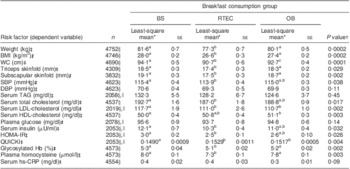
NHANES, National Health and Nutrition Examination Survey; BS, breakfast skippers; RTEC, ready-to-eat cereal; OB, other breakfast; WC, waist circumference; SBP, systolic blood pressure; DBP, diastolic blood pressure; HOMA-IR, homeostatic model assessment insulin resistance; QUICKI, quantitative insulin sensitivity check index; hs-CRP, high-sensitivity C-reactive protein.
a,b,cMean values within a row with unlike superscript letters were significantly different (P < 0·0167 using Bonferroni's correction).
*All values are sample-weighted.
†Indicates composite P value from Wald's F test.
‡Covariates: energy intake, age, gender, ethnicity, ethnicity × gender, poverty income ratio, smoking status, alcohol consumption, physical activity and marital status.
§Sample size varied from the original during analysis due to missing data.
∥Only data for those who were fasting for at least 8·5 h before the blood draw were used.
Association of breakfast skipping or breakfast consumption with anthropometric and other cardiometabolic risk factors and the metabolic syndrome
Compared with the BS and the OB consumers, the RTEC consumers had a lower prevalence of overweight/obesity; abdominal obesity; elevated blood pressure; and elevated glycosylated Hb (Table 3). Among all young adults, 57·5 % were overweight/obese; 18·8 % had the MetS; 36·3 % had abdominal obesity; 17·7 % had elevated blood pressure; 24·5 % had elevated serum TAG; 33·9 % had reduced serum HDL-cholesterol; and 20·6 % had elevated plasma glucose. Relative to the BS, the RTEC consumers were 31 %, 39 %, 37 %, 28 %, 23 %, 40 %, 42 % and 94 % less likely to be overweight/obese or have abdominal obesity, elevated blood pressure, elevated serum total cholesterol, elevated serum LDL-cholesterol, reduced serum HDL-cholesterol, elevated serum insulin or elevated glycosylated Hb, respectively. Relative to the OB consumers, the BS were 1·24, 1·26, 1·44 and 2·53 times more likely to have elevated serum total cholesterol, elevated serum LDL-cholesterol, reduced serum HDL-cholesterol or elevated glycosylated Hb, respectively. Relative to the OB consumers, the RTEC consumers were 22 %, 31 %, 24 % and 84 % less likely to be overweight/obese or have abdominal obesity, elevated blood pressure or elevated glycosylated Hb, respectively. No association was found between breakfast skipping or type of breakfast consumed and the prevalence of the MetS (Table 3).
Association between breakfast skipping or breakfast consumption from a reported 24 h dietary recall and anthropometric/other cardiometabolic risk factors and the MetS in young adults (20–39 years of age): NHANES 1999–2006

MetS, metabolic syndrome; NHANES, National Health and Nutrition Examination Survey; ref., reference group; BS, breakfast skippers; RTEC, ready-to-eat cereal; OB, other breakfast; hs-CRP, high-sensitivity C-reactive protein; WC, waist circumference; SBP, systolic blood pressure; DBP, diastolic blood pressure.
a,b,cValues within a row with unlike superscript letters were significantly different (P < 0·0167 using Bonferroni's correction).
*From covariate-adjusted logistic regression models.
†All values are sample-weighted.
‡Indicates overall P value from the χ 2 test.
§Covariates: energy intake, age, gender, ethnicity, ethnicity × gender, poverty income ratio, smoking status, alcohol consumption, physical activity and marital status.
∥Definitions: overweight/obesity, BMI ≥ 25 kg/m2; abdominal obesityA, WC ≥ 102 cm (males) or WC ≥ 88 cm (females); elevated blood pressureB, SBP ≥ 130 mm Hg or DBP ≥ 85 mm Hg or medication use; elevated serum TAGC, ≥150 mg/dl or medication use; elevated serum total cholesterol, >200 mg/dl; elevated serum LDL-cholesterol, ≥130 mg/dl; reduced serum HDL-cholesterolD, <40 mg/dl (males) or <50 mg/dl (females); elevated plasma glucoseE, ≥100 mg/dl or medication use; elevated serum insulin, >20 μU/ml; elevated glycosylated Hb, >5·9 %; elevated plasma homocysteine, ≥16 μmol/l; elevated serum hs-CRP, >0·3 mg/dl; MetS, three or more of five risk factorsA–E.
¶Only data for those who were fasting for at least 8·5 h before the blood draw were used.
**Only those who had data available on all five MetS risk factors were included.
††Indicates statistical significance (unity not in the 95 % CI of an OR).
Discussion
Breakfast is considered to be the most important meal of the day; yet previous NHANES studies had found a decline in the reporting of breakfast consumption by Americans(Reference Kant and Graubard44). In the present study almost a quarter of the young adult population skipped breakfast, and 16·5 % consumed an RTEC at breakfast. These results agree with earlier studies(Reference Deshmukh-Taskar, Radcliffe and Liu8, Reference Song, Chun and Obayashi9), one of which also found that a lower percentage of young adults consumed breakfast (especially, an RTEC breakfast) compared with older adults(Reference Song, Chun and Obayashi9). Further, the results of the present study also suggested that eating breakfast that includes an RTEC may have several cardiometabolic benefits in young adults.
The mean BMI among all three breakfast groups was ≥25 kg/m2; yet the RTEC consumers had a lower mean BMI than the BS and the OB consumers. Moreover, relative to the BS and the OB consumers, the RTEC consumers were less likely to be overweight/obese. Similar results were reported previously in the NHANES III study, in which adults who ate RTEC, cooked cereal or quick breads for breakfast had a lower mean BMI than BS and those consuming meat/eggs(Reference Cho, Dietrich and Brown10). The present study also found that the mean values for skinfold measures of body fat were lower in the RTEC consumers than in the BS and the OB consumers. There were no differences or associations in adiposity measures between the OB consumers and the BS, except for mean WC, which was lower in the OB consumers than in the BS. Yet the mean WC was lowest in the RTEC consumers and highest in the BS. The RTEC consumers were also less likely to have abdominal obesity relative to the BS and the OB consumers. These results may have important implications since a combination of obesity and abdominal obesity, or abdominal obesity by itself, was found to be associated with obesity-related metabolic disorders or all-cause mortality in adults(Reference Han, Williams and Sattar45, Reference Bigaard, Frederiksen and Tjonneland46).
The factors associated with breakfast skipping and increased adiposity are unclear; however, there are several possibilities. Previous studies from the USA have shown that BS had a higher mean BMI(Reference Cho, Dietrich and Brown10), especially in women(Reference Kant, Andon and Angelopoulos11), despite lower mean daily energy intakes than breakfast consumers(Reference Nicklas, Myers and Reger7, Reference Deshmukh-Taskar, Radcliffe and Liu8, Reference Cho, Dietrich and Brown10, Reference Kant, Andon and Angelopoulos11), as was also seen in the present study. However, along with lower energy intakes, BS were also found to have lower mean scores for both nutrient adequacy and dietary quality than breakfast consumers(Reference Deshmukh-Taskar, Radcliffe and Liu8), especially RTEC consumers(Reference Deshmukh-Taskar, Radcliffe and Liu8). Low dietary quality scores have previously been found to be associated with overweight/obesity in US adults(Reference Guo, Warden and Paeratakul47). Further, eating breakfast may contribute to a greater daily meal frequency than breakfast skipping(Reference van der Heijden, Hu and Rimm12), which may possibly, in turn, promote energy expenditure by increasing diet-induced thermogenesis(Reference Drummond, Crombie and Kirk48). Breakfast consumers may also be more likely to be regular exercisers than BS(Reference Song, Chun and Obayashi9), which may provide them with beneficial effects on weight status. Yet, in the present study, for physical activity patterns and breakfast consumption, the overall χ 2 was not significant.
Eating an RTEC at breakfast in particular may help with weight management. In previous NHANES studies, it was found that RTEC breakfast consumers had higher mean daily intakes of milk/milk products(Reference Deshmukh-Taskar, Radcliffe and Liu8) and Ca(Reference Deshmukh-Taskar, Radcliffe and Liu8, Reference Song, Chun and Kerver49) than either BS(Reference Deshmukh-Taskar, Radcliffe and Liu8) or OB consumers(Reference Deshmukh-Taskar, Radcliffe and Liu8, Reference Song, Chun and Kerver49). Dairy products are an excellent source of Ca and whey protein, both of which may play a role in lowering adiposity via multiple mechanisms(Reference Zemel50); yet some studies have not confirmed their role in weight management(Reference Zemel50). Further, many RTEC are nutrient-dense (approximately 92 % are fortified with vitamins and minerals) and are low in total fat and SFA, while some contribute substantial amounts of dietary fibre(51, Reference Anderson and Bridges52). Such dietary attributes are suggested as strategies for achieving a healthful diet that may be of benefit in weight management(53).
The present study showed that in comparison with the BS, the RTEC consumers had lower mean values for serum total cholesterol and LDL-cholesterol, serum insulin and insulin resistance, but had higher mean insulin sensitivity, and they were also less likely to have elevated blood pressure, elevated serum total cholesterol or LDL-cholesterol, reduced serum HDL-cholesterol or elevated serum insulin. While comparing the BS and the OB consumers, the BS had higher mean serum LDL-cholesterol but lower mean serum HDL-cholesterol and insulin sensitivity, and they were also more likely to have elevated serum total cholesterol or LDL-cholesterol or reduced serum HDL-cholesterol. The beneficial effects of breakfast consumption on cardiometabolic health were also found in the previously mentioned Australian longitudinal study, in which participants who were BS in both childhood and young adulthood had a higher mean for WC and also had higher mean fasting values for serum total cholesterol, LDL-cholesterol and insulin than those who ate breakfast at both the time points(Reference Smith, Gall and McNaughton14). Further, in a 2-week randomized crossover clinical trial on healthy lean premenopausal women, it was found that the omitting breakfast period was associated with higher fasting plasma total cholesterol and LDL-cholesterol than the eating breakfast period in the morning comprising of an RTEC. In the same study, although no differences were noted in fasting serum insulin or insulin resistance over the course of the experiment, the postprandial insulin sensitivity was reduced after the omission period than the eating period(Reference Farshchi, Taylor and Macdonald17).
Higher insulin resistance may lead to increases in CVD risk factors associated with the MetS(Reference Eckel, Grundy and Zimmet54) and cholesterol synthesis(Reference Smith, Gall and McNaughton14, Reference Pihlajamäki, Gylling and Miettinen55). Yet the potential effect of insulin resistance on cholesterol status may be offset by a concomitant decrease in cholesterol absorption(Reference Pihlajamäki, Gylling and Miettinen55). In the present study, the mean values for serum insulin and insulin resistance were not different between the OB consumers and the BS, but the values for these parameters were higher in the BS than in the RTEC consumers. It is unclear if higher mean values for serum total cholesterol in the BS than in the RTEC consumers were related to higher mean serum insulin and insulin resistance in them than in the RTEC consumers. Results from the present study may have important implications in the prevention of CVD in young adults. Further, the lower likelihood of having elevated glycosylated Hb in the RTEC consumers relative to the BS and the OB consumers may implicate their having a better long-term glycaemic control. Overall, there is a possibility that breakfast consumption may be related to having healthy dietary(Reference Nicklas, Myers and Reger7, Reference Deshmukh-Taskar, Radcliffe and Liu8) and other lifestyle habits(Reference Song, Chun and Obayashi9), providing benefits for cardiometabolic health.
The present study has some limitations. First, due to its cross-sectional nature, causality between breakfast skipping or breakfast consumption and anthropometric or other cardiometabolic risk factors cannot be determined. The present results may also be confounded by reverse causality (i.e. healthier people choosing consumption of an RTEC at breakfast, rather than consumption of an RTEC at breakfast making them healthier). Additionally, the use of a single 24 h dietary recall to assess breakfast skipping or breakfast consumption did not permit the assessment of the regular breakfast consumption habits of the population. Nevertheless, a single 24 h dietary recall does produce reasonably robust group estimates of dietary intakes(Reference Thompson and Byers56) and has previously been used to estimate daily breakfast consumption habits in large data sets such as the NHANES(Reference Deshmukh-Taskar, Radcliffe and Liu8–Reference Kant, Andon and Angelopoulos11). Also, many times with self-reported dietary assessment techniques such as the 24 h dietary recall, individuals tend to under-report energy intake, especially women and those who are older, overweight or trying to lose weight(Reference Briefel, Sempos and McDowell57). Such under-reporting of energy intake may have resulted in a reporting bias in the present study and could have influenced the results on energy intake among the three breakfast groups. Further, the definition of breakfast consumption was as self-reported by the participants in the study; therefore, it may have varied between them. Yet, this definition is consistent with that used in previous NHANES studies(Reference Deshmukh-Taskar, Radcliffe and Liu8–Reference Kant, Andon and Angelopoulos11). A misclassification bias may also have potentially resulted if the OB consumers from the present study consumed only a cup of coffee for breakfast, since their energy/nutrient intakes and metabolism could be different from their OB-consuming counterparts or could be even similar to the BS. Lastly, despite covering a large time span of the NHANES data, the sample size for assessment of the fasting values for some cardiometabolic risk factors and for the prevalence of the MetS was reduced due to missing data or data with <8·5 h of fasting reported by the participants. This may have lowered the power to detect differences for those risk factors among the breakfast groups.
Conclusions
In this sample of US young adults, eating a breakfast that included an RTEC was associated with lower prevalence of overweight/obesity, abdominal obesity and several other cardiometabolic risk factors in contrast to the potential adverse metabolic effects that were found from skipping breakfast. More studies using multiple days of dietary assessment, along with a longitudinal study design to determine the relationship between regular breakfast habits, overweight/obesity, abdominal obesity and other cardiometabolic risk factors, are suggested. Nevertheless, health professionals should encourage regular consumption of a nutritious breakfast (e.g. one that includes an RTEC) in the young adult population. Interventions to increase the prevalence of breakfast consumption in the young adult population are also warranted.
Acknowledgements
This work is a publication of the United States Department of Agriculture/Agricultural Research Service (USDA/ARS) Children's Nutrition Research Center, Department of Pediatrics, Baylor College of Medicine, Houston, TX. The contents of this publication do not necessarily reflect the views or policies of the USDA, nor does mention of trade names, commercial products or organizations imply endorsement from the US government. Sources of funding: This research project was supported by the USDA Agricultural Research Service through specific cooperative agreement 586250-6-003. Partial support was received from the USDA Hatch Project LAB 93951. Conflicts of interest: The funding agencies had no role in the study design, analyses or preparation of the manuscript. The authors have no conflict of interest to report. Authors’ contributions: P.D.-T. conceptualized and designed the study, performed the initial statistical analyses, interpreted the data and drafted the manuscript; T.A.N. and J.D.R. conceptualized and designed the study and critically reviewed and revised the manuscript; C.E.O’.N. critically reviewed and revised the manuscript; Y.L. acquired the data, performed additional statistical analyses and provided statistical support.



