Introduction
Recently scholars of health politics and policy have concerned themselves with the political, economic and social factors contributing to the emergence of health care policy and inequalities in the emerging economies. Of particular interest has been the international and domestic political, economic and social conditions accounting for differences between nations in access to essential medicine, quality hospital infrastructure, primary health care systems and financing (WHO, 2008a; Carrie, Reference Carrie2009). Others have looked at how these differences account for variation in health outcomes, such as nutrition, disease prevalence and mortality between socio-economic groups and genders between nations (WHO, 2013; TV et al., 2015).
Nevertheless, the emerging economies also appear to be different with respect to the presence of health care institutions ensuring financial protection from personal health care expenditures, such as out-of-pocket (OOP) and catastrophic spending. That is, when governments are committed to providing financial protection through national health insurance programs, to what extent are they different with respect to the creation of bureaucratic agencies that ensure this kind of financial protection? Are some governments more capable than others at regulating hospital compliance with national health insurance reimbursement procedures and monitoring unethical practices, such as charging unnecessary user fees, prescribing non-reimbursable medications and tests, and accepting bribes for better quality treatment? This alternative institutional perspective not only addresses a lacuna in the literature, it also provides insight into the paradox of why OOP and catastrophic expenses are increasing in countries that have made political commitments to universal health coverage and financial protection (Saksena et al., Reference Rueschemeyer, Stephens and Stephens2014).
This article argues that several domestic political and institutional factors account for these differences in bureaucratic regulatory outcomes. First, I argue that differences between nations are attributed to differences in the transitional politicization processes of health care rights: that is, and as seen in Indonesia, governing elites campaigning on rights to health care during democratic transitions, as a form of political legitimacy, and the resulting electoral incentives to pursue reforms. This politicization process contributes to subsequent expectations and incentives for civil society to mobilize and pressure governments for access to health care, pressures that are reinforced through constitutional amendments guaranteeing access to health care and electoral reforms requiring presidents to be directly elected into office. Politicians in this context become sensitive to public opinion and fearful of the electoral consequences of failing to provide financial protection, thus making this outcome an important electoral campaign strategy. Conversely, and as seen in China, when these transitional politicization processes, social pressures, constitutional constraints and electoral fears are absent, politicians will have no incentive to create effective bureaucratic regulatory institutions and will therefore experience ongoing OOP and catastrophic expenses.
Second, these differences in transitional politicization processes will also create differences in central government fears that particular health systems approaches to insurance provision, such as decentralization, can achieve their goals. In a successful transitional politicization process – for example, Indonesia, politicians will be less likely to trust state health departments in their ability to effectively regulate health insurance providers and will instead seek to resuscitate historic patterns of centralized bureaucratic intervention in order to ensure desired regulatory outcomes. In contrast, in the absence of transitional politicization processes and subsequent electoral fears – for example, China, politicians will have greater trust in decentralization processes; this, in turn, generates fewer incentives for federal health officials to intervene and regulate providers.
The cases of Indonesia and China were selected for several reasons. First, they were selected because they are Asian nations with consistently high economic growth rates; similar government commitments to implementing federal programs providing universal health insurance coverage, with specific programs focused on ensuring financial protection for the poor; and similar approaches to decentralized health care provision and challenges in implementing national health insurance programs across a vast geographic terrain. Yet, these cases were also selected in order to examine the importance of key differences in political regime type and their institutional affects, with Indonesia representing a more representative democratic electoral government vs China’s ongoing authoritarian governance structure, with the expectation, based on a qualitative Most Different Systems design (Ragin, Reference Pitriyan1987), that these critical causal differences in political regime type would also account for differences in institutional outcomes. To substantiate the author’s empirical claims, secondary literature from books, articles and newspapers were used and cited where appropriate.
Health insurance coverage, financial protection and political institutions
A growing body of literature has emphasized the different kinds of policies that governments pursue to avoid OOP and catastrophic expenses. One area emphasizes the importance of increased government spending for public providers, such as hospitals (Xu et al., Reference Xu, Evans, Carrin and Mylena2005; Bitran, Reference Bitran2012; Van Minh et al., Reference Van Minh, Phoun, Saksena, James and Xu2013; Vian et al., Reference Vian, Domente, Negnuta, Matei and Habicht2015; Masiye et al., Reference Mares2016). Spending for improving doctor and administrator salaries, training, medical equipment and infrastructure can incentivize hospital boards and physicians to refrain from profiting from an oversubscription of medications, tests and unnecessary user fees (Xu et al., Reference Xu, Evans, Carrin and Mylena2005; Bitran, Reference Bitran2012; Vian et al., Reference Vian, Domente, Negnuta, Matei and Habicht2015). Increased government spending can also improve the overall quality of health care in the public sector and reduce incentives to pay OOP for better quality care in the private sector (Xu et al., Reference Xu, Evans, Carrin and Mylena2005; Masiyet et al., 2016). To help ensure the sustainability of health care spending, some argue that transitioning from a fee-for-service to pooled insurance fund through taxation is imperative (Savedoff, Reference Saksena, HSD and Evans2012; Bristol, 2014).
Innovations in public provider financing may also help to avoid OOP and catastrophic expenses. Here, either eliminating or capping user fees is important (Lee and Shaw, Reference Kaufman2014; Masiye et al., Reference Mares2016). Others stress the possibility of hospitals formalizing informal user fee payments, thereby reducing consumer uncertainty and building trust in providers, as well as requiring pre-payments into health insurance accounts to avoid catastrophic expenses (Xu et al., Reference Xu, Evans, Carrin and Mylena2005).
Expanding insurance benefits has also been emphasized. Increasing the number of inpatient and outpatient services included in insurance plans can avoid OOP and catastrophic expenses (Shahrawat and Rao, Reference Savedoff2012; Van Minh et al., Reference Van Minh, Phoun, Saksena, James and Xu2013). Alternatively, increasing the number of medications included on essential drug lists, while regulating the price of medicine to ensure government affordability, can increase the poor’s access to medicine and ensure financial protection (Shahrawat and Rao, Reference Savedoff2012; Van Minh et al., Reference Van Minh, Phoun, Saksena, James and Xu2013).
A perspective that is absent in this literature however is understanding the politics of creating bureaucratic regulatory institutions for ensuring financial protection (Bristol, 2014; Carrin et al., Reference Carrin, Mathauer, Xu and Evans2016). This article fills in this lacuna by first addressing how the transitional politicization process of health care rights establishes differences in subsequent governing elite interests and incentives to achieve these institutional outcomes; and second, by addressing how these differences in transitional processes and resulting electoral incentives account for eventual differences in overcoming the challenges of decentralization in order to facilitate federal regulation and ensure financial protection.
Political regime type and policy reform
Studies have recently examined the extent to which political regime types affect social welfare and health care policy (McGuire, 2010; Haggard and Kaufman, 2008; Rudra and Haggard, 2005; Mulligan et al., 2004). Some claim that historically the nature of democratic institutions, increased industrialization, employment and income; citizens and labor unions’ ability to mobilize, lobby governments and vote, and transparency in policy decision making increases political accountability and creates incentives for elected representatives to provide social welfare and health care policies (Rueschemeyer et al., Reference Ragin1992; Huber and Stephens, Reference Huang2001; Acemoglu and Robinson, 1999). Democratic regimes guaranteeing civil societal representativeness – mainly within elected legislative institutions – inclusiveness and influence either through these institutions and/or national policy committees have been perceived to be more proactive in providing social welfare policies (Acemoglue and Robinson, 2012; Bueno de Mesquita et al., 2005). Others maintain that during democratic transitions, the presence of long denied electoral franchise and corporatist coalitions between governing parties, unions, and in some instances business has led to the introduction of progressive redistribution and social welfare programs in several Latin American and Asian nations (Esping-Andersen, Reference Eggleton1990; Huber and Stephens, Reference Huang2001).
Nevertheless, recently scholars have found that non-democratic regimes are equally as successful than democratic regimes in creating social welfare and health care policies (Haggard and Kaufman, 2008). Authoritarian regimes are known to respond to citizens needs through the creation of several health, education and income redistribution programs just as effectively as democracies, even in the absence of national elections, loss of interest group autonomy, denial of civil liberties, and the concentration of power among a small group of elites (Bangura, Reference Bangura2007). Often times scholars maintain that these social welfare programs are the unintended consequence of authoritarian regimes introducing democratic-type institutions in order to remain in power, such as representative legislatures and multi-party elections, to learn about potentially destabilizing social problems, unrest and to quell them through social welfare spending (Gandhi, Reference Forrat2008; Brancati, Reference Brancati2014); the provision of social policy is therefore viewed as a survival tactic, often revealing politicians’ strategies to build a loyal following and to suppress the political opposition (Wintrobe, 1998). Others attribute the existence of social policies within authoritarian regimes to pre-existing political and ideological commitments to socialist programs and transformations (Haggard and Kaufman, 2008).
Other literature has emphasized the formal institutional advantages of authoritarian regimes. In these types of governments, the concentration of political authority, absence of political party fragmentation, polarization, and thus electoral veto points – which has delayed policy making in nascent democracies (Haggard and Kaufman, 1995) – thwarting agenda-setting process can facilitate governing elites’ abilities to introduce and even expand social welfare benefits (Mares, 2005; Forrat, Reference Esthey2013). In the area of public health, work by Gauri and Khaleghian (2002) has argued that precisely because of these institutional advantages, in addition to high levels of intra-political party discipline, centralized authoritarian regimes, such as Cuba and China, were more successful than some democracies in implementing immunization programs. McGuire (2010) also found similar findings in Latin America (Brazil and Chile) and Asia (Thailand), where the public health bureaucracy’s high degree of centralized policy-making autonomy facilitated the imposition of policies that reduced maternal and children’s mortality rates.
Furthermore, in recent years democracies have not been as successful in creating social welfare and health care policies. Scholars find that in developing nations, the aforementioned benefits of free electoral franchise and accountability dissipated over time, due to subsequent periods of social unrest, political and economic instability, and politicians’ lack of interest in meeting social welfare needs and fulfilling promises (Stokes, Reference Shahrawat and Rao2001; Mkandawire, Reference Masiye, Kaonga and Kirigia2004; Bangura, Reference Bangura2007). Ongoing ethnic and racial conflict has engendered a heterogeneous voting population that often favors choosing electoral candidates based on their stance on theses issue rather than social policy issues (Bangura, Reference Bangura2007).
This is not to say, however, that authoritarian regimes posses greater advantages in all aspects of social welfare and health care policy. To understand this, an important distinction must be made between the creation and expansion of health care policies vs the subsequent creation of those bureaucratic institutions that regulate and enforce them. The politics of policy creation and expansion vs bureaucratic regulation and enforcement are often quite different and, according to this article, tend to favor democratic regimes.
Indeed, while in recent years authoritarian regimes, such as China, appear to be more capable than democracies at swiftly implementing and extending social and health care benefits, they have not had the enduring, periodic electoral incentives for federal bureaucratic regulation and enforcement, a process that requires either the creation or reform of bureaucratic regulatory institutions for monitoring and regulating the implementation of national insurance programs. In contrast, in democracies, such as Indonesia, the presence of periodic national elections and the prospect of re-election can continue to create electoral incentives to achieve these institutional and regulatory objectives. In the absence of these periodic electoral incentives, authoritarian regimes, such as China, may often concern themselves more with hastily introducing and subsequently extending national health insurance programs for domestic and international reputation-building purposes, but with little subsequent follow-up to ensure that the proper bureaucratic procedures are in place to monitor and enforce health insurance procedures and to guarantee financial protection from OOP and catastrophic expenses, especially among the poor.
Institutions and financial protection in Indonesia and China
Indonesia
During Indonesia’s authoritative rule under General Suharto (1965–1998), the government was committed to administering and providing universal health care. In an effort to help legitimize his political rule, Suharto proclaimed his commitment to achieving this policy objective (Halabi, Reference Gómez2013). Hailing from a poor upbringing, Suharto was motivated by the poor’s historic inability to obtain access to public health care services (Halabi, Reference Gómez2013). In response, during the transition to democracy beginning in 1988, Suharto’s government provided 80% of all funding for primary care services, while establishing community health centers, known as Pukesmas, to ensure the poor’s access to health care (The Economist, Reference Stokes2010).
Because of this transitional politicization process in providing health care, civil society grew to expect and demand effective health care coverage. These civic demands derived from society’s recollection of Suharto’s unwavering commitment to meeting their health care needs, reinforced by demands for democratization (Pisani, 2014). These civic movements gradually transformed into an influential force shaping health and other social welfare policies (Pisani, 2014). In addition, an amendment to the 1945 constitution in 2000 requiring universal access to health care as a constitutional right (WHO, 2008b), when combined with the introduction of national presidential elections in 2004, provided further political incentives to guarantee access to health care (Gómez, Reference Gandhi2015).
During this period, politicians feared the prospect of losing elections because of their inability to ensure adequate health care coverage and financial protection (Mujani and Liddle, 2010). By the 2009 presidential elections, these health care issues became a central campaign strategy for President Susilo Bambang Yudhoyono’s re-election into office (Mujani and Liddle, 2010).
In this context, politicians feared that health care decentralization processes would not deliver on their campaign promises. Politicians believed that state health departments did not have the managerial experience and funding needed to ensure that national health insurances programs, namely Jamsostek for all formal sector workers (eventually becoming the Badan Penyelenggara Jaminan Sosial, in 2014), Askes for government employees, and Jamkesmas for the poor, could achieve complete converge and financial protection. Because of these fears the government resuscitated its historical pattern of centralizing financial and administrative health care decisions (Heywood and Harahap, Reference Hesketh and Wei2009). This led to the Ministry of Health’s (MOH) increased influence in hiring health care personnel, enforcing policy through conditional fiscal transfers, while reducing the provinces policy-making autonomy (Pitriyan, Reference Mkandawire2013).
Restoring pre-existing patterns of bureaucratic centralization facilitated the government’s interest in regulating public health care providers. To ensure that OOP and catastrophic expenses decreased, the MOH created federal regulatory institutions and laws monitoring hospital performance. For example, in 2000, in order to ensure that physicians were not engaging in corrupt practices, such as charging extra co-payment fees and ordering unnecessary medications, the MOH created Komisi Akreditasi Rumah Sakit (KARS) (Hort et al., 2013). Through KARS, not only did the MOH monitor physicians’ practices, but it also trained local health officials to do the same (Hort et al., 2013). Through these efforts physicians have been discouraged from engaging in malfeasance, while adhering to national insurance coverage procedures (Hort et al., 2013). Hospital transparency and accountability was further increased with the MOH’s creation of independent national and provincial hospital boards (Badan Pengawas Rumah Sakit), which reports to the president and governors (Asia Law, 2010).
Because of these regulatory efforts, the MOH has been able to maintain its commitment to safeguarding the poor from OOP and catastrophic expenses, which in recent years has decreased, particularly among the poor (Esthey, Reference Esping-Andersen2014). While OOP still exists, it is rare and mainly limited to distant rural communities where public hospitals lack a sufficient supply of medications (Esthey, Reference Esping-Andersen2014).
China
Unlike Indonesia, China had a rich history of providing public health care services. Under the Communist government of Chairman Mao Zedong (1945–1976), the government was committed to not only achieving this but also ensuring near universal health insurance coverage (Hesketh and Wei, Reference Halabi1997). While government employees, university faculty, students and retirees were insured through the Government Insurance Scheme and state-owned enterprise employees through the Labor Insurance Scheme (Brown et al., Reference Brown, Píriz, Liu and Moore2012), by the 1960s, 90% of the rural poor were covered through a Commune Cooperative Medical System (CMS) (Brown et al., Reference Brown, Píriz, Liu and Moore2012). Sponsored by the government and emphasizing preventative over curative care, the CMS was managed and primarily funded by members of local communes, such as physicians, health care workers and agricultural workers (Duckett, Reference Duckett2011), paying for most health care services through a pooled fund (Hesketh and Wei, Reference Halabi1997; Wong and Chiu, 1997). Basic health care services were provided by brigade health stations, followed by commune health centers and urban hospitals for more complex treatments (Wong and Chiu, 1997). To ensure that the CMS worked effectively, Mao sent medical doctors from urban to rural areas to train local traditional medical care staff, nurses, former military medics and agricultural workers, ultimately leading to thousands of barefoot doctors providing primary care services (Daemmrich, Reference Daemmrich2013).
Increased spending for public health initiatives, such as providing universal immunization, building public latrines and draining swamps, also contributed to the eradication of diseases such as schistosomiasis, sexually transmitted diseases, leprosy and plague (Hesketh and Wei, Reference Halabi1997; Daemmrich, Reference Daemmrich2013). Infant mortality rates declined from 250 to 22 deaths per 1000 live births, while life expectancy increased (Hesketh and Wei, Reference Halabi1997; Daemmrich, Reference Daemmrich2013). Because of this success, Mao’s public health system drew international attention and fame (Wong and Chiu, 1997), showing that even an authoritarian communist regime could provide health care services in the absence of democratic elections.
Nevertheless, during this period China differed from Indonesia due to the absence of transitional politicization processes in access to health care. With a strong governing Communist party at the helm of the State Council under Mao, using public health policy to establish political legitimacy was never an issue, nor were political leaders seeking to publicize universal commitments to health care as a human right (Wong and Chiu, 1997).
Civil society consequently never had any expectations and collective demands for the government’s provision of health care coverage (Xiangqian, Reference Xiangqian2012). The absence of civic pressures could also be partly attributed to the absence of influential non-governmental organizations, which were suppressed during Mao’s cultural revolution (Keping, 2009). Unlike Indonesia, there also never existed a transition to democracy, with a constitution concretizing citizens’ rights to health insurance and access to medicine (Huang, 2013) and amendments requiring the election of politicians. Consequently, unlike Indonesia, national electoral interests in guaranteeing access to health care and financial protection never became a priority (Gómez, Reference Gandhi2015). These disincentives emerged even after the government’s introduction of national health insurance programs, such as the 1988 Urban Employee Basic Medical Care program, the 2002 Medical Financial Assistance (MFA) program, the 2003 New Rural Cooperative Medical Scheme (NCMS), and the Urban Resident’s Basic Medical Insurance program (URBMI) of 2007. When combined, all of these programs provided near universal coverage (Eggleton, 2012). Furthermore, the NCMS was explicitly designed to protect the poor from OOP and catastrophic expenses (Barber and Yao, Reference Barber and Yao2010).
The absence of transitional politicization processes notwithstanding, eventually the government was still successful in strengthening its public health system. Much of this was prompted by the 2002 severe acute respiratory syndrome (SARS) epidemic. In response to international criticisms and media reports highlighting the government’s weak public health system, in 2003 the government invested $2 billion Yuan to improve health infrastructure, such as beds, X-ray machines, upgrade existing hospitals, while MOH regulations and legal amendments were created to improve the government’s center for disease control (Kaufman, Reference Huber and Stephens2006). In 2004, the government also invested in a web-based disease surveillance system (Wang et al., Reference Wang, Wang, Yang, Ma, Wang and QiN/D). From 2002 to 2006, government spending for public health also increased by 107%, leading to the construction of hospitals, especially in rural areas and specialized training for health care personnel (Huang, 2013). Furthermore, the SARS aftermath prompted efforts to strengthen the government’s response to other infectious diseases, such as HIV/AIDS, leading to US$1.42 billion for prevention services, antiretroviral medication for the rural poor and HIV-positive pregnant women through the 2003 ‘Four Frees, One Care’ program (Huang, 2013).
Shortly thereafter the State Council also decided to further increase health insurance coverage. This decision mainly emerged in response to a 2005 report published by a high profile think-tank critiquing the MOH’s lack of effective health insurance coverage, ongoing urban/rural divides in access to health care, and poor resource allocation (Kaufman, 2008; Daemmrich, Reference Daemmrich2013). In 2009, through the Guidelines on Deepening the Healthcare System Reform and the Healthcare System Reform Priority Implementation Plan, the State Council announced 850 billion RMB (US$136 billion) in health care spending, with the goal of further expanding health insurance coverage, establishing a national essential drugs list, promoting equal access to public health services, strengthening primary care and public hospitals (Yu, Reference Yu2015). Expanding insurance coverage entailed the State Councils’ decision to increase funding for the aforementioned NCMS and URBMI programs (Daemmrich, Reference Daemmrich2013; Yu, Reference Yu2015). Much of this funding was used to expand URBMI’s coverage of retirees, state owned enterprise employees, rural migrants and college students (Brown et al., Reference Brown, Píriz, Liu and Moore2012). In 2010, the central and local governments also increased their financial contributions to the NCMS from 10 RMB annually to 50 RMB (Barber and Yao, Reference Barber and Yao2010). Moreover, government funding for the 2002 MFA program, which subsidizes the poor’s ability to pay premiums for the NCMS and URBMI, increased from 3994.10 billion Yuan in 2009 to 8279.90 billion Yuan in 2013; funding for the NCMS also increased from 1308.33 in 2010 to 2972.48 billion Yuan in 2013 (China National Statistics Bureau, 2014). By 2011, Yu (Reference Yu2015) claims that government subsidies for the NCMS and URBMI accounted for 75% and 85% of their premiums, respectively, leading to a surge in program enrollment, especially for NCMS. By 2010, expanding insurance coverage also entailed funding for outpatient services in hospitals and adding several priority diseases – such as cancer and diabetes – for benefit coverage (Yu, Reference Yu2015). What’s more, in 2012 the government made plans to further expand benefits by covering 50–75% of expenditures for inpatient and outpatient services (Yip and Hsiao, Reference Yip, Hsiao, Chen, Hi, Ma and Maynard2015; Yu, Reference Yu2015). All of these endeavors demonstrated yet again the willingness of an authoritarian regime to ensure and expand access to health insurance even in the absence of democratic elections.
Throughout this reform process, however, and for the aforementioned absence of transitional politicization processes, China’s Premier and State Council never had any periodic electoral fears and therefore concerns about the effectiveness of decentralization processes in both regulating and implementing the aforementioned national health insurance programs; instead, the State Council and the MOH became increasingly reliant on state and municipal health departments to implement, regulate and finance these programs (Yip and Hsiao, Reference Yip, Hsiao, Chen, Hi, Ma and Maynard2015; Yu, Reference Yu2015). Beijing viewed its adherence to decentralization as a way to safeguard regional political and financial autonomy, while placating provincial governors’ interests.
The upshot is that the central government has never been willing to intervene in order to ensure that national health insurance programs, especially those targeting the poor, work effectively. Neither central nor state health departments have made an effort to coordinate and regulate public and private provider adherence to national insurance procedures, such as providing coverage for particular inpatient/outpatient services; doctors have not been monitored to ensure that they refrain from prescribing medications not covered by the MOH’ essential drug lists, unnecessary medical tests and fees (Yip et al., Reference Yip and Hsiao2012). Worse still, no bureaucratic regulatory oversight procedures have been implemented to ensure that doctors refrain from corrupt practices, such as accepting bribes for timely and better quality treatment (Gómez, Reference Gandhi2015). In fact, in a context where public hospitals do not receive sufficient government funding and where the latter indirectly encourages the sale of medication for hospital revenues and salaries, there have been strong incentives for doctors to sell unnecessary medications, exams, accept bribes for preferential treatment and to focus on profits rather than quality health care (Cornelius-Schecter, Reference Cornelius-Schecter2016).
In the absence of federal oversight, OOP and catastrophic expenses have increased at all income levels (Li at al., Reference Lee and Shaw2014). In contrast to Indonesia, the poor have borne the highest share of expenses (Long et al., 2013). In fact, in 2013, ~34.8% of NCMS register participants experienced catastrophic expenses, thus revealing the program’s failure to provide financial protection for the poor (Li et al., Reference Lee and Shaw2014).
Conclusion
Among the emerging economies, governments have varied in their introduction of federal bureaucratic institutions that can effectively regulate health care providers and ensure financial protection. In contrast to the prevailing literature, this article has emphasized the transitional politics of creating these institutions, highlighting how the politicization of health care rights during transitions to democracy, its positive effect on civil societal expectations and pressures, constitutional rights and electoral reforms incentivizes politicians to overcome inefficient decentralization processes through centralized bureaucratic regulation. While both Indonesia and China confronted similar OOP and catastrophic expenses, eventually Indonesia was the only government capable of achieving this regulatory outcome. The case of Indonesia therefore suggests that until politicians have strong electoral incentives to introduce regulatory institutions, ensuring financial protection – and thus effective universal health coverage – will be difficult to achieve.
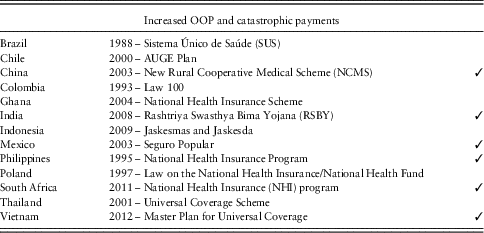
Future research should consider if other governments have followed Indonesia’s path. Brazil, Colombia and Thailand, for example, have also seen a reduction in OOP and catastrophic expenses following the introduction of universal health insurance programs, experienced the politicization of health care rights during transitions to democracy, the emergence of strong social health movements, and constitutional/electoral reforms. In contrast, India, Vietnam and the Philippines joined China in seeing ongoing OOP and catastrophic expenses, did not experience the politicization of health care rights during political transitions, proactive social movements and similar constitutional/electoral reforms .
Emerging economies offering financial protection through universal health insurance programs

Source: Authors’ calculations; Nicholson et al. (2015).
AUGE=Universal Access with Explicit Guarantees Program; OOP=out-of-pocket.
Realizing the importance of establishing federal regulatory institutions, future research may also consider creating a global database coding nations based on the presence of these institutions and supportive governance processes, such as constitutional rights to health care and direct presidential/congressional elections. This database can facilitate our ability to establish a stronger association between the importance of establishing these institutions and ensuring financial protection, while providing an opportunity for political scientists and health economists to work together in finding alternative policy solutions for achieving universal health coverage.
Acknowledgements
The author wishes to thank the anonymous referee(s) for helpful comments and suggestions.