


Globally, higher education is experiencing a tsunami of changes, with a call for increased efficiency and accountability in training and nuanced leadership. The COVID-19 pandemic had an impact on education systems worldwide. Training in South Asian countries is adapted to each country’s educational and healthcare systems and culture. Most South Asian countries have similar frameworks for medical education, where psychiatry is often introduced as part of the broader medical curriculum (Kallivayalil Reference Kallivayalil and Enara2021). Postgraduate and super-specialty training vary considerably. Some common themes across the countries include psychiatry exposure with an emphasis on clinical training. However, stigma, lack of resources and workforce gaps are challenges across all countries.
Undergraduate psychiatry training
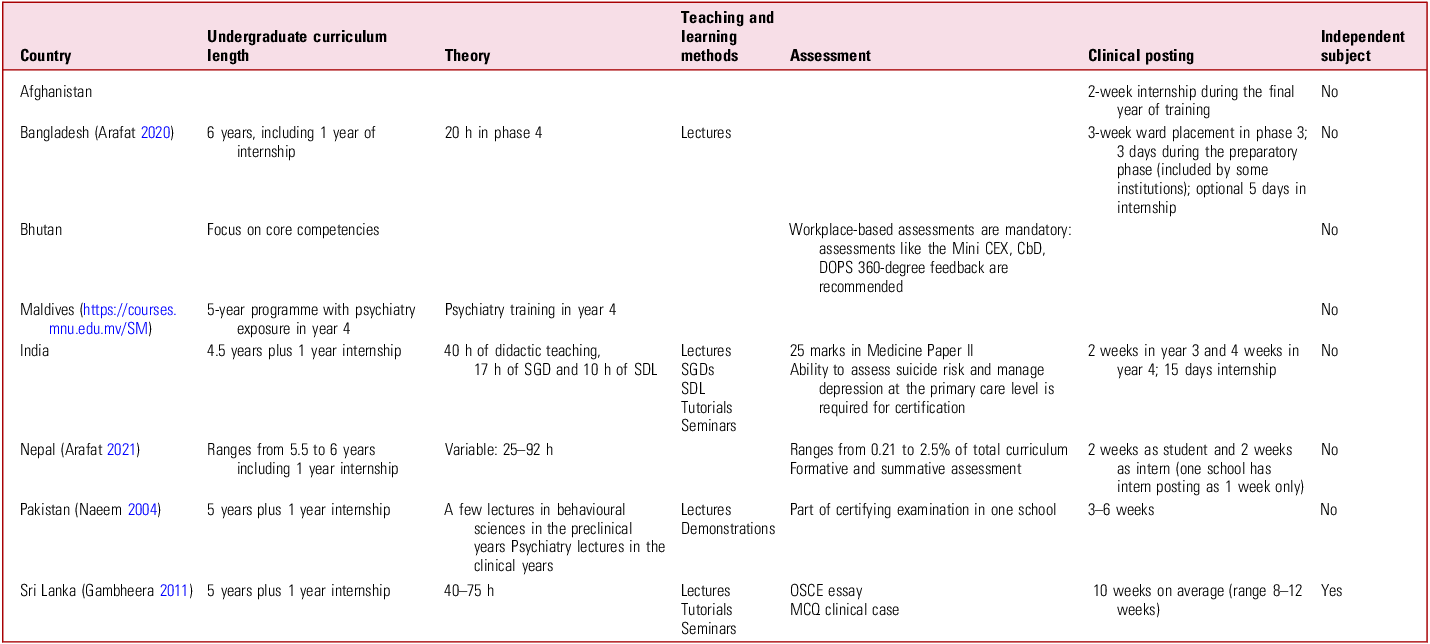
In South Asia, undergraduate training in psychiatry, while providing a foundation, is not robust enough to deal with the increasing prevalence of mental disorders. In India, the MBBS course takes 5.5 years, which includes a compulsory rotating internship. With competency-based medical education (CBME), undergraduate psychiatry training in India became more structured, outlining 17 competencies (Sethi Reference Sethi, Tekkalaki and Shah2024). Key competencies, such as suicide risk assessment and managing depression at the primary care level, are mandatory skills for certification (Sethi Reference Sethi, Tekkalaki and Shah2024). Sri Lanka is the only country to offer psychiatry as a separate subject and have a separate summative assessment (Hanwella Reference Hanwella and De Silva2024) (Table 1). The Maldives has started undergraduate training in psychiatry (https://courses.mnu.edu.mv/SM), as has Bhutan (Khesar Gyalpo University of Medical Sciences of Bhutan 2021).
Status of undergraduate education in psychiatry in South Asian countries

TABLE 1 Long description
The table compares undergraduate psychiatry curriculum details across South Asian countries, including Afghanistan, Bangladesh, Bhutan, Maldives, India, Nepal, Pakistan, and Sri Lanka. It has 8 rows and 5 columns. The columns are Country, Undergraduate curriculum length, Teaching and learning methods, Assessment, Clinical posting, and Independent subject. Each row provides specific details for each country. For example, Bangladesh has a 6-year curriculum with 20 hours of theory in phase 4, lectures as teaching methods, a 3-week ward placement in phase 3, and no independent subject. India has a 4.5-year curriculum plus a 1-year internship, 40 hours of didactic teaching, lectures and SGDs as teaching methods, 25 marks in Medicine Paper II for assessment, and a 2-week clinical posting in years 3 and 4. Sri Lanka offers psychiatry as a separate subject with a 5-year curriculum plus a 1-year internship, 40-75 hours of theory, lectures and tutorials as teaching methods, OSCE and essay assessments, and a 10-week clinical posting on average.
Mini CEX, Mini Clinical Evaluation Exercise; CbD, case-based discussion; DOPS, direct observation of procedural skills; SDL, self-directed learning; SGD, small-group discussion; OSCE, Objective Structured Clinical Examination; MCQ, multiple choice question.
Postgraduate psychiatry training
In India, as per the latest update (March 2025) of the National Medical Commission (NMC), 331 medical colleges offer postgraduate (Doctor of Medicine, MD) courses in psychiatry with a total of 1291 seats for the annual intake (https://www.nmc.org.in/information-desk/college-and-course-search). The National Board of Examinations (NBE) offers postgraduate psychiatry courses in the Diplomate of National Board (DNB) prorgamme in 26 accredited hospitals, with an annual intake of 49 seats (https://accr.natboard.edu.in). Other than this, PhD and integrated MD-PhD degrees in psychiatry, child and adolescent psychiatry and non-invasive neuromodulation are being run by certain institutes in India. As per the latest available information, there is no postgraduate training programme in psychiatry in Afghanistan; however, there are facilities for MPhil clinical psychology training in some centres. In Bhutan, the postgraduate course in psychiatry started in 2019. Bangladesh offers a 5-year postgraduate course in psychiatry which has two phases (phase A for 2 years and phase B for 3 years). Also, there has been an MD residency course in child and adolescent psychiatry in Bangladesh since 2016 (Arafat Reference Arafat2020). As per the available information, there are no postgraduate courses in psychiatry offered by any institutes in the Maldives, although there are some short-term certificate courses in psychology and well-being offered by some non-governmental organisations (NGOs). Several institutes in Nepal offer a 3-year MD course in psychiatry. Pakistan offers an MD course in psychiatry that is of 4 years duration, whereas in Sri Lanka, the postgraduate course in psychiatry (MD) is of 5 years duration with two stages (Stage 1: 36 months; Stage 2: 24 months).
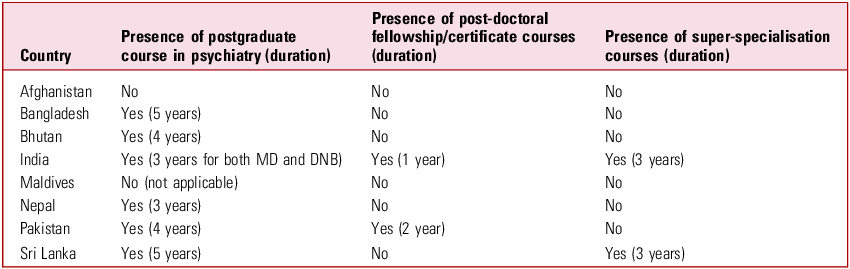
Table 2 summarises the status of higher education in psychiatry in South Asian countries.
Status of higher education in psychiatry in South Asian countries

TABLE 2 Long description
A table comparing the presence and duration of postgraduate courses, post-doctoral fellowship/certificate courses, and super-specialisation courses in psychiatry across South Asian countries. The table has 3 columns and 8 rows. Column headers are Country, Presence of postgraduate course in psychiatry (duration), Presence of post-doctoral fellowship/certificate courses (duration), and Presence of super-specialisation courses (duration). Row 1: Afghanistan, No, No, No. Row 2: Bangladesh, Yes (5 years), No, No. Row 3: Bhutan, Yes (4 years), No, No. Row 4: India, Yes (3 years for both MD and DNB), Yes (1 year), Yes (3 years). Row 5: Maldives, No (not applicable), No, No. Row 6: Nepal, Yes (3 years), No, No. Row 7: Pakistan, Yes (4 years), Yes (2 years), No. Row 8: Sri Lanka, Yes (5 years), No, Yes (3 years).
DNB, Diplomate of National Board.
Most South Asian countries largely refer to ICD-10/11 or DSM-5 diagnoses in the postgraduate teaching of psychiatry (Williams Reference Williams2024). The duration of training ranges between 3 and 5 years, and a research dissertation/ thesis is a mandatory requirement for the completion of the postgraduate training in the majority of South Asian countries (Williams Reference Williams2024). Recently, CBME was introduced in India, which gives a skeletal framework to postgraduate psychiatry teaching and training (Williams Reference Williams2024).
Super-specialisation in psychiatry
As per the latest update from the NMC, India, selected premium institutes in the country offer a number of post-doctoral certificate/fellowship super-specialisation courses (geriatric mental health; mental health education; psychiatric rehabilitation; addiction medicine; child and adolescent psychiatry; consultation-liaison psychiatry; community mental health; forensic psychiatry; neuropsychiatry; tele-psychiatry; integrative psychiatry; obsessive–compulsive and related disorder; non-invasive brain stimulation; clinical neurosciences; and therapeutics in schizophrenia). India also offers 3-year super-specialisation degrees (Doctorate of Medicine, DM) in addiction psychiatry, child and adolescent psychiatry, and geriatric psychiatry (geriatric mental health) (https://www.nmc.org.in/information-desk/college-and-course-search). A 2-year fellowship programme in child and adolescent psychiatry is available in Pakistan (https://www.aku.edu/mcpk/fellowship/Pages/child-and-adolescent-psychiatry.aspx). In Sri Lanka, post-MD, 3 years of focused training in either child and adolescent psychiatry or forensic psychiatry are available (Rohanachandra Reference Rohanachandra, Dahanayake, Chandradasa and Wijetunge2022). There are currently no super-specialisation courses in psychiatry in Afghanistan, Bhutan, Nepal and the Maldives.
Conclusions
Psychiatry is increasingly being recognised as vital. The inclusion of psychiatry in all undergraduate medical school curricula and increase in (in some cases initiation of) training programmes in postgraduate psychiatry teaching centres reflect efforts to improve training. Introduction of CBME and workplace-based assessments will enrich the competencies of budding psychiatrists and be a source of upgraded services to the community.
Author contributions
H.R.S. and S.K.K. were jointly responsible for the conceptualising, drafting and final reviewing of this article.
Funding
This work received no specific grant from any funding agency, commercial or not-for-profit sectors.
Declaration of interest
H.R.S. is a member of the BJPsych Advances editorial board and did not take part in the review or decision-making process of this article.



eLetters
No eLetters have been published for this article.