


Introduction
A major and long-standing concern in the larger welfare state literature is understanding and explaining the causes of public support for and opposition to egalitarian, inclusive and redistributive public policies: simply put, why do some people support the welfare state while others oppose it (Giger & Nelson, Reference Giger and Nelson2013; Svallfors, Reference Svallfors1997)?
Traditionally, much of the research on social policy attitudes (henceforth abbreviated to SPA) has focused on explanations based on objective self-interest as measured via e.g. income, class or risk exposure (e.g. Iversen & Soskice, Reference Iversen and Soskice2001; Korpi, Reference Korpi1983). A second important group of predictors are macro-level factors, notably welfare state institutions (e.g. Larsen, Reference Larsen2008; Svallfors, Reference Svallfors1997).
However, the existence of seemingly irrational attitudes, for example the fact that many voters with low economic resources support regressive and punitive social policies (e.g. Achterberg et al., Reference Achterberg, van der Veen and Raven2014), and the universality of some attitudinal patterns in otherwise different welfare state contexts (e.g. van Oorschot, Reference van Oorschot2000) have led scholars to incorporate psychological theories and concepts. RWA, a deep-seated preference for order, stability, conformity and aggressive coercion (Feldman, Reference Feldman2003), has featured prominently in SPA studies, notably those regarding minorities and ‘deviant’ groups such as the unemployed and their social rights (Achterberg et al., Reference Achterberg, van der Veen and Raven2014; Crepaz, Reference Crepaz2020). Next to this, research on SPA has drawn on other psychological concepts such as stereotypes (Hjorth, Reference Hjorth2016), implicit attitudes (de Vries, Reference de Vries, Van Oorschot, Roosma, Meuleman and Reeskens2017) and evolutionary psychological theories of heuristics and resource sharing (Petersen, Reference Petersen2012). Relatedly, research has considered the role of ‘just world beliefs’ (Appelbaum et al., Reference Appelbaum, Lennon and Lawrence Aber2006), subjective socioeconomic status (Eick, Reference Eick2024) and personality traits (Tepe & Vanhuysse, Reference Tepe and Vanhuysse2020) for SPA.
Curiously, however, SDO, a variable that has played a central role in social and political psychological research on intergroup relations and political behaviour since the 1990s (e.g. Newman et al., Reference Newman, Hartman and Taber2014; Thomsen et al., Reference Thomsen, Green and Sidanius2008), has so far been essentially absent from the SPA literature. SDO is defined as a ‘desire for group-based dominance’ (Sidanius et al., Reference Sidanius, Pratto, Van Laar and Levin2004, p. 848) or, alternatively, as a deep-seated preference for group-based supremacy and inequality (Pratto et al., Reference Pratto, Sidanius, Stallworth and Malle1994). More simply put, it is a preference for a hierarchical society in which stronger groups dominate weaker ones, and it is believed to be rooted in a perception of the world as a lawless, ‘dog-eat-dog’ jungle in which one either dominates or must accept being dominated by others (e.g. Osborne et al., Reference Osborne, Costello, Duckitt and Sibley2023). While there are some psychological studies that have investigated the role of SDO for attitudes toward social and economic policies (Jedinger & Burger, Reference Jedinger and Burger2020; Jedinger and Kaminski, Reference Jedinger and Kaminski2024; Pratto et al., Reference Pratto, Stallworth and Conway-Lanz1998), these studies were limited geographically, focused on contextually specific attitudes (e.g. support for the German social market economy), and engaged only marginally with salient debates in the social policy literature. The SPA literature, on the other side, has so far not systematically engaged with SDO or the wider theoretical framework it is related to (Sidanius & Pratto, Reference Sidanius and Pratto1999). As a case in point: a search for articles published in the Journal of Social Policy that relate to ‘SDO’ in some way yielded zero results.
We suggest that this omission is problematic and that social policy research has much to gain from integrating SDO more systematically. First, including SDO as a measure of group-based supremacy orientations as an explanatory variable improves our understanding of the attitudes and behaviours central to the field, including notably rejection of redistribution and social equality, xenophobia, discrimination, support for traditional gender roles and populist radical-right voting. Second, SDO is correlated to central socio-structural variables including occupation and class in theoretically relevant ways (Zubielevitch et al., Reference Zubielevitch, Cheung, Sibley, Sengupta and Osborne2022), meaning that it not only improves our ability to explain seemingly irrational SPA (Achterberg & Houtman, Reference Achterberg and Houtman2006) but also provides a potential mechanism by which occupational choices and workplace experiences affect political attitudes (Kitschelt & Rehm, Reference Kitschelt and Rehm2014).
To substantiate our points empirically, we rely on original comparative survey data (Gandenberger et al., Reference Gandenberger, Trein, Knotz, Fossati, Bonoli and Varone2020) from the United States and five European democracies (Germany, Denmark, Switzerland, Sweden, and the United Kingdom), which combine validated measures of SDO and other relevant ideological orientations and attitudes (RWA, ethnocentrism) with different measurements of SPA and political preferences. We demonstrate that SDO captures unique variation that is not already measured by more commonly used psychological or ideological variables. We also show that SDO predicts reduced support for social equality, inclusion of vulnerable groups, and redistributive social policy, net of other ideological orientations and a range of socio-demographic controls. Similarly, SDO is linked to increased support for political parties with anti-immigrant and gender-conservative stances, which include mainly (but not exclusively) radical-right populist parties.
We emphasise that our aim here is not to exhaustively establish all possible links and interactions between SDO and concepts in SPA research. Rather, our goal is to demonstrate that SDO captures a unique and fundamental ideological orientation and that it, accordingly, explains unique variation in SPA and related attitudes. In doing so, we aim to provide an impulse and a research agenda on the role of SDO in welfare state politics. Our analysis also shows how SDO can be measured in cross-country surveys with a validated, short and thus cost-effective four-item scale (Pratto et al., Reference Pratto, Çidam, Stewart, Zeineddine, Aranda, Aiello, Chryssochoou, Cichocka, Cohrs, Durrheim, Eicher, Foels, Górska, Lee, Licata, Liu, Li, Meyer, Morselli and Henkel2013). This, we hope, will encourage other scholars to include measurements of SDO in future surveys.
The remainder of this paper proceeds as follows. The next section introduces SDO and discusses how it is related to central social policy attitudes. The third section presents our data and methods. The fourth section presents our results, and the final section concludes and suggests avenues for future research.
Social dominance orientation and social policy attitudes
The nature, origins and role of SDO
SDO is ‘the degree to which individuals desire and support group-based hierarchy and the domination of “inferior” groups by “superior” groups’ (Sidanius & Pratto, Reference Sidanius and Pratto1999, p. 48). Very simply put, SDO is a desire for society to be organised into a hierarchy of different groups, and that ‘stronger’ groups dominate ‘weaker’ ones. Conversely, it is an aversion to an egalitarian organisation of society in which social groups coexist as equals (Pratto et al., Reference Pratto, Sidanius, Stallworth and Malle1994, p. 742).
To clarify the nature of SDO, it is helpful to briefly shed light on its intellectual origins. SDO emerged from an endeavour by social psychologists to understand why human societies are generally and enduringly characterised by group-based inequality (e.g. inequality between genders, age groups, ethnicities or religions) and by conflicts between different groups. This endeavour gave rise to social dominance theory (Sidanius et al., Reference Sidanius, Pratto, Van Laar and Levin2004; Sidanius & Pratto, Reference Sidanius and Pratto1999), which explains how individual- and macro-level factors conspire to create and maintain group-based hierarchies and conflicts. At the macro-level, the theory claims, institutions such as criminal justice systems, economic institutions and obviously also education systems, social security systems and other parts of the welfare state affect group hierarchies and inequalities by allocating and re-allocating resources. Such institutional arrangements are stabilised by legitimizing myths, which are widely shared beliefs and ideologies that justify different forms of group inequality. Social Darwinism, racism, sexism or also meritocracy are examples of such beliefs that can be invoked to justify why some groups are inherently ‘superior’ to others and thus deserve privileges and access to dominant roles in society, while other groups are ‘inferior’ and should be given subordinate roles (Sidanius & Pratto, Reference Sidanius and Pratto1999; Mijs, Reference Mijs2021; see also Trump, Reference Trump2018).
In this framework, SDO is the micro-level counterpart to macro-level institutional arrangements and the myths that sustain them: SDO determines the extent to which a given individual supports group-based inequalities and legitimising myths (Pratto et al., Reference Pratto, Sidanius, Stallworth and Malle1994). Individuals who are high in SDO strongly believe that society ought to be hierarchical and support ‘hierarchy-enhancing’ ideologies, policies and institutions. Conversely, individuals who are low in SDO prefer societies to be egalitarian and thus support ‘hierarchy-attenuating’ ideologies, policies and institutions.
SDO is what Pratto et al. (Reference Pratto, Sidanius, Stallworth and Malle1994, p. 742) call a ‘general attitudinal orientation’, which means it is not an attitude in and of itself (as e.g. support for immigration or increased public health care spending) but a deeper-seated orientation that influences people’s more specific political and social attitudes (see also Osborne et al., Reference Osborne, Costello, Duckitt and Sibley2023). In this regard, SDO is similar to other general attitudinal and ideological orientations such as RWA or socio-economic left-right ideology (Feldman, Reference Feldman2003; Pratto et al., Reference Pratto, Sidanius, Stallworth and Malle1994). However, it is also important to emphasise that SDO, as an orientation related to social groups and their relationships, is conceptually different from RWA (an orientation related to social conformity and authorities) or left-right ideology (a preference for the state or the market in economic production). Similarly, SDO is positively related to – but conceptually distinct from – ethnocentrism (Carvacho et al., Reference Carvacho, Zick, Haye, González, Manzi, Kocik and Bertl2013). Where SDO is a desire for group-based inequality, ethnocentrism is a justification for inequalities based on ethnic differences (Kam & Kinder, Reference Kam and Kinder2012; Pratto et al., Reference Pratto, Sidanius, Stallworth and Malle1994).
At an even deeper level, SDO is thought to reflect a view of the world as a competitive ‘dog-eat-dog’ jungle, in which the strong rule as they please and the weak endure what they must (Osborne et al., Reference Osborne, Costello, Duckitt and Sibley2023). SDO and this worldview have been linked to both genetic (Kleppesto et al., Reference Kleppesto, Czajkowski, Sheehy-Skeffington, Vassend, Roysamb, Eftedal, Kunst, Ystrom and Thomsen2024) and environmental factors, notably early-life socialisation in contexts of inequality and intergroup competition over scarce resources (Osborne et al., Reference Osborne, Costello, Duckitt and Sibley2023). Accordingly, SDO is generally relatively stable over time, and it prospectively predicts variation in more specific political and social attitudes (Kteily et al., Reference Kteily, Sidanius and Levin2011; Zubielevitch et al., Reference Zubielevitch, Osborne, Milojev and Sibley2023).
Next to these genetic and environmental drivers, SDO is also related to socio-demographic variables that have important roles as explanatory variables in the SPA and wider welfare state literature, notably gender, occupation and class (Pratto et al., Reference Pratto, Stallworth and Sidanius1997a; Zubielevitch et al., Reference Zubielevitch, Cheung, Sibley, Sengupta and Osborne2022). First, and generally speaking, SDO is positively linked to membership in dominant and privileged groups. Since men are still commonly in more dominant and privileged positions relative to women in most human societies, this implies that men are typically higher in SDO than women, all else equal (Sidanius & Pratto, Reference Sidanius and Pratto1999, p. 49).
SDO is also reciprocally related to occupation (Zubielevitch et al., Reference Zubielevitch, Cheung, Sibley, Sengupta and Osborne2022). On the one side, there is a self-selection mechanism that leads individuals who are high in SDO to move into ‘hierarchy-enhancing’ occupations, which include many dominant, higher-status occupations (e.g. business executives, legal professionals) but also occupations that may have a lower socio-economic status but grant those holding them authority over others (e.g. police or prison security officers). Conversely, individuals who are low in SDO tend to choose occupations that are ‘hierarchy-attenuating’ such as social workers or healthcare professionals (Pratto et al., Reference Pratto, Stallworth, Sidanius and Siers1997b). On the other side, occupations also shape SDO over time. Specifically, exposure to ‘hierarchy-attenuating’ work environments decreases SDO, all else equal, while exposure to ‘hierarchy-enhancing’ environments increases it (Zubielevitch et al., Reference Zubielevitch, Cheung, Sibley, Sengupta and Osborne2022). This occupational socialisation mechanism resonates well with political economy theories about work experiences as drivers of political attitudes and preferences (Kitschelt & Rehm, Reference Kitschelt and Rehm2014).
Education likewise affects SDO via a socialisation mechanism, depending on educational content. Exposure to ‘hierarchy-attenuating’ content (which is typically taught at universities, but arguably more so in social work than in business administration) tends to reduce SDO, while exposure to ‘hierarchy-enhancing’ content has the opposite effect (Sidanius et al., Reference Sidanius, Pratto, Van Laar and Levin2004, pp. 854–855). This educational socialisation mechanism dovetails with recent research on the effects of educational content on voting behaviour (Hooghe et al., Reference Hooghe, Marks and Kamphorst2025).
Overall, while SDO has a straightforward link to gender, it is not necessarily linearly linked to socio-economic status in the sense that groups who have lower socio-economic status (e.g. individuals in ‘hierarchy-enhancing’ occupations that do not require university degrees) are higher in SDO than individuals in some higher-status occupations (e.g. medical professionals). This also means that SDO provides an additional explanation for seemingly irrational political preferences (e.g. support for welfare state cutbacks or parties that advocate for them) among socio-economically weaker groups (Achterberg et al., Reference Achterberg, van der Veen and Raven2014; Achterberg & Houtman, Reference Achterberg and Houtman2006).
SDO and attitudes toward redistribution and social inequality
As Sidanius and Pratto (Reference Sidanius and Pratto1999, p. 49) put it, SDO should be ‘related to attitudes toward any social ideology, attitude, belief, career path, or social policy with strong implications for the distribution of social value between social groups’ (emphasis in original). It is straightforward to see that SDO should be directly relevant for attitudes toward government redistribution between rich and poor and toward different forms of social inclusion and equal treatment. Specifically, to someone high in SDO, and the corresponding competitive worldview, inequality and social hierarchies are natural and actively desirable. Accordingly, measures that aim at reducing inequality and hierarchies, such as government redistribution, are anathema to them (Pratto et al., Reference Pratto, Sidanius, Stallworth and Malle1994), and higher SDO should therefore significantly reduce support for government redistribution.
SDO should also affect views on gender inequality and on related public policies. As Sidanius and Pratto (Reference Sidanius and Pratto1999) argue, gender-based hierarchies, where men are the dominant or ‘superior’ group, are widespread in human societies, and there are corresponding legitimising myths that justify this (patriarchalism, sexism; Sidanius and Pratto, Reference Sidanius and Pratto1999, pp. 40, 111). Given that SDO leads people to seek and maintain such group-based hierarchies, it should have a significant negative effect on support for gender equality and for policies aimed at increasing it. Moreover, SDO should also negatively affect people’s views of other groups that tend to have a weaker position, such as immigrants and refugees, as well as public policies aimed at supporting them (Knotz et al., Reference Knotz, Taylor, Gandenberger and Chueri2025; Pratto et al., Reference Pratto, Stallworth and Conway-Lanz1998).
Since SDO is conceptually and empirically distinct from other ideological orientations such as left-right ideology or RWA (Pratto et al., Reference Pratto, Sidanius, Stallworth and Malle1994), its effects on attitudes toward redistribution, inequality or different forms of social policy should be robust to controlling for these other variables.
SDO and party preferences
The relevance of ideological orientations as a predictor of party preferences and electoral behaviour is generally well established in political and psychological research. We know that voters can place political parties at least approximately in terms of their positions on relevant issues and base their electoral decisions to a significant extent on the extent to which parties are close to their own preferred positions (e.g. Elff, Reference Elff2009; Häusermann & Kriesi, Reference Häusermann, Kriesi, Beramendi, Häusermann, Kitschelt and Kriesi2015). This implies that variables like SDO should have relevant effects on party support. Consistent with this expectation, prior research has linked high levels of SDO to greater support for political parties that champion unrestrained markets and free competition, seek to maintain group inequality and oppose support for disadvantaged and minority groups (Pettigrew, Reference Pettigrew2017; Satherley et al., Reference Satherley, Osborne and Sibley2023; but see also Vasilopoulos & Robinson, Reference Vasilopoulos and Robinson2025). This includes primarily parties on the right, such as mainstream conservative and market-liberal parties, but notably also radical and populist right-wing parties (e.g. Chueri, Reference Chueri2023). However, past research at the intersection between electoral behaviour and the welfare state (e.g. Busemeyer et al., Reference Busemeyer, Rathgeb and Sahm2022; Rathgeb, Reference Rathgeb2020) has so far exclusively focused on the role of right-wing authoritarianism.
Data and methods
Given SDO’s potential relevance for a wide array of attitudes and preferences and its interrelations with various socio-demographic and institutional factors, there is, in principle, a vast number of hypotheses that could be tested empirically. However, doing so clearly exceeds the scope of a single article. We therefore focus our analysis on demonstrating that SDO captures and explains unique variation in variables that are central in the social policy attitudes literature and that, consequently, omitting SDO from analyses limits our understanding of the drivers of these attitudes. We discuss additional hypotheses to be tested in the concluding section.
The data we use in this analysis come from a recent comparative survey project (Gandenberger et al., Reference Gandenberger, Trein, Knotz, Fossati, Bonoli and Varone2020) that was conducted in the United States, Germany, Switzerland, the United Kingdom, Denmark and Sweden in the fall of 2021 on approximately 3,000 respondents in the US and Germany and around 1,500 respondents in the other countries. Respondents were recruited from online panels operated by a European survey firm (Bilendi) using quotas for age, gender, education and urban vs. rural locality (see Figure A-1 in the online Appendix for descriptive statistics). The sample of countries covers the three worlds of welfare capitalism (Esping-Andersen, Reference Esping-Andersen1990) and provides variation in terms of ethnic diversity and immigration histories (Koopmans & Michalowski, Reference Koopmans and Michalowski2017).
SDO
We measure SDO using the short four-item scale that was developed, translated, and validated for cross-country analyses by Pratto et al. (Reference Pratto, Çidam, Stewart, Zeineddine, Aranda, Aiello, Chryssochoou, Cichocka, Cohrs, Durrheim, Eicher, Foels, Górska, Lee, Licata, Liu, Li, Meyer, Morselli and Henkel2013).Footnote 1 This scale offers a straightforward and cost-effective way to incorporate a direct measurement of SDO into public opinion surveys, including surveys that are fielded in multiple countries and languages simultaneously. The scale measures SDO via four items introduced with a short explanation that, in the English version, read as follows:
There are many kinds of groups in this world: men and women, ethnic and religious groups, nationalities, political factions. How much do you support the following ideas about groups in general:
-
i. In setting priorities, we must consider all groups.
-
ii. We should not push for group equality.
-
iii. Group equality should be our ideal.
-
iv. Superior groups should dominate inferior groups.
Respondents could indicate their (dis-)agreement on 1–10 scales (1 = ‘oppose extremely’; 10 = ‘favour extremely’). Overall SDO values were calculated as the overall scale mean (following Pratto et al., Reference Pratto, Sidanius, Stallworth and Malle1994), with items i. and iii. reversed so that higher scores indicate a stronger SDO.
Dependent variables
Immigration attitudes: We expect that SDO is associated with more negative views of immigrants and opposition toward immigration in general, and we measure people’s attitudes toward immigration using a set of seven items, which read as follows: (i) ‘Immigrants are generally not qualified enough for the labour market’, (ii) ‘In general, it is good for the economy that immigrants come to our country’, (iii) ‘The cultural life in our country is being enriched by immigrants’, (iv) ‘[Country] is made a better place to live by people coming to live here from other countries’, (v) ‘[Country] is made a worse place to live by people coming to live here from other countries’, (vi) ‘[Country] should allow people of the same race or ethnic group as most [country] people to come and live here’ and (vii) ‘[Country] should allow people of other race or ethnic group as most [country] people to come and live here’. A factor analysis on these variables yields one factor (mean = 0; SD = 1) with a strong eigenvalue (3.37; see Table A-3, Appendix), which we use to measure immigration attitudes.
Attitudes toward inequality and social policy: Based on the discussion above, we would expect effects of SDO on attitudes toward social inclusion, redistribution and social protection. We test for these effects using four different items that measure attitudes toward inequality and social policies.
First, we use an item toward income differences (‘Income differences in [country] are too large’) to capture general attitudes toward social inequality (Mijs, Reference Mijs2021). Related to this, we test support for meritocratic beliefs with an item capturing acceptance of merit-based inequality (‘Large differences in people’s incomes are acceptable to properly reward differences in talents and efforts’). We expect that SDO is linked to a greater acceptance of inequality and stronger endorsement of meritocratic beliefs.
Second, we use two items to capture attitudes toward redistributive or ‘hierarchy-attenuating’ social policies. The first measures support for unemployment benefits (‘The government should provide a decent standard of living for the unemployed’), the other support for public childcare (‘The government should expand access to early childhood education and improve its quality’). Given that unemployment risk is significantly related to socio-economic (dis-) advantage (Lahtinen et al., Reference Lahtinen, Sirniö and Martikainen2020), unemployment benefits can be considered as a redistributive social protection programme (which is less the case, for e.g. healthcare or public pensions; see e.g. Jensen, Reference Jensen2012). Public and universal childcare is, at least in theory, also a type of ‘hierarchy-attenuating’ policy, even if the effects are not always in line with these intentions (Bonoli & Liechti, Reference Bonoli and Liechti2018).
Responses to all four items were recorded on four-point ‘completely disagree’ to ‘completely agree’ scales, but we dichotomise the variables (‘completely disagree’/’disagree’ vs. ‘agree’/’completely agree’) to facilitate the interpretation of the results.
Gender roles: We further expect that SDO is significantly related to regressive gender roles, and we measure these attitudes with responses to the following question: ‘A woman should be prepared to cut down on her paid work for the sake of her family’, where respondents could indicate their agreement on a five-point Likert scale (1 = ‘disagree strongly’; 5 = ‘agree strongly’). We treat this as a linear variable.
Party preferences: To show the relevance of SDO as a predictor of party preferences, we use respondents’ stated vote choices in the most recent elections in their countries (which, in the US, was the 2020 Presidential election and national parliamentary elections in all other countries). We aggregate these vote choice variables into a single variable that groups parties into broad party families (centre-left; centre-right; liberal; green; populist radical right). We base our coding on that by Armingeon et al. (Reference Armingeon, Engler, Leemann and Weisstanner2023; which is in turn based on Mackie & Rose, Reference Mackie and Rose1991), except for that we group mainstream conservative parties (e.g. the Swedish Moderates) and Christian democratic parties (e.g. the German CDU/CSU) into a single ‘centre-right’ family, and that we classify the US Republican Party with Donald Trump as its candidate and leader as a populist and radical right-wing party (Norris & Inglehart, Reference Norris and Inglehart2019). Table A-2 in the Appendix shows how we assigned parties to party families.
Control variables
We control for several ideological and socio-demographic variables (See Appendix, Figures A-1 and A-2 for descriptive statistics) to demonstrate the explanatory value of SDO over and above predictors that are more commonly used in the SPA literature. First, we include general political ideology using a standard 0–10 left-right self-placement scale (0 = far left; 10 = far right). Second, we control for RWA, which we measure with a set of child-rearing items (Feldman, Reference Feldman2003). Respondents were asked to what extent they think that children should be taught the following qualities at home: (i) good manners, (ii) obedience, (iii) religious faith, (iv) independence, (v) imagination, (vi) tolerance and respect for others (possible answers: important, not important, don’t know, refuse to answer). Here, the first three qualities reflect an authoritarian worldview, whereas the last three items capture anti-authoritarianism. Our indicator measuring authoritarianism was calculated as the difference between the number of authoritarian and anti-authoritarian qualities selected by each respondent (Tillman, Reference Tillman2013). This variable ranges from −3 (very anti-authoritarian) to +3 (very authoritarian).
A third variable we control for is ethnocentrism, which we measure following Kam and Kinder (Reference Kam and Kinder2012). We use a set of items where respondents were asked to evaluate native born citizens of their respective countries and different groups of immigrants ((i.) from other European or North American countries, (ii.) from post-Soviet countries, (iii.) from the Middle East and (iv.) from Africa) on three traits: laziness, intelligence and trustworthiness. All evaluations were measured on 1–7 scales ranging from 1= ‘almost all are hard-working/ intelligent/ trustworthy’ (i.e. positive evaluation); to 7= ‘almost all are lazy/ unintelligent/ untrustworthy’ (i.e. negative evaluation). Based on these responses, we calculate an indicator of ethnocentrism that is the average difference between rankings given to natives and the average over all immigrant groups per trait. A score of 0 on this indicator means no ethnocentrism (i.e. natives are not systematically better evaluated than immigrants), while a positive score reflects ethnocentrism (natives are seen as superior to immigrants). The variable skews positive (as in the analysis by Kam & Kinder, Reference Kam and Kinder2012), which means that our samples tend toward ethnocentrism.
In addition, we control for gender (male/female), age (in years), the number of children (0, 1, 2, 3+), citizenship (native vs. non-native), education (below secondary, secondary, tertiary), employment status (active, unemployed, inactive, platform work, self-employed), financial resources (for how long a respondent could live off of savings: two weeks, one month, three months, six month, one year, more than one year), political interest (continuous; 0-10), the subjective ethnic diversity in the neighbourhood (1 = very mixed to 4 = not mixed at all) and locality (urban vs. rural).Footnote 2
Methods
We estimate different types of models depending on the nature of the response variables: we use linear ordinary least square (OLS) models in the case of the immigration support and gender roles variables, binary logistic regression in the case of the variables measuring attitudes toward inequality and social policy and multinomial logistic regression models in the case of the vote choice variable (Venables & Ripley, Reference Venables and Ripley2002). We interpret the results of the non-linear models in terms of average marginal effects (AMEs; Mood, Reference Mood2010). All pooled models include country-specific intercepts to control for unobserved between-country variation (Bryan & Jenkins, Reference Bryan and Jenkins2016).
Results
SDO and its relation to other ideological variables
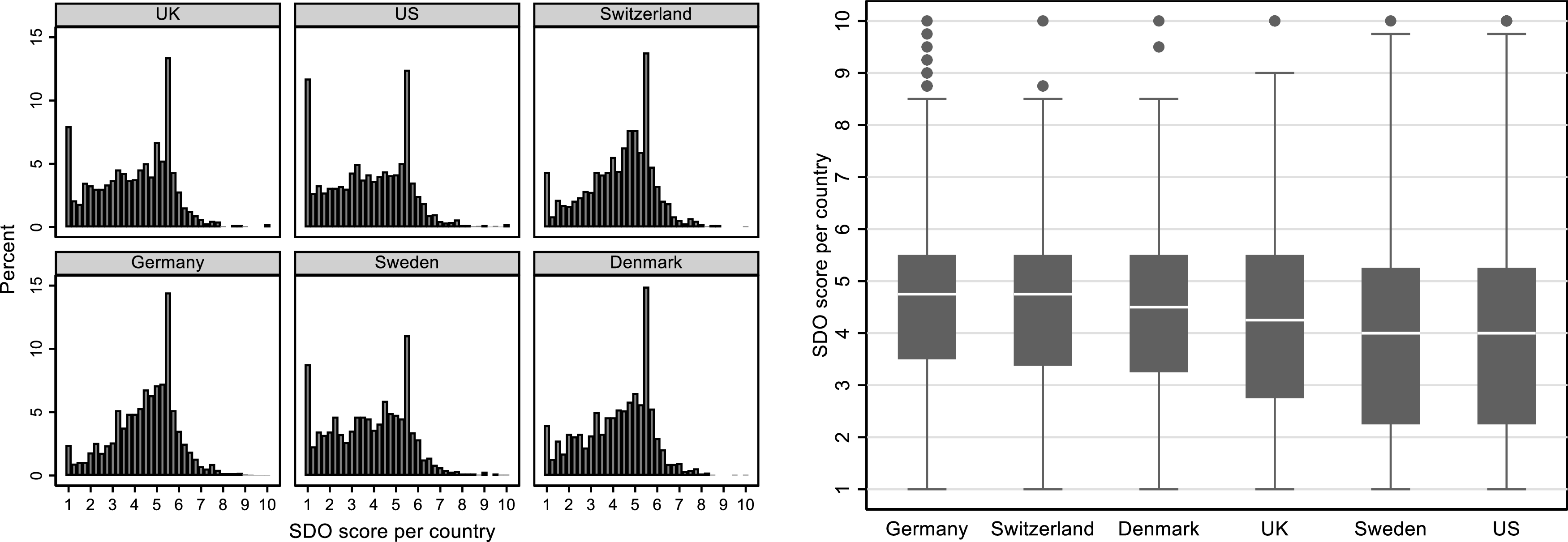
In Figure 1, we provide a descriptive overview of the distribution of SDO in the six countries. A first aspect to note is that although high SDO scores (7 and above) are rare and most respondents in all countries score relatively low (5 and lower), there are still pluralities of respondents that lean toward dominance orientation. There are also noticeable spikes at around 6 on the 1–10 scale, which likely reflect a tendency to choose the scale midpoints among a minority of respondents (ca. 15 per cent). It should also be added that, given the way the individual SDO items are phrased (see above), already relatively low scores (e.g. 3–4) indicate a significant departure from liberal democratic norms of equal treatment and inclusion. In our case, 73.1 per cent of all respondents (i.e. across all countries) score 3 or higher on the SDO scale, and 33.6 per cent score 5 or higher. This means that SDO is quite widespread and that, accordingly, substantively meaningful effects of SDO on political attitudes and behaviour at the individual level should also have substantive implications at the aggregate population level (see Halikiopoulou & Vlandas, Reference Halikiopoulou and Vlandas2025).
The distribution of SDO across countries.

Figure 1. Long description
The image contains two types of graphs: histograms and a box plot. Panel A includes six histograms, each representing a different country: UK, US, Switzerland, Germany, Sweden, and Denmark. The x-axis of each histogram shows the SDO score per country, ranging from 1 to 10, and the y-axis shows the percent distribution. Each histogram displays the distribution of SDO scores within the respective country, with varying peaks and spreads. Panel B is a box plot comparing the SDO scores across the same six countries. The x-axis lists the countries, and the y-axis shows the SDO score per country, ranging from 1 to 10. Each box plot displays the median, interquartile range, and potential outliers for the SDO scores in each country. The box plots allow for a visual comparison of the central tendency and variability of SDO scores across the different countries.
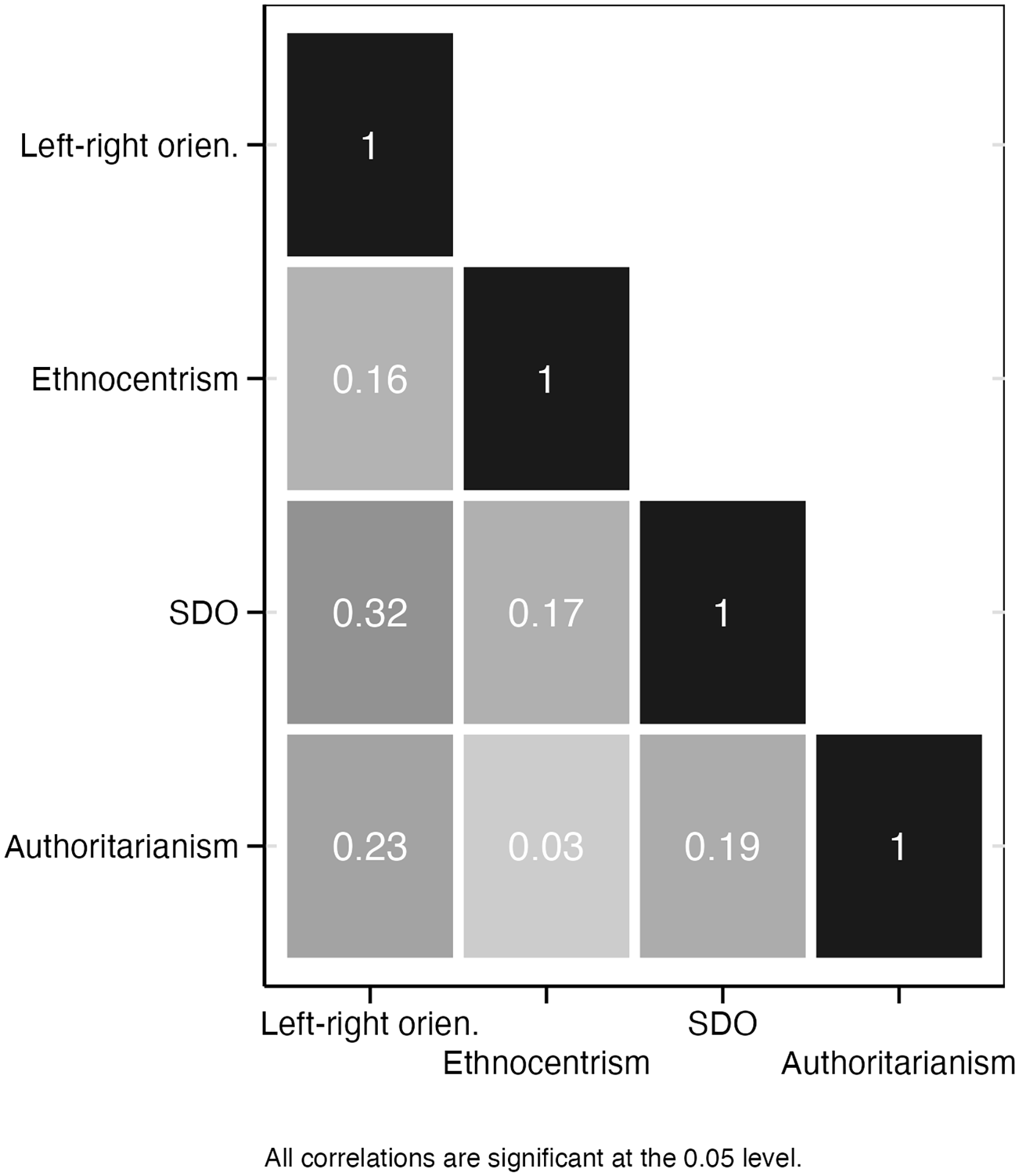
Next, we explore the bivariate relationships between SDO, RWA, ethnocentrism and left–right ideology using Pearson correlations (see Figure 2): our main aim here is to show that SDO captures unique variation that is not already accounted for by the other variables. Unsurprisingly, all variables are positively correlated with each other, but the correlations are, in substantive terms, weak to moderate in strength (and similar to the correlations reported originally by Pratto et al., Reference Pratto, Sidanius, Stallworth and Malle1994). Thus, SDO indeed captures unique variation that is not already measured with other variables more commonly used in the SPA literature.
The associations between SDO and other ideological variables.

SDO and support for social inclusion, equality and social policy
To demonstrate that SDO is a relevant predictor of attitudes toward social equality and inclusion, we assess its effect on attitudes toward gender equality and immigration (using ordinal and linear regression models, respectively). As expected, SDO is clearly related to more regressive attitudes toward gender roles and antipathy toward immigrants (see the top two panels in Figure 3). More importantly, including RWA, ethnocentrism and left-right ideology in the models only slightly attenuates the effect of SDO.
The association between SDO and attitudes toward inequality and inclusion.

Substantively and based on the full model, a one-unit increase in SDO results in a 0.15 standard deviation decrease in support for immigration as measured by the factor scores (see above). This effect (which is net of a range of other ideological and socio-demographic variables) is roughly twice that of left-right ideology (which is also measured on a 0–10 scale and thus easiest to compare to that of SDO). Similarly, a one-unit increase in SDO leads to a ca. 0.7 unit increase in support for more regressive gender roles (in the full model), which is again substantively larger than the effect of left-right ideology.
Next, we assess the relationship between SDO and attitudes toward social inequality and the acceptability of hierarchies. Here, SDO is significantly and negatively related to the view that income differences are too large and positively related to the view that merit justifies large income differences. The magnitude of the effect remains again almost unchanged when adding the other ideological variables to the model. Here again, the coefficient estimates of SDO are either stronger or at least comparable in size to that of left-right ideology.
To test the effects of SDO on support for social policy specifically, we regress SDO on support for unemployment benefits and childcare services. Figure 4 shows the AME estimates of SDO next to the other three ideological variables. As in the two earlier analyses, SDO is significantly and negatively related to support for either type of social policy, and the effect estimates are again only marginally attenuated by the inclusion of the additional ideological controls.
The association between SDO and social policy preferences.

Figure 4. Long description
Two scatter plots compare the impact of different psychological factors on social policy preferences. Panel A: The scatter plot titled Decent living standard unemployed shows the change in probability on the horizontal axis ranging from -0.15 to 0.15. The vertical axis lists four factors: SDO, Left-right, Ethnocentrism, and Authoritarianism. Data points are marked with triangles for the restricted model and circles for the full model. Panel B: The scatter plot titled Expansion of early education follows the same format as Panel A, with the same axes and markers. The plots illustrate how different psychological factors influence preferences for social policies related to unemployment and early education.
Given that SPA and their relationships to predictor variables tend to vary across welfare regimes (e.g. Larsen, Reference Larsen2008), we also explore the between-country differences in the effect of SDO on the two social policy support measures. To do so, we estimate two further models in which we interact SDO with the country dummies and then calculate the conditional marginal effects of SDO across countries and test the joint significance of the interaction terms. While we find that the interaction effects are statistically significant, the cross-country differences in the marginal effect estimates are substantively so small that we consider them negligible (Figure A-4, Appendix).
It is worth emphasising again the stability in the effects of SDO on the different types of attitudes, irrespective of whether other more commonly used predictors such as RWA and left-right orientation are included in the model. This indicates that SDO explains a unique part of the variation in these attitudes that has, by implication, remained unexplained in previous research.
SDO and party support
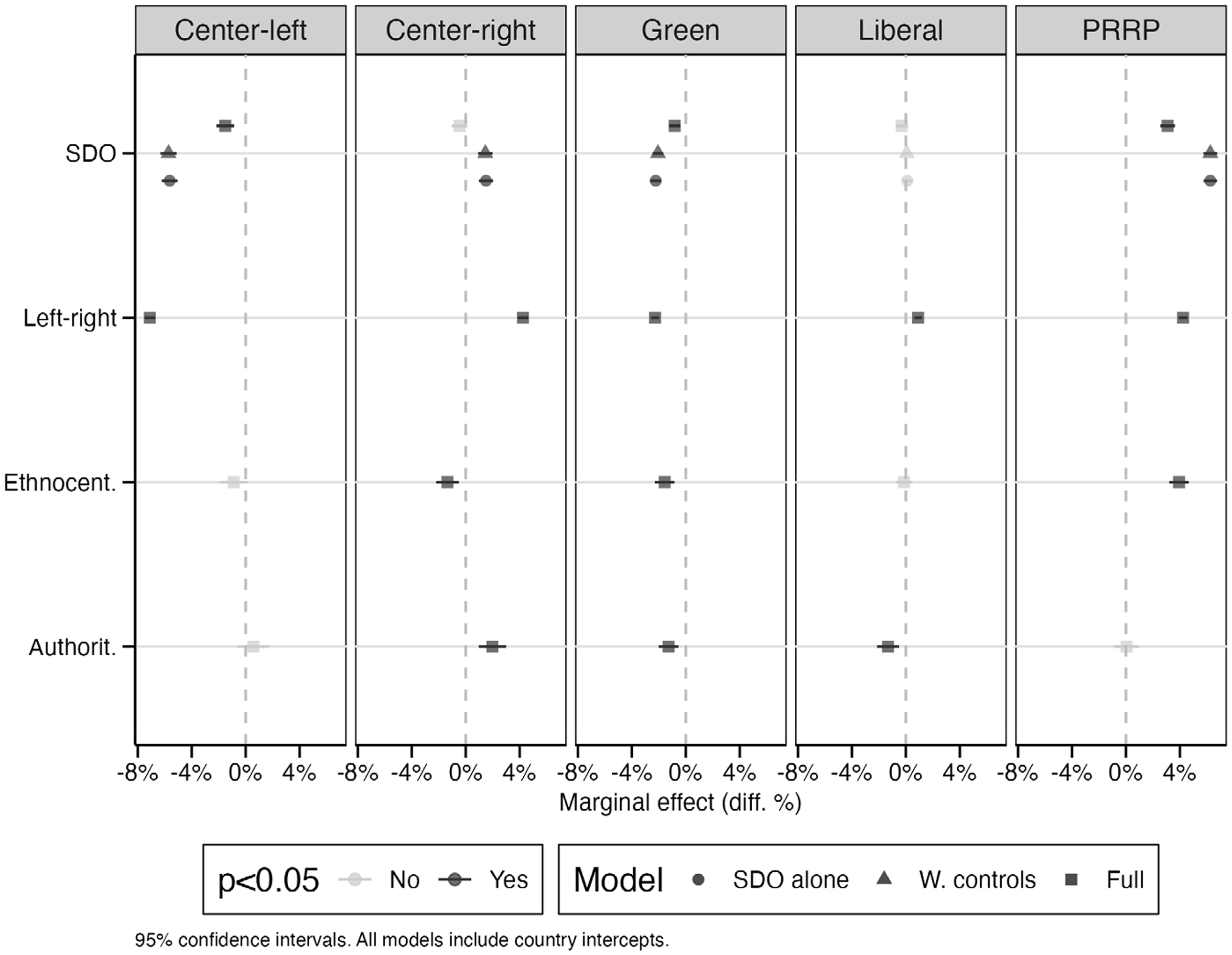
Next, we estimate a set of multinomial regression models where support for different party families is regressed on SDO alone first, then on SDO and the socio-demographic controls, and finally on SDO, the controls and the other ideological variables. Figure 5 displays the main results focusing on the effects of SDO and the ideological variables. In brief, SDO is a strong and consistent predictor of electoral preferences, net of otherwise powerful predictors such as RWA or left-right orientation. First, SDO has a negative effect on support for centre-left parties and a positive effect on centre-right support, but these effects turn insignificant in the final models that include all controls. Support for green parties and populist radical right parties, however, is consistently and significantly linked to SDO, negative in the former case and positive in the latter. These effects get slightly weaker in the full models but remain substantively and statistically significant. For example, the ca. 2–3 pp. increase in populist radical right (PRRP) support associated with a one-unit increase in SDO corresponds roughly to previously estimated effects of severe economic dislocations (Cremaschi et al., Reference Cremaschi, Bariletto and Vries2025).
The effects of SDO on party support.

Interestingly, RWA does not have a significant effect on populist radical right party support in the fully specified model, which is contrary to some previous research (MacWilliams, Reference MacWilliams2016). However, when we estimate a further model in which RWA is added without any of the other ideological variables but with demographic controls and country-dummies, it does have the expected positive and significant effect on populist radical right party support (see Figure A-5 in the Appendix). The effect of RWA on populist radical-right voting is thus less robust than it seems based on the results of earlier studies, which did not control for SDO. This is noteworthy given that RWA is widely used in political science studies as a predictor of populist radical-right voting, and it again underscores the importance of including SDO as either a predictor or, at the very least, a control variable in empirical models.
Additional country-specific models (Figure A-6, Appendix) largely confirm the results of the pooled analysis, with a notable exception: SDO is not robustly linked to populist radical right support in the UK. Here, it has a stronger effect on support for the Conservatives. This, however, likely reflects the strong right-wing populist tendencies of this party at the time when our survey data were collected and thus actually confirms the effect of SDO on support for parties with inegalitarian and chauvinist tendencies.
Conclusion
People differ systematically in their fundamental ideological orientation toward intergroup relations: some people desire different social groups in a society to co-exist on an equal basis, but many others prefer group relations to be hierarchical and for their own group to dominate others. This variable, called SDO, is a relevant predictor of a host of social-political attitudes, including those long studied in social policy literature: attitudes toward social inequality, redistribution, social protection, gender relations, immigration as well as party preferences.
We have shown here that SDO has significant effects on social policy attitudes net of a range of ideological variables that have been more commonly considered in the social policy literature. While admittedly limited in scope, the point of our analysis was to add empirical substance to our larger argument, which is that the social policy literature would benefit considerably from incorporating SDO and social dominance theory more systematically into research projects.
More specifically, insights from social psychological research on SDO could contribute to a better understanding of some important patterns and mechanisms in the welfare state literature. First, and as mentioned earlier, occupation, education and, relatedly, class are central explanatory variables in the SPA literature and in comparative political economy, but the exact mechanisms by which education or membership in an occupation affect social and political attitudes (e.g. via self-selection or socialisation, or both) remain the subject of investigation (Hooghe et al., Reference Hooghe, Marks and Kamphorst2025; Kitschelt & Rehm, Reference Kitschelt and Rehm2014). Recent research offers evidence that SDO, by responding to occupational socialisation experiences, is a mediating link, but more research from different contexts and on self-selection effects is needed (Zubielevitch et al., Reference Zubielevitch, Cheung, Sibley, Sengupta and Osborne2022). Second and relatedly, social status, status threat and status decline have been central in much recent research on the political effects of economic dislocations (e.g. Kurer & van Staalduinen, Reference Kurer and van Staalduinen2022). In this work, RWA has played a central role as a potential mediating variable (Ballard-Rosa et al., Reference Ballard-Rosa, Malik, Rickard and Scheve2021), while the potential role of SDO – a variable that is directly related to status positions – has only begun to be considered (Buzzelli et al., Reference Buzzelli, Nicoli and Sacchi2026 ). Third, recent evidence that SDO, alongside RWA, is formed in early childhood (Reifen-Tagar et al., Reference Reifen-Tagar, Zreik, Cimpian and Shenhav2026), together with the above-mentioned evidence on its genetic roots, should be directly relevant to the SPA literature because it sheds light on the origins of important precursors of social policy attitudes. Finally, the short four-item SDO scale (Pratto et al., Reference Pratto, Çidam, Stewart, Zeineddine, Aranda, Aiello, Chryssochoou, Cichocka, Cohrs, Durrheim, Eicher, Foels, Górska, Lee, Licata, Liu, Li, Meyer, Morselli and Henkel2013) we used here provides social policy researchers with a validated, cross-culturally applicable, and cost-effective instrument to incorporate SDO into survey studies.
Research should continue investigating the potential cross-country differences in the effect sizes of SDO on different types of social policy attitudes. While we found only minor variation in our analysis, this does not preclude variation in the effects of SDO on attitudes toward social policies that we did not consider here. As Pratto et al. (Reference Pratto, Çidam, Stewart, Zeineddine, Aranda, Aiello, Chryssochoou, Cichocka, Cohrs, Durrheim, Eicher, Foels, Górska, Lee, Licata, Liu, Li, Meyer, Morselli and Henkel2013) have argued, the effect of SDO on attitudes toward the treatment of a given group should be stronger when the group in question is involved in group power contestation. Welfare states are known to shape the salience of group distinctions and conflicts (Larsen, Reference Larsen2008), and social policy scholars could draw on their intimate understanding of welfare states to shed new light on how these institutions shape the effects of SDO on social and political attitudes.
Supplementary material
The supplementary material for this article can be found at https://doi.org/10.1017/S0047279426101548
Acknowledgements
An earlier version of this paper was presented at the 2025 Annual Conference of the European Social Policy Analysis Network (ESPAnet) in Milan, Italy. We are grateful to Dorottya Szikra, Philip Rathgeb, Leonce Röth and the other panel participants for their helpful comments and criticism. All remaining errors are obviously our own.
Funding statement
This research was supported by the National Centre of Competence in Research for Migration and Mobility studies (NCCR – on the move), which is funded by the Swiss National Science Foundation (SNSF Project No. 51NF40-182897 and Project No. 212258).
Competing interests
The authors declare none.




 Open access

