

Introduction
As Venturini (Reference Venturini2004) has suggested, in re-constructing the different phases of migratory flows from and to the European continent, the fall of the Berlin Wall was followed by a so-called fifth phaseFootnote 1 of migration in Europe. The quantity of immigrants reaching Southern Europe increased by an order of magnitude, as well as the number of asylum seekers and refugees arriving in countries like Italy and Greece. The Italian demographic composition quickly began to change: after a long tradition of emigration toward Northern and Central Europe and the United States, Italy quickly became a crucial crossroads of the Central Mediterranean and the Balkan routes, with scholars labeling it a ‘new’ immigration country (Pugliese, Reference Pugliese2011). As a result, immigration has been gaining salience since the mid-90s, and has become a central issue within the Italian political debate (Bonifazi, Reference Bonifazi, Heinz, Strozza and Vitiello2007; Bonifazi et al., Reference Bonifazi2009).
Immigration entered political parties’ agendas just as the Italian party system changed to a predominantly bipolar party system during the so-called second republic (Fabbrini, Reference Fabbrini2009). The changed political landscape led to the creation of new parties challenging the status quo and ‘affecting’ (mainstream) parties’ strategies (van Spanje, Reference Van Spanje2010). This is particularly the case with the anti-immigration Lega Nord party [Northern League (LN)]. The increasing salience of immigration has inevitably been linked with increasing issue conflict among the political parties. Left-wing parties began to directly engage in the political debate on immigration in the issue competition model. However, as a complex and multi-faceted issue, immigration has attracted attention from both sides of the traditional left–right political spectrum, as well as from ‘new politics’ actors (Kriesi et al., Reference Kriesi and Pappas2012). These new forces, ‘rooted in the opposition between materialist and post-materialist [value] orientations’ (Kriesi, 1998: 166), saw immigration as a ‘Green/Alternative/Libertarian – Traditional/Authoritarian/Nationalist’ (GAL/TAN) issue (Hooghe et al., Reference Hooghe, Marks and Wilson2002). Immigration can be treated as a security-related challenge to the nation, or claimed by green, left, and center-left parties as a universal human right that deserves international protection (Odmalm and Bale, Reference Odmalm and Bale2015). Immigration can also be used to see the differences in how parties handle an issue depending on whether they are in government or the opposition, and whether this pattern is equally applicable to right- and left-wing parties.
This article aims to answer the following research questions: To what extent is the framing of immigration associated with the traditional left vs. right spectrum? Do parties’ ideologies matter? Do incumbent political parties tend to adopt different positions toward immigration than opposition parties do? Although this is not a new area in the study of party politics in electoral campaigns, this study analyzes the framing of immigration in everyday, non-electoral politics as well. In order to do so, this paper analyzes party competition dynamics on immigration in the news using an original data set assembled from newspaper articles from 1995 to 2011. Data were gathered within the Support and Opposition to Migration (SOM)Footnote 2 project, and are the result of a political-claim analysis of articles from two Italian national daily newspapers, La Repubblica and Il Giornale.
This paper’s goal is to analyze the relationship between framing and parties’ ideologies. The paper is organized as follows: the first part presents a brief review of the existing literature on the agenda-setting approach and framing studies, and explains how recent literature on the politicization of immigration can bridge the two. The second part provides a general overview of the evolution of immigration within the Italian political debate since 1995. The third part presents the results of a statistical analysis investigating the role of political parties’ ideologies in shaping the immigration political debate.
Between agenda-setting and issue framing
Over the past decades, scholars have investigated the politicization of immigration, looking at the way it has gained importance in both public and political discourse and shedding light on the many facets of this issue.Footnote 3
Political actors strategically select and emphasize different immigration-related topics within political and public debates (Buonfino, Reference Buonfino2004; Vaccari, Reference Vaccari2010; Fryberg et al., 2012; Kriesi et al., Reference Kriesi and Pappas2012; Ruedin and Berkhout, Reference Ruedin and Berkhout2012; Colombo, Reference Colombo2013; Helbling, Reference Helbling2013; Morales et al., Reference Morales, Pardos-Prado and Ros2015). Therefore, there is not a single definition of immigration, but rather different ways of interpreting and presenting the phenomenon. This framing process is not immune to political conflict, on the contrary, it should be considered part of the politicization process itself.Footnote 4 van der Brug et al. (Reference van der Brug, Gianni, Joost and Didier2015) conceive the framing process as part of the two-dimensional process of politicization. In this framework, variations in the political attention devoted to a relevant topic (i.e. salience) and the degree of agreement and disagreement among political actors (i.e. polarization) can politicize or depoliticize the issue in question. Thus, when focusing on the framing of the immigration issue by the news media as part of the politicization process, the level of attention and the political parties’ positions toward migration cannot be ignored.
An agenda-setting approach allows the political realm to be mapped using the instruments of political communication (Soroka, Reference Soroka2002). It looks specifically at the way policy entrepreneurs compete to make their preferred issues top priorities on the political agenda. To do this, political actors provide their own interpretations of an issue, that is they frame the issue. Thus, framing is inevitably linked to agenda-setting dynamics, and grants an issue access to the political agenda by defining and presenting it as a relevant problem.
Again, as the agenda-setting approach highlights (McCombs and Shaw, Reference McCombs and Shaw1972; Kingdon, Reference Kingdon1984; Rochefort and Cobb, Reference Rochefort and Cobb1993; Baumgartner and Jones, Reference Baumgartner and Jones1993, Reference Jones and Baumgartner2005; Dearing and Rogers, Reference Dearing and Rogers1996; Soroka, Reference Soroka2002), party competition is a central component of politicization, as well as of the framing process. Issue-specific positions and arguments structuring a political conflict can be identified by examining the way political party actors frame issues.
As Helbling (Reference Helbling2010) and Höglinger et al. (Reference Höglinger, Helbling and Wüest2012) argue, the strategic choice to emphasize or de-emphasize certain aspects of an issue (Koopmans, Reference Koopmans and Olzak2004; Koopmans and Olzak, Reference Koopmans2004) ‘depends crucially on whether a political actor is situated on the left or on the right and whether or not this actor belongs to established political forces’ (Höglinger et al., Reference Höglinger, Helbling and Wüest2012: 243). This is what Robertson (Reference Robertson1976) has called the ‘selective emphasis’ of party competition (Robertson, Reference Robertson1976), in which parties’ strategies are oriented toward issues considered more useful to dominate electoral competition. As in the case of immigration, parties’ ideological and historical roots drive the way they selectively advocate an issue. It is generally assumed that immigration issue framing strictly follows the bi-dimensional nature of political conflict (Odmalm and Bale, Reference Odmalm and Bale2015). In particular, immigration intersects two areas of fundamental political conflict – the role of the state and human rights – with the traditional left–right continuum, putting into question the traditional positions expressed by political actors. On the one hand, a strong role of the state in controlling national borders is preferred by right-wing parties to the more traditional paradigm of free-market liberalism and the limited role of public agencies. On the other hand, left-wing parties tend to put more emphasis on the humanitarian and cosmopolitan perspective on immigrants’ rights than on working class jobs and their need of protection. The humanitarian dimension of immigration structures an authentic new political cleavage, as the literature suggests on this regard. The rise of post-materialist issues such as the environment, respect for ethnic cultures, and nationalism (Inglehart, Reference Inglehart1997; Hooghe et al., Reference Hooghe, Marks and Wilson2002) creates new sources of conflict with socio-cultural rather than strictly economic grounds (Kriesi et al., 2006; Odmalm and Bale, Reference Odmalm and Bale2015). In the case of immigration, these new grounds seem to gain more relevance than the economic ones. Both poles of the political continuum, indeed, frame the immigration issue in a specific way that makes one type of argumentation prevailing over the other: security and defense of national identity over liberalism in the case of the right, humanitarianism over social security in the case of the left.
This is particularly evident in the Italian political debate (Riva et al., Reference Riva, Monica and Lorenzo2008). As a highly contested issue (Boswell, Reference Boswell2003; Morales et al., Reference Morales, Pardos-Prado and Ros2015) in a new country of destination, immigration pushes mainstream political parties to adjust their positions, especially when a political party like LN plays a significant role. Both mainstream right- and left-wing parties face challenges in this policy field: center-right and right-wing parties tend to focus on national culture and border controls, and they tend to adopt more negative positions towards migration. Conversely, left and center-left political parties tend to stress humanitarian arguments and adopt an inclusive perspective of ‘open’ society where cultures and identities mix and integrate each other. Thus, left-wing parties tend to adopt more open, progressive, and in general positive positions towards migration. Their rhetoric usually focuses on migrants’ fundamental rights and the need for national and international protection. This can be seen not only in electoral campaigns but also in non-electoral politics.
hypothesis 1a: If the claimant is a right-wing or a center-right party, then identity- and security-related arguments will be relatively more frequent.
hypothesis 1b: If the claimant is a left-wing or a center-left party, then morality and arguments related to human rights will be relatively more frequent.
Therefore, right-wing parties are expected to frame immigration in securitarian terms, that is as an international threat or a concrete problem for domestic security in hosting societies (Hypothesis 1a). Conversely, left-wing parties are expected to emphasize humanitarian values such as solidarity, cooperation, and respect of the ‘others’ (Hypothesis 1b). In this sense, immigration is conceived as a positional issue. Political parties tend to adopt different immigration stances in relation to their positions on the left vs. right political spectrum. In doing so, they affect the political process as a whole (Wolfsfeld et al., Reference Wolfsfeld, Segev and Sheafer2013).
Furthermore, political actors’ centrality within the politicization process allows a combination of the agenda-setting approach and framing theory. Governments and political opponents act as policy entrepreneurs in setting first the party system agenda and later the governmental political agenda.
In parliamentary political systems, both incumbent and opposition parties are even more powerful in influencing the party-system agenda, as Green-Pedersen and Mortensen (Reference Green-Pedersen and Mortensen2010, 2015) outlined in their new model of issue competition. Opposition parties have the power to challenge the government when they emphasize new issues, even if they are less responsible for the party-system agenda than governing parties. Governments are responsible for policy solutions, but they have to face pressing issues that sometimes diverge from their initial agendas. This structure affects how ruling and opposition parties tend to frame migration. Incumbent parties’ positions are expected to reflect both their own stances towards migrants and the other arguments proposed (Hypothesis 2).
hypothesis 2: When parties are incumbent, their statements tend to be more neutral (neither inclusive nor exclusive) towards migration and they tend to use more instrumental (rather than humanitarian or securitarian) arguments.
Due to the complexity of the issue at stake and the challenging aspects affecting different sub-policy fields for which the government is responsible, incumbent parties are expected to adopt a more neutral tone towards contested issues, such as immigration. They are expected to maintain a stable intra- and inter-party agreement. In terms of (immigration) issue competition, if there is such an inter-party agreement, then center-right and center-left parties will tend to emphasize their neutral positions towards immigration and to provide pragmatic arguments. Otherwise, they will not do so (Odmalm and Bale, Reference Odmalm and Bale2015) in order to guarantee the support of coalition members. In this regard, the above hypotheses specifically focus on arguments and positions towards immigration that incumbent parties tend to adopt. In other terms, when in government, both right- and left-wing parties face the complexity of ruling and dealing with multiple issues, and this is expected to push them to adopt more pragmatic and cautious positions on immigration. In terms of the arguments they use, being in government should discourage the right from securitizing immigration, and the left from supporting moral principles and human rights arguments, because they need to provide practical solutions to emerging specific and circumstantiated problems.
Within this context, another element is worth mentioning concerning the broader literature on the so-called anti-immigration parties (see Mudde, Reference Mudde2004; Norris, Reference Norris2005; Van der Brug et al., Reference van der Brug, Fennema and Jean2005; Van Spanje, Reference Van Spanje2010). Although Italy is not an entirely typical example of the political divide on immigration, the rhetoric employed by a right-wing populist (and ethno-regionalist) party like Lega Nord, with its clear anti-immigration stance, merits inclusion in the analysis. LN played a crucial role in emphasizing immigration as a top priority problem and establishing the issue in the Italian government’s political agenda. In doing so, LN employed the same anti-immigration stances as the rising and consolidating extreme and far right (and populist) parties in Western Europe (Kriesi and Pappas, Reference Kriesi2015).
As previous studies have demonstrated, as a right-wing populist party, LN has firmly maintained its populist rhetoric, whether in a right-wing coalition government [alongside forza italia (FI)/Popolo della Libertà (PDL)] or in the opposition (Bobba and McDonnell, Reference Bobba and McDonnell2015) (Hypothesis 3a). Hence, LN is expected to firmly express its anti-immigration position. On the contrary, left-wing parties’ positions are expected to be more inclusive (Hypothesis 3b).
hypothesis 3a: When the claimant is from a right-wing party, statements tend to be restrictive towards migration.
hypothesis 3b: When the claimant is from a left-wing party, statements tend to be inclusive towards migration.
Moreover, framing might also change in relation to the specific groups or categories actors’ statements refer to. These can be distinguished between administrative status groups (such as ‘irregular immigrants,’ ‘aliens,’ ‘labor migrants,’ and ‘refugees’), religious communities (‘Muslims,’Footnote 5 ‘Jews,’ etc.), and ethnic groups, like ‘Roma and Sinti,’ whose presence in major Italian cities is an element of both national and local political debate (Clough Marinaro and Sigona, Reference Clough Marinaro and Sigona2011; Sigona, Reference Sigona2011; Burchianti and Zapata-Barrero, Reference Burchianti and Zapata-Barrero2012; Gattinara, Reference Gattinara2016). As Anderson (2013) argues, political discourse on immigration tends to homogenize migrants until they are a mere figure, a number that can be manipulated easily for demagogic purposes. The entirely predictable immigrant/refugee (them) vs. us dichotomy is a perfect example of the way migrants are split into different categories to serve political rhetoric: ‘the migrant is a symbolic figure delineating the borders of the national community but taking this separation of Us and Them for granted means that connections and tensions are overlooked’ (Anderson, 2013: 70). Therefore, it is to be expected that the framing of immigration will change according to the criteria already described. The arguments political actors use can explicitly or implicitly refer to immigrants as political or economic actors as well as racial or religious groups.Footnote 6
Finally, following Ferree et al. (Reference Ferree, Anthony, Jürgen and Rucht2002) and Benson (Reference Benson2013), investigating media contents offers the opportunity to assess how immigration, as a contested issue, is shaped in the news. News coverage mirrors the existing political debate on immigration (Helbling, Reference Helbling2013), and despite some inevitable media bias, journalists give voice to politicians, the main actors in the framing process.
This article therefore analyzes the framing of immigration in Italy as a ‘new immigration country,’ whose country-specific features allow the identification of circumstances in which this controversial issue catches media and political party actor attention.
Methods and design
Immigration in Italy
As previously discussed, since 1995 Italy has faced different demographic and political changes that have had significant implications for issue-specific political conflict. As a new immigration country, Italy shares some socio-economic similarities with other countries, such as Spain and Greece. These similarities consist of common immigration patterns (i.e. young, male, low-skilled workers coming from developing countries, most of them employed in the service sector or in small- and medium-size firms in the industrial and agricultural sectors), a high rate of unemployment, a robust informal sector, ‘clandestine’ entries, and a political discourse oriented toward sea and land border security. These shared challenges are exacerbated by inefficient and immature immigration policies.
Historically, Italy’s demographic composition underwent a pivotal transformation with the oil crisis in the 1970s, when outflows decreased and inflows of ‘return migrants’ increased. Particularly since the mid-90s, increasing numbers of foreign nationals and refugees, coming from Balkan countries, Eastern Europe, and North Africa, have crossed sea and land borders and rapidly become residents in Italy.
Structural factors pushed foreign populations (both labor immigrants and refugees) to come to Italy. The most recent significant external cause was the so-called Arab Spring, but the accession of emigration countries like Romania and Bulgaria to the EU affected the migratory flows considerably as well, along with the demographic composition of the Italian population. Peaks in the number of third-country nationals have corresponded to windows of regularization, such as those in 1989, 1990, 1995, 1998, and 2002.
Immigration frames
This work focuses specifically on framing, utilizing a simultaneously deductive and inductive approach to argument categorization. The classification this study presents is the result of a combination of other categorizations developed in previous studies on the framing of immigration (Helbling, Reference Helbling2014; van der Brug et al., Reference van der Brug, Gianni, Joost and Didier2015), which build on Habermas’ (Reference Habermas1993) conception of ethical-political reasoning, as opposed to instrumental, identity, or moral-practical communicative reasoning. In this framework, arguments can be goal-oriented as rational calculations of utilities, identity-related appeals to the traditional dichotomy between them and us, or focused on moral principles and the protection of human rights.
However, this article suggests a different classification that nevertheless takes into account previous contributions. It identifies three main broadly conceived types of actor justifications: national identity- and security-related arguments (i.e. securitarian arguments); arguments related to moral principles and human rights, such as solidarity, individual freedom, women’s equality, and tolerance; and a third category that includes other instrumental arguments such as economic, social security, or pragmatic justifications. To discuss framing, it is also essential to measure whether the political actors taking positions on migration are adopting restrictive or inclusive stances. For this reason, it is operationalized as the second dependent variable included in the operational definition of the framing of immigration proposed in this study.
The two variables operationalized here, argument and position of claim, are conceptually different. Although they are associated from a statistical point of view,Footnote 7 they represent two distinctive dimensions of the framing. There can be claims in which actors provide securitarian arguments while remaining generally in favor of or neutral towards immigration, for example ‘Immigrants do not commit crimes more than Italians do.’ Similarly, humanitarian arguments can be used while adopting restrictive positions towards migration, for example ‘It is not our duty to help them,’ or ‘Let’s help them in their own country of origin.’ Actors can utilize the same arguments while adopting different positions towards migration, and frame the same positions differently.
Data collection
The quantitative analysis used here relies on data gathered within a larger research project, the SOM project. Specifically, the extension of data collection to include the Italian case (which was not originally included in the SOM project data setFootnote 8 ) provided the data analyzed in this work.
The research sample used is a random sample size of 950 days from the 1st of January 1995 to the 31st of December 2011.Footnote 9 This means 450 days of coverage per newspaper, plus 50 days of overlapping coverage from both national newspapers to cross-validate the data. The unit of analysis is a specific component of each article: the political claim, that is, ‘the purposive and public articulation of political demands, calls to action, proposals, criticisms, or physical attacks, which, actually or potentially, affect the interests or integrity of the claimants and/or other collective actors’ (Berkhout and Sudulich, Reference Berkhout and Sudulich2011: 3).
Operationalization and coding procedure
Roberto Castelli (LN) denounces the presence of mosques because of the risk of terrorism and the clash of civilizations (La Repubblica, 24 March 2004).
This is an example of a political claim coded from La Repubblica. A political claim can provide a variety of information, such as: media (La Repubblica), date (March 2004), claimant (a right-wing party member), incumbency (in government), during an electoral campaign or not (not in electoral campaign), topic (integration), claimant’s position (restrictive towards migration), migrant group (Muslims), and argument(s) (identity-security argument).
Each aspect has been operationalized into distinct dimensions. These are:
∙ Media: distinguishing between the two newspapers used as data sources, that is, La Repubblica and Il Giornale;
∙ Date: indicating when the claim was voiced (day/month/year);
∙ Political actor: this variable connects a claimant’s statement with his/her party’s position on the left–right continuum (Mair and Mudde, Reference Mair and Mudde1998; Mudde, Reference Mudde2002). This work developed a classification system for Italian political parties (and then their party members), dividing them into four categories: (i) left-wing (7.4% of the claims), (ii) center-left (25.8% of the claims), (iii) center-right (30.3% of the claims), and (iv) right-wing (36.5% of the claims). Within the left-wing category (i), this work grouped parties like the Italian PRC and Federazione dei Verdi, while parties like Partito Democratico, Democratici di Sinistra, Partito Socialista Democratico Italiano, and Partito Popolare Italiano were included in the center-left category (ii). The category of center-right (iii) parties includes Silvio Berlusconi’s parties, the FI and PDL, and other Christian-democrat and conservative parties like the Centro Cristiano Democratico, Unione di Centro, and Alleanza Nazionale (AN).Footnote 10 LN is classified as the only right-wing populist (ethno-regionalist and anti-immigration) partyFootnote 11 (iv);
∙ Incumbency: a binary variable, specifying whether the claimant belongs to a party that, at the moment the claim is made, is incumbent (or is part of the governing coalition).Footnote 12 The ‘incumbency’ variable has a value of ‘1’ if they are incumbent, otherwise it has a value of ‘0’;
∙ In electoral campaign: a binary variable that takes into account the national electoral campaigns that took place in Italy from 1995 to 2011. Claims falling within 60 days (2 months) before a general election are coded as ‘1’ (in electoral campaign), while all others are coded as ‘0’ (not in electoral campaign);
∙ Topic: distinguishing between claims related to immigrants’ entry to and exit from the state (Italy) and those pertaining to integration;
∙ Migrant group: the nominal ‘migrant group’ variable specifically deals with immigrant minority groups, excluding all non-immigration-related categories and coding the immigration-related ones into six groups. These are: asylum seekers and refugees, irregular immigrants, labor migrants, Roma and Sinti, Muslims, and other migration-related groups (e.g. racial or religious groups);
∙ Inclusiveness or position: a dichotomous variable, in which ‘1’ indicates an inclusive claim and ‘0’ indicates a non-inclusive claim (i.e. a restrictive position);
∙ Arguments: this nominal variable consists of three different categories: ‘1’ corresponds to identity-security, ‘2’ corresponds to morality-human rights, and ‘0’ indicates instrumental (pragmatic) arguments (i.e. all the other possible values). While in the SOM codebook on media data one claim can have up to two arguments coded in a single row, in this work claims with more than one argument have been split up into a corresponding number of claims. The data are weighted accordingly: 1 point is assigned to each claim that contains only one argument, while claims with two arguments are broken down into two separate claims, with each one assigned 0.5 points.Footnote 13
Data source selection
As Hallin and Mancini (Reference Hallin and Mancini2004) suggest, the Italian media system can be conceived as a ‘Mediterranean or polarized pluralist model.’ Thus, there is no substantial variation in terms of the quality of sources. Newspaper circulation data shows that the two newspapers selected gained relevance in the public space (Magone, Reference Magone2009), have a major circulation within the country,Footnote 14 and reflect the existing political (left vs. right), and sometimes territorial (such as Milan vs. Rome), cleavages that characterize the Italian context. Country-specific features had to be considered in the selection of national newspapers, such as the need to consider the local and regional dimensions that immigration has taken on (with specific regard to the Northern regions, particularly reflected in Il Giornale), as well as the distribution numbers at the national level (Berkhout, 2015, in van der Brug et al., Reference van der Brug, Gianni, Joost and Didier2015). The selection of quality newspapers had to take into account their political party affiliation as well; in Italy, newspapers’ political traditions are evident in the center-left mainstream broadsheet La Repubblica and the right-wing newspaper owned by the Berlusconi group Il Giornale. Footnote 15 The media’s political parallelism (Papathanassopoulos, Reference Papathanassopoulos2007) is particularly evident in the Mediterranean media system (Hallin and Mancini, Reference Hallin and Mancini2004) that characterizes Italy, in which the relationship between media and politics remains strong (Bobbio and Roncarolo, Reference Bobbio and Roncarolo2016). Thus, this aspect must be considered as well when analyzing the political debate on immigration.
Media attention on immigration is inevitably biased to a certain extent (Koopmans, Reference Koopmans and Olzak2004). Journalists select news items, emphasizing or de-emphasizing issues in relation to the priorities of their own media agendas. This risks altering the actual objectivity of media data, especially newspaper data (Semetko and Scammell, Reference Semetko and Scammell2012). However, the filtering role journalists play in selecting news items can be useful in understanding what (i.e. immigration-related topic) was seen as being worth media attention, as the two newspapers selected here are considered quality newspapers. Moreover, media still represents the main channel of communication between political actors and the public sphere. The media mirrors the immigration political debate, while maintaining its watchdog function and generally adopting a more neutral perspective compared to other data sources such as party manifestos.
Hence, the following analysis proposes a combination of descriptive statistics and multivariate analyses based on immigration-related news items’ political claims. Data are analyzed using multiple-variable logistic regression.Footnote 16
Results: the evolution of immigration in the news coverage
Immigration has quickly entered the Italian political agenda as a threatening new phenomenon that has challenged the precarious socio-economic and cultural equilibrium of the country.
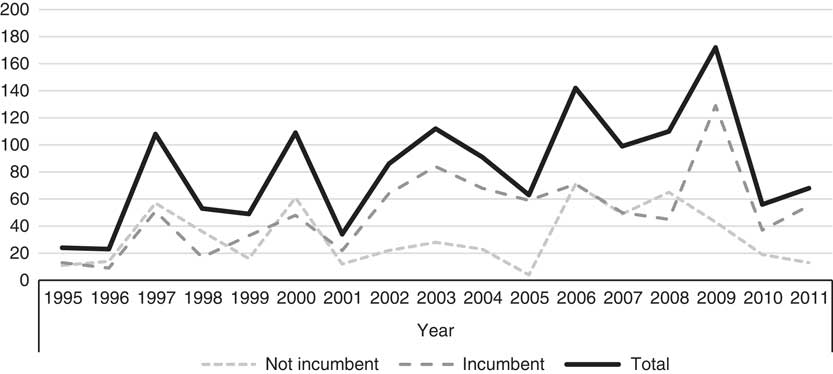
As Figure 1 shows, media coverage of immigration has had several ups and downs. It is possible to identify distinct phases: from 1995 to 2000, there are two peaks in the number of claims, in 1997 and 2000. The third phase, from 2001 to 2005, is characterized by a relative decrease in the amount of attention paid to immigration, but the number of claims increases again during the fourth phase from 2005 to 2009. Indeed, in this last period the total number of claims is the highest. This last phase is followed by a rapid decrease in news coverage in 2010 and a small increase in 2011. Overall, the data confirm an increase of media attention on this issue since the early 2000s.
Distribution of political actors’ claims in Italy by year (1995–2011). The figure shows the distribution of all claims included in the data set (n=1265). Source: Author’s elaboration.

The increasing attention paid to immigration in the news over time reflects some of the important events that contributed to reinvigorating the political debate. For instance, the 1997 ‘Albanian emergency’Footnote 17 (Dal Lago, Reference Dal Lago1999) was depicted negatively in the news, with many news outlets focusing on irregular migration problems and expulsions. This has also characterized the content of statements and political claims following the second phase of arrivals from former Yugoslavia between 1999 and 2000.
At the domestic level, a highly contested debate on the 2009 proposal concerning citizenship reform received a great deal of media visibility and political attention from both sides of the political spectrum. The reform was in fact promoted by Gianfranco Fini (a fundamental member of the newly founded center-right People of Freedom party led by Silvio Berlusconi) and supported by some members of the center and center-left, such as the Union of Christian and Center Democrats, the Democratic Party, and Italy of Values (Zincone, Reference Zincone2010).
Another relevant factor that characterizes the Italian political debate on immigration is the type of actor, that is who is the main claim-maker. Figure 1 shows political actors’ claim distributions over time. These are governmental or legislative actors, as well as party members and leaders. Not surprisingly, 61.1% of the total number of claims coded were made by incumbent political actors (773 out of 1265). This may be due to the media’s selective attention (Vliegenthart et al., 2016), and more specifically on the opportunities media outlets give to different political actors. It has been thoroughly demonstrated that governmental actors have more opportunities to gain access to the news, playing a major role in the media’s agenda setting (Bennett, Reference Bennett1990; van Dijk, Reference Van Dijk1995; Baumgartner and Bonafont, Reference Baumgartner and Bonafont2015).
Changes in the framing of immigration: the effects of ideology and incumbency on arguments
An examination of the statements voiced by members of political parties allows an investigation of the political conflicts surrounding immigration and how this has affected the framing process. The hypotheses tested in this work relate to all of the main Italian parties directly engaged in the political debate on immigration since 1995. Parties are categorized in relation to their positions on the left–right political spectrum. Furthermore, this analysis looks for a connection between parties’ positions and their incumbency to test whether parties adopt different strategies when they are in government or in the opposition.
This analysis also takes into account whether a claimant’s political party is incumbent or not, examining the successive ten Italian governments between 1995 and 2011.
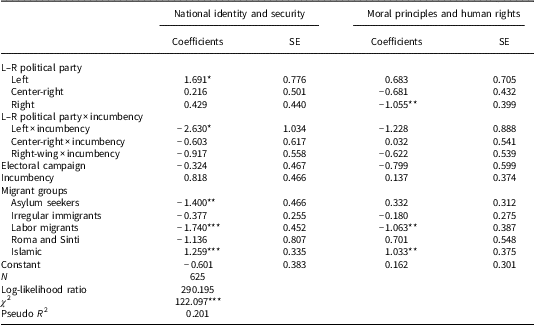
Furthermore, as previously discussed, since both dependent variables are categorical, logistic regression models have been used. Two different models have been run including the interaction terms here considered. Each model also includes other dimensions, such as whether the claim was made during an electoral campaign,Footnote 18 and whether it refers to a specific category of migrant. The empirical analysisFootnote 19 reveals a complex scenario. Table 1 presents the results of the multinomial regression model related to Hypotheses 1 and 2. The first two columns on the left show the estimated coefficients for national identity and security arguments. In this model, party position is the explanatory factor, while all the other independent variables are included in the model. The model also includes an interaction term connecting party position and incumbency. The third and the fourth columns report the estimated coefficients for arguments dealing with moral principles and human rights compared with the reference category (i.e. other instrumental).
Identity-security and morality human rights arguments

The reference group of the multiple-variable logistic regression is other instrumental (pragmatic) arguments.
Reference categories: L–R political party (center-left), electoral campaign (no), incumbency (no), migrant groups (others).
*P≤0.05, **P≤0.01, ***P≤0.001.
As Table 1 shows, the results confirm the hypotheses, but also highlight a more complex reality. There is a significant positive correlation between left-wing party identity and arguments dealing with national identity and security, meaning that left-wing parties (such as the PRC) are more likely to use identitarian and securitarian arguments compared with center-left parties (which are the reference category).
The interaction term between party family and incumbency shows a negative and significant association for incumbent left-wing parties. This indicates that while left-wing parties are more prone to using identitarian/securitarian arguments than center-left parties when both are in the opposition, the opposite is true when these parties are in government.
When the claim refers to labor migrants, political parties are significantly less likely to use humanitarian arguments, and more likely to employ instrumental ones. Conversely, there is a positive and significant relationship between references to Islamic groups (as the target of claims) and the use of arguments related to moral principles and human rights. As is evident in Table 1 (third and fourth columns), LN is less likely to adopt arguments dealing with moral principles and human rights. Center-right parties are also less likely to adopt moral principles and human rights arguments, although the correlation is not significant in this case. This tendency of LN’s seems to be even stronger when LN is in government (the coefficient is negative, although not significant). On the other side, left-wing parties are more likely to frame their claims in humanitarian terms when they are at the opposition. When in government, they tend to use fewer humanitarian arguments (even though the results, at 0.001, are not significant).
Changes in the framing of immigration: ideology and inclusiveness
The third hypothesis focuses on inclusiveness of the claims that political party actors tend to adopt when debating immigration in the news. The traditional left–right spectrum is expected to be highly correlated to the inclusive-exclusive positions political actors adopt within the immigration political debate (Hypothesis 3).
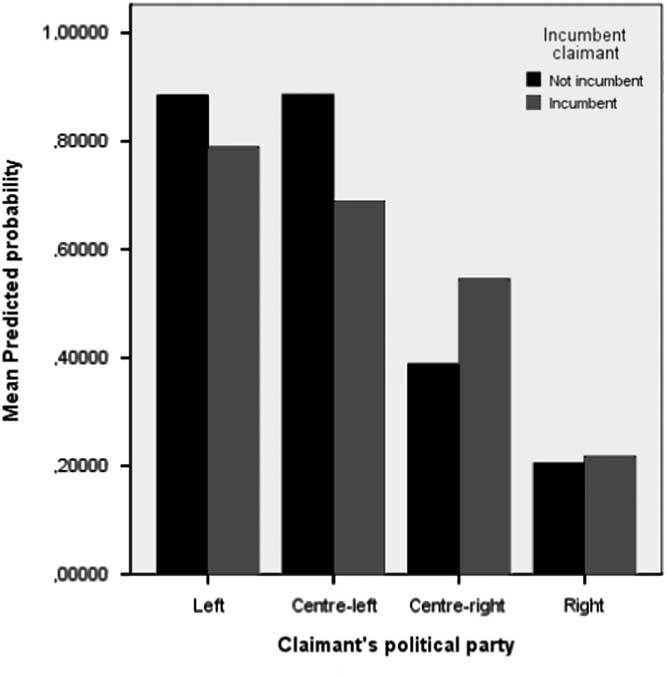
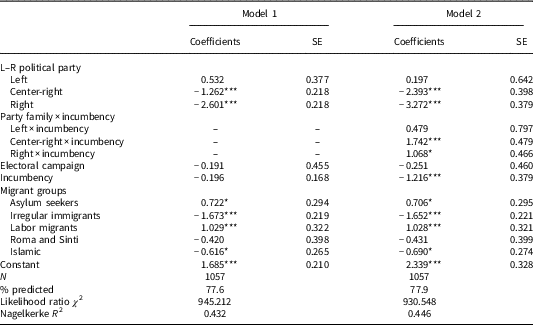
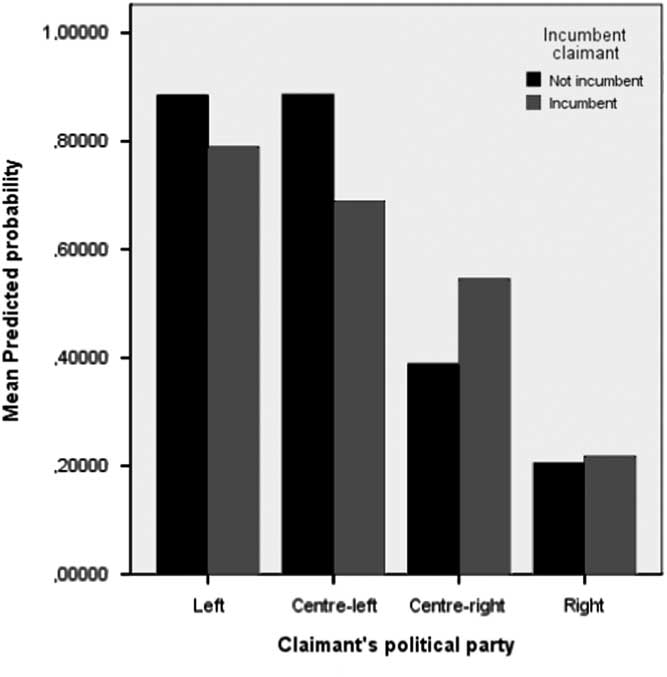
The analysis highlights that position towards migration is linked to parties’ political ideologies; thus, the two logistic regression modelsFootnote 20 confirm this hypothesis. The results from model 1 allow the relationship between political party and inclusiveness toward migration to be examined. Left-wing and center-left parties tend to adopt more inclusive positions toward migration, while inclusive claims are rarer from right-wing and center-right party members. Model 2 shows how widespread this association is. By adding the variable of incumbency as a mediator between political party and inclusiveness, parties’ strategies for framing immigration can be further categorized based on their being in government or in the opposition. The results are consistent with those of Model 1. The coefficients of the interaction terms between incumbency on the one hand and center-right and right-wing party membership on the other are positive and significant, substantially counterbalancing the negative ‘effect’ associated with incumbency per se. Indeed, the coefficient of the incumbency variable shows that center-left parties’ members (which are the reference category) tend to soften the inclusiveness of their claims when they are in government. The same can be said for left-wing parties’ members, since the coefficient of the interaction between this category and incumbency is only slightly positive (even though not significant). This means that being in government is associated with less inclusiveness when claimants are members of center-left or left-wing parties, while center-right and right-wing parties’ members do not modify their positions when in government. In sum, as Figure 2 shows, being in government only softens the position of claims on immigration on the left side of the political spectrum (Table 2).
Estimated predicted probability of inclusive position. The figure shows the estimated predicted probability of an inclusive claim for different combinations of the political party and incumbency variables. Source: Author’s elaboration.
Inclusive position

Dependent variable of the multiple-variable logistic regression is inclusive position (1=inclusive, 0=exclusive).
Reference categories: L–R political party (center-left), electoral campaign (no), incumbency (no), migrant groups (others).
*P≤0.05, **P≤0.01, ***P≤0.001.
The relationship between inclusiveness and other background (independent) variables reveals that the positions political party actors tend to adopt vary substantially when referring to different targeted groups. Not surprisingly, claims tend to be more inclusive when they refer to asylum seekers, refugees, and labor migrants. Conversely, when irregular immigrants and Islamic groups are the targets, claimants’ positions toward migration tend to be less inclusive.
A comparison of the two models’ Nagelkerke R 2 shows a small increase in the value from Model 1 to Model 2. Thus, the introduction of the interaction effect increases the model’s overall goodness of fit, which is relatively high.
To conclude, parties’ positions on the left–right continuum are strongly linked to the pro- or anti-immigration stances they adopt within the political debate. Thus, parties on the right side of the political spectrum, and particularly LN, tend to be anti-immigration, and their positions do not change substantially when party members are in government (Bobba and McDonnell, Reference Bobba and McDonnell2015). On the other hand, center-left and left-wing parties tend to adopt positions on immigration that are definitely more inclusive. This means that the left–right axis and the pro-/anti-immigration axis are strongly linked and tend to overlap. Being in government substantially affects this mechanism, wielding a ‘softening’ effect on the center-left and left-wing parties. At the same time, evidence supports spatial competition theories: the left–right dimension of political conflict drives parties’ competition on immigration (van der Brug and Spanje, 2009; van der Brug et al., Reference van der Brug, Gianni, Joost and Didier2015). Once more, LN is not the only party that ‘owns’ the immigration issue; left-wing parties strategically debate immigration, and change their focus/position depending on the issue at stake (Green-Pedersen and Walgrave, Reference Green-Pedersen and Mortensen2014).
Final discussion and conclusion
Although there have been several ups and downs, immigration has gained salience within the Italian political debate since the end of the 90s and the beginning of the 2000s. This corresponds with an increase in the number of immigrants coming to Italy, both those in transit to other countries and those settling in the Belpaese. A specific focus on the political-claim analysis shows that political party actors’ strategies for framing immigration underline the controversial nature of the issue.
The regression models performed here allow an estimation of the likelihood that immigration will be framed in securitarian or humanitarian and inclusive or exclusive terms based on parties’ political ideologies. The results mainly confirm previous studies’ findings, but not always in the ways expected.
First, being in government seems to play a crucial role in ‘softening’ the way party actors frame immigration, in terms of both the arguments used and the pro- or anti-immigration positions adopted. When they are incumbent, parties are more responsive to the party-system agenda (Green-Pedersen and Mortensen, Reference Green-Pedersen and Walgrave2015). Thus, when incumbent parties are center-right, they tend to frame immigration in pragmatic terms. This is also related to contextual factors: in the case of Italy, the presence of LN within a government coalition (2008–11) might have affected the way PDL, the mainstream center-right party, framed immigration, pushing it to adopt a neutral position towards migration in order to counterbalance LN’s more extreme position. However, the same can also be said in reference to center-left and left-wing parties. Incumbency seems to play a role in changing the way (leftist) parties tend to present and define immigration, as they have to bear in mind other political actors’ points of views while responding to their own electorate’s expectations. Therefore, when in government, left-wing parties tend to focus more on instrumental arguments. This further highlights the complexity of the issue at stake, and the complexity of policy fields in which the government must respond to both the media and public opinion.
Second, the use of identitarian and securitarian arguments does not seem to be strongly affected by parties’ political ideologies.Footnote 21 In fact, members of left-wing parties are significantly more likely to frame immigration in these terms. However, this does not mean that left-wing parties’ claims are restrictive towards migration; left-wing parties’ claims may use these frames and nevertheless be positively oriented towards migration, as in the following examples:
Livia Turco (PDS) declares new measures in favor of non-EU nationals’ collaboration with the police forces to combat crime (La Repubblica, 5 August 1999).
Luciano Violante (DS) criticizes Bossi’s position on immigration because it is against social cohesion and generates insecurity (La Repubblica, 7 May 2002).
Being in government appears to influence only members of parties on the left side of the political spectrum, making center-left and left-wing parties more similar to each other.
Conversely, frames for immigration that rely on moral principles and human rights arguments seems to be more linked to parties’ positions on the left–right axis. Members of center-right parties and above all the LN rarely justify their statements in humanitarian terms. This tendency was confirmed and even slightly reinforced when LN was part of the right-wing government coalition led by Silvio Berlusconi. Third, findings indicate that there is a significant correlation between the left–right axis and the pro-/anti-immigration continuum. However, the picture is more nuanced when incumbency is considered. Take the center-left parties as an example: overall, they tend to adopt inclusiveness more frequently than center-right (and, even more, right-wing) parties do. Nonetheless, when in government this tendency is more muted. Results show that incumbency is a key factor that affects the way party actors frame immigration, particularly on the left side of the political spectrum. It plays a crucial role in ‘softening’ both the ideological impetus of argumentation and the extremism of pro- and anti-immigration positions.
Thus, data show that immigration is more a positional issue than a valence one. Political actors’ positions towards migration appear to be anchored to the old left vs. right dimension of the political conflict (van der Brug and Spanje, 2009).
Fourth, the empirical analysis shows that the migrant group targeted by the claim is another fundamental factor that influences a claimant’s strategic choice to use certain arguments rather than others or adopt different positions toward migration entirely. In most cases, claim-makers’ rhetoric changes in relation to the migrant-related status and, more specifically, whether the targeted groups are asylum-seekers, labor migrants (seen as ‘good’ migrants), or irregular immigrants or migrants from Islamic groups (portrayed in negative and predominantly securitarian terms) (Anderson, Reference Anderson2008). The restrictive, identitarian, and securitarian ways in which political actors frame immigration when referring to Muslims in Italy is also prevalent within political debates in other Western European countries, such as the United Kingdom, Switzerland, Spain, and Belgium (Ruedin and Berkhout, Reference Ruedin and Berkhout2012).
Finally, the data presented here builds on the issue competition approach (Green-Pedersen and Mortensen, Reference Green-Pedersen and Walgrave2015). It demonstrates that parties’ engagement within the political conflict goes beyond electoral campaigns. This also means that the LN is not the unique owner of the immigration issue; other parties from both sides of the political continuum take part in the immigration debate, and incumbent parties are not exempt, just as in other European countries of ‘new’ and ‘old’ immigration such as Spain, the Netherlands, and the United Kingdom (van der Brug et al., Reference van der Brug, Gianni, Joost and Didier2015). Governments are directly involved in the politicization process as well (Green-Pedersen and Mortensen, Reference Green-Pedersen and Mortensen2010, Reference Green-Pedersen and Mortensen2012), although they take stands that do not always coincide with their political ideologies. This makes immigration an even more controversial issue, one that remains relevant to political parties and government agendas.
Data.
The replication dataset is available at http://thedata.harvard.edu/dvn/dv/ipsr-risp
Acknowledgments.
The author wishes to acknowledge this special issue’s guest editors for their valuable comments.
Financial Support.
This research received no grants from public, commercial or non-profit funding agency.
Conflicts of Interest.
None..