




No CrossRef data available.
Article contents
The effect of a low level primary Schistosoma japonicum infection on establishment of a challenge infection in pigs
Published online by Cambridge University Press: 09 October 2003
Abstract
The aim of the study was to investigate the effect of a low-level primary infection of Schistosoma japonicum on a challenge infection in pigs. Groups of pigs were given either light or heavy primary infections and heavy challenge infections 14 weeks later. One group of pigs served as a challenge control group. Challenge infection superimposed on the heavily infected pigs did not result in increased worm burden, faecal and tissue egg counts or IgG levels. In contrast, the challenge infection established fully when superimposed on the light primary infections. However, neither faecal egg counts nor the IgG levels increased, and the amount of liver pathology, as judged by septal fibrosis, did not increase either, as compared to the challenge control group. These results suggest that pigs are not able to mount an effective anti-worm response to reinfection when the primary infection is low. However, some modulation of the infection takes place, possibly as a result of an anti-embryonation effect. Collagen content in the liver was found to be relatively insensitive as a marker for liver pathology, as judged using portal and septal fibrosis as a criteria.
Keywords
Information
- Type
- Research Article
- Information
- Copyright
- 2003 Cambridge University Press
INTRODUCTION
Schistosoma japonicum is a zoonotic parasite infecting man as well as a wide range of other mammalian hosts, including the pig. The use of the pig as a host model for S. japonicum infection in humans has been explored due to the many anatomical, physiological and immunological similarities between humans and pigs (Phillips & Tumbleson, 1986; Willingham & Hurst, 1996; Johansen et al. 2000). Many clinical and pathological consequences of infection are also similar in pigs and humans, including fibrosis formation and granulomatous reactions around eggs in various tissues (Yason & Novilla, 1984; Hurst, Willingham & Lindberg, 2000; Johansen et al. 2000). It has been shown that pigs mount an effective response to a re-infection, resulting in prevention of establishment of the challenge infection, provided that the primary infection is relatively high (Willingham et al. 1997; Sørensen et al. 1999). Congenital transmission has also been demonstrated in pigs as well as in humans (Willingham et al. 1999). Willingham et al. (1999) thus showed that pregnant sows infected during late pregnancy all gave birth to congenitally infected piglets. However, the establishment of worms in the congenitally infected piglets was rather low, i.e. most piglets harboured only a few worm pairs. Further studies done by Johansen et al. (2001) showed that a challenge infection superimposed upon congenitaly infected piglets established fully, i.e. no anti-worm response was elicited. Various possible reasons for this have been proposed, including an age-related limited immuno-competence in the young piglets, tolerance, or simply that the very light primary infection is unable to induce an effective anti-worm response. However, very little information is available regarding the effect of a low-level primary S. japonicum infection on challenge infections in pigs. The present study was therefore undertaken to elucidate the ability of a low-level primary S. japonicum infection to induce resistance to a challenge infection, using parasitological, immunological and pathological parameters.
The paper also reports on an attempt to quantify hepatic collagen content and to use it as a marker of liver fibrosis. The motivation to study liver fibrosis in schistosomiasis derives from the fact that the most important morbidity from infection with S. japonicum is due to the complications of liver fibrosis (Wyler, 1992). Kardorff et al. (2003) used the pig model to study the relationship between gross pathology and the amount of hepatic collagen in a 12-week-old infection. They showed that the hepatic collagen content among infected pigs clearly exceeded that of uninfected pigs and that a clear correlation existed between collagen content and gross pathological scores of the liver. In this study we tried to evaluate the use of the method under different conditions i.e. different infection levels and different lengths of infection.
MATERIALS AND METHODS
Experimental animals and study design
Forty-nine Danish/Yorkshire/Duroc crossbred pigs, aged 8–11 weeks and weighing 10–17 kg at the beginning of the experiment, were used. After being housed in a stable with straw-bedded concrete floor for 5 weeks, the pigs were moved to a pasture plot. At the pasture plot all the pigs had the possibility of seeking indoor protection in a straw-bedded shelter and were fed commercial pig fodder and water ad libitum. The pigs, 25 females and 24 castrated males, were grouped according to sex and weight into 7 groups of 7 animals each and infected with S. japonicum as presented in Table 1. Group 1 received a light primary infection (100 cercariae) and a challenge infection (1000 cercariae) week 14, group 2 received a heavy primary infection (1000 cercariae) and a challenge infection week 14, groups 3 and 4 received only a light primary infection, and groups 6 and 7 received only a heavy primary infection. Group 5 was the challenge control group, receiving a heavy infection (1000 cercariae) in week 14. Necropsy of all groups took place 22 weeks following the primary infection except for groups 3 and 6, which were necropsied in week 14 following the primary infection. Unfortunately 1 pig died during the experiment and no results were obtained from this pig. The pigs were infected intramuscularly with S. japonicum cercariae of a laboratory maintained Anhui strain according to the method described by Willingham et al. (1996). In the collagen study 2 additional groups of uninfected pigs were included in order to assess the collagen content in the liver of naïve pigs. Group 8 contained 3 pigs at 14 weeks of age and group 9 contained 3 pigs at 26 weeks of age.

Starting from week 5 following the primary infection, faecal and blood samples were obtained every second week except for week 15.
All pigs were treated in accordance with the Danish animal ethic law.
Parasitological techniques
At the time of necropsy the pigs were weighed. Prior to slaughtering the pigs were sedated with 0·07 ml/kg Zoletil® (Boehringer Ingelheim, Hellerup, Denmark) and 0·1 ml/kg Narcoxyl® (Veterinaria AG, Taastrup, Denmark). The anaesthetized pigs were then killed by an overdose of pentobarbital (30 mg/kg) and perfusion was carried out according to the method described by Bøgh et al. (1997) in order to collect the schistosomes from the liver and intestinal mesenteries. After perfusion and manual inspection of the intestinal mesenteries, the worms were counted and sorted according to sex and maturity. Worm nodules were also counted as they are considered to contain a dead worm pair (Willingham et al. 1998). Pathological changes of the liver in terms of the degree of portal and septal fibrosis were scored as none (0), mild (1), moderate (2) and severe (3). Tissue samples were taken from the caecum and from the central part of the left lateral lobe, the central lobe and right lateral lobe of the liver. Estimation of the number of eggs in the liver and caecum was done according to the method described by Bøgh et al. (1996) and Giver et al. (1999), respectively, and expressed as egg per gram (epg) of tissue. The collagen content of the liver was determined essentially as described by Wyler (1972) which involves biochemical quantification of the amount of protein-bound hydroxyproline. The hydroxyproline content in collagens was set to be 14% according to Etherington & Sims (1981). The result is expressed as the percentage collagen/g of tissue.
Faecal egg counts were done by the method described by Willingham, Johansen & Barnes (1998) which combines filtration, sedimentation and centrifugation. The result is expressed as epg faeces. Detection of specific IgG against worms and eggs was done by ELISA using crude worm and egg antigens as target. The method was essentially as described by Johansen et al. (1996). Worm antigen concentration was 3·0 mg protein/ml buffer and the egg antigen concentration was 1·0 mg protein/ml buffer. Sera were diluted 1[ratio ]2500 for worm antibody detection and 1[ratio ]2000 for egg antibody detection. HRP-conjugated goat anti-pig was diluted 1[ratio ]3000 for plates containing worm antigens and 1[ratio ]4000 for plates containing egg antigens.
Statistical analysis
One-way analysis of variance with treatment of 7 levels as the factor was applied to test for differences in group means for worm burden, faecal and liver egg counts, antibody levels and collagen content. Data for worm burden, faecal egg counts and tissue egg counts were log10(x+1) transformed before the analysis because they were not normally distributed. Sheffes post-hoc multiple range tests were used to identify groups that differed from others. Repeated measures of variance was applied to analyse the faecal egg counts. Pearson's correlation was used to assess possible correlations between collagen content of the liver and tissue egg counts, worm burden and fibrosis. Kruskal-Wallis test was used to compare the ranked degree of liver fibrosis between the different groups. Analysis was carried out with the SPSS for Windows (10.0) statistical program. For all tests P values <0·05 were considered significant.
RESULTS
Infections were established in all pigs exposed to S. japonicum. In 4 out of 14 pigs, which received a low-level primary infection, only immature and/or male worms were recovered. However, S. japonicum eggs were found in low numbers in all of these pigs, except for 1. The vast majority of pigs showed no clinical signs of schistosomiasis except for a few pigs which had slight diarrhoea around the onset of patency of infection.
Worm recovery
The number of worms (male, female, immature and nodules) recovered at perfusion is presented in Fig. 1. The mean percentage of establishment among all pigs only receiving a primary infection was 9·5% (range: 1–26·7%). Size of cercarial exposure had no influence on percentage establishment as the average establishment rate for 100 cercariae was 8·1% and the average establishment for 1000 cercariae was 10·2%.

Fig. 1. Geometric mean number of Schistosoma japonicum worms (male, female, immature and worms in nodules) recovered at perfusion with 95% confidence interval (indicated by error bars) for the total worm burden from 7 groups of infected pigs. w.p.i., Weeks post-infection.
The worm burdens were significantly higher in the groups primarily exposed to 1000 cercariae compared to groups primarily exposed to 100 cercariae (1-way ANOVA F6,41=31·155, P<0·01). However, no significant differences were observed in the total number of worms recovered when comparing groups of similarly exposed pigs killed 14 weeks post-infection (p.i.) or week 22 p.i., respectively. Dead worms embedded in firm nodules were only found in groups infected with 1000 cercariae. Investigation of the challenge control group (group 5) revealed that the worm burden was comparable with the groups that only received a high primary infection (group 6 and group 7). Challenge infection superimposed on the heavily primary infected pigs (group 2) did not result in additional worm establishment i.e. worm recovery in this group remained comparable with those in the primary heavily exposed, non-challenged groups of pigs (groups 6 and 7). In contrast, the challenge exposure of pigs harbouring primary light infections (group 1) resulted in a considerable additional worm establishment. Thus, the worm recovery from group 1 was statistically comparable with that from the challenge control group (group 5), both exceeding statistically (1-way ANOVA F6,41=31·155, P<0·01) those from groups 3 and 4, which had only received the low primary exposure.
Tissue egg counts
Geometric mean egg counts from subsamples of left lateral lobe, central lobe and right lateral lobe of the liver and for samples of caecum are shown in Fig. 2. The egg counts in the 3 different lobes of the liver were comparable throughout, and irrespectively of age and intensity of infection, i.e. there was no significant difference between the numbers of epg of tissue found in the different lobes. Pigs exposed to 100 cercariae in general had much lower tissue egg counts than pigs exposed to 1000 cercariae. However, due to large individual variation, a significant difference could only be demonstrated for group 3 (1-way ANOVA F6,40=22·633, P<0·01) as compared to all other groups (groups 1, 2, 5, 6, 7).

Fig. 2. Geometric mean number of Schistosoma japonicum eggs per gram tissue in the left lateral lobe, central lobe and right lateral lobe of the liver and in caecum with 95% confidence interval (indicated by error bars) for 7 groups of infected pigs. w.p.i., Weeks post-infection.
The challenge infection superimposed on the low-level primary infection (group 1) resulted in a 4 to 5-fold increase in the mean number of eggs deposited in the liver compared to the mean number of eggs in the livers of non-challenged, low-level primary infected groups (groups 3 and 4). In fact, the number of eggs in the liver of the challenged group (group 1) was comparable to the number of eggs in the liver of the challenge control group (group 5). However, statistically this was not significant due to the wide range of variation within groups. The challenge infection superimposed on a high level primary infection (group 2) did not result in any additional egg deposition in the liver. In general, the number of eggs found in the caecum was much higher than the number of eggs found in the liver. There were significantly more eggs in the caecum of pigs exposed to 1000 cercariae compared to pigs only infected with 100 cercariae (1-way ANOVA F6,36=11·842, P<0·05). The challenge exposure of pigs harbouring a low-level primary infection resulted in a 20-fold mean increase of eggs in the caecum. This increase was, however, not significant. A challenge exposure of high-level, primary infected pigs did not result in a significant increase in the number of eggs deposited in the caecum as compared to groups only harbouring heavy primary infections.
Faecal egg counts
The patterns of faecal egg excretion in the different groups are shown in Fig. 3. Eggs were first detected in very low numbers 5 weeks after infection in groups of pigs primarily exposed to a heavy infection. At 7 weeks, all infected pigs, with the exception of 4 which had only been exposed to a low level infection, excreted eggs in faeces. Egg excretion among pigs exposed to 1000 cercariae exceeded markedly that among pigs exposed to 100 cercariae during weeks 7, 9 and 11 following primary infection. Egg excretion actually peaked at week 7 following primary infection, followed by a rapid decline. Significant differences could thus not be demonstrated among any of the groups at week 13 post-primary infection. Both the rise and decline in faecal egg output were most pronounced in the heavily exposed groups. The challenge infection did not result in any measurable increases in faecal egg excretion in any of the challenged pigs. In fact, eggs were never passed in the faeces of lightly infected challenged pigs. In contrast, the challenge control group (group 5) followed the typical pattern with the first eggs being detected 5 weeks p.i. followed by a marked increase at week 7.

Fig. 3. Geometric mean number of faecal eggs expressed as eggs per gram faeces for 7 groups of pigs infected with different doses of Schistosoma japonicum.
IgG responses
The specific IgG responses to crude S. japonicum egg and worm antigens are shown in Fig. 4. The response patterns to egg and worm antigens were quite similar. The mean IgG levels in all infected groups were elevated. The response began to rise from week 5 and peak levels were reached after 7 weeks, followed by a slight and variable reduction. The antibody response, in general, differed according to level of infection. The antibody levels in response to the heavy exposure (1000 cercariae) generally exceeded those induced by the light exposure (100 cercariae). In the same way the levels in the lightly infected groups could be distinguished clearly from those in the challenge control group which served as non-infected control until the time of the challenge. However, large intra-group variation and small group sizes makes a strict statistical comparison problematic 7 weeks post-challenge infection, both IgG responses in the challenge control group had increased markedly. In contrast, the challenge infection of the primary exposed pigs, irrespective of size of infection, did not result in further increase in antibody levels. Thus, the level in the challenge control group exceeded those in all other groups at the end of the experiment.

Fig. 4. Specific IgG responses to crude Schistosoma japonicum worm (top) and egg antigens (bottom) for 7 groups of pigs infected with different doses.
Pathology
Gross pathological lesions were noted in the livers of all infected pigs, being most severe in heavily infected animals. Lesions appeared as small firm grey-white nodules characteristic of schistosome egg granulomas.
Mild septal fibrosis was noted in pigs infected with 100 cercariae (groups 3, 4) whereas moderate fibrosis dominated in pigs infected with 1000 cercariae (groups 6, 7). In the challenge control group (group 5) most pigs had severe septal fibrosis. The statistical analysis revealed that the challenge control group had significantly more septal fibrosis than any other group (Kruskal-Wallis, P<0·05). There was no difference in the degree of septal fibrosis in groups of pigs only primary infected and the groups of pigs also exposed to a challenge infection, irrespective of the size of the primary infection. Portal fibrosis was noted in all groups to different degrees with no general trend between groups. However, severe portal fibrosis was only noted in challenged groups.
Collagen content in the liver
The percentage of collagen in subsamples from the left lateral, central and right lateral lobe of the liver is presented in Fig. 5. In general the mean percentage of collagen in the left lateral lobe exceeded those in the other lobes, although only significantly in group 3 (1-way ANOVA F2,18=8·064, P<0·05). The content of collagen in the liver was very similar regardless of exposure and duration of infection. However, the challenge control group (group 5) harbouring an 8-week-old heavy infection had a significantly higher percentage of collagen in the right lateral liver lobe than all other groups (1-way ANOVA F8,43=5·055, P<0·05). For the left lateral lobe, group 5 significantly exceeded group 4 and the uninfected control groups (1-way ANOVA F8,45=3·815, P<0·05), while for the central lobe group 5 significantly exceeded groups 1, 3 and 6 (1-way ANOVA F8,40=4·184, P<0·05).

Fig. 5. The mean percentage of collagen in the left lateral lobe, central lobe and right lateral lobe in the liver of 9 groups of pigs infected with different doses of Schistosoma japonicum with 95% confidence interval (indicated by error bars). w.p.i., Weeks post-infection.
No correlations were found between the number of eggs deposited in the different lobes of the liver and the percentage of collagen in the same lobe. Also no clear correlations were found between collagen content and pathological scorings, although severe (3) septal fibrosis, in general, gave rise to high collagen content in the liver. Thus septal scorings of 0, 1, 2 or 3 in the left lobe corresponded to a mean collagen content of 0·99%, 1·19%, 1·42 and 3·02%, respectively. For portal fibrosis in the left liver lobe scorings of 0, 1, 2 or 3 corresponded to mean collagen contents of 1·08%, 1·36%, 1·64% and 1·74%, respectively.
DISCUSSION
In this study S. japonicum establishment approximated 9·5% following the primary infection, and establishment was independent of size of exposure. This is very much in line with previous findings (Willingham et al. 1998; Sørensen et al. 1999) and is a strong indication that keeping the pigs under outdoor conditions has not induced a major change in the host–parasite relationship.
The present study confirms that Landrace/Yorkshire/Duroc cross-bred pigs are able to mount an effective regulatory response to a heavy S. japonicum infection, as demonstrated by suppressed faecal egg excretion soon after peak levels during early patency (Willingham et al. 1998; Giver et al. 2000) and reduced numbers of viable worms over time (Willingham et al. 1998). The regulatory response to a low-level primary infection was much less pronounced (Willingham et al. 1998).
The present study also confirms the findings of Willingham et al. (1997) and Sørensen et al. (1999) showing that a rapid and effective response against reinfection with S. japonicum occurs provided that the primary infection is relatively heavy. In our study, challenge infection in week 14 of pigs primarily infected with 1000 cercariae did not result in additional worm establishment compared to similarly primary infected but unchallenged pigs. Faecal and tissue egg counts obviously also remained unaffected. Therefore, this may be described best as an anti-worm response directed towards the challenge worms, resulting in prevention of establishment of the challenge infection, while the worms originating from the primary infection remain unaffected. Sørensen et al. (1999) have, however, questioned this hypothesis. Using PCR-based identification of distinct cohorts, evidence was obtained that the incoming population of parasites gradually and eventually replaced the primary infection. That study was, however, based on the use of 2 different isolates of S. japonicum, and a difference in compatibility between the pigs and the 2 isolates may have resulted in a rather unusual type of interaction.
In contrast to the anti-worm effect seen in response to a challenge infection superimposed on a heavy primary infection, no anti-worm effect was detected when a challenge infection was superimposed on a light primary infection (100 cercariae). The pigs were fully susceptible to the challenge infection, as judged by challenge worm establishment. The result from tissue egg counts remains inconclusive. Due to the young age of the challenge infections, resulting in only limited manifestation in terms of tissue egg counts, and large intra-group variation, the result was non-significant. However, based on mean egg counts it seemed that a challenge infection superimposed on a light primary infection in fact did result in additional eggs in the tissue. Interestingly, however, in spite of additional worm establishment and an increase in mean tissue egg counts, the faecal egg excretion did not increase at all. The basis for this is not clear, but it is presumably not an immune induced anti-fecundity effect. One explanation could be an immune-mediated modulation of the intestinal wall, resulting in a physical prevention of the passage of eggs across the intestinal wall. Another possibility could be a relative shift in the position of the worms away from the intestinal mesenteries towards the liver. Such a shift could not be examined because our perfusion technique does not differentiate between liver and intestinal worms. Murrell et al. (1973) thus explained the reduced number of eggs in the faeces of rhesus monkeys challenge-infected with S. japonicum by an immune-induced hepatic shift of the worms, resulting in a relatively larger proportion of eggs being entrapped in the liver. A third possibility could be an immune induced anti-embryonation effect resulting in the killing of the miracidium inside the egg. This would prevent the secretion of the enzymes that facilitate the passage of eggs through the intestinal wall. Such an anti-embryonation effect has been demonstrated in mice infected with S. japonicum, which furthermore resulted in reduced liver pathology possibly as a result of the dead eggs being less potent as immunopathological agents and thereby causing less reaction (Mitchell et al. 1994).
In this study very little septal fibrosis was observed in the low-level infected groups. A challenge infection resulted only in limited additional septal fibrosis and much less compared to the challenge control group. These findings are very much in agreement with the anti-embryonation hypothesis put forward by Mitchell et al. (1994). Irrespective of the mechanism for retention of the eggs inside the infected host, it is of interest in terms of transmission dynamics in endemic areas, since it could have a marked influence on disease patterns. However, a fourth possibility for the lack of faecal egg excretion could simply be a prolonged pre-patent period.
Johansen et al. (2001) infected sows with S. japonicum in late pregnancy and found that piglets from these sows were congenitally infected with very modest worm burdens. A challenge infection of 1000 cercariae superimposed upon these pre-natally infected piglets did not result in any anti-worm response, and the challenge infection was allowed to establish with tissue egg counts comparable to the challenge control. In spite of this, much less liver pathology was observed than in the challenge control infected piglets. These findings were suggested to be either development of tolerance due to foetal exposure, low immuno-competance of the piglets at the time of challenge or that the light primary infection was too low to induce an anti-worm response. The results from the present study are very much in line with those from the congenital experiment. This indicates that the findings from the congenital model may not necessarily be due to a tolerance phenomenon but simply reflect that the primary infection was not heavy enough to induce a sufficient immune mediated anti-worm response. It is possible that a threshold must be reached before an effective anti-worm response is induced. If so the size of the primary infection needed to induce resistance remains to be determined.
The specific IgG responses against worm and egg antigens followed nearly identical patterns. The responses were partly infection-dose dependent. This has also been seen in a human population study done by Li et al. (1999) where the intensity of S. japonicum infection correlated with the level of specific IgG. Such a correlation has also been demonstrated in mice infected with S. mansoni (Nessim & Demerdash, 2000). Keeping our parasitological findings in mind it was not surprising that the challenge of the heavily infected pigs did not give rise to increased antibody levels. It was, however, surprising that such additional responses were not observed in response to the challenge of the lightly, primary infected pigs in which additional worm establishment and egg production occurred. It is possible that the initial level of exposure influences the level of antibody response even after a challenge infection and that the initial priming may be an important controller of the response. This, however, clearly deserves further investigation. The lack of an anti-worm effect seen in response to the challenge infection of a low-level primary infection might be a reflection of the lack of an additional IgG antibody response. Whether it is possible to build up an antibody response by repeated infections and whether this has any influence on resistance remains to be investigated.
The result of liver egg counts showed no significant difference within groups between the number of eggs accumulating in the 3 different lobes, irrespective of size and duration of infection. Bøgh et al. (1996) proposed on the basis of a study involving one infection size at one specific time-point of necropsy, that egg counts from the left lateral lobe of the liver provided a reasonably good estimate of egg counts of the whole organ. The results from our study support the proposal by Bøgh et al. (1996), as it shows that the quantitative distribution of eggs between liver lobes remained very constant, irrespective of age and size of infection.
Only pigs harbouring an acute high-level infection (group 5) had significantly increased amounts of collagen in the liver. These pigs, in general, also had the highest scorings of fibrosis. No difference was observed between any other groups in spite of marked differences in intensity and duration of infection. Kardorff et al. (2003) found that the hepatic collagen content in pigs harbouring a 12-week-old S. japonicum infection clearly exceeded that of uninfected pigs. They were also able to show a relationship between the pathological grading made using ultrasonography and liver collagen content. However, our study indicates that the method is of limited value for detection and grading of early and late stages of disease and in cases of only mild to moderate pathological changes of the liver.
In conclusion a low-level primary infection did not induce any anti-worm or anti-fecundity effect in response to a challenge infection. In spite of this some modulation of the challenge infection took place resulting in impeded faecal egg excretion and reduced septal fibrosis, possibly as a result of an anti-embryonation effect.
Charlotte R. Bergholdt and Heidi M. Nielsen from the Danish Bilharziasis Laboratory are thanked for their technical support. Agnes Preusse from the Royal Veterinary and Agricultural University, Department of Dairy and Food Science is thanked for her generous laboratory assistance. Michael Agerley and Jørgen Olesen from the Danish Centre for Experimental Parasitology are thanked for their practical help. The Danish National Research Foundation is acknowledged for financial support.
References
REFERENCES
BØGH, H. O.,
WILLINGHAM, A. L.,
BARNES, E. H.,
JOHANSEN, M. V.,
CHRISTENSEN, N. Ø. &
NANSEN, P.
(1996).
A methodological study on egg counts in the tissues from pigs infected with Schistosoma japonicum.
Veterinary Parasitology 65,
21–27.CrossRefGoogle Scholar
BØGH, H. O.,
WILLINGHAM, A. L.,
JOHANSEN, M. V.,
ERIKSEN, L. &
CHRISTENSEN, N. Ø.
(1997).
Recovery of Schistosoma japonicum from experimentally infected pigs by perfusion of liver and mesenteric veins.
Acta Veterinaria Scandinavica 38,
147–156.Google Scholar
ETHERINGTON, D. J. &
SIMS, T. J.
(1981).
Detection and estimation of collagen.
Journal of Science and Food Agriculture 32,
539–546.CrossRefGoogle Scholar
GIVER, H.,
JOHANSEN, M. V.,
CHRISTENSEN, N. Ø. &
NANSEN, P.
(1999).
Schistosoma japonicum in the pig: A new technique for estimation of intestinal tissue egg counts.
Southeast Asian Journal of Tropical Medicine and Public Health 30,
664–669.Google Scholar
GIVER, H.,
DE VLAS, S. J.,
JOHANSEN, M. V.,
CHRISTENSEN, N. Ø. &
NANSEN, P.
(2000).
Schistosoma japonicum: day to day variation in excretion and hatchability of parasite eggs in the domestic pig, Suis suis.
Experimental Parasitology 95,
8–18.CrossRefGoogle Scholar
HURST, M. H.,
WILLINGHAM, A. L. &
LINDBERG, R.
(2000).
Tissue responses in experimental schistosomiasis japonica in the pig: a histopathologic study of different stages of single low- or high dose infections.
American Journal of Tropical Medicine and Hygiene 62,
45–56.CrossRefGoogle Scholar
JOHANSEN, M. V.,
FILLIE, Y.,
MONRAD, J.,
CHRISTENSEN, N. Ø. &
DEELDER, A.
(1996).
Experimental Schistosoma bovis in goats. Circulating antigen and antibody responses to egg and adult worm antigens during infection and following treatment with praziquantel.
Parasitology 113,
367–375.Google Scholar
JOHANSEN, M. V.,
BØGH, H. O.,
NANSEN, P. &
CHRISTENSEN, N. Ø.
(2000).
Schistosoma japonicum infection in the pig as a model for human schistosomiasis japonica.
Acta Tropica 76,
85–99.CrossRefGoogle Scholar
JOHANSEN, M. V.,
IBURG, T.,
BØGH, H. O. &
CHRISTENSEN, N. Ø.
(2001).
Postnatal challenge infections of congenitally Schistosoma japonicum-infected piglets.
Journal of Parasitology 87,
813–815.Google Scholar
KARDORFF, R.,
ERIKSEN, L.,
NIELSEN, D. H. &
JOHANSEN, M. V.
(2003).
Validation of ultrasonography for hepatic schistosomiasis using a porcine Schistosoma japonicum model.
Acta Tropica 85, 315–323.CrossRefGoogle Scholar
LI, Y. S.,
ROSS, A. G. P.,
SLEIGH, A. C.,
LI, Y.,
WAINE, G. J.,
WILLIAMS, G. J.,
TANNER, M. &
McMANUS, D. P.
(1999).
Antibody isotype responses, infection for Schistosoma japonicum in a marshland area of China.
Acta Tropica 73,
79–92.CrossRefGoogle Scholar
MITCHELL, G. F.,
GARCIA, E. G.,
RIVERA, P. T.,
TIU, W. U. &
DAVERN, K. M.
(1994).
Minireview: Evidence for and implications of anti-embryonation immunity in schistosomiasis.
Experimental Parasitology 79,
546–549.CrossRefGoogle Scholar
MURRELL, K. D.,
YOGORE, M. G.,
LEWERT, R. M.,
CLUTTER, W. G. &
VANNIER, W. E.
(1973).
Immunization with a zoophilic strain of Schistosoma japonicum: a re-evaluation of the Formosan strain of S. japonicum in Rhesus monkeys.
The American Journal of Tropical Medicine and Hygiene 22,
723–733.CrossRefGoogle Scholar
NESSIM, G. N. &
DEMERDASH, C.
(2000).
Correlation between infection intensity, serum immunoglobulin profile, cellular immunity and the efficacy of treatment with praziqantel in murine schistosomiasis mansoni.
Arzneimittel – Forchung/Drug Research 50,
173–177.Google Scholar
SØRENSEN, E.,
JOHANSEN, M. V.,
WILSON, S. &
BØGH, H. O.
(1999).
Elucidation of Schistosoma japonicum population dynamics in pigs using PCR-based identification of individuals representing distinct cohorts.
International Journal for Parasitology 29,
1907–1915.CrossRefGoogle Scholar
PHILLIPS, R. V. &
TUMBLESON, M. E.
(1986).
Models.
In Swine in Biomedical Research(ed. Tumbleson, M. E.),
pp. 437–440.
Plenum Press, New York.
WILLINGHAM, A. L.,
BØGH, H. O.,
JOHANSEN, M. V.,
CHRISTENSEN, N. Ø. &
NANSEN, P.
(1997).
Schistosoma japonicum infection in the pig: the effect of a patent primary infection on a challenge infection.
ActaTropica 66,
51–59.CrossRefGoogle Scholar
WILLINGHAM, A. L.,
BØGH, H. O.,
VENNERVALD, B. J.,
JOHANSEN, M. V.,
ERIKSEN, L.,
CHRISTENSEN, N. Ø. &
NANSEN, P.
(1996).
Worm establishment and egg production of Schistosoma japonicum in pigs infected by percutaneous methods or intramuscular injection.
Veterinary Parasitology 61,
157–163.CrossRefGoogle Scholar
WILLINGHAM, A. L. &
HURST, M.
(1996).
The pig as a unique host model for Schistosoma japonicum infection.
Parasitology Today 12,
132–134.CrossRefGoogle Scholar
WILLINGHAM, A. L.,
HURST, M.,
BØGH, H. O.,
JOHANSEN, M. V.,
LINDBERG, R.,
CHRISTENSEN, N. Ø. &
NANSEN, P.
(1998).
Schistosoma japonicum in the pig: The host-parasite relationship as influenced by the intensity and duration of experimental infection.
American Journal of Tropical Medicine and Hygiene 58,
248–256.CrossRefGoogle Scholar
WILLINGHAM, A. L.,
JOHANSEN, M. V. &
BARNES, E. H.
(1998).
A new technic for counting Schistosoma japonicum eggs in pig feces.
Southeast Asian Journal of Tropical Medicine and Public Health 29,
128–130.Google Scholar
WILLINGHAM, A. L.,
JOHANSEN, M. V.,
BØGH, H. O.,
ITO, A.,
ANDREASEN, J.,
LINDBERG, R.,
CHRISTENSEN, N. Ø. &
NANSEN, P.
(1999).
Congenital transmission of Schistosoma japonicum in pigs.
American Journal of Tropical Medicine and Hygiene 60,
311–312.CrossRefGoogle Scholar
WYLER, D. J.
(1992).
Why does liver fibrosis occur in schistosomiasis.
Parasitology Today 8,
277–279.CrossRefGoogle Scholar
WYLER, O. D.
(1972).
Routine-Untersuchungsmethoden für Fleisch und Fleischwaren.
Die Fleischwirtschaft 1,
42–44.Google Scholar
YASON, C. V. &
NOVILLA, M. N.
(1984).
Clinical and pathological features of experimental Schistosoma japonicum infection in pigs.
Veterinary Parasitology 17,
47–64.CrossRefGoogle Scholar
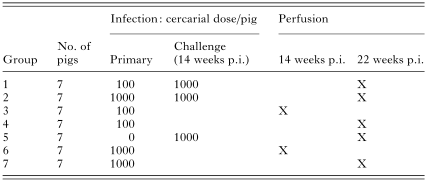
Table 1. Experimental design
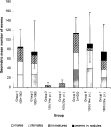
Fig. 1. Geometric mean number of Schistosoma japonicum worms (male, female, immature and worms in nodules) recovered at perfusion with 95% confidence interval (indicated by error bars) for the total worm burden from 7 groups of infected pigs. w.p.i., Weeks post-infection.
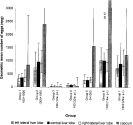
Fig. 2. Geometric mean number of Schistosoma japonicum eggs per gram tissue in the left lateral lobe, central lobe and right lateral lobe of the liver and in caecum with 95% confidence interval (indicated by error bars) for 7 groups of infected pigs. w.p.i., Weeks post-infection.
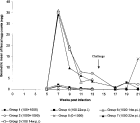
Fig. 3. Geometric mean number of faecal eggs expressed as eggs per gram faeces for 7 groups of pigs infected with different doses of Schistosoma japonicum.
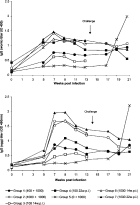
Fig. 4. Specific IgG responses to crude Schistosoma japonicum worm (top) and egg antigens (bottom) for 7 groups of pigs infected with different doses.
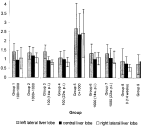
Fig. 5. The mean percentage of collagen in the left lateral lobe, central lobe and right lateral lobe in the liver of 9 groups of pigs infected with different doses of Schistosoma japonicum with 95% confidence interval (indicated by error bars). w.p.i., Weeks post-infection.
 You have
Access
- 5
- Cited by