The diversification of floral traits in hummingbird-visited plants results from evolutionary pressures imposed by herbivores, environmental features and the pollinators (Brown et al. Reference BROWN, DOWNS and JOHNSON2011). Birds tend to select flowers with larger nectar rewards and promote pollinator-mediated selection in plant communities (Schiestl & Johnson Reference SCHIESTL and JOHNSON2013). Hummingbirds in particular respond to specific floral features that may serve as signals in a search for profitable nectar rewards (Pérez et al. Reference PÉREZ, LARA, VICCON-PALE and SIGNORET-POILLON2011).
Hummingbird-visited flowers are mostly long-tubed and reddish, and offer abundant nectar (10–30 µl) (Johnson & Nicolson Reference JOHNSON and NICOLSON2008). However, flower colour does not guarantee the best nectar rewards because it does not necessarily predict the nectar volume and sugar concentration (Tello-Ramos et al. Reference TELLO-RAMOS, HURLY and HEALY2014). Thus, other morphological floral signals such as flower size could help pollinators to find suitable sources of nectar (Benitez-Vieyra et al. Reference BENITEZ-VIEYRA, FORNONI, PÉREZ-ALQUICIRA, BOEGE and DOMÍNGUEZ2014). Flower size, which is usually measured by the width of the opening and the length of the corolla tube, is a determinant constraint affecting the ability of hummingbirds to access the nectar in the flowers (Vizentin-Bugoni et al. Reference VIZENTIN-BUGONI, MARUYAMA and SAZIMA2014). The corolla has been positively correlated with nectar production for a number of plant species (Stanton & Young Reference STANTON and YOUNG1994), indicating that flower size may drive resource partitioning among hummingbird species. Though the positive relationship between corolla and nectar production is expected due to allometric constraints, it may result from the selection mediated by pollinators (Schiestl & Johnson Reference SCHIESTL and JOHNSON2013). Thus, a phylogenetic perspective is crucial to identifying mechanisms that drive trait covariation. Furthermore, very few cross-species studies have shown a correlation between flower size and both nectar volume and sugar production among hummingbird-visited species (Ornelas et al. Reference ORNELAS, ORDANO, DE-NOVA, QUINTERO and GARLAND2007, Temeles et al. Reference TEMELES, LINHART, MASONJONES and MASONJONES2002). Large-scale comparisons of species within a certain phytogeographic domain are lacking. This approach may be informative because the putative cause-effect relationships can be assessed in the context of plants and pollinators that share their evolutionary history.
We investigated the relationship between nectar volume and sugar concentration, and the flower size of hummingbird-visited flowers in the Brazilian Atlantic Forest. We analysed this relationship using the Phylogenetic Generalized Least Squares (PGLS), a phylogenetic comparative method to account for the influence of phylogenetic signals in the data. Our hypothesis is that nectar properties are correlated with flower size and drive resource partitioning among hummingbird species. Furthermore, to separate the general allometric effect from flower-hummingbird relationship, we examined the covariation between corolla length and the bill length of hummingbirds that visit each species.
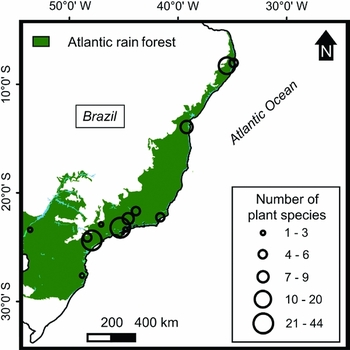
The Brazilian Atlantic Forest is among the most often studied ecosystems regarding interactions between hummingbirds and plants (Piacentini & Varassin Reference PIACENTINI and VARASSIN2007, Vizentin-Bugoni et al. Reference VIZENTIN-BUGONI, MARUYAMA and SAZIMA2014). Thus, we organized an extensive database of plant species visited by hummingbirds in those rainforests to study associations among nectar properties, corolla length and bill length. Our literature review included 16 studies with data on nectar volume, nectar concentration and corolla length for 150 plant species, as well as data on bill length for 26 hummingbird species that were recorded visiting them on those studies (data available at Pangaea data repository, https://doi.pangaea.de/10.1594/PANGAEA.859056). The collected studies cover a wide territory of the Atlantic Forest (Figure 1) and the two families with the most species sampled were Bromeliaceae (58 species) and Gesneriaceae (15).
The locations of hummingbird-visited plant species in the Brazilian Atlantic forest, with available data on flower size and nectar volume and concentration.

The data were collected by means of a systematic literature review performed in the Google Scholar, Web of Science and SpringerLink databases. The key terms used in the search were: (1) hummingbird + Atlantic Forest; (2) hummingbird + nectar properties + Atlantic Forest; (3) hummingbird + floral resources + Atlantic Forest, (4) hummingbird + nectar + Atlantic Forest; (5) hummingbirds + nectar volume; (6) hummingbirds + nectar concentration. We also collected data on the thesis databases available online in Brazil, and checked the references in the collected literature. Studies were included that provided mean values of nectar volume (µl), nectar sugar concentration (%) and corolla length for the plant species. Only studies reporting cumulative nectar volumes in bagged flowers were included, in an attempt to reduce bias due to nectar production over successive measurements in the field and after exploitation by animals. When corolla length was not available in the literature for a certain plant species, we estimated its value by accessing specimens from the JABOT – Brazilian Flora database application (http://aplicacoes.jbrj.gov.br/jabot). We did not include data on corolla width, because few studies report these measurements. In the case of different literature sources for nectar measurements and different visitors of the same plant species, we calculated grand means of the reported values (Johnson & Nicolson Reference JOHNSON and NICOLSON2008). In addition, we calculated the average bill length of visitors for each plant species. Data on bill length were collected in the studies that provided floral traits and in Paton & Collins (Reference PATON and COLLINS1989).
The correlation between traits may result from phylogenetic constraints in closely related taxa (Münkemüller et al. Reference MÜNKEMÜLLER, LAVERGNE, BZEZNIK, DRAY, JOMBART, SCHIFFERS and THUILLER2012). We used phylogenetic generalized least squares (PGLS) to examine the relationship between nectar volume and concentration, corolla length and the bill length. PGLS is an extension of generalized least-squares models that allows us to account for the influence of phylogenetic signals on the regressions using Pagel's λ (Freckleton et al. Reference FRECKLETON, HARVEY and PAGEL2002). Pagel's λ is a branch-length scaling parameter, ranging from 0 to 1. λ = 0 indicates that the correlation between response and predictor variables is not affected by phylogenetic signals, while λ = 1 indicates strong phylogenetic signals (Mundry Reference MUNDRY and Garamzegi2014). To estimate the branch lengths used in the PGLS regressions, we built a phylogenetic tree for the plant species studied, using Phylomatic v3, available at http://phylodiversity.net/phylomatic/. Phylomatic uses a plant megatree based on a variety of sources involving molecular and morphological studies, to assemble a phylogenetic tree for the species of interest. Specifically, we used the megatree published by Zanne et al. (Reference ZANNE, TANK, CORNWELL, EASTMAN, SMITH, FITZJOHN, MCGLINN, O'MEARA, MOLES, REICH, ROYER, SOLTIS, STEVENS, WESTOBY, WRIGHT, AARSSEN, BERTIN, CALAMINUS, GOVAERTS, HEMMINGS, LEISHMAN, OLEKSYN, SOLTIS, SWENSON, WARMAN and BEAULIEU2014). The analyses were performed with the software R – version 3.0.2, using the packages caper and ape for PGLS regressions.
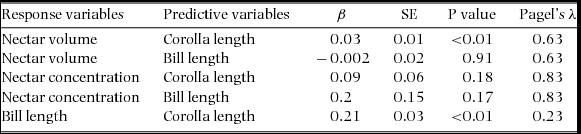
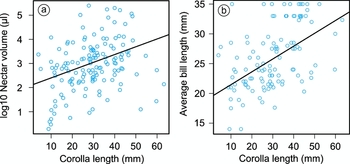
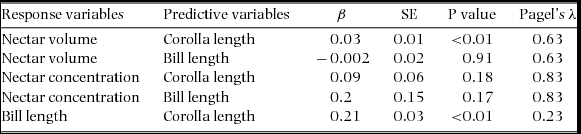
We found that nectar volume is more strongly associated with corolla length than average bill length (PGLS: corolla length, P < 0.0001; average bill length, P = 0.91) (Table 1). Nectar volume was positively correlated with corolla length (Figure 2a). The estimate of Pagel's λ = 0.63 indicates that the phylogenetic signal markedly affected the relationship between nectar volume and corolla length (λ 95% CI = 0.31–0.86). Corolla length showed no significant effect on nectar sugar concentration (PGLS, P = 0.08) (Table 1). The estimate of Pagel's λ = 0.83 indicates that the relationship between nectar sugar concentration and corolla length is strongly affected by phylogenetic constraints (λ 95% CI = 0.43–0.94). In addition, corolla length was positively correlated with the average bill length of visitor species (PGLS, P < 0.0001) (Table 1; Figure 2b).
Summary of the phylogenetic generalized least-squares (PGLS) analysis for nectar volume and concentration as a function of corolla length for 150 hummingbird-visited flowers that occur in the Brazilian Atlantic Forest. β indicates the regression slopes.
Responses of nectar volume and hummingbird bill length to corolla length for 150 hummingbird-visited flowers that occur in the Brazilian Atlantic Forest. Nectar volume as a function of corolla length (a). Average hummingbird bill length as a function of corolla length (b). The responses were obtained with phylogenetic generalized least squares (PGLS). Blue circles indicate observations.

The phylogenetic signal affecting the covariation between nectar volume and corolla length indicates that these traits are driven by allometric constraints, rather than a pollinator mediated-selection. Many short-billed hummingbirds are able to feed in deep-tubed flower species (Rengifo et al. Reference RENGIFO, CORNEJO and AKIROV2006), weakening the hypothesis of an adaptive relationship between nectar volume and corolla length, in favour of allometric effects. The higher nectar content in larger corollas may stimulate short-billed hummingbirds to visit them (Lázaro et al. Reference LÁZARO, VIGNOLO and SANTAMARÍA2015) and thus reduce their specificity to smaller flowers. In contrast, we found a positive relationship between flower size and the average bill length, which indicates that larger flowers provide better rewards for long-billed hummingbirds. The size of the hummingbird body and bill are positively correlated with its energy requirements (Brown et al. Reference BROWN, CALDER and KODRIC-BROWN1978). Short-billed hummingbird species are usually restricted to short corollas, while large-billed species are able to exploit long corollas (Araújo et al. Reference ARAÚJO, SAZIMA and OLIVEIRA2013). For instance, the short-billed Clytolaema rubricauda and Thalurania glaucopis do not interact with many deep-tubed plants such as species of Vriesea and Nidularium in montane Atlantic Forest (Vizentin-Bugoni et al. Reference VIZENTIN-BUGONI, MARUYAMA and SAZIMA2014). Our results support the correspondence between the floral morphology characteristics that drive partitioning among hummingbirds and the quantity of resources produced by the flowers in the Atlantic Forest; even the covariation between flower size and nectar volume is due to allometric effects.
From the plant perspective, hummingbirds that are able to exploit deep-tubed corollas improve pollen transfer and increase the chance of pollination success, as a consequence of their long handling times (Dudash et al. Reference DUDASH, HASSLER, STEVENS and FERNSTER2011, Montgomerie Reference MONTGOMERIE1984). Thus, it is expected that large flowers offer the best nectar rewards to fulfil the energy requirements of their most-effective large-bodied pollinators. The pollination success rate of Heliconia tortuosa increases when plants are visited by large-bodied traplining hummingbirds rather than by small territorial species (Betts et al. Reference BETTS, HADLEY and KRESS2015). Also, Temeles et al. (Reference TEMELES, LINHART, MASONJONES and MASONJONES2002) found a positive association between long-billed species and deep-tubed flowers. In contrast, there is a cost for plants to produce larger flowers, which leads to a trade-off between flower size and flower number. A number of hummingbirds defend plants with short flowers, because they produce larger numbers of flowers and are therefore more rewarding (Feinsinger & Colwell Reference FEINSINGER and COLWELL1978). Information on floral display is scarce in studies of hummingbird-pollinated plants in the Atlantic Forest (Vizentin-Bugoni et al. Reference VIZENTIN-BUGONI, MARUYAMA and SAZIMA2014), precluding the inclusion of this trait in our analysis.
We found no significant relationship between nectar concentration and corolla length. Although the current paradigm predicts that hummingbirds prefer concentrated nectar, a number of studies suggest that they use nectar with a wide range of concentrations (Johnson & Nicolson Reference JOHNSON and NICOLSON2008, Kim et al. Reference KIM, GILET and BUSH2011, Ornelas et al. Reference ORNELAS, ORDANO, DE-NOVA, QUINTERO and GARLAND2007). The high viscosity of more-concentrated nectar increases the energy costs of fluid uptake, making concentrated solutes less profitable (Kim et al. Reference KIM, GILET and BUSH2011). Also, the strong phylogenetic signal driving the lack of correlation between nectar concentration and corolla length supports the hypothesis that this relationship is conservative and not affected by allometric constraints.
In contrast to our findings, Araújo et al. (Reference ARAÚJO, SAZIMA and OLIVEIRA2013) reported a weak correlation between nectar volume and corolla length for hummingbird-visited flowers in the Brazilian savanna (cerrado domain). Small non-ornithophilous flowers in the Brazilian savanna provide substantial amounts of nectar for hummingbirds during the marked dry period, in which ornithophilous flowers are scarce due to water stress (Maruyama et al. Reference MARUYAMA, OLIVEIRA, FERREIRA, DALSGAARD and OLIVEIRA2013). In contrast, rainfall is abundant throughout the year in most areas of the Atlantic Forest (Buzato et al. Reference BUZATO, SAZIMA and SAZIMA2000), and therefore the availability of nectar from hummingbird-visited flowers with typical larger flowers is not impaired by water stress (Galen Reference GALEN1999). Thus, the positive relationship between flower size and nectar volume may be modulated by regional and climatic conditions.
We demonstrate that characteristics of floral morphology such as corolla length correlate with the amount of nectar offered by hummingbird-visited flowers in the Atlantic Forest. Also, our results indicate that the relationship between nectar properties and corolla length is allometric and affected by phylogenetic constraints. Thus, a phylogenetic approach is needed in future studies assessing the interaction between floral traits.
ACKNOWLEDGEMENTS
We gratefully acknowledge Dr Nico Blüthgen and two anonymous reviewers for helpful comments on early versions of the manuscript. L.F. and M.C.G. are supported by Conselho Nacional de Desenvolvimento Científico e Tecnológico (Cnpq) and D.C.T. is supported by Coordenação de Aperfeiçoamento de Pessoal de Nível Superior (CAPES).