I received the photograph from “Le Progrès” newspaper showing the plume of smoke from our flare (…). Obviously, such a plume is very unpleasant and bad at a psychological level, and it must be avoided as much as possible (…).
For all that, it doesn’t mean we shouldn’t make considerable efforts to eliminate or at least significantly reduce these fumes, but I do mean this: the Lyon authorities are not to expect they can benefit from our site without ever suffering the slightest inconvenience.Footnote 1
On November 17, 1970, Bernard Delapalme worried about the image of his company’s smoke in Le Progrès, the main newspaper in the Lyon region of France. At the time, he was director of the Rhône-Alpes company in charge of operating the Feyzin refinery, ten kilometers from the center of France’s second most populous city and on the banks of the Rhône River that was undergoing major anthropization.Footnote 2 After working as an engineer in the nuclear industry, he held a position with the oil major Elf, where he had been Director of Scientific and Technical Research since 1967. His concern was even more acute given the still recent memory of a major industrial disaster. Inaugurated in 1964, the refinery was presented as one of the eruptive expressions of technical modernity in post-war France, comparable with nuclear investments.Footnote 3 However, less than 18 months after production began at the site, a fire and a series of explosions occurred on January 4, 1966, causing eighteen deaths and launching an instant media outcry. Ever since, the French oil industry has tried to dispel the specter of this traumatic event.Footnote 4 This article sheds light on the work of the refinery’s public relations (PR) agents who helped make the continuity of industrial activity acceptable, both nationally and in a localized social context.
Those years were marked by controversies that were part of a redefinition of the oil industry’s environmental concerns, whose history began with the founding of the sector. Indeed, Martin Boon reminds us that these companies’ climate strategies are part of “the industry’s long-run experience with the fundamental debate over how to manage environmental pollution from oil production and consumption – a debate that emerged in the nineteenth century.”Footnote 5 Therefore, despite the variety of these companies’ environmental concerns (from controlling pollution on their lands at the turn of the twentieth century to today’s climate issues), a historical constant lies in their shared hostility to the public regulation of their operations.Footnote 6 Although this principle has never been queried, we argue here that the 1960s and 1970s were a turning point, not only because of the recurrence of disasters in the oil industry,Footnote 7 but also because of the reception of the first warnings on the anthropic origin of global warming by industry leaders. These decades were therefore of crucial importance to the role of oil companies’ public relations on environmental issues.
The concerns of research conducted at the intersection of environmental and business history have focused on employer initiatives since the late nineteenth century to reduce industrial pollution, as well as investments in industrial hygiene.Footnote 8 Hugh Gorman emphasizes that oil engineers acted according to a guiding ethic of efficiency, i.e., considering all pollution as waste that could be saved and put to more profitable use.Footnote 9 The postwar years have often been portrayed as an “emergence of public leadership,”Footnote 10 forcing oil companies to comply with government regulations. Several analyses also examine the development of corporate environmentalism since the 1960s, highlighting the shift in business concerns in response to public opinion, the market, and government regulations.Footnote 11 More recently, business and environmental historians have taken a keen interest in the eighties, as corporate environmentalism was changing under the influence of the Bhopal disaster (1984) and on the eve of the Earth summit (Rio de Janeiro, 1992).Footnote 12 Anthropologist Kim Fortun argued that the Bhopal accident paved the way for a “new awareness of industrial risks at a time when growth of information technology and culture was also dramatic.”Footnote 13 The last two decades of the twentieth century were also marked by the rise of climate issues that were gradually becoming a matter of concern for companies.Footnote 14 These concerns gave rise to different reactions from companies, especially fossil-based enterprises.Footnote 15 Several studies have focused on the role of the “merchants of doubt,” i.e., networks of actors from the scientific field who worked on the periphery of companies during the last decade of the Cold War.Footnote 16
This article returns to an earlier period, as the foundational study on corporate environmentalism by Andrew Hoffman suggested that the sixties marked the first moment of awareness among oil companies, particularly regarding the issues of urban smog and gasoline reformulations. Similarly, Hugh Gorman detected that oil companies were then shaping a “new guiding ethic (…) framed in terms of environmental quality.”Footnote 17 At the time, these companies were confident of their ability to solve the environmental problem that was regarded as a technological issue. Yet, this “optimistic social activism came to an abrupt end in 1969 when Union Oil’s Platform A began spilling crude oil into the Santa Barbara shipping channel.”Footnote 18 This US-based chronology does not exactly fit with the European context. First, oil consumption increased in Western Europe, from 58 to 203 million tons of coal equivalent between 1948 and 1958.Footnote 19 This expansion was even faster in France, where oil became the most widely consumed energy source in 1965, and consumption of petroleum reached more than 120 million tons in 1973. While France became a petroleum products exporter in the fifties, most of the refineries were operated by US, British, or Dutch companies. A change occurred with governmental decisions to exploit the Hassi Messaoud oil field in Algeria in 1958. This extraction represented the promise of building a French oil major capable of competing with the international companies, paving the way for the foundation of the Union Générale des Pétroles (now UGP) in 1960,Footnote 20 and the Entreprise de Recherche et d’Activités Pétrolières (ERAP, then Elf-ERAP, one of the components of the actual TotalEnergies) in 1965. Because these companies were built from small, pre-existing state-owned enterprisesFootnote 21 and consequently used public capital, they nevertheless formed a complex chain of relationships. Despite the public capital, the governance of French oil companies is very different from that of the nationalized electricity company, where a partial redistribution of income takes place with the involvement of labor unions.Footnote 22 Moreover, the Ministry of Industry and its Fuel Division ( Direction des Carburants —DICA) encouraged the construction of a new generation of refineries by these recently created companies, with most being built near major cities that provided outlets for refined products, starting with Feyzin near Lyon in 1964.Footnote 23
The relative confidence of the young French oil industries was therefore badly eroded by the Feyzin disaster, and being at the heart of the French economy’s “Trente Glorieuses (the postwar economic boom),”Footnote 24 the event was a watershed moment for the industry’s national-level CEOs as well as for local managers.Footnote 25 As historian Daniel Boullet has pointed out, “the industry still had little awareness (…) of the shift that was going on in French society”Footnote 26 regarding environmental issues. Aware that the accident had been terrifying for the local community, oil company executives were determined that residents would accept the continuation of industrial activity and that regulations concerning polluting factories would evolve.Footnote 27 French regulations on industrial pollution are characterized by a long-standing division between the laws governing unhealthy establishments ( établissements dangereux et insalubres , now included in environmental law) and labor law.Footnote 28 Although labor inspectors had the authority to inspect the établissements insalubres until the 1960s, they did not have technical training and were required to justify their interventions exclusively on the basis of one or other of these regulations. As early as 1958, a reform of the regulations on unhealthy establishments was envisioned by the Government to create a specific inspection body. The Feyzin disaster accelerated this process, not only because labor inspectors collectively resigned from their duties relating to établissements insalubres to protest against the indictment of one of their number as a result of the accident, but also because the Ministry of Industry set up a Service for Protection against Industrial Nuisances (1968), which was then transferred to the Ministry of the Environment (1971).Footnote 29 At the same time, workers’ unions were calling for environmental and labor regulations to be brought closer together.Footnote 30 However, in 1976, the passing of the law on classified facilities for environmental protection led to the reaffirmation of a strict separation between these two sets of regulations. Companies had to deal with these changing public policies and the growing expression of environmental concerns within unions.
In this article, I argue that this crisis was foundational in the growth of public relations in the French oil industry regarding environmental issues. A continuum runs through the development of communications during this disaster and the increased advisories about global warming, since the same actors capitalized on their recently acquired media skills. For example, Delapalme was the first Elf manager to attend, in 1968, a conference where “the increase in carbon dioxide and the possibility of a global modification of the earth’s climate”Footnote 31 were discussed. The study of communications following the Feyzin accident sheds light on two unique aspects. Firstly, in comparison with other countries, French laws regulating industrial pollution place the State in the role of protector of industrial activities. While PR agents often occupy a “liminal position among industries and between industry and government,”Footnote 32 their role has a specific character as French regulations and public policy primarily lead the government to communicate on industrial pollutants and accidents. It sheds another light on “PR actors’ strategies of silence,”Footnote 33 insofar as this private company silence is only made possible by proliferating public discourse. Secondly, beyond this national specificity, observing both the regional and national levels allows for a more granular analysis of corporate communication on industrial risks.Footnote 34 Above all, it provides a better understanding of how these strategies fit into localized social relations. Indeed, several works aim to show how oil companies’ various communication strategiesFootnote 35—sometimes in association with the study of petrocultures—were considered as acculturation devices for oil expansion.Footnote 36 However, these works often study global discourses, without linking them to social relations on the scale of the territories where oil activities are carried out—and where the consent of the inhabitants is necessary for their continuation.Footnote 37
The scarcity of work about refining areas is currently being corrected in historiography, as these territories have a major importance in global oil chains: they are nodes of infrastructure and workers that allow the marketing of derivatives.Footnote 38 Focusing on these areas enables us to emphasize that levers of consent to industrial activities are phenomena that are constructed in lived spaces where frontline communities have to cope with petrochemistry’s ordinary risks.
Cross-referencing public archives with company records makes it possible to explain how environmental and health issues have been relegated to the background during the construction of industrial discourses. However, company sources must be handled with care, since the company’s voice leaves several phenomena in the dark—the population’s reactions, in particular, which have been recently analyzed based on public and labor union archives.Footnote 39 Moreover, the relevance of these documents remains comparatively low if not compared with three types of public archives regarding the post-crisis period. Firstly, we have the archives of the Prefectures. They are headed by a prefect who is appointed by the President of the Republic as the representative of the State in each French département , an administrative entity at the local level. They are responsible for implementing public policies and coordinating the policies of state public administrations. As Feyzin was then at the border between the departments of Rhône and Isère, both Prefectures were involved in the planning of the refinery and the management of the disaster. Under the authority of each Prefect, administrative services related to labor, industry, and civil protection were called upon to intervene after the accident. We would know very little about the development of crisis communication without these archives, as prefectural services were much more proactive than the refinery in disseminating news about the disaster. Secondly, the municipality of Feyzin’s records are of great value regarding the long-standing opposition of some residents to the industrial establishment, as well as the social, political, and financial arrangements that were made by local officials and the refinery’s management. None of this information is accessible within company archives. Finally, the files of the accident trial are accessible only by special dispensation. They provide detailed information on the refinery’s daily operations, as well as on the relationships established by management with various local interest groups.
The first part of this article reviews the industrial effort to make the Feyzin refinery a showcase for French oil modernity. In the second part, the cross-referencing of different sources sheds light on the reasons for the public silence to which oil companies committed themselves in the wake of the disaster. This silence was nonetheless accompanied by a discreet activism in order to reactivate the vectors of consent to the industrial presence at national and local levels. Corporate communication strategists were aware of the precedent they were setting and soon learned the lessons of their actions. Their writings were presented as methodological guides for the Elf Group’s public relations (PR) agents in anticipation of the need for future crisis management.
A “Permanent Showcase for the French Oil Industry”Footnote 40 at a Time of Energy Transition
For the actors involved in the French economic “modernization” process, the Feyzin refinery must embody the determination of the French oil policy, as well as being an example of refining companies’ ability to establish themselves harmoniously in their chosen territories. This refinery was a matter of great interest to the French state, as it symbolized the desire to build a major oil company. Close ties between the Ministry of Industry, regional planning authorities, and UGP, a newly created oil company funded by public capital, had to be established before the construction of the plant could take place. At a time when oil was becoming the most widely consumed energy source in the French energy base (overtaking coal in 1965), PR agents assumed the role of promoting this infrastructure as a “showcase.” To convince the residents, who had been quick to protest, they also crafted a narrative that the refinery would connect Feyzin to modernity, defined as a connection to global material and commercial flows. In the words of both the company and prefectural authorities, the refinery would “save the town from obscurity.”Footnote 41 Feyzin was thus becoming both a showcase for French technical skills and an example of France’s entry into a “modernity” associated with increasing oil consumption.
The construction of this infrastructure took place at a time of far-reaching changes in the French energy system. At the end of 1959, the Minister of Industry, Jean-Marc Jeanneney, introduced a plan to gradually reduce coal mining in France.Footnote 42 At the same time, the development of oil fields in Hassi Messaoud (Algeria) led senior officials in the Fuel Department (DICA, Direction des carburants ) of the Ministry of Industry to encourage state investment in a French oil industry. Founded in 1960, UGP was mainly a state-owned company and was heavily backed by the French government: indeed, Pierre Guillaumat, former director of the DICA and a key figure in French energy policy, was appointed president.Footnote 43 For UGP, the construction of the Feyzin refinery was a priority operation to legitimize the foundation of a company that intended to capitalize on Algerian crude to introduce a French oil major to world markets.Footnote 44 Its location near Lyon was also a way of asserting the presence of the new firm in this territory, 100 kilometers from Switzerland and 150 kilometers from the Italian border, while the transalpine oil major ENI (another public oil company closely linked to Italian state capitalism) was booming.Footnote 45 Its operation began in the first half of 1964,Footnote 46 in sync with the transition in the French energy base, in which oil had become the most widely consumed energy source from 1965 onwards.Footnote 47
The Rhône-Alpes company’s management, in charge of operating the refinery, was entrusted to Delapalme.Footnote 48 A former student at the prestigious Ecole Polytechnique, and then an Engineer General of Armaments, he had held a number of industrial, scientific, and media positions, which gave him special skills for his role in the development of communication strategies advocating refining activities. From 1956 to 1964, he was deputy director of the Centre d’études nucléaires de Grenoble (Isère). This position won him the regional authorities’ sympathy, as evidenced by his friendly correspondence with the Prefect of Isère.Footnote 49 In addition, he was very knowledgeable about the workings of the media, as he had been a member of the Office de Radiodiffusion Télévision Française’s Programme Committee from 1965 to 1973—at a time when the French broadcasting corporation still had a state monopoly over audiovisual services. Finally, from the founding of ERAP (1966), then Elf (1967), he held the position of Director of Research, Development and Innovation for nearly twenty years.
After the building permit was granted in 1962 and during the construction of the refinery, the media were mobilized by oil companies’ communications departments. Alongside Delapalme, two PR agents became architects of a corporate narrative and had many contacts with prefectural services as well as local elected politicians.Footnote 50 Marcel Ferrez was the refinery’s Communications Officer. Author of a legal thesis on labor disputes, which he defended in 1942, he was complacent about the Labour Charter adopted by the Vichy regime and displayed a definite hostility to workers’ strikes.Footnote 51 This trait can be seen in his writings from the 1960s, when he had become an employee of the Elf ERAP Group’s public relations delegation for the South-East region. As he was physically present in the region, he played a central role in what he himself defined as “an active information and communication policy,”Footnote 52 thereby building a network with journalists and regional elected officials. His work was carried out in collaboration with R. L., who worked in ERAP’s (then Elf’s) External Relations Departments on an international scale.Footnote 53 Together they made the refinery an exclusive place reserved for distinguished guests: industrialists, political leaders, and engineering students from all over the world. In late 1964, they organized visits for guests as diverse as the North Korean regime’s representatives and officials from Franco’s Spain.Footnote 54
Before the mid-sixties, environmental conflicts did exist throughout France,Footnote 55 but they were localized, scattered, and often invisible in the media. The Feyzin disaster became a sounding board and a moment of visibility for ecological anxieties. It is often defined as one of the starting points in the organization of a French environmental movement.Footnote 56 We can only summarize here the reasons for and main players in this opposition, as recent in-depth studies have revealed the extent of opposition to the project on three grounds. The first protest registered was brought by the pre-industrial territory’s ordinary inhabitants, in particular the farmers and horticulturists who used to grow roses in the municipality. Not only did the installation of a refinery doom some of them to have their land expropriated, but the industry’s emissions were a cause for concern about their plants’ quality. The second issue at stake was mainly driven by health professionals, starting with a Dr. Cinelli (who spoke both as a doctor and as the mayor of the neighboring town of Saint-Symphorien-d’Ozon), and the Director of the Bureau d’hygiène municipale de Paris (Dr. Coin), whose opinion had been sought—and then disqualified—by the DICA (the state Fuels Department) within the Ministry of Industry.Footnote 57 Finally, a set of protests was expressed in the deliberations of the Lyon city council, whose councilors were anxious to promote its reputation of being a clean city.Footnote 58
To quell these protests, Ferrez made frequent visits to the construction site and collaborated with the public administration in charge of the Isère département (county), whose views on the matter were taken up by the regional press: the industrial complex, it claimed, will be required to “carry its full weight in the economic expansion of the Rhône-Alpes region.”Footnote 59 On the eve of its inauguration, one of the main regional dailies, the Dauphiné Libéré, exalted the site:
Along the Rhône’s left bank, the earth is being churned, turned over, kneaded, spread out, packed and, here and there, blocks, cubes, parallelepipeds, chimneys and pipes are springing up. Trucks, cranes, bulldozers, scrapers, machines are all frantically bustling around in this once pastoral setting. Chemistry, physics, mathematics, technology, engineering and planning are replacing willows, poplars, goats, cows and fishermen (…).
Here, with the Rhône-Alpes Raffinerie de Feyzin, is another quatrain of industrial poetry. This is a marvelous, magnificent, breathtaking achievement: crude oil will be processed in Feyzin to make all kinds of liquids and gases. Out of these 180 hectares levelled off on the banks of the “god-river”, will flow car fuels (“regular” and “premium”), fuel oil, ethylene, butadiene, propane, butane, all sorts of “stuff”, “things”, “whatsits.”Footnote 60
While industrialist exaltation is taken to its extreme here, this excerpt encapsulates the three themes conveyed by the regional press, echoing the refinery’s promoters. Firstly, the description of the accelerated transformation of the landscape is presented as the economization of a territory previously marked by a struggling rural economy, which was now being labeled as an archaism. This depiction was supplemented by the idea that the ensuing direct and indirect jobs would make it possible to retrain the people who used to work in the nearby Gier valley coal mines. Yet, while the coal mines employed thousands of workers, by 1966 the refinery’s workforce did not exceed 400 employees. With the creation of a limited number of direct jobs and opportunities for upward social mobility, the refining industries not only shaped the local working classes’ expectations but also financed the new social and cultural infrastructures. Thus, a territorialized Fordist compromise was formed: in exchange for pollution and land appropriation by industry, local communities received jobs and revenue. This phenomenon has already been studied in Feyzin, Montreal-Est (Canada),Footnote 61 Grangemouth (Scotland),Footnote 62 and other places.Footnote 63 The promise of an oil-related moral economy was in the making at the very moment when coal mining was beginning to decline, and miners were expressing their feelings that their moral economy was being betrayed.Footnote 64
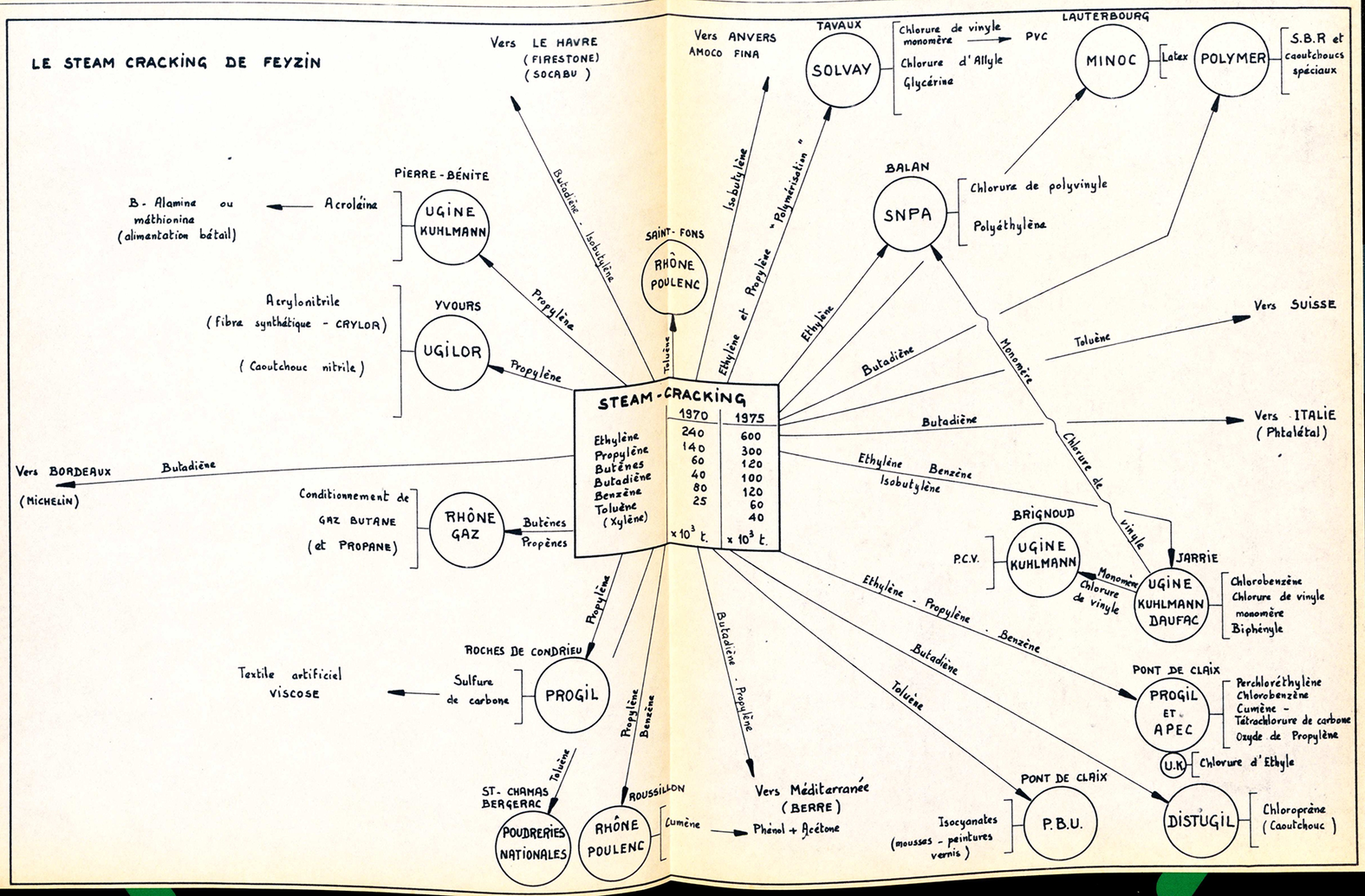
Secondly, industrial achievement was so aestheticized as to be presented as a civilizing endeavor. The elaboration of the “industrial quatrain” was thus based on the construction of a future petrochemical cluster, presented as a way of embedding the southern Lyon territory into global economic networks. In the company’s press releases, as in the letters from the Prefect to the local councilors, the construction of the steam cracker became the symbol of the arrival of modernity in the region (Figure 1).Footnote 65 This representation was influenced by a transnational debate on “economic backwardness” which had been erupting since the fifties, and on the idea that industrialism was the only way to modernism.Footnote 66 The doctrine of French regional planning authorities was strongly influenced by the concept of “growth poles,” i.e., the idea that a growth dynamic was initially launched in a specific locality, before spreading to neighboring areas. This was not specifically a French matter, as the petrochemical territory of Grangemouth and other Scottish areas were also designated as “growth points” by the British government. The same occurred across Italy.Footnote 67 Thanks to the industrial innovations that took place during the war, the petrochemical industries had established themselves as symbols of modernity and revampers of the natural world.Footnote 68 In the eyes of public authorities in Western European countries, the diversity of this industry’s production appeared to hold great promise for the development of their chosen territories.
Diagram showing the uses of petroleum derivatives from steam cracking at Feyzin and production forecasts, 1968.
This diagram places the Feyzin steam cracking plant at the center. The arrows point to petrochemical facilities located within a radius of more than 100 kilometers from the refinery. The location and name of each plant are indicated, as well as the type of petroleum derivative used and the products manufactured. This diagram was drafted to promote the expansion of the steam-cracker in 1968.
Courtesy of the Archives départementales du Rhône.

Figure 1 Long description
This diagram places the Feyzin steam cracking plant at the centre. The arrows point to petrochemical facilities located within a radius of more than 100 kilometres from the refinery. The location and name of each plant is indicated, as well as the type of petroleum derivative used and the products manufactured. This diagram was drafted to promote the expansion of the steam-cracker in 1968. Courtesy of the Archives départementales du Rhône.
Finally, the writer’s inability to name these products (“stuff, things, and whatsits”) testifies to a paradox; it highlights that inhabitants are being dispossessed of the use of the area they lived in, but this phenomenon was expressly vaunted and pledged as to the high value of the infrastructure under construction. The benefits linked to the redistribution of the refinery’s products in the territory remain fuzzy, to the point of causing journalists to make an unsubstantiated hypothesis of “cheaper gasoline for Lyon’s motorists.”Footnote 69 In fact, these three themes can be found in both main regional dailies, Le Progrès de Lyon and Le Dauphiné Libéré, at a time when these two titles were merging into a press group that was to become hegemonic in the region.Footnote 70
While critical voices were never completely muted, they were largely relegated to the background and made invisible in the media when the January 4, 1966, disaster occurred. On that day, during a routine purge of a propane tank, a gas leak spilled onto a highway a few meters away. A passing car caused the gas cloud to ignite for the first time. Despite a partial control of the fire, the high temperature led to the explosion of several spherical containers. The accident caused 18 deaths, including firemen, refinery employees, and subcontracted workers, as well as more than 80 serious injuries, and material damage that caused 1,475 complaints.Footnote 71 The media coverage of this event is proportional to the extent of the damage.Footnote 72 The tone of the press was dominated by the creation of a martyrology, giving a major place to the firefighters—and only secondarily to the workers—who died in the accident. While recounting intimate stories of the victims’ families, journalists strongly emphasized the idea that risks should no longer be considered inevitable in so-called modern industries. Finally, more left-leaning newspapers often sought to investigate the organization of work and production in order to shed light on who was responsible for the accident. This media attention also reflected the political, economic, and symbolic investment that accompanied the founding of UGP and the construction of the refinery.
Although the memory of this shock was mobilized by voices criticizing the oil industry throughout France in the following years,Footnote 73 PR agents continued to organize high-level visits to the refinery each month. They soon welcomed the USSR’s Council of Ministers Chairman Alexis Kosygin in December 1966, Algerian and Czech engineering students (in January 1968), and also political leaders whose constituencies would be affected by future oil developments.Footnote 74 PR agents ramped up their efforts to promote the region’s petrochemical future, because the Feyzin refinery was the jewel in the crown of an oil industry that was being promoted as specifically French. Yet, the relative fluidity of the international communications may seem surprising given the scale of the disaster. It is important to better understand how the development of this communication strategy relied on the State or, more specifically, on the administrations responsible for industrial expansion.
The Refinery’s Passive Defense, or Why Remain Silent Despite the Disaster
From the first hours after the explosion, reactions by the government and the presidency of the Republic flowed in.Footnote 75 The municipality of Feyzin, its inhabitants, refining workers, and above all the firemen who intervened on the site, made the national press’s front page for almost a week. In the context of an expansion of print media and local titles were competing for regional markets,Footnote 76 the search for sensationalism led to an information overkill on the news of (supposedly) an unprecedented nature. However, neither the refining company management’s voice nor those of the national industrial group’s managers were heard in the media in the weeks following the accident. Their silence was a deliberate choice by those in charge of communication. However, conditions for making this posture effective went far beyond the communication officers’ choice, as this was indeed protected by existing laws on the regulation of industrial establishments classified as dangerous, unhealthy, or inconvenient.
Since the first hours of the accident, archives documented a small group of communicators’ intense activity. Led by PR agents, they regularly sent notes for validation to officials such as Delapalme, Paul Moch (President of UGP), or Jean Méo (General Manager of UGP). Archives also testify to the organization of several meetings these men participated in to approve the communication strategy. In the days following the disaster, L. expressed that “the relative silence solution seemed the best for the time being. This would allow for a local appeasement of spirits and avoid the accumulation of difficulties in Porcheville.”Footnote 77 In short, this low communication level was thought to be a way of minimizing local criticism, but also for ensuring that future refinery projects would not be compromised in areas where UGP would have to deal with mistrust of local companies. Indeed, the accident occurred when several refineries were either under construction or being planned.
If the company was able to keep silent, it was because Prefectural authorities and civil servants from the Ministry of Industry were making themselves heard in the media, often to demonstrate the factory’s compliance with existing regulations. At that time, the most important regulation on industrial hazards was influenced by a Napoleonic decree from 1810, partially revised by a law of 1917. As Geneviève Massard-Guilbaud has pointed out, “If France was a pioneer in publishing the 1810 decree, it was in its attempt to manage nuisance and prevent the conflicts they caused, not in the field of industrial pollution control.”Footnote 78 In the refining sector, a decree of April 1, 1939, completed these provisions to establish an “emergency procedure for the examination of applications for hydrocarbon deposits.” All these provisions formed the basis of an “administered pollution regime,”Footnote 79 i.e., industrialists were obliged by public authorities to apply for certification prior to starting new operations. After an investigation procedure on the operation and possible technical requirements, an authorization would be issued by the administration. From then on, this ratification ensured the protection of the State in the event of protests from residents. In January 1966, it was therefore the statements by the representatives of the State (especially the Isère Prefect) that made the industrialists’ silence possible and ensured its effectiveness.
The refinery’s management and national oil groups’ communication managers spent the days following the disaster primarily reading the press carefully to sort out the “reliable” newspapers from those to whom corrections should be addressed. Regarding the January 4 evening papers alone, for example, Le Monde’s coverage was presented as “very objective,” while France Soir’s coverage was considered “very hard-hitting and sensational,”Footnote 80 as it included inaccuracies that would exacerbate a negative perception of the company. A constant concern for PR agents was the former head of security at the refinery, Paul Tollance. He had left his post a few months earlier, after several warnings about security conditions. In this respect, many newspapers began looking for an interview with him. This frantic search led the intelligence services to keep an eye on him as it was worried about his possible proximity to the Communist Party,Footnote 81 which was suspected of using the accident for political purposes.Footnote 82
Tollance did not give interviews to any newspapers. PR agents monitoring the press were compelled to produce two documents aimed at standardizing responses to solicitations. On the one hand, a list of answers to frequently asked questions was drafted. These related mainly to compliance with safety instructions, previous accidents, and the criteria for choosing the refinery’s location. The proposed answers were brief, varying from five words to three sentences, while strictly technical and regulatory in nature. For instance, to the question “Was the spacing between storage tanks insufficient?,” the answer was a laconic: “In accordance with regulations.”Footnote 83 The answers, hence, anticipated a defense against future legal proceedings. On the other hand, a longer document was written to draw up a shared narrative among those who might be entitled to exercise the company’s public representation in the months following the crisis. This long text challenged the three main accusations made by the press against the company: the staff had extensive experience in oil activities; the location choice had been well thought out; and safety measures had been thoroughly devised beforehand. This text is particularly relevant for its conclusion, which states that “it now is established the gas leak was the cause of the accident and it is attributable to human error.”Footnote 84
In the days following the disaster, the communication strategy was characterized by three dimensions: maintaining industrial silence; simultaneously keeping a scrupulous watch on the content of articles in the press; being prepared to intervene discreetly with journalists or press group managers who could influence the treatment of the event. PR agents elaborated a narrative of the event emphasizing the “human error,” which appears to be a constant feature of industrial communication after a crisis. Indeed, this attribution of responsibility to individual error reactivated a set of old discourses, interpreting the accident as the result of individual responsibility leads to sidelining organizational factors (status of the various workers in the company, preventive measures, etc.) or regulatory factors. This kind of speech had been heard since the nineteenth century and in French industries’ reactions to other accidents in the Rhône Valley during the 1960s,Footnote 85 and even after the Bhopal disaster in India, where company management accused workers of sabotaging the plant.Footnote 86 However, these arguments never fully convince ordinary residents of industrial areas. After having settled on their narrative, PR agents had to ensure they were in sync with opinion leaders at the territorial level. While it has been asserted that oil companies were “willing to consider environmental issues but found that [their] room to maneuver was restricted by the demands of the market and society,”Footnote 87 it is worth clarifying how PR agents also helped shape opinion in local communities.
Enlisting Opinion Leaders and Manufacturing Consent
During the construction of the plant, refinery managers made sure to establish a “growth coalition” as was done in many other industrializing areas.Footnote 88 A coalition with local leaders who were in favor of the refinery ensured that dissenting voices from farmers, residents, and elected officials concerned about public health were outnumbered. After the shock, PR agents quickly met with neighboring towns’ mayors to ensure their loyalty and made sure to give visibility to these exchanges.Footnote 89 However, most of the efforts were directed toward media groups, whose influence appears to have been decisive in disseminating modernist and desirable representations of oil activities. These representations are not simply soothing discourses, as petroculture studies often identify them, nor are they discourses that fit into a democratic conception of communication as understood in public relations studies.Footnote 90 Far from taking a conciliatory approach, PR agents often intervene directly with editorial offices and do not hesitate to exert financial pressure on the press.
Three strategies were implemented to deal with critical voices. First, some journalists were monitored with particular vigilance. Accordingly, Camille Rougeron, a journalist at Le Progrès, was presented as “A writer known as an imbecile in specialized circles.” His articles were described as “a professional problem that went beyond the refinery,” so that refiners should “certainly react.”Footnote 91 However, the most closely monitored writings were articles by journalists with strong social capital, such as Robert Butheau. He published in the magazine Témoignage chrétien but was also Le Monde’s Lyon correspondent and editorial secretary of the regional daily Le Progrès. In addition, he was the leader of several political clubs that marked French political life at the time, most notably Lyon’s Cercle Tocqueville, and later the Union des Clubs pour le Renouveau de la Gauche. Footnote 92 He rubbed shoulders with social Catholic activists, former members of the Resistance, and unionist members of Confédération Française des Travailleurs Chrétiens (which became the Confédération Française Démocratique du Travail in 1964). On January 13, 1966, he wrote an article entitled “Feyzin: a trap,” recalling that the refinery had been built in a rush.Footnote 93 Robert Butheau worried ERAP’s PR agents because of his ability to influence Le Progrès’s media treatment (some of whose articles were regarded as “malicious”) and Le Monde, which published “unfavorable and partisan articles.”Footnote 94 To undermine him, Ferrez noted that “Butheau is a member of the Head of Journalists’ National Union, which can provide an argument to appeal to his objectivity.” Subsequently, ERAP sent a letter to the Témoignage Chrétien editors, reaffirming the two arguments put forward by the refinery’s management: that the refinery was a driving force in the regional economy and that all regulatory procedures had been complied with.Footnote 95 The letter concluded by questioning Robert Butheau’s “objectivity” because of his union affiliation.
The second strategy was to intervene with newspaper editors through intermediary relationships. On several occasions, ERAP and UGP communicators called on industrial groups’ management members to intervene with Le Monde editorial staff through, for example, Paul Fabra, an editorialist in charge of economic issues.Footnote 96 Backroom conversations were also conducted in the context of the merger of two major dailies (Le Progrès and Le Dauphiné Libéré) within the Aigles press group in 1966. In November, a meeting was organized between the refinery’s management and the main Aigles representatives, in particular its director, Alfred Delsart. The latter informed his interlocutors of the “instructions [given to his editorial staff] concerning Feyzin, based on the following line of conduct: Feyzin is a fact; Feyzin contributes to the regional economy. Be objective in all information concerning Feyzin.” Furthermore, he informed people of his refusal to publish a letter from Feyzin’s Mayor which mentioned the city council’s concern about plans to extend the refinery. The chief editor eventually informed the head of the refinery that he “voluntarily gave the November 6, 1966, Le Progrès article a three-column headline, « The Feyzin refinery: France cannot afford the luxury of doing without it.»”Footnote 97 The press group showed a willingness to reach an agreement with industrialists, and this collaboration continued, enabling the refinery management to devise its communications during subsequent pollution incidents.
A last strategy was put in place, aiming to intervene in newspapers’ orientation according to the financial interests which could link the oil companies with specific newspapers. As of late January 1966, UGP’s PR agents drew the first lessons from the relations with the media since the disaster. A note underlined, in particular, that “newspapers’ administrations are sensitive to the financial aspect of our reports (…). If we add up what the Group distributes in financial advertising, we should be carrying some weight. The support of the SNPA [ Société nationale des pétroles d’Aquitaine ] can obviously prove very important.”Footnote 98 In fact, the extent of the economic interest relationship between the press and the oil companies was barely mentioned in the archives. However, in the event of a disaster, the existence of extensive economic relationships is sometimes reignited: faced with an accident affecting a refining plant, hydrocarbon processing companies showed solidarity by using their advertising budgets to influence editors.
These three strategies were implemented as the action unfolded, without necessarily following a predefined plan. Indeed, although the refinery had established contacts with the local press to defuse critical voices at the time of the site’s development, the industry did not have any fallback scheme on how to communicate in these circumstances. However, ERAP and UGP personnel were aware, at an early stage, of the singular nature of the event and the potential extent of its media coverage. From the end of January 1966, while pleading for the company’s public silence, L. advocated a discreet procedure that should be better coordinated. He made four concrete recommendations in case of future events: to set up a team on the spot to collect and formalize information; the need to “know well beforehand the main opinion makers’ local correspondents,”Footnote 99 to maintain good relations with the administrative authorities; and the importance of having information available quickly in order to establish a shared narrative within the company. Another note, written by Ferrez, gave an assessment of the “state of public opinion,” before proposing measures to restore the refinery’s image: relief and compensation for victims; reconstruction and forecasts into the future of the area; measures to “make the refinery a pilot plant” in terms of safety. He concludes by stating:
This policy should be defined in a short note and presented orally to the representatives of the various stakeholders at regional and county levels, to the Feyzin Municipality, to the Rhône-Alpes staff, and to the major regional newspapers’ heads, to make our interlocutors supportive and to present our policy as concerted with the interested parties. If we apply this policy and that strategy, we will be able to obtain the support of the regional press, and through it, of public opinion, and we will be able to contribute effectively to re-establishing the climate of confidence necessary for developing our activities.Footnote 100
Over the months following the disaster, the range of voices allowed to express themselves became narrower, particularly in the regional daily press. PR agents deployed a series of actions that contributed to the dampening of overly harsh criticism, from transmitting technical data to journalists, to using relationship networks to influence treatment by some newspapers, while at the same time exerting financial pressure by reminding them of the importance of advertising revenues. The decline of protesting voices in these newspapers was facilitated by the editorial staff, who sometimes anticipated the requests of oil companies’ communication services, which then “pointed out the Le Progrès journalists’ perfect spirit of correction and cooperation.”Footnote 101 Press archives would have been valuable for understanding journalists’ attitudes toward company strategies. Nevertheless, even in the absence of such archives,Footnote 102 we can note that pieces written by PR agents were sometimes published in newspapers as if they were written by journalists.
Refining Communications
Until the 1973 oil crisis, PR agents continued to promote Feyzin refinery with modernist representations, while focusing more on technical issues. This focus on technology tended to disqualify actors who did not have scientific expertise, thereby reducing the scope of issues that could be subject to democratic deliberation involving all actors concerned with the area’s future. Far from being specific to the situation in Feyzin, this phenomenon was observed in the same years in Sarnia (Canada), where such technical discourse allowed the petrochemical industry to “prevent pollution from rising on the political agenda.”Footnote 103 During the decade following the accident, the feedback on communications provided guidelines for refinery management on how to encourage support for continuing industrial activity. On the one hand, the dissemination of arguments was now adjusted to the message’s recipients. Mass arguments were subtly segmented and refined before being released to two main groups: journalists and local elected officials. On the other hand, the discourse aimed at justifying industrial continuity was renewed by breaking it down into three main arguments, which were made weightier by scientific expertise. This helped to disarm critics who did not have similar resources to secure counter-expertise. This strategy was developed in the run-up to the first anniversary of the disaster, on the eve of which the refinery management met with the Aigles news agency’s director. The meeting was reported as follows:
Mr. Delsart told us: ‘it is to be expected that newspapers will talk about the anniversary of the 4th.’ He added: ‘a newspaper that did not talk would, in the public eyes, be expected to be bought up by oil companies. It is therefore necessary to ensure that what was said at that time is as little unfavourable to us as possible, hence the importance of the prior press meeting, which should take place around December 10, 1966.’Footnote 104
The refinery’s management was making sure it became the writer of its own story. In fact, the articles published on the commemoration date were of little concern to the PR agents.Footnote 105 Their attention shifted to assessing the perceptions of the population whose reactions appeared to destabilize the region’s industrial future. This approach to monitoring was steeped in a psychologizing interpretation of popular attitudes, borrowed from American disaster studies.Footnote 106 The Feyzin crisis was a milestone for the spread of this approach in France. One resource was Colonel Charles Chandessais, a military officer who had conducted social psychology research on behalf of the army during the Algerian war and, after decolonization, had studied the behavior of crowds when faced with accidents or panic-stricken incidents. He was the first to publish a study on the Feyzin accident.Footnote 107 His work caught the attention of disaster studies specialists such as Allen Barton and, later, Enrico Quarantelli. Based on his first study on Feyzin, Charles Chandessais created the Centre de recherche sur les catastrophes (Disaster Research Centre).Footnote 108
This socio-psychological approach promoted patterns of understanding that were taken up by oil company PR agents and supplemented by conducting more regular opinion surveys. In 1969, this approach became apparent as the refinery’s management was planning to build a catalytic cracking unit, stirring fears of adverse reactions throughout the region. In May, a meeting brought together the communication officers and several UGP/ERAP/Elf national leaders, notably Delapalme. Participants in the meeting agreed on the need to forge a local communication plan, which was to be carried out by Havas, one of the most important French public relations companies.Footnote 109 The foundations were laid for an opinion survey that would better define the actions that should be taken to ensure industrial acceptability. Feyzin remained a showcase for Elf, as evidenced by a note on the group’s determination to “commit itself fully to obtaining the necessary authorizations” and its refusal to give up unless “the constraints imposed by the administration in return for this development led to such an increase in costs that the situation became absurd.”Footnote 110
A PR agent then wrote a note aimed at establishing how Feyzin oil infrastructures were perceived by local opinion. He emphasized the pride that journalists, local elected officials, and some sections of the population took in competing with the oil infrastructures expanding at the time in Marseille.Footnote 111 Somewhat to his satisfaction, he noted the press’s moderation regarding nuisances but was concerned about multiple protests when spectacular pollution episodes occurred and black, foul-smelling fumes were released from the steam cracking plant. These protests were made by municipal councilors in the winter of 1967,Footnote 112 followed by numerous complaints by residents from 1969 onwards.Footnote 113 Regarding these immediately perceptible nuisances, PR agents believed they could “in no way expect public opinion to become accustomed to them.”Footnote 114 Since communication tricks were ineffective in the face of the reality of these nuisances, they suggested that the company should invest in pollution control techniques and equipment to measure the amounts of the substances released so that expert opinions could then be marshaled to counter the complaints. These considerations and the Havas Agency’s recommendations led to the creation of a committee called “ Action et développement de Feyzin ,” set up on the initiative of Jean Méo, national manager of the Elf-ERAP group’s refining division.Footnote 115 This committee, which met face-to-face once a quarter, set itself the task of “systematically taking action targeting the various agents likely to influence the development of these matters: local government officials, including, first and foremost, the Prefect; public opinion as expressed, in particular, by the press; and Parisian administrations (DICA, DATAR, etc.).”Footnote 116 While maintaining relationships with these departments, the committee did pass on information to the divisions, currently being restructured, that were responsible for hazardous industries.Footnote 117 While this committee’s archival traces are significant in the archives of Elf-ERAP’s external relations department,Footnote 118 they are almost non-existent in public archives as this committee was primarily a tool for internal coordination among the oil economy’s stakeholders.
Going forward, priority was given to two other groups who were likely to influence how public opinion perceived the refinery. Firstly, journalists were now regularly invited to the site, with a view to establishing inter-organizational knowledge collaboration and to disseminate technical discourse on the installation’s operations. For example, in July 1969, the plant was visited by regional press representatives (directors of the Aigles press agency, the Le Progrès newspaper from Lyon, etc.), and by major national press groups (Le Figaro, AFP, etc.).Footnote 119 Secondly, PR agents paid particular attention to local elected officials to prevent their expressions of disapproval from appearing in the regional press. In the summer of 1969, faced with increased protests by local councilors, the latter were invited to visit the refinery numerous times.
The decision to focus on communication with local elected officials and journalists ultimately made it possible to show concern for consultation with local stakeholders, while ignoring residents’ and workers’ protests. Before communication to journalists and local elected officials could be implemented, a prior response—mostly financial compensation—to victims’ complaints was required. On the one hand, protests by residents initially took various forms such as alarmist messages written on walls around the city before a committee to defend the interests of residents was organized. The refinery management quickly succeeded in addressing most of these complaints by speeding up insurance compensation procedures, but also by reaching bilateral financial agreements with those who considered themselves most aggrieved.Footnote 120 On the other hand, the trade unions had responded to criticism of land-use planning choices and denounced the “race for profit” that they claimed had led to a lack of safety. However, on February 3, 1966, a demonstration that was mounted attracted only a few hundred people.Footnote 121 This difficulty in mobilizing support can be understood by considering the company’s responses to the families of the workers, that were initially based on the laws on compensation for workplace accidents and then, on a case-by-case basis, on compensation for widows. Most of these compensation mechanisms remained at the discretion of the company.Footnote 122
After that, the time for silence was over except for the construction of a technical discourse, promoting three aspects of industrial presence. The first feature reactivated the idea, already widely stated, that the refinery would constitute the foundation of a modernized regional economy. This assertion was supported by the announcement that satellite sites would be erected within a radius of about twenty kilometers (petrochemical plants, research institutes, etc.).Footnote 123 The second feature concerned pollution control, emphasizing the extent of investment in emission reduction techniques. On the one hand, the evolution of steam cracking technical equipment proved to be pivotal in reducing fumes and noise. On the other hand, PR agents wanted above all to “prove the non-nuisance of implicated fumes.”Footnote 124 However, as in the case of Royal Dutch Shell, “it became apparent that not all problems could be solved by new technologies.”Footnote 125 The Lyon Municipal Hygiene Office and the refinery’s departments were committed to measuring sulfur emissions in the atmosphere. This approach was explicitly designed as a tool that could be used against plaintiffs, as explained by Elf’s External Relations Manager.
I am sharing with you President [Guillaumat]’s reaction. [He has stated] “You will never have peace as long as you have not done as we, at the CEA, have done. We have encouraged and indirectly financed the founding of a major laboratory of indisputable value, in charge of carrying out all nuisance analyses”. I understood that we had an agreement of this kind with a local laboratory (…). Can we consider that it worked well and that there were enough prompt and objective analyses or should we help to increase its resources?Footnote 126
This concern for financing emission measurements is evidence of a change in the way pollution was monitored throughout France.Footnote 127 The organization for these provisions was not based on the motivation that drove US oil industries, which sought to improve their efficiency at the beginning of the twentieth century.Footnote 128 First, it was based on the industrial experience of the Lacq (Pyrénées-Atlantiques) hydrocarbon extraction site, where the Société nationale des pétroles d’Aquitaine (SNPA, whose financial interests were linked to UGP and then Elf’s operations) undertook to set up a laboratory in 1960.Footnote 129 Measuring pollutant emissions was intended to restrict the claims for compensation made by farmers who felt they had been wronged. Secondly, several Elf Group managers were former nuclear engineers, like Delapalme. Hence, they were familiar with nuclear industry’s practices along the Rhône River, which boiled down to financing release measurement campaigns to anticipate complaints.Footnote 130 As release quantification became a language shared by both the public authorities in charge of the industrial environment and companies,Footnote 131 these figures also became resources in the oil industry PR agents’ toolkit. Like the SNPA’s in Lacq, which had set itself up as the holder of “a monopoly of scientific knowledge on pollution,”Footnote 132 this approach contributed to marginalizing the plaintiffs, whose resources for counter-expertise were lacking. This move to claim a monopoly on expertise and measurement techniques was also seen in other petrochemical areas at the same time, such as in Sarnia, Canada, where industries maintained “exclusive control of manufacturing knowledge and processes.”Footnote 133
Finally, just like in Sarnia, where industry “portrayed itself as a good citizen seeking to mitigate the nuisances necessarily accompanying the prosperity it offered the community,”Footnote 134 the last argument of PR agents in Feyzin was the same, stating that “Elf is a good citizen of Lyon.”Footnote 135 The refinery’s management presented itself as being respectful of local authorities, ensuring the transmission of regular information, or reminding them of the tax revenues generated by the industry. In fact, between 1964 and 1967, subsidies to Feyzin’s associations were multiplied by eight (from 3,000 to 25,000 francs).Footnote 136 Presenting the company as a “respectful neighbor” was also fostered by a post-disaster reconstruction of memory, according to which it had been quick to compensate for the damage, although this claim is disputed by the victims.Footnote 137
These contacts were put to the test when a fire broke out on August 27, 1969. Although PR agents noted the population’s “emotion,” the political fallout seemed largely under control.Footnote 138 Communicators were satisfied with the absence of criticism of the company: “nowhere was ELF mentioned (…), no attack to be reported.”Footnote 139 Sympathy, even connivance, with the regional press and local elected officials, had helped to amplify the company’s message about risk control and the cardinal value of refining for the regional economy.
This relative success does not mean that the population adhered unconditionally to the company’s discourse, and PR agents were well aware of it.Footnote 140 Voices of protest were regularly raised, particularly by trade unionists who spoke out forcefully about the refinery’s nuisance.Footnote 141 In the same way, expressions from radical left-wing organizations denounced the company’s public relations. The Front Uni Feyzin was created after the disaster with the aim of conducting an inquiry into the causes and politicizing the accident. This committee was mostly led by Maoist activists from Lyon who developed a critical analysis of the company’s silencing of health and environmental issues. In a leaflet, these activists expressed:
A general malaise is seizing the population.
-
- It is due to the memory of the terrible explosion in ’66.
-
- It is due to the feeling that too few safety measures were taken after the disaster: is it true that explosions and fires have frequently occurred inside the refinery? The management blacked on these incidents, except when they were serious enough to arouse an emotion that needed to be “calmed down”.
-
- It is due precisely to management’s SILENCE about the safety measures it takes, on what happens inside, on spilled gas intoxications.Footnote 142
However, this protesting voice was by then filtered and no longer featured in the regional daily press or in public debate. Sometimes, the refinery’s management was even consulted by the regional press before any publication concerning pollution. For example, in February 1969, the Progrès’s editorial staff received a press release from the CGT chemical industries union concerning this nuisance. This statement was quashed, and a counterpoint article was written by the refinery’s services but published under cover of a journalist’s name.Footnote 143 The success of the refinery’s communication strategy is measured by its capacity to confine disapproving voices to marginal social spaces (radical-left organizations, residents’ associations, minority groups within the labor movement), rather than by its ability to convince the population of the merits of industrial activity. The Feyzin case shows that public relations efforts were primarily aimed at restricting the definition of legitimate audiences to those with the necessary skills and technical tools.
Conclusion—The Paradox of the Smokestack, From Industrial Silence to Silencing Disapproving Voices
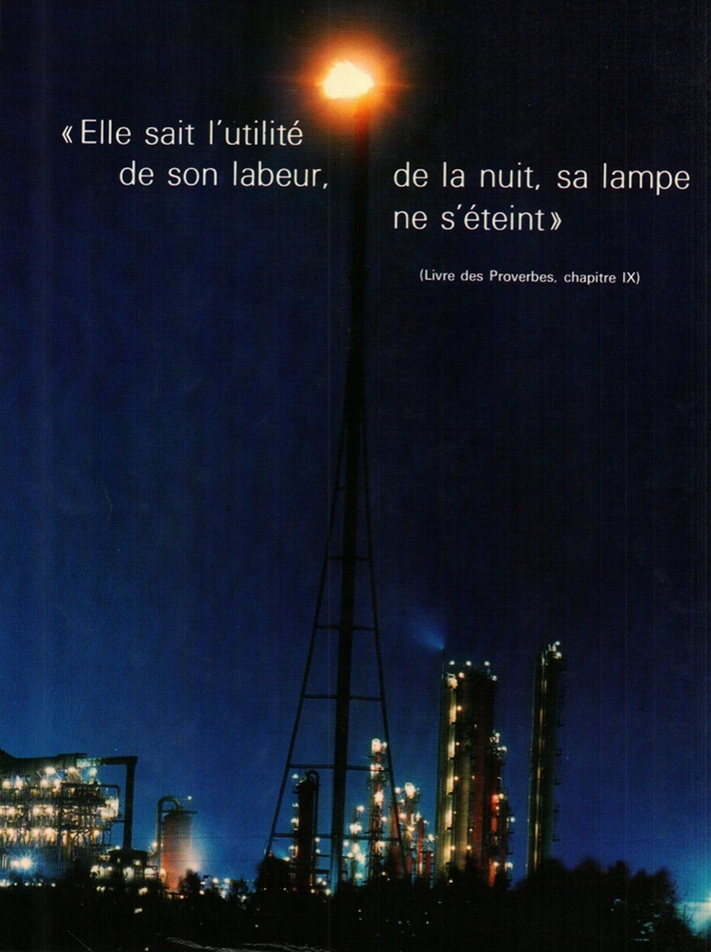
Once the markers of discord, the flare and its fumes were now at the heart of an advertising campaign broadcast in Feyzin in 1974 (Figure 2). The image of the night lights was accompanied by a biblical quotation: “She sees that her trading is profitable, and her lamp does not go out at night.”Footnote 144 The flare had thereby become the emblem of a sort of petroleum sacredness, which accompanied calculated opacity on industrial nuisance. In this sense, the communication strategy deployed by the refinery’s managers had proved to be a success in relation to the industrialists’ objective of securing local opinion leaders’ goodwill—if not their complacency. For oil companies, controlling local opinion remains an important issue, since refineries are the nodes of infrastructure that enable the commodification of oil derivatives. If the protests never completely died down in Feyzin, they were relegated to marginal social spaces, and these disapproving voices had difficulty in challenging the social utility and ecological viability of production choices.
Leaflet from the Elf refinery in Feyzin (1974).
The last page of this leaflet shows the night lights on the smokestacks of the refinery. The picture is accompanied by a biblical quotation: “She sees that her trading is profitable, and her lamp does not go out at night.”
Private collection of the author.

Figure 2 Long description
The last page of this leaflet shows the night lights on the smokestacks of the refinery. The picture is accompanied by a biblical quotation: “She sees that her trading is profitable, and her lamp does not go out at night”. Private collection of the author.
An important aspect of this contribution lies in the cross-referencing of public archives and company archives, whose degree of openness can vary depending on the strategic orientations of different companies and the social or political context. In their book Deceit and Denial, Rosner and Markowitz made an observation that could be applied to the oil sector, namely that “It is ever foolish to forget that industry’s first obligation is to its shareholders, and that all too often industry values secrecy over openness if only out of jealous protection of its competitive position.”Footnote 145 While corporate archives provide valuable insights, historians cannot rely on only a single source, as all of them are fragmentary.
Only by cross-referencing them can the archives of a specific producer be made intelligible and, in this way, this article contributes to two main fields of historiography. Firstly, this study is a renewed invitation to make room to embrace multi-scalar history that is more attentive to the diversity and complexity of social relations at the territorial level. It advocates a retreat from a research field that has too often been written with the assumption that studying multinational companies gives it a “global” character, or by focusing on a few iconic territories. Unlike the American companies studied by Hugh Gorman, French companies in the 1960s were not (yet) concerned with developing a “guiding ethic” based on environmental quality. Their priority was to ensure that no obstacles hindered productive activities, and all other objectives (compensation for plaintiffs, investment in less polluting technologies, etc.) were conditional on the continuation of these. At that time, the Feyzin refinery was to be a technological showcase in the politically driven creation of a French oil major and, amid an international competition, an industrial accident could not be allowed to hinder its expansion. Corporate communication was therefore placed in service of the urgent need for the resumption of industrial activity. Furthermore, the French state’s role in the oil economy was unequivocal in the 1960s. The nascent oil major was funded by both public and private capital, and the company’s executives had close ties with the government and the Ministry of Industry. Finally, French regulations applicable to polluting enterprises allowed entrepreneurs to leave public discourse to state representatives.
These reasons, as well as the multi-scalar approach and the attention paid to the phenomena that build up in the refining territory, are essential for understanding the global mutation of the French oil industry’s strategies. The sequence of events around the Feyzin disaster was a time of learning about crisis communication for the actors in the young French oil industry. This was significant because future communications on environmental stakes were undertaken by the French oil sector’s leading figures, who continued to hold responsibilities in these companies during the following decades. They were among the first to receive information about global warming, and they capitalized on the communication strategies implemented after the Feyzin accident. This case study could be an argument for a reassessment of the overwhelming importance given to US actors in the global environmental history of oil.
Secondly, this contribution enriches our understanding of corporate public relations related to industrial hazards and ecological concerns. While the period studied is prior to the rise of the environmental movements, we have identified a transition in companies’ communication strategies, marked by a double phenomenon. First, these strategies aimed to consider public opinion’s growing sensitivity to health and environmental issues. While PR agents continued to enlist some journalists’ support thanks to the regional economic spin-offs’ argument, “the common good” rhetoric was no longer sufficient on its own. As in other industrial areas, it was by then accompanied by a discourse based on the use of pollution measurements carried out in laboratories. Through a cumulative effect of discreet interventions with regional and national press groups, this communication allowed the condensation of a fog clouding the scope of critical voices. Faced with communications that focused on technoscientific issues, residents and workers alike did not have the equivalent resources that would enable them to harness counter-expertise. Thus, public relations were attempting to undermine the reach of legitimate audiences. PR agents’ communication was based on the implicit principle that those who lacked technical expertise were not entitled to intervene and had to be satisfied with the rewards promised by companies as part of a territorialized Fordist compromise. While sociologists Melissa Aronczyk and Maria Isabel Espinoza pointed out that the “foundational definition of public relations [was to create] relational meanings to structure groups of people who are enjoined to think of themselves as legitimate publics in a democracy,”Footnote 146 the Feyzin case shows that the actual practice of PR agents did not fit within this framework. On the contrary, their ethics were not based on any democratic foundation, if we think of democracy as the possibility of a contentious public sphere where disagreements can be expressed and where decision-making processes can involve all stakeholders.Footnote 147 These PR agents eventually shared an ethic that was very similar to that which had been held by leaders of polluting industries in France since the nineteenth century, whom Geneviève Massard-Guilbaud has clearly shown to have been “undoubtedly capitalists, but liberals only in their spare time.”Footnote 148
Acknowledgments
The first draft of this paper has been presented during a workshop in Liege, Belgium, and I wish to thank Michel Trigalet for organizing this workshop, Alexis Zimmer and Eric Geerkens for their remarks. A second draft was presented in Bristol, during an ESEH conference, and I wish to thank Nicolas Chachereau, Tim Cooper, and the participants in this session for their comments. A last draft was presented during a webinar of the Institute of Historical Research, and I would like to thank Venus Bivar and the participants in this seminar for their comments. I would like to thank the four anonymous reviewers for their very precise reviews and insightful suggestions. I would also like to extend my thanks to Kate Sommerville for her linguistic expertise.