Sweetpotato is a valuable commodity in the United States with approximately 58,500 ha harvested in 2018 worth an estimated US$654 million (USDA 2019a, 2019b). The major sweetpotato producing states of North Carolina, California, Mississippi, and Louisiana account for approximately 93% of the production area in 2018 (USDA 2019a). Weeds compete with sweetpotato for sunlight, moisture, and nutrients throughout the growing season and negatively affect yield and quality (Barkley et al. Reference Barkley, Chaudhari, Jennings, Schultheis, Meyers and Monks2016; Coleman et al. Reference Coleman, Chaudhari, Jennings, Schultheis, Meyers and Monks2016; Meyers et al. Reference Meyers, Jennings, Schultheis and Monks2010; Seem et al. Reference Seem, Creamer and Monks2003). Season-long interference from Palmer amaranth [Amaranthus palmeri (S.) Wats.] and large crabgrass [Digitaria sanguinalis (L.) Scop] can reduce sweetpotato yield from 36% to 81% and from 35% to 76%, respectively, depending upon weed density, and can also decrease harvest efficiency (Basinger et al. Reference Basinger, Jennings, Monks, Jordan, Everman, Hestir, Waldschmidt, Smith and Brownie2019; Meyers et al. Reference Meyers, Jennings, Schultheis and Monks2010). The prostrate growth habit of sweetpotato makes it vulnerable to interference from weeds throughout the growing season, and effective season-long weed management practices are required to protect storage root yield and quality.
An investigation of potential herbicides for weed control in sweetpotato is critically important due to the limited number of registered herbicides currently available and the increase of herbicide-resistant weeds. Several herbicides have been evaluated for their potential use in sweetpotato production systems (Beam et al. Reference Beam, Jennings, Chaudhari, Monks, Schultheis and Waldschmidt2018a, Reference Beam, Chaudhari, Jennings, Monks, Meyers, Schultheis, Waldschmidt and Main2018b; Chaudhari et al. Reference Chaudhari, Jennings and Meyers2018; Smith et al. Reference Smith, Jennings, Monks, Schultheis and Reberg-Horton2019). Pendimethalin (WSSA Group 3) is a dinitroaniline herbicide, registered for PPI and PRE use in several cropping systems to control many annual grasses and small-seeded broadleaf weeds as they germinate (Anonymous 2014). This herbicide does not control established weeds. Greater than 90% control of johnsongrass [Sorghum halepense (L.) Pers.], barnyardgrass [Echinochloa crus-galli (L.) Beauv.], and common lambsquarters (Chenopodium album L.) was reported in cotton (Gossypium hirsutum L.) with 1,120 g ai h−1 pendimethalin application (Shaner et al. Reference Shaner, Tecle and Johnson1998). Gardner et al. (Reference Gardner, York, Jordan and Monks2006) reported >90% control of redroot pigweed (Amaranthus retroflexus L.) and Palmer amaranth; common lambsquarters; and a mixture of large crabgrass, goosegrass [Eleusine indica (L.) Gaertn], broadleaf signalgrass [Urochloa platyphylla (Munro ex C. Wright) R.D. Webster], and fall panicum (Panicum dichotomiflorum Michx.) at 3 wk after PRE application of 1,120 g h−1 pendimethalin.
The negative effects of pendimethalin and other dinitroaniline herbicides on root development has been reported in several crops (Gordon and Green Reference Gordon and Green1999; Keeling et al. Reference Keeling, Dotray and Abernathy1996; Smith Reference Smith2004; Worley et al. Reference Worley, McCarty, Kenty and Leon1999). Pendimethalin interrupts mitotic cell division in developing root systems through inhibition of the polymerization of microtubule basic units and the creation of protofilaments, which leads to the loss of structure and function of the microtubule (Vaughn and Lehnen Reference Vaughn and Lehnen1991). Gordon and Green (Reference Gordon and Green1999) reported inhibition of lateral root formation in cotton after a pendimethalin application. Although extensive research is available on PRE and PPI applications of pendimethalin in a variety of cropping systems, limited data are available regarding its effect on sweetpotato growth and root development. Lewthwaite and Triggs (Reference Lewthwaite and Triggs2000) reported no injury to sweetpotato plants from pendimethalin applied at 990 g ha−1 1 d after transplanting (DAP) in New Zealand. The use of pendimethalin in sweetpotato would be beneficial to growers because it controls broadleaf weeds including Palmer amaranth and annual grasses. Thus, the objective of this research was to determine the influence of pendimethalin application rate and timing on sweetpotato tolerance and storage root yield.
Materials and Methods
Experiments were conducted at the Horticultural Crops Research Station, Clinton, NC, in 2018 (35.0227°N, 78.2794°W); the Sweet Potato Research Station, Chase, LA (32.0998°N, 91.7016°W) in 2018; and Pontotoc Ridge–Flatwoods Branch Experiment Station in Pontotoc, MS (34.1331°N, 89.0063°W) in 2017 and at two locations in 2018. Soil was a Norfolk loamy sand (fine-loamy, kaolinitic, thermic Typic Kandiudults) with pH 5.9 and 0.7% organic matter (OM) in North Carolina; a Gilbert silt loam (fine-silty, mixed, active, thermic Typic Glossaqualfs) with pH 5.9 and 1.5% OM in Louisiana; a Frizzell silt loam (coarse-silty, siliceous, thermic Aquic Glossudalfs) with pH 6.5 and 1.3% OM in Mississippi in 2017; and a Falkner silt loam (fine-silty, siliceous, thermic Aquic Paleudalfs) with pH 6.3 and 7.7, and 1.3% and 1.4% OM, respectively, at two locations in Mississippi in 2018. Field-grown, nonrooted sweetpotato cuttings were mechanically transplanted 10-cm deep and 30-cm apart in-row. Plots consisted of two rows (North Carolina) or three (Mississippi and Louisiana) ridged rows; the second row of each plot was used for data collection in North Carolina, and the middle row of each plot was used for this purpose in Mississippi and Louisiana. In Louisiana and North Carolina, the first row of each plot was nontreated and served as a border row. In Mississippi, all rows were treated. Cultivar; plot size; and planting, treatment, and harvest dates differed slightly by location (Table 1). Cultivars planted were the predominant rose-skinned, orange-fleshed, and fresh-market cultivar in each state. All plots were maintained weed-free throughout the growing season with an application of 107 g ai ha−1 flumioxazin (Valor SX, Valent U.S.A. Corporation, Walnut Creek, CA) before transplant and 1,120 g ai ha−1 clomazone (Command 3ME, FMC Corporation, Philadelphia, PA) after transplant, between-row cultivation, and hand-removal of weeds as needed. The experimental design at all locations was a randomized complete block with four replications.
Location, year, sweetpotato variety, plot size, planting date, herbicide application timing, and harvest [days after transplanting (DAP)] for experiments conducted in North Carolina, Mississippi, and Louisiana, 2017–2018.

Treatments consisted of a factorial arrangement of five pendimethalin (Satellite HydroCap, United Phosphorus, Inc., King of Prussia, PA) rates (266, 532, 1,065, 1,597, and 2,130 g ha−1) by two application timings (0 to 1 or 10 to 14 DAP). All pendimethalin applications were broadcast over the top of the transplanted sweetpotato crop. Additionally, a nontreated check was included for comparison. In Mississippi and Louisiana, herbicide applications were made with a tractor-mounted, CO2-pressurized sprayer calibrated to deliver 140 L ha−1. In Mississippi, herbicide was applied at 165 kPa with a six-nozzle boom equipped with TeeJet XR 8002 VS flat fan tips (Spraying Systems Co., Wheaton, IL). In Louisiana, herbicide was applied at 234 kPa with a four-nozzle boom equipped with TeeJet TTI 11002 tips. In North Carolina, herbicide was applied with a CO2-pressurized backpack sprayer calibrated to deliver 187 L ha−1 at 173 kPa with a two-nozzle boom equipped with TeeJet XR 8003VS flat fan nozzles. At least 10 mm rainfall occurred at most of study locations within 7 d of application, which helped activate pendimethalin (Table 1). Along with rainfall, crops were irrigated throughout the sweetpotato growing season in Louisiana and North Carolina based on crop requirement. Sweetpotato plants were visually rated 2, 4, 6, 8, 10, and 14 wk after transplanting (WAP) for crop injury (chlorosis, necrosis, stunting, and leaf deformation) on a scale 0% (no injury) to 100% (crop death; Frans et al. Reference Frans, Talbert, Marx, Crowley and Camper1986). Sweetpotato storage roots were harvested between 103 to 119 DAP (Table 1) with a chain digger and hand-graded into jumbo (≥8.9 cm in diam), no. 1 (≥4.4 cm but <8.9 cm), canner (≥2.5 cm but <4.4 cm), and cull (misshapen roots; USDA 2005) and weighed. Marketable yield was calculated as the sum of jumbo, no. 1, and canner yields. The aggregate of all grades was used to calculate total yield.
The experiment was repeated in five environments where each was a combination of location and year. All data were subjected to ANOVA using the SAS (SAS 9.3, SAS Institute Inc., Cary, NC) PROC GLM procedure with the fixed effects of environment, pendimethalin application rate, and application timing and random effect of replication within environment. All data were checked for variance homogeneity and normality before statistical analysis by plotting residuals. Sweetpotato injury data were subjected to arcsin transformation to improve normality and homogeneity of error variances. However, to facilitate the interpretation of results, back-transformed means are presented. Analysis of injury data did not include ratings from the nontreated check, which were 0% with a variance of 0. Treatment means were separated by Fisher’s protected LSD at a significance level of 0.05.
Results and Discussions
Due to a lack of environment-by-treatment interaction, data for crop injury and yield of all grades was combined across locations for all three states. There was no significant (P > 0.05) pendimethalin application rate by timing interaction reported for crop injury and yield for all grades; therefore, results are presented with respect to significant main effects. Injury from pendimethalin was reported as crop stunting. Crop injury was minimal (<4%) through 6 WAP and no injury was observed from 8 to 14 WAP regardless of pendimethalin application rate or timing (data not presented).
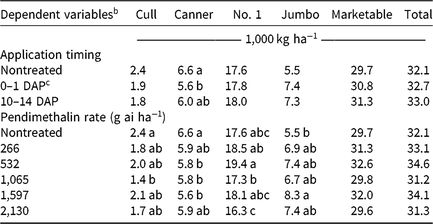
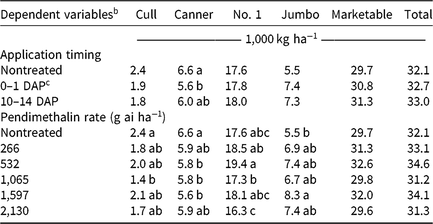
The nontreated check yielded 6.6, 17.6, 5.5, and 32.1 × 10³ kg ha−1 of canner, no. 1, jumbo, and total grades, respectively (Table 2). Neither pendimethalin application rate nor timing influenced no. 1, jumbo, marketable, or total sweetpotato yield relative to the nontreated check. However, all rates of pendimethalin resulted in reduced canner sweetpotato yield (5.6 to 5.9 × 10³ kg ha−1) compared with the nontreated check. Similarly, applications made at 0 to 1 and 10 to 14 DAP did reduce yield of canner-grade sweetpotato (5.6 and 6.0 × 10³ kg ha−1, respectively) compared with the nontreated check.
Overall, these results indicate that early-season sweetpotato stunting following pendimethalin application is minimal and temporary, and sweetpotato is able to recover from this injury with no effect on no. 1 or total yield when compared with a nontreated check, regardless of application rate and timing. A similar level of sweetpotato crop tolerance to pendimethalin was reported by Lewthwaite and Triggs (Reference Lewthwaite and Triggs2000). The addition of pendimethalin in a sweetpotato production system as a herbicide with an added mode of action would be beneficial for growers to reduce the selection pressure and manage herbicide-resistant weeds. Because Palmer amaranth and goosegrass resistance to microtubule inhibitors has already been documented in the southeastern United States (Heap Reference Heap2019), pendimethalin should be part of an integrated weed management program.
Based on these results demonstrating crop tolerance and the findings of others (Gardner et al. Reference Gardner, York, Jordan and Monks2006; Shaner et al. Reference Shaner, Tecle and Johnson1998) demonstrating efficacy on annual grasses and small-seeded broadleaf annual weeds, pendimethalin has potential for use in sweetpotato production systems as a component of an integrated weed management system. Additional research should focus on effective weed management programs in sweetpotato production systems with an application of pendimethalin in combination with other herbicides and/or cultural and mechanical weed management strategies. A single application of pendimethalin is not enough to provide season-long weed control and can cause up to 48% yield reduction of marketable grades due to poor weed control, as reported by Lewthwaite and Triggs (Reference Lewthwaite and Triggs2000). Future research should be conducted to determine the potential impact of soil incorporation and irrigation or rainfall, which may place pendimethalin in direct contact with sweetpotato roots during the initiation phase of storage root development.
Sweetpotato yield as influenced by pendimethalin application timing and rate in North Carolina, Mississippi, and Louisiana, 2017–2018.a
a Data were combined for all experiments in Louisiana, Mississippi, and North Carolina, 2017–2018.
b Means within columns for dependent variables (application timing or rate) are significantly different according to Fisher’s as protected LSD (α = 0.05).
c Abbreviation: DAP, days after transplanting.
Acknowledgments
We thank the staff of the Horticultural Crops Research Station, Pontotoc Ridge–Flatwoods Branch Experiment Station, and Sweet Potato Research Station for the cultural management of sweetpotato research plots throughout the studies. This research received no specific grant from any funding agency, commercial, or not-for-profit sectors. No conflicts of interest have been declared.