Introduction
Aeromedical retrieval in Australia is essential due to a lack of services such as diagnostic imaging in the small hospitals accessible to rural communities, the concentration of medical specialists in larger hospitals, and vast distances between major population centers. 1,2 Yet, there is limited understanding of aeromedical patient outcomes due to a lack of comprehensive patient data. Reference Edwards, Franklin and Aitken3,Reference Franklin, King and Aitken4
This study builds upon an understanding of the patients’ journeys (ie, the integrated, continuums of care that span multiple settings; prehospital and hospital-based pre-flight, flight transport, after-flight hospital in-patient, and disposition) Reference Edwards, Franklin and Aitken3,Reference Franklin, King and Aitken4 and outcomes by linking aeromedical data with emergency department (ED), in-hospital, and death data. When patients’ journey data are pieced together by a unique patient identification (ID), it creates a more complete picture of prehospital and in-hospital emergency care. Reference Chikani, Blust and Vossbrink5,6
This study will explore whether a previously developed air ambulance quality framework Reference Edwards, FitzGerald, Franklin and Edwards7,Reference Edwards, FitzGerald, Franklin and Edwards8 is useful when applied to existing air ambulance patients’ journeys using outcomes from linked data analysis. It is hypothesized that the framework will help guide prehospital and in-hospital performance reporting and improve the planning and delivery of aeromedical services. Until now, the frameworks’ Reference Edwards, FitzGerald, Franklin and Edwards8 utility to accommodate actual patient outcome and service variables has not been explored. These variables include patient mortality, receiving hospital or ED disposition, aeromedical aircraft type, the patients’ sending facility rurality, receiving facility admission type (ie, via ED or direct hospital admission), and number of flights per patient by regional referral pathways.
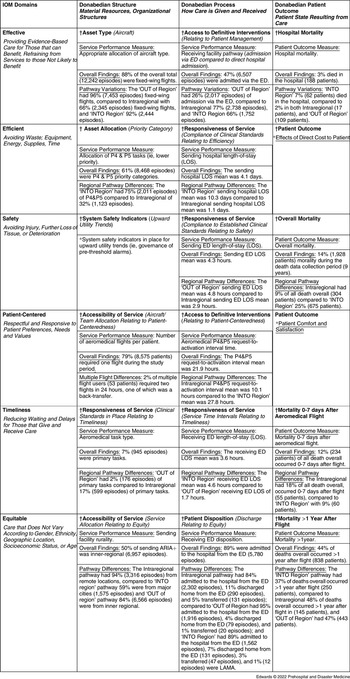
The recently published air ambulance quality framework Reference Edwards, FitzGerald, Franklin and Edwards8 was developed based on a scoping review which examined air ambulance independent and dependent outcome variables used in the literature. Reference Edwards, FitzGerald, Franklin and Edwards7,Reference Edwards, FitzGerald, Franklin and Edwards8 However, the framework has not been applied and using linked data should provide better understanding of outcome measures. Reference Edwards, FitzGerald, Franklin and Edwards7,Reference Edwards, FitzGerald, Franklin and Edwards8 The aeromedical framework combined generally accepted quality measures from the Institutes of Medicine (IOM; Washington, DC USA) 9 and Dr. Avedia Donabedian. Reference Donabedian10 The six IOM 9 service provision domains included: “Effective,” “Efficient,” “Safety,” “Patient-Centered,” “Timely,” and “Equitable.” The three Donabedian Reference Donabedian10 measures included: “Structure,” “Process,” and “Patient Outcome.” The performance themes of air ambulance outcome measures were previously identified by using a four-phased content analysis process. Reference Edwards, FitzGerald, Franklin and Edwards8 The process was chosen to increase transparency and reproducibility. Reference Edwards, FitzGerald, Franklin and Edwards8 Performance theme categorization was done with qualitative content analysis using an origination approach Reference Vaismoradi, Jones, Turunen and Snelgrove11 (ie, identifying meaning in the clinical and air ambulance context based on the authors’ combined professional aeromedical and hospital experience). The co-authors agreed on eight performance themes (Asset/Team Type, Access to Definitive Interventions, Prehospital Factors, Mortality, Morbidity, Responsiveness of Service, Accessibility of Service, and Patient’s Disposition). Reference Edwards, FitzGerald, Franklin and Edwards8 The patient, prehospital, and in-hospital service outcomes (Supplementary Files S1, S2, S3; available online only) were selected for their relevance to the previously determined performance theme categories Reference Edwards, FitzGerald, Franklin and Edwards8 (found in bold font in Table 1). The intention of the aeromedical framework presentation in Table 1 was to examine whether patient outcome and process measures of air ambulance and in-hospital services could be categorized into quality themes to help guide performance reporting and improvement planning. Reference Edwards, FitzGerald, Franklin and Edwards7,Reference Edwards, FitzGerald, Franklin and Edwards8 It was not the intent to impose rigid replication of the selected outcome measures 12 for other air ambulances services due to the significant variation between service system structures, governance, and management. Reference Edwards, FitzGerald, Franklin and Edwards8
Patient and Service Outcomes Situated by Performance Themes in the Air Ambulance Quality Framework

Note: Patient and service variables are found in Supplementary Files S1, S2, and S3.
Abbreviations: ARIA+, Accessibility/Remoteness Index of Australia; ED, emergency department; IOM, Institutes of Medicine; LAMA, left against medical advice; RFDS, Royal Flying Doctor Service.
† Performance theme findings from previous scoping review.
* Initiatives identified by the research team as areas for linked data to improve and include in future research.
In Queensland, Australia, 16 jurisdictions (or regions) with political and economic boundaries were developed to manage health service needs. 2 However, hospital service capability levels vary among regions. Some regions exclusively provide rural hospital level capability (few specialties) which often require transfer to regions with higher capability; regional hospital level capability (more differentiated); and tertiary hospital level capability (highly specialized). Referral of patients toward appropriate levels of care is called referral pathways.
Central Queensland Hospital and Health Service (CQHHS; Supplementary Files S4, S5; available online only) is used here to explore prehospital and in-hospital aeromedical service outcomes. Rockhampton Public Hospital (Rockhampton, QLD, Australia), the main regional capability level hospital serving the entire CQHHS region, accepts patients from 16 small, rural capability level hospitals within its own boundaries, and from two large, adjacent rural/remote service regions (Central West and South West) which lack both regional capability level and tertiary hospital services. 13 Currently, CQHHS covers a geographical area of 44,016 square miles (114,000 sq kms) and had an estimated resident population of 217,449 during the study period. 13 However, the CQHHS region lacks tertiary-level health services. The closest tertiary services are 466+ miles (750+kms; approximate eight-hour ground transport time) from the CQHHS regional capability level hospital. Moreover, rural and remote patients with complex chronic illnesses may require frequent flights for interventions (eg, mental health crises or medical non-compliance) due to the large distances to the CQHHS regional capacity level hospital. Moreover, ground transportation options for patients may be limited: if patient lacks access to a car, utilizing a rural ambulance will remove the only emergency service transport and paramedic from the community for many hours; or ground transport is not safe for patients or ground staff. 14 The lack of rural health services and the vast distances are examples demonstrating the necessity of aeromedical retrieval in the CQHHS region.
Methods
This is a descriptive, retrospective cohort study of patients retrieved on a dedicated, medical-specific aircraft via one of the three referral pathways: (1) between facilities within CQHHS; (2) departed from a facility within CQHHS to a hospital outside the district; or (3) arrived into CQHHS from a facility outside the district. Data sources from aeromedical, ED, and hospital records were collected from January 1, 2011 through December 31, 2015. Death registry data covered the period from January 1, 2011 through June 30, 2019. Human research ethics approval was granted by the CQHHS HREC (CQC/16/HREC/8) and the Queensland Department of Health (Brisbane, QLD, Australia; RD007591).
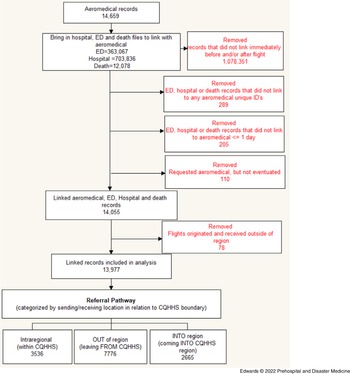
Queensland Health (Brisbane, QLD, Australia), 2 the State’s public health provider, requires data linkage to be completed by the internal Statistical Service Branch (SSB) to maintain patient confidentiality and reduce information bias. 6 The SSB utilized deterministic and probabilistic data linkage methods. 6 The SSB generated a set of data linkage keys to be used by researchers. 6 Each patient was given a unique patient ID. Record linkage used the dates and times associated with each patient ID to match the end of one patient care episode to the start of the next care episode for that patient. A total of 13,977 patient episodes were linked (Figure 1). After the data linkage and analysis was complete, the patient outcomes and service performance variable results were categorized within the performance themes described earlier. Reference Edwards, FitzGerald, Franklin and Edwards8 This study examined both overall patterns of aeromedical use and the variations among the three referral pathways.
Flowchart of Data Collection where Boxes with Red Text Indicate Records that were Removed from the Study and Those in Black are Records Kept.
Abbreviations: ED, emergency department; CQHHS, Central Queensland Hospital and Health Service; ID, identification.

Linked data inclusion criteria were patients retrieved/transported on a dedicated, medical-specific aircraft, all patient ages, genders, and illness/injury types. Exclusion criteria included advice calls and cancelled tasks. Regional referral pathways were defined by the origin and destination location of the flight in relation to the CQHHS jurisdiction. Patients that originated in CQHHS and were flown out of the regions’ boundary were labelled “OUT of Region.” Patients that originated in CQHHS and were flown within the CQHHS region boundary were labelled “Intraregional.” Patients that originated outside of CQHHS and were flown into the CQHHS boundary were labelled “INTO Region.”
Illness and injury categories used International Classification of Diseases, Australian Modification, tenth revision (ICD-10-AM) 15 and diagnosis-related groups, refined to represent the Australian hospital service Australian Diagnosis-Related Groups/AR-DRG (version 7.0). 16 In Queensland, the five air ambulance priority categories (P1 = most urgent and P5 = least urgent) were designated by Retrieval Services Queensland (RSQ; Kedron, QLD, Australia) for expected targeted crew response time and is a State-wide governance key performance indicator (Supplementary File S6; available online only). 17 Hospital and ED data time was determined by computer entry. Aeromedical data time was determined by standardized clocks or watches. Presentation of the study followed STROBE guidelines to ensure adequate reporting (Supplementary File S7; available online only). Reference von Elm, Altman, Egger, Pocock, Gøtzsche and Vandenbroucke18 The rurality profile of CQHHS was classified using the Accessibility/Remoteness Index of Australia (ARIA+) 19 to define scales of remoteness in Queensland. The ARIA+ was chosen as it is based on measurements of road distance measures to services and number of services available. 19 Age group levels were consistent with Australian recommendations. 20 Mortality after flight intervals was based on air ambulance outcome measure findings: zero-to-seven days; seven to 31 days; one-to-six months; six to 12 months; and >one year. Reference Gardiner, Bishop and Dos Santos21 The number of flights undertaken by each included patient during the study period was counted. Key variables were explored independently so that the variations in the regional referral pathways were better understood. These variables were: patient mortality (Supplementary File S1); patient’s receiving hospital or ED disposition; aeromedical aspects (eg, aircraft and task type); patient’s receiving and sending facility rurality and length-of-stay (LOS); aeromedical request for service to activation of service time interval; receiving facility admission type (ie, via ED or direct hospital admission); and number of flights per person (Supplementary Files S2, S3).
Comparisons of data between referral pathways were made using a χ 2 test or Analysis of Variance (ANOVA), as appropriate. Continuous data were summarized using means and standard deviations (SD) and compared using ANOVA. Categorical data were summarized using percentages. Summaries of the frequencies of missing data are provided in Supplementary File S8 (available online only). Cohen’s d standardized effect size characterized differences between means and Cohen’s h standardized effect size characterized differences in proportions. Reference Cohen22 The “Intraregional” pathway was the control pathway to compare the “OUT of Region” pathway results and the control to compare “INTO Region” pathway results. Cohen’s d and h reference values consist of: 0.20 (small effect); 0.50 (medium effect); and 0.80 or higher (large effect). Reference Cohen22 Hypothesis testing used a statistical significance level of <0.05. Statistical analysis used R (2019-07-05; version 3.6.1, The R Foundation for Statistical Computing; Vienna, Austria). The R package “effsize” (2020-10-05; version 0.8.1) was used to determine Cohen’s d and R package “pwr” (2020-03-16; version 1.3-0) was used for Cohen’s h.
Results
Results classified according to the air ambulance quality framework are found in the Supplementary Files S1, S2, S3. The overall findings and the results from the regional referral pathway variations are presented for each IOM and Donabedian domain in Table 1. For example, the space where the IOM Timeliness and Donabedian Process domains intersect falls into the performance theme “Responsiveness of Service.” The performance measure “Receiving ED LOS” suited the theme, as it related to the clinical process of timely definitive management of the patient. In the overall study findings, the receiving ED LOS mean was 3.6 hours. However, there were statistically significant referral pathway variations between the “OUT of Region” pathway ED LOS mean of 1.7 hours, the “Intraregional” ED LOS mean of 10.1 hours, and the “INTO Region” ED LOS mean of 4.6 hours (Supplementary File S2).
Of the patients who were retrieved during the study period, 1,928 (14% overall study total) had died by June 30, 2019 (Table 1 [Safety row] and Supplementary File S1). Rates of mortality were highest in the “INTO Region” referral pathway (25% pathway total; χ 2 =367.8; df=2; P <.001), although differences between pathways were small (Cohen’s effect size 0.2). Mortality zero-to-seven days after aeromedical flight also differed between referral pathways with mortality following the “Intraregional” pathway (18% death zero-to-seven-day total) higher than for the “OUT of Region” pathway (9%; χ 2 =75.9; df=24; P <.001). Again, differences were small (Cohen’s effect size 0.2; Table 1 [Timely row] and Supplementary File S1).
Aircraft type also differed between pathways (χ 2 =2949.5; df=2; P <.001) with the “OUT of Region” pathway having the largest use of fixed wing aircraft (96% of pathway total) with large differences (effect size 0.84) between “Intraregional” and “OUT of Region” groups (Table 1 [Effective row] and Supplementary File S2). Using an ARIA+ scale 19 (ie, remoteness of sending facilities), the total volume of flights from rural sending facilities was largest in the “Intraregional” pathway (95% of pathway total) compared to the total volume of flights from inner regional sending facilities was largest volume in the “OUT of Region” pathway (84% of pathway total; Table 1 [Equitable row] and Supplementary File S2).
Receiving ED disposition was most frequently “Admit to Hospital” (89% overall study total), but was less frequent in the “Intraregional” pathway (84% of pathway total) compared to the receiving ED disposition in the “OUT of Region” pathway (95% of pathway total; χ 2 =156; df=8; P <.001; Table 1 [Equitable row] and Supplementary File S2). Receiving facility admission pathway via the ED (opposed to direct hospital admission) was least frequent in the “OUT of Region” pathway (26% of pathway total) and most frequent in the “Intraregional” pathway (77% of pathway total) with large differences between these two groups (Cohen’s effect size 1.1; Table 1 [Effective row] and Supplementary File S2). The most common receiving ED ICD-10-AM-specific clinical condition code for the “Intraregional” pathway was appendicitis (6% of pathway total), whereas the most common “OUT of Region” code was myocardial infarct (4% of pathway total; Supplementary File S2).
In total, 10,864 patients flew during the study period (Supplementary File S5). Most of those patients (79%) required only one flight with 21% requiring two to 12 flights. Of the 2,289 patients with multiple flights, 675 were connected to the same episode of care (6% of total patients). There were 53 patients who had one flight toward definitive care and one back-transfer within 24-hours, and 59 patients required three flights within 24-hours. There were three performance areas where measures could not be identified in the available data: the effects of direct cost to patient; safety indicators for upward utility trends; and patient comfort and satisfaction scoring.
Discussion
With limited resources, such as air ambulances, there is an on-going need to ensure that health services are effective, efficient, safe, patient-centered, timely, and equitable. However, to date, there has been limited exploration of these service attributes for air ambulance patients due to a lack of linked outcome data and a framework to accommodate the findings. Reference Edwards, FitzGerald, Franklin and Edwards8 In this paper, a previously developed air ambulance quality framework Reference Edwards, FitzGerald, Franklin and Edwards8 was used and found that it could usefully be applied to aeromedical performance using linked data.
As the CQHHS population ages, the complexity of patient presentations increases and demand for health services outpaces population growth, the challenge will be to adapt the availability and the access to health services to meet health needs in the region. 23 This study demonstrated that service comparisons need to take regional referral pathways into account, since patient requirements and outcomes differ among pathways. According to the IOM, failure to identify this kind of variation hinders the ability to recognize service disparites. 12 On-going review of prehospital and in-hospital quality performance in each referral pathway will be critical for the CQHHS region in order to meet future health service needs.
A recent Australian Parliamentary inquiry explored the lack of imaging availability and accessibility outside urban centers. 1 In this study, the frequency of appendicitis admission via ED, rather than direct admission to hospital for surgery, confirms the lack of diagnostic imaging in rural hospitals. 1 This has implications for health outcomes, as the on-going reliance on aeromedical retrieval for diagnostic confirmation may delay treatment and remove patients from their community supports. 1 Future solutions may include training and provision of equipment, upskilling, or telehealth to improve prehospital and in-hospital effectiveness.
Future Research
This study demonstrated that the theoretical air ambulance quality framework can be used to explore the effective, efficient, safe, patient-centered, timely, and equitable nature of prehospital and in-hospital service delivery. There are, however, questions that remain regarding the benefits of a regional referral pathway model, as it functions within the whole State prehospital and in-hospital system, to meet community needs and health service variations over time. Reference Becher, Sukumar and DeWane24 While data linkage is not a new process, it is still not commonly undertaken with aeromedical data and clear definitions of patients’ journeys which have developed for this study would be valuable to be applied to State-wide aeromedical data.
The authors propose three suggestions. First, future exploration of air ambulance quality frameworks Reference Edwards, FitzGerald, Franklin and Edwards8 should include outcome measures which relate to: the effects of direct cost to patient (eg, patients’ out-of-pocket costs for the health services rendered or bankruptcy due to health service cost); safety indicators in place for upward utility trends (eg, wait times for primary tasks or delays in ground transport coordination); and patient comfort and satisfaction scores. Second, a Queensland State-wide referral pathway analysis should be undertaken with the other 15 hospital jurisdictions in the State using similar methods described in this study. The analysis can create a prehospital and in-hospital service capability model for the State, based on patients’ sending locations, medical conditions, and health service provision, noting that there may be a need to build capacity in regions. Third, further analysis of high frequency aeromedical illnesses, particularly stroke and cardiac-related pathologies, is needed.
Limitations
The generalizability of these results is subject to certain challenges. There is considerable heterogeneity among air ambulance service structures and processes internationally. The scope of the study was limited, as the study period data were from 2010-2015 with death data through 2019, although they include the total population who used the air ambulance service. However, the value of the study was to highlight how aeromedical patients’ experiences and outcomes can be used for service evaluation within a previously created quality framework. Changes may well have occurred in the air ambulance service since the study period. Therefore, there is added value for future linked data studies to consider the regional referral pathways which were introduced in this study to evaluate changes in aeromedical service delivery over the intervening period. This study also provides a pre-COVID-19 baseline for comparison. Finally, there is an inherent limitation in the use of retrospective cohort studies since risk factors may vary over time and location. Reference von Elm, Altman, Egger, Pocock, Gøtzsche and Vandenbroucke18 However, this limitation was minimized by utilizing STROBE quality reporting guidelines (Supplementary File S7). Reference von Elm, Altman, Egger, Pocock, Gøtzsche and Vandenbroucke18
Conclusion
The air ambulance quality framework was able to be applied to existing prehospital and in-hospital services data to report their provision of quality care and explored areas for future quality framework improvement. The study successfully linked data from aeromedical, ED, in-hospital, and death sources and explored the aeromedical patients’ journeys. Three distinct pathways were identified with variation across the pathways: Intraregional, INTO Region, and OUT of Region. Three research suggestions include: future aeromedical quality frameworks incorporate outcomes measures which relate to patients’ out-of-pocket costs for the health service provision, safety indicators for upward utility trends, and patient comfort and satisfaction scores; analysis of State-wide linked data through the regional referral pathway lens to enable a more nuanced understanding of the service; and analysis of stroke and cardiac-related aeromedical patient outcomes.
Conflicts of interest/funding
The authors (KHE, RCF, RJ, PMK, & SK) declare no conflicts of interest. Data linkage was funded by a grant from the Emergency Medicine Foundation (Australasia) Queensland Program # EMPJ-370R27 and Central Queensland Hospital and Health Service (CQHHS). The views expressed are those of the authors and are not necessarily those of EMF or CQHHS. The funder had no participation in any aspect of the study. KHE is the recipient of an Australian Government Research Training Program Scholarship and a CSIRO PhD Top-Up Scholarship.
Author Contributions
Kristin Edwards was the main contributor and lead author responsible for the ideas, development of the study, and writing of the paper, and will contribute as part of her PhD candidature and thesis. Sankalp Khanna: Supervision, Reviewing, and Editing. Richard Franklin: Supervision, Reviewing, and Editing. Rhondda Jones: Supervision, Reviewing, and Editing. Petra Kuhnert: Supervision, Reviewing, and Editing.
Supplementary Materials
To view supplementary material for this article, please visit https://doi.org/10.1017/S1049023X22001480