
I. INTRODUCTION
WC–Co cemented carbides, consisting of hard WC grains embedded in the ductile Co-rich binder, have been widely used in many fields including tools, structural components, and wear parts due to high strength and hardness in combination with high wear resistance.Reference Upadhyaya1–Reference Yong and Ding3 In general, the WC–8Co cemented carbide needs to be joined with steel or other metals because of its low plasticity and ductility. In the past decades, much work has been done to get a sound joint between cemented carbide and steel via brazing,Reference Lee, Kwon and Jung4–Reference Zhu, Luo, Luo, Wu and Li12 diffusion bonding,Reference Iamboliev, Valkanov and Atanasova13–Reference Guo, Wang, Gao, Shi and Yuan17 fusion welding,Reference Xu, Ren, Zhang, Gong and Yang18,Reference Zhou, Cui, Xu and Lu19 and transient liquid-phase bonding.Reference Guo, Gao, Liu, Zhou and Qiao20 Among which, brazing has become one of the main methods for joining cemented carbide to steel in terms of simple process and low cost.
However, it remains challenging to obtain a high strength joint due to the great differences between cemented carbide and steel in physical and chemical properties. Presently, there are two challenging problems in the brazing process. One is how to improve the wettability of cemented carbides. As we know, the wettability of substrates by molten filler metals and the brazing process (i.e., brazing temperature and holding time) are recognized as the critical parameters in determining the mechanical properties of brazed joint.Reference Liu, Valenza, Muolo, Qiao and Passerone21–Reference Liu, Qiao, Wang, Yang and Lu23 A few investigations are concerning the wetting and spreading of metals on the cemented carbides.Reference Zhang, Liu, Tao, Shao, Fu, Pan and Qiao11,Reference Sechi, Tsumura and Nakata24–Reference Mirski and Piwowarczyk26 For instance, Silva et al.Reference Silva, Fernandes and Senos25 investigated the wetting behavior of molten Cu on WC–3.5Co, WC film, and WC at 1080 °C by the sessile drop method and obtained the lowest final contact angle of 6° on the WC–3.5Co surface. Mirski et al.Reference Mirski and Piwowarczyk26 reported that the wettability of Cu48ZnNi alloys/cemented carbide system can be enhanced by selective electrolytic etching of the WC phase, with the contact angle decreasing from 120° to 30° at 1100 °C and from 70° to 4° at 1180 °C in nitrogen atmosphere. In our previous study, it was also found that both pure Cu and Ag–Cu alloys presented good wettability on the WC–8Co cemented carbide.Reference Zhang, Liu, Tao, Shao, Fu, Pan and Qiao11 However, the available information on the interfacial behavior of the Cu-based alloy on the cemented carbides at high temperatures is quite limited.
Another problem is the large residual thermal stress in the cemented carbide/steel joint due to the great difference in the thermal expansion coefficient. To minimize this residual stress, appropriate filler metal and Ni-plated coating on the cemented carbide or filler metal can be adopted to release the residual stress in the brazed joints. The filler metals for brazing cemented carbide to steel are mainly focused on the Cu- and Ag-based alloys due to ductility and toughness. On the other hand, Zhu et al.Reference Zhu, Luo, Luo, Wu and Li12 investigated the effect of electroless Ni–Cu–P coating on the brazability of cemented carbide to steel, indicating that the Ni–Cu–P coating on the cemented carbide can greatly enhance the joint shear strength. Chen et al.Reference Chen, Feng, Wei, Xiong, Guo and Wang6 performed the brazing cemented carbide to 3Cr13 stainless steel using the Ni-coated Cu–Zn alloy as the filler metal and found that the added Ni can promote the elemental interdiffusion between the filler metal and base materials, resulting in the improvement of joint strength. Generally, Ni is often considered as a constructive intermediate material and has similar physical and chemical properties to Co in the WC–Co cemented carbide and Fe in the steel, exhibiting a good affinity between the filler metal and base materials.
In this paper, a thin Ni layer was electroplated on the surface of WC–8Co cemented carbide, and then the wetting and brazing of Ni-coated WC–8Co substrates with different coating thicknesses were performed using the Cu–19Ni–5Al alloy as the drop or filler metal. Moreover, the microstructural evolution, interfacial behavior, joint shear strength, and fracture were mainly investigated.
II. EXPERIMENT
A novel Cu-based alloy with normal weight percentage compositions of Cu–19Ni–5Al was fabricated by vacuum refining, wire-electrode cutting, and grinding into ∼0.3 mm thick foils. The melting point of the alloy was ∼1190 °C determined by differential scanning calorimetry. The commercial WC–8Co (wt%) cemented carbide with dimensions of Ø 20 × 6 mm and SAE1045 steel (Yinan Hujing Special Steel Co. Ltd., Shandong, China) with dimensions of Ø 15 × 5 mm were used as the substrate or base materials for wetting and/or brazing experiments. Pure Co was used in fabrication of WC–8Co cemented carbide, and the particle size of WC particles was ∼3 μm.
A Ni coating was electroplated on the polished WC–8Co cemented carbide in Watts electrolyte (280 g/L NiSO4·7H2O, 45 g/L NiCl2·6H2O, 35 g/L HBO3 and 0.1 g/L C12H25SO4Na). The Ni coating thicknesses were ∼20, 52, 78, and 90 μm after depositing for 30, 60, 90, and 120 min under following deposition conditions: cathode current 0.1 A, temperature 30–40 °C, pH value 4–5, respectively, determined by using a micrometer caliper. All the wetting and brazing surfaces of cemented carbide and steel pieces were ground, polished, and then cleaned ultrasonically in alcohol. The sessile drop tests of the Cu–19Ni–5Al alloy on the Ni-coated WC–8Co substrates were evaluated by a high temperature contact angle measuring instrument (OCA15LHT-SV, Dataphysics, Filderstadt, Germany). The wetting sample was heated to 1210 °C at 5 °C/min, held for 10 min in a vacuum of ∼4 × 10⁻⁴ Pa, and then furnace-cooled to room temperature. For the brazing process, the Ni-coated WC–8Co cemented carbide, Cu–19Ni–5Al alloy, and SAE1045 steel pieces were assembled in a graphite mold and finally brazed in a vacuum furnace (vacuity: ∼7 × 10⁻³ Pa, High-multi 5000, Fijidempa Co. Ltd., Osaka, Japan). A pressure of 5 kPa was applied to the top of the Ni-coated WC–8Co/SAE1045 steel couples. The brazing process cycles began at a heating rate of 10 °C/min to 800 °C, and followed by a heating rate of 5 °C/min up to the brazing temperature (1200–1230 °C) and held for a certain time (2.5–10 min). Finally, the joints were cooled in a furnace till 300 °C at an average rate of ∼3 °C/min and then furnace-cooled. And the further optimization of brazing temperature and holding time was performed at 1200, 1210, 1220, and 1230 °C for 2.5, 5, 7.5, and 10 min.
After these wetting and brazing experiments, the wetting couples and brazed joints were cross-sectioned, polished, and then observed to investigate the interfacial behavior by scanning electron microscopy (SEM) coupled with energy dispersive spectroscopy (EDS). To evaluate the joint shear strength, these brazed joints were cut into samples with dimensions of ∼11 × 10 × 5 mm. The shear test was performed by shear-load method using a DDL100 testing machine at the loading speed of 0.5 mm/min. The shear experiments were performed on the specimens according to the literature reported.Reference Liu, Valenza, Muolo and Passerone22 The mean value of joint shear strength under each brazing condition was the arithmetical average of 3–5 samples. The microstructures of the joint fracture surface were examined by SEM.
III. RESULTS AND DISCUSSION
A. Wetting and interfacial behavior
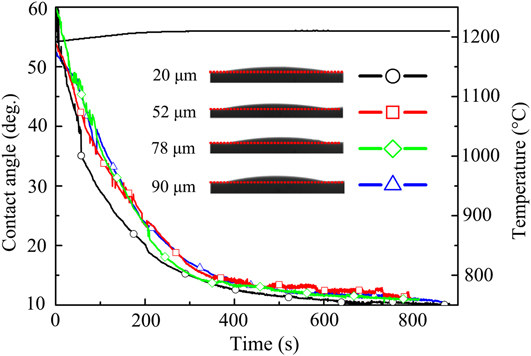
Figure 1 shows the wetting curves of the molten Cu–19Ni–5Al alloy on the Ni-coated WC–8Co substrate with different Ni coating thicknesses at 1210 °C (∼20 °C higher than its liquidus temperature) for 10 min and the corresponding photographs of solidified drop formed in the final states. In spite of the difference in Ni coating thickness, all the Cu–19Ni–5Al/Ni-coated WC–8Co systems present excellent wettability with a final contact angle of ∼10°, and no significant difference in the spreading rate can be observed in these systems. The Cu–19Ni–5Al alloy spreads fast on the Ni-coated WC–8Co substrates, and the wetting systems approximate to the equilibrium in 600 s since they begin to melt. In short, the Ni coating thickness has no obvious effect on the final contact angle, that is, all the final contact angles are ∼10°. For a high-temperature wetting, it is known that the wetting and spreading behavior can be directly affected by the interfacial interactions between the drop and substrate. Thus, a further investigation on the interface behavior between the drop and substrate is carried out as follows.
Wetting curves and sessile drop photographs of Cu–19Ni–5Al on Ni-coated WC–8Co substrates with four kinds of Ni coating thicknesses at 1210 °C.

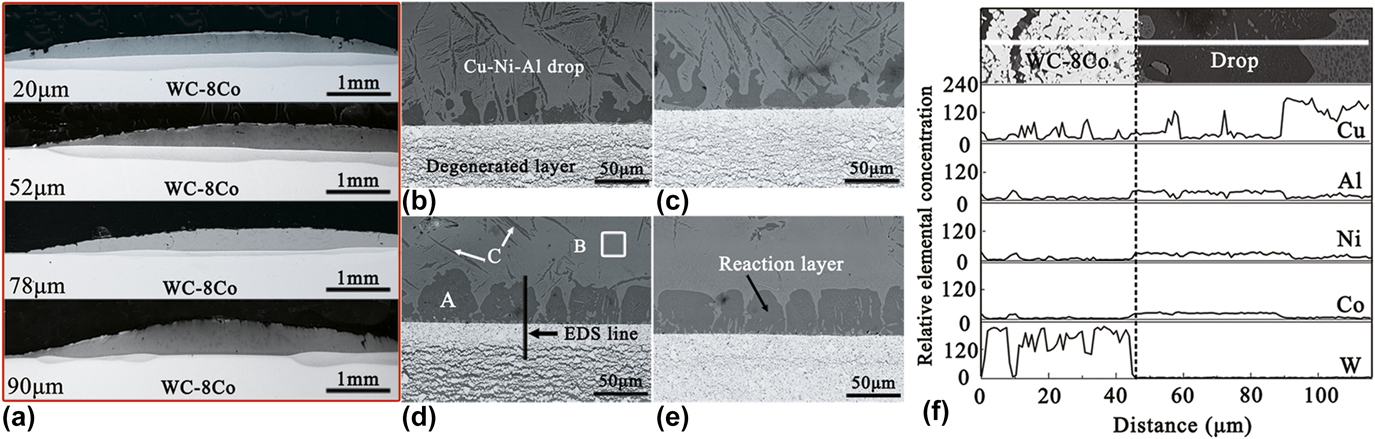
Figure 2(a) presents the cross-sections of four solidified drop/cemented carbide couples. A visible degenerated layer can be observed in all the WC–8Co substrates and the degeneration degree decreases with the Ni coating thickness increasing, indicating that the Ni coating thickness has a significant effect on the interfacial interactions between the Cu–19Ni–5Al drop and Ni-coated WC–8Co substrate. Actually, the formation of the degenerated layer is mainly derived from the escape of Co from the WC–8Co substrate to the molten Cu–19Ni–5Al drop. Figures 2(b)–2(e) show the interfacial microstructures of four Cu–19Ni–5Al/Ni-coated WC–8Co couples. It is clear that not only the degeneration of the WC–8Co substrate but also the formation of a reaction layer at the interface can be observed during wetting. From Fig. 2(d), the interaction zone is mainly composed of a ribbon-like dark phase layer (A), gray phase (B), and needle-like dark phase (C), with rough chemical compositions of 24.3Al + 31.7Ni + 30.8Co + 13.1Cu, 70.6Cu + 8.6Al + 16.1Ni + 4.7Co, and 23.6Al + 31.2Ni + 30.1Co + 12.1Cu (in at.%, next same), determined by the EDS analysis. And the thickness of the ribbon-like dark layer increases with the Ni coating thickness increasing, while the needle-like phase disappears gradually.
(a) Cross-sectional BSE images of Cu–19Ni–5Al/Ni-coated WC–8Co couples; (b–e) interfacial microstructures of four couples with different Ni coating thicknesses on the substrate of ∼20, 52, 78, and 90 μm, respectively; (f) elemental EDS profiles across the Cu–19Ni–5Al/Ni-coated WC–8Co interface while plating Ni of 78-μm thick [marked in Fig. 2(d)].

Based on the atomic stoichiometric ratio of above newly formed phases and the investigations of Co–Ni–Al alloys,Reference Kainuma, Ise, Jia, Ohtani and Ishida27–Reference Ishida, Kainuma, Ueno and Nishizawa29 the dark phases (A and C) can be considered to be β + γ phase. According to the elemental EDS profiles across the Cu–19Ni–5Al/Ni-coated WC–8Co interface [Fig. 2(f)], a large amount of Co originated from the WC–8Co substrate enters into the molten Cu–19Ni–5Al drop, and a large amount of Cu and a small quantity of Ni and Al originated from the molten alloy diffuse into the WC–8Co substrate. In fact, the strong interactions (such as diffusion and solid solution) of Cu–19Ni–5Al/Ni-coated WC–8Co systems can contribute to the excellent wettability. According to the difference of solubility among Al, Cu, Co, and Ni, the Ni coating can react with Cu and Co first to form (Ni,Cu) and (Ni,Co) solid solutions at the drop/cemented carbide interface with the temperature increasing, and then the (Ni,Co) solid solution aggregates around Al atoms to form the β + γ phase at the interface and in the drop. Moreover, the number of Ni atoms in the β + γ phase and the consumption of Al at the interface are gradually increased with the Ni coating thickness increasing, resulting in the increase of thickness of the ribbon-like dark layer at the interface and the disappearance of the needle-like dark phase in the drop [Fig. 2(e)].
From the above analyses, strong interactions between the Cu–19Ni–5Al and Ni-coated WC–8Co can be produced in the wetting process, including two main aspects. One is the dissolution of Ni coating in the molten Cu–19Ni–5Al alloy, and the other is the formation of a new phase (β + γ) at the wetting interface. Thus, the wetting behavior cannot be merely explained by the reactive production control model.Reference Eustathopoulos30,Reference Eustathopoulos31
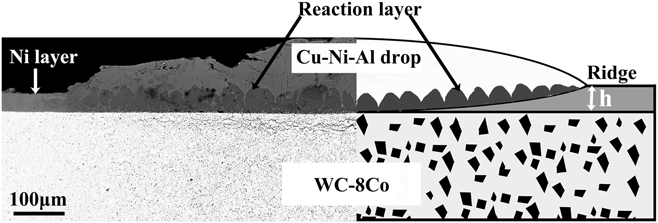
Figure 3 shows a coupling of the typical microstructure and schematic diagram of the triple line in the Cu–Ni–Al/Ni-coated WC–8Co system while plating Ni of 52 μm. From Fig. 3, the gray β + γ phase forms at the interface and terminates at the triple line. Furthermore, a typical ridge (h ≈ 50 μm) proposed by Saiz et al.Reference Saiz, Tomsia and Cannon32,Reference Saiz, Cannon and Tomsia33 is formed at the triple line, which is too large to be neglected. During the wetting process, the ridge can pin the liquid, resulting a slow spreading. When the drive force originated from the reactive product is balanced with the pinning effect of the ridge, the wetting system will reach a metastable state and presents the final contact angle (Fig. 1). In the other three wetting systems with various Ni coating thicknesses, the ridges at the triple line have the proper magnitudes and the reactive production is also similar to each other (Fig. 2), resulting the similar contact angle in spite of the different Ni coating thicknesses.
Coupling of the typical microstructure and schematic diagram of the triple line in the Cu–Ni–Al/Ni-coated WC–8Co wetting system while plating Ni of 52 μm.

B. Joint microstructures
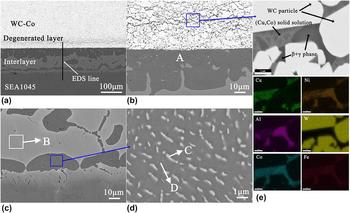
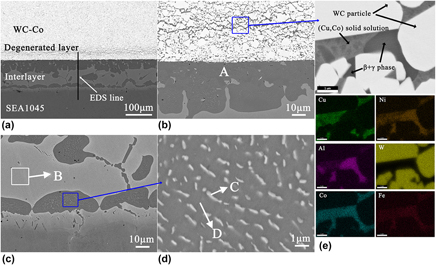
Figure 4 shows the typical cross-sectional images of the Ni-coated WC–8Co/Cu–19Ni–5Al/SAE1045 joint brazed at 1210 °C for 5 min while plating Ni of 78-μm thick. From Figs. 4(a)–4(c), a metallurgical bonding without any defects (such as voids or microcracks) is obtained in the brazed joint. A degenerated layer is observed in the WC–8Co cemented carbides adjacent to the interlayer/cemented carbide interface, which is in good accordance with the previous report,Reference Sui, Luo, Lv, Wei, Qi and He8 indicating the strong interactions between the filler metal and base materials. Moreover, the degenerated layer is involved in two typical metallic phases besides the WC particles: gray (Cu,Co) solid solution and dark β + γ phase [Fig. 4(e)]. The brazing seam is mainly composed of four phases, and Table SI shows the EDS results of four phases marked in Fig. 4. Both the A and D phases are enriched with Co, Ni, and Al elements and contain slight Cu and Fe derived from SAE1045, and they can be considered as the β + γ phase according to the above discussion. The B and C phases can be determined as solid solution of the Cu matrix enriched with Al and Ni and are widely distributed in the interlayer.
Typical BSE images of the Ni-coated WC–8Co/Cu–19Ni–5Al/SAE1045 joint brazing at 1210 °C for 5 min while plating Ni of 78-μm thick: (a) the whole brazing joint, (b) the interlayer/Ni-coated WC–8Co interface, (c) the interlayer/SAE1045 interface, (d) the highlighted microstructures marked in (c), and (e) the highlighted morphology of the degenerated layer and its corresponding elemental mapping.

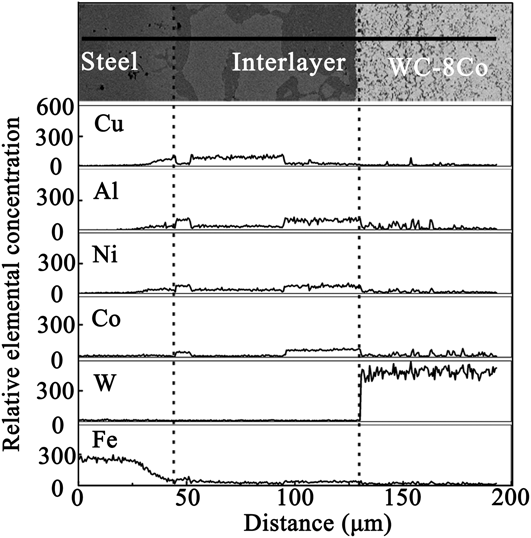
Figure 5 presents the typical EDS profiles across the Ni-coated WC–8Co/Cu–19Ni–5Al/SAE1045 joint brazed at 1210 °C for 5 min while plating Ni of 78-μm thick. The constituted elements in the interlayer involve Cu, Ni, and Al as well as Co and Fe derived from the two base materials. The high concentration of Al, Ni, and Co near the interlayer/cemented carbide interface can be attributed to the high affinity among the Ni, Al, and Co. A certain Cu, Ni, and Al originated from the filler metal diffuse into the WC–8Co. Besides the three elements (Cu, Ni, and Al) in the filler metal, few Fe diffuses for a long distance from the steel across the interlayer into the WC–8Co. The elemental EDS profiles are well correlated with the microstructures (Fig. 4), indicating the visible interdiffusion between the filler metal and Ni-coated WC–8Co cemented carbide or SAE1045 steel.
Elemental EDS profiles across the steel/Cu–19Ni–5Al/Ni-coated WC–8Co joint brazed at 1210 °C for 5 min while plating Ni of 78-μm thick [marked in Fig. 4(a)].

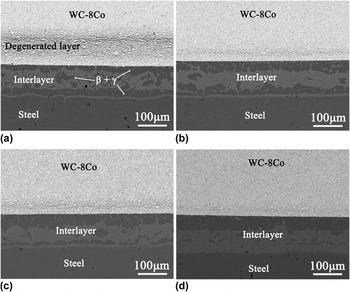
Figure 6 shows the cross-sectional BSE images of four Ni-coated WC–8Co/Cu–19Al–5Ni/SAE1045 joints brazed at 1210 °C for 5 min. All the joints are free of structural imperfections such as voids and cracks. The thicknesses of the ribbon-like dark layer (β + γ phase) at the interlayer/cemented carbide and interlayer/steel interfaces increase and decrease with the Ni coating thickness climbing from 20 to 90 μm, respectively, which can be related to the formation of the β + γ phase derived from the further addition of Ni and the consumption of Al. Until to 90 μm, the ribbon-like dark layer (β + γ phase) at the interlayer/steel interface disappears. Moreover, some needle or ribbon-like β + γ phase emerges in the middle of brazing seam and a degenerated layer of ∼200 μm forms in the WC–8Co when the Ni coating thickness is 20 μm [Fig. 6(a)]. The confusion degree of the β + γ phase in the brazing seam and the degeneration degree are gradually weakened with the Ni coating thickness increasing.
Cross-sectional BSE images of four Ni-coated WC–8Co/Cu–19Ni–5Al/SAE1045 joints at 1210 °C for 5 min while plating Ni of: (a) 20 μm (b) 52 μm, (c) 78 μm, and (d) 90-μm thick.

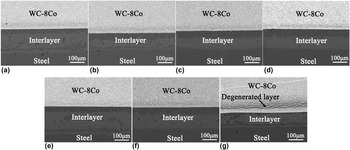
Figure 7 shows the cross-sectional BSE images of Ni-coated WC–8Co/SAE1045 joints brazed at 1200–1230 °C for 2.5–10 min while plating Ni of 78-μm thick. Similarly, all the brazed joints are free of structural imperfections. From Figs. 7(a)–7(c), the thicknesses of the β + γ phase at the interlayer/cemented carbide and interlayer/steel interfaces increase and decrease gradually with the brazing temperature increasing from 1200 to 1220 °C, respectively. However, the thickness of the β + γ phase at the interlayer/cemented carbide interface and the degeneration degree almost remain unchanged with the brazing temperature further increasing to 1230 °C [Fig. 7(d)]. And the needle or ribbon-like β + γ phase in the brazing seam disappears gradually with the brazing temperature increasing. On the other hand, the thicknesses of the β + γ phase at the two interfaces increase and decrease with the holding time prolonging from 2.5 to 7.5 min, respectively [Figs. 7(b), 7(e), and (f)]. The increasing holding time can cause sufficient elemental diffusion and homogeneous solid solution to a certain extent, which can improve and reduce the formation of the β + γ phase at the two interfaces, respectively. However, much more Al, Ni, and Co can seriously interdiffuse while brazing for 10 min, resulting in a serious degenerated layer [Fig. 7(g)], which can greatly deteriorate the joint mechanical properties.
Cross-sectional BSE images of Ni-coated WC–8Co/Cu–19Ni–5Al/SAE1045 joints brazed at (a) 1200 °C × 5 min, (b) 1210 °C × 5 min, (c) 1220 °C × 5 min, (d) 1230 °C × 5 min, (e) 1210 °C × 2.5 min, (f) 1210 °C × 7.5 min, and (g) 1210 °C × 10 min while plating Ni of 78-μm thick.

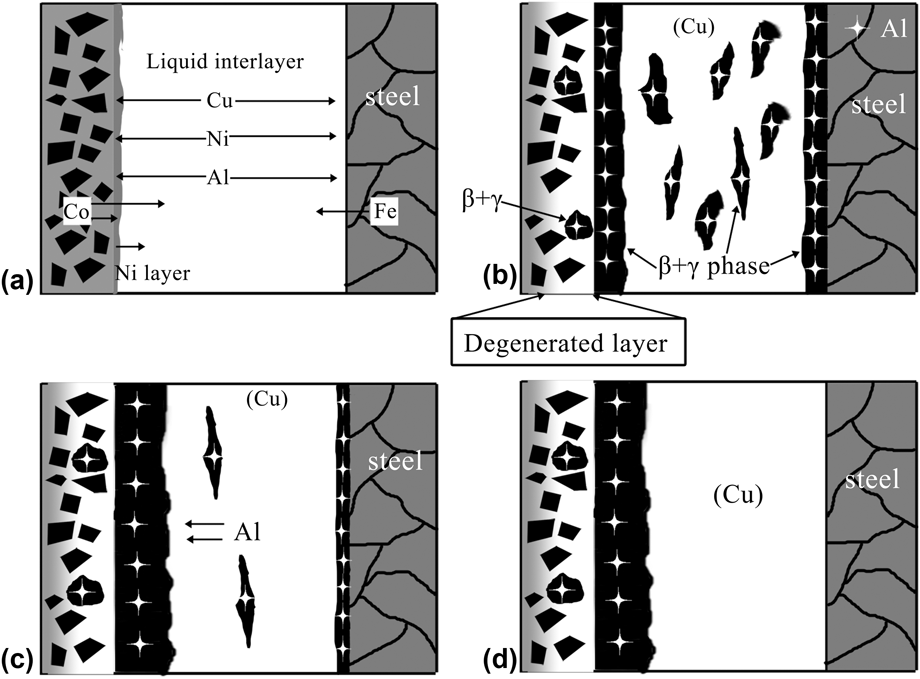
When the brazing temperature is approximate to the melting temperature (∼1190 °C), the Cu, Ni, and Al atoms from the filler metal are attracted to the two interlayer/base material interfaces and the Ni atoms from the Ni coating can diffuse into the filler metal, as shown in Fig. 8(a). Meanwhile, the Co and Fe atoms from the two base materials can also diffuse into the filler metal. Subsequently, the Co and Ni atoms can aggregate around Al atoms to form the nucleus of the β + γ phase, while the degenerated layer forms due to the partial escape of Co and the diffusion of Cu into the cemented carbide. Along with the precipitation and growth of the β + γ phase at the two interfaces and in the interlayer, the Cu, Ni, Co, Al, and Fe can form solid solution of the Cu matrix in the interlayer during the cooling process, as shown in Fig. 8(b). When the higher brazing temperature, longer holding time, or thicker Ni coating is applied, the diffusion of Al toward the Ni coating is promoted due to the chemical potential gradients, resulting in thickening or thinning of the ribbon-like dark layer (β + γ phase) at the two interfaces and a decrease of the needle or ribbon-like β + γ phase in the middle of the interlayer, as shown in Fig. 8(c). When the brazing temperature and Ni coating thickness, respectively, increase to the highest and thickest one (1230 °C and 90 μm), the consumption of Al at the interlayer/Ni-coated WC–8Co interface is further enhanced, resulting in the disappearance of the β + γ phase in the middle of the interlayer and at the interlayer/SAE1045 interface [Fig. 8(d)].
Microstructural evolution model for the Ni-coated WC–8Co/Cu–19Ni–5Al/SAE1045 brazed joint: (a) Elemental interdiffusion between the filler metal and Ni-coated WC–8Co or SAE1045 steel, (b) formation of the β + γ phase in the interlayer and degenerated layer in the cemented carbide, (c) thickening or thinning of the ribbon-like dark layer (β + γ phase) at the two interfaces and a decrease of the β + γ phase in the middle of the interlayer, and (d) disappearance of the β + γ phase in the middle of the interlayer and at the interlayer/steel interface.

C. Joint mechanical properties
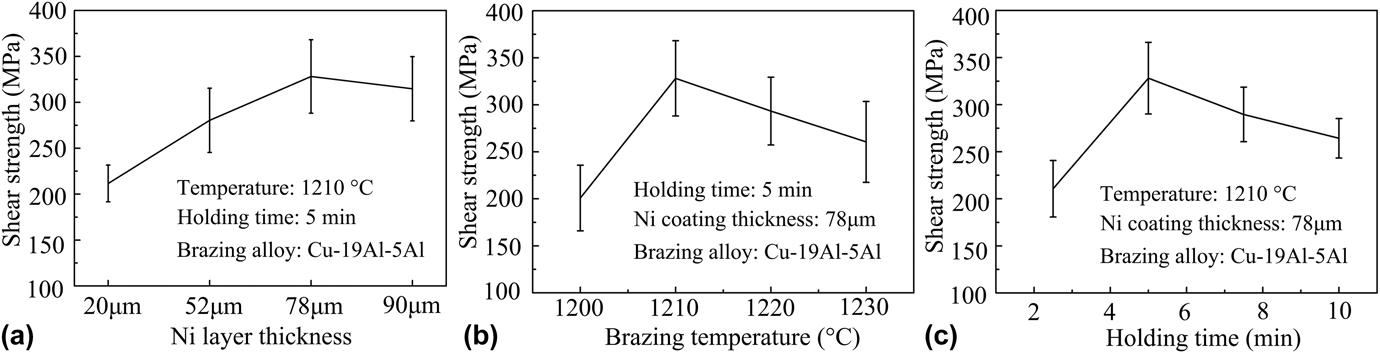
Figure 9 shows the variations of joint shear strength as functions of the Ni coating thickness, brazing temperature, and holding time. The average joint shear strength climbs from 226 to 328 MPa with the Ni coating thickness increasing from 20 to 78 μm but declines to 310 MPa while further increasing the coating thickness to 90 μm [Fig. 9(a)]. From Fig. 9(b), the joint shear strength increases sharply to 328 MPa with brazing temperature increasing from 1200 to 1210 °C and then decreases with further increasing the brazing temperature. This sharp increase can be closely related to the improved wettability and effective elemental diffusion between the filler metal and base materials at the higher temperature. Similarly, the joint shear strength also increases first and then decreases with the holding time increasing from 2.5 to 10 min, as shown in Fig. 9(c). The maximum joint shear strength of 328 MPa is obtained while brazing at 1210 °C × 5 min and plating Ni of 78-μm thick. Noted that Chen et al.Reference Chen, Feng, Wei, Xiong, Guo and Wang6 obtained the WC–Co/3Cr13 joint with the maximum shear strength of ∼154 MPa using a Ni-electroplated Cu–Zn alloy as filler metal, which is comparable with our present work.
Variations of shear strength of Ni-coated WC–8Co/Cu–19Ni–5Al/SAE1045 steel brazed joints as functions of (a) the Ni coating thickness, (b) brazing temperature, and (c) holding time.

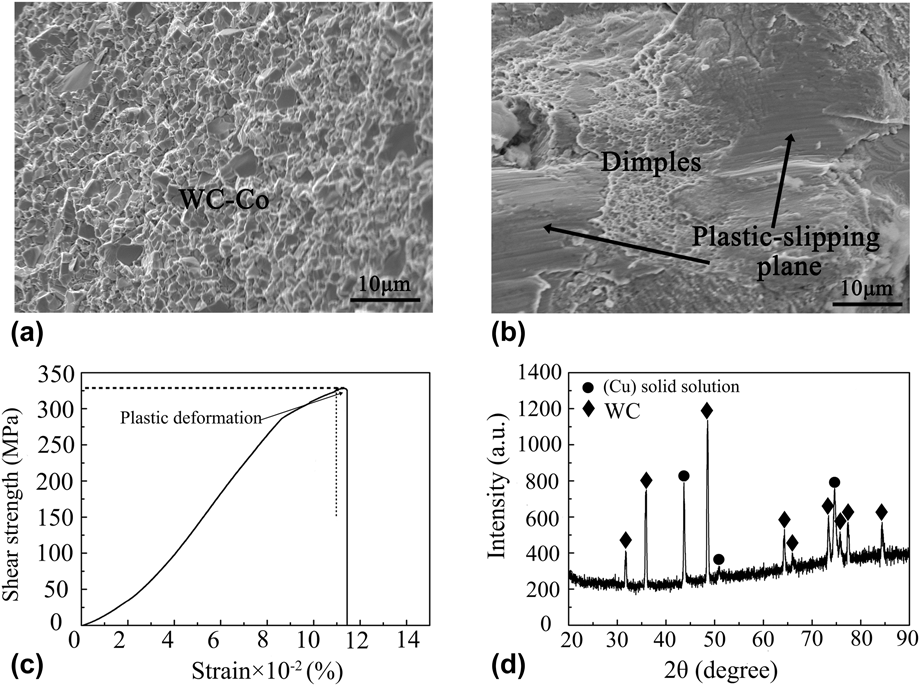
Figure 10 shows the typical fracture surface morphologies of the Ni-coated WC–8Co/SAE1045 joint brazed at 1210 °C × 5 min and the corresponding shear stress–strain curve and XRD pattern of the fracture surface on the WC–8Co side. Two distinct regions are present at the fracture surface [Figs. 10(a) and 10(b)]. The region with fine grains is mainly composed of WC particles [Fig. 10(a)], combined with the result of XRD analysis [Fig. 10(d)], suggesting that this region is the degenerated layer and that its fracture mode is brittle fracture. By contrast, the other region is attached with some plastic-slipping plane and dimples [Fig. 10(b)], indicating that this region bridges across the brazing seam and the degenerated layer. In a word, these two fracture surface morphologies indicate a mixed mode of ductile-brittle fracture [Fig. 10(c)], and the shear crack initiates in the filler layer (ductile fracture), moves across the interlayer/WC–8Co interface and terminates in the degenerated layer (brittle fracture) in turn.
(a and b) Typical fracture surface morphologies of the Ni-coated WC–8Co/Cu–19Ni–5Al/SAE1045 steel joint fabricated at 1210 °C × 5 min, (c) corresponding shear stress–strain curve, and (d) XRD pattern of the fracture surface.

In those cases, the joint mechanical properties can be mainly affected by the distribution of the β + γ phase at the interfaces and the degeneration degree in the cemented carbide, which is in good accordance with the results reported by Jiang et al.Reference Jiang, Chen, Wang and Li9 And the Ni coating thickness on the WC–8Co, brazing temperature, and holding time have a great effect on the distribution of the β + γ phase and the degeneration degree in the cemented carbide.
When a relatively thin Ni layer is applied, only a small amount of Ni can be used to form the β + γ phase at the interlayer/cemented carbide interface, and thus a relatively high concentration of Al can retain near to the SAE1045 steel, resulting in formation of a relatively thick β + γ phase layer at the interlayer/steel interface. With the Ni coating thickness increasing, Al can be greatly consumed at the interlayer/cemented carbide interface. As a result, much thicker and thinner β + γ phase layers can be formed at the interlayer/cemented carbide and interlayer/steel interfaces, respectively, which can bring about a large residual stress in the joint and thus decrease the joint shear strength.
When a relatively low brazing temperature or short holding time is applied, the formed β + γ phase disperses in the middle of the interlayer and at the two interlayer/base material interfaces, showing a disordered microstructure. By moderately improving the brazing temperature or prolonging holding time, the elemental diffusion can be effectively carried out, and the thicknesses of the β + γ phase layer at the interlayer/cemented carbide and interlayer/steel interfaces, respectively, increase and decrease, which contributes to increase the joint shear strength. As an excessively high brazing temperature or long holding time is applied, the ribbon-like β + γ phase layer at the interlayer/steel interface disappears, and the β + γ phase layer at the interlayer/carbide cemented interface becomes thick to produce a large residual stress, as a result of that the joint shear strength decreases at the higher brazing temperature or longer holding time to a certain extent. Especially, a much more serious degenerated layer can be observed in the cemented carbide while prolonging holding time to 10 min [Fig. 7(g)], resulting in the lower shear strength.
Totally speaking, the Ni coating on the WC–8Co can greatly improve the brazability of cemented carbide to steel and the joint shear strength. However, to optimize the joint mechanical properties, each processing parameter (such as coating thick, brazing temperature, and holding time) should be considered seriously.
IV. CONCLUSIONS
This study was carried out to investigate the wetting and interfacial behavior of Cu–19Ni–5Al/Ni-coated WC–8Co wetting systems with various Ni coating thicknesses and to further investigate the effects of the Ni coating thickness, brazing temperature, and holding time on the microstructures and shear strength of Ni-coated WC–8Co/Cu–19Ni–5Al/SAE1045 steel brazed joints. The main conclusions can be summarized as follows:
(1) The Cu–19Ni–5Al/Ni-coated WC–8Co systems present fast spreading and excellent wettability with final contact angles of ∼10°. Increasing the Ni coating thickness can markedly prevent the formation of the degenerated layer in the cemented carbide.
(2) All the Ni-coated WC–8Co/SAE1045 brazed joints exhibit good interfacial bonding. The thickness of the ribbon-like layer (β + γ phase) at the interlayer/cemented carbide interface gradually increases with the Ni coating thickness, brazing temperature, and holding time increasing, while that at the interlayer/steel interface decreases gradually and even disappears. Meanwhile, the β + γ phase in the middle of interlayer is also reduced.
(3) The joint shear strength increases greatly until brazing at 1210 °C for 5 min and using the Ni coating of 78-μm thick but decreases in varying degree with the Ni coating thickness, brazing temperature, and holding time further increasing. The maximum joint shear strength of 328 MPa is obtained. The typical joint shear fracture path passes along the interlayer, Cu–19Ni–5Al/WC–8Co interface and degenerated layer in turn, showing a mixed ductile-brittle fracture.
Supplementary Material
To view supplementary material for this article, please visit https://doi.org/10.1557/jmr.2018.101.
ACKNOWLEDGMENTS
This work was supported by the National Natural Science Foundation of China (51572112); the Natural Science Foundation of Jiangsu Province (BK20151340); the Six Talent Peaks Project of Jiangsu Province (2014-XCL-002, TD-XCL-004); the 333 talents project of Jiangsu province (BRA2017387); and the Innovation/Entrepreneurship Program of Jiangsu Province ([2015]26) and the Qing Lan Project ([2016]15).