INTRODUCTION
The diversity of the benthic fauna from the west coast of Sweden, comprising eastern Skagerrak and Kattegat, has been well investigated for almost a century, much thanks to the work of Leonard A. Jägerskiöld who undertook systematic sampling covering 440 stations in 1921–1938 (Jägerskiöld, Reference Jägerskiöld1971). Sponges, which represent a large component of the benthic communities there, have been studied by Fristedt (Reference Fristedt1885) and Alander (Reference Alander1942), who both did their PhDs on sponges from Sweden; the latter also participated in Jägerskiöld's surveys.
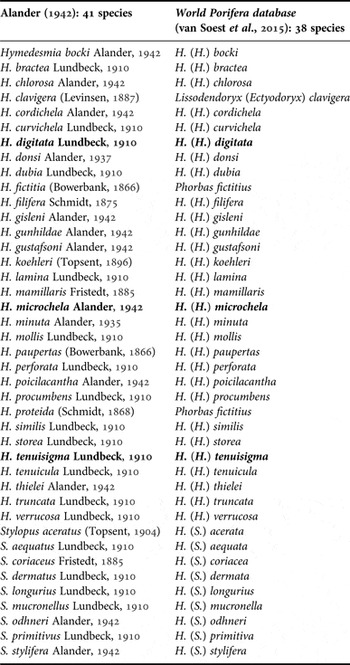
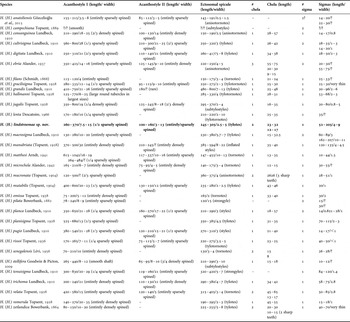
The large genus Hymedesmia Bowerbank, Reference Bowerbank1864 (Poecilosclerida, Hymedesmiidae) is essentially characterized by a hymedesmioid skeleton, with one/two sizes of acanthostyles standing erect on the substrate (van Soest, Reference van Soest, Hooper and van Soest2002). Microscleres can be either present (subgenus Hymedesmia) or absent (subgenus Stylopus). A molecular 18S phylogeny shows that Hymedesmia is a polyphyletic genus (Redmond et al., Reference Redmond, Morrow, Thacker, Diaz, Boury-Esnault, Cárdenas, Hajdu, Lôbo-Hajdu, Picton, Pomponi, Kayal and Collins2013) suggesting that the encrusting state and resulting typical hymedesmioid skeleton organization are homoplasious characters. Twelve new species of Hymedesmia were recently described from shallow and deep waters in the north-east Atlantic (Goodwin & Picton, Reference Goodwin and Picton2009; Goodwin et al., Reference Goodwin, Picton and Van Soest2011; Gözcelioğlu et al., Reference Gözcelioğlu, van Soest, Alvarez and Konuklugil2015), thereby suggesting how diverse and poorly known this genus is. According to the World Porifera Database (WPD) (van Soest et al., Reference van Soest, Boury-Esnault, Hooper, Rützler, de Voogd, Alvarez, Hajdu, Pisera, Vacelet, Manconi, Schoenberg, Janussen, Tabachnick, Klautau, Picton, Kelly, Vacelet, Dohrmann, Cristina Díaz and Cárdenas2015), there are currently 131 species of Hymedesmia recorded in the North Atlantic, including the Mediterranean Sea and Caribbean Sea; 115 belong to the subgenus Hymedesmia (Hymedesmia) characterized by having microscleres (chelae and/or sigmas). The Swedish/Skagerrak Hymedesmia fauna has been particularly studied thanks to Alander (Reference Alander1935, Reference Alander1942) who thoroughly investigated this group. Alander (Reference Alander1942) reported 32 species of Hymedesmia (Hymedesmia), of which 29 are still considered as valid in the WPD, and nine species of Hymedesmia (Stylopus) without microscleres, all valid according to the WPD (Table 1). Here we report the discovery of a hitherto undescribed species of Hymedesmia (Hymedesmia) made during the marine inventory of the Swedish Taxonomy Initiative on the Swedish west coast (Karlsson et al., Reference Karlsson, Berggren, Lundin and Sundin2014).
Checklist of Hymedesmia species from the Skagerrak region. Hymedesmia (Hymedesmia) have microscleres, Hymedesmia (Stylopus) lack microscleres. Species with sigmas are in bold.

MATERIALS AND METHODS
This single specimen was collected in the Swedish Exclusive Economic Zone (EEZ) as part of a study of the Skagerrak marine inventory of Swedish waters. A small piece of the sponge was digested in nitric acid and washed once with water, once with 50% ethanol and once with 96% ethanol. Spicules were used to make spicule preparations (embedded in Eukitt©). Some of these spicules were also placed directly on top of a glass slide taped to a stub and coated with a gold-palladium mix for 30 s. They were then observed with a ZEISS Supra 35VP Scanning Electron Microscope (SEM) at Uppsala University. 30 spicules per spicule type were measured with the optical microscope. Only sigma width and isochelae shaft width were measured with the SEM. Measurements of spicules are given in μm throughout the article.
The holotype, in 70% ethanol, is deposited at the Göteborg Natural History Museum (GNM Porifera 907, type number 822). Spicule preparations from the holotype have also been deposited at GNM (two slides), Museum of Evolution, Uppsala (one slide, UPSZTY 161426) and the Swedish Museum of Natural History, Stockholm (one slide: SMNH Type Coll. 8767, one SEM stub: SMNH Type Coll. 8768).
We have compared our material with the 31 North Atlantic Hymedesmia (Hymedesmia) species which have sigmas. Since it is very likely that Hymedesmia is a polyphyletic group (Redmond et al., Reference Redmond, Morrow, Thacker, Diaz, Boury-Esnault, Cárdenas, Hajdu, Lôbo-Hajdu, Picton, Pomponi, Kayal and Collins2013), we have also compared our material with the North Atlantic species of Phorbas (Hymedesmiidae) and Hymenancora (Myxillidae with hymodesmioid arrangement) which possess sigmas: six species of Phorbas, 10 species of Hymenancora (van Soest et al., Reference van Soest, Boury-Esnault, Hooper, Rützler, de Voogd, Alvarez, Hajdu, Pisera, Vacelet, Manconi, Schoenberg, Janussen, Tabachnick, Klautau, Picton, Kelly, Vacelet, Dohrmann, Cristina Díaz and Cárdenas2015).
RESULTS
SYSTEMATICS
Phylum PORIFERA
Class DEMOSPONGIAE Sollas, Reference Sollas1885
Subclass HETEROSCLEROMORPHA Cárdenas et al., Reference Cárdenas, Pérez and Boury-Esnault2012
Order POECILOSCLERIDA Topsent, Reference Topsent1928
Family Hymedesmiidae Topsent, Reference Topsent1928
Hymedesmia Bowerbank, Reference Bowerbank1864
Subgenus Hymedesmia Bowerbank, Reference Bowerbank1864
Hymedesmia (Hymedesmia) lindstroemae sp. nov.
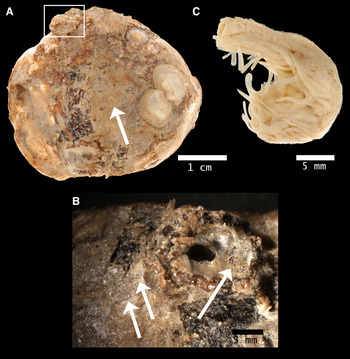
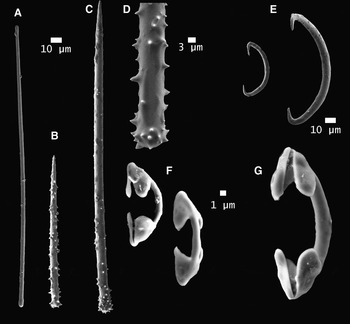
(Figures 1 & 2, Table 2)
(A) Hymedesmia (Hymedesmia) lindstroemae sp. nov. overgrowing a saddle oyster shell, holotype, GNM Porifera 907. (B) Close up of holotype (square in A) showing openings (arrows). (C) Hymedesmia (Hymedesmia) grandis, syntype, ZMUC-DEM-300.

Hymedesmia (Hymedesmia) lindstroemae sp. nov. holotype, GNM Porifera 907. (A–G). (A) Tylote. (B) Acanthostyle II. (C) Acanthostyle I. (D) Close-up of basal part of acanthostyle I. (E). Sigma. (F) Isochelae I. (G) Isochelae II.

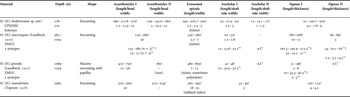
Individual spicule dimensions Hymedesmia (Hymedesmia); minimum-mean-maximum (in μm); n = 30 unless stated otherwise between parentheses, or unless measurements come from other studies.

–, not referred; n.f., not found.
*Measurements and observations from this study.
1 H. (H.) macrosigma, syntype ZMUC-DEM-70.
2 H. (H.) grandis, embryos from syntype, ZMUC-DEM-16.
TYPE MATERIAL
Holotype: (Göteborg Natural History Museum) GNM Porifera 907, type number 822, collected by rock dredge on 16 June 2008 at station SK181 (58°28.30′N 10°37.15′E); water depth: 178–210 m, bottom: clay and pebbles/gravel.
COMPARATIVE MATERIAL EXAMINED
Hymedesmia (Hymedesmia) macrosigma Lundbeck, Reference Lundbeck1910, ZMUC-DEM-69, syntype, wet specimen, Ingolf Expedition, st. 89, Denmark Strait, 64°45′N 27°20′W, 584 m, bottom temp. 8.4°C; ZMUC-DEM-70, syntype, wet specimen and four slides (‘prep 2’, ‘prep 3’, ‘prep. 4, Derm.’ and ‘prep. 5’), Ingolf Expedition, station 78, Reykjanes Ridge, 60°37′N 27°52′W, 1504 m, bottom temp. 4.5°C; ZMUC, syntype, wet specimen (a rock), Ingolf Expedition, station 54, South of Iceland, 63°08′N 15°40′W, 1301 m, bottom temp. 3.9°C.
Hymedesmia (Hymedesmia) grandis Lundbeck, Reference Lundbeck1910, ZMUC-DEM-300, syntype (wet specimen + 2 slides), Ingolf Expedition, station 90, 64°45′N 29°06′W 1069 m, bottom temp. 4.4°C; ZMUC-DEM-16 (slide, ‘prep. 9’), embryos from syntype, Reykjanes Ridge, Ingolf Expedition, station 78, 60°37′N 27°52′W, 1504 m, bottom temp. 4.5°C; ZMUC-DEM-299 (2 slides from syntype), Ingolf Expedition, station 84, 62°58′N 25°24′W, 1192 m, bottom temp. 4.8°C.
OUTER MORPHOLOGY (FIGURE 1A, B)
Encrusting (maximum 0.5 mm thick) on the top shell of a saddle oyster, Monia patelliformis (Linnaeus, Reference Linnaeus1761), ~3.5 cm in diameter, fixed in ethanol 70%. Colour alive unknown. Colour in ethanol is transparent to brownish. Openings are visible (1–2 mm in diameter, Figure 1B).
SPICULES (FIGURE 2, TABLE 2)
Minimum–mean–maximum.
Megascleres:
(a) acanthostyles I, very slightly bent, very slight head-swelling, apical half has almost no spines, spines in the basal part are less than 3 µm long, sharply pointed, and usually symmetrical or slightly curved towards the apical part, the rare spines in the apical part are less than 1 µm long and on the contrary seem to be slightly curved towards the basal part, length: 260–312.8–370 µm, width: 7.5–11.9–15 µm;
(b) acanthostyles II, length: 100–145.6–160 µm, width: 3–10.4–13 µm, spines are regularly distributed all along the style, morphology of the spines is similar to that of the spines in acanthostyles I;
(c) ectodermal spicules are tylotes to subtylotes, straight, with one end slightly more inflated than the other, 245–270.7–305 µm, width in the middle: 2.5–3.4–5 µm.
Microscleres:
(d) sigmas, very large and contorted (i.e. not flat), a few have an ‘s’ shape, the curved end parts are terminating in straight hooks, these hooks are often bent a little out of the plane, length: 52–100.7–205 µm, thickness: 4.1–7.8–9 µm, there is a continuum of size lengths between 52 and 205 µm but most sigmas are 100 µm long;
(e) arcuate isochelae I, 23–27.4–32 µm long, shaft has a gentle bent, shaft width seen from the side: 2.5–3 µm;
(f) isochelae II, 12–14.1–17 µm, shaft width seen from the side: 1–1.5 µm.
ETYMOLOGY
The name is chosen in memory of Maria Lindström (1979–2012), a student at Systematic Biology (Uppsala University), who was instrumental in re-launching research in sponge systematics at Uppsala University.
DISCUSSION
The key character in our specimen was the presence of sigmas, a character shared by only 31 of 115 species of Hymedesmia (Hymedesmia) in the North Atlantic (Table 3). We were also unsure at first whether we had one or two categories of sigmas. However, although most sigmas are fairly large (>100 µm long), we could find intermediates between lengths of 52 and 205 µm, which made a clear continuum of size lengths. Furthermore, the large and robust sizes reached by the sigmas in our specimen (52–205 × 4–9 µm) turned out to be fairly uncommon amongst the 31 species with sigmas (Table 3); so we decided to compare our specimen with species that had sigmas at least 100 µm long and 5 µm thick. This reduced our comparative list to three species (Table 3), all from the deep-sea: H. (H.) grandis Lundbeck, Reference Lundbeck1910, H. (H.) macrosigma Lundbeck, Reference Lundbeck1910 and H. (H.) manubriata Topsent, Reference Topsent1928 (Table 2).
North Atlantic Hymedesmia (Hymedesmia) species with sigmas, listed in alphabetical order, with an overview of their spicule repertoire and spicule measurements (in μm). We call ‘anisotornotes’ tornotes with unequal ends; ‘tylotornotes’ tornotes with inflated ends. Spicule measurements are from the original descriptions except for re-descriptions of the types (H. (H.) filans, H. (H.) pilata and H. (H.) zetlandica) (Burton, Reference Burton1930; van Soest, Reference van Soest, Hooper and van Soest2002; Topsent, Reference Topsent1938) or for the types examined in this study (H. (H.) grandis and H. (H.) macrosigma).

Hymedesmia (H.) manubriata was collected on the Mid-Atlantic Ridge north of the Azores at 2460 m depth. It has one category of sigmas (120–135 × 4–4.5 µm) but they are smaller and thinner than in our specimen. Furthermore it has larger acanthostyles, a single category of chela and characteristic chubby tylotes that all seem clearly different from those of our specimen.
Hymedesmia (H.) grandis was collected in the Denmark Strait and Reykjanes ridge at 1069–1504 m depth. According to Lundbeck (Reference Lundbeck1910), it has robust and large sigmas (31–96 × 2–6 µm). Since Lundbeck (Reference Lundbeck1910) writes ‘the larger forms are the most common’ we examined the type material to confirm the single category of sigmas and to check that he had not overlooked larger sigma sizes. On the slide of H. (H.) grandis, ZMUC-DEM-16 one can find two embryos with only sigmas (20–43.4–92.5 µm), and isochelae (length: 25–30.9–37.5 µm). We also made new spicule preparations from the syntype ZMUC-DEM-300. All our sigma measurements were in agreement with Lundbeck's description. So spicule differences between H. (H.) grandis and H. (H.) lindstroemae sp. nov. were the following: (1) significantly bigger acanthostyles and tylotes in H. (H.) grandis, (2) two categories of chela in H. (H.) grandis vs one in H. (H.) lindstroemae sp. nov. and (3) smaller sigma length and thickness range in H. (H.) grandis. Finally, the external morphology of H. (H.) grandis (Figure 1C) with its numerous papillae was quite different from our specimen.
Hymedesmia (H.) macrosigma was collected in the Denmark Strait and south of Iceland between 583 and 1504 m depth. It has two sizes of sigmas in the same range as those in our specimen, including the largest sigmas of the known North Atlantic Hymedesmia (180–208 × 10–11 µm). According to the original description, it has only one category of acanthostyles (vs two in our specimen), and only one chela category (vs two in our specimen). We reexamined all the type material available to confirm that it was different from our specimen: three syntypes and four slides from syntype ZMUC-DEM-70. We could not find remnants of H. (H.) macrosigma on two of the syntypes, respectively on a brachiopod shell and on a volcanic rock. The only wet syntype left is 3 mm long and we decided not to destroy it. So only the slides were examined for spicules. On the slide of H. (H.) macrosigma (ZMUC-DEM-70, prep. 4, made from the syntype's surface), there are clearly two distinct categories of sigmas and one of chelae; all were measured (Table 2). Small sigmas were flat or contorted, large sigmas were mostly flat (vs usually slightly twisted in our specimen) and slightly thicker (10 µm thick vs 7–8 µm thick on average in our specimen). No acanthostyles or tylotes were present on prep. 4 but three acanthostyles (137, 247, 280 µm long, with a head of 10, 15, 17 µm wide) and a couple of tylotes were found on prep. 2. The head of the acanthostyles is hardly swollen, just like in H. (H.) lindstroemae sp. nov.; and the density of spines on the acanthostyles is similar to that observed in H. (H.) lindstroemae sp. nov. All in all, there are four main spicule differences between H. (H.) macrosigma and H. (H.) lindstroemae sp. nov.: (1) H. (H.) macrosigma clearly has two sizes of sigmas (vs only one size in H. (H.) lindstroemae sp. nov.); (2) the large sigma morphology is different: predominantly flat in H. (H.) macrosigma (vs slightly twisted in H. (H.) lindstroemae sp. nov.) and with uniform thickness, except at the very tip in H. (H.) macrosigma (vs decreasing thickness all the way to the tip) (cf. drawing of Lundbeck (Reference Lundbeck1910, pl. IX, Figure 6D); (3) H. (H.) macrosigma has only one size of chela (vs two sizes in H. (H.) lindstroemae sp. nov.); (4) H. (H.) macrosigma has only one size of acanthostyle (vs two sizes in H. (H.) lindstroemae sp. nov.). To conclude, of all North Atlantic Hymedesmia (H.), our specimen is closest morphologically to H. (H.) macrosigma, but one can find several spicule differences to discriminate them (Table 2), thus confirming that it is a new species.
KEY TO THE NORTH ATLANTIC HYMEDESMIA (HYMEDESMIA) WITH SIGMAS
Several keys to the Hymedesmia species exist: the most comprehensive one is that of Lundbeck (Reference Lundbeck1910) which lists the 70 species known at that time; then there is one from the British Isles (Burton, Reference Burton1930) and one from Sweden (Alander, Reference Alander1942). The present key, essentially based on spicule morphology, will focus on the North Atlantic Hymedesmia (H.) species with sigmas, a total of 32 species (including our new species). Since the subgenus Hymedesmia (Stylopus) does not have microscleres, they are of course not considered in this key. Species recorded in Skagerrak waters are in bold. Species from other regions are also flagged: (C) Caribbean/Gulf of Mexico, (M) Mediterranean Sea, (A) Azores region. Most of these species have never been revised, so identifications errors may exist in the literature. Descriptions of H. (H.) mutabilis (Topsent, Reference Topsent1904) differs between the original description which states one size of chelae and one size of sigmas and Vacelet (Reference Vacelet1969) who describes a new specimen with two sizes of chelae and two sizes of sigmas; we favoured the original description to build the key. In the process of building this key, it occurred to us that H. (H.) pilata Bowerbank, Reference Bowerbank and Norman1882 from Ireland and H. (H.) anatoliensis Gözcelioğlu et al., Reference Gözcelioğlu, van Soest, Alvarez and Konuklugil2015 from Turkey may be conspecific so we kept them together in the key until a proper comparison of the types can settle the matter.
-
1. Chelae absent, just sigmas……2
-
Chelae present……4
-
-
2. Acanthostyles present……3
-
Acanthostyles absent, only smooth tylostyles……campechiana (C)
-
-
3. One size of large sigmas (length: 84–120 µm) …… tenuisigma
-
Two sizes of small sigmas (lengths: 15 and 30 µm) ……pilata or anatoliensis (M)
-
-
4. One size category of sigmas……5
-
Two size categories of sigmas……27
-
-
5. Sigmas are longer than 100 µm……6
-
Sigmas are smaller than 100 µm……8
-
-
6. Acanthostyles not entirely spined, non-inflated tylotes ……7
-
Acanthostyles entirely spined, inflated styles ……manubriata (A)
-
-
7. Sigmas are thick (4–9 µm) and not flat …… lindstroemae sp. nov.
-
Sigmas are thin (2–3 µm) and flat……planisigma (A)
-
-
8. Chelae have a thick shaft (10–15 µm) with robust large alae……9
-
Chelae have a shaft thinner than 10 µm……11
-
-
9. Sigmas are irregular ‘c’ curves, 1 acanthostyle category (140–270 µm)……vomerula (A)
-
Sigmas have a regular ‘c’ or ‘s’ shape, acanthostyles I (>350 µm)……10
-
-
10. Sigmas have a wide range of sizes (20–80 µm)……jugalis (A)
-
Sigmas are small (20 µm)……mutabilis (A, M?)
-
-
11. Ectosomal megascleres are styles……pugio (M?)
-
Ectosomal megascleres are some kind of tylotes/tornotes……12
-
-
12. A category of atypical isochela with sharp teeth……13
-
No atypical isochela with sharp teeth……14
-
-
13. Acanthostyles partially covered with thin small spines……mucronata (A)
-
Acanthostyles entirely covered with thick large spines……zetlandica
-
-
14. One size of chela……15
-
Two sizes of chela……26
-
-
15. Dermal spicules are tylotes……16
-
Dermal spicules are tornotes……18
-
-
16. Sigma sizes can be >80 µm……grandis
-
Sigma sizes are always <75 µm……17
-
-
17. Acanthostyle I entirely spined, flat sigmas……trichoma
-
Acanthostyle I are spined in the basal half, twisted sigmas…… digitata
-
-
18. Acanthostyle I can be >500 µm long……19
-
Acanthostyle I are <500 µm long……20
-
-
19. medium-sized sigmas (53–68 µm), one category of acanthostyles……hallmani (A)
-
small sigmas (10–44), three categories of acanthostyles……matthesi
-
-
20. One size of acanthostyles……21
-
Two sizes of acanthostyles……23
-
-
21. Acanthostyles entirely spined……22
-
Acanthostyles 1/4 sparsely spined……lenta
-
-
22. Large chela (33–40 µm long, 4 µm thick shaft)……omissa (M)
-
Small chela (21–24 µm long, 2 µm thick shaft)……filans (M)
-
-
23. Acanthostyles I with a smooth shaft, small chela (15–18 µm)……stellifera
-
Acanthostyles I entirely spined with thick spines, small chela (12–15 µm)…… microchela
-
Acanthostyles I sparsely spined with small spines, chela >20 µm……24
-
-
24. Small sigmas (14–17 µm)……consanguinea
-
Medium-sized sigmas (25–50 µm)……25
-
-
25. Irregularly curved sigmas (25–30 µm), acanthostyle I (280–335 µm long)……gracilisigma (M)
-
Regularly curved sigmas (35–50 µm), acanthostyle I (170–265 µm long)……rissoi (M)
-
-
26. Small sigmas (20–30 µm)……senegalensis
-
Large sigmas (50–85 µm)……velata (A)
-
-
27. The large sigmas are irregularly contorted……cultrisigma
-
The large sigmas have a regular ‘c’ or ‘s’ shape……28
-
-
28. The large sigmas are 160–212 µm long……macrosigma
-
The large sigmas are <100 µm long……29
-
-
29. One size category of chela……planca
-
Three size categories of chela……ebria
-
ACKNOWLEDGEMENTS
We thank Dr Claire Goodwin (National Museums Northern Ireland) for taking a look at this specimen very early in this project and indicating that it could be a new species. Thank you to the Natural History Museum of Denmark, ZMUC (Ole S. Tendal, Martin V. Sørensen and Laura Pavesi) for sharing type material. Thank you to Erica Mejlon (UPSZMC), Lena Gustavsson (SMNH) and Kennet Lundin (GNM) for help with the type deposition. Thank you to Michael Streng (Uppsala University) for assistance with the SEM. Finally, we are grateful to two anonymous reviewers for their helpful comments, and suggestions for improvement of this study.
FINANCIAL SUPPORT
The study was supported by the Swedish Taxonomy Initiative (Svenska artprojektet), financially by grants dha 150/2012 and dha 59/09 1.4, and logistically through the marine inventory of the Swedish Taxonomy Initiative.