Introduction
Impairments in social and non-social cognition are highly relevant research and treatment targets in both schizophrenia and bipolar I disorder (BP-I). The results of previous studies in schizophrenia have been relatively consistent regarding the pattern of these deficits and have highlighted their impact on psychosocial functioning (Sparks et al. Reference Sparks, McDonald, Lino, O'Donnel and Green2010; Fett et al. Reference Fett, Viechtbauer, Dominguez, Pen, van Os and Krabbendam2012; Horan et al. Reference Horan, Green, Degroot, Fiske, Helleman, Kee, Kern, Lee, Sergi, Subotnik, Sugar, Ventura and Nuechterlein2012) However, social cognitive deficits are very heterogeneous and the levels of impairment among different social cognitive subdomains in schizophrenia and BP-I are not yet sufficiently understood. Our group has previously shown that even during periods of symptomatic remission both patient groups are impaired in social cognitive functioning, e.g. affective prosody perception (Hoertnagl et al. Reference Hoertnagl, Yalcin-Siedentopf, Baumgartner, Biederman, Deisenhammer, Hausman, Kaufman, Kemmler, Muhlbacher, Rauch, Fleischhacker and Hofer2014) or facial affect recognition (Yalcin-Siedentopf et al. Reference Yalcin-Siedentopf, Hoertnagl, Biederman, Baumgartner, Deisenhammer, Hausman, Kaufman, Kemmler, Muhlbacher, Rauch, Fleischhacker and Hofer2014). Gaining more knowledge of the nature of social and non-social cognitive deficits, their commonalities and differences as well as variables impacting upon them may help to refine therapeutic interventions.
The present study's focus is on ‘Emotional Intelligence’ (EI), a concept introduced by Salovey and Mayer which can - in a broader sense - be assigned to the emotion-processing domain of social cognition. EI is ‘the subset of social intelligence that involves the ability to monitor one's own and others’ feelings and emotions, to discriminate among them and to use this information to guide one's thinking and actions’ (Salovey & Mayer, Reference Salovey and Mayer1990) and is understood as a combination of emotion-specific abilities. EI performance can be measured by means of the ‘Mayer–Salovey–Caruso Emotional Intelligence Test’ (MSCEIT; Mayer et al. Reference Mayer, Salovey, Caruso and Sitarenios2003). Previous studies using the MSCEIT have found consistent impairments in schizophrenia patients (Kee et al. Reference Kee, Horan, Salovey, Kern, Sergi, Fiske, Lee, Subotnik, Nuechterlein, Sugar and Green2009; Green et al. Reference Green, Bearden, Cannon, Fiske, Helleman, Horan, Kee, Kern, Lee, Sergi, Subotnik, Sugar, Ventura, Ye and Nuechterlein2012; Horan et al. Reference Horan, Green, Degroot, Fiske, Helleman, Kee, Kern, Lee, Sergi, Subotnik, Sugar, Ventura and Nuechterlein2012). In BP-I, however, only one part of the MSCEIT, the ‘managing emotions’ branch, which is part of the Measurement and Treatment Research to Improve Cognition in Schizophrenia (MATRICS) Consensus Cognitive Battery (Nuechterlein & Green, Reference Nuechterlein and Green2006), has been used so far (Burdick et al. Reference Burdick, Goldberg, Cornblat, Keefe, Gopin, Derosse, Braga and Malhotra2011; Lee et al. Reference Lee, Altshuler, Glahn, Miklowitz, Ochsner and Green2013; Van Rheenen & Rossell, Reference Van Rheenen and Rossel2014; Samame et al. Reference Samame, Martino and Strejilevich2015; Sperry et al. Reference Sperry, O'Connor, Ongur, Cohen, Keshavan and Lewandowski2015) and no difference between patients and control subjects was found. Comparative studies of EI in both schizophrenia and BP-I are scarce. The only study which has directly compared these two diagnostic groups exclusively investigated the ‘managing emotions’ branch and found significantly lower scores in schizophrenia patients (Lee et al. Reference Lee, Altshuler, Glahn, Miklowitz, Ochsner and Green2013).
In a previous study, we could demonstrate that EI differences between schizophrenia patients and healthy control subjects are almost fully attributable to the mediating effect of non-social cognition (Frajo-Apor et al. Reference Frajo-Apor, Pardeller, Kemmler, Welte and Hofer2016). With the present study we aim to answer the question whether this is also the case regarding potential group differences in EI among patients suffering from schizophrenia or BP-I.
Method
Participants
Patients were recruited at the outpatient units of the Department for Psychiatry and Psychotherapy of the Medical University Innsbruck and of the Private Medical University Salzburg.
Diagnoses were confirmed by means of the Mini Mental Neuropsychiatric Interview (M.I.N.I.; Sheehan et al. Reference Sheehan, Lecrubier, Sheehan, Amorim, Janavs, Weiller, Hergueta, Baker and Dunbar1998). Patients had to be clinically stable without hospitalization for at least 6 months and had to be on stable medication for at least 3 months. Psychopathology was assessed by means of the Positive and Negative Syndrome Scale (PANSS; Kay et al. Reference Kay, Fiszbein and Opler1987) (schizophrenia patients), the German version (Schmidtke et al. Reference Schmidtke, Fleckenstein, Moises and Beckman1988) of the Montgomery–Asberg Depression Rating Scale (MADRS; Montgomery & Asberg, Reference Montgomery and Asberg1979), and the German version (Mühlbacher et al. Reference Mühlbacher, Egger, Kaplan, Simhandl, Grunze, Geretsegger, Whitworth and Stuppack2011) of the Young Mania Rating Scale (YMRS; Young et al. Reference Young, Biggs, Ziegler and Meyer1978) (bipolar patients). Exclusion criteria included any other Axis I disorder as well as Axis II disorders as assessed by the Structured Clinical Interview for Axis II Disorders according to DSM-IV (SCID-II; Wittchen et al. Reference Wittchen, Wunderlich, Gruschwitz and Zaudig1996). A brief medical screening interview was used to exclude subjects with any physical or neurological illness or any condition or medication affecting neural or cerebrovascular function. All participants signed informed consent forms.
Emotional Intelligence
To assess EI, the German pencil-and-paper version (Steinmayr et al. Reference Steinmayr, Schütz, Hertel and Schröder-Abé2011) of the MSCEIT (Mayer et al. Reference Mayer, Salovey and Caruso2002a , Reference Mayer, Salovey and Caruso b ) was used. This instrument consists of 141 items and provides eight task scores that measure the four branches of EI: perceiving, using, understanding, and managing emotions. Whereas the ‘perceiving emotions’ part measures the ability to recognize emotions accurately, the ‘using emotions’ part is about using emotions to enhance cognitive processes. The ‘understanding emotions’ part tests the knowledge how emotions interact with each other and change over time, and the ‘managing emotions’ part measures the ability to deal with and regulate emotions. These branches cover all aspects of EI and can be assigned to the areas of emotional experiencing (perceiving + using emotions) and emotional reasoning (= ‘strategic’ EI; understanding + managing emotions). Similar to other intelligence tests, the average score is 100 with a standard deviation (s.d.) of 15.
The test is both content and structurally valid (overall reliability r = 0.93) besides showing discriminant validity from measures of analytical intelligence and many personality constructs (Brackett & Salovey, Reference Brackett and Salovey2006).
Non-social cognition
Non-social cognition was measured with the Brief Assessment of Cognition in Schizophrenia (BACS; Keefe et al. Reference Keefe, Goldberg, Harvey, Gold, Poe and Coughenour2004). This battery covers a broad range of neurocognitive functions (verbal memory, working memory, motor speed, attention and processing speed, executive functioning, and verbal fluency) and requires less than 35 min to complete. The composite score is calculated by standardizing the average of those six measures by dividing that average by the s.d. of the average in the normative sample.
Statistical methods and data analysis
Statistical analysis was performed using the statistical package SPSS v. 22 (IBM Corp., USA). The Shapiro–Wilk test was used to investigate metric variables, in particular subscales of the MSCEIT and BACS, for deviations from normality. Group comparisons (schizophrenia v. bipolar patients) with respect to socio-demographic and clinical variables were performed by means of the t test, Mann–Whitney U test and Fisher's exact test, depending on the variable type (normally distributed, non-normally distributed metric variables, and dichotomous variables, respectively). The Mann–Whitney U test was also employed for group comparisons with regard to EI and non-social cognition, as the majority of the subscales of the MSCEIT and BACS showed significant departures from a normal distribution. In order to assess whether differences in EI between the two patient groups are fully or partly accounted for by differences in non-social cognition, analyses of covariance were performed with adjustment for the BACS composite score.
To investigate this issue in more detail, a mediation analysis was conducted with diagnostic group as the independent variable, EI as the dependent variable, and non-social cognition (BACS composite score) as a potential mediator between the two variables. Following Preacher & Hayes (Reference Preacher and Hayes2008), unstandardized regression coefficients were used as path coefficients. In the case of a dichotomous independent variable these coefficients allow a simple interpretation as mean group differences and are therefore more meaningful than standardized regression coefficients or correlation coefficients.
Ethical statement
All procedures contributing to this work complied with the standards of the local ethics committee and were conducted according to Good Clinical Practice standards on human experimentation and with the Helsinki Declaration of 1975, as revised in 2008. Study procedures were performed by a trained research team consisting of psychiatrists and master-level clinical psychologists.
Results
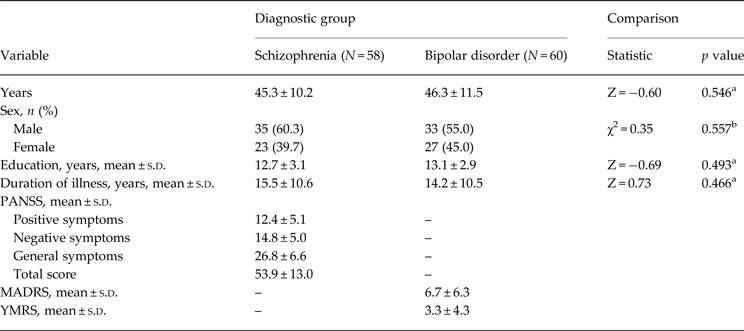
One hundred and eighteen outpatients, either suffering from schizophrenia (N = 58) or BP-I (N = 60), were included into the study. Table 1 provides an overview of demographic and clinical characteristics. The two groups were comparable regarding age, sex, duration of illness, and educational level.
Sociodemographic and clinical variables

PANSS, Positive and Negative Syndrome Scale; MADRS, Montgomery–Asberg Depression Rating Scale; YMRS, Young Mania Rating Scale.
a Mann–Whitney U test.
b χ² test.
EI and non-social cognition
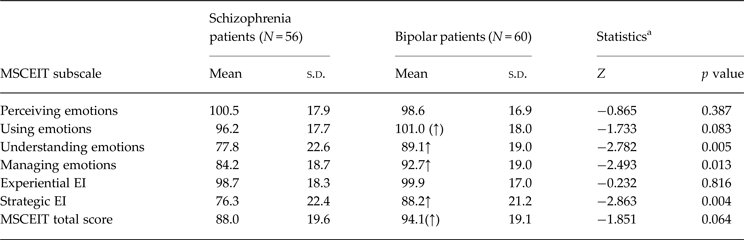
MSCEIT scores were available for 56 schizophrenia patients and 60 bipolar patients. Overall, EI performance scores of schizophrenia patients lay markedly lower than general population norms with a mean MSCEIT total score of 88 (i.e. 12 points or 0.8 s.d. units lower than the population average of 100). Bipolar patients scored only slightly lower than the general population in terms of the MSCEIT total score with a mean score of 94.1 (5.9 points or 0.39 s.d. units below the general population mean).
Schizophrenia patients showed significantly lower scores in almost all MSCEIT branches compared to bipolar patients. Only performance in the ‘emotion perception’ branch was comparable between groups. These differences led to a significantly poorer performance of schizophrenia patients in the area of ‘strategic’ EI, whereas no significant group differences were found with regard to ‘experiential’ EI or the MSCEIT total score (Table 2).
Emotional Intelligence (MSCEIT, EQ values)

MSCEIT, Mayer–Salovey–Caruso Emotional Intelligence Test; EQ, Emotional Intelligence quotient; EI, Emotional Intelligence.
a Mann–Whitney U test.
↑ Significantly higher than in the group of schizophrenia patients, p < 0.05.
(↑) Higher than in the group of schizophrenia patients at a trend level, p < 0.1.
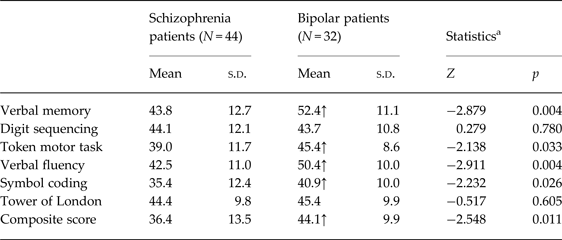
Similarly, both groups differed significantly in non-social cognitive performance. BACS scores were available for 44 schizophrenia and 32 bipolar patients. Compared to bipolar patients, schizophrenia patients achieved a significantly lower BACS composite score scoring significantly lower in four out of six BACS subtests (verbal memory, token motor task, verbal fluency, and symbol coding) (Table 3).
Non-social cognition (BACS T scores)

BACS, Brief Assessment of Cognition in Schizophrenia.
a Mann–Whitney U test.
↑ Significantly higher than in the group of schizophrenia patients.
Effects of non-social cognition on group differences in EI
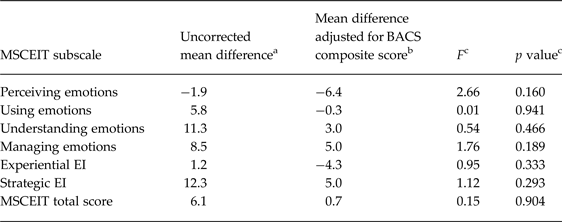
After adjustment for non-social cognition (BACS composite score) the statistical significance of the group differences in EI was lost for all of the MSCEIT branches (Table 4).
Group differences in Emotional Intelligence (MSCEIT) after adjustment for BACS composite score

MSCEIT, Mayer–Salovey–Caruso Emotional Intelligence Test; BACS, Brief Assessment of Cognition in Schizophrenia; EI, Emotional Intelligence.
a Difference between the mean value of the bipolar group and that of the schizophrenia group.
b Parameter estimate for the effect of the diagnostic group obtained by analysis of covariance with adjustment for BACS composite score.
c Statistical information on the effect of the diagnostic group as obtained by analysis of covariance.
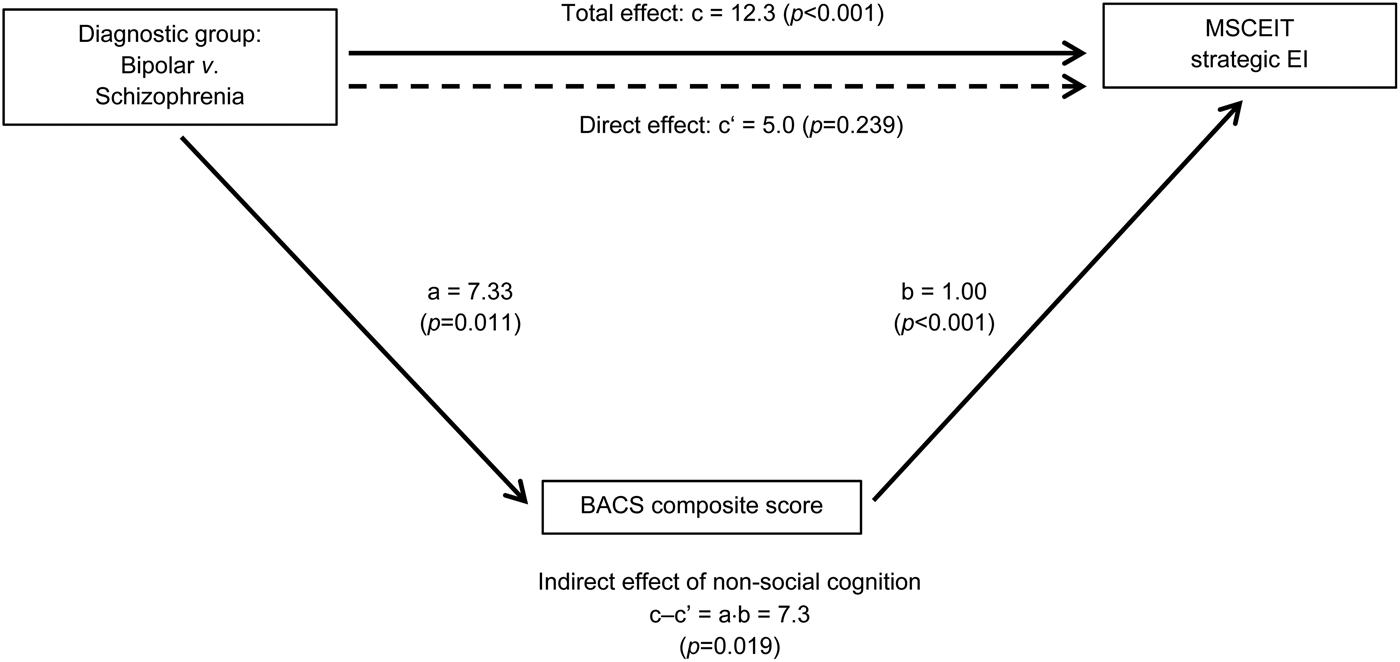
Mediation analysis was performed to investigate this finding more closely. As an example the results for the dependent variable strategic EI are shown in Fig. 1. The total effect of the diagnostic group on strategic EI (12.3 points difference between bipolar and schizophrenia patients) is split up into a significant portion of 7.3 points (Z = 2.34, p = 0.019) attributable to non-social cognition and a smaller, non-significant fraction of 5.0 points (F = 1.12, df = 1, p = 0.239) not attributable to non-social cognition, the direct effect of the diagnostic group on strategic EI.
Indirect effect of non-social cognition on the relationship between diagnosis and strategic Emotional Intelligence: results of mediation analysis. Numbers shown are unstandardized regression coefficients. Solid lines indicate statistically significant effects, dashed lines indicate non-significant effects. MSCEIT, Mayer–Salovey–Caruso Emotional Intelligence Test; BACS, Brief Assessment of Cognition in Schizophrenia; EI, Emotional Intelligence; a, effect of diagnostic group on the mediator BACS composite score; b, effect of BACS composite score on MSCEIT strategic EI (adjusted for diagnostic group); c, total effect of diagnostic group on MSCEIT strategic EI; c’, direct effect of diagnostic group on MSCEIT strategic EI, after adjusting for non-social cognition; c–c’, Indirect effect of non-social cognition on the relationship between diagnostic group and strategic EI.

Similar findings were obtained for the MSCEIT subscales ‘understanding emotions’ and ‘managing emotions’ and for the MSCEIT total score. For ‘understanding emotions’ the total effect (group difference) of 11.3 points was split up into a significant indirect effect of 8.3 points due to the mediator non-social cognition (Z = 2.45, p = 0.014) and a non-significant direct effect of 3.0 points (p = 0.466). For the subscale on managing emotions the total effect of 8.5 points was divided up into a mediation effect which missed significance by a narrow margin (c–c’ = 3.5, Z = 1.79, p = 0.073), and a non-significant direct effect (c’ = 5.0, p = 0.179). Finally, for the MSCEIT total score the total effect of 6.1 points was almost completely mediated by non-social cognition (mediation effect: c–c’ = 5.4 points, Z = 2.26, p = 0.024; direct effect: c’ = 0.7, p = 0.904).
Discussion
The main focus of this study was the comparison of EI in clinically stable patients suffering from schizophrenia or BP-I. To the best of our knowledge, this is the first study to assess all branches of EI in bipolar patients by using the entire MSCEIT.
Schizophrenia patients scored significantly lower in three out of four MSCEIT subscales (using, understanding, and managing emotions). Our finding of significantly lower scores in the ‘managing emotions’ subscale of the MSCEIT in schizophrenia patients is in line with that of a previous study which had exclusively investigated this branch (Lee et al. Reference Lee, Altshuler, Glahn, Miklowitz, Ochsner and Green2013). In addition, our findings corroborate those of further comparative studies on social cognition in patients with serious mental illnesses, which had reported that deficits in this area are more pronounced in schizophrenia than in mood disorders (Hofer et al. Reference Hofer, Biederman, Yalcin and Fleischhacker2010).
In the current study, the most distinct between-group difference was found in the ‘understanding emotions’ section of the MSCEIT, again with bipolar patients outperforming those suffering from schizophrenia. This branch of EI assesses the knowledge how emotions evolve, how they interact with each other and change over time as well as the understanding for conflicting emotions. We hypothesize, that deficits in these abilities are strongly related to psychosocial functioning and accordingly contribute to the poorer community functioning levels of schizophrenia patients (Yen et al. Reference Yen, Cheng, Huang, Ko, Yen, Chang and Chen2009); however, this issue cannot be addressed by our data.
As expected and corresponding to previous reports (Hill et al. Reference Hill, Reilly, Keefe, Gold, Bishop, Gershon, Tamminga, Pearlson, Keshavan and Sweeney2013), we detected significant between-group differences in non-social cognition as assessed by the BACS. Bipolar patients achieved a significantly higher BACS composite score and significantly higher scores in the list learning, token motor, verbal fluency, and symbol coding tasks, indicating higher levels of verbal memory, executive functioning, and processing speed. Notably, and as a main finding of our study, the difference in EI performance between schizophrenia and bipolar patients disappeared after adjusting for the BACS composite score. Previous studies have indicated that the differences between bipolar patients and healthy control subjects in performance on social cognition tasks may be mediated by non-social cognition (Bora et al. Reference Bora, Vahip, Gonul, Akdeniz, Alkan, Ogut and Eryavuz2005; Martino et al. Reference Martino, Strejilevich, Fassi, Marengo and Igoa2011). Our findings suggest that this might also be true for EI differences between patients suffering from schizophrenia and bipolar disorder. In line with this hypothesis, the mediation analysis indicated that the difference between schizophrenia and bipolar patients in ‘strategic’ EI was substantially attributable to the mediating effect of non-social cognition. Accordingly, non-social cognition was largely responsible for the poorer performance of schizophrenia patients in the MSCEIT. This is in line with the findings of our previous comparative study in schizophrenia patients v. healthy control subjects (Frajo-Apor et al. Reference Frajo-Apor, Pardeller, Kemmler, Welte and Hofer2016) and points out that non-social cognition has to be taken into account when interpreting MSCEIT data. Moreover, our results have implications for the development of specialized treatment approaches combining EI training with cognitive remediation, which can be expected to be beneficial (Lindenmayer et al. Reference Lindenmayer, McGurk, Khan, Kaushik, Thanju, Hoffman, Valdez, Wance and Herrman2013). Using laboratory tasks that assess brain function at the neurocognitive/perceptual level, Clementz et al. have recently proposed a classification of psychoses on the basis of three biotypes. Notably, the biotype to which most schizophrenia patients were assigned was associated with the most psychosocial impairments as assessed by the Birchwood Social Functioning Scale (Clementz et al. Reference Clementz, Sweeney, Ham, Ivleva, Ethridge, Pearlson, Keshavan and Tamminga2016). It remains to be seen whether performance in the MSCEIT might also be relevant in this context.
This study has some limitations. First, we used the BACS in both patient groups, although this instrument has originally been developed for the assessment of non-social cognition in schizophrenia only. However, there is evidence that the BACS also has a high sensitivity to measure cognitive impairments in bipolar patients (Cholet et al. Reference Cholet, Sauvaget, Vanelle, Hommet, Mondon, Mamet and Camus2014). Second, although all patients were clinically stable and PANSS, MADRS, and YMRS scores indicated only mild symptom severity levels, not all were in full remission and we were not able to account for a potential influence of psychopathology. Similar considerations apply to the potential impact of psychopharmacological treatment on our findings. Although all patients had been on stable medication for at least 3 months, it cannot be ruled out with certainty that the different compounds used may have influenced measures of both social and non-social cognition in different ways. Third, BACS scores were only available for 32 (of 60) bipolar patients, which may have impacted statistical power. Last, cross-sectional studies always provide only snapshots of intellectual abilities. In conclusion, the present study provides evidence that group differences in EI among schizophrenia and bipolar patients are largely influenced by non-social cognitive functioning. Further research is needed for the better understanding of the relationship between BP-I and other social and non-social cognitive domains in schizophrenia and bipolar disorder.
Acknowledgements
This work was supported by the Austrian Science Fund (grant no. KLI 366). The authors thank Dr Irene Lehner-Adam, Ph.D., for her support in acquisition of data.
Declaration of Interest
Beatrice Frajo-Apor has received travel reimbursements from AOP Orphan, Lundbeck, Eli Lilly and Janssen-Cilag. Moritz Mühlbacher has received speakers’ or consultancy fees from BMS, AstraZeneca, Janssen-Cilag, and Lundbeck as well as reimbursements for travel and meeting expenses from Janssen-Cilag, AstraZeneca Lundbeck, and Roche Anna Welte has received travel reimbursements from AOP Orphan, AstraZeneca and Pfizer. Wolfgang Fleischhacker received research grants from Otsuka, Janssen Cilag and Lundbeck; advisory board honoraria from Lundbeck, Roche, Otsuka, Janssen Cilag, Takeda, Amgen, Teva, Boehringer Ingelheim and Targacept; speakers’ honoraria from Lundbeck, Janssen Cilag, Otsuka, Roche and Takeda; and own stocks of MedAvante. Alex Hofer has received a research grant from Janssen-Cilag. He has received speakers’ or consultancy fees from AOP Orphan, BMS, Janssen-Cilag, and Lundbeck as well as reimbursements for travel and meeting expenses from AOP Orphan, Janssen-Cilag, Lundbeck, Pfizer, and Roche. Silvia Pardeller, Tamara Plass and Georg Kemmler have no conflicts of interest.