Introduction
Despite several decades of significant gains in women’s participation in the public sphere and the labour market, family-based care of older people remains highly gendered. Women still perform a disproportionate share of caregiving to older people (Ferrant et al., Reference Ferrant, Pesando and Nowacka2014; Ophir, Reference Ophir2022), with the exception of spousal care (Glauber, Reference Glauber2017; Patterson and Margolis, Reference Patterson and Margolis2019). This gender asymmetry in caring puts women at a greater risk of reducing their labour supply, thus contributing to gender inequality in labour outcomes, including earnings and employment prospects (Heitmueller and Inglis, Reference Heitmueller and Inglis2007; Mazzotta et al., Reference Mazzotta, Bettio and Zigante2020). The gender gap in the prevalence of informal caregiving is all the more puzzling in light of attitudinal trends towards gender roles from across Europe and North America. These show that gender role attitudes about work and family are becoming more gender egalitarian (Braun and Scott, Reference Braun, Scott, Haller, Jowell and Smith2009; Scarborough et al., Reference Scarborough, Sin and Risman2018) and include growing support for men’s involvement in the domestic sphere as more equal partners in parenting, household work, and care (Davis and Greenstein, Reference Davis and Greenstein2009; Sullivan et al., Reference Sullivan, Gershuny and Robinson2018). Extant research on childcare (Bulanda, Reference Bulanda2004; Evertsson, Reference Evertsson2014; McGill, Reference McGill2014), housework (Grunow and Bauer, Reference Grunow and Bauer2014; Kan and Kolpashnikova, Reference Kan and Kolpashnikova2021), and work-family policies in general (Thébaud and Pedulla, Reference Thébaud and Pedulla2016) indicates that men who hold more gender egalitarian views are more likely to engage in housework or childcare. However, there is, thus far, a dearth of evidence on the role of individual preferences or ‘egalitarian gender ideologies’ on informal care behaviour. Our study aims to fill this gap by exploring the relationship between gender role attitudes and the provision of informal care to parents by women and men. This is a highly relevant and timely discussion as a more egalitarian gender distribution of informal caregiving brought on by more male caregivers would help stave off a possible decline in availability of informal carers. This is particularly important as new cohorts of older people have fewer children who may have to shoulder a greater share of care individually (Tolkacheva et al., Reference Tolkacheva, Broese van Groenou and Van Tilburg2010). A more equal distribution of care could also enable higher employment rates of increasingly higher educated women among younger cohorts (Rodrigues and Ilinca, Reference Rodrigues and Ilinca2021). Moreover, greater gender equality in caregiving has an intrinsic value as recognised by the European Care Strategy and the Sustainable Development Goals of the United Nations (European Commission, 2022). The analysis presented below contributes in a number of novel ways to understanding what factors may contribute to achieving such greater equality.
First, we investigate the extent to which caregiving to parents is associated with individual attitudes towards gender roles in the provision of intergenerational informal care to parents. Specifically, we aim to test whether more gender egalitarian individual attitudes may contribute to a reduction in the gender care gap. Existing data on gender role attitudes consistently show that, in general, women tend to have more egalitarian attitudes than men (Davis and Greenstein, Reference Davis and Greenstein2009). Gender differences in attitudes towards family care provision and support to older adults have been comparatively researched before (Daatland and Herlofson, Reference Daatland and Herlofson2003; Daatland et al., Reference Daatland, Herlofson and Lima2011; Mair et al., Reference Mair, Chen, Liu and Brauer2016; Hess et al., Reference Hess, Schmitz, Naegele and Stiemke2023), but such research has conflated preferences for family care with gender traditionalist views and not focused specifically on attitudes towards gender specialised roles due to lack of such specific questions in datasets. To our knowledge, ours is the first study to analyse the association between individual attitudes towards gender roles and informal caregiving to parents in a cross-national setting, making use of a dataset that includes such specific questions on gender specialised roles.
Second, accounting for a variety of country-level contextual factors, we examine how national cultural and institutional contexts relate to individuals’ caregiving behaviour. This is important as differences in institutional context, such as care policies and gender norms relating to informal care, are likely to moderate the role of individual gender attitudes and care behaviours of women and men across countries. Gender norms and institutional contexts shape not only caregiving behaviours, but also the roles expected of women and men, often placing primary responsibility for care and domestic labour on women (Meyers and Gornick, Reference Meyers and Gornick2005; Ridgeway, Reference Ridgeway2011). Cultural expectations about gender roles are reflected and reinforced in public policies that signal which behaviours and roles are socially supported and valued (Pierson, Reference Pierson1993). For instance, family policies that assume women as the default caregiver tend to reinforce traditional care patterns and gender role attitudes, while public policy designs that promote men’s involvement in care can also foster egalitarian gender role attitudes (Korpi et al., Reference Korpi, Ferrarini and Englund2013; Mauerer, Reference Mauerer2023). The correlation between individual’s gender attitudes and their actions found in other types of unpaid work than informal care suggests a strong desire for consistency between individuals’ beliefs and their behaviour (Gross and Niman,Reference Gross and Niman1975; Schober and Scott, Reference Schober and Scott2012), but these may also be shaped by existing constraints at the societal level that enable or prevent particular actions (Joecks et al., Reference Joecks, Kurowska, Pull and Schober2024). Previous analyses of macro-level determinants of informal care (Schmid et al., Reference Schmid, Brandt and Haberkern2012; Haberkern et al., Reference Haberkern, Schmid and Szydlik2015) have focused on explanations rooted in institutions, mainly care policies. We extend this also by including indicators that reflect national gender equality more broadly as well as country cultural norms. We employ logistic regression models with country fixed effects and include specific country-level contextual variables denoting different public policies with an impact on gender, thus enabling a finer understanding of the interaction between individual and country-level variables that goes beyond simple comparisons between care regimes. In addition, we use a comparative international dataset, the Generations and Gender Survey, that includes a number of Eastern European countries, thus contributing to wider knowledge on informal caregiving and gender inequality beyond the scope of Western Europe.
Gender inequalities in informal caregiving
Intergenerational informal caregiving by relatives remains the main source of support for most older people in need of care in Europe, particularly those with poor health and living alone (Haberkern and Szydlik, Reference Haberkern and Szydlik2010). This support is overwhelmingly carried out by daughters or daughters-in-law, with the gender care gap particularly large when considering intensive informal care (i.e. 20 + hours weekly) (Pinquart and Sörensen, Reference Pinquart and Sörensen2011; Morgan et al., Reference Morgan, Ann Williams, Trussardi and Gott2016). This picture remains valid across studies carried out in the past decades, despite numerous societal and demographic transformations (Rodrigues et al., Reference Rodrigues, Rehnberg, Simmons, Ilinca, Zólyomi, Vafaei, Kadi, Jull, Phillips and Fors2023).
A number of reasons have been proposed for the persistence of this gender care gap. One set takes a structuration view of the gender care gap, seeing it in the broader context of existing gender inequalities in society, namely in political power and access to resources and opportunities such as human capital, employment, and income (Haberkern et al., Reference Haberkern, Schmid, Neuberger and Grignon2012). The predominance of women as carers thus reflects the fewer opportunities they face in the labour market and access to earnings or financial resources, leading to lower opportunity costs when engaging in caregiving.
Other studies focus on the multiple ways the welfare state shapes the gender care gap. For example, care services may partially replace informal care, particularly intensive care, and through this improve gender equality in caregiving (Bonsang, Reference Bonsang2007; Verbakel et al., Reference Verbakel, Metzelthin, Gertrudis and Kempen2018). There is evidence that gender differences in caregiving are smaller in countries with a strong provision of care services (Haberken et al., Reference Haberkern, Schmid and Szydlik2015). Conversely, cash-for-care benefits may reinforce existing gender inequalities, by rewarding informal care (Saraceno, Reference Saraceno2010). It seems, nonetheless, that public policies or ‘institutional constraints’, such as the availability of cash benefits or care services, have a greater impact on the engagement of women in care than on men (Haberkern et al., Reference Haberkern, Schmid and Szydlik2015; Pedulla and Thebáud, Reference Pedulla and Thébaud2015) as they might be seen as addressing a ‘women’s issue’. In an example of what Pedulla and Thebáud (Reference Pedulla and Thébaud2015: 117) called ‘the disjuncture between contemporary institutional structures and individuals’ ideals’, recent policy developments in Europe seem to have reinforced the reliance on the family as caregivers, despite individual attitudes towards caregiving pointing in the opposite direction (Eurobarometer, 2007).
An additional factor influencing gender inequalities in caregiving is societal-level norms regarding ‘who should provide care’, in particular how values that place care responsibility with the family intersect with gender norms regarding caregiving within families. Research on care division among siblings and in-laws indicates that gender norms may play a role as daughters and daughters-in-law are disproportionately more likely to provide care even in the presence of male siblings (Haberkern et al., Reference Haberkern, Schmid and Szydlik2015; Batur et al., Reference Batur, Vergauwen and Mortelmans2022). Under strong preferences for same-sex care (Grigoryeva, Reference Grigoryeva2017), particularly personal care, the gender care gap may also partially reflect the longer life-expectancy of women (Luppi and Nazio, Reference Luppi and Nazio2019). Where cross-sex care takes place, this is often deemed more acceptable when provided by women – an argument that seems borne out by the greater share of personal care that female carers deliver (Morgan et al., Reference Morgan, Ann Williams, Trussardi and Gott2016). Women also seem to be more impacted by expectations of reciprocity and filial duty in Western European societies and thus more likely to reduce their labour supply when care needs arise (Morgan et al., Reference Morgan, Ann Williams, Trussardi and Gott2016; Mazzotta et al., Reference Mazzotta, Bettio and Zigante2020).
Gender role attitudes and the division of unpaid work
A substantive body of research has linked caregiving to older parents by adult children to the latter’s filial norms and beliefs about family responsibilities, although not with a focus on the gender division of care (Silverstein et al., Reference Silverstein, Gans and Yang2006; Klimaviciute et al., Reference Klimaviciute, Perelman, Pestieau and Schoenmaeckers2017; Diederich et al., Reference Diederich, König and Brettschneider2023). More concretely on gender role attitudes, Evertsson (Reference Evertsson2014) and Kan and Kolpashnikova (Reference Kan and Kolpashnikova2021) examined how individual gender role attitudes affected the division of domestic labour, albeit without specifically including care for older parents. Findings from these two studies show that women with egalitarian attitudes tend to do less housework, whereas men with more egalitarian views are more likely to do a larger share of housework compared to men with traditional attitudes. Concomitantly, women with egalitarian gender views are more likely than inegalitarian women to perceive inequalities in the division of household labour as unfair (Davis and Greenstein, Reference Davis and Greenstein2009). Research that analysed the relationship between gender ideologies or gender role attitudes (the two terms are often used interchangeably in research to refer to individual beliefs about the roles of men and women) and the provision of care to children report similar results (Davis and Greenstein, Reference Davis and Greenstein2009). This suggests that egalitarian attitudes towards gender roles contribute to a more equitable division of unpaid work, at least for housework and childcare.
Research questions and hypotheses
In this paper, we seek to address the following research questions: (1) to what extent is caregiving to older parents associated with individual gender role attitudes towards care; and (2) to what extent is the association between caregiving behaviour and attitudes moderated by national contexts?
Based on existing empirical evidence and literature related to care and individual gender role attitudes, we hypothesise that individual egalitarian gender role attitudes towards care will be associated with gender deviance in caregiving behaviour by women and men (H1), with gender deviance understood as divergence from normative expectations about gender behaviour. More specifically, we posit that women will be less likely to perform informal care when they hold more egalitarian gender role attitudes (H1a), and men will be more likely to perform informal care when they hold more egalitarian gender role attitudes (H1b). Our second hypothesis is that this effect will not be uniform among countries, that is, the role of individual gender egalitarian attitudes will be moderated by the national cultural and institutional context in which individuals live (H2a). Moreover, in line with the evidence reviewed above, we expect that this moderating effect will be larger for women than for men (H2b).
Data and methods
We use data from the Generations and Gender Survey (GGS) (Gauthier et al., Reference Gauthier, Cabaço and Emery2018), which is a longitudinal survey of adults aged eighteen to seventy-nine living in the community across several European and non-European countries. GGS offers rich measures on individual gender roles attitudes, including attitudes towards gender roles in informal caregiving specifically, going beyond attitudes towards family care previously studied in the literature. It also includes information on the provision of informal care, and thus allows us to investigate how gender differences in individual gender role attitudes towards care relate to differences in caregiving behaviour. We pooled respondents from both wave 1 (2004–2011) and wave 2 (2008–2015)Footnote 1 and after excluding countries for which no information on informal care or other variables of interest was available, or countries with too few observations, we were left with a geographically and policy-diverse group of nine European countries: Belgium, France, Germany, Norway, Czech Republic, Bulgaria, Poland, Lithuania, and Romania. From the initial 143,850 individual observations, we restricted our sample to those with at least one parent with care needs (17,010 individual observations remaining) and no missing values for the variables used in our study, including weights, thus arriving at the final sample of 14,941 individual observations of which 8160 are women and 6781 are men.
Variables
Our dependent variable is a binary variable representing provision of informal care to a parent, defined as ‘regular help with personal care such as eating, getting up, dressing, bathing, or using toilets’ provided in the last twelve months (see Appendix, Table A2 for details on the question). GGS collects information on the care needs (i.e. limitations in everyday activities due to health or disability) of the care receiver only in the case of parents. This was also one of the main reasons for restricting our sample only to those with a parent with care needs. Our main independent variable of interest, individual attitudes towards gender roles in informal caregiving, is an ordinal variable of three categories that acts as a proxy for how gender egalitarian an individual is in their care views. The statement used is ‘When parents are in need, daughters should take more caring responsibility than sons’. This variable is operationalised as ‘traditional’ individuals that (strongly) agreed with this statement (0), ‘ambivalent’ individuals that neither agreed nor disagreed (1), and the ‘egalitarians’ that (strongly) disagreed (2). We use this item as it directly relates to care provided for a parent and measures individuals’ views on the gendered provision of informal care.Footnote 2 Furthermore, by keeping the middle neutral as a separate category, it allows us to distinguish individuals that are ‘ambivalent’ or ‘indecisive’ in their attitudes towards men and women’s role in relation to care (Joecks et al., Reference Joecks, Kurowska, Pull and Schober2024).
Other selected independent (co)variables at the individual level based on their influence on caregiving (Broese van Groneau and De Boer, Reference Broese van Groenou and De Boer2016) include sex, self-reported health, education, employment status, partner living in the household, number of children living in the household, age, and survey wave (Appendix, Table A2). Recognising the potential confounding effects of views towards family care obligations on gendered views on informal caregiving, we additionally control for views regarding family support. This is proxied by a question on whether children should be responsible for care when their parents need it and is operationalised as those that disagree or strongly disagree (0), neither agree nor disagree (1), and agree or strongly agree (2).
To account for national context, we use five country-level contextual variables: percentage of adults aged sixty-five and older who receive home care services and residential care assessed separately, gender gap in full-time employment rate, percentage of women elected for national parliament and share of the population holding overall gender egalitarian views. The latter is a geometric index calculated for each country per wave using three variables, each individually capturing the share of respondents who disagree or strongly disagree with the following three statements: ‘When jobs are scarce, men should have more rights to a job than women’, ‘On the whole, men make better political leaders than women do’, and ‘When parents are in need, daughters should take more caring responsibility than sons’. The first two statements are about the expected role of men and women in the public sphere whereas the third, which is also used as our main independent variable, concerns assumptions about gendered roles in intergenerational caregiving to parents. Descriptive statistics, data sources, and years for each country-level contextual variable are provided as Appendices. We include home care and residential care as proxies for available care resources outside the family that could reduce pressure on family (and women) to provide care in a given country through what is usually termed defamilialisation (Verbakel et al., Reference Verbakel, Glaser, Amzour, Brandt and Broese Van Groenou2023). We refrained from using public expenditure on long-term care (LTC) as this would include cash benefits whose impact on gender equality is disputed (Verbakel et al., Reference Verbakel, Glaser, Amzour, Brandt and Broese Van Groenou2023). Recognising, however, that home care and residential care may have potential differentiated effects on provision of informal care – the former allowing for home care services and informal care to complement each other, while the latter has arguably greater scope for replacing informal care (Jacobs et al., Reference Jacobs, Broese van Groenou, de Boer and Deeg2014) – we use each indicator separately. Finally, by using these indicators as a percentage of sixty-five and older, we are also accounting for differences in ageing across countries. The theoretical decision to control for the gender gap in full-time employment is to represent the extent of gender equality towards women and men’s roles in the labour market in general and indirectly the availability of women and men to provide care, with the assumption that a higher gap may correspond to a greater gendered division of paid and unpaid work. This indicator has been used before to study the link between egalitarian gender norms and employment status (Cislaghi et al., Reference Cislaghi, Bhatia, Hallgren, Horanieh, Weber and Darmstadt2022). The percentage of women elected for national parliament accounts for gender equality in the form of the roles and power women and men have in society. This can be considered an indirect measure for gender equality mainstreaming in policymaking, in that a higher portion of women in influential policymaking roles likely correlates with more policies that benefit women (OECD, 2014). Finally, the proportion of gender egalitarian individuals for each country follows from research showing that what is deemed as sanctioned behaviour (through prevailing societal opinions) is likely to affect the actions of individuals, in particular gender deviance in behaviour of men (Thébaud and Pedulla, Reference Thébaud and Pedulla2016).
Analytic strategy
We carry out logistic regression analyses to discern: (1) the relationship between having egalitarian-gendered views towards care and the probability to provide care for both women and men; and (2) the moderating effect that country-level contextual variables have on the relationship between egalitarian care views and the probability of providing care by women and men. We employ a series of logistic regression models with a stepwise regression approach beginning with an empty model for our whole sample with no other variables (Model 1). The remaining models are estimated separately for women and men. Model 2 (baseline) separates Model 1 by gender. Model 3 additionally accounts for family support for care, and Model 4 incorporates the remaining individual-level control variables. Taken together, Models 2 to 4 test hypothesis H1. To test hypotheses H2, we add two-way interaction terms of each contextual country-level variable with individual gender attitudes in Models 5 through 9 (Vincens et al., Reference Vincens, Emmelin and Stafström2018). To avoid potential collinearity, these interaction terms are added separately in each model. We use country-fixed effects in all our models to account for remaining country differences. We present Average Marginal Effects (AMEs) of the impact of gendered care attitudes on probability to care (Table 2) in order to compare estimates between men and women and across nested non-linear models (Mood, Reference Mood2010). Predicted probabilities are used to represent the interaction terms of each category of gender role attitudes (traditional, ambivalent, egalitarian) with the country-level contextual variables.
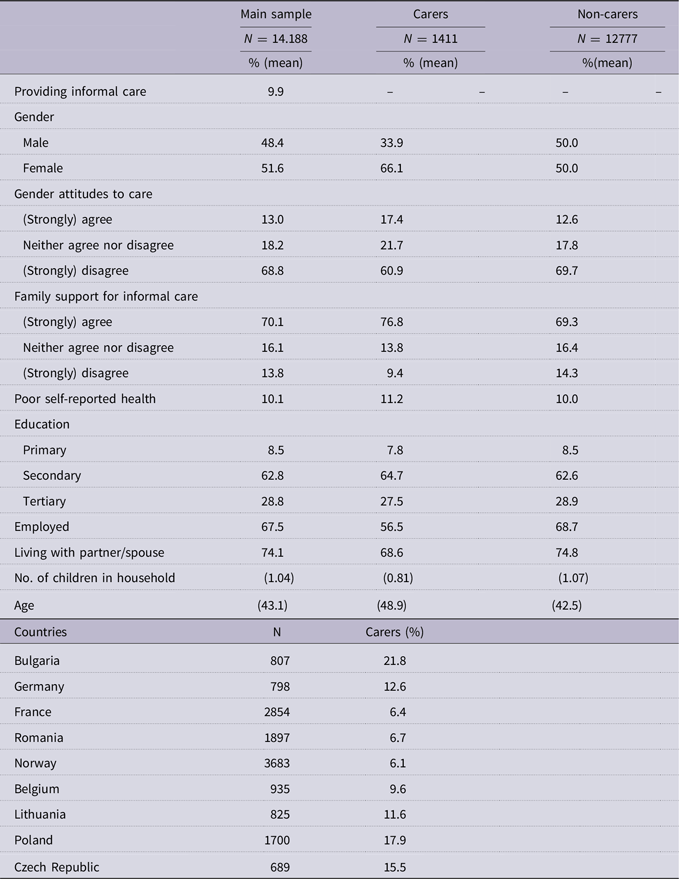
Descriptive statistics for the total sample

Source: GGS Wave 1 and Wave 2. Weighted results.
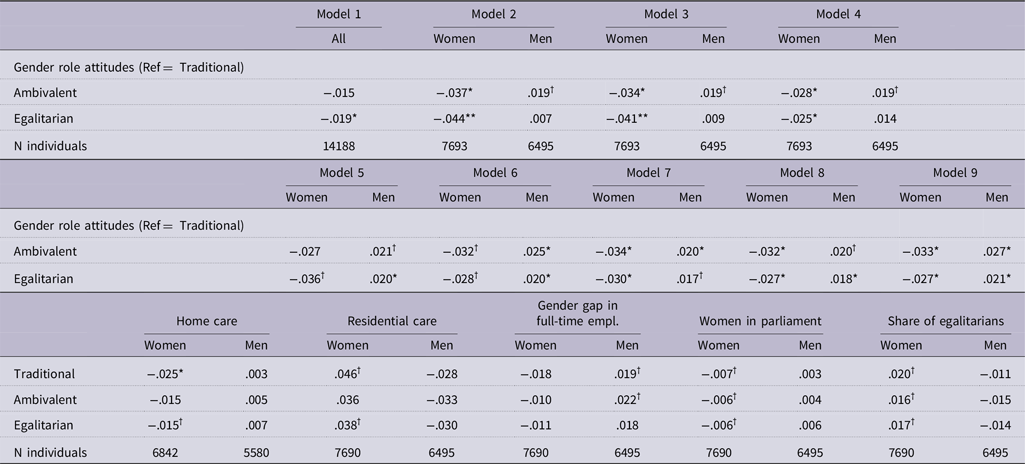
Relationship between gender role attitudes and informal caregiving for parents, average marginal effects (AMEs)

Notes: †p < 0.10; *p < 0.05; **p < 0.01; ***p < 0.001. Weighted results. Average Marginal Effects. All models contain country fixed effects. Standard errors are clustered around individuals to account for repeated observations. Model 1: accounts for gender role attitudes. Model 2: accounts for gender role attitudes, gender, and an interaction of the two variables. Model 3: same as model 2 but additionally accounting for the family support variable and interaction of it with gender. Model 4: same as Model 3 but additionally controlling for poor self-reported health, education, employment, parent’s health limitations, partner in the household, and number of children in the household. Model 5 through 9 consist of all control variables in Model 4. The models additionally control for the following additional country-level variables: Model 5: % of adults aged 65 and older who receive home care services; Model 6: % of adults aged 65 and older in residential care; Model 7: gender gap in full-time employment rate; Model 8: % of women in national parliament; Model 9: % of gender egalitarian individuals.
Results
Table 1 displays the descriptive statistics for our sample. A notable distinction is that carers are more likely to agree or strongly agree than non-carers that children should be responsible when care needs arise (family support for informal carers), which may contribute to their increased likelihood to provide care. Carers are also more likely than non-carers to agree or strongly agree that daughters should provide care (gender role attitudes towards care), although the majority of carers still (strongly) disagree with this sentiment. Of the countries and sample included in the analysis, Bulgaria contains the largest proportion of carers (21.8 per cent), while the lowest proportion is in Norway (6.1 per cent).
Regarding attitudes towards gender roles in informal caregiving in our sample, there is an egalitarian attitudes gradient that runs north to south and west to east of Europe (Figure 1). In nearly all countries, a larger share of women and men hold egalitarian views concerning gender roles in providing care. Egalitarian views are stronger among women than among men in all countries. The share of people who neither agreed nor disagreed with specific gender roles in informal care (termed ‘ambivalent’ in our analysis) is higher among Eastern and Central European countries and among men in all countries. In line with other studies, this could signal that a larger portion of people, and especially men, in those countries are still adapting to a culture regarding gender norms that is shifting and therefore show reluctance to admit traditionalist views or have an indifferent stance towards gender issues (Yang, Reference Yang2023).
Percentage of individuals with traditional, ambivalent, and egalitarian attitudes about gender roles in caregiving in our sample by sex and country.
Source: GGS Wave 1 and Wave 2
Notes: ‘Traditional’ represents those that (strongly) agree with the statement that ‘When parents are in need, daughters should take more caring responsibility than sons’. Those in the ‘Ambivalent’ category neither agree nor disagree with this statement, and those in the ‘Egalitarian’ category (strongly) disagree with the statement. Weighted results. Unilaterally across all countries, a larger proportion of women than men provide informal care, with the largest gender gap in Belgium (21 percentage points (pp)) and narrowest in Bulgaria and Romania (7 pp) (Appendix, Figure A1)

The proportion of individuals providing informal care according to their gendered views on care by country and sex is shown in Figure 2. Women with traditional views are more likely to provide care compared to those with egalitarian views in five of the nine countries. Men with egalitarian views are more likely to provide care compared to men with traditional views in five of the nine countries, with traditionalist men only marginally more likely to care for a parent in the remaining four countries. The gender care gap is widest amongst individuals holding traditional views within most countries. The bivariate analysis thus offers only mixed support for H1 (individual egalitarian gender role attitudes towards care would be associated with gender deviance in caregiving behaviour).
Proportion of women and men in our sample providing informal care for parents by country and category of attitudes towards gender roles in caregiving.
Source: GGS Wave 1 and Wave 2
Notes: ‘Traditional’ category represents those that (strongly) agree with the statement that ‘When parents are in need, daughters should take more caring responsibility than sons’. Those in the ‘Ambivalent’ category neither agree nor disagree with this statement, and those in the ‘Egalitarian’ category (strongly) disagree with the statement. Weighted results

Table 2 presents the AMEs from our set of multivariate models to further test H1a (i.e. egalitarian women will be less likely to provide informal care – gender deviance behaviour for women) and H1b (i.e. egalitarian men will be more likely to provide informal care – gender deviance behaviour for men). The association of gender egalitarian views with informal caregiving to a parent is negative for the sample as a whole, but as Model 2 clearly shows, gendered attitudes have opposite effects for men and women. The probability for egalitarian women to provide informal care to a parent is 3.7 percentage points (pp) lower than for traditional women, whereas there is no statistically significant effect among men. Considering the prevalence of informal care provision among the sample of women (12.8 per cent of women provide care to a parent), the magnitude of the AME for women is high. These results hold when views about family responsibility for care are controlled for (Model 3). Once the remaining independent variables are included (Model 4), ambivalent and egalitarian women remain less likely to provide care to a parent (albeit the size of the AMEs is reduced), while for men gendered attitudes show no correlation with caregiving. Taken together, these results partially confirm our hypothesis H1a, but not H1b.
When introducing a single country-level variable into each model in Models 5 through 9 (see lower panel of Table 2), egalitarian women continue to be less likely to provide care than traditional women by between 2.7 and 3.6 pp. Conversely, egalitarian men are now more likely to provide care compared to their traditional counterparts by between 1.7 and 2.1 pp. Most results are significant at the 5 per cent level.
Further key insights for our study aims are provided by Models 5 to 9, which allow us to examine the interaction of each contextual country-level variable with individual gender role attitudes for men and women separately. With this, we are able to assess whether cultural and institutional contexts at the national level enable egalitarian men and women to have gender deviant behaviour in caregiving. We find some evidence that country-level context affects the probability of providing care among men and women, although this is not differentiated across gender role attitudes. For example, higher home care receipt among older people reduces the probability of providing care for both traditional and egalitarian women, particularly among the former. Conversely, residential care (measured as the share of those aged 65 + in residential care) is associated with higher informal care provision for both traditional and egalitarian women (albeit with marginal statistical significance), again particularly among traditional women. For both home and residential care, the probability of providing care among men is not statistically significant. Model 7 indicates that increases in the full-time gender employment gap correspond to an increased probability of providing care among traditional and ambivalent men (marginal statistical significance), with no effects observed for women. All women, regardless of their gender role attitudes towards care, are less likely to provide informal care as the share of women in parliament increases, although the magnitude of this effect is small and only marginally statistically significant (Model 8). Finally, a large share of gender egalitarians in a country increases the probability that women provide care (with marginal significance), regardless of their gender role attitudes, while no statistically significant effect is observed among men. Thus, our results provide some support for H2a – i.e. the role of individual gender egalitarian attitudes is moderated by national cultural and institutional contexts – and partial support for H2b, as the moderating effect of these contextual factors is larger for women than for men.
Discussion and conclusion
In this paper, we sought to analyse the association of individual gender role attitudes with women’s and men’s probabilities of providing informal care to parents, and to assess how national context may moderate this relationship. First, we hypothesised that individual gender role attitudes could be associated with gender deviance in caregiving (H1a and H1b). We find that women holding egalitarian views are significantly less likely to engage in caregiving to parents than their traditional peers. This association of individual gender egalitarian views with gender deviance in caregiving among women holds when controlling for individual and family characteristics. For men, we find no support that egalitarian attitudes are related to greater involvement in caregiving to parents. Our results are therefore consistent with findings from the childcare literature concerning the association of gender egalitarian views with gender deviance in caregiving behaviour (Bulanda, Reference Bulanda2004; Evertsson, Reference Evertsson2014; McGill, Reference McGill2014) with respect to women only. This may reflect women’s greater interest in supporting gender equality (Bolzendahl and Myers, Reference Bolzendahl and Myers2004) as they have more to gain from men’s equal participation in informal caregiving. While the association between gender egalitarian attitudes and caregiving lacked statistical significance for men, we did observe a higher probability of providing care for men with ambivalent views relative to those with traditional gender role attitudes. This finding could be related to men’s lagged adaptation to the changing position of women in society and home (Sullivan et al., Reference Sullivan, Gershuny and Robinson2018), which we discuss later.
We next hypothesised that the role of individual gender egalitarian attitudes would be moderated by national cultural and institutional contexts (H2a). We also conjectured that this moderating effect would be greater for women (H2b). Starting with the latter hypothesis, the effect indeed tended to be larger for women than for men. The results for egalitarian men were statistically insignificant, but the direction of the effect remained the same as in the models without the contextual variables (i.e. increase for men, decrease for women) with the exception of the residential care and general gender attitudes in the country indicators, where this was inverted. For egalitarian women, context had some marginally significant effect, namely greater use of home care and representation of women in parliament meant that women were less inclined to provide care to parents. However, greater societal support for gender equality and reliance on residential care had the opposite effect. Hypothesis 2a thus only partly holds for women. The results for men were similar for traditional and gender egalitarian individuals alike, whereas among women, the moderating role of contexts was stronger for traditional-minded women. Other studies showed gender egalitarian contexts at the country level to be associated with a reduction in the probability to provide care by women (cf. Haberkern et al., Reference Haberkern, Schmid and Szydlik2015; Pedulla and Thebáud, Reference Pedulla and Thébaud2015). This is not wholly confirmed by our results, regardless of women’s gender role attitudes. On the one hand, home care seems to substitute for informal care provision regardless of the individual gendered attitudes of women, while greater representation of women in parliament could mean greater scope for gender egalitarian policies benefiting all women. On the other hand, however, greater availability of residential care was associated with higher provision of informal care among women. This apparently counterintuitive result may be explained by strong preferences for ageing in place and postponing residential care in Western European countries (Eurobarometer, 2007) or reflect the fact that informal care is still present in residential care, albeit of a less intensive nature (Coe and Werner, Reference Coe and Werner2022) – although we are unable to account for care intensity in our data. Similarly, the lack of association between the gender gap in full-time employment and caregiving behaviour across gender role attitudes among women could be related to the specific sample of countries in our data. We have a predominance of Eastern European countries, where at the time of data collection female full-time employment rates were still high as a result of higher average education levels and historical high female employment under Communism (Pascall and Manning, Reference Pascall and Manning2000). The lack of a moderating effect for most context variables for men is in line with other findings (Haberkern et al., Reference Haberkern, Schmid and Szydlik2015) and may be attributed to what Gershuny and colleagues (Reference Gershuny, Bittman and Brice2005) termed a lagged adaptation response of men to the changing behaviour of women and to institutional context. While women have changed their behaviour (for example, labour market participation), which may have already begun to alter the policy environment in which care is provided, this has yet to influence men.
It is worth bearing in mind that this study focuses solely on intergenerational care, mostly due to the nature of the information available (the gender role attitudes question refers specifically to care provided to parents). There is evidence that intragenerational care, namely spousal care in older couples, has a number of differentiating characteristics, not least of all a lower gender care gap (Glauber, Reference Glauber2017; Bertogg and Strauss, Reference Bertogg and Strauss2020). Spousal caregiving is less incumbered by trade-offs with labour market participation and caregiving may be framed by other values besides gender role attitudes, such as marital reciprocity in a context of ‘couplehood’ or not even be defined as caregiving by male spousal carers (Hong and Coogle, Reference Hong and Coogle2016; Cash et al., Reference Cash, Warburton and Hodgkin2019). Taken together, this may result in spouses automatically taking up or continuing their caregiving roles in old-age, and as such the results presented here may not as readily translate to intragenerational care.
There are a number of limitations to our analyses. Our analysis focuses on informal caregiving to older parents and moreover the survey question in the GGS strictly inquiries about providing personal care only. Informal care tasks are highly gendered, with women more likely to provide personal care, while men carry out infrequent tasks or those related to housework (Paraponaris et al., Reference Paraponaris, Davin and Verger2012). Our dependent variable may therefore underrepresent the prevalence of care provided by men. However, this allows us to focus on the type of caregiving where gender inequalities remain the highest (Patterson and Margolis, Reference Patterson and Margolis2019; Ophir, Reference Ophir2022). Conversely, our findings are also less likely to be confounded by including caregiving tasks of dissimilar care intensity (Ferrant et al., Reference Ferrant, Pesando and Nowacka2014). Our single-item measure of gender role attitudes towards care may also be contested to adequately capture individuals’ views concerning the gendered division of informal care. We did observe, however, that views on the gendered division of informal care and family responsibilities of care are seen differently by individuals and by carers in particular. Measurements of gender role attitudes in family care other than childcare are still lacking (Walter, Reference Walter2018) and, to our knowledge, this item in the GGS is the only one currently available that represents gender role attitudes in relation to caregiving to parents, which is the focus of this study. Finally, our findings cannot be generalised to countries beyond those in our sample and allow for only limited conclusions to be drawn about the role of national cultural and institutional contexts in shaping the relationship between caregiving behaviour and attitudes.
These caveats notwithstanding, national contexts such as care policies captured by the country-level indicators in this study may still contribute to reducing the gender care gap by meeting women’s stated preferences for greater gender equality and offering them enhanced possibilities to abstain from unpaid care. These policies, however, seem to play a limited role in expanding male intergenerational caregiving (at least as far as personal care is concerned). This may be because policies in care may not directly address men’s right to care (Knijn and Kremer, Reference Knijn and Kremer1997) thereby signalling that alternative divisions of care are not socially supported – in line with what we had previously alluded to as the role of public policies in shaping norms (Pierson, Reference Pierson1993). As a result, these policies may still be perceived by men as addressing what they still see as a ‘women’s issue’. Caution is also needed in placing too much hope on changing behaviours simply through shifts of individual gender role attitudes – i.e. in taking a strictly individualist approach to the determination of informal care behaviour. In our data, an overwhelming majority of men in Norway, Belgium, France, and Germany expressed strong gender egalitarian views. Yet, the gender division of intergenerational caregiving was hardly egalitarian even in those countries. Gender role attitudes may, however, play another role in narrowing the gender care gap. They may influence policy change through an iterative process – lagged generational change – in which evolving individual attitudes and norms put pressure on public policies and hegemonic representations to change accordingly (Sullivan et al., Reference Sullivan, Gershuny and Robinson2018). If this is the case, change may come more slowly in Eastern European countries, where egalitarian and traditional gender role attitudes are much more evenly distributed within women and men. Our finding that men with ambivalent attitudes are more likely than traditional men to provide care may indicate a first step in this process (Yang, Reference Yang2023).
This study represents a first attempt at extending the literature on individual gender role attitudes and their association with caregiving to the realm of intergenerational care for parents, using a dataset that despite the number of countries considered has a wide geographical variation across Europe. Moreover, the analysis focuses on individual countries rather than countries grouped in care regimes, therefore capturing nuances within types of care regimes. While the analysis carried out here considered the moderating effect of national cultural and institutional contexts, further research is needed on which specific policies may shape preferences for a more even distribution of informal caregiving. This might be accomplished by employing vignettes or quasi-experimental study designs (cf. Bünning and Hipp, Reference Bünning and Hipp2021, for childcare). This study focused on the intersection between gender role attitudes and national contexts. The intersectional focus could be expanded further in the future to explore how gender role attitudes may be shaped or constrained by socio-economic position or ethnicity, besides gender, following up on existing qualitative studies on this (Timonen et al., Reference Timonen, Conlon, Scharf and Carney2013). We used individual level data, but further surveys using households as the sampling unit may be able to analyse how shared or dissonant gender role attitudes within couples affect the division of informal caregiving between spouses as demonstrated by Nitsche and Grunow (Reference Nitsche and Grunow2018) in the case of childcare. This subject is all the more relevant since demographic ageing will likely pressure the current gendered distribution of intergenerational care as more recent generations of older people with fewer children become frail.
Supplementary material
The supplementary material for this article can be found at https://doi.org/10.1017/S1474746426101377.
Acknowledgements
This research was funded in whole, or in part, by the Austrian Science Fund (FWF) (Grant number I4216), the Canadian Institutes of Health Research (Grant number 161787), the Swedish Research Council (grant number 2018-00940), and from the Portuguese Foundation for Science and Technology – FCT (grant number UIDB/04521/2020). This paper uses data from the GGS Waves 1 and 2 (DOIs: 10.17026/dans-z5z-xn8g, 10.17026/dans-xm6-a262), see Gauthier, A. H. et al. (Reference Gauthier, Cabaço and Emery2018) or visit the GGP website (https://www.ggp-i.org/) for methodological details. We are very grateful for comments received from Prof Francesca Bettio (University of Siena) and Prof Janet Jull (Queens University) on earlier drafts.
Author Contributions: CRediT Taxonomy
Eszter Zólyomi: Formal analysis, Methodology, Writing - original draft, Writing - review & editing.
Cassandra Simmons: Conceptualization, Formal analysis, Methodology, Visualization, Writing - original draft, Writing - review & editing.
Ricardo Rodrigues: Conceptualization, Formal analysis, Funding acquisition, Methodology, Supervision, Writing - original draft, Writing - review & editing.
Afshin Vafaei: Conceptualization, Validation, Writing - review & editing.
Johan Rehnberg: Methodology, Validation, Writing - review & editing.
Susan Phillips: Conceptualization, Funding acquisition, Writing - review & editing.
Stefania Ilinca: Validation, Writing - review & editing.
Selma Kadi: Validation, Writing - review & editing.
Stefan Fors: Conceptualization, Funding acquisition, Validation, Writing - review & editing.
Funding statement
This study received funding from the Austrian Science Fund (FWF) (Grant number I4216), the Canadian Institutes of Health Research (Grant number 161787), the Swedish Research Council (grant number 2018-00940) and from the Portuguese Foundation for Science and Technology - FCT (grant number UIDB/04521/2020).
Competing interests
The authors confirm that they have no conflict of interest.
Ethics approval
This research uses secondary data from the Gender and Generations Survey (GGS). GGS itself is subject to continuous ethics review, namely by the Gender and Generations Program Ethics Board and the Dutch Royal Academy of Arts and Science Data Protection Officer. More information is available here: https://www.ggp-i.org/data/ggp-research-ethics/.