Significant outcomes
-
∙ Peripheral interleukin-6 (IL-6) contributes to resilience versus susceptibility in rats subjected to inescapable electric shock.
-
∙ Brain IL-6 may not be involved in the depression-like behaviour.
-
∙ Blood IL-6 would be a peripheral biomarker to predict the onset of depression.
-
∙ Novel therapy using IL-6 monoclonal antibody (e.g. tocilizumab) in depressed patients with high-blood IL-6 levels is of great interest.
Limitations
-
∙ In this study, we did not measure interleukin-6 (IL-6) level in other brain regions, such as hippocampus.
-
∙ IL-6 antagonist should be used to observe its antidepressant effects to confirm our hypothesis.
Introduction
Resilience is the ability to adapt successfully in the face of stress and adversity. After exposures to psychological stress, humans display a wide variability in their response to stressor. Accumulating evidence suggests that resilience is mediated by adaptive changes in several neural circuits, involving numerous neurotransmitters, neurotrophic factors (e.g. brain-derived neurotrophic factor), and molecular pathways (Reference Feder, Nestler and Charney1–Reference Yang, Shirayama, Zhang, Ren and Hashimoto4). However, the precise mechanisms underlying the stress resilience in psychiatric disorders such as major depressive disorder (MDD) remain unknown.
Accumulating evidence suggests that inflammatory processes play a crucial role in the pathophysiology of MDD, as well as in the therapeutic mechanisms of antidepressants (Reference Dantzer, O’Connor, Freund, Johnson and Kelly5–Reference Young, Bruno and Pomara7). A meta-analysis shows higher blood levels of pro-inflammatory cytokines such as interleukin-6 (IL-6) and tumour necrosis factor-α in drug-free MDD patients compared with healthy controls (Reference Dowlati, Herrmann and Swardfager8). Among pro-inflammatory cytokines, serum IL-6 levels were consistently elevated across a number of studies (Reference Young, Bruno and Pomara7,Reference Dowlati, Herrmann and Swardfager8). A subsequent recent paper also demonstrated elevated serum IL-6 levels in MDD patients, but has presented mixed results (no change or decrease) with IL-6 levels in cerebrospinal fluid (Reference Young, Bruno and Pomara7). A recent meta-analysis showed that blood levels of IL-6 in patients with suicidality were significantly higher than those of patients without suicidality and healthy control subjects, indicating that IL-6 may be robustly associated with suicidality (Reference Black and Miller9). Peripherally, IL-6 is secreted by macrophages and monocytes to stimulate differentiation and proliferation of B cells. Taken together, it is likely that peripheral IL-6 may play a role in the pathophysiology of MDD.
Rat learned helplessness (LH) has been widely used as an animal model of depression (Reference Muneoka, Shirayama, Horio, Iyo and Hashimoto10,Reference Shirayama, Muneoka and Fukumoto11). In the rat LH model of depression, ~65% of the rats were susceptible (LH rats), and other rats were defined as resilience (non-LH rats) (Reference Yang, Shirayama, Zhang, Ren and Hashimoto4,Reference Muneoka, Shirayama, Horio, Iyo and Hashimoto10,Reference Shirayama, Muneoka and Fukumoto11). However, there is no report on the relationship between IL-6 levels and the stress resilience in the LH model of depression. In this study, we examined whether IL-6 in the serum and brain may be associated with stress resilience in the rat LH model.
Materials and methods
Animals
A total of 22 male Sprague-Dawley rats (200–230 g; 7-week-olds; Charles River Japan Co., Tokyo, Japan) were used. The animals were housed under 12 h light/dark cycle with free access to food and water. Procedures of this animal experiment were approved by the Chiba University Institutional Animal Care and Use Committee.
Stress paradigm (LH model)
LH paradigm was performed as reported previously (Reference Yang, Shirayama, Zhang, Ren and Hashimoto4,Reference Muneoka, Shirayama, Horio, Iyo and Hashimoto10,Reference Shirayama, Muneoka and Fukumoto11). To create the LH paradigm, rats are initially exposed to uncontrollable stress. When the rat is later placed in a situation in which shock is controllable (escapable), it not only fails to acquire the escape responses but also often makes no efforts to escape the shock at all.
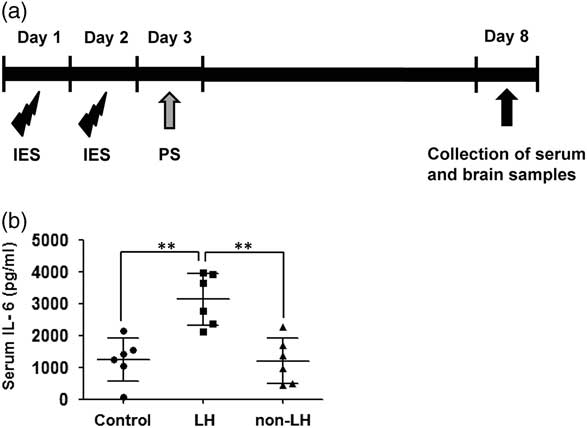
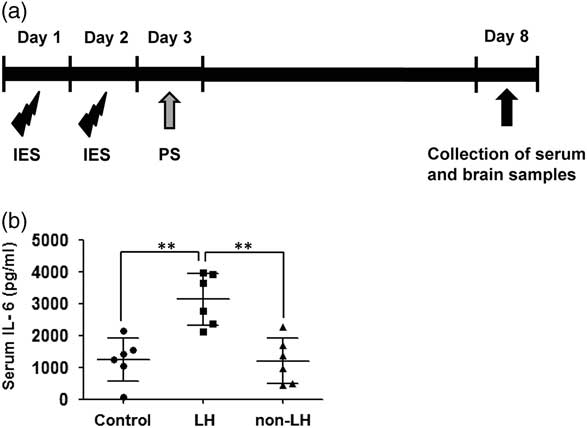
LH behavioural tests were performed using the Gemini Avoidance System (San Diego Instruments, San Diego, CA, USA). This apparatus was divided into two compartments by a retractable door. On days 1 and 2, 16 rats were subjected to 30 inescapable electric foot shock (0.65 mA, 30 s duration, at random intervals averaging 18–42 s) (Fig. 1a). On day 3, a two-way conditioned avoidance test was performed as a post-shock test to determine if the rats would show the predicted escape deficits (Fig. 1a). This screening session consisted of 30 trials in which electric foot shocks (0.65 mA, 6 s duration, at random intervals with a mean of 30 s) were preceded by a 3-s conditioned stimulus tone that remained on until the shock was terminated. The numbers of escape failures and the latency to escape in each 30 trial were recorded by the Gemini Avoidance System. Rats with >25 escape failures in the 30 trials were regarded as having reached criterion for depression (susceptible). Approximately 65% of the rats met this criterion. Rats with <24 failures that did not meet the criterion were defined as non-LH rats (resilience) (Reference Muneoka, Shirayama, Horio, Iyo and Hashimoto10). Although we obtained LH rats (n=9) and non-LH rats (n=7), we used LH rats (n=6) and non-LH rats (n=6) in this study. On day 8, serum sample was collected after anaesthesia by dry ice (Fig. 1a), then animals were decapitated, and the brain regions including medial prefrontal cortex (mPFC) and nucleus accumbens were rapidly dissected on ice (Fig. 1a). Serum and brain samples were stored at −80°C until biochemical assay.
Serum levels of interleukin-6 (IL-6) in control, learned helplessness (LH), and non-LH groups. (a) Rats received inescapable electric shock (IES) for 2 days (days 1 and 2), passed through post-shock (PS) test at day 3, and attained LH and non-LH. On day 8, serum samples were collected. (b) Serum levels of IL-6 in the control (n=6), LH (n=6), and non-LH (n=6) groups were measured using rat IL-6 ELISA kits. Data are shown as mean±SD. **p<0.01, compared with LH group.
Serum levels of IL-6
Serum levels of IL-6 were measured using the rat IL-6 Quantikine ELISA kits (R&D Systems Inc., Minneapolis, MN, USA) according to the manufacture’s protocol.
Western blot analysis
Tissue samples were homogenised in Laemmli lysis buffer. Aliquots (10 μg) of protein were measured using the DC protein assay kit (Bio-Rad, Hercules, CA, USA) and incubated for 5 min at 95°C, with an equal volume of 125 mM Tris/HCl, pH 6.8, 20% glycerol, 0.1% bromophenol blue, 10% β-mercaptoethanol, 4% sodium dodecyl sulphate, and subjected to sodium dodecyl sulphate polyacrylamide gel electrophoresis, using 10% mini gels (Mini-PROTEAN® TGX™ Precast Gel; Bio-Rad). The proteins were then transferred onto polyvinylidene difluoride membranes using a Trans Blot Mini Cell (Bio-Rad) after blocking with 2% BSA in PBST (PBS+0.1% Tween-20) for 1 h at room temperature, and kept with rat anti-IL-6 (1 : 1000; Novus Biologicals LLC, Littleton, CO, USA) overnight at 4°C. Subsequently, membranes were incubated for 1 h at room temperature with secondary antibody. Bands were detected by using enhanced chemiluminescence plus the western blotting detection system (GE Healthcare Bioscience, Little Chalfont, Buckinghamshire, UK). Images were captured with a Fuji LAS3000-mini imaging system (Fujifilm, Tokyo, Japan), and then the band intensity was analysed.
Statistical analysis
The data are shown as mean±standard deviation. Analysis was performed by using PASW Statistics 20 (formerly SPSS Statistics; SPSS, Tokyo, Japan). Comparisons between groups were performed by one-way analysis of variance (ANOVA), followed by post hoc Bonferroni test. The p<0.05 was considered statistically significant.
Results
One-way ANOVA showed a significant change of serum IL-6 levels among the three groups [F(2,15)=13.34, p=0.0004]. Post hoc analyses demonstrated that serum levels of IL-6 in the LH group were significantly higher than those of control group (p<0.01) and non-LH group (p<0.01), and that levels of IL-6 of non-LH group were not different from control group (Fig. 1b).
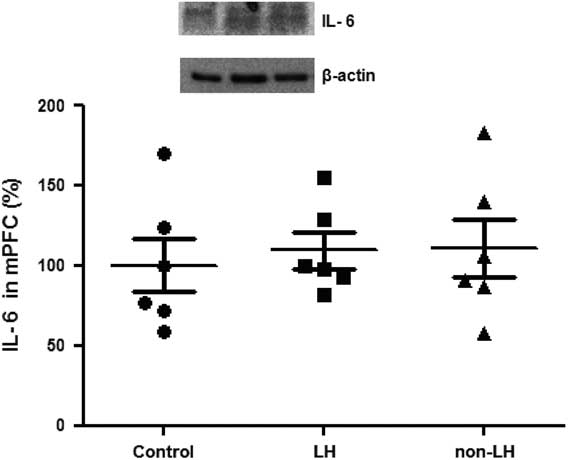
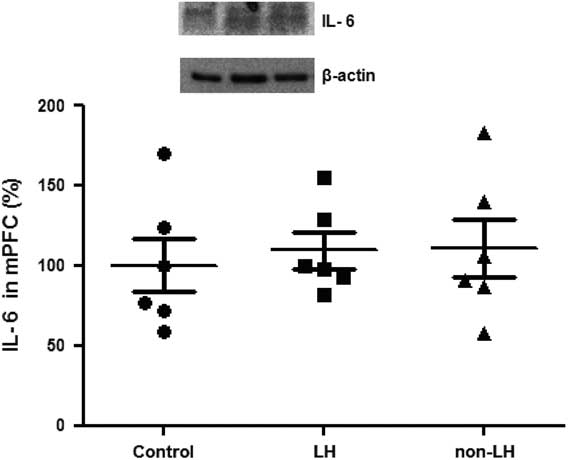
Next, we performed western blot analysis of IL-6 protein in the mPFC and nucleus accumbens. One-way ANOVA showed no significant change of IL-6 levels in the mPFC among the three groups [F(2,15)=0.469, p=0.635] (Fig. 2). Furthermore, there was no difference of IL-6 levels in the nucleus accumbens among the three groups as the band of IL-6 was very low (data not shown).
Levels of interleukin-6 (IL-6) in the medial prefrontal cortex (mPFC) of control, learned helplessness (LH), and non-LH groups. Levels of IL-6 in the mPFC from control (n=6), LH (n=6), and non-LH (n=6) groups were measured using western blot analysis. Data are shown as mean±SD.
Discussion
In this study, we found that serum IL-6 levels in the LH rats, but not non-LH rats, were significantly higher than those of control rats, whereas tissue levels of IL-6 in the mPFC were not different among three groups, suggesting that peripheral IL-6 may be a biomarker for stress resistance. These individual differences in the sensitivity of serum IL-6 occurred within genetically same strain (SD rats), indicating that epigenetic and environmental factors may contribute to stress resilience. Very recently, Hodes et al. (Reference Hodes, Pfau and Leboeuf12) reported that serum IL-6 was most highly up-regulated only in mice that ultimately developed a susceptible behavioural phenotype following a subsequent chronic stress, and that serum IL-6 levels remained elevated for at least 1 month. Furthermore, IL-6 levels strongly correlated with social interaction behaviour following repeated social defeat stress. Moreover, stress-susceptible bone marrow chimaeras exhibited increased social avoidance behaviour after exposure to either sub-threshold repeated social defeat stress or a purely emotional stressor termed witness defeat. Interestingly, IL-6(−/−) bone marrow chimaeric and IL-6(−/−) mice, as well as those treated with a systemic IL-6 monoclonal antibody, were resilient to social stress (Reference Hodes, Pfau and Leboeuf12). Thus, peripheral IL-6 response before social stress exposure can predict individual differences in vulnerability to a subsequent social stressor. Very recently, we also reported that serum IL-6 may be a predictive biomarker for ketamine’s antidepressant effect in treatment-resistant MDD patients (Reference Yang, Wang, Yang, Shi, Yu and Hashimoto13). In addition, Virtanen et al. (Reference Virtanen, Shipley and Batty14) reported that low IL-6 levels at baseline in participants with psychological distress were associated with symptoms resolution at follow-up, and that symptomatic participants with repeated low IL-6 were more likely to be symptom free at follow-up compared with those with repeated high IL-6, indicating that IL-6 may be a predictor of symptom resolution in psychological distress. Taken together, it is likely that blood IL-6 would be a peripheral biomarker for depression.
A recent study demonstrated that modulation of skeletal muscle condition through PGC-1α1 expression mediates resilience to stress-induced depressive behaviour, without the need to cross the blood–brain barrier (Reference Agudelo, Femenia and Orhan15). The importance of the enhanced peripheral kynurenine breakdown is shown by the fact that mck-PGC-1α1 mice are protected from developing depressive behaviour (Reference Agudelo, Femenia and Orhan15). Furthermore, peripheral conversion to kynurenine from tryptophan under pro-inflammatory and stress conditions is linked to neuroinflammation, and the pathway contributes to the pathogenesis of depression (Reference Schwarcz, Bruno, Muchowski and Wu16). In this study, we did not find alterations in the tissue levels of IL-6 in the brain of LH rats, suggesting that brain IL-6 may not be involved in the depression-like behaviour. Taken together, it is likely that peripheral inflammation may play a role in the pathogenesis of depression (17).
In conclusion, this study suggests that peripheral IL-6 may contribute to resilience versus susceptibility in rats subjected to inescapable electric shock. Furthermore, the novel therapy using IL-6 monoclonal antibody (e.g. tocilizumab) in MDD patients with high-blood IL-6 levels is of great interest as tocilizumab (ActemraⓇ, Roche Holding AG, Basel, Switzerland) has been used as treatment of patients with rheumatoid arthritis (Reference Hashimoto18).
Acknowledgements
Dr. Chun Yang thanks the Uehara Memorial Foundsation (Tokyo, Japan) for his stay in Japan. Authors’ contribution: C.Y. for substantial contributions to conception and design, acquisition of data, analysis and interpretation of the data, drafting the article, and final approval of the version to be published; Y.S., J.C.Z., and Q.R. for substantial contributions to conception and design, final approval of the version to be published; K.H. for substantial contributions to conception and design, acquisition of data, analysis and interpretation of the data, drafting the article, and final approval of the version to be published.
Financial Support
This study was supported by a Grant-in-Aid for Scientific Research on Innovative Areas of the Ministry of Education, Culture, Sports, Science and Technology, Japan (to K.H., #24116006). Dr. Chun Yang was supported by the Uehara Memorial Foundation (Tokyo, Japan).
Conflicts of Interest
Dr. Shirayama has received research support from Eli Lilly, Eisai, MSD, Otsuka, Pfizer, Taisho, Takeda, and Mitsubishi-Tanabe. Dr. Hashimoto has served as a scientific consultant to Astellas, Dainippon-Sumitomo, and Taisho, and he has also received research support from Abbvie, Dainippon-Sumitomo, Otsuka, and Taisho. The other author reports no potential conflicts of interest.
Ethical Standards
The experimental procedure was approved by the Animal Care and Use Committee of Chiba University. The authors assert that all procedures contributing to this work comply with the ethical standards of the relevant national and institutional guides on the care and use of laboratory animals.