Congenital heart diseases (CHDs) are the most common congenital anomalies worldwide and comprise a broad spectrum of malformations that arise during cardiac development. Reference Triedman and Newburger1 Although 20% of CHD incidence can be attributed to genetic syndromes, teratogens, or maternal diabetes, substantial uncertainty persists regarding risk factors for the remaining 80% of non-syndromic cases. Reference Blue, Kirk, Sholler, Harvey and Winlaw2
The genetic and epigenetic changes are being increasingly acknowledged as key factors in the development and progression of CHDs. Reference Vecoli, Pulignani, Foffa and Andreassi3 In particular, the posttranscriptional regulation of gene expression by miRNAs in the complex process of cardiogenesis may be crucial for CHD prevention. Reference Pulignani and Andreassi4 Nevertheless, profiling of specific miRNAs in human CHD poses some inherent challenges, due to the complex aetiology of disease and the high genetic heterogeneity between CHD patients. Reference Pulignani and Andreassi4
A novel approach has recently emerged from the study of genetic variants within miRNA-machinery genes, key factors involved in the biogenesis of miRNAs. Reference Borghini and Andreassi5 Such variants are likely to affect the maturation and function of miRNAs, possibly leading to the overall suppression of miRNA output with crucial effects in biological functions and disease risk. Reference Borghini and Andreassi5,Reference Cammaerts, Strazisar, De Rijk and Del Favero6
Recent studies have investigated the role of these single-nucleotide polymorphisms in the development and progression of different types of cancers Reference Guo, Shu, Zhou and Zhang7,Reference Ryan8 as well as their influence on the risk of stroke Reference Kim, Bae and Kim9 and coronary artery disease. Reference Borghini, Pulignani and Mercuri10 Conversely, the association between genetic variants in miRNA-machinery genes and CHD susceptibility has not been investigated yet.
Therefore, the purpose of this study was to investigate the individual impact of single-nucleotide polymorphisms in DICER (rs1057035), DROSHA (rs10719), and XPO5 (rs11077) and their combined effect in a genetic risk score on the risk of CHD.
Materials and methods
Study population
This study included a total of 125 patients (65 males; age 9.2 ± 10 years) with a diagnosis of isolated non-syndromic CHD and without a familial history, including ventricular septal defect, atrial septal defect, tetralogy of Fallot, patent ductus arteriosus, coarctation of the aorta, and transposition of great arteries. The diagnosis was confirmed by one or more of the following procedures: echocardiography, cardiac catheterization, and/or surgical intervention. Reference Pulignani, Vecoli, Borghini, Foffa, Ait-Alì and Andreassi11 A control group of 514 healthy controls (289 males; age 15.8 ± 18 years) without any congenital malformations was also enrolled. A sample of venous blood was collected from adult participants, whereas a cord blood sample was collected from newborns (both CHDs and controls). This study was conducted with an informed consent of every participant subject/parent and was approved by the local Ethical Research Committee.
Genotyping assays
Genomic DNA was extracted by using QIAamp DNA Blood Mini Kit (Qiagen) according to the manufacturer’s instructions. DNA concentration and quality were assessed by a NanoDrop Lite Spectrophotometer (Thermo Scientific, Waltham, USA), and an absorbance ratio at both 260 and 280 nm (A260/A280) greater than 1.6 was considered suitable for the subsequent analysis.
Allelic discriminations for the DICER rs1057035, DROSHA rs10719, and XPO5 rs11077 genetic variants were completed by quantitative real-time PCR on CFX RT-PCR System (Bio-Rad) TaqMan® SNP Genotyping assays (Applied Biosystems, USA). Negative and positive controls were included as a quality control measure. Genotyping results were analysed by allelic discrimination assay of the CFX Manager® software (Bio-Rad).
Statistical analysis
Statistical analysis of the data was conducted with the StatView statistical package, version 5.0.1 (Abacus Concepts, Berkeley, CA, USA). Values are presented as mean ± standard deviation (SD) or percent. Comparisons of normally distributed variables between groups were performed by using unpaired t-tests. Chi-square test was used to test for deviation from Hardy–Weinberg equilibrium and to compare allelic and genotypic frequencies between groups. The most significant test among the different genetic models (codominant, dominant, and recessive) was used to determine the statistical significance of each single-nucleotide polymorphism. Multivariate logistic regression analysis was used to estimate odds ratios (ORs) and 95% confidence intervals (CIs) for the association of the polymorphisms in microRNA-machinery genes and CHD risk.
High-risk alleles were used to generate a genetic risk score using an unweighted approach. Genetic risk score was calculated by the following method: the genotypes were coded as 0 for both homozygous for low-risk allele and heterozygous, and as 1 for homozygous for the high-risk allele. A summation term was then created by adding the risk allele count for each participant. The genetic risk score was modelled as a continuous variable and divided into three groups. Values of p < 0.05 were considered statistically significant.
Results
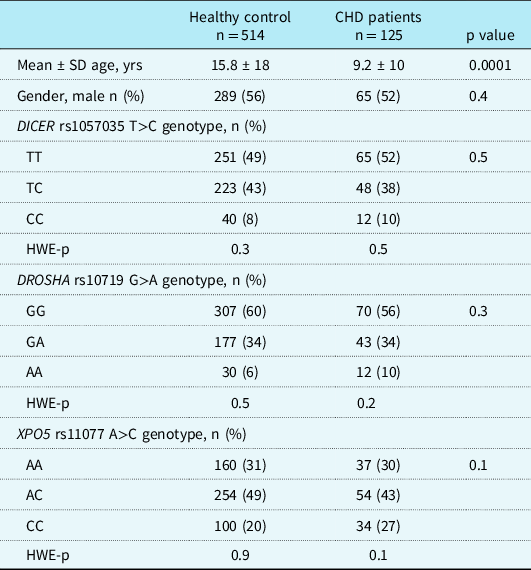
Demographic and genetic characteristics of the study participants are summarised in Table 1. There was no statistically significant difference between cases and controls in terms of gender (p = 0.4), whereas a significant difference was found for age (p = 0.0001).
Demographic and genetic characteristics between healthy controls and CHD patients

HWE: Hardy–Weinberg equilibrium
Minor allele frequencies (MAF) of DICER rs1057035, DROSHA rs10719, and XPO5 rs11077 were comparable with MAF reported in the public database for European population (i.e., Ensembl Genome Browser). The observed genotype frequency of the three single-nucleotide polymorphisms in both groups was in agreement with that expected under the Hardy–Weinberg equilibrium (p > 0.05; Table 1). No difference was observed in the distribution of genotypes between CHD patients and controls.
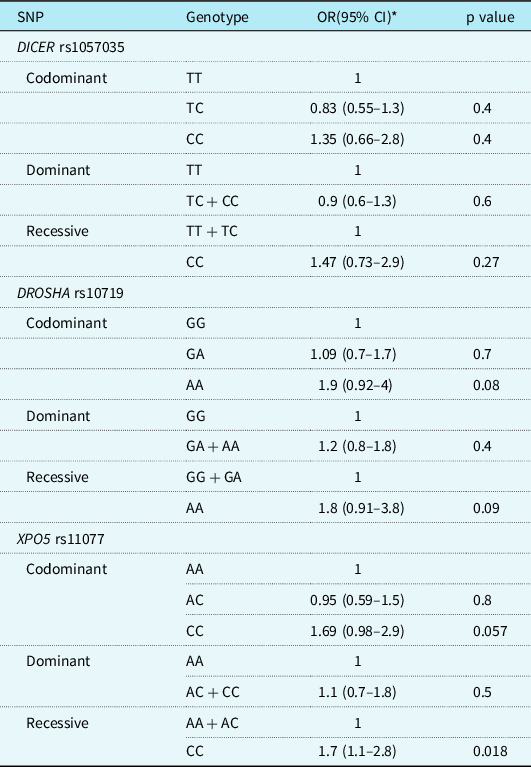
Table 2 summarises the associations of the three single-nucleotide polymorphisms in miRNA-machinery genes and CHD susceptibility under different genetic models. After adjustment for age and gender, the XPO5 rs11077CC genotype was significantly associated with increased risk for CHD (ORadjusted = 1.7; 95% CI: 1.1–2.8; p = 0.018) in the recessive model. A tendency towards increased risk was observed in carriers of XPO5 rs11077 CC genotype as compared to AC heterozygote and AA homozygotes (ORadjusted = 1.69; 95% CI: 0.98–2.9; p = 0.057).
Association of DICER, DROSHA and XPO5 polymorphisms and CHD susceptibility under different genetic models

* Adjusted for age and gender
Although not statistically significant, a trend close to significance was also found for DROSHA rs10719 AA genotype and CHD risk in both codominant (ORadjusted = 1.9; 95% CI: 0.92–4; p = 0.08) and recessive models (ORadjusted = 1.8; 95% CI: 0.91–3.8; p = 0.09).
The integrated effect of the three single-nucleotide polymorphisms was further evaluated by calculating a genetic risk score representing the sum of the high-risk alleles for each variant, which resulted in a score ranging from 0 to 2. The resulting genetic risk score was significantly associated with CHD susceptibility, with each allele associated with a 1.73 (95% CI: 1.2–2.5; p = 0.002).
Splitting the risk score in tertiles (I tertile with a score of 0; II tertile with a score of 1; III tertile with a score of 2), subjects in the top tertile of genetic risk score were estimated to have more than three-fold increased risk of CHD compared with those in the bottom tertile (ORadjusted = 3.5; 95% CI: 1.4–9; p = 0.009). Patients in the second tertile of the genetic risk score had a 1.62-fold increased risk compared with those in the I tertile (ORadjusted = 1.62; 95% CI: 1.05–2.5; p = 0.03).
Discussion
The present study is the first to investigate the impact of genetic variants in miRNA-machinery genes on CHD susceptibility. Our findings demonstrated that the XPO5 rs11077 CC genotype was significantly associated with an increased CHD risk. A clear tendency was also found for DROSHA rs10719 AA genotype, although the association did not reach statistical significance. Interestingly, the analysis of the joint effect of single-nucleotide polymorphisms in miRNA-machinery genes showed that higher scores were associated with increased risk of CHD, supporting the utility of a genetic risk score to provide a stronger predictive value than any single variant.
Accumulating evidence has revealed the highly complicated regulatory networks governing heart development, underscoring the importance of genetic and epigenetic factors in CHD development. Although various forms of CHD have been associated with altered expression of miRNAs, their causal role in the pathogenesis of CHD remains to be elucidated. Reference Pulignani and Andreassi4
Our analysis focused on potentially functional single-nucleotide polymorphisms located in genes involved in the biogenesis and processing of miRNAs. In general, miRNAs are formed in a multi-step biological process involving proteins and protein complexes, including DICER, DROSHA, and XPO5. Reference Bartel12 The presence of polymorphic variants in the core components of miRNA-machinery genes may impair or enhance miRNA processing efficiency or function, resulting in altered levels of mature miRNAs with potential deleterious effects. Reference Borghini and Andreassi5,Reference Cammaerts, Strazisar, De Rijk and Del Favero6
XPO5 is a protein responsible for the transport of pre-miRNAs between the nucleus and cytoplasm. The overexpression of XPO5 results in enhanced miRNA activity, Reference Yi, Doehle, Qin, Macara and Cullen13 whereas the loss of XPO5 leads to reduced expression and function of pre-miRNAs. Reference Zeng and Cullen14
Among the genetic variants in XPO5, rs11077 has received the most attention. Located in the 3’-UTR, the A > C substitution may modify the expression of XPO5 and, consequently, alter the expression of miRNAs. Reference Guo, Shu, Zhou and Zhang7,Reference Shao, Shen, Zhao, Guo, Niu and Liu15 The rs11077 C allele has been associated with an increased risk of developing cancer Reference Shao, Shen, Zhao, Guo, Niu and Liu15 and venous thromboembolism, Reference Ko, Kim and Kim16 but it also appears to decrease the risk of coronary artery disease. Reference Borghini, Pulignani and Mercuri10
To our knowledge, no previous studies associating these specific single-nucleotide polymorphisms with CHD are available. In our work, this polymorphic variant resulted associated with an increased risk of disease revealing a potential role of XPO5 miRNA-machinery gene in CHD susceptibility. An increased risk of disease was also found for the DROSHA rs10719 AA genotype, although the results did not reach statistical significance.
DROSHA is an RNAse III enzyme, which mediates the processing of pri-miRNAs into pre-miRNAs inside the nucleus. In a previous in vitro functional investigation, a reduction in miRNA processing efficacy induced by the knockdown of DROSHA was found to reduce the levels of mature forms of tumour-suppressive miRNAs. Reference Noh, Hong, Dong, Pan, Jing and Huang17 In addition, the loss of DROSHA leads to vascular smooth muscle cells disorder followed by hypoplastic blood vessel walls, cardiomyopathy, and embryonic lethality in mice. Reference Fan, Chen and Tian18
The 3′-UTR rs10719 polymorphism alters DROSHA expression levels. Reference Saeki, Watanabe and Inoue19 It has been associated with different kinds of cancers Reference Wen, Lv, Ding, Fang and Sun20 as well as recurrent implantation failure. Reference Lee, Ryu and Kim21 Interestingly, these single-nucleotide polymorphisms may affect the risk of non-syndromic orofacial clefts which represent major craniofacial congenital abnormalities characterised by unsuccessful fusion of normal facial processes. Reference Xu, Ma and Lou22
Previous studies have already proven the important role of DICER in the craniofacial development. Reference Barritt, Miller and Scheetz23 DICER is essential for the survival of the tissues derived from neural crest cells which exerts an essential influence on the formation of a majority of embryo tissues, including craniomaxillofacial structures. Reference Zehir, Hua, Maska, Morikawa and Cserjesi24
Deletion of cardiac DICER also results in defective heart morphogenesis and embryonic lethality. Reference Zhao, Ransom and Li25 Cardiac outflow defects were observed in mice with a conditional knockout of the DICER gene in the developing heart. In particular, embryos lacking DICER displayed a highly penetrant phenotype of double outlet right ventricle with a concurrent ventricular septal defect. Reference Saxena and Tabin26 Nevertheless, the analysis of DICER mutations in sporadic and familial cases did not appear to play a major role in the transposition of the great arteries. Reference Sabbaghian, Digilio, Blue, Revil, Winlaw and Foulkes27
DICER is an enzyme responsible for the cleavage of pre-miRNAs into their mature form. The rs1057035 T>C polymorphism is located within 3′-UTR and the C allele may lead to reduced expression levels of the enzyme as compared to the T allele. Reference Ma, Yuan and Yuan28
To date, conflicting results remain about the association between DICER rs1057035 and cancer risk in Caucasian populations, Reference Yu, Kuang and Yin29 whereas it seems to be involved in coronary artery disease. Reference Borghini and Andreassi5 In our study, no significant association was observed between this genetic variant and CHD susceptibility.
To overcome the limited effects of individual risk variants, we further constructed a genetic risk score by summing the risk alleles of the selected variants present in each study participant. The genetic risk score approach allows combining multiple loci with low-modest effects into a global risk score facilitating the identification of high-risk patients.
Interestingly, in the analysis of the combined effects of single-nucleotide polymorphisms in miRNA-machinery genes, the resultant genetic risk score predicted a 1.73 risk for CHD per risk allele. In addition, individuals in the top tertile score had a three-fold higher CHD risk, thus supporting the utility of the genetic risk score approach to increase understanding of the genetic basis of CHD.
The results of this case–control study should be approached and interpreted bearing in mind some limitations. Firstly, the number of enrolled patients and controls is limited. This does not allow to focus on the impact of the single-nucleotide polymorphisms on different types of CHD. Secondly, the study did not evaluate the relationship between other genetic variants in miRNA-machinery genes and CHD risk. Finally, the molecular mechanisms underlying the impact of these polymorphisms in CHD have not been investigated.
In conclusion, this study is the first to identify an association between the 3′-UTR XPO5 rs11077 polymorphism and CHD susceptibility. Additionally, our findings indicate that the combined analysis of single-nucleotide polymorphisms in miRNA-machinery genes might participate in the development of CHD.
Further studies are necessary to validate our results in larger populations and other ethnic groups. Experimental studies should also be conducted to understand the biological relevance of DICER rs1057035, DROSHA rs10719, and XPO5 rs11077 polymorphisms in the pathogenesis of cardiac defects. The characterization of these variants and the identification of their functional impact may provide a good starting point for the development of individually tailored miRNA-based therapy. Therapeutic modulation of miRNA expression during cardiac malformations by either inhibition by anti-miRNAs or overexpression by miRNA-mimics may represent a promising approach to enhance clinical outcomes in CHD patients.
Acknowledgements
We thank all the individuals who participated in this study. We are very grateful to all clinical staff of the Pediatric Cardiology (Fondazione Toscana “G. Monasterio”, Massa, Italy) and of Maternity and Pediatric Units (ASL 01, Massa and Carrara, Italy) for kindly support and assistance.
Financial support
This research received no specific grant from any funding agency, commercial or not-for-profit sectors.
Conflicts of interest
None.
Ethical standards
The authors assert that all procedures contributing to this work comply with the ethical standards of the relevant national guidelines on human experimentation and with the Helsinki Declaration of 1975, as revised in 2008, and has been approved by the local Ethical Research Committee