


In 2018, National Security Advisor John Bolton gave a major speech on America’s efforts to combat an adversary that was “outright dangerous” to “US national security interests” (Bolton Reference Bolton2018). Secretary of State Mike Pompeo similarly warned about “the threat” this antagonist posed to American security (Noack Reference Noack2019). President Donald Trump even imposed sanctions designed to cripple this troublesome foe.
Who is this allegedly grave threat to American interests? Is it a geopolitical rival such as Russia or China? A rogue state like North Korea? A terrorist group? Perhaps surprisingly, it is a handful of judges and prosecutors on the other side of the world: the International Criminal Court (ICC).
Based in The Hague, the ICC is the first permanent international tribunal with broad jurisdiction over atrocity crimes. One concern has formed the backbone of US opposition to the Court since its founding: the ICC might initiate biased investigations that target members of the American military scattered across the globe. Many view the ICC’s recent decision to open an investigation into possible war crimes in Afghanistan—an investigation that puts American troops, among other actors, under the Court’s microscope—as proof that the ICC is politically motivated to target the US military. As Secretary Pompeo put it, “Our fears were warranted” (Noack Reference Noack2019).
But are these fears really warranted? Are ICC investigations biased against the American military? Answering this question by examining only investigations (e.g., Afghanistan) is problematic because it samples on the dependent variable. We now have two decades of data on the situations the ICC decided to investigate and—equally important—the situations the ICC decided not to investigate.
In this article, I test a primary observable implication of the ICC bias argument: are ICC investigations disproportionately likely in situations involving the American military? I start with a global sample of civilian killings that approximates the universe of situations the ICC might plausibly investigate. I then use data on the locations of all US foreign military installations to examine how the presence of American troops in a country affects the likelihood of the ICC launching an investigation. Contrary to the common narrative, the estimated effects of US military installations are statistically indistinguishable from zero and substantively negligible. Simply put, there is no evidence that ICC investigations target (or avoid) America’s military.
This article joins a growing body of political science research on the ICC. Existing work compellingly examines public opinion toward the ICC (Chapman and Chaudoin Reference Chapman and Chaudoin2020; Dancy et al. Reference Dancy, Dutton, Alleblas and Aloyo2020; Zvobgo Reference Zvobgo2019), state support for the ICC in the shadow of American antipathy (Kelley Reference Kelley2007; Nooruddin and Payton Reference Nooruddin and Payton2010), patterns of ICC ratification (Chapman and Chaudoin Reference Chapman and Chaudoin2013; Simmons and Danner Reference Simmons and Danner2010), and the ICC’s effects on political violence (Hillebrecht Reference Hillebrecht2016; Jo and Simmons Reference Jo and Simmons2016; Krcmaric Reference Krcmaric2018; Reference Krcmaric2020; Nalepa and Powell Reference Nalepa and Powell2016; Prorok Reference Prorok2017). But less is known about a different question: which situations of violence does the ICC investigate in the first place?Footnote 1 The answer, I explain, raises important policy implications and calls into question America’s approach to the ICC.
America and the ICC
Established by the Rome Statute in 1998, the ICC began operating in 2002 after 60 states ratified its founding treaty. There currently are 123 ICC state parties. The US is not one of them. In fact, the US was one of only seven states to vote against establishing the Court after negotiations in Rome. The ICC can prosecute individuals for three atrocity crimes: genocide, war crimes, and crimes against humanity. The ICC automatically has jurisdiction over crimes committed on the territory of a state party or if the accused is a national of a state party. Beyond its standard jurisdiction, the United Nations Security Council (UNSC) can refer situations to the Court, giving it potentially global reach. Though the ICC ultimately prosecutes specific individuals, it first opens investigations of overall “situations” (typically large-scale violence within one country’s borders).
American opposition to the ICC stems from two of its institutional features (Amann and Sellers Reference Amann and Sellers2002; Goldsmith Reference Goldsmith2003; Schabas Reference Schabas2004; Scheffer Reference Scheffer2012). First, the Court has automatic jurisdiction over all individuals—including those from the US and other states that never joined the ICC—when they are on the territory of an ICC member.Footnote 2 This form of territorial liability creates a special challenge for the US because it has hundreds of thousands of troops stationed around the world. Given America’s global military presence, its troops are uniquely exposed to ICC investigations. Congress was worried enough about this exposure that a bipartisan majority passed the American Servicemembers Protection Act in 2002. Dubbed the “Hague Invasion Act,” this legislation authorized the president to use any means necessary to liberate members of the military detained or imprisoned by the ICC.
Second, the ICC has an independent prosecutor who can select her own situations to investigate.Footnote 3 Given this discretion, US policymakers have long alleged that the prosecutor would inject anti-American biases into investigations (e.g., Bolton Reference Bolton2001) and turn the ICC into “an instrument of political warfare” (Kissinger Reference Kissinger2001, 94). Even if American soldiers never end up in the dock at The Hague, a biased ICC could still jeopardize American interests by putting its military under the microscope of a high-profile investigation (Goldsmith Reference Goldsmith2003, 97). This concern was the basis of US Ambassador to the United Nations Bill Richardson’s lament at the Rome Conference: “Soldiers deployed far from home need to do their jobs without exposure to politicized proceedings” (Stanley Reference Stanley1998). Thus, even if American troops simply do their jobs—and presumably refrain from committing atrocity crimes—US policymakers worry that they still might get dragged into politicized ICC investigations.
Overall, the hostile American reaction to the ICC is based on the premise that the ICC may launch politically motivated investigations that ensnare US troops deployed abroad. This is a testable hypothesis. If the ICC is biased in the way many US policymakers suggest, ICC investigations should be more likely in countries where American troops are present.
However, it is possible that ICC bias goes the other way. In contrast to policymakers who suspect anti-US bias, some scholars anticipate pro-US bias because the ICC has political reasons to avoid getting entangled with the American military (e.g., Bosco Reference Bosco2014; Rudolph Reference Rudolph2017). After all, the Court depends on powerful states for funding, intelligence sharing, cooperation at the UNSC, and the enforcement of its arrest warrants. Rather than alienate the US, the ICC might try to win over the world’s superpower to its cause by avoiding investigations that threaten American interests.Footnote 4 If this alternative view is correct, ICC investigations should be less likely in countries where American troops are present.
Research Design
Sample of Cases
Examining only situations where the ICC opens investigations is an indeterminate research design. A systematic analysis must also include noninvestigations. That is, the sample must include situations where investigations were possible even if they ultimately did not occur.
In theory, identifying the universe of cases is straightforward: the ICC might plausibly investigate any situation involving genocide, war crimes, and crimes against humanity. In practice, however, identifying clear-cut cases of these crimes is difficult because their legal definitions are fiercely contested (e.g., Goldsmith Reference Goldsmith2003; Hathaway et al. Reference Hathaway, Stauch, Walton and Weinberg2019).Footnote 5 Given this, I use a more objective indicator to identify situations the ICC might investigate: the killing of civilians. This is an appropriate indicator for two reasons. First, the killing of a substantial number of noncombatants allows the ICC to make a strong case that at least one of the three atrocity crimes occurred. Second, the ICC openly acknowledges using data on civilian killings when selecting investigations. Although many factors are relevant, the “most obvious of these is the number of persons killed” (Moreno-Ocampo Reference Moreno-Ocampo2005, 6).
To identify civilian killings, I examine cases of “one-sided violence” in the UCDP georeferenced event dataset (Sundberg and Melander Reference Sundberg and Melander2013). A one-sided violence event occurs whenever an organized political actor directly and deliberately kills at least 25 civilians in a given year (Eck and Hultman Reference Eck and Hultman2007). For my purposes, the UCDP dataset has three advantages over alternative datasets.Footnote 6 First, it includes both state and rebel violence against civilians, making it possible to capture the universe of cases the ICC might investigate. Datasets that focus on only one actor (e.g., state-sponsored violence) risk missing situations where the ICC could open investigations. Second, it is georeferenced, allowing me to match the location of violent events with ICC investigations and US deployments. Third, it codes the precise number of civilians killed instead of only a dummy variable for a civilian killing event. Although one can fairly quibble with the threshold of 25 deaths (or any other number) needed to qualify as a one-sided violence event, the precise death tolls make it possible to control for the gravity of violence in each case. This allows me to differentiate between cases that barely met the threshold and those that greatly exceeded it.
The unit of analysis is the country year. The study window begins in 2002, the first year of the ICC’s temporal jurisdiction. A country enters my sample after its first instance of one-sided violence, putting it at risk of an ICC investigation. The country exits my sample if and when the ICC opens an investigation (observations are right censored after 2020). Note that I include all countries with one-sided violence, not just those that ratified the ICC’s Rome Statute. Including nonratifiers is important because the ICC can and does investigate violence in countries that are not ICC state parties. In total, 59 different countries appear in my sample.Footnote 7
ICC Investigations
The dependent variable is the onset of an ICC investigation.Footnote 8 To date, the ICC has opened 17 investigations: Uganda, Democratic Republic of the Congo, Sudan, Central African Republic, Kenya, Libya, Ivory Coast, Mali, Central African Republic II, Georgia, Burundi, Myanmar, Afghanistan, Palestine, the Philippines, Venezuela, and Ukraine. Given the rarity of investigations, I confirm rare events bias does not drive the results (see Appendix).
US Military Presence
To determine whether the US has a military presence in each country, I use Vine’s (Reference Vine2019) dataset that tracks the location of every known American military installation around the world. It includes both bases (larger, more permanent installations that often resemble cities) and lily pads (smaller, more temporary installations that house limited numbers of forces). Importantly, Vine’s dataset draws on government and nongovernment sources, which is preferable to relying exclusively on the Department of Defense’s notoriously incomplete reporting on its foreign military facilities.Footnote 9 Using Vine’s dataset, I create a dummy variable that equals 1 for countries that have a US military installation on their territory.
Covariates
One group of covariates captures legal factors. To start, I control for whether a country has ratified the ICC’s Rome Statute. As mentioned earlier, the ICC has investigated crimes committed on the territory of nonstate parties, but investigations may be more likely when the ICC automatically has jurisdiction. I also account for two legal principles—gravity and complementarity—that guide the ICC’s selection of investigations. The gravity principle holds that the ICC should prioritize investigating the worst abuses, so I control for the cumulative number of civilians killed in one-sided violence on a country’s territory since 2002 (Sundberg and Melander Reference Sundberg and Melander2013). The complementarity principle holds that the ICC is a “court of last resort” that should only get involved when national courts do not make a genuine effort to address crimes committed on their territory. To proxy the quality of national legal systems, I include a rule of law index (Coppedge et al. Reference Coppedge, Gerring, Knutsen, Lindberg, Teorell, Altman and Bernhard2021).
Another group of covariates captures political factors that might shape investigations. Because the ICC is sometimes accused of having an anti-Africa bias (e.g., Smeulers, Weerdesteijn, and Hola Reference Smeulers, Weerdesteijn and Hola2015), I include a dummy variable for countries in Africa. Given that the permanent five members of the UNSC can shield their allies from some ICC investigations by vetoing referrals, I add a dummy variable for states that have an alliance with any “P5” member (Gibler Reference Gibler2009). To proxy the difficulty of investigating American troops, I control for states that signed “Article 98 agreements” with the US promising not to cooperate with the ICC in situations involving Americans. Last, as some US presidents have been more combative toward the ICC than others, I account for each president’s tenure.
Results
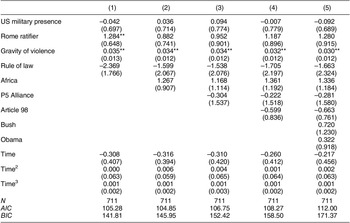
I estimate discrete duration models that use logistic regression and include cubic time polynomials that measure how long each country has been at risk of an ICC investigation. I start with a simple model that includes only variables for America’s military presence, ratification of the Rome Statute, and the proxies for gravity and complementarity. I then add the political covariates individually. Across all five models in Table 1, the results are consistent: the relationship between ICC investigations and the presence of American troops in a country is statistically insignificant. In fact, the p-value for the US military presence variable is never less than 0.89. Rather than target the US, all five models indicate the ICC is following its mandate to investigate the world’s gravest abuses.
Correlates of ICC Investigations

Note: The dependent variable is ICC investigation onset. Standard errors clustered by country are in parentheses. *p < 0.10, **p < 0.05 (two-tailed).
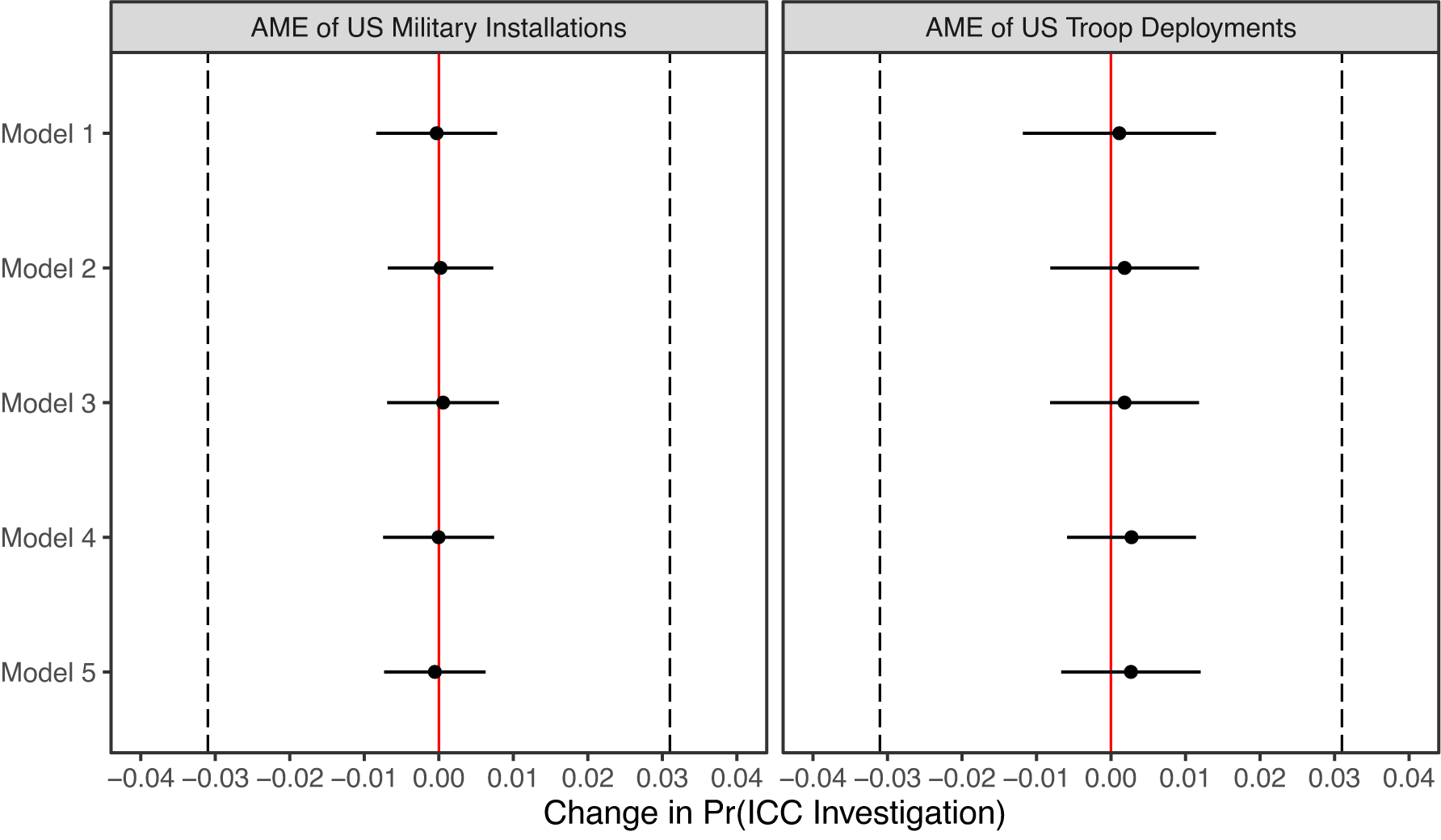
The regressions are consistent with a finding of “no effect” for American troops, but they do not necessarily mean the data are inconsistent with meaningful effects. As research on negligible effects and equivalence testing illustrates, a large confidence interval can include both negligible and meaningful effects. Therefore, I follow Rainey’s (Reference Rainey2014) approach that calls for explicitly defining what counts as the smallest substantively meaningful effect (or, m). Only if the estimated substantive effect and its 90% confidence interval fall entirely within the range of -m to m can one conclude that a variable’s effect is negligible.Footnote 10
The challenge, of course, is defining an appropriate value for m. Following Rainey’s (Reference Rainey2014) suggestion for research agendas that lack consensus on “meaningful” effect sizes, I let the data speak for itself. Specifically, I define m as 3.1 percentage points, which is the predicted change in the probability of an ICC investigation when the cumulative number of civilian deaths increases from 500 to 5,000.Footnote 11 By the unfortunate standards of atrocity crimes, this represents a moderate increase in the death toll.Footnote 12 Using this value as m, I conclude that an effect is negligible only if its entire confidence interval falls between -3.1 and 3.1 percentage points. If any part of the confidence interval exceeds this range, I cannot rule out meaningful effects.
The left panel of Figure 1 reports the average marginal effect of American military installations on ICC investigations using the five models reported in Table 1. In every case, the estimated effect is virtually zero and the confidence interval falls entirely within the negligible effects range (the dashed lines). This means that effect sizes larger than 3.1 percentage points are implausible. In fact, the results are estimated precisely enough to rule out effect sizes larger than just 1 percentage point. As a robustness check, the right panel shows the average marginal effects for the same five models using an alternative definition of US military presence (see Appendix for underlying regression results). Specifically, I create a variable capturing whether any active-duty American troops are deployed to a country using Allen, Flynn, and Machain’s (Reference Allen, Flynn and Machain2022) deployments dataset. Once again, every confidence interval crosses zero and falls completely within the negligible effects range. Simply put, the effect of American servicemembers on ICC investigations is either nonexistent or very small.
The Negligible Effects of American Troop Presence on ICC Investigations

Conclusions
I find no evidence to corroborate allegations that the ICC launches biased investigations that target American soldiers around the world. Specifically, the ICC is no more or less likely to investigate situations where the US military is present. These null results are precisely estimated, substantively negligible, and robust to multiple measures of US military presence.
However, my results do not necessarily imply that the ICC is free from all political biases. Future work could explore possible bias after investigations are opened. The ICC has thus far never issued an arrest warrant for an American, a point that casts further doubt on claims of anti-American bias.Footnote 13 Scholars should also continue questioning potential ICC bias vis-à-vis other actors. Whereas I focused on the US–ICC relationship, others assert that the ICC may be biased toward the global south, especially Africa.Footnote 14 Thus, there remains much work to do on how the ICC selects situations to investigate and individuals to prosecute.
In terms of broader implications, policymakers, activists, and academics all agree on one thing: the ICC cannot live up to its lofty goal of ending impunity without American support. Because the ICC relies on states to provide enforcement, the antagonistic relationship between the world’s superpower and the ICC limits the Court’s ability to get wanted criminals in the dock. As one judge put it, “This court needs some American muscle” (Simons Reference Simons2013). Some even worry that without American backing, the ICC may “follow its spiritual cousins, the League of Nations and the Kellogg–Briand Pact, to the grave” (Goldsmith Reference Goldsmith2003, 104).
My paper addresses this debate by questioning the basis for America’s wariness of the ICC. The critique—now two decades old—that the ICC would inject anti-American biases into its investigations has not come to pass.Footnote 15 That said, US policy toward the ICC will not shift easily. Some hardliners oppose the Court simply because it could target Americans. Given their insistence that the ICC should never be able to exercise jurisdiction over US personnel, documenting the absence of ICC bias to date will not sway this group. But for many others, the ICC’s track record matters. Even the Bush administration—infamous for its hostile initial approach to the Court—later softened its stance because, as one official admitted, the ICC “had not actually done anything threatening to us” (Bosco Reference Bosco2014, 112).
Looking ahead, there is reason for cautious optimism about US–ICC relations. During ICC negotiations in Rome, American diplomat David Scheffer (Reference Scheffer2012, 192) noted that the US position always “turned on the fear of the prosecution of American soldiers [without] considering the larger picture of ending atrocity crimes.” But ICC advocates in the US can now point to the Court’s track record, including the evidence documented here. Moreover, US public opinion about the ICC continues to improve, especially when American engagement with the Court is framed as a human rights issue (Zvobgo Reference Zvobgo2019). In the post-Trump years, the US has an opportunity to reassess its relationship with the ICC by balancing the small risk to American soldiers deployed abroad with other priorities such as ending impunity.
Supplementary Materials
To view supplementary material for this article, please visit http://doi.org/10.1017/S0003055422000478.
Data Availability Statement
Research documentation and data that support the findings of this study are openly available at the American Political Science Review Dataverse: https://doi.org/10.7910/DVN/HHNZGT.
Acknowledgments
For helpful feedback, I thank Andrew Bell, Thomas Gift, the excellent anonymous reviewers, and the APSR editors.
Conflict of Interest
The author declares no ethical issues or conflicts of interest in this research.
Ethical Standards
The author affirms this research did not involve human subjects.




Comments
No Comments have been published for this article.