Green parties are identified with support for a particular collection of political values,Footnote 1 prominent among which is decentralization. Green advocacy of decentralization is founded on deep mistrust of elites and hierarchies and derives from the belief that decision-making should be devolved to those most proximate to the site of problems. The solution to ecological and political malaise is argued to lie, in part, in empowering individuals to participate in ‘directing technological and economic development’ and in radically extending democratic participation to smaller decision-making units (Radcliffe Reference Radcliffe2000: 21; see also Dobson Reference Dobson2007; Porritt Reference Porritt1984: 164–8).
The principle of decentralization is strongly expressed in the organizational structures that have been adopted by green parties. While green parties diverge in aspects of their organizational format (see the edited collection by Frankland et al. Reference Frankland, Lucardie and Rihoux2008), they share a preference for arrangements that are highly participatory and minimally hierarchical, and which privilege lower units of the organization over executive bodies and party elites.Footnote 2 These flattened organizational structures have typically been partnered with other power-dispersing devices, such as rotation of offices, strict separation of parliamentary and party functions, binding mandates on elected members, consensus as the basis for decision-making, open access to party meetings and collective forms of leadership (Burchell Reference Burchell2001; Poguntke Reference Poguntke1993; Rihoux Reference Rihoux2006).
Support for the principle of decentralization can acquire an added dimension for green parties competing in federations and multilevel settings. It is argued that the power-dispersing properties of formally decentralized polities discourage strong centralized party structures, resulting instead in either multilevel structures or territorially based parties (Chandler Reference Chandler1987; Panebianco Reference Panebianco1988; Riker Reference Riker1964). In this respect, the principles of decentralization and subsidiarity that are characteristic of federal systems are values that are promoted by green parties.
In theory at least, the philosophical commitment to decentralization should provide a robust foundation for the maintenance of a multilevelFootnote 3 structure if such an arrangement has been established, regardless of any latent centralizing pressures generated within the particular polity. There is support in the scholarship for the view that green parties might be more resistant than other party types to centralization in all its manifestations (Koelble Reference Koelble1989; Rohrschneider Reference Rohrschneider1994). Certainly, the evidence suggests that although green parties have modernized their party structures, they have been reluctant to abandon all of those features that weaken core organizational values (Burchell Reference Burchell2001: 132; Rihoux and Frankland Reference Frankland2008: 266–71).
However, we know little about the multilevel party arrangements that have been adopted by green parties and how these structures have fared over time. The organizational dimension of green parties has been the subject of extensive treatment in the literature (Burchell Reference Burchell2001; Lucardie and Rihoux Reference Lucardie and Rihoux2008; Poguntke Reference Poguntke1993; Richardson and Rootes Reference Richardson and Rootes1995), although many of the analyses have focused on the power dynamics between different organizational units rather than across organizational levels of green parties. Understanding how green parties have operationalized confederal or federal principles in organizational terms and whether they have been able to maintain these arrangements over time is important because it is applicable to broader debates about organizational change within green parties. More particularly, it offers an alternative avenue to assess the professionalization of green parties, which has been almost exclusively evaluated through a consideration of changes to their broadly amateur-activistFootnote 4 traits. By exploring the power relationship between the national and sub-national structures, we are able to consider the interplay between green parties’ philosophical values and electoral imperatives, and their effect on its organizational arrangements over time.
This article investigates the evolutionary trajectory of a devolved organizational arrangement in green parties using an Australian case study. The explanatory robustness of a single-party case study is limited, but such an approach does have certain strengths. It allows for a more nuanced exploration of the relationship between normative organizational values and the institutional setting. The Australian Greens (Greens) was selected as the focus of this study for three key reasons. First, the Greens has what might be regarded as an archetypal federal structure. The party is composed of eight formally autonomous state divisions, representing every state and territory in Australia, and a fairly weak national apparatus in formal terms. This arrangement is cemented in the party’s national constitution. Second, the Greens’ success both in electoral and representational terms, and its longevity, enhances its suitability for this study. The Greens has existed for more than two decades, having formed in 1992.Footnote 5 Since 1996, it has maintained uninterrupted representation in the powerful Senate (upper chamber) and has held the balance of power, whether in its own right or shared with other parties and independent senators, continuously since 2007. Third, the Australian setting serves as a useful site in which to explore questions about the organizational development of green parties in formally devolved polities. The Australian federal system possesses a potent mixture of centralizing and decentralizing imperatives. The dual design of the system, along with the entrenched structural basis of the federation, has generated a strong bias towards confederal party formats (Holmes and Sharman Reference Holmes and Sharman1977: 105–11; Miragliotta Reference Miragliotta2012a, Reference Miragliotta2012b; Rydon, Reference Rydon1988; Sharman Reference Sharman1994). At the same time, the homogeneous nature of the Australian population, combined with the parliamentary system of government, produces equally powerful centralizing pressures within Australian parties (Epstein Reference Epstein1982; Holmes and Sharman Reference Holmes and Sharman1977: 104).
Organizational centralization within the Greens is evaluated by tracking changes in the locus of decision-making between the sub-national and national levels of the party organization. This is done in the first instance by assessing the formal level of interaction between the national and state party organizations, or vertical integration (Huckshorn et al. Reference Huckshorn, Gibson, Cotter and Bibby1986: 978). While vertical integration is used principally to indicate the extent to which two levels of a party organization are enmeshed (Thorlakson Reference Thorlakson2009: 160–1), it does provide a framework for exploring progress towards (or against) the growth and consolidation of the national layer of the Greens’ party organization. Thorlakson’s twin measures (2009: 162–3) of ‘influence’ (the degree to which the state organizations enjoy substantive representation on key national structures) and ‘autonomy’ (the extent to which the state organizations have scope for independent action and freedom) and corresponding indicators are used in order to help identify which level of the party organization holds the preponderance of power in formal terms (see too Fabre Reference Fabre2011: 348–50). The analysis is extended further by investigating the dynamic interaction between these indicators, as well as other critical features of the party’s organizational order that have the potential to modify the relationship between the state and national levels of the party organization. Especially in the context of devolved parties which institutionalize the regional ‘voice’ within the organization, there is likely to be a higher incidence of contestation over the meaning and application of formal rules. For this reason, authority patterns within the organization are unlikely to be located exclusively in the formal rules but also in the informal norms and structures (van Houten Reference van Houten2009: 147; Moon and Bratberg Reference Moon and Bratberg2010: 55).
This article draws principally on documentary texts sourced from the archives of the Greens as well as party statutes and bylaws to explore whether the party’s ideological temperament is sufficient to militate against expansion in the power of the national stratum of the party organization. It is argued that growth in the size of the party’s federal parliamentary wing, and the concomitant increase in resources, have served to enhance the operational capacity of units functioning at the level of the national organization. The sub-national organizations continue to retain significant formal power and autonomy but the national organization is becoming highly influential in directing and coordinating the party’s national policy and campaign priorities. We conclude that the Greens’ support for the principle of decentralization has provided little defence against the strengthening of the national level of the party organization, especially following the enlargement of the party’s federal parliamentary wing.
DEVOLVED POLITIES AND GREEN PARTIES
The received wisdom is that devolved polities correlate positively with the electoral performance of new and smaller parties (Gerring Reference Gerring2005: 95; Reif and Schmitt Reference Reif and Schmitt1980: 9; Willey Reference Willey1998: 656). The track record of green parties in a number of established democracies would appear to confirm this view. Some of the most successful green parties in electoral terms have emerged in devolved states, famously Die Grünen in Germany. This is attributed to the positive links that these types of polities offer to more permissive political opportunity structures, particularly proportional electoral regimes. Moreover, the multiple venues for competitive elections create opportunities for green parties to enhance their visibility within the electorate and to refine their campaigning skills (Carter Reference Carter2001: 108; Müller-Rommel Reference Müller-Rommel1998: 149; Rootes Reference Rootes1995: 239–40).
Devolved settings are also likely to provide a sympathetic venue for the implementation of the programmatic goals of green parties. The principles of devolution and subsidiarity underpin both the federal ideal and green political values. The complementarities between federalism and the normative aspirations of green parties are manifest in the Greens’ Global Charter,Footnote 6 the definitive statement of the principles and goals of green parties. The charter stresses ‘building grassroots institutions that enable decisions to be made directly at the appropriate level by those affected, based on systems which encourage civic vitality, voluntary action and community responsibility’. It is further reflected in the commitment to ‘increase opportunities for public participation in political, social and economic decision making’ (Australian Greens 2010a).
The clearest manifestation of the effect of devolved polities on green parties has been the formation of multilevel party organizations. Notwithstanding the inevitable variations that arise owing to the different structures of incentives for vertical integration within the apposite system (Deschouwer Reference Deschouwer2006: 295; Thorlakson Reference Thorlakson2009), two models predominate. In some settings, green parties utilize confederal structures that are characterized by weak coordination and a very loose national architecture. The regional parties retain full authority over their own activities, including their conduct at national elections. In Belgium, for example, Groen (formerly Agalev) and Ecolo exist as discrete organizations, each representing their Flemish and Walloon-speaking constituencies respectively. The parties maintain a collaborative relationship which is principally channelled via the joint federal executive and joint federal parliamentary groups (de Winter Reference de Winter2006: 83). In the UK, the greens have formed what is possibly best described as a quasi-confederal arrangement. Here, the greens are fractured into three autonomous organizations that correspond to the nation’s main political units. These parties formally recognize one another as kindred organizations and avoid direct competition by confining their electoral and campaign activities to particular geographical sites. Cross-party collaboration occurs largely under the auspices of the European Green Party (EGP), of which all three are members. Interparty contact is otherwise sporadic and ad hoc.
In other dispersed polities, green parties are organized as federal structures that operate under a much more stable and largely permanent national infrastructure that is capable, to a greater or lesser extent, of consolidating regional associations under its umbrella. The national structure has autonomy and control over its own affairs but very little authority to intrude in the activities of the regional associations. In the case of the German Greens, there is a robust national architecture that is dominated by regional associations which have control over candidate selection and party membership. The high levels of autonomy granted to the regional associations reduce the extent to which the national apparatus and elites can intrude into local affairs (Bolleyer Reference Bolleyer2012: 324).
Like its German counterparts, the Green Party of Switzerland has a weak national organization and a high degree of heterogeneity among the cantonal organizations, albeit one that is characterized by low levels of formalization (Ladner and Brändle Reference Ladner and Brändle2008: 115–22). The national party comprises member groups (affiliated cantonal parties), with individuals required to join at the regional level, unless no such party exists. The rules permit multiple parties from the same canton affiliated to the national structure, with each member group guaranteed between one and two members on the delegates’ assembly, the highest decision-making organ. There is an entitlement to additional representation for cantonal parties, which turns on a complex formula based on the membership and electoral performance of affiliates. The powers of assembly include, among other things, the right to join and to exclude member groups and to amend the national platform and party statute, but only subject to very exacting majorities (Green Party of Switzerland 1989).
In a pattern consistent with the phenomenon of ‘disconnected party organizations’ typical of Canadian political parties (Wolinetz and Carty Reference Wolinetz and Carty2006), the Canadian Green Party (CGP) competes only in federal elections. Although the Canadian Green Party maintains links to provincial and territorial green parties, these entities are not entitled to representation on the federal council, the highest decision-making body outside general meetings. The rules do, however, specify that the composition of the federal council must reflect the territorial make-up of the state. As a result, each of the provinces and territories is entitled to one representative who is elected by members residing in the relevant jurisdiction. The federal party lacks authority to interfere in the organizational affairs of affiliated regional parties (and vice versa) but is permitted access to membership lists of sub-national green parties (Canadian Green Party 2010).
Regardless of how these parties are configured, their multilevel characters create potential fault lines within the party organization. There are inevitable tensions between national and sub-national elites over party resources, tactics and policy. The dominant view in the literature is that it is the broader shifts in state centre–periphery dynamics that induce alteration in the power dynamic between different levels of the party (for example, Epstein Reference Epstein1980: 32; but see Hopkin Reference Hopkin2003). Yet the scholarship on organizational change recognizes that a wider array of variables have the capacity to impel alterations to a party’s governing structure, such as natural life-cycle effects, electoral success and electoral defeats, as well as changes in the composition of dominant elites (see Harmel Reference Harmel2002). One of the most discussed accounts of change within parties in recent years has linked organizational reform to the site at which critical material and financial resources, such as state subventions, aggregate (Katz and Mair Reference Katz and Mair1995). In multilevel parties there is evidence to suggest that state subventions have produced a general strengthening of the central party office which has also been beneficial to enhancing the authority of national party organizations (Farrell and Webb Reference Farrell and Webb2000: 115–18).
AUSTRALIAN GREENS
Not unlike their counterparts in other formally politically dispersed polities, the Australian Greens’ development has been influenced by the configuration of the Australian federal model. The ‘dual’ design of the Australian system initially militated against the formation of a national party organization, nursing instead organizationally distinctive and autonomous state-based bodies (Miragliotta Reference Miragliotta2012a, Reference Miragliotta2012b). Although this evolutionary trajectory was convoluted and protracted, it was later to assist the institutionalization of the national organization. The lower barriers of entry in many of the sub-national electoral arenas, and the electoral success it helped facilitate, abetted the consolidation of state organizations, providing stable footings for the creation of the national party organization (Miragliotta Reference Miragliotta2006; Miragliotta and Sharman Reference Miragliotta and Sharman2012).
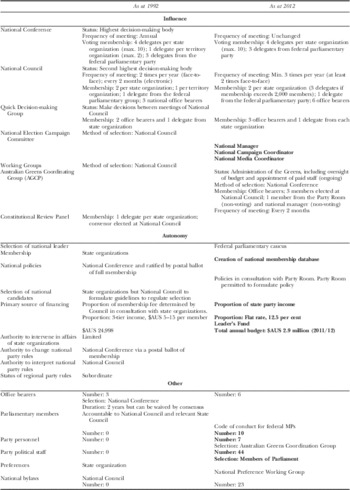
The Greens’ adoption of a confederal party structure is an organizational feature that it shares with Australia’s oldest established political parties (Sharman Reference Sharman1994: 28). The broad outline of the party’s federal architecture is shown in Table 1, which describes the party’s formal structures and provides an overview of some of its informal arrangements. The informal rules, which have been derived primarily from party bylaws and other official documents such as minutes, are denoted in bold print to distinguish them from the party’s statutes. The formal rules make plain that the distribution of power within the organization is weighted heavily in favour of the state associations, with only limited specified autonomy reserved for the national structure.

The privileged position of the regional associations within the national organization is indicated by the composition and remit of the party’s main national governance structure, the National Council. The National Council is second only in authority to the National Conference and is tasked with coordinating and organizing the policies, functions and administration of the Greens at the national level. It can demand the compliance of state organization in regard to the Greens’ agreed policy frameworks, as well as to compel member bodies to take into account state and national campaign and election priorities. The National Council is also empowered to expel uncooperative and non-compliant state organizations.
The dominance of the state organizations on the National Council moderates the extent to which this body is disposed to exercise its full powers. The National Council is controlled by state organizations that enjoy more or less equal representation.Footnote 7 The only explicitly ‘national’ presence on the National Council is limited to non-voting national office bearersFootnote 8 and a single delegate from the federal parliamentary group. The meagre number of national representatives on the National Council, in addition to the lack of voting rights for non-state delegates, means that there is little to temper the parochial self-interest of the state branches.
Three other features of the national party statute further bolster the power of the state organizations. First, the rank-and-file membership of the party is affiliated at the level of the state organizations, with individuals being members of the national organization only in consequence of their affiliation to state organizations. The national organization’s relationship to the membership is mediated through the state organizations and consequently lacks direct access to the extra-parliamentary wing’s financial reserves and labour. Second, candidate selection is performed at the level of the state organization. This serves to place the allegiance of candidates, and ultimately elected representatives, at the level of the state organization that is responsible for their selection. Third, the national organization possesses a limited formal capacity to intervene directly in the affairs of the state organization.
While there has been little alteration to the party’s formal arrangements, there have been developments subtly shifting the locus of decision-making power away from the state organizations towards the national level. This is particularly apparent in the growth in the size and complexity of the national party apparatus and the numerical strength of its dedicated personnel, in the expansion in the capacity of the federal parliamentary wing, including the establishment of the Office of the Leader of the Greens, and in the creation of a national database of members. It is to an examination of these developments that this article now turns.
GROWTH AND CONSOLIDATION OF NATIONAL GOVERNANCE STRUCTURES
There has been a significant expansion in the complexity of the national party apparatus in the 20 years since its creation. While in itself not an indicator of antipathy towards decentralization or a decentralizing ethic, the growth and consolidation of central party organs and structures do produce an impetus towards centralized organization. This is particularly apparent in the enhanced capacity of two executive party organs: the Australian Greens Coordinating Group (AGCG) and National Election Campaign Committee (NECC).
The Australian Greens Coordinating Group developed following a structural review of the party, beginning in 2001. Although the Australian Greens Coordinating Group lacks the authority and scope of a traditional party ‘executive’, it nonetheless acts as a national coordination and decision-making body in respect of the operations of the party (Australian Greens 2003). Over the years, and coinciding with the increased workload on voluntary office holders precipitated by the Greens’ electoral success, the responsibilities of the Australian Greens Coordinating Group have been expanded significantly. Its remit now includes advising and monitoring on legal compliance with relevant Acts in respect of party registration, funding and reporting, as well as responsibility for the overall day-to-day operation of the national organization (Australian Greens 2013). The other important dimension of the Australian Greens Coordinating Group is that it is constituted as an expressly national body, thereby engendering a stronger national disposition to its proceedings and decisions. This is in contrast to most of the Greens’ other national governance structures, which are composed on the basis of state representation.
The National Election Campaign Committee has existed since the foundation of the Greens to coordinate federal election campaigns. In its formative years, the National Election Campaign Committee merely supported regional campaign activities and priorities, serving to encourage communication between the state organizations (Australian Greens 2002). But over the years, the National Election Campaign Committee’s remit has been gradually extended. First, the appointment of a national campaign coordinator boosted the capacity of the National Election Campaign Committee by providing it with dedicated permanent staffing. Second, the expansion of the National Election Campaign Committee has permitted the composition of the committee to include an increasing number of centrally based staff, thus contributing to a more national orientation and focus. While the National Election Campaign Committee’s original membership was dominated by state representatives (Australian Greens 1994), its composition has since been altered to include more expressly ‘national’ representation (Australian Greens 2008). Third, the responsibilities of the National Election Campaign Committee were expanded following agreement on a national preference strategyFootnote 9 in 2004, to include both advertising and electronic engagement. Fourth, the National Election Campaign Committee has become less financially dependent on state organizations. Important in this respect has been the creation of the Leader’s Fund,Footnote 10 a separate account established in 2007 in order to reduce the National Election Campaign Committee’s reliance on state organizations for campaign funds. The National Election Campaign Committee’s ability to obtain independent sources of funding has provided the body with considerable latitude to pursue national rather than state-based campaign aims.
The strengthened position of the National Election Campaign Committee has produced a gradual shift in certain aspects of the party’s affairs, both in functional and psychological terms. Over time, election campaigns are devised and organized to reflect national themes. Local state campaign bodies no longer dictate campaign strategies and priorities but implement them, even though state organizations ultimately retain autonomy to run their own campaigns. A national advertising budget and the use of a national advertising agency are now deployed for federal election campaigns. There has been agreement among the sub-national parties to standardize party websites and the party logo, as well as campaign materials, with the result that the formerly distinct identities of state organizations have been replaced by a homogeneous public profile.
The consolidation of key national executive organs has been augmented further by an expansion of central party staffing levels. Prior to 2010, most of the national operational positions were temporary roles that typically disappeared between elections. As Table 2 shows, national office staffing in non-election periods was between one and two and a half staff for much of the 2000s. Since the 2007 federal election, and accelerating after the 2010 contest, staffing increased to seven full-time equivalent staff, across ten positions. The extent of growth in the ranks of national campaign staff is reflected by the fact that the national campaign coordinator is now permanent, and acts in a directive as well as coordinative manner, whereas the equivalent state positions are temporary and focus entirely on coordination. The national campaign coordinator is thus able to provide ongoing campaign direction that counterparts in the state organizations are generally unable to provide.
National Staffing Levels of the Australian Greens, 2001–12

Source: Australian Greens (2001–10, 2012a).
As the number of central staff has expanded, so too has the diversity of operational roles performed by national personnel. These tasks include the national manager, national campaign manager, national fundraiser and national web manager, with a small administrative staff pool to support these roles (Australian Greens 2012a). The role of the national office has thus shifted from a purely administrative one, with office bearers and support staff performing mostly functional administrative roles, to one where office bearers assume responsibility for a greater share of the political activities, supported by full-time, paid, national executive and campaigning positions.
The growth in central (national) party staff is such that it has eclipsed the number of employees in any of the state organizations. In 2012, the national office had seven staff, not including contract and campaign staff. This compares with a combined total of 21 employees spread across eight state organizations. Moreover, whereas the preponderance of national party staff are employed on a full-time basis, most state organization employees are part-time only. By a ‘full-time equivalent positions’ measure, the state organizations employ 11.8 staff, as compared with the national office’s 6.2 full-time positions. Approximately one-third of positions are employed at a national level.
The expansion in paid personnel at the national level, coupled with the state organizations’ heavier administrative burden, has positioned the national office as the dominant voice on matters pertaining to campaigning, the development of initiatives on internal organizational reform, as well as national policy formulation. Over time, national party personnel generate an increasing proportion of proposals that are presented at the National Conference and National Council. Whereas through the 1990s and early 2000s state parties accounted for up to two-thirds of proposals brought to the National Conference (and quite a number would be generated during discussion at the conference), this situation is now reversed such that less than a third of proposals are generated by state bodies, with the bulk of proposals coming from national working groups, office holders or the federal Party Room. This has had the effect of transforming the state organizations into receivers and processors of initiatives that are generated by the national organization. It is the staff linked to the national stratum of the party organization, and not elites at the level of the state organizations, who are central to shaping the party’s agenda.
THE RISE AND RISE OF THE FEDERAL PARLIAMENTARY PARTY
The consolidation of the national party organization has occurred in tandem with growth in the capacity and authority of the party’s national parliamentary group.Footnote 11 One important development in respect of strengthening the status of the national parliamentary group was the creation of the Office of the Federal Parliamentary Leader in 2007.
Although the formal authority of the parliamentary leader applies only in respect of the parliamentary group, the foreshortening of the nomenclature to ‘leader’ has greatly extended the informal authority of the position. While not able to direct the state organizations, the positional authority of the party leader has facilitated the building of a web of political influence across the organization (Jackson Reference Jackson2012a). This has been particularly apparent in the leader’sFootnote 12 use of the position to exert pressure on state organizations to dilute and even recant policy positions that may injure the party brand.Footnote 13
The authority of the leader has been accentuated in recent years due to the expansion in the size of the parliamentary contingent (see Table 3). Although the first Green MP entered the federal parliament in 1990, it was not until 1996 that the Australian Greens had a consistent presence in the federal legislature. Following the 1998 federal election, the federal parliamentary caucus increased to two senators, doubling again in 2004. At the 2007 election, the Greens managed to gain an additional senator, increasing the contingent of parliamentary representatives to five. However, it was following the election in 2010 that the party recorded the single biggest increase, with four more federal representatives gaining senate vacancies and one other being elected to the lower house. The effect was to increase the contingent of MPs from the Greens to 10, re-qualifying the party for the status of Office of a Federal Parliamentary Leader, which had first been attained in 2007, continuing the slew of additional entitlements and resources funded from the public purseFootnote 14 (Department of Finance and Deregulation 2012a, 2012b).
Federal Parliamentary Representation of the Australian Greens, 1990–2013

Note: *Between 2002 and 2004 the Greens held the seat of Cunningham, following a by-election. The seat was lost at the subsequent (2004) general election.
The Office of the Federal Parliamentary Leader supports the work of the designated parliamentary leader. The additional resources that are attached to the office have strengthened the parliamentary leader’s ability to speak authoritatively on issues (Bean and Mughan Reference Bean and Mughan1989). The increased capacity of the leader’s office to work with the media (Herrick Reference Herrick2010) has facilitated the leader’s access to media resources. The media attention that the leader now attracts has transformed the office into a focal figure not only among the public but also within the party organization. This has helped to elevate the standing of the national, as against state, organization in the public mind.
The growth of the federal parliamentary party has also opened up new resourcing opportunities for the national organization, especially in the form of tithing a portion of federal members’ parliamentary salary. Whereas state organizations benefit exclusively from tithing the salaries of MPs serving in sub-national parliaments, the national organization receives at least half of the tithe set for federal MPs. Although tithing is not a stable funding source, it nonetheless is an alternative source of revenue for the national party, separate from funds provided by state organizations. In 2012, tithing from federal MPs represented 4.4 per cent of total revenue for the national organization (Australian Greens 2012a).
But perhaps more significant in overall impact than tithing are the staffing entitlements that accrue to the Greens’ federal legislators. In addition to allowances provided for electorate-based activities, such as printing and travel, each federal member is entitled to four full-time staff (Department of Finance and Deregulation 2012c). Moreover, the party’s leader and deputy are assigned an extra complement of staff. In 2012, for example, the Greens’ leader and deputy leader were permitted a further 17 staff, in addition to their regular electorate staffing allowance (Department of Finance and Deregulation 2012b: 43).
The growth in national staffing levels, both within the party organization and the parliamentary wing, has been critical to supporting and promoting an organizational perspective which is informed by national, as against state priorities. Central party office staff are critical players in discussions about organizational reform, election campaigning and intraparty negotiations. In occupying important ‘national’ roles within the organization, central party staff possess the expertise and knowledge to direct national party debates, particularly vis-à-vis time-poor state representatives. Similarly, personnel situated within the offices of national MPs provide a ready pool of full-time policy and campaign advisers. While their activities are restricted to working for elected members, this has not prevented staff from promoting policies and campaigns separately from the party that reflect national priorities.Footnote 15
CENTRALIZED DATABASE
The creation of a centralized membership database is also an indicator of dilution in the confederated basis of the Greens. In 2006, the state organizations assented to a proposal from the national convenor and supported by the parliamentary leader (Australian Greens 2006) to allow the national party organization to use the membership list to contact members. Although this initiative did not affect the level at which members were affiliated to the party, it did ensure that vital details on members were also held at a national level. This has enabled the national organization to build a direct relationship with members, and to lobby them directly on issues without interference from the state organizations. For instance, donation receipts to the Australian Greens from members and supporters rose from $AUS 546,000 to $AUS 987,000 between 2012 and 2013 (Australian Greens 2013: 20). While existing fundraising sharing arrangements see some 62 per cent of these funds returned to states, this still represents a significant increase in central party fundraising generated through the national office. Equally, and given the previous debates on access to the national database by federal MPs and the national office (Australian Greens 2007), the ability of the national party to carry out fundraising emails and for MPs to mail members directly is now increasingly uncontested, if still regulated (Australian Greens 2012b). This has allowed the national stratum to perform a wide variety of activities with members, such as fundraising, campaign communication and member engagement that had hitherto been impossible. The national membership database has effectively increased the reach of the national party to each individual member.
The reach of the national organization has been further enhanced by the incorporation of more professionalized campaign techniques and use of technologies, such as electoral management systems (EMS). An electoral management system, which is a form of database held on a single server, holds information on members and supporters with controls on specific access, but available from any level of the party, ensuring that all details are effectively centralized. The electoral management system has been progressively extended to include contact and liaison details, scheduling for activities such as campaign rostering, fundraising, policy feedback and direct feedback from MPs on their activities, with some success (Jackson Reference Jackson2012b: 92). The use of the electoral management system to cultivate a relationship to a network of non-party members has enabled the national party organization to offset some of the limitations associated with the lack of a specifically national membership base.
DISCUSSION
Over the previous decade, especially, the national organization of the Greens has emerged as a more powerful and effective stratum of the party organization. The institutionalization of national decision-making organs has bolstered the capacity of the national organization vis-à-vis the sub-national associations. Bodies such as the Australian Greens Coordinating Group and National Election Campaign Committee have become increasingly capable of autonomous spheres of action, and the ability to pursue a separate, national agenda. The growth in complexity of the national organization has undermined the power of the state organizations to the extent that the national office is now less dependent on the sub-national layer to perform particular functions. The influence of the state organizations on the national governance structure is increasingly being modified by a permanent coterie of party and party-political bureaucrats whose primary affiliation and allegiance lie at the level of the national party. While the different levels of staff (as state/federal MPs’ staff or party staff) hold varying views on their own roles, MPs’ staff see an expanded role for MPs – and by extension themselves – in the establishing of national priorities, whether they be electoral or programmatic (Jackson Reference Jackson2011: 185–8). This development is wholly consistent with Panebianco’s claim (1988: 227) that party elites acquire an outlook that is sympathetic and protective of the level of the party organization at which they are attached.
The strengthening of the national structure has been assisted by a surge in resourcing at the national level, specifically from within the Office of the Federal Parliamentary Leader and the federal parliamentary party. The increased size of the federal parliamentary contingent, along with its growing national profile, has generated new streams of revenue from which to finance the expansion in national party organs, as well as a platform from which to elevate the presence and authority of the national organization both within the party and with the wider electorate. The capacity for the federal parliamentary wing of the Greens to exert influence over the party’s internal organizational affairs has been accentuated by their access to comparatively generous state-sponsored staffing allocations. The ability of the parliamentary wing to pursue a national agenda, and to promote a more national orientation, has been protected by the party rules, which impose minimal constraints on the activities of the parliamentary wing, particularly compared with other party organs. The federal party leader has served as one of the important catalysing figures around which much of the ‘nationalizing’ agenda has coalesced.
The enlargement of the federal parliamentary wing has created and fuelled much of the momentum for further strengthening the national decision-making apparatus. This is not an unfamiliar theme within the literature on parties in parliamentary federations (Farrell and Webb Reference Farrell and Webb2000: 115–19), including green parties (Bolleyer Reference Bolleyer2010: 613; Frankland Reference Frankland2008: 29–34; Mair Reference Mair1994:9; Poguntke Reference Poguntke1987a: 621). There are powerful imperatives for federal parliamentary members to promote procedural and operational uniformity among the sub-national units (van Houten Reference van Houten2009). The dynamics of parliamentary systems, with its stress on cohesive partisan blocs, creates incentives to build centralized parliamentary parties (Koop and Sharman Reference Koop and Sharman2008), while provision for state subventions can encourage centralization, even among green parties (Jansen and Lambert Reference Jansen and Lambert2013). Similar exigencies are often at work at national elections. The electoral fate of national candidates depends to some extent on electoral coordination, as well as programmatic and policy coherence across the sub-national organizations. It is further reinforced by modern electioneering practices that increasingly concentrate party resources and focus on the party leader (Farrell Reference Farrell2002: 81), with the effect of shifting the priorities away from lower units of the party towards a more centralized site.Footnote 16 The authority of the national party leadership is often an effective weapon which can be used by the national stratum of the party organization to impose discipline on state associations (van Biezen and Hopkins Reference van Biezen and Hopkins2006: 17–18).
The consolidation and growth of national structures, to the extent that they are indicators of organizational centralization, is to be partly expected. Michels (Reference Michels1962) argued that the centralization of decision-making authority was a naturally occurring phenomenon, even in federations where the territorial dimension may serve to temper the effects of organizational oligarchy (Duverger Reference Duverger1964). Green parties, it seems, are not immune to centralizing imperatives when the structure of incentives are sufficiently strong. It has been observed that mature green parties have moderated those features of their organizational model that may hinder potential future representational outcomes (Poguntke Reference Poguntke1987a; Rihoux Reference Rihoux2006).
The strengthening of the capacity and authority of national party organs at the expense of the state organization has been the experience of Australia’s oldest main political parties. The intensification in vertical integrative linkages and in a direction that favours the national organizational apparatus does suggest that the Greens value decentralization as long as it does not substantially interfere with electoral success and threaten representational outcomes. This is consistent with Thorlakson’s (Reference Thorlakson2009: 172–4) finding that one of the best indicators of the organizational arrangements adopted by parties in federations is the particular configuration of power within the apposite political system, and not party family temperament.
This is not to say that the national apparatus of the Greens must inevitably supersede the existing confederated party architecture. In the short to medium term, the extent to which the national stratum of the organization is able to continue to extend its influence at its present pace will most likely depend on maintenance of the Greens’ federal parliamentary wing at current levels. It is party elites who fundamentally determine the pace and magnitude of organizational reform (Harmel and Janda Reference Harmel and Janda1994: 266), even if reform has the capacity to generate its own momentum (Panebianco Reference Panebianco1988: 242). We might expect, therefore, that any significant contraction in the size of the federal parliamentary group will lessen the availability of resources that have been used to fund the activities of some national party organs and initiatives, but importantly, vanquish one of the most persistent and authoritative voices within the party for further nationalization.
Over the longer term, however, there are other powerful forces that favour the maintenance of a dispersed, as against integrated, arrangement in one form or another (Epstein Reference Epstein1982; Panebianco Reference Panebianco1988: 50–1). In part, this is because the historical origins of the Greens and geospatial considerations – namely, the physical isolation of the state organizations from one another – mean that the sub-national layer of the party organization is likely to remain a critical actor (Miragliotta Reference Miragliotta2012a). These power-dispersing organizational properties are buttressed by three additional factors. First, the single member basis of the lower house electoral system places a premium on sub-national knowledge and networks for successful campaigning (Koop and Sharman Reference Koop and Sharman2008). Second, the low levels of simultaneity in state and national electoral cycles carve out a strong role for the state branches in lower-order elections (Deschouwer Reference Deschouwer2006: 296–7). Thirdly, the availability of subventions at the sub-national level does ensure that the state organizations continue to enjoy access to resources that are useful to protecting their own spheres of interest (Bolleyer Reference Bolleyer2012: 332; Miragliotta Reference Miragliotta2012a).
Conclusion
This article is a modest contribution to the question of the professionalization of green party organization in dispersed polities. The article has explored whether confederated party structures are likely to succumb to a similar centralizing fate as other organizational traits particular to green parties. This has been done through an in-depth study of the Australian Greens, which incorporated an archetypal confederal party structure at its inception. We have found evidence of subtle erosion in the confederated basis of the Greens. The national apparatus has expanded in influence, scope and, importantly, capacity. While this has not produced any formal diminution in the autonomy of the regional associations, it has displaced them within the national apparatus to a not altogether insignificant extent.
The main agent propelling the strengthening of the national stratum of the party organization has been the federal parliamentary wing. Growth in the federal parliamentary fraction has reduced the financial dependence of the central/national apparatus on the regional associations, and in the process bolstered the capacity of the national decision-making bodies for independent action. More importantly, perhaps, the federal parliamentary wing has mobilized and channelled much of the momentum for strengthening the governance organs within the national structure. This has been achieved through the national platform created by the Office of the Leader of the Federal Parliamentary Party and those of federal MPs.
The findings from this study are consistent with other studies which show that green parties are inclined to respond to incentives similarly to the conventional parties and/or find it equally difficult to resist institutional arrangements found within the system in which they compete. The broader institutional rules have an inextricable logic that parties must conform to if they hope to emerge as stable fixtures of the party system. Green parties are just as much creatures of their institutional context as other party family types.