1. Introduction
Named entity recognition (NER) is an information extraction task in natural language processing that aims to identify and categorize each word into predefined categories. For example, for the sentence “Thomas Bayes was the son of London Presbyterian minister Joshua Bayes,” as an NER task, we aim to assign PERSON label for Thomas Bayes and Joshua Bayes and assign LOCATION label for London, and CORPORATION label for Presbyterian. As we can see from the recent studies in the literature, the performance of NER on formal (e.g., newspapers, academic papers) data is very high, particularly for languages like English with comparably poor morphology and abundant annotated data. Recent research such as Lample et al. (Reference Lample, Ballesteros, Subramanian, Kawakami and Dyer2016) and Ma and Hovy (Reference Ma and Hovy2016) achieved over 91% F1 score on English formal data, almost comparable to human annotation performance. So one can prematurely conclude that the NER task has nearly reached its peak performance.
However with the ever-changing nature of the Internet, especially after the emergence of social media, we have been introduced to informal/noisy data (user-generated data) such as user comments and tweets. This new type of data is highly valuable for information extraction tasks such as opinion mining due to being widespread and having almost up-to-date nature. However, noisy and informal text normally includes missing characters in words (either deliberately or by forgetfulness), missing punctuation, various emojis, slang words, and abbreviations. All of these bring new problems for the existing Turkish NER studies, considering that most of them are either statistical or rule-based models that usually depend on manually crafted features (e.g., capitalization, numerical/date/time patterns, or other rule-based features) and/or external domain-specific resources (e.g., gazetteers, lexicons), therefore ill-suited to noisy data. Some of these studies try to solve these new challenges either by extending their existing feature set to better suit on this new domain or by adding new domain-specific resources. Current state-of-the-art Turkish NER model (Şeker and Eryiğit Reference Şeker and Eryiğit2017), which is a conditional random field (CRF)-based model utilizing domain-specific heavy feature engineering and external resources, achieves an F1 score of 91.94% on formal data and only 67.96% (and 63.63% without using Twitter mention feature to label mentions as PERSON) on noisy data. This is mostly due to Turkish being a morphologically rich and agglutinative language and having scarce annotated data. It is evident that Turkish NER performance is far behind on noisy/informal data, despite being a well-studied topic for formal data. Recent successful studies on other languages, especially on English, address these issues by utilizing neural architectures with the help of auto-generated features.
Turkish being a morphologically complex language, NER receives its own share. Although derivation in Turkish named entities is not very common, inflected named entities are seen quite often in Turkish. Especially, case markers are seen with any type of named entity. For example, in the sentence “Istanbul’a gideceğim” (means I will go to Istanbul.”), the location named entity “İstanbul” is inflected in the dative case; “Onu Ahmet’ten alabilirsin.” (means “You can take it from Ahmet.”), the person name “Ahmet” is inflected in the ablative case. Thereby, due to the common usage of suffixes with named entities, the sparsity problem is introduced in NER task. The problem is even more severe in noisy text, since the morphemes could also be spelled differently by different users on social media. For example, the suffix “ciğim” that means “dear” when it is used with person names, could be written as “cim,” or as “çim,” “çum,” “çm,” “cm,” “cim,” etc., depending on the last vowel in the name accordingly with the vowel harmony.
This motivates us to research and adopt deep recurrent neural network models for Turkish and obtain valuable features without using any external domain-specific resources or any hand-crafted features. To this end, we propose a transfer learning model that is an extension of the widely used bidirectional long short-term memory (LSTM)-CRF model by incorporating an additional CRF layer that we train on another, preferably larger dataset to overcome the annotated data scarcity problem. The model is rather similar to the model presented by von Däniken and Cieliebak (Reference von Däniken and Cieliebak2017), since we also use another CRF layer to further improve the performance. We argue that subword information is crucial in word representation for morphologically rich and agglutinative languages; therefore, the model also utilizes different subword embeddings such as morph2vec (Üstün, Kurfal, and Can Reference Üstün, Kurfal and Can2018), fasttext (Bojanowski et al. Reference Bojanowski, Grave, Joulin and Mikolov2017) and orthographic character-level embeddings. Morph2vec (Üstün et al. Reference Üstün, Kurfal and Can2018) is a word representation model that estimates the word embeddings through its morphemes where the segmentation of words is not required a priori; therefore, the pretrained word embeddings are mimicked by using an attention mechanism over a list of potential segmentations of each word to obtain the final word representation. On the contrary, fasttext (Bojanowski et al. Reference Bojanowski, Grave, Joulin and Mikolov2017) estimates the word embeddings through the n-grams of each word. To the best of our knowledge, this is the first neural network model without using any hand-crafted features and external resources for Turkish NER. Consequently, we obtain an F1 score of 67.39% on Turkish noisy data and 45.30% on English noisy data, which are both the highest scores for both languages.
The paper is organized as follows: Section 2 reviews the recent work on NER on noisy text for Turkish and also for English, Section 3 describes the word representation methods used for representing each word by a dense vector in the NER models proposed in this paper, Section 4 describes and gives the mathematical definition of the baseline Bi-LSTM-CRF model (Huang, Xu, and Yu Reference Huang, Xu and Yu2015) adopted in this article, Section 5 describes the proposed transfer learning model, Section 6 gives the details on datasets and on the implementation of the models in addition to the experimental results obtained from the proposed models on Turkish and English, and finally Section 7 concludes the paper along with the future goals.
2. Related work
Various methods have been adopted for NER, those include statistical methods (Bikel Reference Bikel, Miller, Schwartz and Weischedel1997; Wu, Zhao, and Xu Reference Wu, Zhao and Xu2003; Suzuki and Isozaki Reference Suzuki and Isozaki2008), rule-based models (Petasis et al. Reference Petasis, Vichot, Wolinski, Paliouras, Karkaletsis and Spyropoulos2001), and recently deep neural network architectures (Huang et al. Reference Huang, Xu and Yu2015; Ma and Hovy Reference Ma and Hovy2016). Since user-generated text on the Internet is typically different compared to formal text, more latent features need to be defined manually or more sophisticated methods need to be used to learn the latent features automatically from a given text. This is because noisy text is more scarce compared to formal text since it may change from one user to another.
One of the commonly used features would be the meaning of the words. Although the spelling of each word may change from one text to another, the meaning would stay the same. Meaning representation has benefited from distributional approaches a lot. In recent years, distributional models such as Latent Semantic Analysis (Landauer, Foltz, and Laham Reference Landauer, Foltz and Laham1998) have changed direction toward neural models. Word representation models such as word2vec (Mikolov et al. Reference Mikolov, Chen, Corrado and Dean2013) or GloVe (Pennington, Socher, and Manning Reference Pennington, Socher and Manning2014) have shown superior performance. However, those models learn word representations very well when there is enough contextual information for each word, which will not be true for the scarce and noisy text. Therefore, other neural models that make use of subword information such as characters (Cao and Rei Reference Cao and Rei2016), character n-grams (Bojanowski et al. Reference Bojanowski, Grave, Joulin and Mikolov2017), and morphemes (Üstün et al. Reference Üstün, Kurfal and Can2018) have been introduced, which learn the representations of scarce data (i.e., noisy text or any text in a morphologically rich language) better than word-level models. Neural word embeddings obtained from such models have been used as features and have shown superior performance when they are sequentially encoded by LSTMs. Moreover, it has been discovered that an additional CRF layer can learn the named entities by using the latent features learned by the LSTMs, which introduces the well-known Bi-LSTM-CRF (bidirectional long short-term memory and CRF) architecture (Huang et al. Reference Huang, Xu and Yu2015) as a sequence labeling model.
Here, we review mainly the research on NER for noisy text. Although the main scope of this article is Turkish NER, since we are also inspired by other models on English, we also review the research on English NER on noisy text.
2.1 NER on Turkish noisy data
First of all, it is worth mentioning that all studies reported in this section use the same Turkish noisy dataset, so the reported scores are comparable to each other.Footnote a
Çelikkaya, Torunoğlu, and Eryiğit (Reference Çelikkaya, Torunoğlu and Eryiğit2013) introduce the first study focusing on noisy data for Turkish with a CRF-based model that utilizes hand-crafted morphological and lexical features (e.g., stem, PoS tag, noun case, lower/upper case) along with gazetteers. They reported an F1 score of 19.28% on noisy dataset and 91.64% on formal dataset which can be interpreted as another indication that NER on noisy data does not perform as well as NER on formal text. With the aim of adapting the model for noisy data, Küçük and Steinberger (Reference Küçük and Steinberger2014) extend a previous multilingual rule-based NER system by expanding existing domain-specific resources based on the fact that most sentences in the noisy data miss the letters with diacritics (ç, ğ, ı, ö, ş, ü) and the authors employ a normalization scheme using this feature. As a result, they achieved an F1 score of 46.93% on the same Turkish noisy dataset.
Eken and Tantuğ (Reference Eken and Tantuğ2015) introduce another CRF-based approach that also makes use of gazetteers (with optional distance-based matching) and numerous features (e.g., apostrophe, case of the word, start of sentence) along with the word suffixes and prefixes. They reported 46.97% F1 score on a new noisy imbalanced dataset, and 28.53% F1 score on the same Turkish noisy dataset. Okur, Demir, and Özgür (Reference Okur, Demir and Özgür2016) present a regularized averaged multiclass perceptron with hand-crafted features (e.g., word type flags, suffix, prefix, capitalization) along with pretrained embeddings obtained from word2vec (Mikolov et al. Reference Mikolov, Chen, Corrado and Dean2013). They also perform tweet normalization using the model introduced by Torunoğlu and Eryiğit (Reference Torunoğlu and Eryiğit2014). Consequently, they obtain an F1 score of 48.96% on the noisy dataset.
Şeker and Eryiğit (Reference Şeker and Eryiğit2017) present the state-of-the-art model on Turkish NER which is another CRF-based model, similar to that of Çelikkaya et al. (Reference Çelikkaya, Torunoğlu and Eryiğit2013). The authors use an extensive set of morphological and lexical features (e.g., stem, part-of-speech (POS) tags, capitalization, word type and shape flags) and gazetteers. Additionally, they use the existence of Twitter mentions as a feature. They also provide the reannotated versions of the two commonly used Turkish datasets: news dataset (Tür et al. Reference Tür, Hakkani-Tür and Oflazer2003) and Twitter dataset (Çelikkaya et al. Reference Çelikkaya, Torunoğlu and Eryiğit2013). Reannotated versions also include TIMEX (Date, Time) and NUMEX (Money, Percent) types along with previously labeled ENAMEX (Organization, Person, Location) types. Finally, they report an F1 score of 67.96% with Twitter mentions and 63.63% without the mentions on the reannotated version of the Turkish noisy dataset.
2.2 NER on English noisy data
Analogously, all studies reported in this section use the same English noisy dataset, which was provided by the 3rd Workshop on Noisy User-Generated Text at Empirical Methods in Natural Language Processing (EMNLP) (WNUT’2017)Footnote b so that all the reported results are comparable to each other.
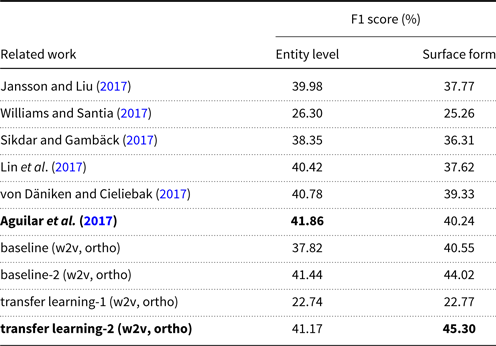
Aguilar et al. (Reference Aguilar, Maharjan, Monroy and Solorio2017), the winner of the WNUT’17,Footnote c apply multitask learning approach with a CRF-based model that incorporates pretrained word embeddings obtained from word2vec (Mikolov et al. Reference Mikolov, Chen, Corrado and Dean2013) and orthographic character-level embeddings trained on a Convolutional Neural Network (CNN) with two-stacked convolutional layers. They also make use of gazetteers for the well-known entities. They report an F1 score of 41.86% on entity level and 40.24% on surface forms.
von Däniken and Cieliebak (Reference von Däniken and Cieliebak2017) use a transfer learning model. One of our proposed models is also based on their model. However, unlike our model, their model incorporates sentence-level embeddings (sent2vec) (Pagliardini, Gupta, and Jaggi Reference Pagliardini, Gupta and Jaggi2017) and capitalization features in addition to character-level embeddings trained by a CNN and pretrained word embeddings obtained from fasttext (Bojanowski et al. Reference Bojanowski, Grave, Joulin and Mikolov2017). As a result, they obtain 40.78% F1 score on entity level and 39.33% F1 score on surface forms. Lin et al. (Reference Lin, Xu, Luo and Zhu2017) follow a similar approach for a CRF-based model and use word embeddings that are obtained from pretrained word embeddings and character-level embeddings obtained from another bidirectional LSTM. They also incorporate syntactic information by using POS tags, dependency roles, and word position, and head position. They achieve an F1 score of 40.42% on entity level and 37.62% on surface forms.
Sikdar and Gambäck (Reference Sikdar and Gambäck2017) propose an ensemble-based approach that uses features learned from CRF, support vector machine, and an LSTM. They also use hand-crafted features such as PoS tags, local context, chunk, suffix and prefix, word frequency, and a collection of flags (e.g., is-word-length-less-than-5, is-all-digit). Consequently, they achieve 38.35% F1 score for entity level and 36.31% F1 score for the surface forms.
Williams and Santia (Reference Williams and Santia2017) propose a statistical approach, where each word is associated with its context. Context conditional probabilities are used to estimate the named entity tag probabilities. They obtain an F1 score of 26.30% on entity level and 25.26% F1 score on surface forms. Jansson and Liu (Reference Jansson and Liu2017), inspired by the work of Limsopatham and Collier (Reference Limsopatham and Collier2016), use a bidirectional LSTM-CRF model that is similar to our baseline model but instead of orthographic features, Latent Dirichlet Allocation (Blei, Ng, and Jordan Reference Blei, Ng and Jordan2003) topic models and PoS tags are used as features. As a result, they achieve a performance of 39.98% F1 score on the entity level and 37.77% F1 score on the surface forms.
3. Neural word embeddings
We use neural word embeddings of words as input to our proposed models. We use different levels of word embeddings such as the word-level word embeddings obtained by word2vec (Mikolov et al. Reference Mikolov, Chen, Corrado and Dean2013), character n-gram-level word embeddings obtained by fasttext (Bojanowski et al. Reference Bojanowski, Grave, Joulin and Mikolov2017), morpheme-level word embeddings obtained by morph2vec (Üstün et al. Reference Üstün, Kurfal and Can2018), character-level embeddings, and orthographic character-level embeddings. By using these models, we aim to capture orthographic, morphological, and contextual information of words in noisy data.
For the notation that will be used throughout the article, we denote each sentence (i.e., tweet) by
 $S = (w_1, w_2, ..., w_N)$
that consists of N tokens (i.e., words or other tokens), where the ith token is denoted by
 $w_i$
.
3.1 Orthographic character-level embeddings
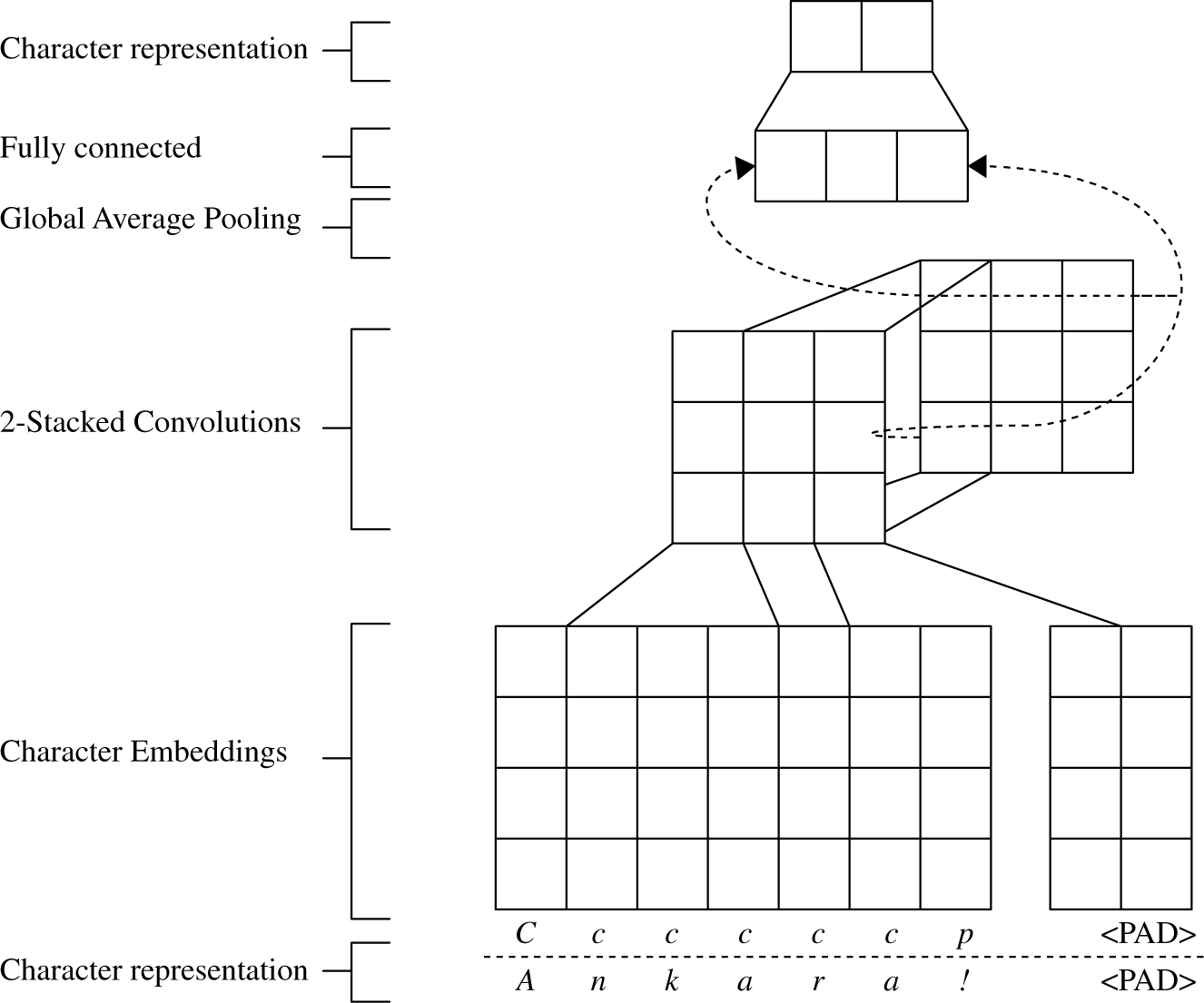
We use an orthographic character encoder similar to that of Aguilar et al. (Reference Aguilar, Maharjan, Monroy and Solorio2017) that encodes alphabetic characters as “c” (or “C” if the character is capitalized), numeric characters as “n,” punctuation as “p,” and other characters as “x.” For example, the word “Türkiye’ye!” (means to Turkey) becomes “Cccccccpccp.” Each orthographic encoding is also padded with 0s accordingly with the longest word in the dataset to have a fixed length of orthographic embedding for all words. This allows us to reduce sparsity and capture the shapes and orthographic patterns within the words. We train the embeddings by a character-level CNN. We apply two-stacked convolutional layers and perform global average pooling on the output. Finally, we use a fully connected feed-forward layer with a rectifier linear unit (ReLU) activation function with the final character-level word representation of each word that is denoted by
 $E_{w_i}^{(c_{cnn})}$
. An overview of the architecture is given in Figure 1. Here, the word “Ankara!” is first encoded in terms of its characters such as “Ccccccp,” and then the orthographic embeddings are fed into the convolutional layers to obtain the character representation for orthographic encoding.
Character-level word embedding using CNN (Aguilar et al. Reference Aguilar, Maharjan, Monroy and Solorio2017).

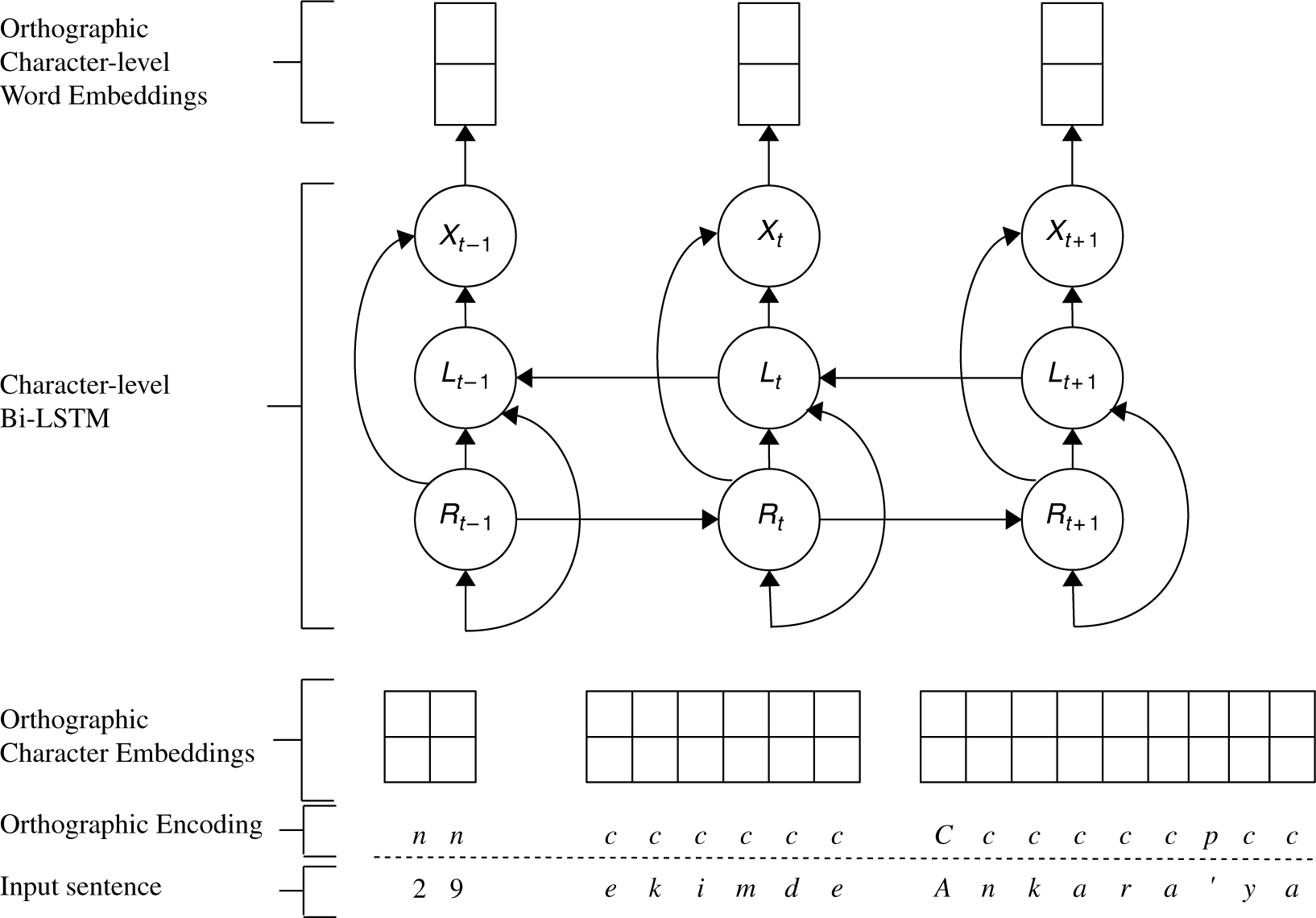
As an alternative approach, we also train the orthographic character-level embeddings using a Bi-LSTM that is simply a combination of two different LSTMs (i.e., forward and backward LSTMs) where one of them takes the input sequence in the forward and the other one in the reverse order. Output of the forward and backward LSTMs are concatenated for the final orthographic character-level word embedding
 $E_{w_i}^{(c_{Bi-LSTM})}$
. The Bi-LSTM model is given in Figure 2. Here, the sentence “29 ekimde Ankara’ya” is first encoded in terms of its orthographic characters such as “nn cccccc Ccccccpcc,” and then the embeddings of the orthographic characters are fed into a Bi-LSTM to obtain a character-level orthographic word embedding.
Character-level word embedding using a bidirectional LSTM.

3.2 Character-level word embeddings
We also learn the character-level word embeddings using the actual characters rather than the character types unlike the orthographic word embeddings. For example, the word “Bravo” is first encoded in terms of the character embeddings of “B,” “r,” “a,” “v,” and “o.”
We use another Bi-LSTM to learn the character-level word embeddings. To this end, the Bi-LSTM is fed by the character embeddings of the word. We obtain the character-level word embeddings denoted by
 $E_{w_i}^{(c)}$
by concatenating the vectors that are output by both LSTMs from both directions.
3.3 Character n-gram-level word embeddings
Fasttext (Bojanowski et al. Reference Bojanowski, Grave, Joulin and Mikolov2017) is an extension of word2vec (Mikolov et al. Reference Mikolov, Chen, Corrado and Dean2013), and it is comparably better at capturing word representation for morphologically rich languages such as Turkish. This is due to its ability to form vector representation of words from their vectors of character n-grams. As a result, this allows us to generate word embeddings
 $E_{w_i}^{(c_{ngram})}$
using n-grams even for out-of-vocabulary words, which is a common case for noisy text and also agglutinative languages.
3.4 Morpheme-level word embeddings
Morph2vec (Üstün et al. Reference Üstün, Kurfal and Can2018) is another representation learning model that utilizes subword information to learn the word embeddings. The algorithm takes a list of candidate morphological segmentations of all words in the training data that are suggested by an unsupervised morphological segmentation system (Üstün and Can Reference Üstün, Can, Král and Martín-Vide2016). Given that each word has multiple sequences of candidate morphological segmentations, the final word representation
 $E_{w_i}^{(m)}$
is a weighted sum of the morpheme-level word embeddings of all segmentations of that word. An attention mechanism is used on top of the model in order to learn the weights, where the mechanism assigns more weight to the correct segmentation of the word. We incorporate morpheme-level word embeddings that we obtain from pretrained morph2vec embeddings in our proposed models in this article.
It can be argued that words in an informal text may not have proper morphemes. For example, “gidiyorum” in Turkish (means “I am going”) is usually written as “gidiyom” by combining the present participle suffix -iyor with the person ending -um. However, morph2vec (Üstün et al. Reference Üstün, Kurfal and Can2018) builds the word embeddings from several segmentations of the word that are likely to include the portions of the suffixes in the corrupted form.
3.5 Word-level word embeddings
Word2vec (Mikolov et al. Reference Mikolov, Chen, Corrado and Dean2013) has been one of the leading word representation methods that has shown superior performance in capturing syntactic and semantic features of words. The method aims to estimate word embeddings
 $E_{w_i}^{(w)}$
using their contextual information similar to other aforementioned methods, but it does not make use of any subword information and all words are considered as distinct tokens.
3.6 Final word embeddings
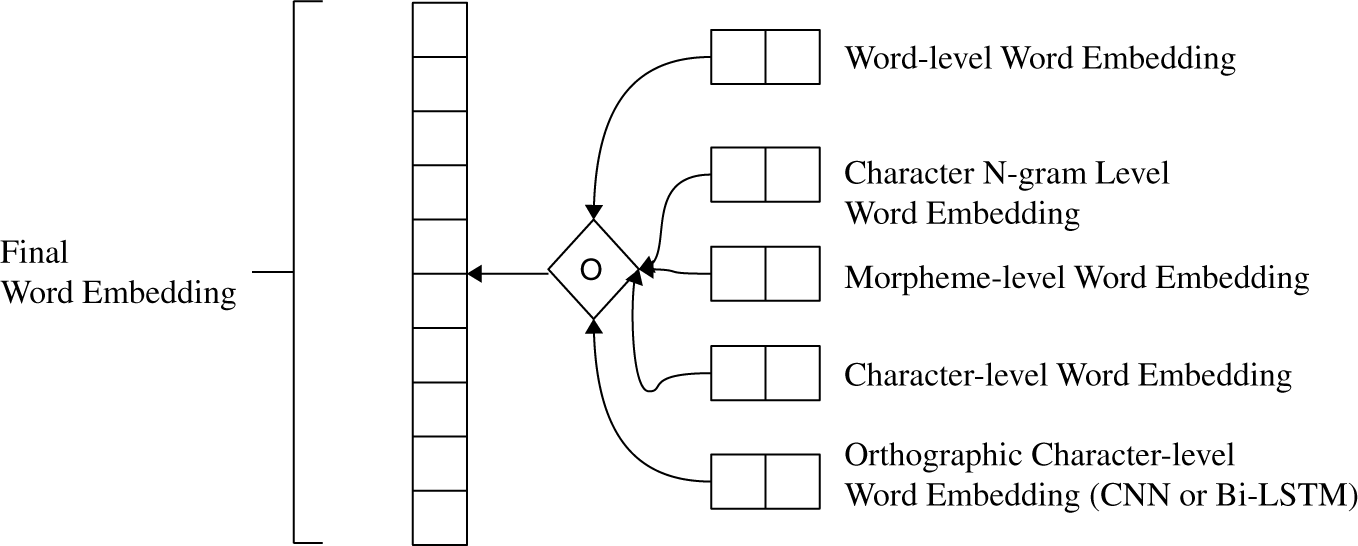
The final word embeddings that we use as input to the proposed models are the concatenation of fasttext (Bojanowski et al. Reference Bojanowski, Grave, Joulin and Mikolov2017), morph2vec (Üstün and Can Reference Üstün, Can, Král and Martín-Vide2016), word2vec (Mikolov et al. Reference Mikolov, Chen, Corrado and Dean2013), character-level word embeddings, and orthographic character-level embeddings (either CNN-based or LSTM-based):
 $$\begin{equation} E_i = E_{w_i}^{(w)} \circ E_{w_i}^{(c_{ngram})} \circ E_{w_i}^{(m)} \circ E_{w_i}^{(c)} \circ E_{w_i}^{(c_{cnn|Bi-LSTm})} \end{equation}$$
An overview of the approach is given in Figure 3. Each vertical stacked box represents a different level of word embedding for the given input word.
Overview of the final word embeddings. After concatenating embeddings obtained from fasttext, word2vec, morph2vec, and character-level word embeddings, orthographic character-level embeddings, we apply dropout for better generalization.

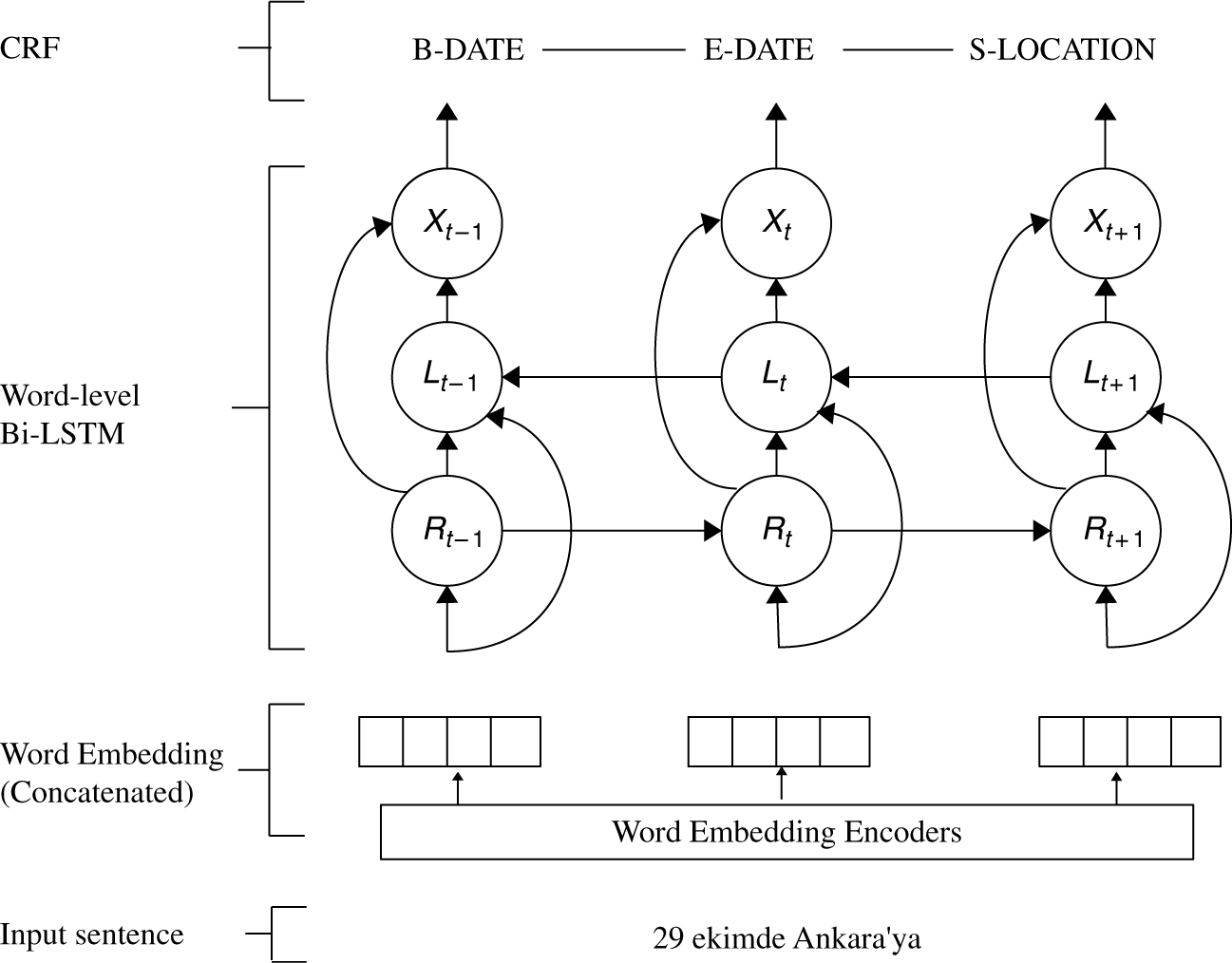
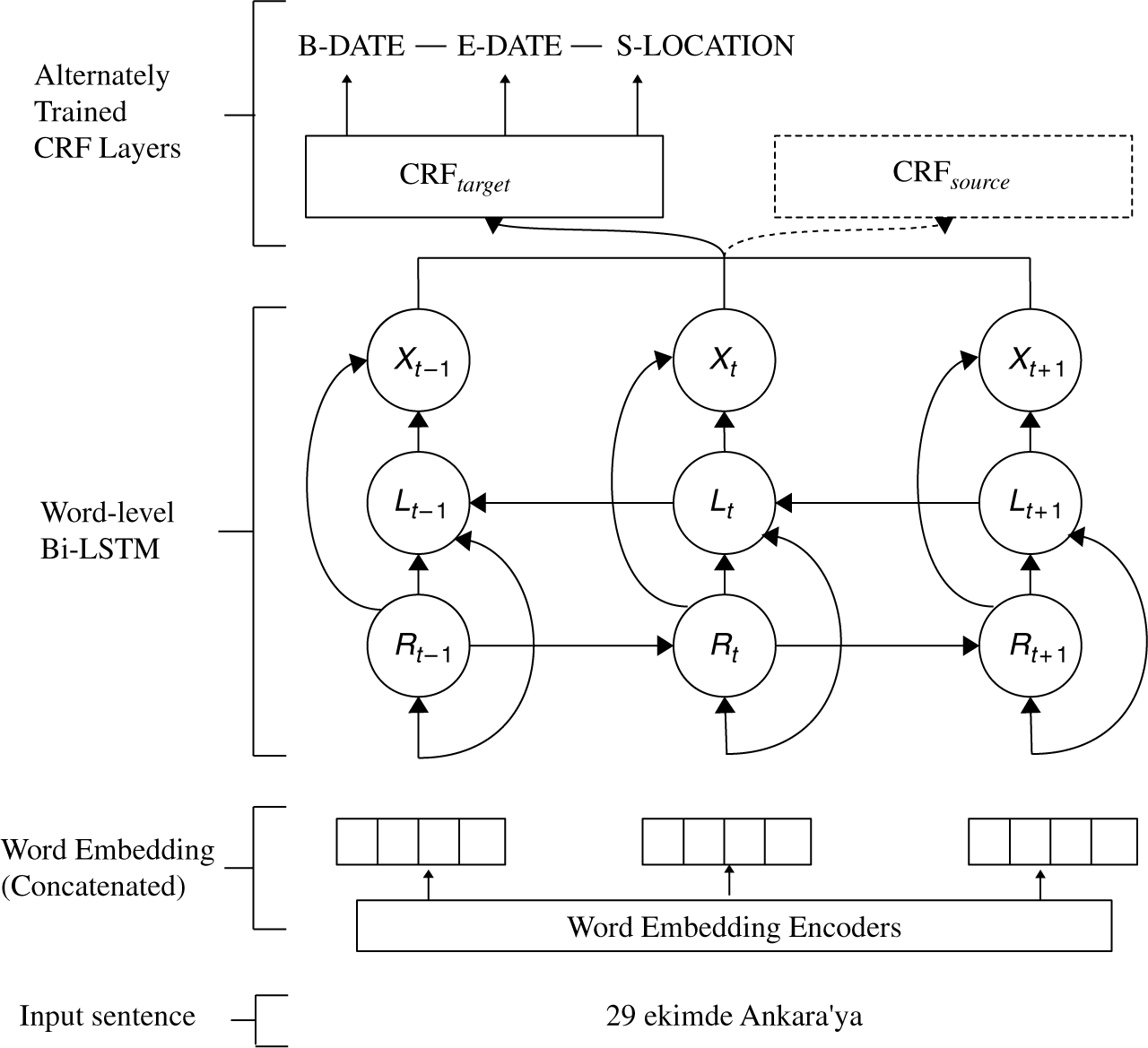
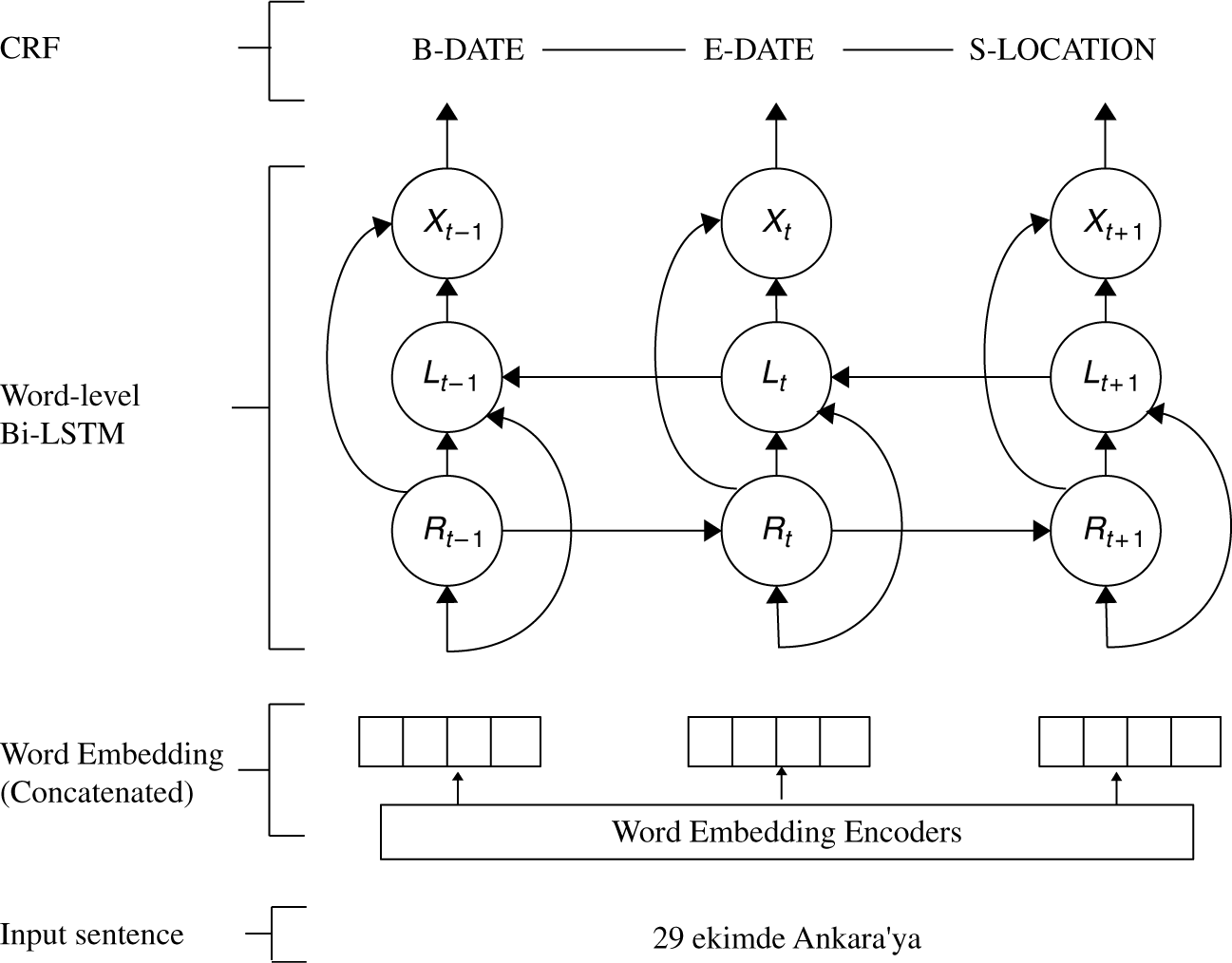
Architecture of our baseline Bi-LSTM-CRF model. We learn latent features by using a Bi-LSTM that is fed by the combined word embeddings and then we feed the output of each Bi-LSTM state to CRF in order to predict the label sequence. Here, Word Embedding Encoders are namely word2vec (Mikolov et al. Reference Mikolov, Chen, Corrado and Dean2013), fasttext (Bojanowski et al. Reference Bojanowski, Grave, Joulin and Mikolov2017), morph2vec (Üstün and Can Reference Üstün, Can, Král and Martín-Vide2016), character-level word embedding, and orthographic character-level embedding methods. The Turkish input sequence “29 ekimde Ankara’ya” means “To Ankara on 29th October”.
After concatenating the different-level word embeddings, we apply dropout on the final word embedding
 $E_i$
. This prevents the model from solely depending on one type of word embedding and, therefore, ensures a better generalization. We assign dropout rate
 $r=0.5$
.
4. Baseline model
Our baseline model is founded on the well-known bidirectional LSTM-CRF (Bi-LSTM-CRF) model proposed for sequence labeling, which is similar to that of Huang et al. (Reference Huang, Xu and Yu2015), Chiu and Nichols (Reference Chiu and Nichols2015), Lample et al. (Reference Lample, Ballesteros, Subramanian, Kawakami and Dyer2016), Ma and Hovy (Reference Ma and Hovy2016).
A Bi-LSTM is fed by the final word embeddings
 $E_i$
in order to learn the higher order latent features for the NER task, and another layer with a linear-chain CRF is fed by the LSTM outputs of each word to compute a prediction of the label sequence. Overview of the baseline model is given in Figure 4. Word embeddings are encoded as given in Figure 3.
4.1 Bidirectional LSTM layer
Given an input sentence (i.e., tweet)
 $S=\{w_1,w_2,\dots,w_n\}$
, bidirectional LSTM is used to process the words sequentially. To this end, the combined word embedding
 $E_i$
of each word in the sentence is given as input to the bidirectional LSTM layer that is composed of a forward LSTM
 $LSTM_{forward}$
and a backward LSTM
 $LSTM_{backward}$
(Hochreiter and Schmidhuber Reference Hochreiter and Schmidhuber1997). Latent feature vectors
 $\overrightarrow{R_t}$
and
 $\overleftarrow{L_t}$
are learned as an output of the LSTMs at time step t:
 $$\begin{eqnarray} \overrightarrow{R_t} = LSTM_{forward}(E_{1:N},t) \end{eqnarray}$$
 $$\begin{eqnarray} \overleftarrow{L_t} = LSTM_{backward}(E_{1:N},t) \end{eqnarray}$$
The outputs of the LSTMs are concatenated to build a single vector output from the Bi-LSTM as follows:
 $$\begin{equation} X_t = \overrightarrow{R_t} \circ \overleftarrow{L_t} \end{equation}$$
where
 $X_t$
denotes the concatenated output vector for each word. We also apply dropout on
 $X_t$
for a better generalization. Weights of the Bi-LSTM are initialized using uniform Glorot initialization (Glorot and Bengio Reference Glorot, Bengio, Teh and Titterington2010) that initializes the weights by drawing samples from a Gaussian distribution with mean = 0.0 and variance based on the fan-in (input units in the weight tensor) and fan-out (output units in the weight tensor) of the weight.
4.2 CRF layer
We use a linear-chain CRF to predict the sequence of labels
 $Y = (y_1, y_2, ..., y_N)$
for the sentence S where
 $y_i$
denotes the named entity label of the ith word
 $w_i$
in S. The prediction score of a sequence is defined as follows:
 $$\begin{equation} C(S, Y) = \sum^N_{i=0} A_{y_i, y_{i+1}} + \sum^N_{i=1} P_{i, y_i} \end{equation}$$
where the score is estimated over a sequence of size N. Here, P is the matrix of scores that is the output by the Bi-LSTM and A is the matrix that denotes the transitions from the previous label to the next label. P has a size of
 $N\cdot k$
, where k is the number of the distinct entity tags. The concatenated representation of each word
 $X_t$
is linearly projected onto a layer that has a size of k. Therefore, the matrix defines the scores of labeling each word in the sequence with the possible k tags, which is not a proper probability distribution yet. In other words,
 $P_{i, y_i}$
is the score of the tag
 $y_i$
for a given a word
 $w_i$
. By defining a log-linear model using the scores, the probability of the output sequence of Y becomes:
 $$\begin{equation} p(Y|S) = \dfrac{e^{C(S,Y)}}{\sum_{\widetilde{Y} \in Y_S} e^{C(S,Y)}}, \end{equation}$$
where
 $Y_S$
denotes the set of possible label sequences for S. Finally, the goal becomes to maximize the log probability of the predicted label sequence. Building the log-linear model gives us the form:
 $$\begin{equation} log(p(Y|S)) = C(S,Y) - log\left(\sum_{\widetilde{Y} \in Y_S} e^{C(S,\widetilde{Y})}\right) \end{equation}$$
The correctly predicted sequence of labels is the one that maximizes Equation 7:
 $$\begin{equation} \text{arg max}_{\widetilde{Y} \in Y_s} C(S, \widetilde{Y}). \end{equation}$$
Weights of the CRF layers are initialized using uniform Glorot distribution. Both the parameter estimation and decoding are performed by dynamic programming.
5. Transfer learning
The amount of annotated Turkish noisy text is considerably limited. This prevents the basic baseline model from learning especially some of the infrequent types such as DATE, TIME, and PERCENTAGE. To overcome this problem, we incorporate another CRF layer
 ${(CRF_{source})}$
that is trained on a different, but preferably a larger dataset (i.e., source dataset), in addition to the CRF layer
 ${(CRF_{target})}$
that is trained on a small amount of noisy text (i.e., target dataset). Therefore, the model learns from both datasets jointly.
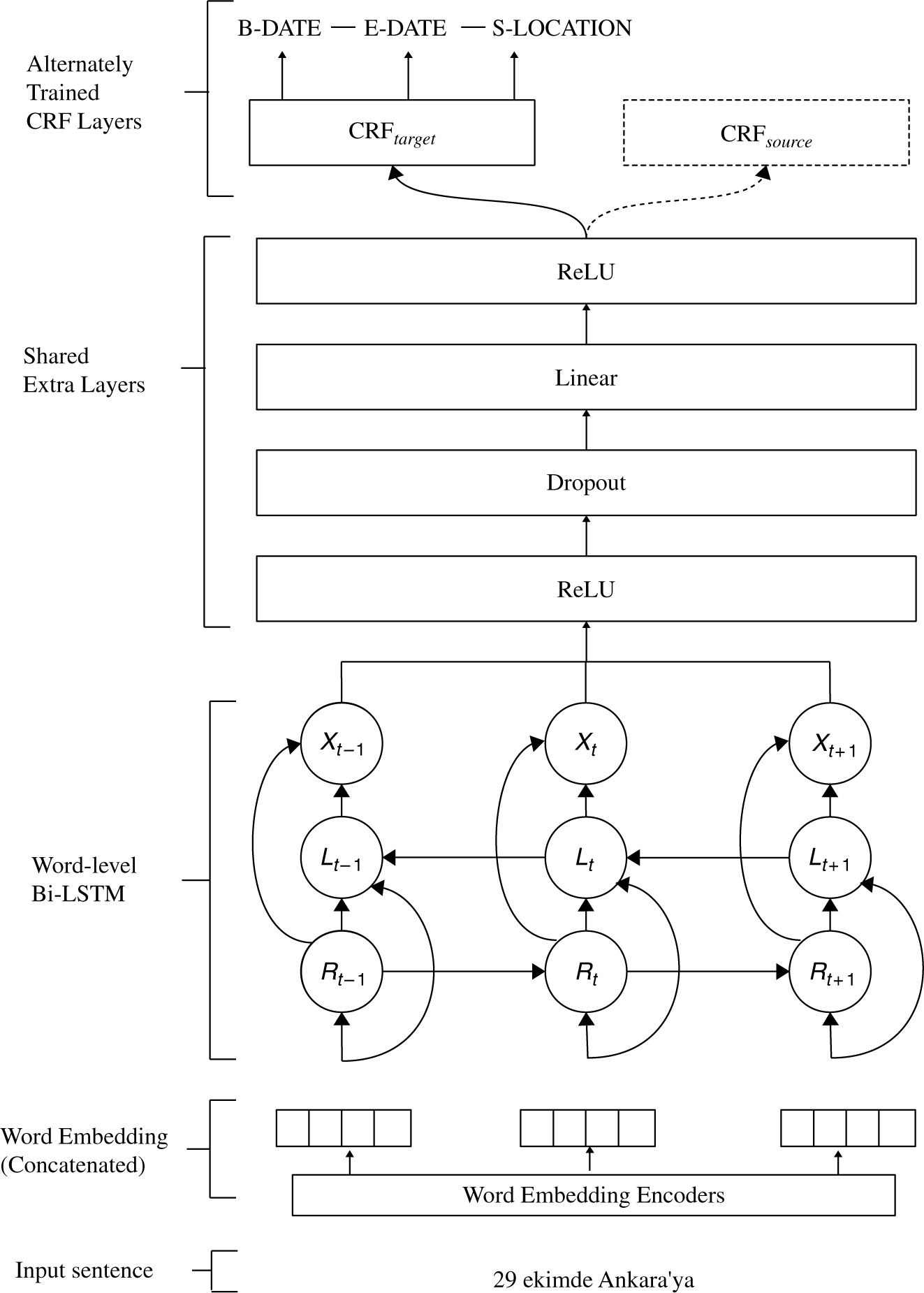
The architecture of the baseline transfer learning model is given in Figure 5. As shown in the figure, lower layer that involves the word-level Bi-LSTM is shared by two CRFs. The embeddings are also shared by both CRF layers. However, the CRF layer involves two independent CRFs, where one of them is trained on the formal text and the other one is trained on the noisy text. Therefore, we transfer the dependencies learnt from the larger and formal text toward the noisy text gradually. The training procedure is performed by doing the gradient updates through each CRF layer alternately. In other words, in every other iteration, the output of one CRF layer is considered to perform the gradient update based on its loss by discarding the output of the other CRF layer. Therefore, the outputs of both CRFs are used alternately, where both CRF outputs are gradually optimized in time. In this way, using the knowledge transferred from the larger text, some dependencies between rare entity types and rare words are also learnt for the noisy text.
Overview of the transfer learning model that incorporates an additional CRF layer. CRF layers are alternately trained on different datasets so that the shared layers learn from both datasets and therefore learning can be transferred from the source dataset to the target dataset. The Turkish input sequence “29 ekimde Ankara’ya” means “To Ankara on 29th October”.

This model is an adaptation of the cross-domain transfer learning model proposed by Yang, Salakhutdinov, and Cohen (Reference Yang, Salakhutdinov and Cohen2017). In their work, the authors introduce various transfer learning architectures for cross-domain, cross-application, and cross-lingual transfer. We adapt the cross-domain transfer learning architecture by introducing the parameter sharing in the word-level Bi-LSTM, where each domain learns a separate CRF layer. However, the LSTMs are shared across different domains. Cotterell and Duh (Reference Cotterell and Duh2017) also apply a similar transfer learning scheme for low-resource NER with a shared Bi-LSTM across different languages with language-specific CRFs. We particularly used the Bi-LSTM-CRF architecture and not a single Bi-LSTM as suggested by Riedl and Padó (Reference Riedl and Padó2018) for transfer learning because the best results have already been achieved by this architecture without transfer learning (Reimers et al. Reference Reimers, Eckle-Kohler, Schnober, Kim and Gurevych2014; Ma and Hovy Reference Ma and Hovy2016; Cotterell and Duh Reference Cotterell and Duh2017).
We further extended the transfer learning architecture by adding extra shared layers on the baseline architecture. Following the various architectures proposed by von Däniken and Cieliebak (Reference von Däniken and Cieliebak2017), we added two ReLUs, a dropout layer, and a linear layer (a feed-forward network) between the Bi-LSTM and the CRF layers. The architecture of the model is given in Figure 6. First,
 $X_t$
, the output of the Bi-LSTM is passed through an ReLU (Nair and Hinton Reference Nair and Hinton2010) layer. Then, a dropout is applied to
 $X_t$
. The dropout applied output
 $X_t$
is then passed through a feed-forward network with one hidden layer and ReLU activation, which outputs a score for possible k number of entity tags:
 $$\begin{equation} score_t = W_2 \cdot ReLU(W_1h_t+b_1)+b_2 \end{equation}$$
where
 $W_1 \in {{R}^{d_H\times d_X}}$
,
 $b_1 \in R^{d_H}$
,
 $W_2 \in {{R}^{k\times d_H}}$
, and
 $b_2 \in R^{k}$
are the weights of the feed-forward network. Here,
 $d_H$
is the dimension of the hidden layer and
 $d_X$
is the dimension of
 $X_t$
. As seen from the figure, all layers and their parameters are shared by both CRF layers. The motivation behind adding a feed-forward network between the Bi-LSTM layer and the CRF layer is to encode the outputs of the Bi-LSTM by introducing sparsity to lead the negative features to become zero. Otherwise, vanishing gradients problem stands out again due to the many layers that require backpropagation during gradient descent. Therefore, some outputs are forced to be zero by the ReLU unit, and the vanishing gradient problem is naturally solved in this multilayered architecture.
Overview of the extended transfer learning model that incorporates an additional CRF layer. CRF layers are alternately trained on different datasets so that the shared layers learn from both datasets and therefore learning can be transferred from the source dataset to the target dataset. The Turkish input sequence “29 ekimde Ankara’ya” means “To Ankara on 29th October”.

As for the training, analogously, we performed backpropagation using the loss of one of the CRF layers alternately. Therefore, the CRF layer gains generalization through two different datasets from different domains during training.
6. Experiments & Results
We did the experiments for the baseline and the transfer learning models on Turkish, and additionally on English to compare with other related work. First, we describe the datasets, the implementation details of the models, and the evaluation methods that we followed in this work, then we present the experimental results along with a discussion on the results.
6.1 Implementation details
Both the CNN-based (
 $E_{w_i}^{(c_{cnn})}$
) and Bi-LSTM (
 $E_{w_i}^{(c_{Bi-LSTm})}$
)-based orthographic character embeddings have a dimensionality of 30. The CNN-based character embeddings are initialized by uniform Glorot initializer. For the CNN model, 20 is assigned for the maximum word length, where the shorter words are padded with zeros and the longer ones are truncated. The Bi-LSTM-based character-level word representation has a dimensionality of 60.
We trained fasttext (Bojanowski et al. Reference Bojanowski, Grave, Joulin and Mikolov2017) for Turkish with a learning rate of 0.025 for 4 epochs to learn the character n-gram-level word embeddings
 $E_{w_i}^{(c_{ngram})}$
that have a dimensionality of 200. Character n-gram-level word embeddings have a dimension of 300 for English.
Morpheme-level word embeddings
 $E_{w_i}^{(m)}$
have a dimensionality of 75 and 50 for English and Turkish, respectively. Word-level word embeddings
 $E_{w_i}^{(w)}$
have a dimension of 400 for both English and Turkish.
Weights of the shared ReLU and linear layers in transfer learning models are initialized using uniform Glorot initializer and biases are set to 0.
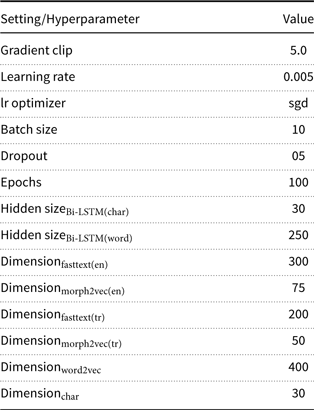
During all experiments, both the baseline and transfer learning models are trained using backpropagation and the parameters are optimized using Stochastic Gradient Descent algorithm. We trained both models for 100 epochs and set the learning rate to 0.005 in addition to using a gradient clipping of 5.0. Dropout rate of all of the dropout layers is set to 0.5. Hidden dimension of character-level Bi-LSTM and word-level Bi-LSTM layers are set to 30 and 250, respectively. Tuning the dimensions or any other hyperparameter did not significantly improve the accuracy of the models. An overview of the hyperparameters is given in Table 1.
Implementation and training details

All models are implemented using Tensorflow 1.8.0,Footnote d and the implementations and the related material are publicly available.Footnote e
6.2 Tagging scheme
When it is thought that a named entity can span multiple consecutive words, a tagging scheme that impose some constraints on determining the possible label of a word is highly useful. Inside, outside, beginning (IOB) format is such a tagging scheme that uses B for the token that refers to the beginning of a named entity, I for the token that refers to the inside of a named entity, and O for the token for other words in the sequence. Inside, outside, beginning, ending, single (IOBES) is a variant of IOB format that further restricts the possible label of a word with additional tokens such as E token that is used for specifying the ending of a named entity, and S token that is used for the named entities with only one word. Here is an example sentence tagged with the IOBES format:
Mustafa/B-PERSON Kemal/I-PERSON Atatürk/E-PERSON was born in 1881/S-DATE in the former Ottoman/B-ORGANIZATION Empire/E-ORGANIZATION.
We follow the IOBES tagging scheme for Turkish and IOB tagging scheme for English to be able to compare with other related work using the same annotated noisy text.
6.3 Datasets
In order to obtain Turkish character n-gram-level word embeddings, we trained Skipgram model of fasttext (Bojanowski et al. Reference Bojanowski, Grave, Joulin and Mikolov2017) on a corpus of 20M Turkish tweets.Footnote f As for English, we used the pretrained English word embeddings that are provided by fasttextFootnote g (Bojanowski et al. Reference Bojanowski, Grave, Joulin and Mikolov2017). The word embeddings are obtained from the Continuous Bag of Words model of fasttext trained on Common Crawl,Footnote h a website that provides web crawl data.
Pretrained word embeddings obtained from word2vec (Mikolov et al. Reference Mikolov, Chen, Corrado and Dean2013) are used to learn the morpheme-level word embeddings by imitating them in morph2vec (Üstün et al. Reference Üstün, Kurfal and Can2018).
We use pretrained word2vec (Mikolov et al. Reference Mikolov, Chen, Corrado and Dean2013) embeddings that are trained on a corpus that involves 400M English tweets (Godin et al. Reference Godin, Vandersmissen, De Neve and Van de Walle2015). As for Turkish, we use pretrained word2vec embeddings that are trained on a news corpus (Boğaziçi University web corpus) that involves 423M words (Sak, Güngör, and Saraçlar Reference Sak, Güngör and Saraçlar2008, Reference Sak, Güngör and Saraçlar2011) and 20M Turkish tweets (Sezer, Sezer, and Ünivesitesi Reference Sezer, Sezer and Ünivesitesi2013).
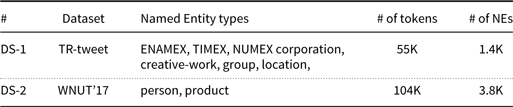
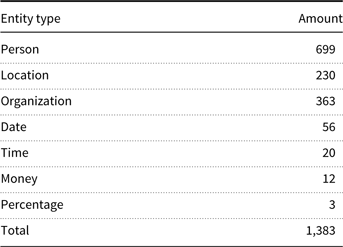
We experimented on two datasets on Turkish and English that are given in Table 2. DS-1 (Şeker and Eryiğit Reference Şeker and Eryiğit2017) is the reannotated version of the initial Turkish noisy dataset (Çelikkaya et al. Reference Çelikkaya, Torunoğlu and Eryiğit2013) that consists of ENAMEX, TIMEX, and NUMEX types. As we can see in Table 3, this is a relatively small dataset with a highly imbalanced entity type distribution. Since the dataset does not have training and test splits, during experiments, we applied 10-fold cross-validation and split the dataset into training, test, and validation sets with ratios of 80%, 10%, and 10%, respectively for Turkish, and we did not apply a cross-validation for English to be able to compare our results with other work participated in the 3rd WNUT’17.Footnote i
Datasets

Number of entity types in Turkish noisy dataset, DS-1

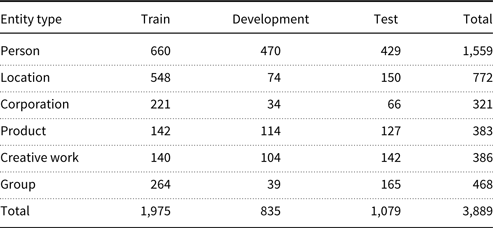
DS-2 is an English noisy dataset (Derczynski et al. Reference Derczynski, Nichols, van Erp and Limsopatham2017) that is released by the 3rd WNUT’17 that includes person, location, corporation, product (consumer goods, service), creative work (song, movie, tv series, book), and group (music band, sports team, noncorporate organizations) types. This dataset has training, test, and development sets with sizes of 65K, 23K, and 16K tokens. Distribution of the entity types in this dataset is also given in Table 4.
Number of entity types in English noisy dataset, DS-2

6.4 Preprocessing
Prior to tokenization of the datasets,
We replaced the URLs (tokens starting with http) with a special token. This allows us to reduce sparsity and allows our model to converge relatively faster.
We replaced the Twitter mentions (Twitter usernames starting with @ sign) with another special token in DS-1. This reduced the number of PERSON entities from 4256 to 699, and we believe this prevents memorizing the mentions in the text.
6.5 Evaluation methods
We evaluate the results with accuracy, precision, and recall. Accuracy measures the overall performance of the model by computing the ratio of correctly labeled tokens to the total number of tokens. However, this results in a highly imbalanced value since most of the tokens are not part of a named entity and, therefore, labeled as OTHER. Precision gives the ratio of correctly labeled named entities (chunks) to the total label predictions, and recall measures the ratio of correctly labeled named entities (chunks) to the total number of correct predictions. Finally, F1 score is computed as the harmonic mean of precision and recall:
 $$\begin{equation} F1 = \frac{2*precision*recall}{(precision+recall)} \end{equation}$$
In order to measure the overall performance of any given model for the sequence labeling task, F1 score is commonly chosen over accuracy since it intuitively defines a good measure of the model by taking false negatives and false positives into account, whereas accuracy gives imbalanced results due to highly skewed entity type distribution because most of the tokens do not have an entity label.
6.6 Experimental results on Turkish
We experimented with different combinations of embedding methods to analyze the impact of the word and subword embedding methods used in the baseline and the transfer learning models. To this end, we used word-based word embedding method word2vec (Mikolov et al. Reference Mikolov, Chen, Corrado and Dean2013), character n-gram-level word embedding method fasttext (Bojanowski et al. Reference Bojanowski, Grave, Joulin and Mikolov2017), morpheme-level word embedding method morph2vec (Üstün and Can Reference Üstün, Can, Král and Martín-Vide2016), character embeddings trained with a Bi-LSTM (and CNN), and orthographic character-level embeddings trained on a character-level Bi-LSTM.
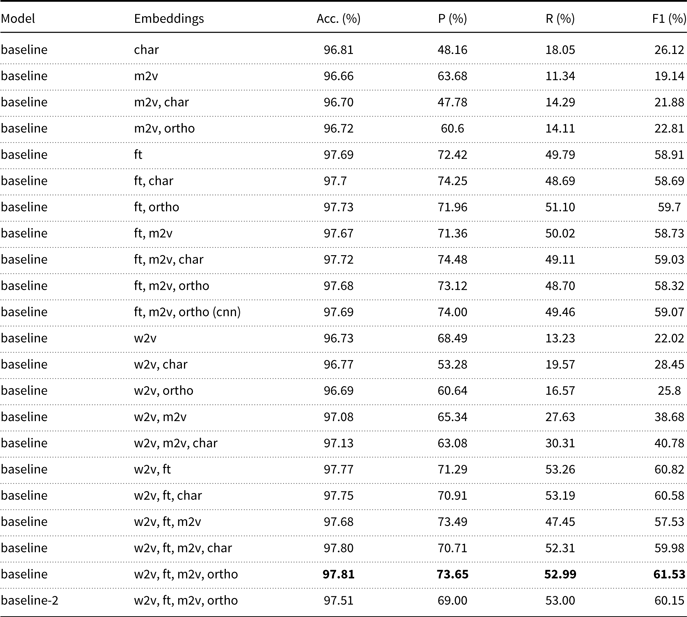
The results obtained from the baseline model are given in Table 5. In the baseline model, among using only one type of embedding, fasttext performs the best compared to other embedding types with an F1 measure of 58.91%, where CNN-based orthographic char embeddings perform 26.12%, morph2vec performs 19.14%, and word2vec performs 22.02%. This shows that using character n-grams in representation learning can cope with the sparsity issue better compared to other embedding types. We were expecting a similar performance from the morph2vec embeddings; however, they have not performed as well as fasttext. This might be a sign of ill-formed nature of the noisy text, where the morphemes are degenerated. Since morph2vec is trained on a formal text with exact morpheme boundaries, the noisy text could not benefit from the morphological knowledge adequately.
Overview of the experimental results of the baseline models on the Turkish noisy dataset, DS-1. Baseline-2 uses extra layers in the Bi-LSTM CRF model. Fasttext (Bojanowski et al. Reference Bojanowski, Grave, Joulin and Mikolov2017), morph2vec (Üstün et al. Reference Üstün, Kurfal and Can2018), word2vec Mikolov et al. (Reference Mikolov, Chen, Corrado and Dean2013), character-level and orthographic embeddings are denoted in the embeddings column by ft, m2v, w2v, char and ortho respectively. Acc refers to accuracy, P refers to Precision, and R refers to Recall.

When the contribution of other embeddings used along with fasttext embeddings is observed, we see that orthographic features contribute the most with an improvement of 0.79% and the other embedding types do not contribute to the performance of the model and rather they degrade the results. We believe that since fasttext embeddings also contain character-level and morpheme-level features, those embeddings do not provide a significant improvement on the fasttext embeddings. The results are also similar when more embeddings are combined with fasttext embeddings, which is due to a similar reason.
Because of the morphological structure of Turkish, using solely word2vec trained word embeddings does not perform very well. Combining the word embeddings with character embeddings or orthographic embeddings improves the scores, although the final scores are still below 30%. Using morph2vec along with word2vec provides a better improvement compared to character-level word embeddings and orthographic embeddings with an F1 measure of 38.68%. The highest improvement is obtained, when word2vec is combined with fasttext and it gives an F1 measure of 60.82%.
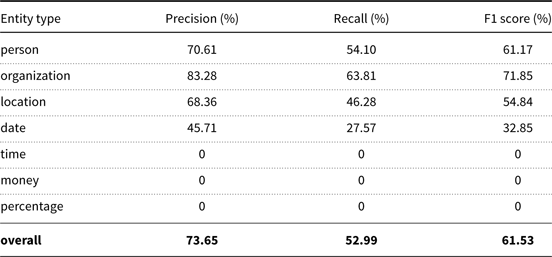
The highest performance is obtained when all embedding types (fasttext, word2vec, morph2vec, and orthographic encoding) are used together, which gives an F1 measure of 61.53%. The highest scores obtained for different entity types are given in Table 6. Our baseline model fails to label the infrequent types such as time, money, and percentage since the annotated noisy data are too small to learn the latent features for such infrequent entity types. However, the frequent entity types such as person and organization are learned well compared to location and date.
Experimental results of the baseline model with fasttext (Bojanowski et al. Reference Bojanowski, Grave, Joulin and Mikolov2017), morph2vec (Üstün et al. Reference Üstün, Kurfal and Can2018), word2vec (Mikolov et al. Reference Mikolov, Chen, Corrado and Dean2013) and orthographic character-level embeddings on Turkish noisy dataset, DS-1

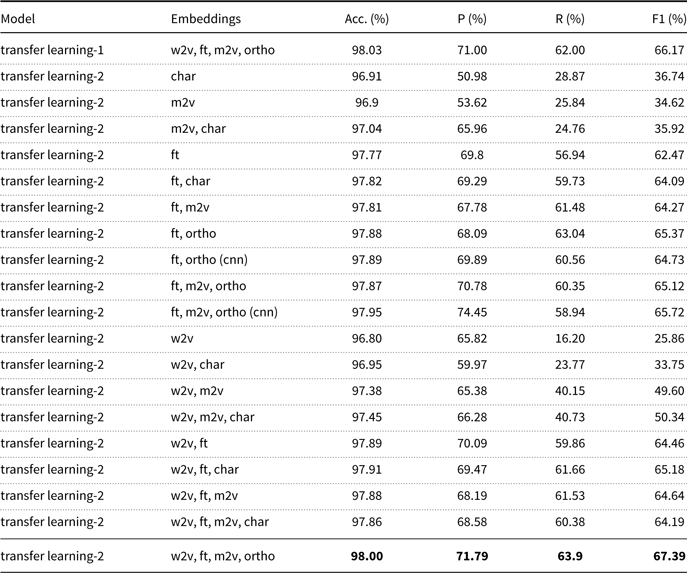
In order to transfer any learned features from another larger dataset, we added an extra CRF layer where the Bi-LSTM layers are shared by both datasets as described in Section 5. We call this model transfer learning 1. We trained the model alternately with different datasets in each epoch. Therefore, the shared layers up to the CRF layers can learn from both of the datasets. As a larger dataset (source dataset), we used the reannotated version of the Turkish news corpus with 492K tokens, which was originally provided by Tür et al. (Reference Tür, Hakkani-Tür and Oflazer2003) and reannotated by Şeker and Eryiğit (Reference Şeker and Eryiğit2017). The results obtained from the transfer learning models are given in Table 7. By using orthographic character-level word embeddings, character n-gram-level word embeddings, morpheme-level word embeddings, and word-level word embeddings, we obtained an F1 score of 66.17% that is better than the baseline model that incorporates all embedding types.
Overview of the experimental results of the transfer learning models on the Turkish noisy dataset, DS-1. Fasttext (Bojanowski et al. Reference Bojanowski, Grave, Joulin and Mikolov2017), morph2vec (Üstün et al. Reference Üstün, Kurfal and Can2018), word2vec Mikolov et al. (Reference Mikolov, Chen, Corrado and Dean2013), character-level and orthographic embeddings are denoted in the embeddings column by ft, m2v, w2v, char and ortho respectively. Transfer learning - 1 represents the basic transfer learning architecture without the additional (ReLU, linear) layers between the word-level Bi-LSTM and CRF layers and transfer learning - 2 is the transfer learning model with additional ReLU and linear layers. Acc refers to accuracy, P refers to Precision, and R refers to Recall

We also incorporated additional ReLU and linear layers between the Bi-LSTM and CRF layers as described in Section 5. We call the extended model as transfer learning 2. The results obtained from the transfer learning model are coherent with the results of the baseline model. Fasttext embeddings perform the best with an F1 measure of 62.47%, whereas using the other embedding types on its own perform comparably poorer similar to the baseline model. Morph2vec embeddings and character embeddings perform alike with F1 measures of 34.62% and 36.74%, respectively, which are still significantly better than the results obtained from the baseline model when those embeddings are used alone. This is possibly due to the inclusion of another larger dataset that compensates the sparsity issue in embeddings.
Interestingly, using character embeddings in addition to fasttext embeddings improves the F1 score from 62.47% to 64.09%, whereas in the baseline model adding character embeddings on fasttext embeddings did not make an impact. This is possibly due to the transfer of character embeddings between different domains. However, without transferring any character information between the domains, the fasttext emnbeddings seem to cover character embeddings and this hinders the impact of character embeddings against fasttext embeddings. Similar to the baseline results, using word2vec embeddings or character embeddings along with fasttext embeddings improves the scores by around 2%. Using orthographic embeddings along with fasttext embeddings also improves the scores by around 3%.
Using character embeddings in addition to fasttext and word2vec embeddings still improves the scores with an F1 measure of 65.18%, which was not the case in the baseline model. The highest score is obtained with an F1 measure of 67.39% when again the combination of all embedding types (word2vec, fasttext, morph2vec, orthographic embeddings) is used. Therefore, adding extra layers improved the results considerably.
As an alternative to orthographic character-level embeddings, we also incorporated the character-level embeddings that are trained on a character-level Bi-LSTM (by using the actual characters this time instead of replacing the characters with various symbols for the shape of the word) following the work of Lample et al. (Reference Lample, Ballesteros, Subramanian, Kawakami and Dyer2016). However, the results obtained from the character-level word embeddings performed comparably poorer.
Additionally, in order to analyze the impact of the additional layers, we performed a separate experiment for the baseline model with a single CRF layer without any transfer learning. The model is called baseline-2 in Table 5. We used word2vec, fasttext, morph2vec, and orthographic embeddings in this setting. The baseline model with the additional layers gives 60.15% F1 score, which is lower than the baseline model without the additional layers using the same embeddings.
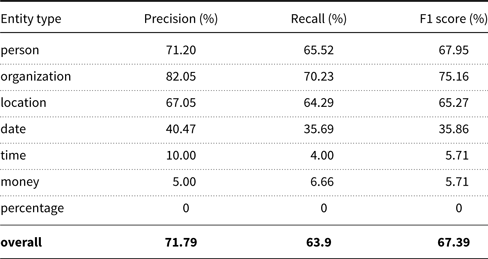
Table 8 presents the highest scores obtained for different entity types in the transfer learning model. We can see that the transfer learning model improves upon the results of the baseline model significantly. Although the overall results on rare entity types (such as date, time, money) are higher compared to the baseline model, transfer learning model still fails to label percentage but we believe that this is an expected outcome given that it has only three examples belonging to the percentage type in the whole dataset. Note that we are also using cross-validation so that number of times an entity type is seen in one iteration is further decreased.
Experimental results of transfer learning model (transfer learning - 2) with fasttext (Bojanowski et al. Reference Bojanowski, Grave, Joulin and Mikolov2017), morph2vec (Üstün et al. Reference Üstün, Kurfal and Can2018), word2vec (Mikolov et al. Reference Mikolov, Chen, Corrado and Dean2013) and ortographic character-level embeddings on Turkish noisy dataset, DS-1

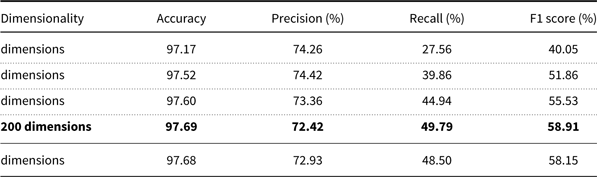
Experimental results obtained from different dimensions of fasttext character n-gram-level word embeddings (Bojanowski et al. Reference Bojanowski, Grave, Joulin and Mikolov2017)

We trained Skipgram model of fasttext (Bojanowski et al. Reference Bojanowski, Grave, Joulin and Mikolov2017) on the same corpus of 20M Turkish tweetsFootnote j for different dimensions of character n-gram-level word embeddings to analyze the impact of the character n-gram-level word embeddings’ dimensionality. The results for different sizes of embeddings are given in Table 9. The results show that the scores improve with higher dimensionalities, where we obtain the highest scores with 200 dimensional fasttext embeddings. The results also support the findings of Yin and Shen (Reference Yin and Shen2018), where it was reported that the over-parametrization does not hurt the performance and the performance increases with the dimensionality up to a level, where it degrades slightly and converges so long as the dimensionality increases.
In all experiments, we used orthographic and character embeddings that have a dimensionality of 30. We did further experiments to analyze the impact of the dimensionality of the orthographic embeddings. We used 200 dimensional fasttext embeddings along with orthographic embeddings with different dimensions (30, 50, 100). However, the results did not change considerably, and the F1 score was always around 59–60%, which are in line with the previous results reported in Table 5.
Since we used pretrained word2vec embeddings that are already high dimensional (400), we did not perform further experiments to analyze the dimensionality of the word2vec embeddings. As Yin and Shen (Reference Yin and Shen2018) suggest, the higher dimensions of word embeddings perform better compared to lower dimensions to a certain extent.
As for the morph2vec (Üstün et al. Reference Üstün, Kurfal and Can2018) embeddings, they are optimized by the authors using 50 and 75 for the morph vector dimensions for Turkish and English, respectively.
6.6.1 Comparison with related work on Turkish
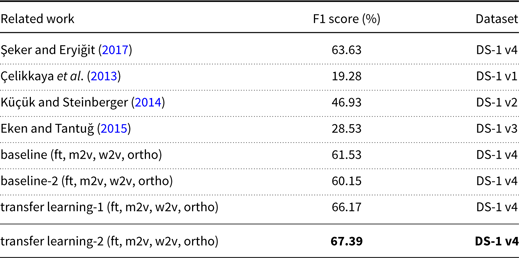
We compare our results with the related work on Turkish noisy dataset DS-1. The results are given in Table 10. The related work uses different reannotated versions of the same dataset; therefore, named entity distributions within the datasets may slightly differ; however, the difference between the datasets is not very significant. Therefore, all results are comparable with each other. Şeker and Eryiğit (Reference Şeker and Eryiğit2017) present the latest version called DS-1 v4, which is also used in our experiments. Note that, we replaced any Twitter mentions (number of mentions labelled as person: 3557) in the dataset prior to training. We compare our model with the results of Şeker and Eryiğit (Reference Şeker and Eryiğit2017) that are obtained by replacing the mentions in the tweets, so that we can make a fair comparison. Additionally, we compare our model with the models proposed by Çelikkaya et al. (Reference Çelikkaya, Torunoğlu and Eryiğit2013), Küçük and Steinberger (Reference Küçük and Steinberger2014), and Eken and Tantuğ (Reference Eken and Tantuğ2015).
Comparison with related work on Turkish noisy dataset DS-1. All results are tested on the same noisy text and are therefore comparable with each other

It should be noted that none of the related work on Turkish NER is designed particularly for noisy text. Therefore, those models are trained on formal text, and as an additional experimental setting, the authors also present their results on noisy text by using the Turkish noisy text (from DS-1 v1 to DS-1 v4) only for testing purposes. Therefore, our training sets are different.
Our baseline model and the transfer learning model without the additional layers outperform the models proposed by Çelikkaya et al. (Reference Çelikkaya, Torunoğlu and Eryiğit2013), Küçük and Steinberger (Reference Küçük and Steinberger2014), and Eken and Tantuğ (Reference Eken and Tantuğ2015) significantly with F1 measures of 61.53% and 66.17% respectively, whereas the highest score among the other works is 46.93%. The model proposed by Şeker and Eryiğit (Reference Şeker and Eryiğit2017) is slightly better with an F1 measure of 63.63%.Footnote k Nevertheless, our transfer learning model with extra layers outperforms all of the models with an F1 score of 67.39%.
6.6.2 Error analysis
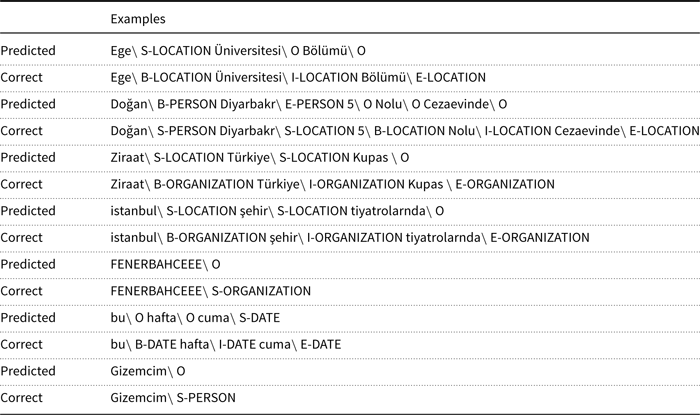
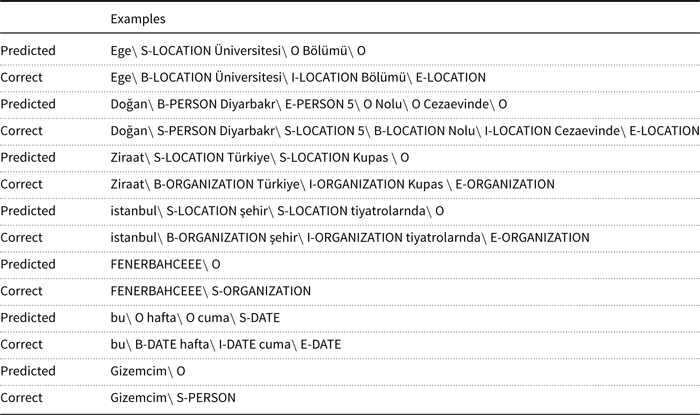
We did a qualitative error analysis to examine the common errors in the results. Frequent person names are usually tagged correctly. However, if they are not frequent or if they are spelled with multiple vowels to give a shouting effect (e.g., Tülaaaaaaaayy, where the correct name is Tülay), then they may not be tagged correctly. In some circumstances, the location names are also tagged as PERSON especially when the person names are followed straight away by location names. This mistagging does not occur when organization names are followed by location names.
Another frequent error type occurs when the organization names span across few words. Those organization names are usually confused with the location names. This mistagging also occurs when the organization name is not frequent enough. Another interesting usage is seen with the organization names that are shortened by the name of the location since the organization belongs to that location. For example, instead of using Trabzonspor (the football team that belongs to the city Trabzon), it is shortened to Trabzon to refer to the team. This requires more information to extract the correct meaning of the named entity and usually such names are mistagged by our models. Those are the typical tagging errors of the organization entries. Apart from these, frequent and single word organization names are tagged correctly by the models. Abbreviated organization names are also tagged correctly whether or not capitalized (e.g., “FB” for the football team name “Fenerbahçe”, “gs’ for the football team name “Galatasaray”). Even some organization names that include spelling errors are tagged correctly by our model. However, some of the misspelled organization names are not tagged as organization, but instead tagged as other in the gold data. Therefore, although those organization names are tagged correctly by our model, they are counted wrong. For example, Fenev (the name of the football team Fener is misspelt) is tagged as organization correctly by our model.
Location names that span across few words also usually cannot be identified properly, and only the first word is tagged correctly. Infrequent location names are also tagged incorrectly. Another error occurs because of the non-ASCII characters in the location names. Since we do not perform any preprocessing on the data, those location names also cannot be identified correctly.
The inflection of named entities also have a significant impact on tagging. The inflectional morphemes such as case markers or possessive morphemes are seen frequently with the location names. To our observation, the frequent inflectional morphemes do not affect the tagging. For example, “samsunsporuma” (means “to my team samsunspor”) is tagged correctly even though it has got two inflectional suffixes (i.e., “um” for “my” and “a” for “to”). However, infrequent morphemes lead to mistagging with the location names. Person names are also sometimes inflected with the suffix ciğim (means “dear” and usually abbreviated as cim in the informal text) as a salutation and they cannot be tagged correctly.
The infrequent named entities are learned better in transfer learning, which is an expected result. Even some of the frequent named entities that are inflected can be correctly tagged in transfer learning model. Otherwise, the errors are common in baseline and transfer learning. Therefore, the main contribution of transfer learning is the compensation of the infrequent named entities using a larger corpus. When we also compare the results obtained from different levels of word embeddings, it shows that using subword information improves the tagging significantly. However, the subword information in noisy text does not need to be syntactic (morphological units) as suggested and character n-gram-level features help in tagging substantially.
As for the date label, the week days can be tagged correctly. However, analogously, if they span over multiple words, they cannot be identified.
A list of examples to errors in our Turkish results is given in Table 11.
A list of incorrect tags in Turkish
6.7 Experimental results on English
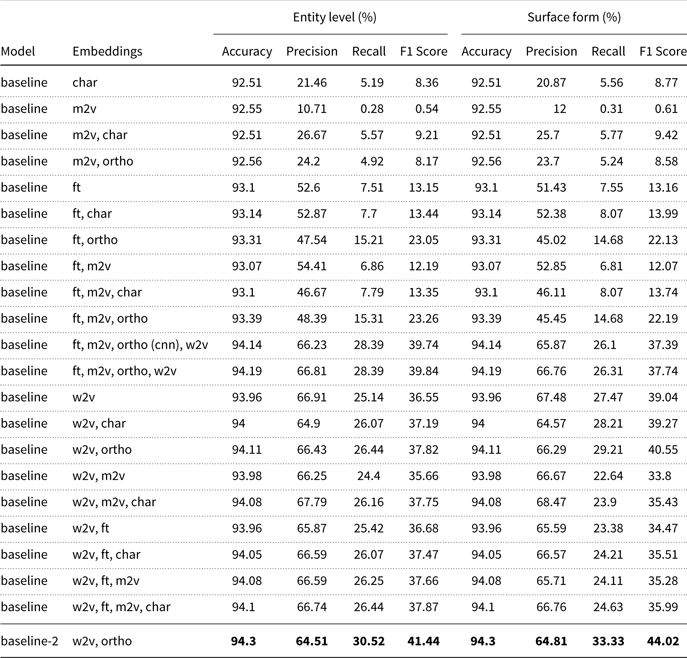
We performed a similar set of experiments by combining various word representations to measure the effect of different word and subword representation levels for the English noisy text. Analogously, we employed word-based word embedding method word2vec (Mikolov et al. Reference Mikolov, Chen, Corrado and Dean2013), character n-gram-level word embedding method fasttext (Bojanowski et al. Reference Bojanowski, Grave, Joulin and Mikolov2017), morpheme-level word embedding method morph2vec (Üstün and Can Reference Üstün, Can, Král and Martín-Vide2016), character embeddings trained with a Bi-LSTM (and CNN), and orthographic character-level embeddings trained on a character-level Bi-LSTM. The overview of the English results is given in Tables 12 and 13 for the baseline and the transfer learning models, respectively.
The results of the baseline model on the English noisy dataset, DS-2. Baseline-2 uses extra layers in the Bi-LSTM CRF model. Fasttext (Bojanowski et al. Reference Bojanowski, Grave, Joulin and Mikolov2017), morph2vec (Üstün et al. Reference Üstün, Kurfal and Can2018), word2vec (Mikolov et al. Reference Mikolov, Chen, Corrado and Dean2013), character-level and orthographic character-level embeddings are denoted in the embeddings column by ft, m2v, w2v, char and ortho respectively
The results of the transfer learning model on the English noisy dataset, DS-2. Fasttext (Bojanowski et al. Reference Bojanowski, Grave, Joulin and Mikolov2017), morph2vec (Üstün et al. Reference Üstün, Kurfal and Can2018), word2vec (Mikolov et al. Reference Mikolov, Chen, Corrado and Dean2013), character-level and orthographic character-level embeddings are denoted in the embeddings column by ft, m2v, w2v, char and ortho respectively. Transfer learning - 1 represents the basic transfer learning architecture without the additional (ReLU, linear) layers between the word-level Bi-LSTM and CRF layers and transfer learning - 2 is the transfer learning model with additional Relu and linear layers

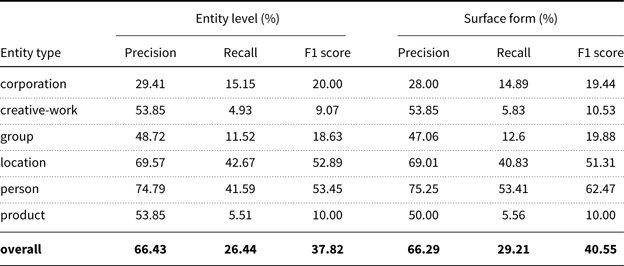
Among using solely character-level embeddings, morph2vec (Üstün and Can Reference Üstün, Can, Král and Martín-Vide2016), fasttext (Bojanowski et al. Reference Bojanowski, Grave, Joulin and Mikolov2017), or word2vec (Mikolov et al. Reference Mikolov, Chen, Corrado and Dean2013), the highest results are obtained from word2vec (Mikolov et al. Reference Mikolov, Chen, Corrado and Dean2013) with an F1 measure of 39.04% in the surface level and an F1 measure of 36.55% in the entity level, which gives a completely different picture from the Turkish results where the highest score was obtained from fasttext with an F1 measure of 58.91%. The English results are both lower than that of Turkish, and moreoever word-level embeddings are more beneficial in English compared to Turkish. Due to the morphological divergence between the two languages, obtaining a better performance from word-level word embeddings is an expected result. However, the performance is still not satisfactory compared to the highest result in Turkish when using a single type of word embedding. Using orthographic character-level word embeddings in addition to word2vec contributed the most with an F1 measure of 40.55% in the surface level and 37.82% in the entity level. Although the other embedding types do not contribute on top of the word2vec embeddings in the surface level, character-level word embeddings, orthographic embeddings, and fasttext embeddings slightly contribute to the word-level word embeddings; however, the contribution is not more than 0.6%.
Combining word2vec embeddings with other embeddings obtained from different levels still does not change the results, and the highest results in the surface level still remain the same as the one obtained from using solely word2vec embeddings. However, in the entity level, the highest performance is obtained by using word2vec, fasttext, morph2vec, and orthographic word embeddings, which gives an F1 measure of 39.84%. This is around 3% higher than the results obtained from using solely word2vec. However, in the surface level, the highest results are obtained by using word2vec and orthographic character embeddings with an F1 score of 40.55%.
Without using any word-level word embeddings, the results are far behind the highest obtained score in English, and most of them are below 20%. This concludes that word-level word embeddings of a morphologically poor language such as English bear further information compared to other embedding types, and the other levels of word embeddings hardly contribute on top of the word-level word embeddings.
Here, orthographic character-level embeddings are trained on CNN instead of Bi-LSTM performed poorer, and thus, we used only Bi-LSTM-trained character-level word embeddings in all experiments on English.
The highest results obtained from different entity types are given in Table 14. We obtain the highest scores again for the most frequent entity types such as person and location, whereas the other sparse entity types such as corporation, product, creative-work, or group cannot be detected as accurate as the frequent types.
The results of the baseline model with word2vec (Mikolov et al. Reference Mikolov, Chen, Corrado and Dean2013), and orthographic character-level embeddings on English noisy dataset, DS-2

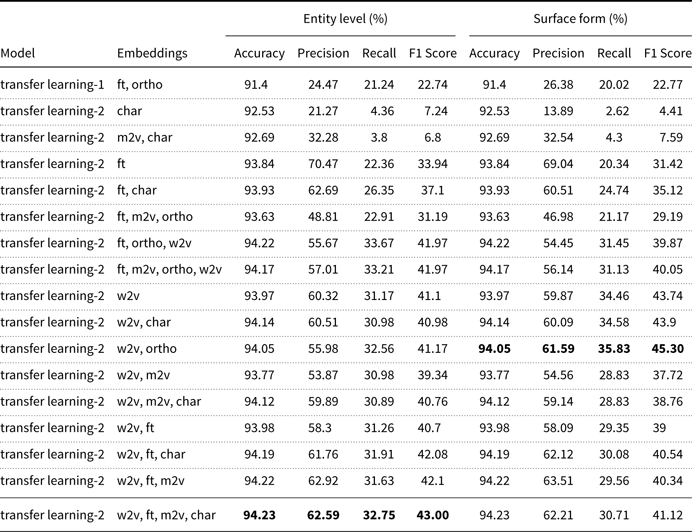
In both transfer learning models, we used the English noisy dataset released by the 2nd WNUT’16Footnote l as a source dataset. Therefore, both source and target datasets are noisy, but sizes of the datasets are different. The first transfer learning model, transfer learning - 1, has not improved upon the baseline and the results are even worse for this model. We obtained an F1 score of 22.77% for the entity level and 22.74% for the surface level from transfer learning - 1 by using fasttext embeddings and orthographic character-level word embeddings.
As for the transfer learning model with additional layers, the results are significantly improved upon the baseline model accordingly. For example, using solely word2vec embeddings in the baseline model gives an F1 measure of 39.04%, whereas it improves up to 43.74% in the surface level. The highest score is obtained with an F1 measure of 45.3%, when orthographic embeddings are combined with the word2vec embeddings, which was also the highest in the baseline model. Likewise, fasttext embeddings do not perform well on the transfer learning model for English. Therefore, the results obtained from baseline model transfer learning model for different levels of embeddings are coherent with each other.
We also performed another experiment with the baseline model with additional layers similar to Turkish, which is called baseline-2 in Table 12. We used only word2vec and orthographic character embeddings in this setting, since it gives the highest score in the surface level for the baseline model without the additional layers. Using the additional layers improves the F1 score up to 44.02%, which is higher than F1 score of 40.55% obtained from the baseline model without the additional layers using the same embeddings. In Turkish, using additional layers in the baseline model does not help, whereas in English the additional layers contribute significantly.
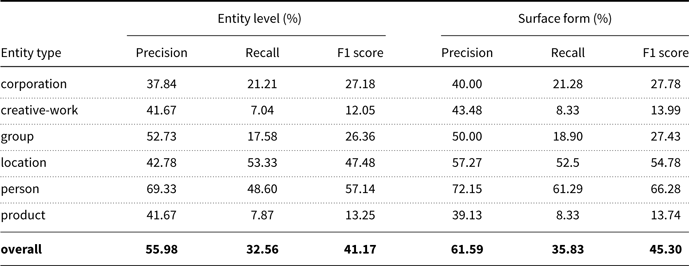
Table 15 presents the highest obtained results for different entity types for the transfer learning model. It is clearly seen that transfer learning helps the model to learn rarely seen entity types better compared to the baseline model, thus the overall results on both entity level and surface forms are significantly improved.
Experimental results of transfer learning model (transfer learning - 2) with word2vec (Mikolov et al. Reference Mikolov, Chen, Corrado and Dean2013) and ortographic character-level embeddings on English noisy dataset, DS-2

6.7.1 Comparison with related work on English
We present a comparison of our proposed models to the related work on English noisy dataset DS-2. The results are given in Table 16. Our transfer learning model with additional layers achieves competitive results for the entity level, whereas our baseline model and the transfer learning model with additional layers outperform all other models including the highest scoring models competed in WNUT’17, that are proposed by von Däniken and Cieliebak (Reference von Däniken and Cieliebak2017) and Aguilar et al. (Reference Aguilar, Maharjan, Monroy and Solorio2017). The highest score in related work was achieved by Aguilar et al. (Reference Aguilar, Maharjan, Monroy and Solorio2017) with 40.24% F1 score. Our transfer learning model gives 45.30% F1 score for the surface forms using the word2vec and orthographic character-level embeddings. However, applying McNemar testFootnote
m
(McNemar Reference McNemar1947) between the model proposed by Aguilar et al. (Reference Aguilar, Maharjan, Monroy and Solorio2017) and our transfer learning-2 model does not strongly imply this difference (p = 0.248) in the surface level. If we compare the transfer learning-2 model with the transfer learning model proposed by von Däniken and Cieliebak (Reference von Däniken and Cieliebak2017) in the surface level, McNemar test confirms the significance of this difference,
 $p<0.05$
. Therefore, our transfer learning-2 model significantly outperforms the transfer learning model of von Däniken and Cieliebak (Reference von Däniken and Cieliebak2017) in the surface level. Additionally, our baseline model with additional layers (baseline-2) gives 41.44% F1 score for the entity level, which is competitive to that of Aguilar et al. (Reference Aguilar, Maharjan, Monroy and Solorio2017), where their highest reported result is 41.86% for the entity level. However, McNemar test between the baseline-2 and the model of Aguilar et al. (Reference Aguilar, Maharjan, Monroy and Solorio2017) shows that this difference is not significant in the entity level (
 $p=1.0$
). The same also applies for the difference between the transfer learning model of von Däniken and Cieliebak (Reference von Däniken and Cieliebak2017) and baseline-2. On the other hand, McNemar test shows that the difference between baseline-2 model and the model proposed by Lin et al. (Reference Lin, Xu, Luo and Zhu2017) is significant (
 $p<0.05$
).
Comparison with related work on English noisy dataset DS-2. All results are comparable with each other
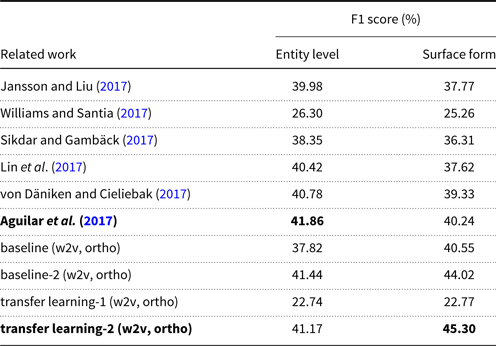
It should be noted that both Aguilar et al. (Reference Aguilar, Maharjan, Monroy and Solorio2017) and von Däniken and Cieliebak (Reference von Däniken and Cieliebak2017) make use of hand-crafted features such as capitalization or domain-specific knowledge such as gazetteers, whereas our models do not use any external resource.
6.7.2 Error analysis
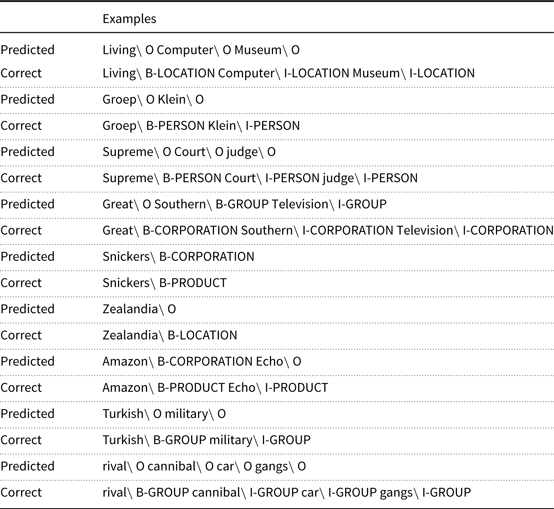
Since English is not a morphologically rich language, the errors do not occur because of the inflection of the named entities. Instead, most of the errors are due to the sparsity in the data. The variety of the proper names (i.e., word types) in English data is quite intense compared to Turkish data. Hence, the infrequent named entities cannot be identified analogously to Turkish. For example, although the name “Thomas Jane” is correctly tagged as person, “Groep Klein” cannot be tagged correctly as person since it is not as frequent as the former.
Analogously, location, organization, and person names that span across multiple words and that are also infrequent cannot be tagged correctly. However, the frequent named entities with multiple words can be tagged correctly (e.g., “Fly Community Theater”). The English text is overcapitalized compared to Turkish text and even the common names could be capitalized. This leads to mistagging especially in location names. For example, “Hotel Housekeepers Needed” is incorrectly tagged as location because of the location word “hotel” that is capitalized. On the other hand, “newzealand” is tagged as other, since the word embeddings do not help in those multiword entities.
Corporation names are usually tagged as group. Moreover, product names and creative work are tagged as corporation in general. Since the number of those entities are not sufficient to be learned in the noisy text, they cannot be identified properly. For example, corporation names are identified correctly, if they are frequent (e.g., “reddit”). Most of the time, the group names cannot be identified and tagged as other. The same also applies for the product names. For example, “Chevrolet Corvette” is tagged correctly as product, whereas “Centrelink” and “Sudocrem” are tagged as other.
A list of examples to errors in our English results is given in Table 17.
A list of incorrect tags in English

7. Conclusion & Future work
Various attempts have been made on Turkish NER recently. However, the results are still not satisfactory for noisy text. In this article, we have investigated using deep neural networks along with transfer learning instead of using rule-based or statistical approaches for NER on noisy Turkish text. Noisy text has its own difficulties because of the very sparse orthography of words that highly depend on the user style. Moreover, Turkish brings more challenges due to its morphologically rich structure, which introduces more sparsity in the text. We have investigated the effects of using different word and subword-level word representation methods such as word-level, character n-gram-level, morpheme-level, and orthographic character-level embeddings to mitigate the sparsity in text. We did not use any hand-crafted features and external resources unlike the other existing studies on Turkish NER on noisy text. We investigated transfer learning between a formal text and a noisy (informal) text in order to deal with the sparsity issue in the noisy text.
Therefore, we obtained the highest scores for Turkish NER on noisy text by using a combination of word-level and subword embeddings with transfer learning between a formal text and noisy text. We have also experimented with English as a relatively morphologically poor language and obtained the highest surface-level score and competitive entity-level scores on the English noisy dataset.
The results show that subword information plays a vital role for the NER task, especially on morphologically rich languages. More importantly, we can successfully learn valuable information without using hand-crafted features or domain-specific external resources. Furthermore, it is also proven that transfer learning approach can indeed effectively be used to tackle the problem of data scarcity.
Since our model is not domain and language specific, we believe that it can also be effectively trained and used for other morphologically rich languages, especially those with data sparsity problem. Therefore, experimenting for different languages remains as a future goal.
Supplementary materials
For supplementary material for this article, please visit https://doi.org/10.1017/S1351324919000627