Prosody has been related to speech processing in several ways, namely, to speech stream processing (Cutler, Dahan, & Donselaar, Reference Cutler, Dahan and Donselaar1997), lexical access (Donselaar, Koster, & Cutler, Reference Donselaar, Koster and Cutler2005; Soto-Faraco, Sebastián-Gallés, & Cutler, Reference Soto-Faraco, Sebastian-Gallés and Cutler2001), and syntactic parsing (Fodor, Reference Fodor1998). Prosody has been shown to affect speech stream processing, indicating sentence, phrasal, and word boundaries (Cutler et al., Reference Cutler, Dahan and Donselaar1997; Sebastián & Costa, Reference Sebastián-Gallés and Costa1997), as well as the division of words into sublexical units such as onset–rime (Goswami, Reference Goswami2003; Wood, Reference Wood and Columbus2006a). As a lexical access cue, prosody has been shown to be useful to distinguish between very similar words (Donselaar et al., Reference Donselaar, Koster and Cutler2005; Soto-Faraco et al., Reference Soto-Faraco, Sebastian-Gallés and Cutler2001). Finally, Fodor (Reference Fodor1998) has suggested that prosodic processing occurs in parallel with syntactic processing and that this information is used in the resolution of syntactic ambiguities.
All of these functions have been studied as part of speech and spoken word recognition processing. However, prosody may also be relevant for reading because it is a mandatory component of reading aloud. In a nutshell, in stress-assigning languages we cannot read without giving stress. Moreover, it has been claimed that readers impose stress and intonation patterns during silent reading (e.g., Brown, Reference Brown1958; Rayner & Pollatsek, Reference Rayner and Pollatsek1989). If prosodic processing occurs during silent reading then prosody may work in reading as it does in spoken word recognition. This requires the inclusion of word prosody (lexical stress) as part of the stored word's phonology, and suggests that readers know the stress regularities that are necessary to stress unknown or uncommon words. Stress representation and knowledge of stress regularities probably depend on readers’ ability to perceive changes in duration, intensity, and pitch (“prosodic sensitivity”). This argument suggests the hypothesis that prosodic sensitivity skills are related to reading performance. The aim of this paper is to investigate this hypothesis for reading in Spanish.
PROSODIC SENSITIVITY AND READING PERFORMANCE
Prosody has been related to reading through the onset–rime structure of the syllable. Wood and Terrel (Reference Wood and Terrell1998) proposed that prosody might highlight the phonological components of the spoken language. For example, it may facilitate vowel identification that, in turn, indicates the onset–rime division. This information is useful because rime is a relevant unit for reading acquisition, especially in nontransparent spelling systems (Goswami, Reference Goswami2002). According to this view, Wood and Terrell (Reference Wood and Terrell1998) analyzed the relationship between reading difficulties, spoken word recognition, and prosodic sensitivity. They low-pass filtered six-syllable sentences, so that the only information that remained was the intonation pattern. Prosodic sensitivity was then measured through a sentence-matching task, which consisted of choosing between two nonfiltered sentences, the sentence that matched the one that children first listened to. They found that children with reading difficulties were significantly worse than age-matched controls on this task. In further analysis of these data, Wood (Reference Wood and Columbus2006a) has found that, after controlling for vocabulary and age, prosodic sensitivity (rhythmic sensitivity in the original paper) still predicted a significant amount of the variance in phonological awareness scores. Wood interpreted these results as evidence that prosodic sensitivity underlies phonological awareness skills.
In other studies, prosodic sensitivity is measured as the ability to detect changes in word stress patterns (“stress sensitivity”). For example, Wood (Reference Wood2006b, Study 2) used a task that consisted of listening to individual words that had their metrical stress pattern reversed (e.g. “soFA”: sofa, instead of “SOfa”). Children (ages 5–7 years) were asked to identify the image that represented the target word from a selection of images presented in a cartoon. Wood found that stress sensitivity could account for independent variance in the children's spelling scores and rhyme detection scores (although stress sensitivity did not predict rime scores when vocabulary was taken into account). These results suggest that stress sensitivity might influence spelling development.
Stress sensitivity has also been studied within the field of second-language acquisition. For example, Wade-Woolley, Goetry, and Lung (Reference Wade-Woolley, Goetry and Lung2004) compared two groups of adult Spanish and Mandarin learners of English. They measured the subjects’ sensitivity to stress contrasts by using the Dupoux, Peperkamp, and Sebastián-Gallés (Reference Dupoux, Peperkamp and Sebastián-Gallés2001) task.Footnote 1 They found that Spanish-speaking participants who were better at this task were also those who scored higher in reading and language measures in English (word reading, phoneme deletion, and expressive vocabulary tasks). However, in the case of Mandarin-speaking participants, stress sensitivity (as measured by Dupoux et al.'s tasks) did not correlate with English reading and language measures. Mandarin is a tonal language, whereas Spanish and English are very similar in terms of stress. Therefore, it could be argued that unlike Spanish speakers, Mandarin speakers do not use lexical stress to learn to read English. Stress sensitivity may be necessary for reading acquisition in stress assignment languages.
Stress sensitivity has also been studied by comparing fixed versus nonfixed stress languages. In fixed stress languages all words have the same stress, as in French, where main word stress is placed on the last syllable. In nonfixed stress languages, stress varies across words, and it can be used to differentiate between word meanings, such as in English or Dutch. It is expected that stress sensitivity should play a relevant role in reading acquisition only in nonfixed stress languages. According to this hypothesis, Goetry, Kolinsky, Wade-Woolley, and Mousty (Reference Goetry, Wade-Woolley, Kolinsky and Mousty2006) used the Dupoux et al.'s task and found a significant correlation between stress processing and reading in French-native bilinguals schooled in Dutch and not in Dutch-native bilinguals schooled in French. The better that French children performed in Dupoux et al.'s task, the better they learned to read Dutch.
The above results do not exclude the possibility that Mandarin speakers may use prosody to learn to read in their own language. Prosodic sensitivity may still help them to learn tone discriminations and their correspondences in the written language. So and Siegel (Reference So and Siegel1998) studied Cantonese (another tonal language), and found that Cantonese speakers (children from Grade 1 to Grade 4 of primary school) with higher scores in a tone discrimination task performed better in reading words in their own language. So and Siegel (Reference So and Siegel1998) suggested that tone discrimination skills may be part of the phonological skills that are necessary for reading acquisition in Cantonese. As tone discrimination and rhyming scores were highly related, So and Siegel (Reference So and Siegel1998) suggested that both measures might be tapping similar skills (e.g., phonological awareness). However, they conducted several stepwise regression analyses and found that tone discrimination was a better predictor of word reading than of rhyming scores (a measure closely related to phonological awareness). Therefore, tonal discrimination scores in So and Siegel's study reflect something slightly different from phonological awareness.
Although Wade-Woolley et al. (Reference Wade-Woolley, Goetry and Lung2004) found a significant correlation between stress sensitivity and phonological awareness, Goetry et al. (Reference Goetry, Wade-Woolley, Kolinsky and Mousty2006) did not. There is, therefore, no unequivocal support for the view that prosodic sensitivity affects reading acquisition through phonological awareness (e.g., Goswami et al. Reference Goswami, Thomson, Richardson, Stainthorp, Hughes and Rosen2002). Differences in orthographic transparency may be responsible for these conflicting findings: English is a language with a less regular and less consistent orthography than Dutch. More research is needed here, but there is another way through which prosody may affect reading. Prosodic sensitivity may help beginner readers to learn word stress and cues for stress assignment. As previously argued, this knowledge is necessary for reading aloud, and it may be useful for word recognition. Whalley and Hansen's (Reference Whalley and Hansen2006) results seem to support this hypothesis. They assessed prosodic sensitivity at the word and phrase level. At word level, children (ages 8.8–10.5 years) heard compound nouns (i.e., “ice cream”) or noun phrases (i.e., “ice, cream”) and had to choose the graphic that best depicted the spoken phrase. At phrase level, children heard phrases that used the same reiterative syllable (e.g., “dee”) to eliminate phonemic information, but spoken so as to retain the same stress, rhythm, and intonational pattern of the original phrase. Whalley and Hansen (Reference Whalley and Hansen2006) found that word-level prosodic skills accounted for independent variance in word-reading accuracy, after controlling for phonological awareness, nonspeech rhythm sensitivity, and phrase-level prosodic sensitivity. Moreover, phrase-level prosodic skills accounted for reading comprehension, after controlling for phonological awareness, nonspeech rhythm sensitivity, and word-reading accuracy. They suggested that word-level prosodic sensitivity might contribute to word identification skills beyond a role in the development of phonological awareness, and that phrase-level prosodic sensitivity skills might help children to discern syntactic structure during silent reading.
STRESS PROCESSING AND READING
Stress processing is necessary for reading aloud, and it may be useful for word recognition. However, stress processing is underresearched. In the case of visual word recognition, this can be justified on the grounds that stress is inherent to speech but not to reading. However, in some written systems there are many cues to stress. Studies conducted on this topic are scarce, but they have shown that stress assignment uses some of the statistical and structural properties of language (Black & Byng, Reference Black and Byng1986; Capa, Nespor, Ielasi, & Miozzo, Reference Cappa, Nespor, Ielasi and Miozzo1997; Colombo, Reference Colombo1992; Gutiérrez & Palma, Reference Gutiérrez and Palma2004; Kelly, Reference Kelly2004; Kelly, Morris, & Verrekia, Reference Kelly, Morris and Verrekia1998; Miceli & Caramazza, Reference Miceli and Caramazza1993). Within the statistical properties, research has focused on orthographic regularities, frequency of the stress pattern, and neighborhood stress consistency. Within the structural properties, research has focused on syllabic structure.
In some languages (e.g., Greek) there are stress characters that mark word stress. In Greek, stress is always marked by a special character, similar to the acute accent in French (e.g., παράθυρο: window). However, Protopapas (Reference Protopapas2006) found that, despite the stress diacritic, Greek children (12–13 years old) mis-stressed a significant percentage of pseudowords (14.1%). In these cases, lexical stress seemed to depend on the similarity of these pseudowords to real words. This does not mean that children did not use the lexical stress diacritic at all; in fact, they more often assigned stress correctly than incorrectly. Protopapas’ (Reference Protopapas2006) results suggest that the stress diacritic is not the only cue for stress assignment in Greek, and that lexical information is also important.
In addition to the stress diacritic, other orthographic cues for lexical stress assignment have been studied. Kelly et al. (Reference Kelly, Morris and Verrekia1998) analyzed the orthographic regularities associated with stress in English. They found that the presence of more letters than necessary to represent a word's final phoneme indicates that stress falls on the last syllable. For example, in the word “disCUSS,” the last “S” is not necessary to pronounce the phoneme /S/, but it does indicate final-syllable stress compared to “DIScus,” where the absence of the final “S” indicates stress on the previous syllable. Therefore, in English, some letters in final positions could be considered as analogous to the stress marks used in other languages. Kelly et al. (Reference Kelly, Morris and Verrekia1998) used naming and lexical decision tasks to compare penultimate stressed words in two conditions: (a) marked for final stress (e.g., sheriff); (b) nonmarked (e.g., salad). In condition (a), word stress and orthographic stress cues did not match (i.e., although words had penultimate stress, orthographic stress cues pointed to final stress). In condition (b), orthographic stress cues did not point to final stress. Words in condition (a) were slower than in condition (b), which suggests that lexical stress affected word recognition.
In terms of statistical properties, the most common stress pattern has been proposed as the stress pattern by default. Consistent with this hypothesis, Black and Byng (Reference Black and Byng1986) studied nine deep dyslexic aphasic patients and found that fewer errors were made in disyllabic words with first syllable stress. Similarly, Colombo (Reference Colombo1992) found that Italian readers’ latencies to name three-syllable words were longer for low-frequency words stressed on the antepenultimate syllable (a rather unusual stress pattern in Italian) than for words stressed on the penultimate syllable (the most common stress pattern; Experiments 1 and 3). Moreover, in a lexical decision task more errors were made in words with antepenultimate stress (Experiment 2). Colombo (Reference Colombo1992) concluded that there is a general mechanism in Italian that assigns penultimate stress by default.
More recently, Burani and Arduino (Reference Burani and Arduino2004) failed to replicate Colombo's (Reference Colombo1992) results. They found that antepenultimate stressed words were named even faster than penultimate stressed words when they had a higher number of stress friends (words sharing the stress, the last syllable, and the penultimate rime; Experiment 2). Therefore, they concluded that stress assignment in Italian mainly depends on neighborhood stress consistency.
In terms of structural properties, syllabic structure is the most widely studied structural factor that has been related to stress in several languages. In Italian, Miceli and Caramazza (Reference Miceli and Caramazza1993) present the case of an acquired dyslexic patient, CLB. In a printed word naming task, CLB made fewer errors when word stress was predictable from the phonological structure (heavy penultimate syllable). Cappa et al. (Reference Cappa, Nespor, Ielasi and Miozzo1997) found something similar for patient GM, who made no errors in predictable stress words. In Spanish, Gutiérrez (Reference Gutiérrez2003) used lexical decision and naming tasks and found facilitation for words stressed consistently with the dominant pattern for their syllabic structure (prefinal stress for consonant vowel–consonant vowel [CV–CV] words, and final-stress for CV–CVC words). In English, Kelly (Reference Kelly2004) analyzed the MRC psycholinguistic database for disyllabic words, and found that the incidence of trochaic stress (first syllable stressed) increased significantly with the number of consonants in word onset position (Study 1). Moreover, in a study conducted via the Internet, he found that English speakers assigned trochaic stress to disyllabic pseudowords when they began with two consonants rather than one (Study 2). These data show that syllabic structure affects stress assignment, either through the syllabic quantity (heavy vs. light syllables), or through the onset structure.
Colombo (Reference Colombo1992) suggested that many sources of information intervene in lexical stress assignment. Consistent with this hypothesis, the literature we have reviewed shows that stress assignment processing uses both statistical and structural cues. Stress sensitivity may help readers to identify these cues in written language. Once readers learn these cues, they can use them to read words aloud or to gain access to the mental lexicon.
STRESS ASSIGNMENT IN SPANISH
Spanish orthography includes explicit and implicit cues to lexical stress. First, some words have a stress mark, an acute accent that marks word stress (e.g., “PÁjaro,” bird, with antepenultimate stress or “caJÓN,” drawer, with final stress). Second, most words without the stress mark (e.g., “CAsa,” house) have penultimate stress, except when they end in a consonant other than “n” or “s,” when they have final stress (e.g., “caLOR”). Words with final stress bear the stress mark if they end in “n” or “s” (e.g., “caJÓN”); therefore, the implicit rule is that words without stress mark that end in “n” or “s” have prefinal stress.Footnote 2 These rules correctly stress 99% of Alameda and Cuetos’ (Reference Alameda and Cuetos1995) word database. They may be implemented in several ways. For example, they may be modeled using a two-layer network where activation spreads from orthographic input units to phonological output units (e.g., Zorzi, Houghton, & Butterworth, Reference Zorzi, Houghton and Butterworth1998). Another possibility is that stress rules are integrated into the grapheme–phoneme conversion rules (GPC). Rastle and Coltheart's (Reference Rastle and Coltheart2000) adaptation of the Dual Route Cascade Model (Coltheart & Rastle, Reference Coltheart and Rastle1994) for stressing and reading disyllabic English words offers an example of this possibility.
THE PRESENT STUDY
Prosody itself is part of word phonology, at least for irregularly stressed words (Levelt, Roelofs, & Meyer, Reference Levelt, Roelofs and Meyer1999). Stress sensitivity should facilitate lexical stress acquisition (Wood, Reference Wood and Columbus2006a). Then, readers can use stored stress (instead of computing it through GPC rules) to read words more fluently. Stored stress would also facilitate lexical access because it could be used as another phonological cue to differentiate among words. Therefore, if stress sensitivity facilitates lexical stress acquisition, it should also predict reading. This study aims to test these hypotheses for Spanish, that is, that stress sensitivity (a) facilitates stress acquisition and (b) predicts reading.
To test the above hypotheses, subjects were required to perform two tasks. The first task was similar to that used by Dupoux et al. (Reference Dupoux, Peperkamp and Sebastián-Gallés2001), and its aim was to measure participants’ stress sensitivity. The relationship between stress sensitivity and reading scores was analyzed. The second task consisted of reading aloud a list of pseudowords drawn up according to Spanish stress rules. The readers’ goodness of fit to these rules was related to stress sensitivity.
In addition to stress and reading tasks, we required readers to perform phonological awareness and working memory tasks. We used phonological awareness scores to test the hypothesis that prosodic sensitivity may affect reading through phonological awareness (e.g., Goswami et al., Reference Goswami, Thomson, Richardson, Stainthorp, Hughes and Rosen2002). We used working memory scores to control for memory load in Dupoux et al.'s task. As previously described, this task requires participants to maintain pseudowords in memory and to compare them.
We chose to study children because phonological codes are more relevant at the beginning of reading acquisition, at least in Spanish (Defior, Martos, & Cary, Reference Defior, Martos and Cary2002). As lexical stress is phonological in nature, it is expected to play a more relevant role in the case of beginner readers. If so, stress sensitivity should help children to read in the early stages of reading acquisition.
METHOD
Participants
Thirty-three second-grade Spanish children (15 boys, 18 girls; age in months: M = 92.6, SD = 3.63; length of tuition in reading = 3 years) took part in this study. They did not speak any language other than Spanish. They were drawn from one single school and represented a similar middle social class. Reading tuition used characteristics of both global and phonetic methods. None of the children had any reported difficulties in reading or other cognitive skills.
Materials and procedure
Testing was conducted from November 2005 to June 2006, in one collective and three individual sessions. In the first session, participants performed a reading comprehension task. This was a collective session and took around 10 min (5 min to explain the test's instructions and 5 min to complete the test). In the second session, participants performed by reading words and pseudowords, reading a text and working memory tasks (the order of the tasks was counterbalanced). This session took around 20 min. In the third session, participants carried out the prosodic sensitivity task and a task of pseudoword reading that aimed to score their knowledge of the Spanish stress rules (the order of the tasks was counterbalanced). This session took around 45 min. Finally, in the fourth session, participants performed phoneme awareness tasks. This session took around 30 min.
On average, the time interval between each session was 1 week. Therefore, testing for each subject took 1 month from the first to the last individual session.
Reading ability measures
Reading ability was measured through the TECLE test (Test Colectivo de Eficacia Lectora; Marín & Carrillo, Reference Marín and Carrillo1999) and subscales 5, 6, and 8 of the PROLEC test (Batería de Evaluación de los procesos lectores de los niños de educación primaria; Cuetos, Rodríguez & Ruano, Reference Cuetos, Rodríguez and Ruano1996). In the TECLE test, children had 5 min to read incomplete sentences and to choose (from four options) the word that correctly completed each sentence,Footnote 3 providing a measure of sentence level comprehension skills. We scored number of correct responses after subtracting chance (number of errors divided by 3; maximum = 64). In the PROLEC test, reading was scored through accuracy at reading pseudowordsFootnote 4 and through time to read the text of subscale 8. In the case of pseudoword reading, we scored number of items with fluency errors (e.g., false starts or pauses) (maximum = 50). When fluency and other type of errors (e.g., errors at applying GPC rules) were committed within a single pseudoword, we scored a fluency error if it occurred the first from the left edge of the pseudoword. For example, if the pseudoword domerficie was read as do(pause)marficie we scored a fluency error, but we did not if it was read as domar(pause)ficie. In this last case, there are more possibilities that the GPC error is the cause of the fluency error.
If pronouncing syllables according to a stress pattern minimizes fluency errors, then stress sensitivity would correlate with fluency at pseudoword reading. Moreover, if stress sensitivity relates to fluency, then it should correlate with text reading time.
Working memory task
We used the digit span subscale of the Wechsler Intelligence Scale for Children—Revised (Wechler, Reference Wechler1997), which consists of two parts. In the first part (digits forward), participants have to repeat strings of numbers exactly as heard. In the second part (digits backward), the strings had to be repeated in reverse order. Each correct repetition is given two points at the first attempt, and one point at the second. Working memory was scored as the sum of points across forward and backward subscales (maximum = 28).
Phonological awareness tasks
Participants performed oddity (e.g., raz, daz, tiz), blending (e.g., /s/-/o/-/p/-/a/ –> sopa: soup), isolating (e.g., sopa –> /s/), segmenting (e.g., sopa –> /s/-/o/-/p/-/a/), and deleting (e.g., sopa –> opa) tasks. Stimuli for the oddity task, CVC syllables, were selected from the Prueba de Análisis Fonémico test (cf. Jiménez & Ortiz, Reference Jiménez and Ortiz1995). Stimuli for the other tasks, CVCV disyllabic words, were selected from the Prueba de Conciencia Fonológica test (cf. Jiménez & Ortiz, Reference Jiménez and Ortiz1995). Overall, these tasks measured nucleus awareness and phonological awareness at the onset–rime boundary, as shown in the examples above. Nucleus awareness may be relevant for identifying word stress, as stress is closely related to vowel properties (e.g., Quilis, Reference Quilis1971). This is why we selected 16 CVC syllables for the oddity task, and 5 CVCV words for each of the other tasks (in the blending task we also included 5 CVC words). As we are interested in whether stress sensitivity predicts stress assignment irrespective of phonological awareness, we measured phonological awareness skills that could be useful for learning word stress.
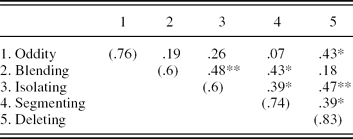
Participants were told to play a game with sounds. For each task, they were given an example and then testing started. We scored phoneme awareness as the number of correct responses (oddity maximum = 16, blending maximum = 10, other tasks’ maximum = 5). We do not aim to use phonological awareness measures separately; rather, we aim to obtain an overall measure of phonological awareness through a wide variety of tasks. To combine the scores of the phonological awareness tasks, we examined the tasks’ reliabilities and correlations (see Table 2).
Stress assignment task
This task consisted of reading aloud a set of 256 disyllabic pseudowordsFootnote 5 that varied in their syllable structure. One hundred twenty-eight pseudowords ended in a vowel (CV–CV structure), and 128 ended in a consonant (CV–CVC). As orthographic cues also affect stress assignment in Spanish, the final consonant was manipulated in the CV–CVC pseudowords (32 ended in “n,” 32 in “s,” and 64 in a different consonant). Moreover, pseudowords were presented with and without the Spanish stress mark, but participants saw stimuli only once. They were presented in a counterbalanced fashion. For example, the first participant saw bilén, fujó, bofin, jesi, the second saw bilen, fujo, bofín, jesí, and so forth. This was done to avoid any possible effects the repetition of stimuli might cause.
In CV–CV and CV–CVC (ending in “n” or “s”) pseudowords, the stress mark was placed on the last syllable: prefinal stress is not marked in words with these structures. In CV–CVC pseudowords ending in a consonant other than “n” or “s,” the diacritic was placed on the first syllable, because prefinal stress is marked in such words.
Further to these pseudowords, 40 real words were used as fillers. Testing started after 12 practice trials. During the testing phase, two pauses were included to avoid fatigue. Stimuli were displayed on a computer screen. First, a warning signal “+” remained centered on the screen for 500 ms, followed by a blank screen for 500 ms. Then, a pseudoword appeared on screen and the experimenter marked the stress of the subject's response. The next trial started 1,000 ms after this. Stimuli were presented at random, with a different order for each subject.
Knowledge of orthographic stress cues can be scored as the number of pseudowords stressed as expected. However, a possible stress bias (most Spanish words have penultimate stress) suggested that this measure would not be reliable. If children simply assign penultimate stress to all pseudowords they will still be correct on many of them (because half of pseudowords have penultimate stress). This stress bias would minimize differences in stress assignment scores between children with different levels of knowledge of the Spanish stress rules. To use a less biased measure, we scored stress knowledge as the number of pseudowords with correct final stress (maximum = 128). We excluded from this measure pseudowords with GPC errors. When these kinds of errors are committed participants do not pronounce the intended item, which makes it difficult to compare stress assignment across subjects.
As well as using orthographic stress cues, readers may stress pseudowords by analogy to real words (e.g., Protopapas, Reference Protopapas2006). To test this hypothesis we scored pseudowords’ neighborhood,Footnote 6 which may be taken as an index of word similarity. We used the Martínez and Pérez (Reference Martínez and Pérez2004) frequency dictionary for children ages 6–12 years old and computed a phonemic analog of the classic definition of Coltheart's N (Coltheart, Davelaar, Jonasson, & Besner, Reference Coltheart, Davelaar, Jonasson, Besner and Dornic1977). We scored word similarity as the number of words having the same number of phonemes as the target, and differing only by a single phoneme while respecting phoneme position (Grainger, Muneaux, Farioli, & Ziegler, Reference Grainger, Muneaux, Farioli and Ziegler2005). Pseudowords were then divided into two categories: (a) wordlike (N = 126) and (b) not wordlike (N = 127). In category (a) we included pseudowords with at least one final stress neighbor (M = 2.09, SD = 1.34). In category (b), pseudowords did not have any final stress neighbor (list of stimuli is shown in Appendix A). As we scored final stress knowledge, we just considered phonological neighbors with final stress,Footnote 7 although pseudowords in both categories could have prefinal stress neighbors (wordlike: M = 3.35, SD = 4.14; not wordlike: M = 3.05, SD = 3.86).
As we presented pseudowords in a counterbalanced fashion, maximum possible scores varied across subjects. In the wordlike condition, maximum for pseudowords with prefinal stress was 68 and 58 (Subjects 1 and 2, respectively), and it was 58 and 68 for pseudowords with final stress (maximum mean = 63). In the not wordlike condition, maximum was 59 and 68 for pseudowords with prefinal stress, and 68 and 59 for pseudowords with final stress (maximum mean = 63.5).
We compared pseudowords according to their word similarity and expected stress (i.e., according to stress rules). On the one hand, if readers are mainly using lexical analogies then stress rules should not affect stress assignment in the wordlike condition. Pseudowords in this condition have final stress neighbors; thus, they will be assigned final stress regardless of whether stress rules indicate prefinal stress. However, in the not wordlike condition, stress rules are the only source of information for assigning final stress. Therefore, stress assignment will depend on whether stress rules indicate prefinal or final stress. On the other hand, if readers are using both strategies equally (i.e., stressing by analogy and stressing by rules), then no interaction should be found between word similarity and expected stress.
Stress sensitivity
Children's stress sensitivity was assessed through Dupoux et al.'s (Reference Dupoux, Peperkamp and Sebastián-Gallés2001) task, using stimuli from their Experiment 3. The stimuli consisted of two minimal pairs of pseudowords: one containing a phoneme contrast (/kúpi/–/kúti/) that served to measure phoneme sensitivity, and another one containing a stress contrast (/mípa/–/mipá/) that served to measure stress sensitivity. Items were recorded by a female speaker, digitized at 44 kHz at 16 bits, and digitally edited. The duration and pitch of the phoneme contrast sound files (/kúpi/–/kúti/) were 384–366 ms and 193.46–202.99 Hz, respectively. The duration and pitch of the stress contrast sound files (/mípa/–/mipá/) were 371–371 ms and 181.11–179.62 Hz, respectively. In addition, the word “YA” was recorded by a male speaker. Sound intensity remained at a comfortable level.
Following Dupoux et al. (Reference Dupoux, Peperkamp and Sebastián-Gallés2001), stimuli were presented in two blocks, containing first phoneme contrasts and then stress contrasts. Phoneme contrasts served as a baseline control for specific task factors. The procedure was identical across the two blocks. Children were told that they were going to learn two invented words. Then, they pressed the two keys (“z” and “m”) that played the sound files (/kúpi/ or /kúti/ in the phoneme contrast block, /mípa/ or /mipá/ in the stress contrast block) as many times as they needed to learn the association between a key and the stimulus produced when pressing it. Then, the success of this paired associate learning was checked by requiring children to press the correct key for a spoken pseudoword to a criterion of 12 consecutive correct responses. Once successful learning had been established and checked in this way, three experimental blocks were administered, each containing sequences of two, three, or four pseudowords. The children were told to press the keys that corresponded to the pseudowords in the sequence they had just heard. For example, if the two-pseudoword sequence “/kúpi/–/kúpi/” was presented, children should press the “z” key (associated with “/kúpi/” in the learning and practice trials) twice. Feedback on item response accuracy was given during the checking phase, but not during the experimental trials.
In the first block, each of the four possible two-pseudoword sequences (/kúpi/–/kúpi/: z z; /kúpi/–/kúti/: z m; /kúti/–/kúti/: m m; and /kúti/–/kúpi/: m z) were presented twice. In the second block, each of the eight possible three-pseudoword sequences (key sequences: z z z, z z m, z m m, m m m, m m z, m z z, z m z, m z m) appeared once. Finally, in the third block, as in Dupoux et al., the eight four-pseudoword sequences (key sequences: z z m z, z z m m, z m z z, z m m z, m z z z, m z z m, m z m m, m m z m) maximized the number of transitions between the two keys. For example, the sequence “z m m m” has a transition from “z” to “m,” whereas the sequence “m z m m” has a transition from “m” to “z” and another one from “z” to “m.” Therefore, “m z m m” appeared in the third block instead of “z m m m.” Phoneme and stress sensitivity were scored as the number of sequences responded correctly by participants. In each block, maximum score is 8.
Sequences were followed by the word “YA.” Then, participants made their response. Intersound and intertrial intervals lasted 100 and 1000 ms, respectively.
RESULTS
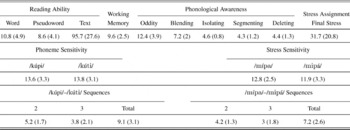
We aimed to test the hypotheses that stress sensitivity predicts reading and stress assignment. We scored participants in each of the above measures and examined whether stress sensitivity accounted for a significant amount of variance in reading and stress assignment scores. /kúpi/, /kúti/, /mípa/, and /mipá/ accuracy was calculated individually and for two, three, or four /kúpi/–/kúti/ or /mípa/–/mipá/ sequences. Participants’ performance at four-pseudoword sequences was very low (M = 1.57, SD = 1.67 in /kúpi/–/kúti/ sequences; M = 1.27, SD = 1.54 in /mípa/–/mipá/ sequences). This suggests that these sequences were so difficult that children may have responded by chance. This should be particularly true for the fourth sound within these sequences, which is supposed to be the most difficult. We tested whether subjects’ performance on this item is different from chance, and we found that it is not, either for /kúpi/–/kúti/ (M = 4.24, SD = 1.37; t = 1.01, p > .05) or for /mípa/–/mipá/ blocks (M = 4.18, SD = 1.82; t = 0.57, p > .05). Consequently, we have only included two- and three-pseudoword sequences in our analyses (Table 1).
Mean (standard deviation) values for reading ability, working memory, phonological awareness, stress assignment, and phoneme and stress sensitivity

Note: The text reading score is the mean reading time in seconds.
To rule out uncontrolled phonetic factors affecting phoneme and stress contrasts, we compared /kúpi/ versus /kúti/ and /mípa/ versus /mipá/. No significant differences were found: /kúpi/–/kúti/, F (1, 32) < 1; /mípa/–/mipá/, F (1, 32) = 2.16, p > .05, respectively. Therefore, within each contrast category (phonemic or prosodic), stimuli were functionally equivalent in terms of auditory perception.
As already explained, we aimed to use a single measure of phonological awareness. We examined reliabilities and correlations between phonological awareness measures and found that only segmenting, and deleting measures could be combined (see Table 2). They were significantly correlated and their reliabilities were acceptable. Thus, we turned scores within each measure into z scores and averaged them (M = 0, SD = 0.83). This was our first index of phonological awareness (PA1). The oddity measure was our second index (PA2). It was significantly correlated with deleting scores only (see Table 2), so we used it separately (i.e., without combining with other measures). Blending and isolating reliabilities were too low (see Table 2), so we did not use these measures in our analyses.
Pearson correlations and reliabilities (Cronbach alphas) for phonological awareness tasks
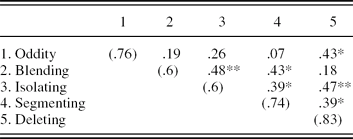
*p < .05. **p < .01.
Hierachical regression analyses examined the relationships between phonological awareness (PA1 and PA2), working memory, phoneme sensitivity, and stress sensitivity (predictor variables) with word (TECLE test) pseudoword, and text reading (dependent variables). These analyses aimed to test the hypothesis that stress sensitivity predicts reading. If this hypothesis is correct, stress sensitivity should account for a significant amount of the variance in word, pseudoword and text reading (after controlling for working memory, phonological awareness, and phoneme sensitivity). This hypothesis was tested separately for each measure (three analyses in total). Total scores of phoneme and stress sensitivity (across two and three /kúpi/–/kúti/ and /mípa/–/mipá/ sequences) were used (Tables 3 and 4).
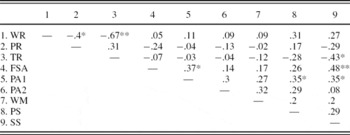
Pearson correlations of word reading, pseudoword reading, text reading, and final stress assignment with phoneme awareness, working memory, phoneme sensitivity, and stress sensitivity

Note: WR, word reading; PR, pseudoword reading; TR, text reading; FSA, final stress assignment; PA1, PA2, phoneme awareness; WM, working memory; PS, phoneme sensitivity; SS, stress sensitivity.
*p < .05. **p < .01.
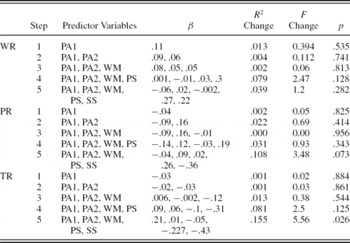
Hierarchical regression predicting word reading, pseudoword reading, and text reading

Note: WR, word reading; PR, pseudoword reading; TR, text reading; PA1, first index of phonological awareness; PA2, second index of phonological awareness; WM, working memory; PS, phoneme sensitivity; SS, stress sensitivity.
Stress sensitivity was not significantly correlated with word reading (see Table 3), so it did not predict any significant amount of the variance in word reading (see Table 4). In contrast, stress sensitivity accounted for a significant amount of the variance in text reading (15.5%). This result showed stress sensitivity to be related to one of the measures of reading fluency used in this study, regardless of phonological awareness and other relevant variables.
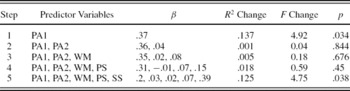
The second aim of this study was to test the hypothesis that stress sensitivity predicts stress assignment scores. If this hypothesis is correct, stress sensitivity should account for a significant and unique amount of the variance in stress assignment after controlling for working memory, phonological awareness, and phoneme sensitivity. We had to eliminate two pseudowords in this analysis: voná, which appeared twice, so we did not count it the second time it appeared; and lotín, because of a writing error. As shown in Table 5, our results supported this hypothesis.
Hierarchical regression predicting correctness in assigning final stress

Note: PA1, first index of phonological awareness; PA2, second index of phonological awareness; WM, working memory; PS, phoneme sensitivity; SS, stress sensitivity.
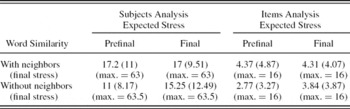
There are two possibilities here. First, children with higher stress sensitivity may have learned word stress so well that they can use this knowledge to stress pseudowords by analogy. Second, they may have learned stress rules so that they can use them to stress pseudowords. To test both hypotheses, we conducted two analyses of variance (ANOVAs), by subjects (F1) and by items (F2), on the final stress scores. Independent variables were word similarity (e.g., pseudowords with final stress neighbors, without final stress neighbors) and expected stress (i.e., prefinal, final). A subject who did not pronounce any word with final stress was removed from analyses. As above, we had to eliminate pseudowords voná (the second time it appeared) and lotín, as well as their stress counterparts vona and lotin. We also had to eliminate pseudoword bilor, as it was not presented with the stress diacritic (i.e., bílor; Table 6).
Means (standard deviations) and maximum possible scores for the subject and item analysis

Main effects were significant: word similarity, F1 (1, 31) = 36.82, p < 0.05, F2 (1, 251) = 4.7, p < 0.05; expected stress, F1 (1, 31) = 10.93, p < 0.05, F2 (1, 251) = 8.16, p < 0.05. The interaction of Word Similarity × Expected Stress was also significant, but in the items analysis only: F1 (1, 31) = 2.49, p > 0.05; F2 (1, 251) = 10.05, p < 0.05. Planned comparisons showed that expected stress differences were significant only in the condition of pseudowords without final stress neighbors: F1 (1, 31) = 8.6, p < 0.05; F2 (1, 126) = 18.09, p < 0.05. These results suggest that lexical knowledge (stressing by analogy) plays a more relevant role for stress assignment than stress rules does.
DISCUSSION
We have hypothesized that if stress sensitivity facilitates word stress acquisition, it would also facilitate reading, for two reasons. First, if readers know a word's stress, they can easily recover it from the lexicon. Consequently, reading will become more fluent. Second, if a word's stress is stored in the lexicon, then it could be used to distinguish between lexical entries. Therefore, stress sensitivity is expected to predict a significant portion of the variance in word, pseudoword, and text reading. Our data partially supported this prediction. Stress sensitivity did not predict word reading or pseudoword reading, but it did predict text reading.
For stress to be used for lexical access, readers have to know and use orthographic stress cues. However, children's knowledge of stress cues may not be strong enough for lexical access. Participants in this study were second-grade children, who may be starting to learn orthographic stress cues. Consistent with this hypothesis, Defior, Jiménez Fernández, and Serrano (Reference Defior, Fernández and Serrano2006) found that fourth-grade Spanish children correctly stressed 53.1% of pseudowords they read aloud. Accuracy among second- and third-grade children was much poorer. In the present study, accuracy at stressing pseudowords was around 25%. This may be obscuring the relationship between stress sensitivity, which is supposed to help learning stress rules, and word reading.
We have found that stress sensitivity is related to text reading ability. Therefore, stress sensitivity seems to predict reading fluency, but why? First, we have to take into account that most Spanish words are multisyllabic and that lexical stress is necessary to read aloud multisyllabic words. This knowledge would help children to be more fluent in reading and stressing words, which would speed up text reading. Moreover, fluency may also improve text comprehension because more resources are available for fluent readers to engage in text-level aspects of reading (Miller & Schwanenflugel, Reference Miller and Schwanenflugel2007). Further to fluency, it may be argued that text reading time is probably affected by text comprehension itself. In any case, we have found a relationship between stress sensitivity and text reading time, which suggests that stress is important for fluency.
In the phoneme and stress sensitivity tasks, participants had to retain pseudowords in memory. Therefore, it may be argued that these tasks are indeed tapping working memory capacity. However, working memory did not significantly correlate with either phoneme sensitivity or stress sensitivity. Therefore, phoneme and stress sensitivity scores seem to be tapping something other than working memory.
It has been proposed that prosodic sensitivity relates to reading through phonological awareness (Wood, Reference Wood and Columbus2006a). In particular, it has been hypothesized that prosody highlights some units of the spoken language that are relevant for reading (e.g., the onset–rime structure). In accordance with this hypothesis, we have found that phonological awareness correlates positively with stress sensitivity. However, stress sensitivity makes a unique contribution to reading which is independent of phonological awareness. As described in the introduction, Whalley and Hansen (Reference Whalley and Hansen2006) reached the same conclusion for reading in English.
Our data suggest that prosody itself affects reading performance. As we have already discussed, fluency may be the mechanism through which stress sensitivity exerts its role in reading. Fluency at reading may require stress rules to be applied in cases of unknown or very uncommon words. Reading by analogy is also possible. Our results suggest that reading by analogy is the main strategy used by readers: when words had final stress neighbors, no differences were found between pseudowords with prefinal or final expected stress. Moreover, we found a positive correlation between stress sensitivity and final stress scores. This suggests that stress sensitivity may help readers to learn word stress, which in turn, may be used to stress similar words. Learning the stress rules may be more difficult (e.g., Defior et al., Reference Defior, Fernández and Serrano2006). However, readers seem to use them somehow, as suggested by the fact that expected stress (i.e., according to the stress rules) has a significant effect in pseudowords without final stress neighbors. Learning of stress rules may be just starting at second grade.
In the present study we did not find working memory and phonological awareness to be significantly related to either pseudoword or word reading, which contrasts with previous findings (e.g., Gathercole, Reference Gathercole2006). In the case of working memory, this may be due to the fact that memory load was very low for the reading tasks that we used. For example, instead of pseudoword repetition we used reading aloud, which is less memory demanding (i.e., participants do not have to make an effort to maintain pseudowords in memory). Furthermore, in the case of word reading, none of our participants managed to read sentences longer than five words in the TECLE test. To maintain five words in memory while choosing the correct answer does not seem to be a task with excessive memory demands.
With respect to phonological awareness, we think that is important to take into account that it may play a more relevant role at the beginning of reading acquisition. Our participants had 3 years of reading tuition, and perhaps they had learned much of the relevant knowledge that is necessary for reading in Spanish. In fact, Spanish is a very transparent language, so GPC rules may be learnt very quickly. If phonological awareness is not longer necessary, it may not be used, and then it may be partially lost. Consistent with this hypothesis, some studies have shown low levels of phonological awareness in adults with good reading skills (e.g., Scaraborough, Ehri, Olson, & Fwloer, Reference Scaraborough, Ehri, Olson and Fowler1998; Serrano, González-Trujillo, & Defior, Reference Serrano, González-Trujillo, Defior and Trindade2002; Stainthorp, Reference Stainthorp1998). Further to this, it may also be argued that reaction time is a better measure for phonological awareness in highly transparent languages as Spanish. However, at least one of the phonological awareness measures (PA1) used in the present research seemed to be sensitive enough as it correlated with other relevant measures (e.g., phoneme and stress sensitivity).
The present study depends largely on correlational data. This type of data has limitations in making conclusions about causality. For example, instead of claiming that stress sensitivity improves reading acquisition, it could be said that reading acquisition improves stress sensitivity. More research is needed, but correlational data can be considered as a first step before looking for causal evidence.
To summarize, the present results show that stress sensitivity is related to reading, which is consistent with previous findings in other languages (Goetry et al. Reference Goetry, Wade-Woolley, Kolinsky and Mousty2006; Wade-Woolley et al. Reference Wade-Woolley, Goetry and Lung2004; Wood, Reference Wood and Columbus2006a, Reference Wood2006b). However, stress sensitivity in Spanish makes a unique contribution to reading that, at least in second grade, seems to be related to reading fluency. Stress sensitivity seems to help in learning word stress, so readers can use this knowledge to assign stress by analogy. This suggests that training in stress sensitivity may improve this knowledge and in turn fluency at reading. This possibility has interesting applications for reading tuition and it remains to be explored in the future.
APPENDIX A
List of stimuli to score final stress assignment

ACKNOWLEDGMENTS
This research has been partially supported by the Spanish Ministry of Education and Science (projects SEJ2007-68024.CO2.01 and SEJ2007-68024.CO2.02), FEDER funding, and the Junta de Andalucía research group HUM 699. We thank Usha Goswami and three anonymous reviewers for their helpful comments on the previous draft of this manuscript.