The conceptualization of the relationship between executives and legislatures (henceforth ‘forms’ or ‘systems’ of government) is central to scholarship on comparative politics, and no categorization is more influential than the tripartite distinction between presidentialism, parliamentarism and semi-presidentialism. This classification has so thoroughly dominated scholars’ understanding of executive-legislative relations that it has almost no conceptual competition. In this article, we examine the constitutions that populate these categories and evaluate the degree to which this time-honored conceptualization captures variance in executive-legislative relations. That is, we examine whether the classification allows one to predict the various powers and responsibilities of executives and legislatures, many of which are presumed to follow from presidentialism and parliamentarism. We have reason to be skeptical, as we explain below.
Most traditional (so-called classic) approaches to categorization require that the objects under study share a set of finite definitional (necessary or sufficient) properties. More recent approaches to classification – such as the well-known prototype (Rosch) and family resemblance (Witgenstein) models – operate under a more probabilistic assumption, in which similarly classified cases are those that share a large number of non-necessary attributes.Footnote 1 However, even those operating using a classical approach expect some family resemblance: that is, that similarly classified objects will resemble one another with respect to a collection of other, elective, attributes. It can be distressing to a taxonomer to find significant variation within a given category with respect to elective features, many of which may also be shared across categories. When biologists categorized the platypus as a mammal rather than a reptile, for example, they relied on definitional characteristics (lactation) over non-definitional ones (laying eggs, a duck bill) to make their determination, and thereby emphasized similarities with beavers over lizards or ducks.
In the context of a widely shared taxonomy among scientists and students, classification decisions serve to reinforce perceptions of the similarity and dissimilarity of organisms. Organisms are assumed to share more characteristics with co-classified than cross-classified organisms. In the field of comparative politics, scholars rely on an assumption that the presidential-parliamentary distinction (defined in various ways) classifies constitutions that are reasonably homogenous across a range of attributes of executive-legislative relations. For many scholars, knowing that, for example, Australia is ‘parliamentary’ would seem to summarize much of what they would want to know about the powers and responsibilities of the Australian parliament, and what makes it distinct from, say, the US Congress.
Beyond its presumptive descriptive power, the distinction between presidential and parliamentary systems (henceforth the ‘classical’ approach to the classification of executive-legislative relations) is also hypothesized to exert significant explanatory power over a wide range of outcomes. An incomplete list of such outcomes includes the survival of democracy, economic policy, budget deficits, economic performance, social cleavage management, ethnic conflict, international peace, international co-operation, the quality of democracy, party systems, human development and accountability.Footnote 2 The classical classification also influences real-world constitutional design. In recent years, the choice of presidentialism or parliamentarism – as debated in such terms – has occupied a good deal of constitution makers’ attention in countries as diverse as Afghanistan, Brazil, Kenya and Russia. In short, this is another case of the very close link between classification and explanation.Footnote 3
We examine the proposition that the classical conceptualization entails a set of systemic properties. If the variation in aspects of executive-legislative relations spans dimensions that do not correlate with the classical distinction, it would behoove us to develop alternative (or at least multidimensional) concepts. The first step, however, is to evaluate the coherence and predictability of the classical typology. A growing literature, including what we might term the ‘varieties of presidentialism’ genre associated with Shugart and Carey,Footnote 4 suggests significant heterogeneity within at least one of the types. New data that we introduce below allow us to inspect the institutional configuration of various executive-legislative arrangements, historical and contemporary, both within and across types. We look closely at design choices for each of six features of the constitutional allocation of powers and authority between the executive and the legislature – features thought to be associated with one or the other system. From a universe of 826 national constitutions written between 1789 and 2006, we evaluate a sample of 401 constitutions considered to be presidential, parliamentary or semi-presidential. We explore whether these labels in fact capture homogenous institutional configurations by examining the similarity of constitutions within and across categories. We find an extraordinary amount of within-type heterogeneity across the attributes in question. Indeed, knowing whether a constitution is parliamentary, presidential or semi-presidential is less helpful in predicting a constitution's executive-legislative structure (across these features, at least) than is knowing the geographic region in which the constitution was produced, or when it was written.
Although within-type cohesion is low (at least by our expectations) for all three categories, we find measureable differences in the degree of cohesion across types, with parliamentary constitutions standing out as the least cohesive of the three. Ironically, we find that semi-presidentialism – despite its seemingly hybrid nature – is more internally coherent than the other categories, and that semi-presidential constitutions are equally similar to parliamentary and presidential ones. The results of the measurement exercise lead us to offer some guidance about the use of the classical typology and suggest a research agenda for further conceptual exploration.
The Classical taxonomy and its boundaries
A telling entrée into the challenges of conceptualizing executive-legislative relations is the troubled concept of ‘semi-presidentialism’, a species of constitutions that now outnumbers pure presidentialism by some counts.Footnote 5 The category has defied easy (or at least a consensual) definition since Duverger first described and labeled it.Footnote 6 After reviewing the definitional debate, Elgie has argued forcefully that the particular powers of presidents and prime ministers should be excluded from the definition, and thus defines semi-presidentialism as a system in which ‘a popularly elected fixed-term president exists alongside a prime minister and cabinet who are responsible to parliament’.Footnote 7 This definition has an elegant simplicity and seems to resonate with current usage. It focuses on the formal provisions of the constitution and thus eliminates many (though not all) ambiguous cases associated with other definitions. It also focuses on the critical question of the source of executive responsibility rather than the relationship among executives, or even the total scope of executive power or independence.
One oft-voiced critique of Elgie's definition (and Duverger's formulation before it) is that the semi-presidential category includes a wide range of disparate systems.Footnote 8 The sense is that the class is internally incoherent, at least compared with the supposedly purer types of presidential and parliamentary systems. Elgie responds to this objection by pointing out that the categories of presidentialism and parliamentarism, accepted by most comparativists as foundational, themselves mask great internal variation.Footnote 9 A more damning critique of ‘semi-presidentialism’ is that one or more of the features that distinguish the category (for example, direct elections for a fixed-term president) may not matter,Footnote 10 perhaps because they do not predict other institutional traits. This issue of institutional coherence within the classical categories is subject to empirical verification and helps to motivate our article.
In fact, a growing number of scholars has come to emphasize the diversity within the ‘purebreds’ as well. Some of these contributions have, naturally, come in the wake of Juan Linz’Footnote 11 widely discussed claims about the perils of presidentialism for democratic survival – claims that led scholars to dig more deeply into the meaning of the subtypes. So, in their groundbreaking study, Shugart and Carey show that presidents wield a wider range of powers than generally assumed.Footnote 12 For example, some presidents have full control of the hiring and firing of the cabinet, whereas others do not; some have significant lawmaking powers (whether proactive or reactive), and others do not.Footnote 13 Similarly, another set of scholars has emphasized the diversity, which some see as growing, within parliamentary systems. An example is the careful study by Poguntke and Webb on the ‘presidentialization’ of governments, in which the authors (and most of their contributors) suggest that parliamentary governments in stable democracies have increasingly taken on stereotypically ‘presidential’ characteristics with respect to power resources, autonomy, and the degree of personalization. Importantly, Poguntke and Webb's dimension of partified versus presidentialized government is orthogonal – theoretically and empirically – to the classic typology: all three types exhibit significant variation along this dimension.Footnote 14 This orthogonal quality is worth emphasizing, lest one conclude that the dimension measures degrees of the category of ‘presidentialism’, which would only reinforce the relevance of the classic dimension. Finally, Tsebelis’ focus on veto players suggests another source of skepticism about the classic categories.Footnote 15 His conceptualization is intended to depart from the ‘institutional debates conducted in pairs’ (with presidentialism and parliamentarism representing only one such pair) approach in favor of a dimension that cuts through these classic lines of demarcation.Footnote 16 Taken together, these three studies – Shugart and Carey, Poguntke and Webb, and Tsebelis – leave one to wonder about how exhaustively the classic categorization maps the contrast space in executive-legislative relations.
We posit that the classical typology implies a set of core defining attributes as well as a set of elective, incidental attributes. The research question turns on how elective, exactly, this set of attributes is. The defining distinction between presidentialism and parliamentarism concerns the degree of dependence of the executive on the legislature, specifically with respect to the selection and dismissal procedures of the executive. Consider a representative formulation: ‘Parliamentarism is understood as a system of government in which the executive is chosen by, and responsible to, an elective body (the legislature), thus creating a single locus of sovereignty at the national level’.Footnote 17 By contrast, presidents – in Shugart and Carey's terms – are distinguished by their separation from the legislature with respect to their ‘origin’ (they are selected by direct elections) and ‘survival’ (they serve fixed terms).
Presidentialism and parliamentarism are also considered to be systems of governance and, in this sense, contain a number of less fundamental (but nonetheless important) features that are supposed to hang together.Footnote 18 As Moe and Caldwell put it:
when nations choose a presidential or parliamentary form, they are choosing a whole system whose various properties arise endogenously – whether they like it or not – out of the political dynamics that their adopted form sets in motion … Presidential and parliamentary systems come with their own baggage. They are package deals.Footnote 19
It is in part due to these presumably elective properties that broad characterizations of these systems are possible and that cross-system performance varies. Thus, to cite only one example, according to Tsebelis, ‘[i]n parliamentary systems the executive (government) controls the agenda, and the legislature (parliament) accepts or rejects proposals, while in presidential systems the legislature makes the proposal and the executive (the president) signs or vetoes them’.Footnote 20 This more encompassing understanding of parliamentarism and presidentialism very likely derives in part from the makeup of prototypical cases such as the United Kingdom and the United States, with the expectation that other cases in the class exhibit some family resemblance. The ‘semi-presidentialist’ constitutions that have never quite fit represent either a discrete family or an intermediate ‘bastard’ tribe.Footnote 21
One distinguishing elective characteristic is that, as the Tsebelis remark above suggests, governments in parliamentary systems maintain tight control of the legislative agenda, which perhaps follows from the idea that losing an important vote may imply their demise. Since governments in presidential systems do not risk removal from power in the middle of their term, they can afford to relinquish agenda-setting powers to the legislature. The Tsebelis characterization (and conventional wisdom) also suggests that veto power – the mechanism that allows presidents to react to the proposals initiated in the legislature – is typical of presidential constitutions. Veto power is so closely associated with presidentialism that Shugart and Carey even go so far as to incorporate it as a defining attribute.Footnote 22
On the other hand, parliamentary constitutions grant the head of state little or no power to block legislation.Footnote 23 Historically, these powers had been granted to monarchs; as they evolved into figureheads of state (and as formal constitutions were adjusted to reflect this fact), veto powers in parliamentary systems tended to fall into oblivion, to use von Beyme's phrase.Footnote 24
Similarly, stylized accounts of presidentialism and parliamentarism suggest that presidents wield unilateral control of the appointment and removal of cabinet members, while such power is left to the assembly in parliamentary government (subject to a ratification by a figurehead of state). Part of the theory here is that the prime minister, as merely primus inter pares, should not be vested with broad hierarchical power to organize the cabinet (which would amount to a constrained choice, anyway, since the candidate list would be a subset of her peers in the legislature). Semi-presidentialist constitutions – true to their nature – occupy a middle ground in this respect: in some cases the appointment and dismissal of the cabinet is the responsibility of the president, in others it is that of the assembly; in still others, the responsibility is shared.Footnote 25 It is indeed due to this ambiguity that many believe semi-presidential constitutions are problematic.Footnote 26 Presidential control over the ministry is explicitly associated with presidentialism in many accounts, and Shugart and Carey even elevate cabinet selection to a definitional attribute.Footnote 27 Muller, Bergman and Strom consider the idea of including ‘cabinet selection by the legislature’ as a defining attribute of parliamentarism and ultimately decide against doing so, reasoning – in part – that actual practice among presumably ‘parliamentary’ systems exhibits substantial diversity with respect to this trait.Footnote 28
Regarding the important matter of the legislature's oversight of the executive, it can be argued that it should be considered to be primarily part of the system of checks and balances that is often embedded in separation-of-powers constitutions. Parliamentary constitutions, in turn, are structured in such a way as to maximize the convergence between the interests of the government and those of the legislative majority; consequently, provisions for legislative oversight of the executive would be redundant in these constitutions.Footnote 29 In semi-presidential constitutions, oversight is only required to the extent that the executive is independent (as in contemporary Taiwan, for example, where the appointment of the prime minister is not subject to parliamentary approval). However, it is certainly the case that many parliamentary systems have a rigorous and visible practice of interpellation (think ‘question time’ in the British House of Commons). Indeed, Muller, Bergman and Strom list legislative control of the executive, through means such as interpellation and ‘committees of inquiry’, as a hallmark of parliamentarism.Footnote 30
We finally come to the complex issues of emergency and executive decree powers, which are intimately connected since the latter evolved and became formalized out of the practice of the former. It was the declaration and maintenance of a state of siege or the passing of full power laws by both warring and neutral powers during World War I that led to, as Agamben puts it, ‘the extension of the executive's powers into the legislative sphere through the issuance of decrees and measures’.Footnote 31 While emergency powers are more typically associated with presidential constitutions, decree powers – in particular the scope of the permissible delegation of authority by parliamentFootnote 32 – have been more easily justified in the context of parliamentary regimes, even though they have been a concern in constitutions representing all regime types – parliamentary, presidential and semi-presidential. The oft-heard refrain is that in parliamentary systems decree power is needed in order to create a more muscular executive.
Thus emergency powers, which allow the executive to suspend the constitution for a specific period of time when unusual circumstances occur, are commonly associated with presidential constitutions. Ferejohn and Pasquino argue that constitutional systems based on parliamentary sovereignty reject the ‘dualistic’ regime that emergency provisions establish – that is, the notion that there exists a regular and an exceptional government. In these systems, they say, ‘if there is a need to suspend rights or consolidate powers to deal with an emergency, all this can be managed efficiently by the sovereign body itself – normally the legislature (like in the British parliamentary system)’.Footnote 33 Loveman, in turn, argues that the uniquely strong emergency provisions of the nineteenth-century presidential constitutions of Latin America were at the root of the region's political instability and militarization of politics (a charge sometimes repeated with regard to Weimar semi-presidentialism).Footnote 34
Executive decree powers, in turn, were justified in the European democracies of the interwar period by the argument that the transfer of legislative authority to the executive did not imply abdication, since parliament retained the power to withdraw confidence from the government and remove it from office. In this sense, decree power was seen as merely an issue of legal technique, changing parliamentary practice from ex ante to ex post approval of government action.Footnote 35 It is precisely because this justification cannot be extended to presidential constitutions that concerns about the abuse of decree powers by presidents is so heightened in new democracies: granting legislative authority to the executive in a system of separation of powers implies abdication, since the legislature has no ex post mechanisms for controlling the actions taken by decree.Footnote 36
The ancillary institutions that are said to characterize the three types of constitutions sometimes play central roles in causal theory on the effects of the types. In fact, many accounts of cross-system variation in important outcomes are focused on the presence or absence of these very attributes. Thus, the tight control of the legislative agenda by the government in parliamentary systems and the head of state's veto in presidential systems is presumed to be at the root of their differences with respect to the probability of shifts in policy from the status quo. The former attribute prevents the ‘separation of purpose’ between the executive and the legislature in parliamentary systems, thus reducing the likelihood that partisan veto players will emerge; the latter ensures that presidential systems will always have at least one more institutional veto player than do parliamentary ones.Footnote 37 As noted above, emergency powers thought to be disproportionally present in presidential constitutions are said to have been at the root of the instability of Latin American countries since the nineteenth century. Linz lists control over cabinets as one of several ‘perils of presidentialism’. Finally, concerns about the dangers posed by constitutional decree powers have been almost exclusively focused on presidential systems, with much of this concern revolving around the notion that such powers lead to the usurpation of legislative powers by the executive, with important consequences for democracy and policy.
Thus a number of modular properties is thought to cohere in presidential and parliamentary constitutions, and to account for differences in the performance of the systems that adopt such constitutions. We are aware that some of these properties are less widely associated with one specific type of constitution, and that some stereotypes may be rooted in non-constitutional elements. This is particularly true of executive decree powers and legislative oversight. The latter is a function that is often achieved via non-constitutional meansFootnote 38 and that, some may argue, is unrelated to presidentialism and parliamentarism. The prevalence of these stereotypes is, of course, an empirical question in its own right. But no matter how widely held these stereotypes may be, they are all central components of the relationship between executives and legislatures, and ones that would be plausibly associated with its dominant conceptualization. In our view, the question of whether or not these attributes cluster in predictable poles is important in and of itself. After all, if these attributes are equally distributed across regime types, political scientists will need to come to grips with a world that has more dimensions and contours than they imagined – which would require rethinking concepts and causal theory.
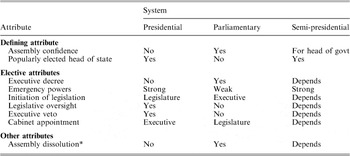
We summarize these expectations in Table 1. Briefly, parliamentary constitutions should provide for strong executive control of the legislative agenda, weak executive veto, relatively strong executive decree powers, relatively weak emergency provisions, relatively weak involvement of the head of state in government formation and removal, and relatively undeveloped oversight instruments. Presidential constitutions should be characterized by weak executive control of the legislative agenda, strong veto powers, relatively weak decree powers, strong emergency provisions, control of government formation and removal by the president, and relatively well-developed oversight provisions. Finally, semi-presidential constitutions, which occupy an intermediate category, presumably labor under fewer stereotypes except – perhaps – with respect to their characteristically strong emergency provisions. One also wonders about the relative cohesion of ‘semi-’ regimes. That is, do these cases exhibit enough consistency in their design that we should think of them as more than just intermediate cases or hybrids? Homogeneity of design would suggest a regime type of its own, not simply a mongrel occupant of a residual category.
Presumed Attributes of Executive-Legislative Systems

*Assembly dissolution is considered by some to be a defining attribute. Our principal analysis does not treat this feature as such, although we do so in some robustness tests.
Some Empirical Reference Points
In spite of the theoretical coherence of parliamentary and presidential constitutions, almost any real-world example of constitutional design seems to raise doubts about the utility of these categories in predicting ancillary institutional attributes. Consider four constitutional experiences drawn from diverse locales: Afghanistan, Ukraine, Australia and Brazil.
Afghanistan
In 2003, the Constitutional Drafting Commission of Afghanistan sent its final draft to the president's office, after which it was to be forwarded to the constitutional Loya Jirga for passage. The draft had been painstakingly constructed, with support from the United Nations and others, and featured a parliamentary system, which many believed was the best model to ensure representation for Afghanistan's diverse population. When the draft emerged from the president's office, however, the system had been changed to a presidential one. But the constitution retained, whether intentionally or not, parliament's ability to vote ‘no confidence’ in government ministers based on ‘well-founded reasons’ (though the text did not clearly spell out the implications of such a vote).Footnote 39
Ukraine
In the Orange Revolution in Ukraine, constitutional amendments adopted overnight (and in violation of constitutional norms) sought to engineer a compromise with the Kuchma regime by recalibrating the powers of the president and parliament.Footnote 40 This led to various instabilities and the creation of a ‘parliamentary oligarchy’, as well as a new round of proposals to restructure the political system. Later proposals sought to extend presidential power, allowing the executive to dissolve parliament and appoint the prime minister if the parliament rejects the proposed candidate. Tensions over the allocation of powers, however, led the government to fall in September 2008. In October 2010, the Ukrainian constitutional court abruptly handed parliamentary powers of government formation and dismissal back to the president, a development that is still unfolding as of this writing. Ukraine seems to be a system swinging between extremes in an effort to find a workable semi-presidential model.
Australia
In 1975, the Australian governor general utilized, for the first time and against constitutional convention, his formal power to dismiss the prime minister after the government had lost the confidence of the upper house of parliament and failed to secure passage of the budget. Given that the government enjoyed the confidence of the lower house, many viewed this as a violation of the norm in parliamentary systems. The debate over the constitutionality of the action led one political scientist to characterize the Australian system as the ‘Washminster’ system, which was neither a variant of Westminster nor a pure presidential system.Footnote 41
Brazil
A memorable photograph from the 1987–88 Brazilian Constitutional Assembly shows a group of presidentialistas celebrating their come-from-behind victory in a highly contested roll-call vote on the simple question of presidentialism or parliamentarism. Until that critical juncture, many of the delegates had operated under the assumption that parliamentarism, not presidentialism, would be the governing structure of the new system. Thus, in constructing much of the constitutional structure, delegates operated with not only an unclear sense of the basic relationship between powers, but also, most probably, with a fundamentally distorted sense of this relationship. The 1988 constitution has certainly induced a pattern of politics that is closer to what is observed in many parliamentary countries than what unfolded, for instance, under the 1946 constitution. Few people would contest the fact that under the 1988 Brazilian constitution the president possesses powers that are often found in parliamentary systems, such as: control of the legislative agenda, including the monopoly of some initiatives; the ability to request urgent consideration of specific legislation; and, of course, decree powers. At the same time, legislators face an incentive structure that does not really distinguish them from their counterparts in the prototypical parliamentary systems, who are appropriately referred to as backbenchers (or ‘low clergy’ in Brazil). It has been argued that the presence of such powers allows for legislative outcomes in Brazil that are similar to the ones obtained in parliamentary systems.Footnote 42 The result is a political structure that has defied all odds, at least the ones that were dominant in the first years of operation of the 1988 document.Footnote 43
In each of these cases, category confusion played some role in constitutional design. In each, the founders had either by design or omission failed to spell out key aspects of legislative-executive relations, or left untouched arrangements that were meant for a different ‘system’. And in each, the lacuna led to a constitutional crisis – or at least misunderstanding. Brazil and Afghanistan are usually classified as having presidential systems; Australia is typically considered parliamentary, and the Ukraine is considered semi-presidential. Yet disputes have emerged between the head of state and parliament in each country, and confusion remains about the scope of their respective powers. In short, the categories used by political scientists have been adopted by constitutional designers, but the actual provisions of texts frequently seem to deviate from the pure types, which sometimes leads to constitutional confusion.
Analysis
How internally cohesive are the classical categories? Our basic research strategy is to analyze whether constitutions that fall into one of the three classes are in fact more similar to one another with regard to key institutional attributes than they are to constitutions outside their class.
Our method is to compare constitutions, contemporary and historical, with respect to their division of power between the executive and legislature. Our data are from the Comparative Constitutions Project (CCP), which is a comprehensive inventory of the provisions of written constitutions for all independent states between 1789 and 2012.Footnote 44 Collection of the data is ongoing; for purposes of this article, the dataset includes 632 systems, of the 826 constitutional systems identified by Elkins, Ginsburg and Melton.Footnote 45 Elkins, Ginsburg and Melton include a large number of questions in their survey instrument, many of which have to do with the powers of the executive and the legislature.
At the outset, we should make clear that our analysis is restricted to formal provisions in written constitutional texts (we will refer to this as de jure constitutionalism). Actual political practice in any country with regard to executive-legislative relations is certainly more complicated than what is written into formal constitutional rules, and likely reflects informal conventions as well as other sources of law such as judicial opinions. Nevertheless, there are good reasons to focus on written texts. For one, formal constitutional rules comprise a roughly comparable set of data to examine across time and space. By contrast, examining unwritten constitutional rules raises significant problems of identification that are likely insurmountable except in small samples. Secondly, formal texts reflect discrete acts of constitutional designers, many of whom are informed by the classical typology. In this sense, we can tie our analysis of institutional design to an identifiable activity and mode of behavior – constitution making – and thereby keep the process in sight. Importantly, we know who did what and when. Our analysis, then, can be seen as examining whether the provisions chosen by constitution makers produce coherent systems that reflect the classical typology. We recognize, though, that the implementation of these decisions may depart from written law.
We proceed in three broad stages. First, we utilize a set of variables from the CCP to develop a tripartite categorization of government type based on the explicit provision of the attributes that define these categories. We then consider each of six ‘elective’ attributes individually and assess their association with one or the other government types. We next develop a measure of institutional similarity between pairs of constitutions, based on items representing these six attributes, and assess institutional coherence in a multivariate regression model that specifies other sources of similarity, notably regional and temporal proximity.
The Operationalization of Presidentialism, Parliamentarism and Semi-presidentialism
Despite the centrality of the classical conceptualization, scholars have not settled on a standard classification scheme, and no one has apparently even attempted to do so for constitutions in force prior to 1945. There are at least three published classifications of countries for the post-war era.Footnote 46 We choose to construct the classical classification using the CCP dataset, which has distinct advantages since its unit of analysis (the constitutional system), its sample and its focus on de jure institutions provides consistency across the left- and right-hand sides of the equation. We then evaluate the measure's validity against the alternative set of measures that are available for the subset of cases that match.
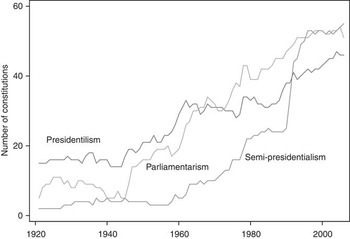
Our measure of the classical categorization scheme hinges on its defining feature: whether or not the government is collectively dependent on the legislature for survival. This feature, as we describe above, is the crux of the distinction between presidentialism and parliamentarism.Footnote 47 If a government can be removed by the legislature for political reasons (that is, removal is not restricted to criminal or behavioral misconduct), the case is coded as parliamentary (n = 119);Footnote 48 if not, it is coded as presidential so long as the head of state is popularly elected, either directly or indirectly (n = 204). Semi-presidential systems (n = 78) are those in which the government can be removed by the legislature and there is a popularly elected head of state. A large set of excluded cases (n = 230) contains constitutions whose provisions do not formally define these powers, such as constitutional monarchies in which assembly confidence in the government is not explicit (for example, the Netherlands 1848, Norway 1814 and Canada 1867) or seemingly presidential systems in which the president is not popularly elected (for example, Brazil's 1937 constitution).Footnote 49 A plot of the population within each class over time (Figure 1) provides a better sense of the universe of cases and documents the well-known increase in the number of semi-presidential systems in recent decades.
Number of constitutions by government type (1920–2006)

How does this classification match those produced by other scholars? And, for that matter, how do these other measures compare to each other? As one rough indication, we calculate the percentage of cases (constitutional systems) for which any two classifications agree. For the three comparisons with our measure, we find that Beck et al.'s classification matches 51 per cent of ours, Norris’ classification matches 68 per cent and Cheibub's matches 94 per cent. Overall, Cheibub's measure (which was produced for another theoretical purpose unrelated to the present inquiry) exhibits the highest degree of intercorrelation, with a mean matching score of 78 per cent, while the Beck et al. and Norris measures exhibit scores of 51 per cent and 64 per cent, respectively.Footnote 50 One inference from these numbers is that scholars’ understanding of presidentialism and parliamentarism may not be as consensual as one would expect. In fact, a major source of divergence has to do with how the scholars decide to treat intermediate cases. Beck et al., for example, appear to push cases toward one of the pure types (presidentialism or parliamentarism) and to avoid a designation of semi-presidentialism.
It is instructive to compare our classification more closely with the Cheibub measure, which exhibits the highest correspondence across datasets and therefore may be the closest thing to a standard measure in the field. Cheibub's classification is available for a smaller set of cases (democratic constitutions since 1945) than that derived from the CCP, whose sample includes all written constitutions since 1789. For the 129 constitutions for which the two measures overlap, 117 fall into the same category, suggesting substantial similarity between the two measurement approaches. Not surprisingly, the difference between the classifications stems from the treatment of the intermediate category. Nine of the twelve cases over which the measures disagree are ones that we have coded as semi-presidential and Cheibub has coded as either presidential (4) or parliamentary (5).
How Elective are the Elective Attributes?
Do we observe coherence in the distribution of the ancillary properties listed in Table 1? Table 2 calculates the proportion of constitutions that have each of these properties across all constitutions, as well as for those constitutions written before and after World War II. We should note that these proportions necessarily mask a fair degree of variation. Certainly, powers can be qualified and restricted in a number of important ways. In other analyses (not shown), we construct a more nuanced measure of these powers; we also evaluate a broader set of powers, such as amendment proposal, budgetary powers, war powers and immunity provisions for either branch.
Percent of Constitutions with Selected Provisions, by de jure Government Type and Era

Source: Comparative Constitutions Project.
Substantively, these latter approaches deliver roughly equivalent results, and so we focus here on the core set of six powers, in their aggregate form. The list of cases before World War II is limited due not only to our more limited sample prior to that time, but also because of the relative silence in early parliamentary constitutions with respect to executive-legislative relations. Because parliamentarism emerged as an evolutionary process characterized by a ‘gradual devolution of power from monarchs to parliaments’,Footnote 51 governmental practice often did not require codification. Rather, executive-legislative relations in these early cases were regulated through informal norms and understandings. By contrast, presidentialism and written constitutionalism were born together with the ratification of the US constitution in 1789, a form adopted by the newly independent republics of Latin America. It seems logical that this more engineered form of government would require the introduction of formal provisions that regulate the interaction of the executive and the legislature earlier than would parliamentary systems.
When comparing executive and legislative attributes across constitutions, problems of comparability arise due to differences in the structure of offices. How does one measure whether ‘the executive’ has, say, veto power when executive power is divided into two offices, as in semi-presidential systems? And how should we compare two systems with a different number of executives with respect to such powers? One could follow one of three strategies: (1) focus on only one office (for example, head of government) and ignore the second office in dual-executive systems; (2) treat single-executive systems as if there were two offices, vesting the same power in each office, for purposes of comparing to dual-executive systems; or (3) use the executive branch as the unit of analysis, and assume that offices are partners (that is, if either office in a dual-executive system has a power, then the entire branch has the power). Each of these strategies introduces error, and it is not entirely obvious a priori which way to proceed. Since our goal is to examine the distribution of powers across branches, and not whether these branches function in harmony or not, we lean toward the third approach and have assessed constitutions accordingly in this study.Footnote 52 In a set of robustness checks summarized below, we evaluate the impact of the alternative measurement strategies.
We thus analyze six elective attributes of executive-legislative relations: executive veto, executive decree, emergency, executive initiative of legislation, legislative oversight and cabinet appointment. We describe each of these powers in turn.
Executive veto
Executive veto powers originate with the US constitution and are seen as a quintessential characteristic of presidential systems. Yet well over half of our constitutions have some sort of executive approval of legislation, and many have a veto, even if it can be overridden or involves only delay. Contrary to what one would expect, not only do a significant number of parliamentary constitutions contain veto provisions, but in the period prior to 1945 they were as likely to grant veto power to the executive as were presidential ones. All of the parliamentary constitutions with executive veto power, however, were written in the 1920s; they include Czechoslovakia (1920), Poland (1921), and Ireland, Latvia and Lithuania (1922). All of these documents allow the head of state (the monarch, the governor-general or the president chosen by parliament) to send a bill back for reconsideration by the legislature; often a supermajority is required for passage of a rejected bill. Occasionally, the head of state is allowed to submit the matter to a public referendum if he or she remains unhappy with the law.
Vetoes are also found, unsurprisingly, in semi-presidential constitutions. The Weimar constitution allowed the president to refer a bill to a plebiscite if he refused to sign it. The French constitution of 1958 had a more complex scheme, including the constitutional council as another veto player. The constitutions that emerged after the fall of communism generally include some provision for executive veto as well. Indeed, the content of semi-presidential constitutions has become very similar to that of presidential constitutions with respect to veto provisions.
Thus, although they originated in a presidential constitution, veto provisions are hardly absent in parliamentary and semi-presidential documents. As a matter of fact, they were incorporated into parliamentary constitutions in the 1920s and existed even in the first semi-presidential constitutions.
Executive decree
Executive decree power is somewhat anomalous because it precedes, historically at least, the existence of independent legislatures. It can be found in monarchic (but not parliamentary in our sense) constitutions such as those of 1889 Meiji Japan and the 1876 Ottoman empire, as well as in early Latin American constitutions, like those of Haiti (1805) and Mexico (1822). About three-fourths of the pre-1945 presidential constitutions, and two-thirds of the parliamentary and semi-presidential ones, contained executive decree provisions. With the exception of semi-presidential cases, post-1945 constitutions were less likely to contain executive decree provisions. Here the empirical record contradicts the widespread perception that recent constitutions, particularly pure presidential ones, are more likely to contain decree provisions.Footnote 53
Emergency
Emergency provisions were late to appear in parliamentary constitutions, at least in those that were actually implemented. Loveman was correct that early Latin American countries introduced emergency provisions into their constitutions, and that this distinguished presidential and parliamentary constitutions in the nineteenth century:Footnote 54 between 1800 and 1899, there were only two countries with parliamentary constitutions that contained emergency provisions (the Netherlands and Prussia); during the same time, there were ten such cases of presidential constitutions, nine of which hailed from Latin America (Ecuador, Venezuela, Uruguay, Chile, El Salvador, Bolivia, Mexico, Guatemala, Haiti and, outside of the region, France in 1852). But this distinction between the two systems with regard to emergency provisions is no longer as apparent. After a sharp decline in the appearance of new constitutions containing emergency provisions in presidential systems, and an increase in the number of such provisions in parliamentary ones, the gap is smaller now and the three types of constitutions seem to evolve in tandem (with a period during the 1980s when the gap between presidential and parliamentary constitutions widened).
The thrust of early constitutional regulation of emergency powers was to assign the legislature some type of oversight role. A common theme was to restrict presidential authority to instances in which the legislature was not in session. But today there does not really seem to be a correlation across government types in the assignment of powers. In South Africa (1996) the legislature is the default regulator. This is shared by presidential Estonia (that is, Estonia under the 1920 constitution). In semi-presidential constitutions, the power is often shared between the government and the legislature, as in Slovenia's constitution of 1991, in which the legislature declares the state of emergency on the proposal of government, or the Bulgarian model of 1991 in which either the president or prime minister can declare a state of emergency. In short, one sees no real correlation with government type.
Legislative initiation
Legislative initiative has traditionally been considered the domain of parliamentary governments. In order to navigate the hazards of legislative confidence, the executive is granted the power to introduce important bills and therefore shape the legislative agenda. As a matter of fact, in many parliamentary constitutions this power goes beyond simple legislative initiative to include the power to force the end of legislative debates, to impose a yes/no vote and to tie the outcome of a vote to the survival of the government.Footnote 55
Our data show that the conventional wisdom is incorrect, at least for the post-1945 period. If, prior to this date, governments were granted legislative initiative when they depended on legislative confidence in order to survive (in parliamentary and semi-presidential constitutions), the same is not true for charters written after 1945. In recent constitutions, presidential systems are more likely than are pure parliamentary ones to allow the government to initiate legislation. When considered together (parliamentary plus semi-presidential), constitutions under which governments depend on assembly confidence are as likely as presidential ones to grant the government legislative initiative. Thus, executives in presidential constitutions are far from being powerless when it comes to initiating legislation. Even since the first decades of the twentieth century, presidential constitutions have, on average, contained at least one of four areas of initiative: ordinary laws, the budget, referendum and constitutional amendment. In some cases, such as in Chile and Brazil, the president holds the exclusive power to initiate the budget bill.Footnote 56
Legislative oversight
We observe a similar phenomenon with respect to legislative oversight. One would expect provisions for legislative oversight to be weaker in parliamentary constitutions due to the control the legislature already exerts over the government via the confidence mechanism. For this reason, parliamentary constitutions would contain fewer provisions for legislative oversight, such as the requirement that the government report to the legislature periodically or that the legislature be allowed to investigate the government.
The CCP survey asks whether the executive must appear in parliament at regular intervals, whether the parliament can interpellate the executive at will and whether the legislature is empowered to investigate the executive. We interpret the existence of any one of these provisions as constituting legislative oversight. Table 2 suggests that presidential constitutions tend to contain such oversight provisions more frequently than either parliamentary or semi-presidential constitutions (despite the fact that all six semi-presidential constitutions that existed prior to 1945 stipulated legislative oversight). The difference, however, is relatively small, particularly if we compare constitutions that require legislative confidence in order for the government to survive (parliamentary and semi-presidential) with those that do not. When we do so, the post-1945 difference is only 14 percentage points, suggesting that constitution makers were not convinced that assembly confidence would represent a sufficient instrument of legislative oversight of the executive.
Cabinet appointment
Another characteristic of presidential systems is the power to appoint the cabinet. Indeed, our data indicate that this power is quite close to the core of the presidential system; it is found in 92 per cent of post-war presidential constitutions. Typically, this power is at the president's discretion and there is little tradition of collective responsibility of the cabinet in presidential systems. The power originates with the US constitution of 1789, and is evident throughout the nineteenth century in many Latin American constitutions. Nevertheless, executives in parliamentary and semi-presidential constitutions also have this power, at least in the post-war era. One might think of this power as an executive prerogative common to nearly all constitutions.
We are aware that there is no universally agreed upon set of criteria to justify the choice of these six attributes of legislative-executive relations. Yet, we believe there are two main factors supporting our choice. First, apart from the elements that are used to define the types of constitution (assembly confidence and popular presidential elections), the attributes we chose are the ones that are most centrally discussed in the literature on executive-legislative relations.
Secondly, our choice was buttressed by the fact that the six elements we selected overlap considerably with the attributes of presidential powers used by Shugart and Carey; Metcalf; and Siaroff, three of the widely employed rules for examining presidential powers.Footnote 57 Shugart and Carey list nine legislative and non-legislative powers of presidents, five of which (veto, decree, legislative initiative, cabinet formation and cabinet dismissal) are part of our six (with cabinet formation and dismissal conflated into one in our case). One of these powers (assembly removal of cabinet, or censure) is a defining trait of the constitutional types, dissolution is something we consider in the robustness section, and budgetary powers are (in some sense) subsumed under legislative initiative (we are, at least, able to detect cases in which the executive has no budget initiative, but cannot detect those in which the initiative is exclusive). Thus the only power that they cover and we do not is the executive's referendum initiative, which has little intuitive connection with regime types. Metcalf's analysis is almost identical to Shugart and Carey's. She adds ‘judicial review’, which we believe does not belong in a set of attributes of executive-legislative relations.
Finally, Siaroff considers nine attributes: one (popular election of head of state) is a defining feature of constitutional type in our analysis; four are similar to the ones we use (discretionary appointment power, central role in government formation, veto and emergency/decree powers); one is assembly dissolution, which we consider later; one (concurrent presidential and legislative elections) does not strictly belong in a list of powers; one is incidental to some of the powers already captured (whether the head of state chairs cabinet meetings); and the last (a central role in foreign policy), if properly coded, would be present in all constitutions since they all denote the head of state as the actor who represents the nation and therefore deals with representatives of other nations.
An Aggregate Assessment of Similarity in Executive-Legislative Provisions
The distribution of the constitutional attributes in Table 2 suggests that the classical conceptualization is less than systemic. In this section, we assess the degree of coherence in a more aggregate fashion and control for other influences on constitutional design. Analytically, one can approach this question using a variety of methods. Here we develop a measure of the similarity between any two constitutions (in the year of their entry into force) based on the set of elective attributes in Table 1 and, essentially, test the predictive power of the classical typology. Our measure of similarity is straightforward. It calculates the percent of the binary provisions in Table 1 along which any two documents agree. Consider, for example, the dyad composed by the Brazilian constitution of 1988 and the US constitution of 1787. These two constitutions share three of six provisions (all but decree, emergency provisions and the initiation of legislation), thus resulting in a similarity score of 0.50. By contrast, the Brazilian constitution of 1891, patterned more closely after the US model, shares five of six provisions with the US document (matching everything except decree) for a similarity score of 0.83.
For the 401 total constitutions for which we were able to measure government type, the number of bilateral comparisons is therefore 80,200 [(401*401−401)/2]. Across these dyads the mean similarity score is 0.68. About 14 per cent of pairs of constitutions (11,801 pairs) share all six provisions for a score of 1.00. Fifty-six per cent of these perfectly matched pairs are composed of two constitutions with different government types, which suggests a fair degree of hybridity with respect to the elective attributes in question. A small number of dyads (486) shares none of the six attributes. Of these polar opposites, roughly 55 per cent are from the same ‘system’, again suggesting that the classical conceptualization is less than systematic. So, for example, the constitutions of Burundi (1981) and Benin (1979) – both presidential – enumerate entirely different provisions with respect to these six attributes. The same holds for the Czech Republic (1993) and South Africa (1993), two assembly confidence constitutions whose ‘systemic’ attributes do not match in any respect.
Congruence of Constitutional Provisions within and across Classes
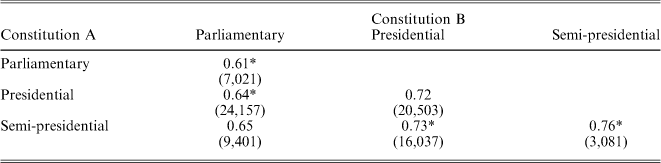
We can begin to get a sense of the degree to which any two presidential, parliamentary or semi-presidential constitutions share a distinct institutional profile by observing the mean similarity scores within and across categories. Table 3 reports this set of comparisons. If attributes of executive-legislative relations cohere within the classical categories, then we should see high within-class scores and low across-class scores, relative to the overall mean. Two of the three diagonal elements (presidentialism and semi-presidentialism) exhibit this pattern, as does one of the three off-diagonal elements (semi-presidential-presidential). This is a mixed pattern, to be sure. While presidentialism (and especially semi-presidentialism) shows some degree of within-class homogeneity, parliamentarism does not. From these data at least, it appears that the classic conceptualization has, at best, only modest power to predict the package of legislative and executive powers.
Similarity of Constitutional Dyads within and across Categories of Government Type

*Significantly different from the overall mean at 5 per cent.
Note: cells represent mean similarity with number of dyads in parentheses.
Overall mean = 0.68 (80,200 dyads), standard deviation = 0.22
The bivariate findings are intriguing and suggest at least two avenues for further inquiry. First, are these patterns stable over time? Secondly, how does the predictive ability of the system classification with respect to pairwise similarity (shown to be quite modest above) compare to that of other explanatory factors associated with differences among states or constitutions? We evaluate these two questions with a set of multivariate models that regresses the similarity between any two constitutions, a and b, on a set of shared characteristics between the two. That is:
 $${{{\rm{y}}}_{{\rm{ab}}}}\, = \,{{{\rm{b}}}_{\rm{0}}}\, + \,{{{\rm{X}}}_{{\rm{ab}}}}\, + \,{\rm{e,}}$$
where y is the measure of similarity between constitutions a and b, X is a vector of attributes describing the relationship between a and b, and e is an error term. X includes measures of the following relationships between the two constitutions in a dyad:
-
(1) Same region. A dummy variable equal to 1 if the two constitutions are from countries in the same geographic region.
-
(2) Same system. A dummy variable equal to 1 if the two constitutions are either both presidential, both parliamentary or both semi-presidential as defined by the variable constructed from the CCP data described above. In some analyses, this variable is broken out into dummy variables representing five of the six combinations of pairs (with parliamentary-semi-presidential as the residual category).
-
(3) Year difference (in 100s). The absolute value of the difference in the year of promulgation between two constitutions, divided by 100.
-
(4) Same country. A dummy variable equal to 1 if the two constitutions are from the same country, since most countries have at least two historical constitutions in our sample.
We begin with a model run on 80,200 dyads in the sample for which we have valid data. Since we are concerned about the independence of observations in which individual constitutions are included in multiple pairings, in separate analyses we test an adapted fixed-effects model in which we explain variation within the first member of the dyad (by entering a dummy variable for each first member) and estimate standard errors clustered within the first member of these dyads. As it happens, the estimates are nearly identical to those from an ordinary least squares (OLS) regression, which we present here.
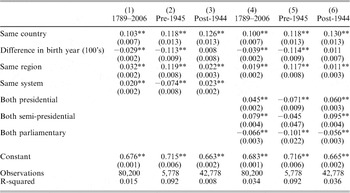
Table 4 presents the OLS estimates for the full sample and those for two eras, pre- and post-World War II. For each of these three samples we test two different specifications of the model. The first specification includes a binary variable that indicates whether two constitutions are from the same system (regardless of which) and the second set includes three binary variables indicating that the two constitutions are both presidential, both parliamentary or both semi-presidential (the residual category thus includes all cross-class pairs). The estimates from the full sample (Table 4, Columns 1 and 4) confirm the bivariate results reported above. The same-system variable in Column 1 suggests that within-class constitutions are indeed more similar to one another than are cross-class constitutions (although by only about two points, b = 0.020). The coefficients on the within-class variables in Column 4 suggest the same mixed pattern that we noticed in Table 3. While presidential and semi-presidential pairs show a modicum of similarity (b = 0.045 and 0.079, respectively), parliamentary systems are actually less alike (b=−0.066) than the cross-class dyads.
Explaining the Similarity of Executive-Legislative Elective Properties, by Era (OLS)

Note: dyads composed of national constitutions promulgated between 1789 and 2006. Standard errors in parentheses; **significant at 1 per cent.
Table 4 provides some sense of how these patterns have changed over time. The models in Columns 2 and 4 restrict the cases to those in which both constitutions were written prior to 1945, and the models in Columns 3 and 6 to those in which both were written after 1945. (This means, of course, that we are excluding the pairs that were written in different eras). Overall, it appears that modern constitutions exhibit more within-class cohesion than pre-WWII ones. The coefficient on the same-system variable is strongly negative for pre-WWII cases (b = −0.074) and modestly positive for post-WWII cases (b = 0.023). Moreover, it appears that much of this reversal can be attributed to growing cohesion among presidential constitutions. The effects in Models 5 and 6 suggest that, although parliamentary constitutions have become more homogeneous in the post-war period, they are still quite dissimilar: when it comes to executive-legislative properties, two modern parliamentary constitutions are still more dissimilar than two constitutions belonging to two different types.
It is important to note that our analysis involves constitutional documents, regardless of their degree of enforcement. Parliamentarism, presidentialism and semi-parliamentarism, however, are labels often applied to democratic forms of government. It is natural to wonder if the same results would be obtained if we restricted our analysis to documents that govern democratic regimes.
Of course, identifying the ‘democratic’ documents is not as straightforward as it may appear. Our solution consisted of using the Cheibub (2007) database to identify forms of democratic government, and matching the CCP constitutional documents to them. This procedure, however, generated a dataset with significant differences with respect to the data analyzed in the body of the article. For example, some constitutions found in the ‘democratic’ sample were excluded from our analysis because they neither had an assembly confidence proviso nor called for popular presidential elections. The reason for this is that, although the constitution had been written prior to the period covered by the Cheibub dataset, it was in force in systems that were democratic after 1945. Examples include Belgium 1831, Canada 1867, Colombia 1886, Cuba 1940, Luxembourg 1868, Netherlands 1848, Sweden 1809, Switzerland 1899 and Norway 1814. Moreover, the sample gets considerably reduced when we adopt this procedure. For the pre-1945 period, there are 55 dyads available for comparison (as opposed to 5,778 using only the CCP data); for the post-1945 period, there are 3,916 dyads in the sample (down from 42,778 when only the CCP data are used).
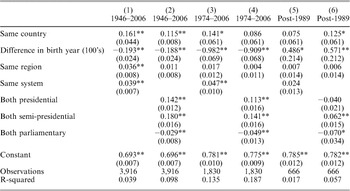
Table 5, Columns 1 and 2, reports the findings for a set of constitutions governing democratic regimes in the post-1945 period, whether or not they were written under these regimes. Qualitatively, the results are the same as reported before: two constitutions that regulate the same type of democracy are more likely to be similar when it comes to executive-legislative relations than two constitutions that regulate different types of democracy. However, regime type is not the biggest influence on the constitutional configuration. Other factors include the era and region in which the constitution was written, and, most importantly, the country: as before, the best predictors of how a constitution regulates executive-legislative relations are the other constitutions written in that country. As before, we also find that the constitutions of two presidential and semi-presidential democracies are more likely to be similar than those of democratic pairs with different systems, and that constitutions in parliamentary democracies are less likely to be similar than those of disparate pairs. The magnitude of the similarity of pairs of presidential and semi-presidential democracies is considerably higher: 0.142 (as opposed to 0.045) for presidentialism and 0.180 (as opposed to 0.079) for semi-presidentialism. This, however, should not be interpreted as an indication that presidential and semi-presidential democratic regimes are becoming more ‘consistent’ in matching their constitutions with ancillary provisions for executive-legislative relations. Columns 3 and 4 of Table 5 show that coefficients do not increase for dyads of presidential and semi-presidential constitutions written in the democracies that emerged since 1974. Columns 5 and 6 show that the effect of system similarity virtually disappears, and presidential dyads become more dissimilar, in constitutions written after the fall of communism.
Explaining the Similarity of Executive-Legislative Elective Properties in Democratic Regimes, by era (OLS)

Note: dyads composed of national constitutions in democracies between 1946 and 2006. Standard errors in parentheses; **significant at 1 per cent; *significant at 5 per cent.
To summarize, we draw two key insights from these findings. First, the classical conceptualization scheme exhibits relatively little institutional cohesion. To some degree, this overall effect masks a degree of internal homogeneity within the presidential and semi-presidential classes. Secondly, this lack of cohesion appears to have declined over time among presidential constitutions but increased among parliamentary ones. This latter finding is somewhat surprising given that, according to conventional wisdom, early parliamentary constitutions rarely codified their legislative-executive relations. The post-war parliamentary constitutions, it seems, have evolved away from classical models.
It is revealing to compare the institutional similarity predicted by the classic typology with other non-institutional predictors. As Table 4 shows, the other characteristics of pairs in the model (same region, same country and same era) all had effects in the direction we would expect: pairs of constitutions written in the same era, the same country and in the same geographic area tend to be more similar than those that were written in different eras, countries or geographic regions. Moreover, all of these effects are, in terms of magnitude, stronger than the effect of government type, at least the aggregate measure that we utilize. So, based on Model 1 of Table 4, we estimate that, on average, constitutions from the same region are 3 percentage points more similar, those from the same country ten points more similar and those separated by 100 years are three points less similar. Knowing the century or the region in which the constitutions were written allows one to predict the similarity of their institutional attributes better than one could by knowing only that they are of the same system type. This is our principal and, we believe, somewhat unsettling finding for those of us who have come to rely upon – and teach – the classical conceptualization of regime types.
Robustness
Are these findings robust to alternative methods? For the most part they are, although some alternative methods and conditions yield increased predictive power for the classical conceptualization. Consider first our measure of the dependent variable. In its construction we faced a decision about how to treat the comparison of systems with different numbers of executives. Given the choice of comparing only the head of government across systems, comparing across two offices by creating twin powers in single-executive systems or collapsing dual-executive systems into one by aggregating the powers of the two offices, we chose the last. The first alternative has the disadvantage of ignoring an entire office, and the second alternative introduces a degree of similarity across systems based purely on a structural attribute (the number of executives) that is perfectly correlated with the classical classification, thus artificially inflating the correlation between the system classification and institutional similarity. Nevertheless, we tested our models with dependent variables constructed with these alternative methods. The results suggest stronger effects for the system variable (the coefficient on the same system variable for models equivalent to Model 1 in Table 4 is b = 0.08 and b = 0.09 for the two alternative methods, respectively). These estimates would suggest significantly stronger predictive power for the classic categorization, though clearly some of that power is an artifact of measurement strategies correlated with the dependent variable.
We also wondered how well the classic conceptualization would predict an expanded set of features of executive-legislative relations. Recall that, in the CCP, we have at our disposal a fairly comprehensive dataset of the powers of (and constraints on) executives and legislatures. We therefore developed a measure of similarity based on the six attributes plus an expanded set of features by including provisions regarding the executive's power to propose budgets, executive immunity, legislative immunity, executive power to propose amendments, executive power to pardon and a bicameral legislature. Models run on this expanded similarity measure returned estimates for the same-system coefficient that were, if anything, smaller than that based on the original six features (for example, b = 0.015 for the model equivalent to Column 1). In some ways this finding is not surprising, since the items in this expanded set are not necessarily suspected of being elective attributes of presidentialism and parliamentarism. Nonetheless, the expanded items are core attributes of executives and legislatures, with important effects on the relationship between the two branches, and it is noteworthy that they too are unrelated to the classical distinction.
Finally, since we found that six allegedly elective attributes were unrelated to presidentialism and parliamentarism, we were led to investigate the relationship between the classification and provisions for assembly dissolution, a feature that is so well associated with parliamentarism that some even include it as part of the concept's definition.Footnote 58 Yet, even with respect to this quasi-definitional feature we found heterogeneity across class. Since 1789, a not unsubstantial percentage of the 204 presidential constitutions in our sample (22 per cent) has included assembly dissolution, while a considerable minority of parliamentary constitutions (20 per cent) does not do so. Certainly, this sort of distribution across classes suggests that the feature is indeed more common to parliamentary systems, but the feature seems hardly definitional. That it is not exclusive to, and universal among, parliamentary systems only emphasizes the hybridity within the classical categories. Curiously, a full 87 per cent of semi-presidential constitutions provides for assembly dissolution, a level that is consistent with our prior finding of relative homogeneity in the semi-presidential class. Again, we note the irony that the intermediate category exhibits the lowest level of hybridity. We were also curious about the robustness of our findings across alternative measures of the classical categorization. Recall that of the four extant measures of the concept that we assembled, we found a decided lack of convergence. Indeed, on average, any two of these measures agreed with one another in only 60 per cent of cases. Accordingly, we tested the predictive power of each of these variables. Not surprisingly, the Cheibub classification, which is highly correlated with our measure (and, on average, most highly correlated with the other measures), returned results that are very similar to ours: we estimated a coefficient of b = 0.05 for the same-system variable across the 4,095 dyads covered. This effect is larger than the one we estimated with the CCP measure, and is comparable in size to the effect of region but not era, whose effect (b = 0.21) is much larger in that model.
Conclusion
It is worth reminding ourselves what is at stake in the choice of analytical concepts to understand executive-legislative relations. As Moe and Caldwell note, with little exaggeration:
Consider the issue that has doubtless been the most enduring focus of institutional attention since democracy first became prevalent among western nations: is a separation of powers system or a parliamentary system somehow better? It is hard to get more basic than this. Historically, these are far-and-away the most common forms democracies have assumed, and they are the usual starting points when designers begin thinking about what kind of democracy they want to build for themselves.Footnote 59
No one should doubt that the idea that the origin and survival of executives represent an important constitutional distinction. But it seems possible that this distinction has preoccupied scholars and constitution makers at the expense of other important dimensions of executive-legislative relations – dimensions that may be orthogonal to the classic distinction. This article has examined formal constitutional provisions of presidential, parliamentary and semi-presidential systems in order to assess the internal cohesion of these classic categories. We recognize that formal constitutions provide only partial guidance in understanding the allocation of powers within all types of systems.Footnote 60 Nevertheless, formal provisions are central to most definitions under consideration, and do capture the intentions of constitutional designers regarding governmental structure.Footnote 61
Our analysis suggests a surprising collection of findings and, by implication, pronounced skepticism regarding the classical typology of presidentialism, parliamentarism and semi-presidentialism. Many countries, it seems, are veritable hybrids, showing absolutely no resemblance to the classic types across a long list of constitutional provisions concerning the power of executives and legislatures. But our skepticism is differentiated: the three classical types differ in their internal cohesion. Ironically, semi-presidential constitutions – a class defined by its hybrid nature – constitute the only class of constitutions that exhibit anything approaching internal coherence. In general, however, the predictive capacity of the classical concept is underwhelming. Indeed, as we note, in order to predict a constitution's content, one would do better to know the region or the century in which the constitution was written than to know whether it was presidential or parliamentary.
In terms of guidance regarding the continued use of the classical taxonomy, we conclude with some provisional alternative directions for usage and further research. First, it seems clear to us that scholars need to be aware of the limited purchase of the classical taxonomy. To scholars for whom ‘parliamentarism’ simply means ‘assembly confidence’ (a label that is specific about the defining attribute), our findings will not give pause. To the many other scholars for whom ‘parliamentarism’ connotes elective attributes other than ‘assembly confidence’, our findings should invite a shift in consciousness and vocabulary. Specifically, it may be worth adopting the more concrete labels ‘assembly confidence executive’ and ‘directly elected executive’ over ‘presidential’ and ‘parliamentary’, respectively. The former labels have the virtue of clearly connoting the definitional properties without furthering stereotypes. Such an approach also has the virtue of overcoming confusion resulting from the fact that the nominal category of ‘presidents’ includes both figureheads in assembly confidence republics and directly elected heads of government.
Of course, even more descriptive labels are only useful if there is a particular theoretical purpose for focusing on the definitional attribute in question. As we argued at the outset, scholars use the core categorization of government type to explain a wide variety of political and economic outcomes. Many of these outcomes do not involve stipulating a causal mechanism that depends on assembly confidence. We ought to then encourage more precise categorizations based on particular attributes of legislative-executive relations that are believed to contribute to the outcome of interest. So, for example, if it is the executive's prerogative to propose legislation that promotes government efficiency, scholars should analyze that feature specifically and not implicate the broader concept of parliamentarism, which is tangential at best to the legislative process.
One important caveat concerns measurement error. As we hope to have made clear, the assessment of institutional similarity involves a set of measurement decisions, including the selection of ‘elective’ properties, the computation of a similarity measure, the choice of an appropriate measure of the classical categories, and the development of an appropriate method to compare two-headed and one-headed executives. Our findings seem to hold across a host of different methodological approaches, but all of our measurement choices should be revisited and tested empirically.
Finally, as suggested above, it seems advisable to seriously consider alternative conceptualizations of executive-legislative relations. Arraying cases along dimensions such as executive or legislative ‘independence’ and ‘power’ are obvious alternatives to the classic types.Footnote 62 So too are well-known concepts such as Lijphart's consensual-majoritarianism and Tsebelis’ veto-players.Footnote 63 Each of these concepts is related to the classical typology, but each also identifies an important theoretical dimension that cuts across the classic distinction. One might also focus on partially aggregated measures of executive power (such as executive power over lawmaking),Footnote 64 which would encompass veto provisions, legislative initiative and executive decree power. However, it could be that other, more incisive ways of slicing cases will occur to the astute scholar. Undoubtedly, some such typologies already exist. Indeed, with respect to semi-presidentialism, some of this re-categorization is noticeably under way. Elgie hints at this in expressing the view that we should not be focusing on normative issues about the classic distinction, but rather on those of more discrete subtypes.Footnote 65 We view all of these efforts as important contributions to an understanding of executive-legislative relations that are at least as important to the dominant classification based on assembly confidence, which is just not as systemic as many believe it to be.