Introduction
Ice-free regions constitute only 0.3% of the Antarctic continental landmass (Ugolini & Bockheim Reference Ugolini and Bockheim2008) and host unique terrestrial ecosystems, including polar deserts, that are well suited to studies of abiotic controls over biodiversity. Organisms inhabiting these polar deserts experience very low temperatures, months of darkness and soils that are highly saline, nutrient-limited and among the most arid in the world (Barrett et al. Reference Barrett, Virginia, Hopkins, Aislabie, Bargagli, Bockheim, Campbell, Lyons, Moorhead, Nkem, Sletten, Steltzer, Wall and Wallenstein2006b). The severity of conditions has constrained the development of multi-trophic ecosystems and as a result, species abundance and distribution in polar deserts is driven primarily by abiotic factors (Hogg et al. Reference Hogg, Craig Cary, Convey, Newsham, O’Donnell, Adams, Aislabie, Frati, Stevens and Wall2006). Most organisms in Antarctic soils are microscopic and include bacteria, fungi, and algae, with nematodes as the top grazers (Wall & Virginia Reference Wall and Virginia1999). Community structure is thought to be controlled mainly by the amount of biologically available liquid water, which is exacerbated by the persistent freezing temperatures and the high salt content of soils (Treonis et al. Reference Treonis, Wall and Virginia1999, Hogg et al. Reference Hogg, Craig Cary, Convey, Newsham, O’Donnell, Adams, Aislabie, Frati, Stevens and Wall2006).
Despite the harsh setting, several recent molecular studies have revealed that Antarctic soils harbour surprisingly high bacterial diversity (Barrett et al. Reference Barrett, Virginia, Wall, Cary, Adams, Hacker and Aislabie2006a, Smith et al. Reference Smith, Tow, Stafford, Cary and Cowan2006, Yergeau et al. Reference Yergeau, Newsham, Pearce and Kowalchuk2007, Niederberger et al. Reference Niederberger, McDonald, Hacker, Soo, Barrett, Wall and Cary2008), spanning as many as 14 different phyla (Cary et al. Reference Cary, McDonald, Barrett and Cowan2010). Most studies have focused on the McMurdo Dry Valleys in southern Victoria Land, the most expansive ice-free region in Antarctica, and have shown that these mineral soils are dominated by Acidobacteria, Actinobacteria, and Bacteroidetes (Cary et al. Reference Cary, McDonald, Barrett and Cowan2010). Smaller ice-free regions in northern Victoria Land (e.g. a dry cirque in the Admiralty Mountains informally known as Luther Vale) harbour Deinococcus/Thermus and the Gammaproteobacteria/Xanthomonas (Niederberger et al. Reference Niederberger, McDonald, Hacker, Soo, Barrett, Wall and Cary2008), while actively penguin-colonized ornithogenic soils at Cape Hallett and Cape Bird are dominated by spore-forming Firmicutes and the Gammaproteobacteria/Psychrobacter (Aislabie et al. Reference Aislabie, Jordan, Ayton, Klassen, Barker and Turner2009). In contrast, the dominant groups in formerly penguin-colonized soils at Cape Hallett shifted to Actinobacteria and Xanthomonas of the Gammaproteobacteria (Aislabie et al. Reference Aislabie, Jordan, Ayton, Klassen, Barker and Turner2009).
This study compares physicochemically distinct soils from Taylor Valley in the McMurdo Dry Valleys of southern Victoria Land and Cape Hallett in northern Victoria Land, which are separated by five degrees of latitude. Taylor Valley has alkaline mineral soils that receive less than 10 cm water equivalent per year (Campbell & Claridge Reference Campbell and Claridge1982, Doran et al. Reference Doran, McKay, Clow, Dana, Fountain, Nylen and Lyons2002). The limited organic carbon in these soils comes from the modern photosynthetic activity of cyanobacteria, lichens and mosses that colonize wetter areas and the ancient organic sediments deposited when the valley was inundated by the palaeolake Washburn during the Last Glacial Maximum (Burkins et al. Reference Burkins, Virginia, Chamberlain and Wall2000). Taylor Valley soils retain salts from past and recent lacustrine intrusions and accumulate additional salts through prolonged weathering and deposition of atmospherically derived salts (Michalski et al. Reference Michalski, Bockheim, Kendall and Thiemens2005, Barrett et al. Reference Barrett, Gooseff and Takacs-Vesbach2009). In contrast, Cape Hallett soils have formed on basaltic screes that receive 18 cm water equivalent per year (Duphorn Reference Duphorn1981) and are heavily influenced by the proximity of marine habitats and by colonies of Adélie penguins (Pygoscelis adeliae Hombron & Jacquinot) and skuas (Catharacta maccormicki Saunders).
This study builds upon two previous studies (Barrett et al. Reference Barrett, Virginia, Wall, Cary, Adams, Hacker and Aislabie2006a, Niederberger et al. Reference Niederberger, McDonald, Hacker, Soo, Barrett, Wall and Cary2008) associated with the Latitudinal Gradient Project (LGP) (Howard-Williams et al. Reference Howard-Williams, Peterson, Lyons, Cattaneo-Vietti and Gordon2006) which examined microbial communities and soil chemistry in northern and southern Victoria Land. Barrett et al. (Reference Barrett, Virginia, Wall, Cary, Adams, Hacker and Aislabie2006a) used the molecular fingerprinting method of DGGE (denaturing gradient gel electrophoresis) to compare microbial assemblages in northern and southern Victoria Land soils. The DGGE method utilizes sequence differences in variable regions of the 16S rRNA gene to create a profile of the bacterial community. This study showed that the richness of the community did not differ between sites, but the different sites had distinct communities comprised of different types of bacteria. While the DGGE profiles were not correlated with any one soil physicochemical property, soils with similar water and nutrient content had similar microbial fingerprints (Barrett et al. Reference Barrett, Virginia, Wall, Cary, Adams, Hacker and Aislabie2006a). In a second study, Niederberger et al. (Reference Niederberger, McDonald, Hacker, Soo, Barrett, Wall and Cary2008) sequenced 16S rRNA genes, allowing the phylogenetic identification of bacteria from four northern Victoria Land soil samples collected from Luther vale (Luther vale is a dry cirque near Cape Hallett that does not contain ornithogenic soils). Niederberger et al. (Reference Niederberger, McDonald, Hacker, Soo, Barrett, Wall and Cary2008) found high diversity and high spatial variability in samples collected from within 200 m of each other. In these Luther vale samples, drier, low productivity soils were dominated by Deinococcus/Thermus species, while high productivity soils were dominated by Xanthomonas species (Niederberger et al. Reference Niederberger, McDonald, Hacker, Soo, Barrett, Wall and Cary2008).
In an effort to resolve the abiotic–biotic interactions, we used a more sensitive, high throughput molecular fingerprinting method, bacterial ARISA (automated ribosomal intergenic spacer analysis), which utilizes size polymorphisms in the 16S–23S ribosomal spacer region (Fisher & Triplett Reference Fisher and Triplett1999). ARISA provides higher resolution of bacterial community structure through the analysis of the highly variable spacer region using capillary electrophoresis rather than gel electrophoresis (Nocker et al. Reference Nocker, Burr and Camper2007). In addition, a variety of multi-variate statistics were used to clearly determine which environmental parameters influenced community structure.
Materials and methods
Sample collection and analysis of soil chemistry
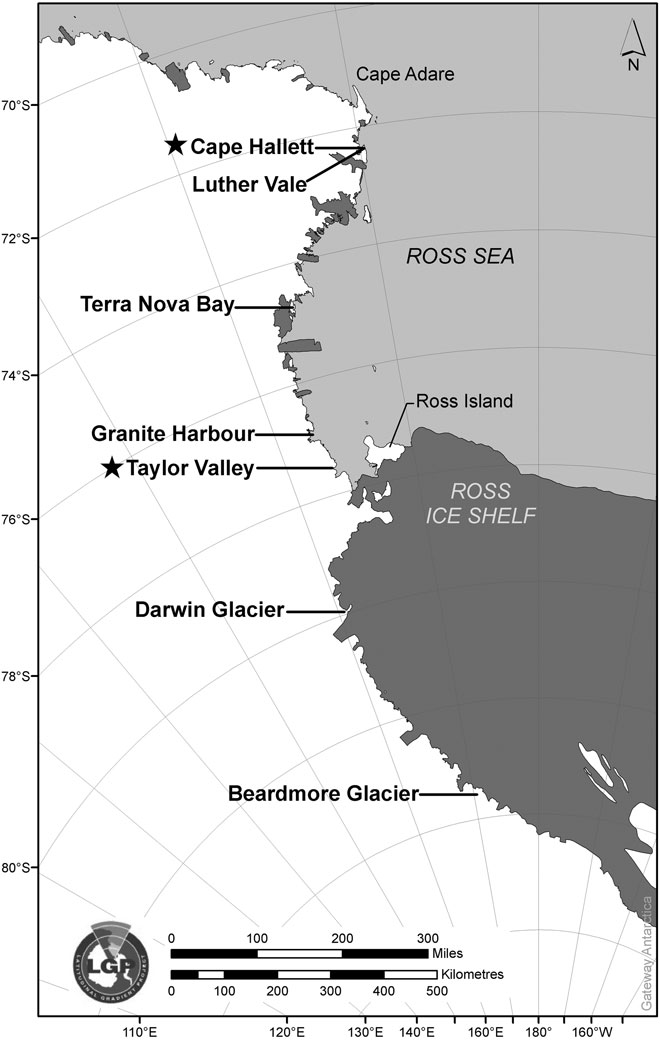
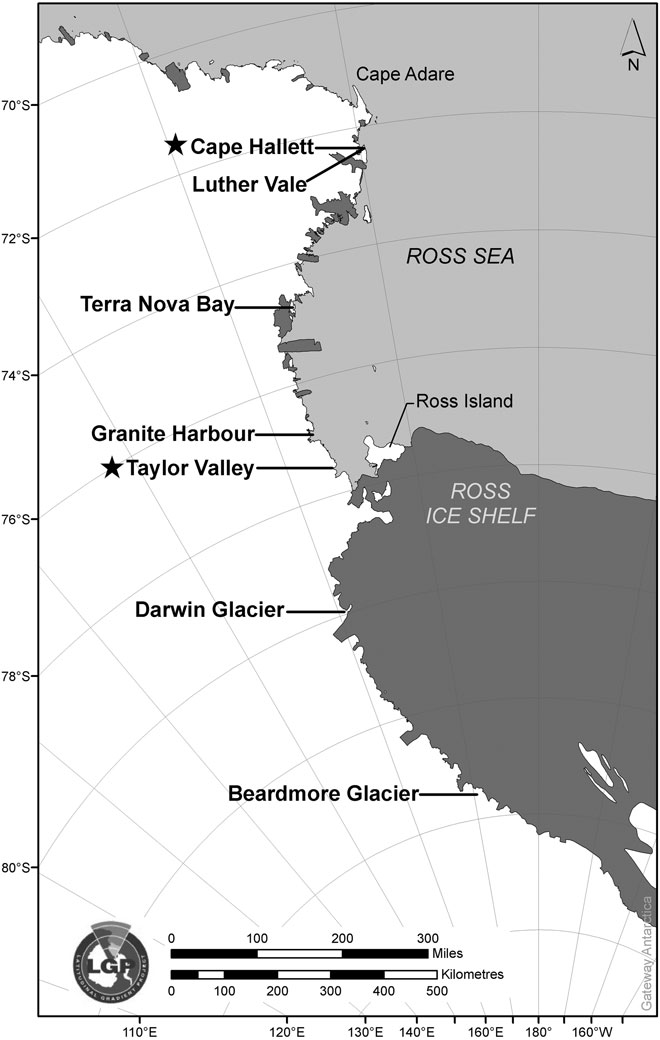
Mineral soil samples were collected in the summer of 2004–05 from two locations in Antarctica: Taylor Valley (77°S, 162°E), in the McMurdo Dry Valleys in southern Victoria Land and Cape Hallett (72°19′S, 170°13′E), an ice-free coastal region in northern Victoria Land (Fig. 1). Cape Hallett soils were collected from moss, algae and lichen dominated surfaces not currently occupied by penguin nests, though stable isotopic signatures of organic matter in this vicinity indicate that ornithogenic influences on soils are ubiquitous (Barrett et al. Reference Barrett, Virginia, Wall, Cary, Adams, Hacker and Aislabie2006a). Both locations were divided a priori into high productivity and low productivity areas based on the relative abundance of visible primary producers (cyanobacteria and bryophytes) on the soil surface as previously described (Barrett et al. Reference Barrett, Virginia, Wall, Cary, Adams, Hacker and Aislabie2006a, Niederberger et al. Reference Niederberger, McDonald, Hacker, Soo, Barrett, Wall and Cary2008). Four replicate transects (10 m in length) were established in a south to north direction for each high and low productivity site at each location, for a total of sixteen transects. Five samples were collected along each transect at 2, 3, 5, 7 and 8 m from the origin. The same positions along adjacent transects were treated as replicates. Soil samples were collected aseptically to a depth of 10 cm. The samples were homogenized and stored at -80°C. Soil physicochemical parameters including gravimetric soil moisture, pH, conductivity, ammonia, nitrate, total nitrogen and organic carbon were measured (Barrett et al. Reference Barrett, Virginia, Wall, Cary, Adams, Hacker and Aislabie2006a).
Map of Antarctic locations studied through the Latitudinal Gradient Project using the Antarctic Digital Database (ADD) datasets. This study compared soils from Cape Hallett (72°19′S, 170°13′E) in northern Victoria Land and Taylor Valley (77°S, 162°E) in southern Victoria Land.
DNA extraction and amplification of ribosomal intergenic spacer region
Genomic DNA was extracted from soil samples using a bead beater protocol (Barrett et al. Reference Barrett, Virginia, Wall, Cary, Adams, Hacker and Aislabie2006a). Prior to amplification, DNA extractions were diluted 1:100 or 1:200 in 0.1X TE buffer to minimize PCR inhibition by co-extractants. The 16S–23S intergenic spacer region was amplified from the extracted community DNA using the primers ITSF (5′-GTCGTAACAAGGTAGCCGTA-3′) and HEX-labelled ITSReub (5′-GCCAAGGCATCCACC-3′) (Cardinale et al. Reference Cardinale, Brusetti, Quatrini, Borin, Puglia, Rizzi, Zanardini, Sorlini, Corselli and Daffonchio2004). Each reaction mixture contained 1X PCR buffer (Sigma), 2.5 mM MgCl2, 1.5 U of Jumpstart Taq DNA polymerase (Sigma), 0.2 mM (each) dNTP, and 0.25 μM (each) primer in a final volume of 25 μl. Amplification was performed with a PTC-200 Programmable Thermal Controller (MJ Research, Inc.) as follows: 94°C for 3 min, followed by 30 cycles of 94°C for 45 s, 55°C for 1 min, 72°C for 2 min, and a final extension at 72°C for 7 min. Amplification quality was evaluated through visualization on a 1% agarose gel stained with ethidium bromide. For each soil sample, three 25 μl reactions were pooled. The pooled PCR products were cleaned by ethanol precipitation and concentrated by resuspension in 20 μl of sterile H2O.
Community profiles were generated by automated ribosomal intergenic spacer analysis (ARISA). For ARISA, 1 μl of cleaned and concentrated PCR product and 1 μl of a ROX-labelled custom internal size standard with fragments up to 1600 bp (BioVentures) were separated by capillary electrophoresis on an ABI 3130xl Genetic Analyzer (Applied Biosystems) using POP-4 polymer (Perkin-Elmer) and a 50 cm capillary. Electrophoresis runs were conducted for 2 hr 45 min with an injection voltage of 1.6 kV, injection time of 15sec, run voltage of 7.5 kV, and a capillary temperature of 60°C. Only peaks with a threshold of 50 fluorescence units or greater were considered. ARISA fragment lengths (AFL) from each soil sample were analysed and exported from ABI GeneMapper v3.7 (Applied Biosystems) and converted to presence/absence data in Microsoft Excel. To minimize error introduced by imprecise capillary electrophoresis, fragment sizes were binned (Hewson & Fuhrman Reference Hewson and Fuhrman2006).
Statistical analysis
Soil chemistry and ARISA data were analysed by 2-way analysis of variance (ANOVA), Tukey tests, and principal components analysis using XLSTAT 2009 (Addinsoft, New York, USA). Bacterial community structure was analysed using Primer 6 (Primer-E Ltd, Plymouth, UK). First, the presence or absence of binned AFLs (ARISA fragment lengths) was used to develop a similarity matrix based on the Bray-Curtis coefficient (Legendre & Legendre Reference Legendre and Legendre1998). The similarity of bacterial communities, grouped by location and productivity type, was assessed by an analysis of similarity (ANOSIM) which produces an R-statistic for each pair of groups where an R-statistic of one means that all of the most similar samples are in the same group and an R-statistic of zero means there is no difference between groups (Clarke Reference Clarke1993). The significance of the R-statistic was tested by Monte Carlo randomization with 999 permutations. A significant R-statistic indicates that samples within groups are more similar than would be expected by random chance. The relationship among individual bacterial community profiles was visualized with a two-dimensional multidimensional scaling (MDS) ordination based on 1000 restarts. An agglomerative, hierarchical clustering of Bray-Curtis similarities was used to designate clusters of 20% similarity.
The effect of abiotic soil properties on the bacterial community profiles was assessed by two methods. First, a Mantel test (Dietz Reference Dietz1983) was performed with 10 000 permutations to compare the Gower similarity matrix (Gower Reference Gower1971) of all eight soil properties and the Bray-Curtis similarity matrix of bacterial community profiles using XLSTAT 2009. The Mantel test determines whether the two matrices are correlated. Second, the BEST analysis method of Primer 6 (Clarke & Gorley Reference Clarke and Gorley2006) was used to determine which abiotic factors best explain the bacterial community structure. All eight soil variables except pH were log transformed and a similarity matrix was determined by Euclidean distance. The agreement between the biotic and abiotic similarity matrices was determined by Spearman’s rank correlation performed with 999 permutations using the BEST analysis method.
Results
Physicochemical characteristics
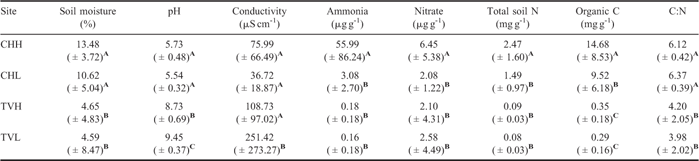
Soil moisture levels ranged from less than 1% to 18%, with significantly higher soil moisture in Cape Hallett soils than in Taylor Valley soils (Table I). Taylor Valley soils had an average pH of 9.1, which was significantly more alkaline (P < 0.05) than Cape Hallett soils, with an average pH of 5.6 (Table I). Conductivity ranged from 23 to 530 μS cm-1, with significantly higher conductivity in Taylor Valley low productivity (TVL) soils than in all other soils (Table I). Cape Hallett high productivity soils had significantly higher levels of ammonia, nitrate, and total nitrogen than all other sites (Table I). Both Cape Hallett high (CHH) and low (CHL) productivity soils had significantly higher levels of organic carbon than the Taylor Valley soils (Table I). Carbon to nitrogen ratios ranged from 2.5:1 to 6.5:1, with significantly larger C:N ratio in Cape Hallett soils than in Taylor Valley soils (Table I).
Average physicochemical properties of soils from high and low productivity sites in Cape Hallett and Taylor Valley. The standard deviation is given in parentheses. Each site includes 20 samples collected from four transects. For each parameter, significantly different (P < 0.01) values determined by 2-way ANOVA and Tukey tests are indicated by superscript letters. CHH = Cape Hallett, high productivity, CHL = Cape Hallett, low productivity, TVH = Taylor Valley, high productivity, TVL = Taylor Valley, low productivity.

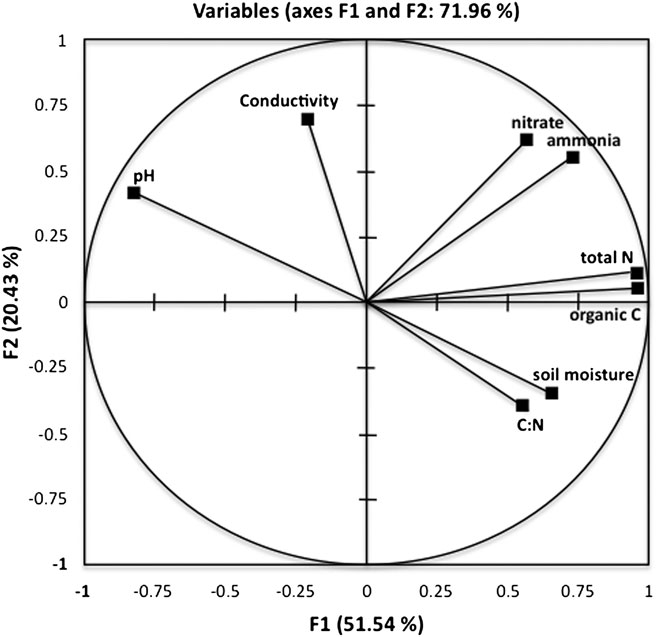
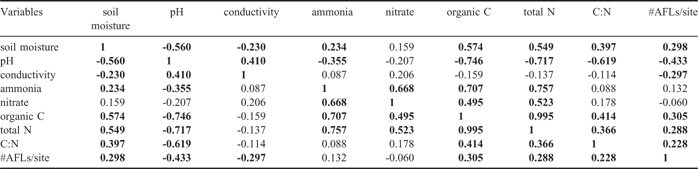
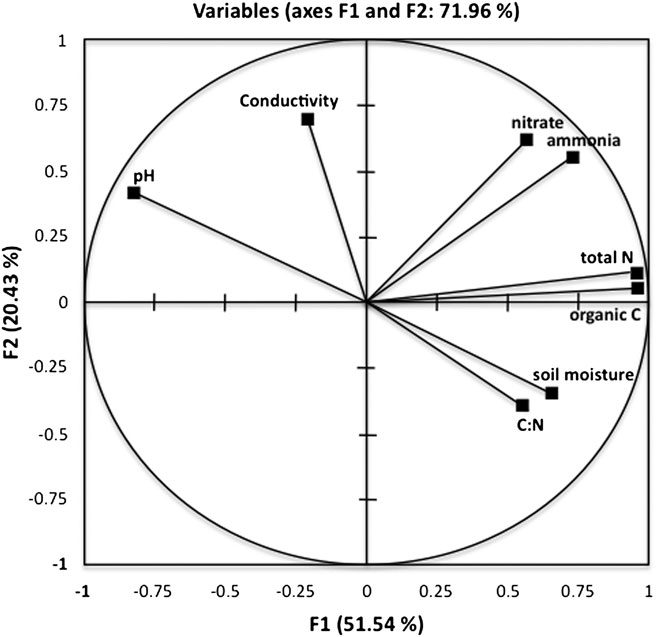
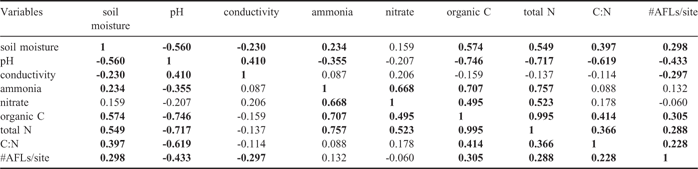
Principal components analysis (PCA) exhibited covariation between soil physicochemical properties. The first two principal components accounted for 72% of the variation (Fig. 2). The largest factor loadings for the first component were organic C (21%), total N (21%), ammonia (17%), pH (17%), and soil moisture (11%). The largest factor loadings for the second component were conductivity (26%), nitrate (25%), and ammonia (17%). Pearson correlation analysis showed that the nutrients were all positively correlated (ammonia, nitrate, total N, organic C) (Table II). Soil moisture was positively correlated with organic C, total N, and C:N and negatively correlated with pH and conductivity. Levels of pH were also negatively correlated with organic C, total N, and C:N.
Principal components analysis plot of soil chemistry data.
Pearson correlation matrix of physicochemical soil properties. Values in bold are different from zero with a significance level alpha = 0.05.
Bacterial community profiles
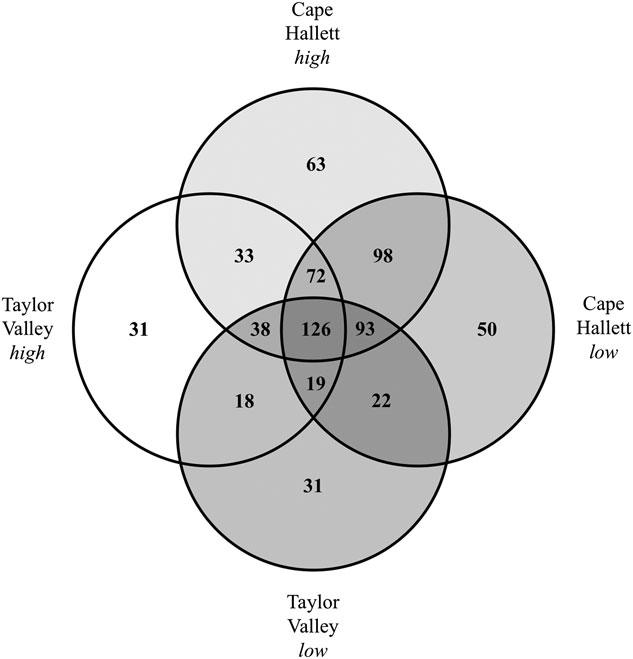
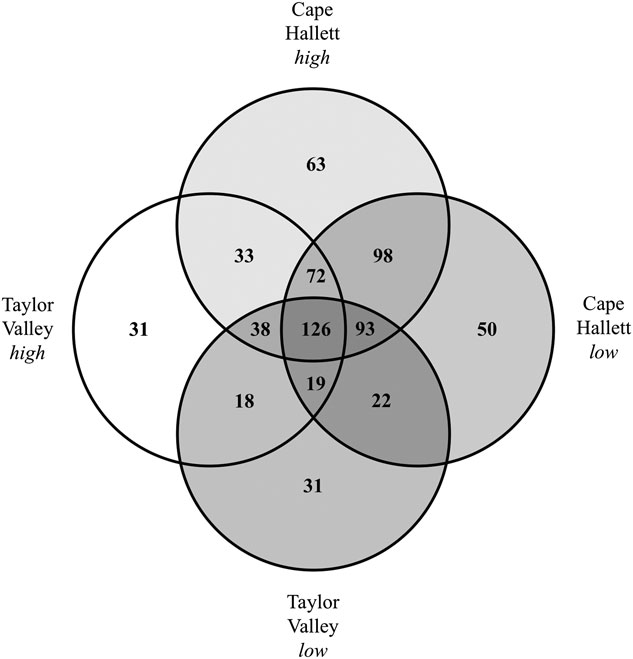
Each soil sample contained 9 to 147 (average = 51) ARISA fragment lengths (AFLs). Fragment sizes ranged from 128 basepairs (bp) in length to 1315 bp, with 80% of the peaks falling within 284 to 727 bp. There was no significant difference in the number of AFLs found at most transect positions (data not shown). However, the transect position with the highest average number of AFLs (CHH1), was significantly different (P < 0.05) from the transect positions with the lowest number of AFLs (TVH2, TVH3, TVH5, TVL4, TVL5). A total of 724 binned AFLs were found, with many AFLs shared between both high and low productivity transects at Cape Hallett and Taylor Valley (Fig. 3). Almost 60% of the AFLs were found in at least one sample from both Cape Hallett and Taylor Valley and 17% of the AFLs were found in at least one sample from all four location + productivity types (Cape Hallett high, Cape Hallett low, Taylor Valley high, Taylor Valley low). However, no individual AFL was found in all 80 soil samples and the most frequently occurring AFL was only found in 38 of the 80 samples. Each AFL was found in an average of six soil samples.
Venn diagram illustrating the distribution of 724 bacterial ARISA fragments among soil samples in high and low productivity areas in Taylor Valley and Cape Hallett. Not shown: 14 AFLs shared by Cape Hallett low and Taylor Valley high productivity samples, 16 AFLs shared by Cape Hallett high and Taylor Valley low productivity samples.
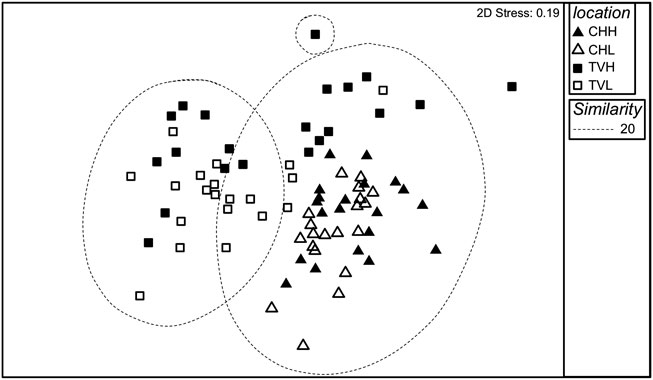
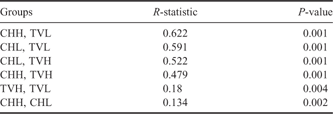
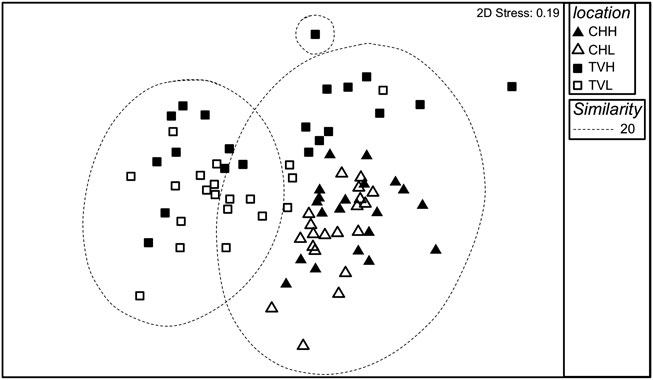
Multidimensional scaling (MDS) of binned AFLs showed that Cape Hallett microbial communities clustered together while Taylor Valley communities showed more variability, regardless of a priori designations of productivity (Fig. 4). An analysis of similarity (ANOSIM) showed that bacterial communities were similar in Cape Hallett low and high productivity soils (Table III). Likewise, the bacterial communities in Taylor Valley low and high productivity soils were similar (Table III).
Multidimensional scaling (MDS) plot generated from Bray-Curtis similarity index based on the presence or absence of bacterial ARISA fragment lengths (AFLs) in Cape Hallett (triangles) and Taylor Valley (squares) soil samples. Closed symbols are samples designated high productivity, open symbols are low productivity. The dashed line represents 20% similarity based on agglomerative, hierarchical clustering of Bray-Curtis similarities.
Analysis of similarity (ANOSIM) between bacterial communities in Cape Hallett and Taylor Valley soils designated high or low productivity a priori. An R-statistic of one indicates that samples within groups are more similar than samples between groups and an R-statistic of zero indicates that there is no difference between groups. The significance of the R-statistic was tested by Monte Carlo randomization with 999 permutations. Significant R-statistics mean that samples within groups are more similar than expected by chance alone. CHH = Cape Hallett, high productivity, CHL = Cape Hallett, low productivity, TVH = Taylor Valley, high productivity, TVL = Taylor Valley, low productivity.

Linking physicochemical characteristics and bacterial community profiles
Pearson correlation analysis of individual soil chemistry parameters and the number of AFLs per soil sample revealed only weak correlations (Table II). A Mantel test between the Gower similarity matrix of soil properties and the Bray-Curtis similarity matrix from binned AFLs showed that the matrices were positively correlated (r = 0.207, P < 0.0001). This indicates that soils with similar physiochemical properties also contained similar bacterial assemblages. The BEST analysis showed the highest correlation (ρ = 0.564) between the bacterial community structure of all 80 soil samples with the abiotic factors, pH and soil moisture (P < 0.001).
Discussion
In agreement with two previous studies (Barrett et al. Reference Barrett, Virginia, Wall, Cary, Adams, Hacker and Aislabie2006a, Niederberger et al. Reference Niederberger, McDonald, Hacker, Soo, Barrett, Wall and Cary2008) of microbial diversity and soil chemistry in Antarctic soils, we found high spatial variability and incidence of correlations between the bacterial community and soil chemical parameters. The current study is unique in examining Cape Hallett soils, which are shaped by coastal and ornithogenic influences, and in the use of a high-resolution molecular fingerprinting method, ARISA. This study yielded an average of 51 peaks per soil sample, compared to an average of 10 DGGE bands from the same Taylor Valley soils (Barrett et al. Reference Barrett, Virginia, Wall, Cary, Adams, Hacker and Aislabie2006a). The number of DGGE bands was not significantly different among sites in Taylor Valley and Luther vale (Barrett et al. Reference Barrett, Virginia, Wall, Cary, Adams, Hacker and Aislabie2006a), whereas the number of ARISA fragment lengths was significantly different among one site in Cape Hallett and some sites in Taylor Valley.
Like other PCR-based fingerprinting methods, ARISA does not detect some members of the microbial community, especially those in very low abundance. However, the high throughput capacity of the ARISA technique allows many more soil samples to be processed than could be achieved by producing 16S rRNA gene clone libraries or through culture-based methods (both of which have their own biases), allowing a more powerful statistical analysis of community and physicochemical data. The ARISA method provides a higher resolution image of bacterial community structure than DGGE due to the increased polymorphisms of the intergenic spacer region and the increased sensitivity of capillary electrophoresis over gel electrophoresis (Nocker et al. Reference Nocker, Burr and Camper2007). One drawback of the ARISA technique compared to DGGE, however, is that phylogenetic identity cannot be assigned to electropherogram peaks.
Each ARISA fragment length (AFL) can be considered an operational taxonomic unit (OTU), although different organisms could potentially have the same length ITS region, albeit with different nucleotide sequences. Conversely, heterogeneity in the rRNA operon within one organism could appear as multiple peaks in the electropherogram. Despite the fact that one AFL does not always equal one “species” of bacteria, differences in ARISA profiles reflect true differences in community composition (Green et al. Reference Green, Holmes, Westoby, Oliver, Briscoe, Dangerfield, Gillings and Beattie2004) and provide a rapid and repeatable assessment that can be applied to a large number of samples. The OTUs identified by ARISA have also been shown to be ecologically relevant as demonstrated in a study of the San Pedro Ocean Time Series in which subsets of the marine bacterioplankton exhibited strong, repeatable temporal patterns (Fuhrman et al. Reference Fuhrman, Hewson, Schwalbach, Steele, Brown and Naeem2006). In this study, community composition was predictable from abiotic and biotic factors, indicating that not only are these communities structured by the environment, but also that the communities contain specialized taxa that are not ecologically redundant. If the community structure did not have a detectable pattern with respect to environmental factors, it could be inferred that the community was well dispersed and members were functionally interchangeable. While the use of ARISA profiles does not identify the functional groups in Antarctic soil communities, there was a detectable pattern in the bacterial communities and significant correlations with abiotic factors. Cape Hallett soils had similar bacterial communities and Taylor Valley soils had similar bacterial communities, with only moderate overlap in taxa among individual soil samples. This suggests that bacteria could be dispersed throughout ice-free regions in Victoria Land, but the very distinct soil properties of Cape Hallett and Taylor Valley create locally selected communities.
The most dramatic difference between Cape Hallett and Taylor Valley soils is in pH, an environmental variable which can exhibit strong selective pressure on bacteria (Padan et al. Reference Padan, Zilberstein and Schuldiner1981). Most microorganisms have an intracellular pH within one unit of neutral (Madigan & Martinko Reference Madigan and Martinko2006) and maintain this internal pH through the use of proton pumps and the internal production of acids by fermentous bacteria (Padan et al. Reference Padan, Zilberstein and Schuldiner1981, Booth Reference Booth1985). This maintenance is critical for cell metabolism and growth as intracellular enzymes require specific pH levels to function efficiently. The current study shows that the bacterial community structure in Taylor Valley and Cape Hallett is correlated to soil pH. This is consistent with a recent study comparing five soil types across Victoria Land that identified Deinococcus/Thermus and Gammaproteobacteria as the dominant bacterial groups in neutral to alkaline soils while Acidobacteria, Bacteroidetes, and Candidate TM7 dominated extremely alkaline soils, indicating that soils with different pH levels harbour different bacterial communities (Aislabie et al. Reference Aislabie, Jordan and Barker2008). Fierer & Jackson (Reference Fierer and Jackson2006) also found that pH was correlated with bacterial community structure and that pH was the best predictor of bacterial richness and diversity in a study of ninety-eight soil samples from different ecosystems across North and South America. They found that neutral soils tended to have higher bacterial richness and diversity compared to acidic and alkaline soils, although not many alkaline soils were included as soils with pH levels greater than 8.5 are rare globally (Fierer & Jackson Reference Fierer and Jackson2006). This agrees with our finding that the alkaline soils of Taylor Valley tended to have fewer bacterial OTUs than the more acidic Cape Hallett soils, though this is conflated with other soil properties that influence both pH and habitat suitability, e.g. organic matter content and water content.
The bacterial community structure from eighty soil samples in Taylor Valley and Cape Hallett was also correlated to soil moisture. The availability of liquid water is believed to be the most important driving factor in the distribution and abundance of life in Antarctica (Kennedy Reference Kennedy1993). The lack of biologically available water inhibits activity and growth even in the presence of adequate nutrients and selects for desiccation tolerant species (Billi & Potts Reference Billi and Potts2002). In this study, we collected soil samples from transects in areas designated as “high” or “low” productivity a priori based on the presence of visible phototrophs at the soil surface. The objective was to collect soil samples with varying soil moisture content as algae, moss, and lichens tend to grow in areas with higher soil moisture (Broady Reference Broady1996, Broady & Weinstein Reference Broady and Weinstein1998). While Cape Hallett soils had significantly higher soil moisture than Taylor Valley soils, we did not discern a significant difference in soil moisture between high and low productivity transects within sites. However, the moisture of individual soil samples within sites is variable and is positively correlated with bacterial community structure, indicating that soil moisture content is patchy and influences microbial communities over fine spatial scales.
Just as there are both unique and shared soil chemistry values between Cape Hallett and Taylor Valley, there are both unique and shared bacterial community members despite the considerable distance and latitudinal difference between the sites. This is in agreement with the previous study that used the DGGE molecular fingerprinting method (Barrett et al. Reference Barrett, Virginia, Wall, Cary, Adams, Hacker and Aislabie2006a) that found both unique and shared microbial signatures at Taylor Valley and Luther vale, a site close to Cape Hallett. The presence of shared taxa among geographically distant soils separated by large ice sheets suggests that differences in the microbial communities are due to local variation in abiotic soil characteristics (intrinsic factors) rather than limitations of dispersion or regional characteristics (extrinsic factors).
Bacterial communities from Taylor Valley and Cape Hallett did not cluster tightly together based on geographical distance, suggesting that these communities are being influenced by either contemporary or historical environmental conditions. Where clear linkages between bacterial communities and modern soil physicochemical parameters are lacking, the biogeographic structure of the communities may be explained by abiotic factors not measured in this study (such as major ions or heavy metals), by the presence of generalist taxa, or by a legacy of past environmental conditions (i.e. glacial events). While all soils are products of past conditions, the paucity of modern sources of organic nutrients in Antarctic soils makes them particularly sensitive to this legacy effect (Barrett et al. Reference Barrett, Virginia, Hopkins, Aislabie, Bargagli, Bockheim, Campbell, Lyons, Moorhead, Nkem, Sletten, Steltzer, Wall and Wallenstein2006b). Another significant challenge to studying the effect of modern environmental conditions on microbial diversity in Antarctic habitats is the persistence of metabolically inactive cells. The very dry and cold climate can preserve dead or inactive cells as well as free DNA for long periods of time (Ah Tow & Cowan Reference Ah Tow and Cowan2005), thereby masking the effects of contemporary conditions. However, the differences seen between the Antarctic sites surveyed in this study and in previous studies (Barrett et al. Reference Barrett, Virginia, Wall, Cary, Adams, Hacker and Aislabie2006a, Niederberger et al. Reference Niederberger, McDonald, Hacker, Soo, Barrett, Wall and Cary2008) suggest that broad scale uniform wind-driven distribution of taxa does not take place.
Despite the limitations of molecular fingerprinting techniques and the unique challenges presented by the ecology of Antarctic terrestrial systems, this study and others like it contribute to the growing body of work uncovering the biogeography of microbial communities and provides baseline data for future monitoring through the Latitudinal Gradient Project. The simplified food webs and lack of vascular plants in polar desert communities allow us to identify which environmental variables have the greatest impact on the diversity and distribution of the unseen microbial majority (Whitman et al. Reference Whitman, Coleman and Wiebe1998) which makes up most of the biomass in Antarctic terrestrial ecosystems. Determining the environmental drivers of microbial community structure and mapping microbial diversity throughout Victoria Land is critical for the identification of potential hotspots that may require special biosecurity consideration.
Acknowledgements
This work was supported by the National Science Foundation (OPP 02-29836 to JEB and SCC and OPP 0739648 and 0632250 to SCC) and the McMurdo Long Term Ecological Research Project (OPP 98-10219). Logistical support was provided by Antarctica New Zealand as part of the Latitudinal Gradient Project, Raytheon Polar Services and Petroleum Helicopters Inc. Special thanks to Shulamit Gordon, Gus McAllister and Rachel Brown of Antarctica New Zealand for field and logistical support. The authors wish to thank B. Kingham, University of Delaware Sequencing and Genotyping Center for technical support. We thank the referees for their comments.