Introduction
Navarro-Rosinés & Hladun (Reference Navarro-Rosinés and Hladun1996) provided a monograph of European species of the Caloplaca lactea group, focused mainly on the western Mediterranean. We deal with the same group, but we prefer to name it after C. crenulatella, a taxon that (though paraphyletic) is common throughout Europe and possesses a representative phenotype for the group. In contrast, the name Caloplaca lactea has been misapplied to various species in Europe; C. lactea proper is restricted, in Europe, to (sub)Mediterranean regions and has a rather atypical phenotype within the group (ascospore size and shape).
Our geographical focus is different from that of Navarro-Rosinés & Hladun since we have emphasized south-east Europe and some parts of western Asia. The centre of our field work was the Black Sea region.
Material and Methods
The main part of the material was collected by the first author during field excursions in 2004 (Bulgaria), 2005 (Romania, Bulgaria, European part of Turkey), 2006 (Ukraine: Crimea), 2007 (Romania, Bulgaria, Turkey, Georgia, Russia, Ukraine, Iran), 2008 (Ukraine: Steppe zone and Crimea) and 2009 (Kazakhstan, Russia, Ukraine). Additional material from the studied regions was seen in KHER, LE and GZU. Comparative material of the species from the western Mediterranean was kindly provided by BCN.
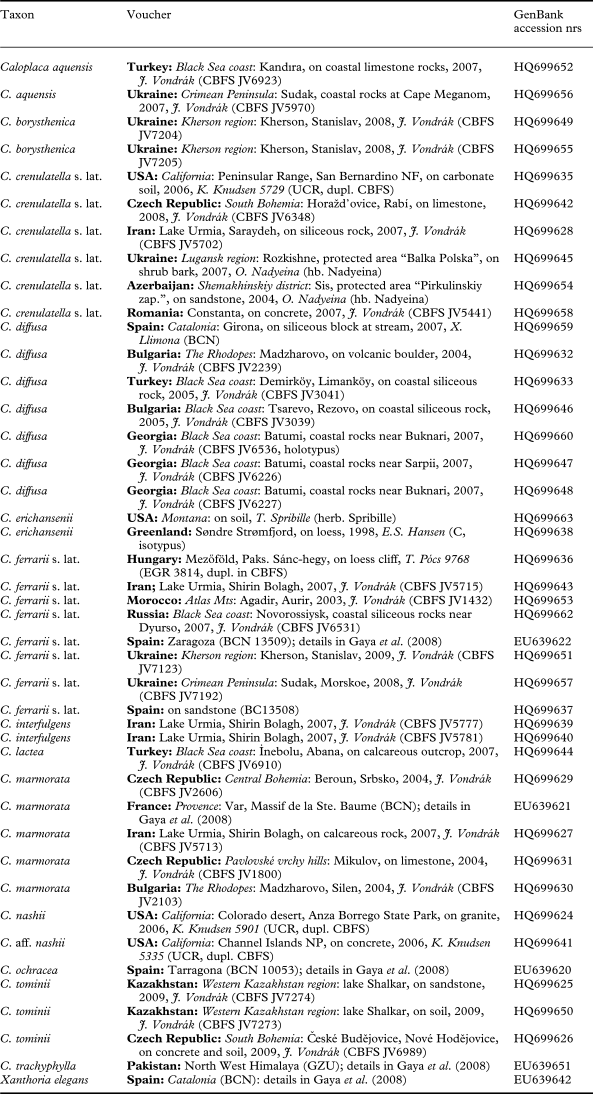
Sample data and GenBank accession numbers of the ITS sequences used in the phylogenetic analysis
Citations of specimens are abbreviated; full information for a majority of the samples deposited in CBFS (herbarium of the University of South Bohemia) is available in a database on the web page: http://botanika.bf.jcu.cz/lichenology/data.php. For the common species Caloplaca marmorata and C. ochracea, only selected samples of particular geographical interest are cited (e.g. new country records). For the taxonomically unresolved species complexes C. crenulatella s. lat. and C. ferrarii s. lat., only samples used in molecular analysis are cited in Table 1. Simplified specimen data for other sequenced lichens are also listed in Table 1.
Morphological investigations
Diagnostic characters for each species are provided in the key and a detailed morphological description is only given for the new species. Measurements are believed to be accurate to 0·25 µm (for cells, e.g. conidia and ascospores), 1 µm (width of asci) or 10 µm (larger structures, e.g. hymenium and width of exciples). All measurements of cells (ascospores, conidia, asci, paraphyses) include their walls. Paraphyses tips were observed after pre-treatment with c. 10% KOH. Only those ascospores with well-developed septa were measured; in these ascospores loculi were connected with a thin cytoplasmatic channel, never disconnected. Measurements are given as (minimum–)  ± SD (–maximum), where
= mean value and SD = standard deviation. Total numbers of measurements are given in square parentheses [n]. Morphological terminology mainly follows Smith et al. (Reference Smith, Aptroot, Coppins, Fletcher, Gilbert, James and Wolseley2009).
Secondary metabolites identification
HPLC chromatography was performed on samples of Caloplaca crenulatella s. lat., C. diffusa, C. ferrarii, C. marmorata and C. tominii according to Søchting (Reference Søchting1997).
DNA extraction and amplification
Direct PCR was used for PCR–amplification of the ITS regions, including the 5.8S gene of the nuclear rDNA following Arup (Reference Arup2006). Primers for amplification were ITS1F (Gardes & Bruns Reference Gardes and Bruns1993) and ITS4 (White et al. Reference White, Bruns, Lee, Taylor, Innis, Gelfand, Sninsky and White1990). PCR cycling parameters follow Ekman (Reference Ekman2001).
Alignment and molecular analysis
The E-INS-i algorithm implemented in the online version of MAFFT 6 (Katoh et al. Reference Katoh, Kuma, Toh and Miyata2002) was employed to align sequence data sets. Further manual adjustments were conducted in BioEdit (Hall Reference Hall1999). Our final alignment included 45 terminals, of which 42 were ingroup samples. A gap matrix was computed in SeqState 1.4 (Müller Reference Müller2005) to encode indel-type mutations; as the dedicated software computing the Bayesian inference does not support cost matrices of MCIC, the simple indel coding (SIC) algorithm was used. Bayesian analysis coupled with Markov chain Monte Carlo (MCMC) simulations was conducted in MrBayes (v3.12; Ronquist & Huelsenbeck Reference Ronquist and Huelsenbeck2003). Two independent simultaneous runs were run for 10 million generations using four Markov chains heated incrementally by 0·25 and sampled every 1000 generations, but the first 25% of trees were discarded as burn-in. Model selection was made in accordance with the Aikake information criterion computed in MrModeltest 2.3 (Nylander et al. Reference Nylander, Ronquist, Huelsenbeck and Nieves-Aldrey2004). In addition, the PAUP* software (Swofford Reference Swofford2002) was necessary to get the ML scores. As suggested, the nucleotide alignment was analyzed under the GTR+Γ model with the assumption of invariable sites. Distribution of prior probability densities of the substitution rates, along with the distribution of the stationary nucleotide frequencies, was set to flat. The indel matrix was treated as restriction data in MrBayes and analyzed under the F81-like model. The stationarity of tree topologies was assessed according to the average standard deviation of split frequencies between both runs (it fell under 0·008). The resulting trees were used for reconstruction of a 50% majority-rule consensus tree.
Results
Phylogeny
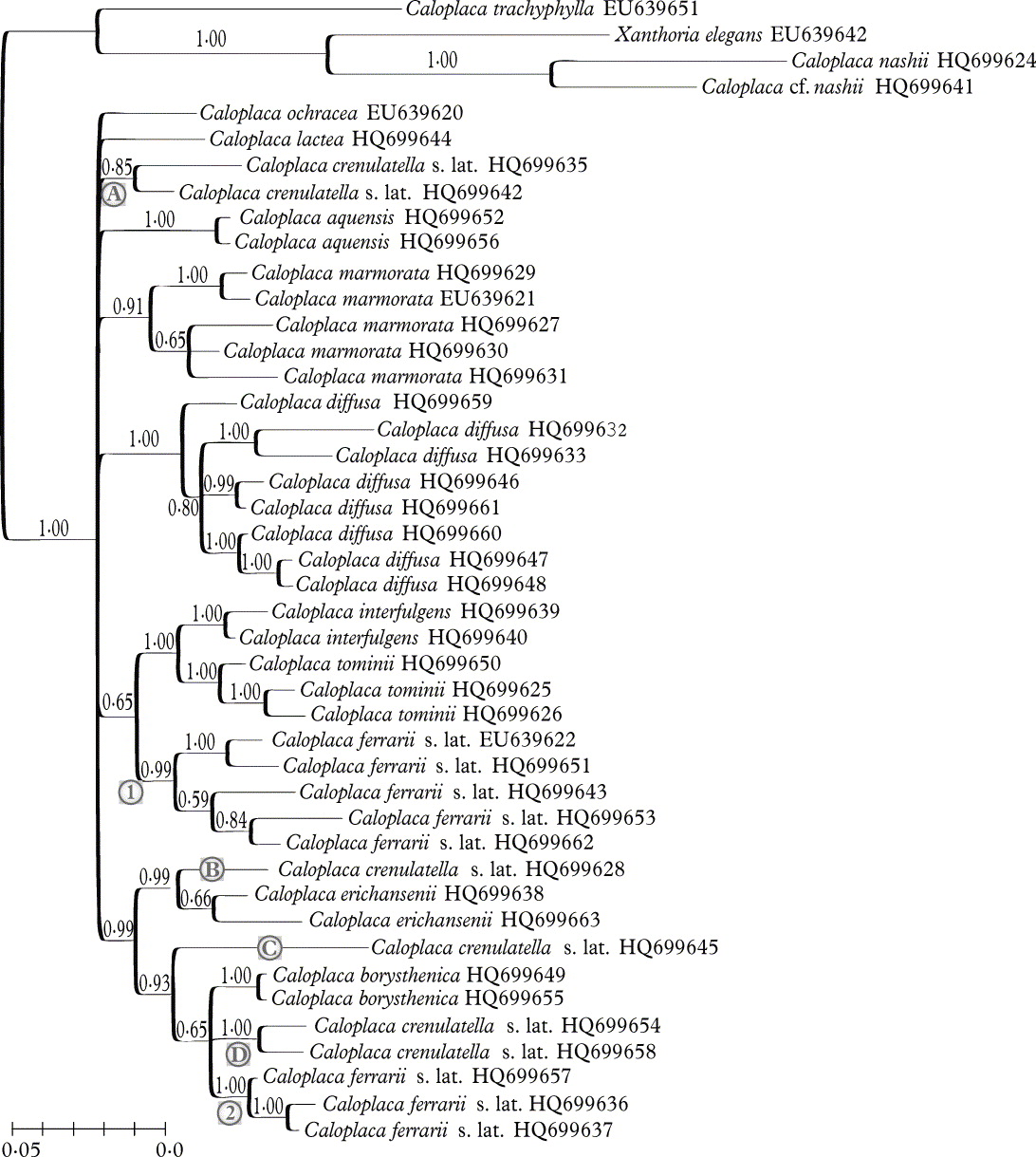
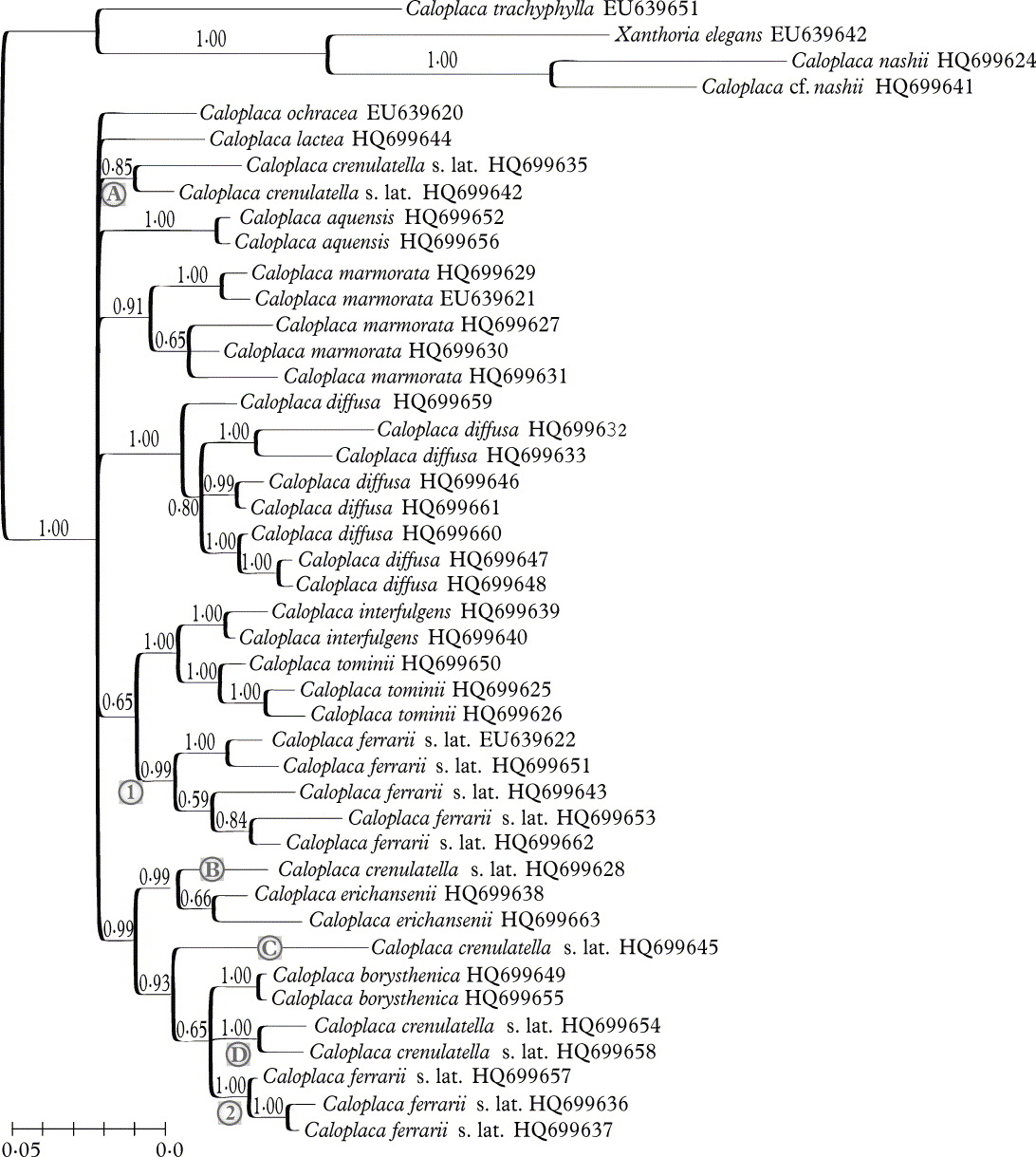
The Bayesian analysis of the ITS nrDNA dataset with coded indels (656 nucleotide positions and 101 indel characters) produced a 50% majority rule consensus tree with an average In L = −4020·305 (Fig.1). In general, the Bayesian inference of our data failed to reveal the relationship between species/lineages, and several single terminals remained ambiguously placed in the basal polytomy. Nevertheless, it provided some important information of interest about the phylogeny of the group. Firstly, all ingroup sequences studied formed a strongly supported monophyletic group (PP = 1·00) in relation to the sequences of C. trachyphylla, Xanthoria elegans and both C. nashii specimens. Secondly, some phenotypically defined species formed convincing ‘molecular taxa’, such as C. diffusa and C. marmorata. Thirdly, some phenotypically distinguishable groups of specimens, for this reason formerly considered as good species (C. crenulatella and C. ferrarii), appear as artificial assemblages of two or more separate lineages. These paraphyletic taxa will be discussed below.
The 50% majority rule consensus phylogram of 15002 Bayesian MCMC trees (two simultaneous runs of 10 million generations sampled every 1000th generation, 25% burn-in) from gap-coded data set of ITS nrDNA sequences from the Caloplaca crenulatella group together with four outgroup sequences. Support values are calculated as Bayesian posterior probabilities. Encircled letters and numbers denote various lineages assigned to C. crenulatella and C. ferrarii, respectively.
Phenotypic circumscription of the group
Although morphologically variable, the Caloplaca crenulatella group is diagnosed by its long and narrow ellipsoid spores, c. 15–20 × 6–8 µm (except for C. lactea) with thin septa, 1–4 µm wide (except for young ascospores of C. ochracea with two small locules and a very broad septum). The thallus is usually reduced, inconspicuous (rarely areolate or exceptionally subsquamulose), yellow or rarely pale grey. The apothecia are zeorine, yellow to red with a thalline exciple that may be enlarged and crenulate in some species. Pycnidia were observed only in C. borysthenica, C. crenulatella, C. diffusa and C. ferrarii; conidia are ellipsoid or shortly bacilliform c. 2·5–3·5 × 1·0–1·5 µm.
The secondary metabolites are anthraquinones of chemosyndrome A (sensu Søchting Reference Søchting1997). Apothecia always contain parietin (main compound) with traces of emodin, fallacinal, parietinic acid, and teloschistin. The thallus, when present and yellow, has the same anthraquinones.
Ecologically, the group shows a preference for calcareous substrata (rock, soil, artificial substrata), although some species tolerate siliceous rocks; only C. diffusa grows mainly on siliceous substrata. Epiphytic occurrences are known in C. crenulatella s. lat., but are exceptional. The biodiversity within the group increases significantly from north to south in Europe.
Another large group of European Caloplaca species containing Caloplaca subpallida H. Magn. and its relatives has a crustose thallus, or no thallus, and ascospores with thin septa. However, it differs from the C. crenulatella group in having smaller and narrower ascospores c. 12–17 × 4–6 µm, and a thallus which (if not entirely reduced) is grey and lacks anthraquinones, but has the pigment Sedifolia-grey. This phylogenetic group is not closely related to the C. crenulatella group (our unpublished data) and includes, for example, C. arenaria (Pers.) Müll. Arg., C. scotoplaca (Nyl.) H. Magn., C. subpallida and C. tristiuscula H. Magn. Species of this group tend to occur on siliceous rocks.
Caloplaca luteoalba (Turner) Th. Fr. is also similar to the C. crenulatella group in its narrow ascosopre septa and outer morphology, but it is an epiphytic species and has smaller ascospores, c. 8–12 × 3–6 µm (Fletcher & Laundon Reference Fletcher, Laundon, Smith, Aptroot, Coppins, Fletcher, Gilbert, James and Wolseley2009).
Taxonomy
The New Species
Caloplaca diffusa Vondrák & Llimona sp. nov
MycoBank No: MB561220
Caloplaca diffusa C. interfulgentis similis est, sed marginem thalli diffusum, et prothallus albus nonnumquam adest. Habitat prope mare, in rupibus siliceis.
Typus: Georgia, Adjara, Batumi, coastal rocks near Buknari, 41°45′58·31″N, 41°45′01·45″E, on siliceous cliff in supralittoral zone, 27 April 2007, J. Vondrák(CBFS JV6536—holotypus; JV6227, JV6493—isotypi). ITS sequence of the holotypus: HQ699660.
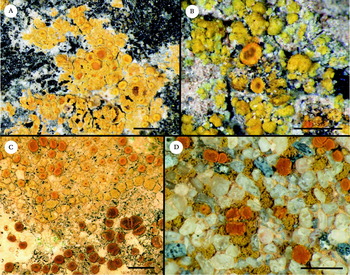
A, Caloplaca diffusa (holotypus); B, C. borysthenica (CBFS JV7314); C, C. interfulgens (CBFS JV5777) together with C. marmorata in the lower part; D, C. tominii (CBFS JV7274). Scales: A–D = 1 mm.

(Fig. 2A)
Thallus yellow, ochre-yellow or grey-yellow, areolate, forming spots up to several cm diam.; thallus margin diffuse, often rimmed by a white or pale grey prothallus. Areoles angular, (170–) 438 ± 250 (–1100) µm diam. [20], up to 150 µm thick. True cortex absent but thin alveolate cortex (sensu Vondrák et al. Reference Vondrák, Říha, Arup and Søchting2009) sometimes present, up to 20 µm thick. Medulla inconspicuous. Prothallus white or pale grey, often present.
Apothecia zeorine, c. 0·4–0·7 mm (rarely to 1 mm) diam.; disc pale to dark orange. Proper exciple covered by yellow-orange pigments, (30–) 78 ± 38 (–150) µm thick [14]; upper part formed of isodiametric cells, c. 5–7 µm diam.; lower part formed of prosoplectenchyma. Thalline exciple covered by yellow pigments, often crenulate, (60–) 104 ± 23(–150) µm thick [14]. Hymenium 70–90 µm thick. Hypothecium of variously shaped cells, conically extended downwards. Asci clavate, Teloschistes-type, (40–) 58 ± 8 (–70) × (12–) 17 ± 3 (–24) µm [18]. Paraphyses branched, thickened in upper part to (2·7–) 4·4 ± 0·7 (–5·7) µm wide [35]. Ascospores (11·0–) 15·3 ± 1·4 (–17·7) × (5·0–) 7·0 ± 1·1 (–9·0) µm [45]; length / breadth ratio (1·5–) 2·2 ± 0·4 (–3·1). Ascospore septa thin, (2·0–) 2·7 ± 0·5 (–3·7) µm thick [45]; ratio of septum width / ascospore length (0·12–) 0·17 ± 0·03 (–0·26).
Pycnidia indistinct or forming orange spots, up to c. 170 µm diam. in section. Conidia narrowly ellipsoid or shortly bacilliform, 2·7–3·2 × 1·0–1·7 µm [10].
Chemistry. Thallus C−, K+ purple, P−, UV+ orange; apothecia C−, K+ purple, P−, UV+ orange. Compounds: parietin (major), ± traces of emodin, parietinic acid, fallacinal and teloschistin.
Phylogeny. All eight sequences of C. diffusa studied formed a well-supported monophyletic group (PP = 1·00), but its precise phylogenetic position remains unclear due to the basal polytomy.
Etymology. The name reflects the diffuse thallus margin of the species.
Ecology and distribution. Caloplaca diffusa prefers damp sites on coastal siliceous cliffs or periodically inundated places where it grows around seepage crevices. The only known inland localities are in Bulgarian Eastern Rhodopes, in NE Spain and in the Peloponnese (Greece) where it grows in the bottom of seasonal streams. It is well-documented in the Black Sea region, but there are two records only from Mediterranean regions (Spain and Greece).
Remarks. Superficially similar species, such as Caloplaca subsoluta (Nyl.) Zahlbr., C. maritima (B. de Lesd.) B. de Lesd. or C. velana s. lat. differ considerably in ascospore characters, mainly in their wider septum. Caloplaca crenulatella s. lat. lacks a diffuse thallus margin and its thallus is more reduced. Caloplaca interfulgens has a different ecology and distribution (calcareous rocks in semi-desert regions), does not have a diffuse thallus margin and never has a distinct prothallus.
Paratypes. Bulgaria: Black Sea coast: Burgas, Kiten, 2007, J. Vondrák (CBFS JV6592, 6593, 6595); Burgas, Rezovo, 2005, J. Vondrák (CBFS JV3039, 3045, 6220); Burgas, Sinemorets, 2007, J. Vondrák (CBFS JV6594, dupl. in GZU). The Rhodopes: Kardzhali, Bregovo, on volcanic rock, 2004, J. Vondrák (CBFS JV2215); Haskovo, Madzharovo, on volcanic rock, 2004, J. Vondrák (CBFS JV2239).—Georgia: Adjara: Batumi, Sarpi, on coastal siliceous rock, 2007, J. Vondrák (CBFS JV6226).—Greece: Peloponese: Argolis Peninsula (Peiraias administrative district), Driopi, on serpentinite in bottom of periodical stream, 2010, J. Vondrák & O. Vondráková (CBFS JV8323).—Russia: Black Sea coast: Tuapse, Gryaznova, on maritime schist, 2007, J. Vondrák (CBFS JV6534).—Spain: Catalonia: Girona, Port de la Selva, on siliceous block at brook, 2007, X. Llimona (BCN).—Turkey: Black Sea coast: Demirköy, Limanköy, on siliceous maritime rock, 2005, J. Vondrák (CBFS JV3041); Istanbul, Kilyos, on siliceous maritime rock, 2005, J. Vondrák (CBFS JV3352, dupl. in LD; 3362, 3372).
Other taxa recognized by the molecular analysis
Caloplaca aquensis Houmeau & Cl. Roux
Bull. Soc. Bot. Centre-Ouest, nouv. sér. 15: 143 (1984); typus: France, Western Gallia, island Aquis (Aix: Le Tridoux), on maritime limesone cliff, 1983, J. M. Houmeau & C. Roux (hb. Houmeau—holotype; MARSSJ— isotype; not seen).
This phenotypically well-circumscribed species (Navarro-Rosinés & Hladun Reference Navarro-Rosinés and Hladun1996) forms a monophyletic group (PP = 1·0) within the Caloplaca crenulatella group, but its closer relationship is unclear as it fell into the basal polytomy. It occurs on limestone cliffs along the Atlantic coast of western Europe, the western Mediterranean (Navarro-Rosinés & Roux Reference Navarro-Rosinés and Roux1992), eastern Mediterranean (e.g. Abbott Reference Abbott2009) and Black Sea coast (Khodosovtsev Reference Khodosovtsev1999).
Specimens studied. Bulgaria: Black Sea coast: Kavarna, 2007, J. Vondrák (CBFS JV6210).—Croatia: Istria: Poreč, Špadići, 2009, J. Vondrák (CBFS JV7248).—Greece: Fokidas: Itea, Galaxidi, 2010, J. Vondrák & O. Vondráková (CBFS JV8330).—Morroco: Mediterranean Sea coast: Al-Hoceima, J. Šoun (CBFS JV6937).—Russia: Black Sea coast: Novorossiysk, 2007, J. Vondrák (CBFS JV6531).—Turkey: Black Sea coast: Kandıra, 2007, J. Vondrák (CBFS JV6120, Reference Kondratyuk, Khodosovtsev and Kärnefelt6923). Sea of Marmara coast: Gallipoli peninsula, 2007, J. Vondrák (CBFS JV7995).—Ukraine: Crimean Peninsula: Sudak, 2007, J. Vondrák (CBFS JV5970); Tarchankut peninsula, 1995, A. Khodosovtsev (KHER 176); ibid., Reference Kondratyuk, Khodosovtsev and Kärnefelt2008, J. Vondrák (CBFS JV8189).
Caloplaca borysthenica Khodos. & S.Y. Kondr
in Kondratyuk, Khodosovtsev & Kärnefelt, Mycologia Balcanica 3: 96 (2006); type: Ukraine, Kherson region, Shirokaya balka, on loess, 2002, A. Khodosovtsev (KW—holotype!; KHER—isotype!).
(Fig. 2B)
The description in Kondratyuk et al. (Reference Kondratyuk, Khodosovtsev and Kärnefelt2006) is based on a poorly developed specimen and the species was characterized by asci with 2–4 (–6) spores that are often deformed. We examined the holotype, isotypes and topotypes again and found some well-developed asci with eight, regularly ellipsoid spores, 14–20 × 4·5–8·5 µm, with septa 1·5–2·5 µm thick. The whole phenotype resembles Caloplaca crenulatella s. lat., but C. borysthenica is often sterile and forms patches of diffuse yellow areoles. It is only known from loess in the northern Black Sea region.
Based on ITS sequences, two topotype specimens represent a well-supported monophyletic group (PP = 1·00), which forms a polytomy with one group of C. crenulatella s. lat (clade D in Fig.1) and one group of C. ferrarii s. lat (clade 2 in Fig.1). This clade is weakly supported (PP = 0·65) and another sequence considered as C. crenulatella s. lat is placed as a sister taxon to this group (PP = 0·93). Whether C. borysthenica is a separate species specialized in living on soil / loess, or whether it is conspecific with the sister clade of C. crenulatella s. lat. is at present unclear.
Specimens studied. Ukraine: Kherson region: Kherson, Stanislav, 2007, J. Vondrák (CBFS JV6223); ibid., Reference Kondratyuk, Kärnefelt, Elix and Thell2008 (CBFS JV6417, 7201, 7203, 7204, 7205); ibid., 2009 (CBFS JV7098, 7314, 7124, distributed in Sel. Exs. Caloplaca, fasc. 2).
Caloplaca erichansenii S.Y. Kondr., A. Thell, Kärnefelt & Elix
Bibliotheca Lichenologica 100: 239 (2009); type: Greenland, SW Greenland, Head of Søndre Strømfjord [Kangerlussuaq], Mt Hassel, south-facing slope, N 67°01 W 50°42, on loess, 1998, Lich. Groenl. Exs 722, E.S. Hansen (C, GZU, Lich. Groenl. Exs. 722, sub C. tominii—isotypes!). ITS sequence of the isotype (C): HQ699638.
Collections from Greenland named Caloplaca tominii were considered a separate taxon by Kondratyuk et al. (Reference Kondratyuk, Kärnefelt, Elix and Thell2009), who described it as C. erichansanii. According to our observations, populations from Greenland (? all arctic populations) and populations from continental North America (e.g. Hansen et al. Reference Hansen, Poelt and Søchting1987; Thomson Reference Thomson1997) are phenotypically indistinguishable from C. tominii s. str. Kondratyuk et al. (Reference Kondratyuk, Kärnefelt, Elix and Thell2009) stated that ascospores of C. erichansenii are longer (18–23 µm) than in C. tominii (14–16 µm), but we have commonly observed ascospores longer than 20 µm in C. tominii s. str. Nevertheless, based on two sequences from Greenland and Montana, C. erichansenii forms a poorly supported clade that is not sister to C. tominii s. str. (Fig.1). Instead, it forms a well supported clade (PP = 0·99) together with one sequence of C. crenulatella s. lat. (terminal B in Fig.1) and this group is sister to the C. crenulatella s. lat. / C. borysthenica / C ferrarii s. lat. clade (PP = 0·99).
Caloplaca interfulgens (Nyl.) J. Steiner
Verhandl. Zool.-Bot. Gesellsch. Wien 52: 479 (1902).—Lecanora interfulgens Nyl., Flora 56: 340; type: Algeria, “Biskra”, 1878, J. P. Norrlin (H-NYL 29579! —holotype).
(Fig. 2C)
The holotype is broken into small pieces but consists of a yellow areolate thallus and matches the samples of Caloplaca interfulgens that we examined. The species occurs in arid regions (semi-deserts) of North Africa, Central Asia and the Middle East. The two sequences studied group together (PP = 1·00) with Caloplaca tominii as a sister clade. This relation was strongly supported (PP = 1·00) and both species occur in dry regions and have similar distributions.
Specimens examined. Iran: Lake Urmia, Shirin Bolagh, 2007, J. Vondrák (CBFS JV5773, Reference Navarro-Rosinés and Hladun5777, 5781).—Kazakhstan: Mangistau region: west chink (slope) of Ustyurt plateau, Manashy, 2009, J. Vondrák & A. Khodosovtsev (CBFS JV7953); Shetpe, Say-Utes, 2009, J. Vondrák & A. Khodosovtsev (CBFS JV8184).
Caloplaca lactea (A. Massal.) Zahlbr
Österr. Botan. Zeitschrift 51: 347 (1901).—Callopisma luteoalbum var. Lacteum A. Massal., Schedul. Critic. 7: 133 (1856); type: Italy, Venetto, Verona, A. Massalongo (A. Massal., Lich. Italici Exs. 236; M—lectotype, selected by Navarro-Rosinés & Hladun Reference Navarro-Rosinés and Hladun1996; LE—isolectotype!).
The name was formerly used in many European countries for specimens of Caloplaca crenulatella or C. marmorata. However, it is a well-characterized species restricted, in Europe, to (sub)Mediterranean regions (Navarro-Rosinés & Hladun Reference Navarro-Rosinés and Hladun1996) with the northernmost confirmed occurrence in Hungary (Vondrák et al. Reference Vondrák, Khodosovtsev, Lőkös and Merkulova2010). Surprisingly, the same species is considered common also in the British Isles (Fletcher & Laundon Reference Fletcher, Laundon, Smith, Aptroot, Coppins, Fletcher, Gilbert, James and Wolseley2009; material not seen by us and in need of revision). The ITS sequence of C. lactea fell into the C. crenulatella group, but its closer relationships are still unresolved. In eastern Europe, the species is restricted to the submediterranean zone of the Black Sea coast in Crimea (Khodosovtsev & Redchenko Reference Khodosovtsev and Redchenko2002) and southern Russia (our data, see below), where it grows on limestone rocks and calcareous schist.
Selected specimens studied. Azerbaijan: Murovdagh: alt. 2900 m, 1912, Schelkovnikov (LE).—Greece: Fokidas: Itea, Galaxidi, 2010, J. Vondrák & O. Vondráková (CBFS JV8331).—Russia. Black Sea coast: Novorossiysk, 2007, J. Vondrák (CBFS JV7540); Tuapse, Reference Navarro-Rosinés and Hladun2007, J. Vondrák (CBFS JV7525).—Turkey: Black Sea coast: İnebolu, Abana, on calcareous outcrop, 2007, J. Vondrák (CBFS JV6910, dupl. in C, GZU).—Ukraine: Black Sea coast: Crimean peninsula, Cape Martian, 1999, A. Khodosovtsev (KHER Reference Navarro-Rosinés and Hladun2713, 2717); Kerch peninsula, Chokrak, 1996, A. Redchenko (KHER 2718).
Caloplaca marmorata (Bagl.) Jatta
Sylloge Lich. Ital.: 251 (1900). —Callopisma marmoratum Bagl., Nuov. Giorn. Botan. Ital. 11: 84 (1879); type: Italy, Sardinia, Cagliari, on limestone, J. B. Canepa (MOD?).
This widely distributed species in Europe was formerly incorrectly named C. lactea but the monograph of the group (Navarro-Rosinés & Hladun Reference Navarro-Rosinés and Hladun1996) clarified its taxonomy. In the eastern part of Europe, it is common on inland, rarely coastal, calcareous rocks (e.g. Khodosovtsev & Redchenko Reference Khodosovtsev and Redchenko2002; Khodosovtsev Reference Khodosovtsev2003; Vondrák et al. Reference Vondrák, Kocourková, Palice and Liška2007). According to our phylogenetic analysis, all sequences studied form one single clade (PP = 0·91) with unresolved relationships.
Selected specimens studied. Iran: Lake Urmia, Shirin Bolagh, 2007, J. Vondrák (CBFS JV5713).—Kazakhstan: Mangyshlag region: Usturt, 1982, M. Andreev (LE, sub C. lactea).—Slovakia: West Carpathians: Spišské Podhradie, 1958, A. Vězda (Vězda: Lich. Boh. Exs. 235, LE!, sub C. lactea).—Turkey: Sea of Marmara coast: Gallipoli peninsula, Abide monument, 2007, J. Vondrák (CBFS JV6663).—Ukraine: Black Sea coast: Kherson region, Tendrivska kosa, 1993, A. Khodosovtsev (KHER 2963). Crimean peninsula: Chatyrdag, 1999, A. Khodosovtsev (KW 2968); Karabi-yaila, 2000, A. Khodosovtsev (KHER 2970); Tyrke, 2000, A. Khodosovtsev (KHER 2964); Roman-Kosh, 2001, A. Khodosovtsev (KHER 2090); Karadag, Mt Besh-Tas, 2001, A. Khodosovtsev (KHER 2967); Tarchankut peninsula, 1998, A. Khodosovtsev (KHER 2965); Kerch peninsula, Mt Opuk, 1994, A. Khodosovtsev (KHER 2956); Chokrak, 1996, A. Redchenko (KHER 2959); Osoviny, 1994, A. Khodosovtsev (KHER 2957).
Caloplaca ochracea (Schaer.) Flagey
Mém. Soc. d'Emulat. Doubs: 257 (1886).—Lecidea ochracea Schaer., Naturwiss. Anzeiger Allg. Schweizer. Ges. Gesamten Naturwiss. 2: 11 (1818); type: Alpes calcariae, Schaerer (G—lectotype designated by Hafellner & Poelt Reference Hafellner and Poelt1979).
Caloplaca ochracea is safely placed in the ingroup (as in the case of C. lactea), but it is an atypical member of the C. crenulatella group for it possesses spores with three thin septa when mature. Two to three-septate spores are not rare among tropical Caloplaca species (Hafellner & Poelt Reference Hafellner and Poelt1979), but they are probably unrelated to C. ochracea. This species is widely distributed on calcareous rocks in Europe and is easily recognizable. In Eastern Europe, it occurs on inland calcareous rocks and also on coastal cliffs (e.g. Khodosovtsev & Redchenko Reference Khodosovtsev and Redchenko2002; Vondrák & Slavíková-Bayerová Reference Vondrák and Slavíková-Bayerová2006).
Selected specimens studied. Romania: Munţii Banatului Mts: Băile Herculane, slope of Mt Domogled, 2005, J. Vondrák (CBFS JV3628).—Ukraine: Crimean Peninsula: Perevalnoye, 1999, A. Khodosovtsev (KHER Reference Vondrák, Khodosovtsev, Lőkös and Merkulova2832); Chiginitra, 2000, A. Khodosovtsev (KHER Reference Vondrák, Khodosovtsev, Lőkös and Merkulova2834); Cape Martian, 2000, A. Khodosovtsev (KHER Reference Vondrák, Khodosovtsev, Lőkös and Merkulova2831, 2833).
Caloplaca tominii Savicz
Isswest. Glawn. Botan. Sada 29: 194 (1930); type: Russia, Astrakhan region, Baskunchak, on soil in steppe, 1926, Savicz (Lich. Ross. 24; LE—holotype!).—Caloplaca gyalolechiaeformis Szatala, Ann. Hist.-Nat. Mus. Natl. Hungarici, s.n. 7: 276 (1956); type: Hungary, Várhegy, Nógrád, on siliceous rock, 1937, V. Kőfaragó-Gyelnik (BP 27571—holotype!; BP 27569, 27570—isotypes).—Caloplaca pseudocitrina Khodos. & Kudratov, in Kondratyuk, Kärnefelt, Kudratov & Khodosovtsev, Nordic Journal of Botany 22: 633 (2002); type: Tajikistan, Southern Tajikistan, Chormagzak pass, 1968, I. Kudratov (KW—isotype!).
(Fig. 2D)
The name C. tominii was previously used for sorediate terricolous populations, common in Central Asian steppes. We discovered that sorediate saxicolous populations named C. gyalolechiaeformis or C. pseudocitrina are conspecific with terricolous C. tominii. The species occurs mainly in the steppe and semi-desert zones of Eurasia with the westernmost records being from Hungary (Vondrák et al. Reference Vondrák, Khodosovtsev, Lőkös and Merkulova2010) and the Czech Republic (this paper). The identity of populations from continental Scandinavia (Nordin Reference Nordin1972), Pakistan (Poelt & Hinteregger Reference Poelt and Hinteregger1993) and the Alps (Hafellner & Türk Reference Hafellner and Türk2001) needs further investigation. Sequences of specimens from the temperate to arid zone of Eurasia formed a well supported clade (PP = 1·00), closely related to C. interfulgens (PP = 1·00 for their mutual sisterhood).
Caloplaca tominii often occurs sterile and cannot then be separated morphologically from some other yellow sorediate species, mainly C. flavocitrina (Nyl.) H. Olivier. However, sterile terricolous samples from continental Eurasia should be identified as C. tominii on ecological grounds.
Selected specimens studied. Czech Republic: České Budějovice, Nové Hodějovice, on concrete and soil, 2009, J. Vondrák (CBFS JV6989).—Iran: Lake Urmia, Bandar-e-Rahmanlu, on soil and over mosses, 2007, J. Vondrák (CBFS JV5591).—Kazakhstan: “Naurzumskiy zapovednik” protected area, on soil, 1939, S. S. Levitskiy (LE). Western Kazakhstan region: lake Shalkar, on soil, 2009, J. Vondrák (CBFS JV7273); ibid., on sandstone (CBFS JV7274).—Kyrgysztan: Kyrgyzskiy khrebet Mts: Kochkorki, alt. 2700, on soil, 1972, L. Bredkina (LE); between Frundze and Osh, alt. 2100 m, on soil, 1870, L. Bredkina (LE).—Russia: Astrakhan region: Baskunchak, on soil, 2009, J. Vondrák (CBFS JV7946, topotype). Orenburg region: Svetliy, locality Aschisayskaya step, on soil, 2004, O. Merkulova (LE, ORIS); Aytuarskaya step, on conglomerate, 2009, J. Vondrák (CBFS JV8234).—Tajikistan: Eastern Pamir: Murghab, alt. 3860 m, 1966, N. S. Golubkova & L. Bredkina (LE); ibid., alt. c. 4000 m (LE).—Turkey: Kurdistan: Lake Van, lava stream near NW shore of Lake Sodalı, on soil among mosses, 2007, J. Vondrák (CBFS JV6629); Kars, Aygir Lake, on siliceous stone, 2007, J. Vondrák (CBFS JV6084).—Ukraine: Kherson region: Stanislav, Shiroka Balka, on loess, 2003, A. Khodosovtsev (KHER Reference Navarro-Rosinés and Hladun2878); Sofiyevka, on loess, 2008, J. Vondrák (CBFS JV7200).
Unresolved Groups
Caloplaca crenulatella (Nyl.) H. Olivier s. lat
According to our phylogenetic study, this taxon is paraphyletic and contains at least four lineages, which we cannot currently distinguish using conventional characters. However, this outcome may be caused partially by the poor resolution of our cladogram. One of the lineages (clade of two sequences, PP = 0·85, marked as A in Fig.1) fell within the basal polytomy and can therefore not be taken into phylogenetic assessment. Another sequence of C. crenulatella (terminal B) forms a clade together with two sequences of C. erichansenii sequences, with strong support (PP = 0·99), and the remaining three sequences (clades C and D) showed clear affinity to C. borysthenica and the ‘clade 2’ of C. ferrarii (PP = 0·93). All studied specimens share characters described in Navarro-Rosinés & Hladun (Reference Navarro-Rosinés and Hladun1996) for C. crenulatella (Nyl.) H. Olivier. The variability of some characters (e.g. ascospore size and width of septa) within individual samples is often large; this makes it difficult to find diagnostic characters of the lineages (possible phylospecies). The degree of thallus development also varies greatly, from absent to subsquamulose and this depends, at least in part, on the age of the lichen. To understand this species complex we need molecular data from more samples to see whether the phenotypic, geographical and ecological characteristics of each clade can be better interpreted. Caloplaca crenulatella s. lat. is common on various base-rich siliceous or calcareous rocks and on artificial substrata, often concrete (e.g. Khodosovtsev Reference Khodosovtsev2001; Vondrák & Slavíková-Bayerová Reference Vondrák and Slavíková-Bayerová2006).
Caloplaca ferrarii (Bagl.) Jatta s. lat
Navarro-Rosinés & Hladun (Reference Navarro-Rosinés and Hladun1996) characterized Caloplaca ferrarii by apothecia between 0·7–1·5 mm diam. and ascospores with septa 1–2 µm. Based on our observations, apothecia in young specimens may be much smaller, usually 0·3–0·7 mm diam. and the ascospore septa are 1–4 µm wide. Caloplaca ferrarii s. lat. (in our sense) is a heterogeneous group appearing in two different clades in our tree (Fig. 1). One of the lineages (clade 1 in Fig.1) contains a sequence of Spanish saxicolous material collected by Navarro-Rosinés (cf. Gaya et al. Reference Gaya, Navarro-Rosinés, Llimona, Hladun and Lutzoni2008) together with saxicolous and terricolous material from a wide geographical range. It is a well supported clade (PP = 0·99), but its position with the sister clade (C. interfulgens + C. tominii) is not strongly supported. The second lineage (clade 2, PP = 1·00) contains a sequence of material identified by Navarro-Rosinés (HQ699637), a sequence of a terricolous sample from Hungary and a sequence of a Ukrainian specimen from concrete. It clusters together with sequences of C. borysthenica and the C and D lineages of C. crenulatella s. lat. (PP = 0·93). Although both clades of C. ferrarii clearly represent separate phylogenetic lineages, we cannot currently distinguish them by their phenotypes.
Species omitted from the molecular analysis
Two more European species have been described from the Caloplaca crenulatella group, but were omitted from our analysis as source material was unavailable. We have some doubts about their delimitation, but include them here for completeness.
Caloplaca epigaea Søchting, Huneck & Etayo
Bibliotheca Lichenologica 96: 282 (2007); type: Spain, Aragon, Zaragoza, on gypsic soil, 2004, A. & J. Etayo 21453 (JACA—holotype; C—isotype!).
The description of the species (Søchting et al. Reference Søchting, Huneck and Etayo2007) corresponds with Caloplaca borysthenica or C. crenulatella s. lat. The authors use well-developed thallus areoles and terricolous occurrence as diagnostic characters, but other taxa may have the same morphology and terricolous occurrences are not exceptional among them (Lőkös Reference Lőkös2003; Vondrák et al. Reference Vondrák, Kocourková, Palice and Liška2007).
Caloplaca lacteoides Nav.-Ros. & Hladun
Bull. Soc. Linn. Provence, 47: 156 (1996); type: España, Cataluña, Prov. Barcelona, Vallès Oriental, el Figaró, al lado del camino hacia Montmany, U.T.M. 31TDG3718 600 m alt., 22 October 1992, P. Navarro-Rosinés (BCC—holotype).
According to the description (Navarro-Rosinés & Hladun Reference Navarro-Rosinés and Hladun1996), this species is characterized by isodiametric cells in the outer part of the proper exciple and by unbranched paraphyses with strongly widened tips. Branching and anastomosing of paraphyses is, however, a variable character within and among samples of the same species and in our opinion it is very unlikely that some species of this group exists with entirely unbranched paraphyses. We have observed swollen cell lumina in the outer part of proper exciples in most species in the group, but this character is variable among samples and we do not consider it to be a good taxonomic character. We have not seen the type of Caloplaca lacteoides, but we are sceptical about the delimitation of this species. Some East European Caloplaca marmorata-like specimens seen by us (KHER 2845, 2916, from Crimea) with large cell lumina in paraphyses tips and in the upper exciple correspond to C. lacteoides, but their identity remains unclear.
Key to the species
1 Thallus sorediate / blastidiate; vegetative diaspores c. 20–80 µm diam. (when sterile, it may be indistinguishable from some other sorediate Caloplaca species) ... 2
Thallus not sorediate / blastidiate ... 3
2(1) Specimens from continental Eurasia ... C. tominii
Specimens from the Arctic and continental N. America ... C. erichansenii
3(1) Ascospores 3-septate when mature ... C. ochracea
Ascospores polarilocular with septum 1–4 µm thick ... 4
4(3) Thallus yellow, well-developed ... 5
Thallus not yellow, or if yellow then poorly developed ... 8
5(4) Thallus of granules, squamules or diffuse convex areoles in apothecial surroundings or forming small sterile spots ... 6
Thallus areolate, effuse, not restricted to apothecial surroundings ... 7
6(5) Often sterile but pycnidia frequent; thallus forming spots a few mm diam.; on loess; often infected by Llimoniella caloplacae S. Y. Kondr. & Khodos ... ... C. borysthenica
Fertile; pycnidia rare or absent; variable in thallus extension; on various substrata ... C. crenulatella s. lat.
7(5) Ascospores c. 14–17 × 6–8 µm; thallus diffuse at margin, often with distinct grey-white prothallus; on siliceous (maritime) rocks ... C. diffusa
Ascospores c. 15–19 × 5–7·5 µm; thallus sharply delimited by marginal areoles; prothallus indistinct; on calcareous (inland) rocks; in N Africa, Near East and Central Asia (not confirmed from Europe) ... C. interfulgens
8(4) Apothecia small, up to 0·5 mm ... 9
Apothecia larger, over 0·5 mm (except for young or grazed thalli) ... 11
9(8) Ascospores broadly ellipsoid, c. 11–16 × 6–9 µm, apothecia in shades of yellow to orange ... C. lactea
Ascospores ellipsoid, more than 15 µm long, apothecia in shades of red, rarely orange ... 10
10(9) Uppermost cells of proper exciple c. 5–9 µm wide ... C. lacteoides
Uppermost cells of proper exciple c. 3–5 µm wide ... C. marmorata
11(8) Ascospores c. 13–18 × 6–8 µm; thallus endolithic; on calcareous maritime cliffs ... ... C. aquensis
Ascospores c. 15–20 × 6–8 µm; thallus usually partly epilithic; on calcareous or siliceous, inland or maritime sites ... 12
12(11) Proper exciple swollen, c. 120–150 µm thick, thalline exciple not enlarged and not distinctly crenulate; thallus pale grey, devoid of anthraquinones ... ... C. ferrarii s. lat.
Proper exciple thinner, c. 80–100 µm thick, thalline exciple (at least in older apothecia) somewhat enlarged, paler than proper exciple (yellow) and often crenulate; thallus (if present) yellow ... C. crenulatella s. lat.
Discussion
The biodiversity of the group is very unequally distributed in Europe. In Scandinavia, only two species occur (Santesson et al. Reference Santesson, Moberg, Nordin, Tønsberg and Vitikainen2004), C. crenulatella (in southern territories) and C. tominii (isolated occurrences in central Norway). From the British Isles only three species are reported (Fletcher & Laundon Reference Fletcher, Laundon, Smith, Aptroot, Coppins, Fletcher, Gilbert, James and Wolseley2009). The situation is similar in most of central Europe, where only C. crenulatella, C. marmorata and C. ochracea are regularly collected. The European centre of biodiversity is the Mediterranean, from where most of the species have been described. This has caused misunderstandings of some names by several European authors; for example, the name C. lactea was used for various central European species and C. interfulgens for C. maritima. The monograph of the group by Navarro-Rosinés & Hladun (Reference Navarro-Rosinés and Hladun1996), which focused on Mediterranean regions, greatly clarified the taxonomy of this group, which was previously poorly understood.
Outside Europe, we have reliable distribution data for species of the C. crenulatella group only from North Africa, Near East, Middle East and Central Asia (Navarro-Rosinés & Hladun Reference Navarro-Rosinés and Hladun1996; this study); records from other regions may be unreliable. Some European species have been reported from North America, but we consider these reports to be doubtful; for example, Wetmore (Reference Wetmore, Nash, Gries and Bungartz2007) listed Caloplaca crenulatella, C. marmorata and C. tominii from the Sonoran Desert. We obtained one sequence from a Californian collection called C. crenulatella; it is placed within the group and, surprisingly, groups with a collection of C. crenulatella s. lat. from the Czech Republic (clade A, PP = 0·85). The sequence from a collection from Montana, called C. tominii, falls into the group with the arctic C. erichansenii and is unrelated to the Eurasian C. tominii s. str. We do not have molecular data for the Sonoran lichen called C. marmorata, but its ascospores are only 14–15·5 µm long, considerably shorter than the 14–19 µm in the European C. marmorata s. str. The North American C. nashii Nav.-Ros., Gaya & Hladun was considered a member of this group on morphological grounds by Navarro-Rosinés et al. (Reference Navarro-Rosinés, Gaya and Hladun2001), but we obtained ITS sequences of C. nashii and C. cf. nashii (second sample differs from the description of C. nashii in its spore characters) from California; they fall outside the group and the BLAST search showed that their closest relationship is to C. bolacina (Tuck.) Herre.
We are grateful to Ester Gaya, Laszlo Lőkös, Olga Nadyeina, Toby Spribille and Kerry Knudsen for providing their herbarium material. Ulf Arup and Ulrik Søchting commented on the manuscript and Ulf Arup also provided one sequence of Caloplaca diffusa. Linda in Arcadia kindly revised the English and Latin. This research received support from the Visegrad Fund (grant 51000067) and the SYNTHESYS Project http://www.synthesys.info/ which is financed by European Community Research Infrastructure Action under the FP7 “Capacities” Programme.