1. Introduction
City-county consolidation stands as a prominent policy adopted by numerous countries globally, serving as a pivotal measure to meet the developmental demands of large cities. There is considerable debate regarding whether city-county consolidations can yield anticipated benefits. Numerous pieces of evidence have indicated that the consolidation allows larger cities to harness the advantages of economies of scale and internalized spillovers, thereby enhancing economic performance as well as optimizing the provision of public goods (Reingewertz, Reference Reingewertz2012). In contrast, other papers have documented the existence of adverse impacts associated with the reduction of local autonomy, the intensification of congestion and the environmental pollution resulting from consolidation (Nelson, Reference Nelson1992; Allers and Geertsema, Reference Allers and Geertsema2016). The issue posed by carbon dioxide emissions deriving due to urbanization has brought the exploration of urbanization paths prioritizing sustainable development to the forefront of concerns for policymakers worldwide. Enhancing energy efficiency is universally acknowledged as the foremost and most economically viable method for mitigating carbon dioxide emissions (Yan and Su, Reference Yan and Su2020). Therefore, it has become imperative for us to explore the causal effect of city-county consolidations on energy efficiency.
Energy efficiency is defined as the ability to achieve the highest possible output and service levels while utilizing the minimum input resources, including energy. Our study endeavours to investigate the causal linkages between city-county consolidations and energy efficiency, with a focus on the county level instead of the municipal level. All findings of our paper are expected to offer policy implications for policymakers to incorporate the welfare of the merged counties into institutional design when formulating policies.
China’s city-county consolidation (namely che xian she qu) provides a critical institutional context. It exhibits distinctive characteristics: (1) administrative hierarchy adjustment: by converting counties (or county-level cities) into districts governed by prefecture-level cities, the reform promotes downward integration and consolidates administrative tiers; (2) spatial and functional reorganization: following the consolidation, the territory of the former county is incorporated into the overall urban planning framework, allowing for unified allocation of land, infrastructure and public services; and (3) economic and governance integration: by dismantling administrative barriers between cities and counties, the reform facilitates factor mobility and industrial coordination, strengthening the capacity of prefecture-level governments to steer economic development within their jurisdictions. In practice, the reform constitutes a comprehensive reform that combines administrative restructuring, spatial expansion and economic integration.
The natural by-product of city-county consolidation is rapid urbanization for consolidated counties. All merged counties have experienced a rapid shift towards urbanization following the city-county consolidation. The urbanization process, in turn, has accelerated changes in energy demand and efficiency. Specifically, the income of residents residing in merged regions increased and their consumption changed to include more energy-consuming products and services (Sadorsky, Reference Sadorsky2013), which would inevitably result in a rise in energy usage in merged counties. Meanwhile, once a county-level region is elevated to the status of a district within the jurisdiction of a prefecture-city, the municipal administration undertakes the task of orchestrating and designing the region’s infrastructure and industrial layout, thereby mitigating potential administrative frictions among various regions. Consolidated counties hold the potential to become high-tech development zones by utilizing their combined resources and expertise. However, it is imperative to recognize that a considerable portion of these areas may also be subject to the influx of energy-intensive and low-tech industries. With the breaking of administrative barriers between regions, the merged counties can attract an inflow of productive factors and realize a regional agglomeration economy under the advantages of higher marginal returns to local capital and labour.
Utilizing China’s city-county consolidations from 2000 to 2017 as a quasi-natural experiment, this paper estimates the causal impact of this administrative reform on county-level energy efficiency. We find that merged counties exhibit lower energy efficiency than their non-merged counterparts. This study extends previous research in the following respects. Firstly, we compute the total factor energy efficiency across a range of Chinese counties over time. Our paper makes a significant contribution to expanding the body of literature on the factors affecting energy efficiency. Secondly, our article extends the cost–benefit analysis of city-county consolidations by incorporating the energy efficiency of merged counties. This analysis serves as a valuable tool for policymakers to make well-informed decisions considering the welfare of merged counties. Thirdly, existing studies have largely focused on the effects of the city-county consolidation policy, such as economic growth, urban expansion or land use, while paying little attention to the mechanisms through which it affects energy utilization. This paper systematically elucidates, both theoretically and empirically, how the city-county consolidation reduces energy efficiency in the consolidated regions through three channels: energy consumption, industrial relocation and economic agglomeration. By identifying these mechanisms, the study extends the literature from examining the policy’s outcome effects to exploring its underlying mechanisms, thus providing a deeper understanding of the economic consequences of administrative boundary adjustments.
2. Policy background and literature review
2.1. Policy background
The current Chinese administrative framework primarily comprises three tiers of governance, namely provincial-level, prefectural-level and county-level administrative regions. While the overall hierarchy has remained stable, the government has frequently adjusted urban administrative boundaries to promote urbanization. These adjustments mainly take two forms: county-to-city upgrading (che xian she shi) and city-county consolidation (che xian she qu). County-to-city upgrading refers to elevating a county to city status, whereas city-county consolidation involves converting counties or county-level cities into municipal districts under a prefecture-level city, thereby expanding the city’s jurisdiction over land and population. Before 1997, county-to-city upgrading dominated administrative reforms; however, stricter approval standards substantially reduced its use thereafter. Since then, city-county consolidation has become the primary instrument for government-led urbanization, with two major waves occurring during 2000–2003 and 2013–2016. Figure A1 (online appendix) illustrates the evolution of merged counties in China from 1999 to 2021.
2.2. Literature review
We will present a comprehensive review of three distinct strands of literature that are pertinent to this paper. Firstly, we will review research on the policy effect of city-county consolidations, which is important for understanding a potential connection between consolidations and energy efficiency. Secondly, we will introduce the literature on factors that influence energy efficiency. Lastly, we will conduct an examination of existing research that explores the impacts of urbanization on energy utilization, which is vital to understanding how urbanization affects energy usage patterns.
Existing studies generally regard city-county consolidation as an important governance tool that achieves economies of scale and enhances administrative efficiency through institutional integration. Early research focused primarily on fiscal performance and public service provision (Reingewertz, Reference Reingewertz2012), finding that administrative consolidation typically reduces managerial redundancies and optimizes resource allocation, thereby improving public service efficiency and lowering administrative costs (Allers and Geertsema, Reference Allers and Geertsema2016). Specifically, consolidation can enhance the scope and quality of government services by centralizing administrative functions, unifying resource allocation and streamlining decision-making processes, while simultaneously reducing duplicated infrastructure and administrative expenditures. Research also indicates that the effects of consolidation vary with context: under mandatory policy settings, administrative integration is more likely to yield significant efficiency gains, whereas in voluntary mergers, the effects are often limited due to insufficient incentives or variations in local autonomy (Blesse and Baskaran, Reference Blesse and Baskaran2016).
As research has progressed, scholars have increasingly examined the broader impacts of city-county consolidation on economic development, population mobility, urbanization, and environmental and energy outcomes. Existing studies indicate that administrative integration can enhance factor allocation and facilitate the flow of capital and labour (Hall et al., Reference Hall, Matti and Zhou2019), thereby boosting local economic dynamism and urban development, though these effects exhibit substantial temporal and spatial variation (Lu et al., Reference Lu, Chen and Zhang2017). In China, the city-county consolidation policy is considered an important instrument for promoting county-level urbanization and regional integration. Empirical evidence shows that, following implementation, consolidated counties experience accelerated economic growth and urban expansion in the short term, while attracting population inflows; however, the long-term effects may diminish, and there is a potential risk of exacerbating regional disparities (Liu et al., Reference Liu, Zeng and Zhou2019). At the same time, some studies have begun to explore the environmental and energy consequences of city-county consolidation, finding that administrative boundary adjustments can not only improve urban air quality (Jiang et al., Reference Jiang, Chen, Yu, Zhong, Dai and Shen2022) but also reduce energy intensity (Li et al., Reference Li, Yan, Zhang, Sun and Zhang2021b). Collectively, these studies highlight the multidimensional effects of city-county consolidation. However, they mainly examine macroeconomic, spatial and urban-level outcomes, leaving county-level energy efficiency and its underlying mechanisms insufficiently explored.
A comprehensive examination of related research suggests that the determinants impacting energy efficiency can be categorized into two major factors, namely factors driven by market forces and related to policy. Research on market factors has focused mainly on technological progress (Trianni et al., Reference Trianni, Cagno and Worrell2013; Wang et al., Reference Wang, Wang, Li and Feng2019); the extent of trade liberalization (Montalbano and Nenci, Reference Montalbano and Nenci2019); urbanization level (Li et al., Reference Li, Fang and He2018; Wang et al., Reference Wang, Wang, Li and Feng2019); industrial structure (Xiong et al., Reference Xiong, Ma and Ji2019); economic development level (Filippini and Hunt, Reference Filippini and Hunt2015); energy price (Herrerias et al., Reference Herrerias, Cuadros and Orts2013); and energy utilization pattern (Yu et al., Reference Yu, Zhou and Yang2019; Zhao et al., Reference Zhao, Guo and Zhao2019). For instance, Liu et al. (Reference Liu, Zhang, Zhang and Wang2020) comprehensively analysed many factors that influence energy efficiency in Chinese provinces, providing a detailed examination of these determinants. As noted by Du et al. (Reference Du, Matisoff, Wang and Liu2016), a feasible strategy for improving energy efficiency involves increasing investments in research and development. Meanwhile, policy measures such as environmental regulation, local governance innovation and regional development strategies have been shown to effectively improve energy efficiency by guiding factor allocation and incentivizing green investment (Han et al., Reference Han, Han, Shi, Su, Lv and Lei2018b; Wu et al., Reference Wu, Hao and Ren2020; Li et al., Reference Li, Han, Wang and Sun2022).
Urbanization represents an important macro-level context for changes in energy consumption and efficiency. Most existing studies suggest that the urbanization process is typically associated with rising energy consumption, particularly during the middle stage of industrialization (Sadorsky, Reference Sadorsky2013; Bilgili et al., Reference Bilgili, Koçak, Bulut and Kuloğlu2017). Industrial agglomeration and lifestyle changes resulting from urban expansion may increase energy demand and reduce energy efficiency (Wang and Yang, Reference Wang and Yang2019). However, some research indicates that once urbanization reaches a stage of high-quality development, technological progress and infrastructure improvements can enhance energy utilization efficiency (Li et al., 2021). In the context of China, urbanization remains at an energy-intensive stage, and its net effect on energy efficiency is still debated. Recently, a few studies have approached the issue from an efficiency perspective, examining the impact of urbanization on total factor energy efficiency. They suggest that rapid urbanization may, in the short term, inhibit improvements in energy efficiency through factor misallocation and spatial congestion effects (Li et al., Reference Li, Fang and He2018; Lv et al., Reference Lv, Chen and Cheng2020).
Based on the above literature, two insights emerge. Firstly, research on city-county consolidation has gradually expanded from fiscal and economic performance to environmental and sustainable development outcomes, yet studies examining energy efficiency in the consolidated regions remain limited. Secondly, while the energy efficiency literature has revealed the roles of market and policy factors, few studies have incorporated administrative institutional changes into the analytical framework. In other words, existing research has not systematically examined how administrative boundary adjustments affect regional energy efficiency through multiple economic channels. This paper aims to enrich the literature on the economic consequences of administrative boundary adjustments and deepen the understanding of the intrinsic links between regional institutional reforms and green development.
3. Theoretical hypothesis
City-county consolidation reform restructures administrative boundaries by incorporating counties with predominantly agricultural characteristics under the direct jurisdiction of prefecture-level cities. In the short term, this reform transforms these areas from agricultural counties into urban districts, significantly raising their level of urbanization. For the affected regions, the reform entails not only a change in administrative status but also comprehensive urbanization across multiple dimensions, including urban functional orientation, infrastructure development, population mobility and land use.
Firstly, the county-to-district conversion drives population concentration and the urbanization of lifestyles. By being incorporated into the management system of the main urban area, the consolidated regions gain access to more comprehensive public services, denser transportation networks and greater employment opportunities, which attract large inflows of rural population to the city. This process of population urbanization shifts labour from the low-energy agricultural sector to higher-energy-consuming non-agricultural sectors, thereby increasing energy demand in production. At the same time, the urbanization of residents’ lifestyles significantly raises household energy consumption. Urban residents have substantially higher demand for energy-intensive goods such as air conditioning, private vehicles and household appliances than rural residents, and these changes in consumption patterns further amplify overall energy use. Secondly, the county-to-district conversion promotes the expansion of urban infrastructure and construction investment. Prefecture-level governments, aiming to enhance the overall urban image and economic capacity, typically increase investment in roads, residential complexes, commercial centres and public facilities in the newly established districts. These infrastructure projects are inherently intensive in energy use during the construction phase, and their operation and maintenance after completion create a sustained source of energy consumption. Thus, infrastructure expansion elevates total energy use during both construction and subsequent operation. Moreover, the reform alters land use patterns and drives the expansion of non-agricultural construction land. Rural collective land is gradually converted into state-owned construction land, providing local governments with increased development capacity and land transfer authority, thereby facilitating urbanization via a model driven by land. The increase in non-agricultural land not only expands the scale of construction but also brings more energy-intensive buildings and transportation facilities, further intensifying regional energy consumption.
Hypothesis 1: City-county consolidation reduces regional energy efficiency by directly increasing energy consumption.
Under China’s decentralized administrative system, the allocation of factors such as capital, labour and land is largely constrained by local government boundaries, giving rise to a typical administrative-region economy. City-county consolidation, which converts former county-level jurisdictions into urban districts under prefecture-level cities, breaks down administrative barriers between central cities and surrounding counties. This allows prefecture-level governments to implement unified urban planning and industrial layouts over a larger spatial scale. Through infrastructure development, public investment and industrial policies, prefecture-level authorities can guide the reallocation of capital and industries within the city, fostering a coordinated division of labour between central urban areas and newly established districts. Formerly independent county-level economies, by virtue of their changed administrative status, are better positioned to absorb industrial spillovers and factor transfers from the city centre. For instance, manufacturing firms located in central urban areas often relocate to newly established districts to reduce land and labour costs. The consolidated districts, with lower land prices and abundant land and labour resources, become the main destinations for these industrial transfers. Many of the industries being relocated are energy-intensive, technologically backward and environmentally poorly managed. Consequently, although city-county consolidation may enhance industrial agglomeration in the merged districts, the influx of low-efficiency firms, because of insufficient technological thresholds and weak environmental constraints, can temporarily increase energy intensity and pollution emissions. This industrial transfer effect may therefore lead to higher energy consumption and lower energy efficiency in the short run.
Hypothesis 2: City-county consolidation reduces regional energy efficiency through industrial transfer.
The city-county reform consolidates the dominant position of cities within a dualistic economic structure, accelerates the integration of urban and rural factors and facilitates the transfer of rural labour to non-agricultural urban sectors. With the inflow of factors and population agglomeration, the urban scale of the merged districts expands continuously. Large areas of rural land are incorporated into urban planning, and agricultural land is gradually converted into construction land. As city districts, local governments can use land transfers to raise fiscal revenue, support infrastructure development and attract industrial and real estate investment through land-based financing and investment driven by land. This process significantly intensifies land use, increases non-agricultural land area and raises industrial density, further concentrating economic activity spatially. By capitalizing on the central city’s attractiveness, merged districts can absorb more industries, population and capital inflows, substantially enhancing regional economic agglomeration.
However, while economic agglomeration improves resource allocation efficiency and promotes growth, it may exert a suppressing effect on energy efficiency. Overconcentration of economic activity can trigger congestion effects, manifested in overburdened resources and environmental capacity, traffic congestion, spatial constraints and pollution. When agglomeration exceeds a critical threshold, its positive impact on economic growth diminishes or even turns negative. Under China’s current industrial-led economic structure, rapid agglomeration resulting from city-county consolidation often leads to surges in energy demand. Because industrial structure and technological levels cannot adjust immediately, energy utilization efficiency may decline. Consequently, although city-county consolidation fosters economic growth and urbanization, excessive agglomeration in contexts of limited resources and environmental capacity can exacerbate energy consumption and hinder improvements in energy efficiency.
Hypothesis 3: City-county consolidation reduces regional energy efficiency by increasing economic agglomeration.
4. Empirical method and data
4.1. Construction of the staggered difference-in-difference model
City-county consolidation reform is primarily driven by prefecture-level states in China. In the context of municipalities that govern counties, county-level governments have little influence on the decision-making of such reforms. Therefore, our study explores the causal effect of urbanization on energy efficiency regarding city-county consolidation from 2000 to 2017 as an exogenous shock for merged counties based on the staggered difference-in-difference (DID).
The counties that executed a city-county consolidation throughout the research phase are deemed our treatment group, whereas the counties that did not carry out any consolidation are treated as the counterfactual group. By conducting a pre- and post-policy comparison of differences between our experimental and control groups, we evaluate the energy efficiency implications of city-county consolidation. Referring to Li et al. (Reference Li, Lu and Wang2016) as well as Ma and Mao (Reference Ma and Mao2018), we build the benchmark model as follows:
 \begin{equation}le{e_{i,t}} = {\beta _0} + {\beta _1}pos{t_{i,t}} + {\beta _2}{X_{i,t}} + {\sigma _i} + yea{r_t} + {c_i} \times t + {\varepsilon _{i,t}}.\end{equation}
In Formula (1),  $i$ represents the county or municipal district,
 $t{\text{ }}$denotes the year,
 $le{e_{i,t}}$ represents the county’s energy efficiency and
 $pos{t_{i,t}}$ indicates whether the county is the object of the city-county consolidation. We set
 $pos{t_{i,t}}{\text{ }}$to 0 before and 1 after the merger.
 $yea{r_t}$ indicates the fixed effect of the year,
 ${\sigma _i}$ indicates the fixed effect of districts and counties,
 ${X_{i,t}}$ represents the control variables and
 ${\varepsilon _{i,t}}$ is a random disturbance term. To avoid omitting factors related to cities that change with time, the fixed effect of city*year is controlled. To mitigate the impact of heteroscedasticity as well as other confounding factors on our statistical analysis, a logarithmic transformation is employed on all continuous variables.
4.2. Variable selection
4.2.1. Explained variable
We employ a super-efficiency slack-based measure (SBM) model with undesirable outputs to estimate energy efficiency as the dependent variable. Compared with traditional radial data envelopment analysis models, the SBM approach explicitly accounts for input–output slacks and allows for the incorporation of undesirable outputs, making it more suitable for measuring energy efficiency in the presence of environmental constraints (Tone, Reference Tone2002; Jin et al., Reference Jin, Zhang, Liu and Zhang2019). Using this method, we calculate county-level energy efficiency in China over the period 2000–2017.
The efficiency model includes three inputs and two outputs. Labour input is measured by total county employment at year-end. Capital input is proxied by county-level capital stock, estimated using the perpetual inventory method following Zhang et al. (Reference Zhang, Wu and Zhang2004). Energy input is estimated using a combination of nighttime light data and provincial energy consumption data, following Chen et al. (Reference Chen, Gao, Cheng, Hou, Song, Liu, Li and Shan2020). The desirable output is real GDP, deflated to constant 2000 prices. The undesirable output is county-level carbon emissions, sourced from Chen et al. (Reference Chen, Gao, Cheng, Hou, Song, Liu, Li and Shan2020).
4.2.2. Explanatory variable
Drawing on reform motivations, we classify city-county consolidation into active promotion and passive implementation. Active promotion is driven by metropolitan expansion resulting from rapid urban growth, whereas passive implementation mainly occurs during county-to-city upgrading. Our analysis focuses on the actively promoted consolidations, which account for approximately 60% of all merged counties. Figure A2 (online appendix) presents a timing diagram illustrating the sample distribution and merger years, where the vertical axis lists merged counties and the horizontal axis denotes time; coloured entries indicate the year in which consolidation occurred.
4.2.3. Control variables
Economic growth is frequently characterized by a substantial escalation in the use of energy; however, it also serves a crucial role in the enhancement of energy efficiency. The manner, as well as the extent to which residents consume energy resources, might be influenced by a multitude of factors, like population density as well as income levels. All these factors may affect energy efficiency arising from a consolidation. Moreover, it is worth noting that the fiscal revenues and expenditures of consolidated counties can exert an influence on energy efficiency through the implementation of their economic policies. In summary, we refer to Liao et al. (Reference Liao, Fan and Wei2007) and Sener and Karakas (Reference Sener and Karakas2019) and select the control variables listed in Table 1.
Descriptive statistics

4.3. Data sources
Most data involved in empirical research (GDP, added value of the three types of industries, population, administrative area, resident savings deposit balance and so forth) are collected from the China County-level Statistical Yearbook, China Regional Statistical Yearbook and relevant prefecture-level statistical yearbooks. We collect detailed information about the policy of city-county consolidation based on the website of the Ministry of Civil Affairs of the People’s Republic of China.Footnote 1 Since this website announced the approval year of the reform, there has been a delay in the actual construction and operation of the districts approved by the State Council (Lu et al., Reference Lu, Chen and Zhang2017). This article uses a corresponding lag period of policy approval as the implementation year of the policy.
5. Empirical results and interpretation
5.1. Statistical description
All data underwent the following processing steps after its collection. Firstly, we deleted related samples of four municipalities (Chongqing, Tianjin, Beijing and Shanghai). Secondly, by comparing different statistical yearbooks, the apparent outliers in some statistical yearbooks were corrected. After processing, the panel data of 1630 counties (districts) from 2000 to 2017 were obtained for 18 consecutive years. Among them, 77 counties had undergone city-county consolidation, accounting for approximately 4.72% of the aggregated quantity of samples.Footnote 2 Table 1 presents the descriptive statistics of the main variables.
5.2. Parallel trend test
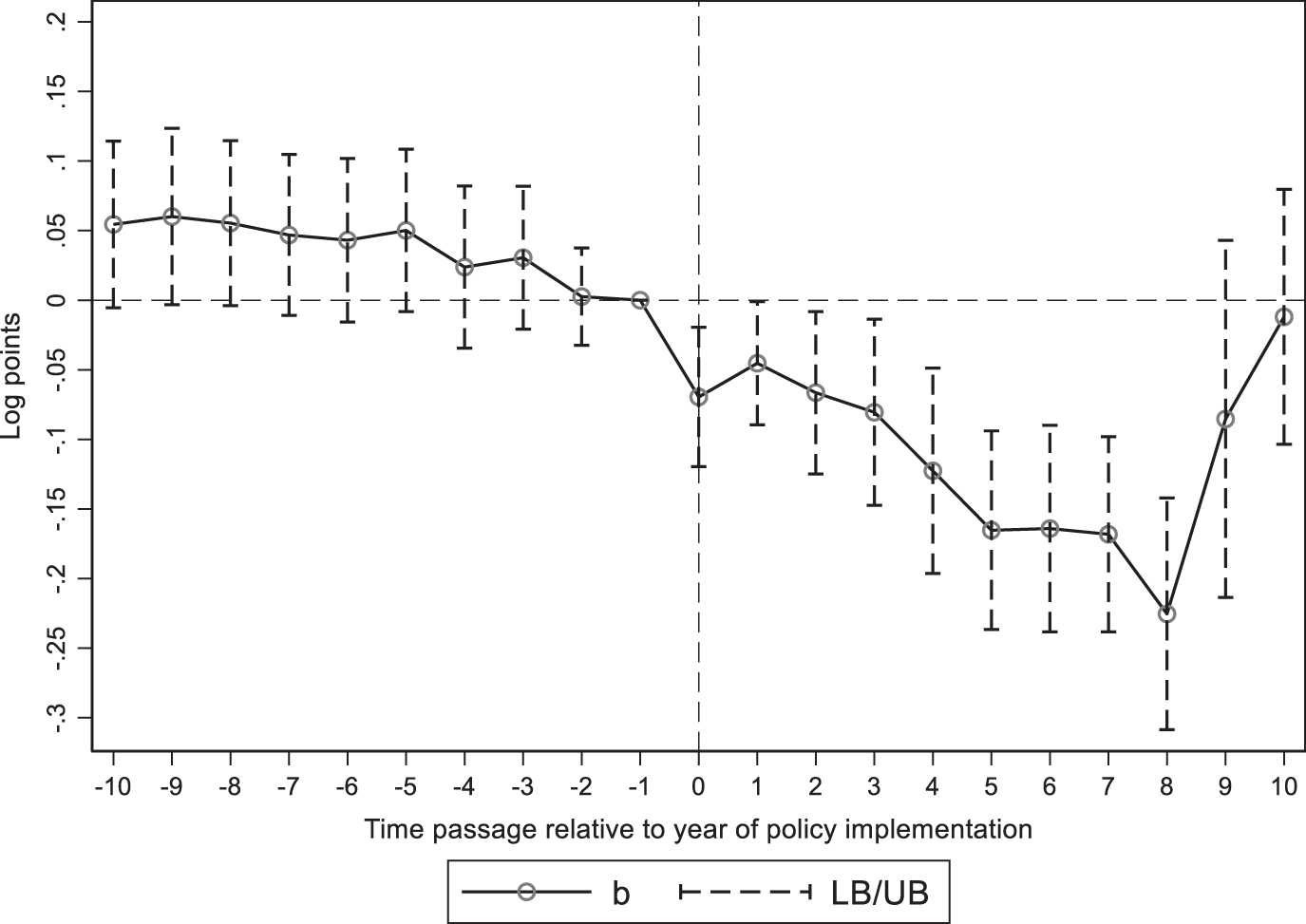
To obtain valid estimates from a staggered DID framework, treated and control counties must follow parallel trends in energy efficiency prior to consolidation. We examine this assumption using an event-study specification following Li et al. (Reference Li, Lu and Wang2016) and Beck et al. (Reference Beck, Levine and Levkov2010). Figure 1 reports the event-study estimates for 10 periods before and after consolidation. The pre-treatment coefficients are statistically insignificant and display no systematic pattern, indicating that energy efficiency trends are parallel across early-treated, later-treated and never-treated counties. In contrast, post-treatment coefficients become significantly negative, suggesting that city-county consolidation reduces energy efficiency.
Time trend of city-county consolidation policy.

Recent studies caution that conventional pre-trend tests have limited power and may provide misleading inference (Roth et al., Reference Roth, Sant'Anna, Bilinski and Poe2023). We therefore complement the event study with the sensitivity analysis proposed by Rambachan and Roth (Reference Rambachan and Roth2023), which evaluates the robustness of treatment effects to potential violations of parallel trends. Figure A3 (online appendix) presents the sensitivity results for the implementation year under both relative deviation and smoothing constraints. The estimated negative effect remains statistically significant even when allowing for moderate pre-treatment trend deviations, confirming that our findings are robust to departures from the parallel trends assumption.
5.3. Benchmark regression
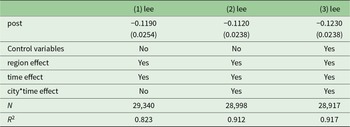
Table 2 illustrates the outcomes of our benchmark regression, which serves as a crucial aspect of our research investigation. Column (1) displays the outcome without any control variables incorporated. The result suggests a significant decline in energy efficiency within the consolidated counties following the city-county consolidation. The significance of the ${\text{ }}post$ coefficient persists at the 1% level in column (2), where the city*time fixed effect is included as the control variable. Column (3) presents our outcomes of adding county-level control variables. The
 $post$ variable’s coefficient exhibits both a similar level of significance and sign as that of the first column. This shows that the merger policy has indeed reduced the consolidated counties’ energy efficiency. This finding contrasts with some existing studies. Previous literature has primarily focused on the positive effects of administrative boundary adjustments on economic growth, investment efficiency and resource allocation (Allers and Geertsema, Reference Allers and Geertsema2016; Liu et al., Reference Liu, Zeng and Zhou2019; Han and Wu, Reference Han and Wu2024). In contrast, our empirical results show that city-county consolidation may lead to a short-term decline in energy efficiency. This discrepancy may reflect higher management costs during the initial phase of the consolidation and local governments’ short-term preference for economic expansion during resource reallocation. Empirically, our study confirms that city-county consolidation can exert structurally negative effects on energy performance in the short run, offering a novel perspective on the multidimensional economic consequences of such policies.
Benchmark regression results

Notes: The values enclosed in parentheses indicate county-level clustered standard errors.
5.4. Robustness tests
5.4.1. Instrumental variables regression
Potential issues such as bidirectional causality, omitted variables and measurement error may bias the baseline regression estimates. A common approach to address these concerns is to employ an instrumental variable (IV) and perform a two-stage least squares estimation. We construct the IV for city-county consolidation by interacting each county’s distance to the prefecture-level city centre with a dummy indicating whether adjacent counties have undergone city-county consolidation. The first-stage results confirm strong instrument relevance, and the second-stage estimates indicate that the consolidation effect remains significantly negative. Weak instrument and under-identification tests further support the validity of the IV strategy (see Table 3).
Instrumental variable estimation results

Notes: The values enclosed in parentheses indicate county-level clustered standard errors. Values in square brackets are p-values, and values in curly brackets correspond to the 10% critical value for weak identification tests.
5.4.2. Propensity score matching (PSM)–DID analysis
While the county-level government lacks the authority to determine the outcome of city-county consolidation, the application of policy is not arbitrary. Instead, it is contingent upon various factors, including the degree of local economic development, demographic characteristics, as well as administrative considerations. Thus, the PSM–DID method is utilized to strengthen the validity of our findings by addressing potential selection biases and endogeneity concerns. The outcomes presented in Table A1 (online appendix) demonstrate that, irrespective of the approach used for matching, the coefficients of the  $post$ variable remain significantly negative.
5.4.3. The re-estimation of the benchmark model
To address concerns regarding heterogeneous treatment timing under the two-way fixed effects framework, we conduct Goodman-Bacon (Reference Goodman-Bacon2021) decomposition and re-estimate the benchmark model using alternative DID estimators, including Cengiz et al. (Reference Cengiz, Dube, Lindner and Zipperer2019), Sun and Abraham (Reference Sun and Abraham2021) and Goodman-Bacon (Reference Goodman-Bacon2021). As reported in Table A2 and Figure A4 in the online appendix, comparisons between treated and never-treated counties account for 97.7% of the total weight. The corresponding event-study results in Figure A5 (online appendix) are highly consistent with the baseline specification.
5.4.4. Other robustness checks
We perform additional robustness checks to rule out alternative explanations. Firstly, placebo tests based on randomly assigned treatment units and timing show that the baseline estimate is unlikely to be driven by unobserved confounding (see Figure A6 in the online appendix). Secondly, excluding counties affected by other contemporaneous policies – such as the low-carbon city pilot program and fiscal energy conservation and emissions reduction pilot program – does not alter the main findings (see Table A3 in the online appendix). Thirdly, the results remain robust after controlling for fiscal capacity, adopting an alternative SBM-based energy efficiency measure and applying different winsorization thresholds to mitigate outlier effects (see Table A4 in the online appendix).
5.5. Heterogeneity analysis
5.5.1. Environmental regulation
We split our sample into areas with strong and weak environmental regulations and conduct a heterogeneity analysis to determine whether the consolidation had different effects. The strength of regulation is proxied by whether less industrial wastewater is discharged by a prefecture-level city to which the counties are affiliated, compared to the median of all samples.
Columns (1) and (2) of Table A5 (online appendix) show that energy efficiency does not decline significantly in merged counties located in cities with strong environmental regulation, whereas a significant decrease is observed for those affiliated with weakly regulated cities. This finding suggests that stringent environmental regulation can mitigate the adverse impact of city-county consolidation on energy efficiency, possibly by curbing energy use directly or inducing technological innovation (Parikh and Shukla, Reference Parikh and Shukla1995; Hamamoto, Reference Hamamoto2006).
5.5.2. Resource dependence
To examine whether the effect of city-county consolidation on energy efficiency varies with regional energy structures, we divide the sample into regions with high and low resource dependence, proxied by whether the share of mining employment in the affiliated prefecture-level city exceeds the median. The last two columns of Table A5 (online appendix) show that energy efficiency declines significantly in highly resource-dependent regions after consolidation, while no significant effect is observed in less resource-dependent areas. This pattern likely reflects the concentration of energy- and resource-intensive industries and strong path dependence in resource-rich regions, which hinder structural upgrading and the development of green technologies (Ruan et al., Reference Ruan, Yan and Wang2020; Li et al., Reference Li, Zeng, Liu, Yang and Xu2021a). Overall, the results suggest that administrative consolidation exacerbates energy efficiency losses in regions with high resource dependence.
5.6. Mechanism tests
Turning to mechanisms, our paper considers the three main channels: energy consumption, industrial transfer and economic agglomeration. We use the county’s per capita energy consumption, a county-level aggregate of the added value produced by the tertiary as well as secondary sectors, as well as the labour force density per unit of land area in a county, to measure these three mechanisms.Footnote 3 Here, we collect data on the three indicators and conduct regression analyses on city-county consolidation, respectively.
5.6.1. Energy consumption
The consolidation accelerated the urbanization of the merged counties. Urbanization requires large quantities of energy-intensive products. In addition, the prefecture-level municipal governments built more infrastructure to strengthen the connection between the urban areas and the merged counties. Meanwhile, residents’ income increased and their consumption changed to include more energy-consuming products and services (Sadorsky, Reference Sadorsky2013). The outcomes reported in column (1) of Table 4 reveal a noticeable increase after the city-county consolidation reform in energy consumption levels among the merged counties. This is consistent with the findings of Wang and Yang (Reference Wang and Yang2019), who show that urbanization can significantly increase energy intensity at certain stages of economic development, thereby negatively affecting energy efficiency. Our results suggest that city-county consolidation may induce an energy-intensive urbanization effect.
Mechanism analysis of city-county consolidation

Notes: The values enclosed in parentheses indicate county-level clustered standard errors.
5.6.2. Industrial transfer
Under the Chinese decentralization system, the allocation of capital, labour and land was interfered with by local governments, resulting in China’s unique ‘administrative region economy’. As a result, market segmentation among different administrative districts has become a common phenomenon. The consolidation reform placed the municipal district and surrounding counties under a unified administrative area. After a county becomes a municipal district, the prefecture-level municipal government may carry out a unified industrial layout and urban planning. According to theory, counties often undertake backward industries with low technological innovation levels and high energy usage in urban regions. Therefore, the policy of city-county consolidation may have reduced county energy efficiency through the mechanism of industrial transfer. We can observe that merged counties undertake the industries in the urban areas because of the consolidation reform from column (2) of Table 4. This finding is complementary to existing studies. Previous research has emphasized that administrative boundary adjustments can promote regional economic growth and improve resource allocation efficiency (Han and Wu, Reference Han and Wu2024). In contrast, our results show that, while city-county consolidation can facilitate spatially coordinated development, it may also temporarily reduce energy efficiency through the mechanism of industrial transfer.
5.6.3. Economic agglomeration
Following the consolidation reform, the merged counties experienced a gradual transition from agriculture-oriented activities towards more diversified industrial and service-based structures. City-county consolidation reshaped land governance and land use patterns, facilitated investment through land transfers and increased population concentration and economic activity, potentially fostering economic agglomeration. The literature on the relationship between economic agglomeration and energy efficiency remains inconclusive. While some studies argue that agglomeration increases energy demand and carbon emissions (Parikh and Shukla, Reference Parikh and Shukla1995; Cole and Neumayer, Reference Cole and Neumayer2004), others emphasize efficiency gains through scale effects, with limited or even negative spillovers on surrounding regions (Han et al., Reference Han, Xie and Fang2018a). Our results, reported in column (3) of Table 4, align with Parikh and Shukla (Reference Parikh and Shukla1995), suggesting that in the short run, economic agglomeration may primarily increase energy demand, thereby offsetting the potential benefits from scale efficiency associated with agglomeration.
6. Conclusions and policy implications
Using China’s city-county consolidation reforms as a quasi-natural experiment, this paper examines the causal effect of municipal amalgamation on energy efficiency. We find that energy efficiency in merged counties declines significantly after consolidation. While the institutional background is specific to China, the findings offer broader implications for developing countries undergoing rapid urbanization. Our results do not suggest that consolidation should be avoided altogether; rather, policymakers should carefully evaluate its consequences for merged counties and incorporate energy efficiency considerations into urbanization strategies.
This study contributes to the literature in several ways. Firstly, by measuring county-level total factor energy efficiency over an extended period, it provides new evidence on the spatial and temporal dynamics of energy efficiency. Secondly, it extends the cost–benefit analysis of city-county consolidation by incorporating energy efficiency from a county-level welfare perspective, complementing existing studies that focus mainly on economic growth or urban expansion. Thirdly, the paper identifies three channels – energy consumption, industrial relocation and economic agglomeration – through which administrative integration may reduce energy efficiency, highlighting the risk of resource misallocation associated with land-centred urbanization.
Further analysis shows that the negative effects are more pronounced in regions with weaker environmental regulation and higher resource dependence. These findings suggest that prefecture-level governments should strengthen environmental performance criteria in official assessments and promote industrial upgrading towards low-carbon and technology-intensive activities, particularly in resource-dependent areas.
This study has several limitations. Due to data constraints, energy inputs and outputs are measured at the aggregate county level, which may mask heterogeneity across industries and energy types. In addition, although total factor energy efficiency captures overall performance, it may not fully reflect technological progress or environmental externalities. Finally, the sample period limits the analysis of long-term effects. Future research could address these issues using more detailed data and longer time horizons.
Overall, this paper provides new causal evidence on the energy consequences of administrative boundary reforms and sheds light on the mechanisms through which government-led urbanization policies affect energy efficiency, offering insights for designing more sustainable urbanization strategies.
Supplementary material
The supplementary material for this article can be found at https://doi.org/10.1017/S1355770X26100485.
Acknowledgements
This work was supported by the National Natural Science Foundation of China ‘How urban governance promotes low-carbon transformation: A study based on perspective of multidimensional urban characteristic’ (Grant No. 72273116).
Competing interests
The authors declare none.