

INTRODUCTION
Women are less willing to run for political office compared with men (Lawless and Fox, Reference Lawless and Fox2010). There are many reasons for the persistent gender gap in political ambition, including perceptions of ability and qualifications (Fox and Lawless, Reference Fox and Lawless2004), attitudes toward competition (Kanthak and Woon, Reference Kanthak and Woon2015; Preece and Stoddard, Reference Preece and Stoddard2015), socialization (Fox and Lawless, Reference Fox and Lawless2014), work–life balance considerations (Silbermann, Reference Silbermann2015), political recruitment (Karpowitz, Monson, and Preece, Reference Karpowitz, Monson and Preece2017), and confidence in one’s own abilities (Preece, Reference Preece2016).
In this paper, we focus on gender role models. Based on evidence from observational studies, it is widely believed that exposure to role models – politicians of the same gender with which potential aspirants can identify – has a positive effect on political engagement (Campbell and Wolbrecht, Reference Campbell and Wolbrecht2006; Fridkin and Kenney, Reference Fridkin and Kenney2014; Lawless and Fox, Reference Lawless and Fox2010; Mariani, Marshall, and Mathews-Schultz, Reference Mariani, Marshall and Mathews-Schultz2015; Wolbrecht and Campbell, Reference Wolbrecht and Campbell2007), as well as on political ambition more specifically (Beaman et al., Reference Beaman, Chattopadhyay, Duflo, Pande and Topalova2009, Reference Beaman, Duflo, Pande and Topalova2012; Ladam, Harden, and Windett, Reference Ladam, Harden and Windett2016). Significantly fewer studies report null findings or conditional effects (Broockman, Reference Broockman2014; Clayton, Reference Clayton2015; Gilardi, Reference Gilardi2015).
We add to this evidence base with a field experiment based on a sample of 959 students attending a prominent Swiss university, a natural pool for the future Swiss political elite, who we recruited to participate in an online panel. Within the female subsample in the online panel, 612 students, we randomly assigned invitations to a large event – organized together with the Frauenzentrale Zürich, a non-partisan Swiss NGO that promotes gender equality – in which students listened to a motivational female speaker, participated in workshops led by four prominent female politicians, and mingled with them over drinks. A few weeks after the event, the Frauenzentrale Zürich gave us the names of the women who applied to a mentoring program for young women interested in a political career, which the NGO organizes every year independently from this study. All women in the online panel received an invitation from the program director to apply to the mentoring program, independently of treatment assignment. Application to this program constitutes the behavioral outcome. We consider also an attitudinal outcome, self-reported motivation to run for office, as measured in both waves of our online panel. In addition, we look at information-seeking behavior during the ongoing national election as a third set of outcomes.
We find that exposure to role models made women more likely to follow the news about the election campaign, but it did not have a positive effect on women’s motivation to run for office. The point estimates are small and negative, and the effects are not statistically significant at conventional levels, neither on the behavioral nor on the attitudinal outcome measure of political ambition. Research in psychology and economics points to reasons why positive effects of role models might not materialize. First, women might perceive successful female politicians as exceptional individuals whose accomplishments are unattainable for normal people. Second, close contact with gender role models might also provide insights into the challenges awaiting women pursuing a political career. We provide some qualitative evidence based on transcripts from the workshops, illustrating that role models might fail to encourage young women to pursue a political career if they do not follow a motivational script.
DO ROLE MODELS INCREASE WOMEN’S POLITICAL AMBITION?
It is widely believed that role models help bring more women into electoral politics.Footnote 1 Successful female politicians make other women more likely to consider running for office by altering their perceptions of their suitability for a political career (Lawless and Fox, Reference Lawless and Fox2010, 174). Fox and Lawless (Reference Fox and Lawless2004, 272) conclude that “the gender gap narrows considerably and becomes statistically insignificant as women perceive themselves as increasingly qualified to run for office.” Women know more about and are more active in politics when they are represented by women (Fridkin and Kenney, Reference Fridkin and Kenney2014; Wolbrecht and Campbell, Reference Wolbrecht and Campbell2007). Wolbrecht and Campbell (Reference Wolbrecht and Campbell2017) found this difference particularly relevant for younger women exposed to new female candidates. Campbell and Wolbrecht (Reference Campbell and Wolbrecht2006, 233) conclude that “the presence of visible female role models does in fact increase the propensity for girls to express an intention to be politically active.” Mariani, Marshall, and Mathews-Schultz (Reference Mariani, Marshall and Mathews-Schultz2015) found a positive effect of very prominent female politicians on young women’s political participation, whereas Hoyt and Simon (Reference Hoyt and Simon2011) emphasize the importance of role models being “non-elite,” that is, easier to identify with. Ladam, Harden, and Windett (Reference Ladam, Harden and Windett2016) found that electing a female governor has a significant effect on the number of female candidates for the state legislature. Positive causal effects of role models on political ambition are well established in the Indian case (Beaman et al., Reference Beaman, Chattopadhyay, Duflo, Pande and Topalova2009, Reference Beaman, Duflo, Pande and Topalova2012). Based on these studies, we expected that exposing female students to female role models would increase their political ambition and interest in running for office.
Although the political science literature has not given much attention to the possibility that role models might fail to increase women’s political ambition, null and negative effects have been identified in other fields such as psychology and economics. As Asgari, Dasgupta, and Stout (Reference Asgari, Dasgupta and Stout2012, 371) write, “seeing successful women leaders sometimes produces a contrast effect, making women see themselves as far less leaderlike compared to successful female leaders.” This happens especially when subjects cannot identify with the role models, for instance, because their successes are seen as unmatchable (Betz and Sekaquaptewa, Reference Betz and Sekaquaptewa2012). Role models have encouraging effects if two conditions are fulfilled: they must be perceived as relevant, and their achievements must be perceived attainable (Lockwood and Kunda, Reference Lockwood and Kunda1997). If role models are relevant but their successes seem unattainable, they “can demoralize and deflate less outstanding others” (Lockwood and Kunda, Reference Lockwood and Kunda1997, 91). Another reason why role models can be discouraging is that their experience might confirm negative preconceptions or otherwise reveal challenges, for instance, in combining career with family life (Bamberger, Reference Bamberger2014).
EXPERIMENTAL DESIGN
Context
Our field experiment was conducted on a sample of female students at a leading Swiss university. The university provides a natural environment for the recruitment of future political leaders. In fact, two of the four politicians who acted as role models for this experiment were former students of the university. Despite its specificities – most importantly, the late introduction of women’s suffrage at the national level in 1971, as well as the militia system in which only few politicians are professional – Switzerland is not an outlier in cross-national comparisons of women’s political representation. On the contrary, it might be regarded as a “typical case,” as shown in Appendix B in the Supplementary Material.
With the help of the Career Services and the student union we registered a sample of 959 students, 612 female and 337 maleFootnote 2 , in an online panel, which was ostensibly unlinked to the field experiment. The gender distribution reflects that of the student population. We prominently advertised the panel on campus via emails, flyers, and on social media, emphasizing the chance to win one of five weekend trips worth 1,400 Swiss Francs each. We also advertised 18 remunerated assistant positions among political science undergraduate students. Out of 33 applicants for the positions, 15 women had also registered in the online panel study. We hence stratified our sample on whether respondents had applied for an assistant position.
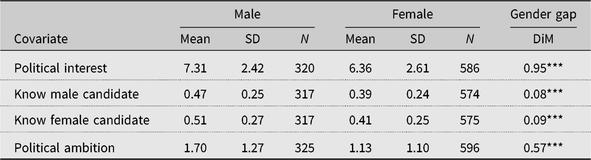
Right after enrollment in the online survey, participants answered the baseline wave, which included questions on gender attitudes and political careers embedded in a longer survey on career and study issues. The survey also measured demographic, as well as social and political background attributes. The full list of covariates includes age, marital status, citizenship, years of study, father’s employment, mother’s employment, father’s education, mother’s education, field of study, career goals, child wish, social skills, presentation skills, networking skills, gender attitudes, political interest, economic interest, and political knowledge. Table 1 shows the distribution of political interest, knowledge, and political ambition, by gender in the baseline wave. Based on Table 1 it is clear that female students reported to be less politically interested than male students; they were able to correctly identify fewer Swiss politicians, no matter if politicians were male or female; and they also reported lower political ambition than male students.
Political interest: 0–10 scale; know male candidates: 0–1 scale; know female candidates: 0–1 scale; ambition: 0–4 scale

*** p < 0.001, **p < 0.01, *p < 0.05.
Field Experiment
To identify the effects of exposure to female role models on political ambition, we randomly assigned invitation emails to the mentoring event, “Women and Career Beyond the Glass Ceiling,” among all women who responded to the first wave of the online survey. We used blocked random assignment to allocate two-thirds of the subjects to the treatment group, and one-third to the control group. Random assignment was blocked on registration period, and on whether the student had applied for one of the assistant roles at the event. Assistants helped with organizational issues at the day of the event, making sure that politicians knew where to go. They also documented the workshops. Positions were remunerated. The treatment groups received an email invitation to attend the event, asking subjects to reply whether they would attend via an online form (see Figure C1 in the Supplementary Material). The control group did not receive any invitation, and admission was invitation-only. The invitation was followed by two personalized reminders. After the registration deadline passed, registered participants received an email confirming their attendance.
We organized the mentoring event in collaboration with several institutional partners including the Frauenzentrale Zürich, the Career Services of the University, and the University’s Gender Equality Commission. Advertisement materials for the event were designed by the partner organizations, and the title was also selected by the partner organizations. The event was held two weeks before the Swiss National Assembly elections. Female politicians were recruited by the Frauenzentrale Zürich to conduct career workshops with female university students; and to match the number of sign-ups, four politicians confirmed their attendance. Politicians were not given specific instructions regarding the themes to be covered in the workshops, but were asked to convey their own personal career experience. Table C1 in the Supplementary Material shows that the workshop leaders represented four different Swiss political parties from across the political spectrum, and that there was variation both in age, ranging from 37 to 51, and position in the National or Cantonal Council. Moreover, we recruited a prominent business woman to give a motivational speech. The event was followed by an evening reception that provided further opportunities for students and politicians to mingle.
Two weeks after the event, all first wave respondents, regardless of gender, received an invitation to participate in the second wave of the online panel that measured the outcomes of the field experiment. The outcomes are meant to capture an interest in a political career, including the self-reported likelihood of running for political office in the future. Moreover, the Frauenzentrale circulated an application to enroll in a political mentoring program among all female survey participants. In the post-treatment wave we also asked students how closely they followed the election campaign, how often they read about the campaign online, and we assessed students’ political knowledge by asking them to identify the candidates who were directly elected to the Swiss Senate a few days earlier.Footnote 3 The set-up of the study is displayed in Figure D1 in the Supplementary Material. Table E1 in the Supplementary Material shows that treatment and control groups are well balanced on our extensive set of pre-treatment covariates collected in survey wave 1.Footnote 4 Moreover, based on randomization inference, Figure E1 in the Supplementary Material shows that we cannot reject the sharp null hypothesis that treatment assignment does not predict survey attrition in wave 2 (p = 0.56).
RESULTS
We know that 71% of subjects in the treatment group opened the email. Despite the attractive program and the proximity to national elections, only around 15% of subjects in the treatment group (n = 60) engaged with our invitation by replying whether they would attend, and 8% of students (n = 32 out of 405) attended the event. This is despite the event being prominently advertised to subjects in the treatment group, providing information on invited guests, and including up to two reminders. The first important result of the field experiment is hence that subjects were not very keen to meet politicians. In the following analysis we always report randomization-inference based two-tailed hypothesis tests and 95%-confidence intervals for the Intent-to-Treat (ITT) effect (Gerber and Green, Reference Gerber and Green2012), and use Two-Stage-Least Squares regression with robust standard errors (HC2) to estimate the Complier Average Causal Effect (CACE), and the 95% confidence intervals surrounding the CACE. Covariate adjustment is done including all available pre-treatment covariates collected in survey wave 1 (see Table E1 in the Supplementary Material).
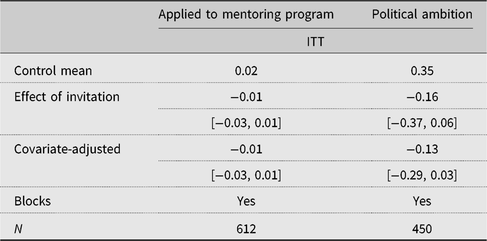
Table 2 reports the key results of the paper, the effects of treatment assignment on whether students applied for the mentoring program offered by the Frauenzentrale Zürich, and whether they could see themselves running for political office in a few years. The behavioral outcome is binary, application (1) or no application (0), and the attitudinal outcome is measured on a 0–4 scale. In Table 2 we report estimates of the ITT effect, that is, the effect of sending the email including the invitation to participate in the event on applying to the mentoring program, and self-reported political ambition.
Applied to mentoring program (1 = yes, 0 = no); “could see myself running for office in a few years” (0–4 scale); 95% confidence intervals in brackets; generalized difference estimator for ITT (Aronow and Middleton, Reference Aronow and Middleton2013)

***p < 0.001, **p < 0.01, *p < 0.05.
Treatment effects are not statistically significant for applications to the mentoring program and for self-reported political ambition, and the direction of both treatment effect estimates is negative. The point estimates amount to −1 percentage point on the application to the mentoring program and −0.16 on the 0–4 attitudinal scale.Footnote 5
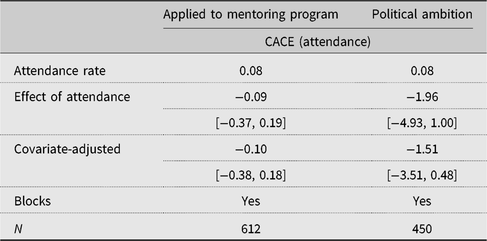
Table 3 displays estimates of the CACE, that is, the effect of attending the event, instrumented by the (randomly assigned) invitation to attend under the exclusion restriction that the email only affected behaviors and attitudes via attendance at the event. It is, of course, possible that the email had an independent effect on applications to the mentoring program and political ambition. CACE estimates displayed in Table 3, therefore, provide an upper bound on the CACE. If we assume that the email only affected attitudes and behaviors via attendance at the event, the CACE is estimated to amount to 10 percentage points for subjects’ application to the mentoring program, and −2 points on the 5-point attitude scale for the behavioral outcome measure. In Table G1 in the Supplementary Material we display the results using a more conservative measure of compliance, whether the subject RSVPed to the invitation.
Applied to mentoring program (1 = yes, 0 = no); “could see myself running for office in a few years” (0–4 scale); 95% confidence intervals in brackets; 2SLS for CACE, HC2 standard errors

***p < 0.001, **p < 0.01, *p < 0.05.
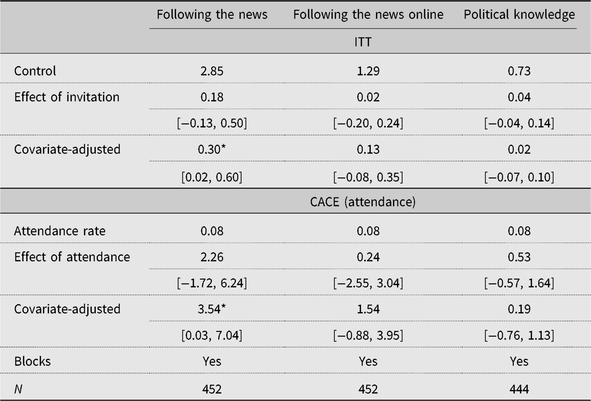
These results raise the question whether the event failed to excite students. However, this does not appear to be the case. Table 4 displays the effects of the email invitation on interest in the ongoing election campaign and on political knowledge. Subjects in the treatment group report following the campaign more frequently via traditional media compared with subjects in the control group, and also report higher levels of online media consumption and political knowledge, albeit the latter effects are not statistically significant.
“How often have you followed the news about the election campaign,” 0–6 scale; “how frequently did you follow the campaign online?,” 0–6 scale; and “which politicians got directly elected in the first round of the Swiss Federal Senate election?” 95% confidence intervals in brackets; generalized difference estimator for ITT, 2SLS for CACE, HC2 standard errors

***p < 0.001, **p < 0.01, *p < 0.05.
DISCUSSION
The event organized in collaboration with a Swiss NGO and the University Careers Services did not increase women’s political ambition. Consistent with our findings, qualitative evidence from the workshops shows that politicians gave a candid assessment of the challenges women can expect to face when running for office (see transcripts in Appendix H in the Supplementary Material). For instance, one politician emphasized that when she first took office, she was the only woman in the legislature who had small children and lived far from the capital. The same politician also presented herself as someone “with above-average energy resources.” It is not difficult to see how some young women, or indeed men, might be put off by such statements. Moreover, another politician put considerable emphasis on the challenges women face when combining a demanding professional career with family life. This was a common thread in all workshops. Qualitative evidence collected during the workshops is consistent with findings from psychology and economics, showing that role models can fail to inspire if their achievements seem unattainable (Asgari, Dasgupta, and Stout, Reference Asgari, Dasgupta and Stout2012; Bamberger, Reference Bamberger2014; Betz and Sekaquaptewa, Reference Betz and Sekaquaptewa2012; Lerner and Malmendier, Reference Lerner and Malmendier2013; Lockwood and Kunda, Reference Lockwood and Kunda1997). If even women who are objectively successful face high barriers, then what would it be like for women who believe that they might not have the same degree of motivation and skills?
An important specificity of the Swiss case is its militia system. Only few politicians are professionals; most pursue their political career on top of a day job. This compounds work–life balance problems for women, and transcripts confirm that work–life balance issues were one of the main themes discussed in the workshops. Nevertheless, the issue of work–life balance is not specific to the Swiss case. Political careers are extremely demanding on politicians’ private lives.
While the results of this field experiment are far from conclusive, they merit a call for further investigation and a larger number of field experiments that expose women to role models in realistic settings. If civil society organizations can develop more effective encouragements for women to attend such events, the design of this study can serve as a blueprint for further field experiments, which can deliver more precise answers to the question: Under which conditions does exposure to female role models encourage women’s political ambition? One hypothesis arising from this study is that role models can fail to motivate women to pursue a political career if they discuss their experience bluntly instead of following a motivational script – a plausible situation in real-world contexts that mentoring programs need to consider and that future research could explore further.
Author ORCIDs
Florian Foos, https://orcid.org/0000-0003-4456-3799, Fabrizio Gilardi, https://orcid.org/0000-0002-0635-3048
Supplementary Material
To view supplementary material for this article, please visit https://doi.org/10.1017/XPS.2019.21.