Assessing the current condition of editorial cartooning invites engagement in a number of potential perspectives: Cartoons may be positioned as journalism, artistic expression, entertaining satire, and political and historical record. A rhetorical perspective examines cartoons as expressions of political discourse positioned within the wider culture that defines, constructs, and frames larger social ideologies as a backdrop to events of the day. Cartoonists accomplish this task not only by devising explicit messages about their subjects, but in the implicit expression of societal norms and values in the conceptual lenses and commonplaces they employ. This essay considers the conceptual lens of gender as it has been used by cartoonists in recent years to frame politicians, and the implications of that framing.
In rhetorical studies the term topoi describes the assortment of potential interpretive frameworks available to advance an argument. When they focus on human subjects, cartoonists regularly use gender as a visual topos, relying on commonplace assumptions about gender ideals to communicate the cartoonist's point about political figures. Commonplaces function as “sense-making” material that forms the basis for metaphors and other meaningful creative devices in the cartoonist's tool kit. In turn, because cartoonists must use gender in a manner relevant to readers' social experiences, cartoons provide a window onto pervasive cultural attitudes about gender. Gender ideals are continuously constructed, nurtured, and negotiated in American society at large (Gamble and Gamble 2003, 42–3). Editorial cartoons, which circulate widely among the public, participate in such constructions by affirming presidential politics as a male domain, while they offer varied strategies in their presentations of female political actors that both ratify and challenge enduring social stereotypes, depending on the context of depiction.
The deeply gendered roots of American politics and the important role of gender in today's political realities underscore the importance of gender as a construction in editorial cartoons. As Carroll and Fox (2006, 1) argue, “underlying gender dynamics are critical to shaping the contours and the outcomes of elections in the United States.” Historically, we have defined our ideals of political leadership and effectiveness around norms associated with masculinity (Wahl-Jorgensen 2000, 55), and men have been the dominant actors in the political sphere, particularly at the national level. The more recent incursion of women into the male domain of political participation and leadership has commanded scholarly attention to women's roles in the political sphere (e.g., Anderson and Sheeler 2005; Borelli and Martin 1997; Braden 1996; Carroll and Fox 2006; Ford 2002; Gutgold 2006; Sreberny and van Zoonen 2000; Watson and Gordon 2003; Whitaker 1999; and Wood 2000). Moreover, gender studies has come full circle to consider how masculinity, as well as femininity, is socially constructed in the realm of politics (Parry-Giles and Parry-Giles 2002; Ducat 2004; Jeffords 1994).
Editorial writer Todd Culbertson (1987, 58) suggested, following Geraldine Ferraro's nomination as a vice-presidential candidate, and Pat Schroeder's potential presidential run, that women's increased prominence in politics could “change the rules” for cartoonists. However, cartoonists still can treat depiction of females as too controversial to comfortably address,1
Based on a comment by a panelist at “Drawing the Line: Political Cartooning Under Pressure,” a symposium held at the University of Iowa in 1999.
Most of the data cited in this essay is based on two research endeavors by the author presented previously at the National Communication Association and the Western States Communication Association.
Masculinity as Presidential Requirement
The modern presidential campaign is a ritual that expresses the heroic myth and mirrors arenas in which masculine-identified constructs are valorized. Campaign discourse frequently draws upon metaphors of sport, war, and conflict, and cartoonists follow suit. While presidential campaigners often perform overt gestures of masculinity—as when Al Gore gave his wife a passionate, on-stage kiss at the 2000 Democratic Convention, or when George H. W. Bush played up his military experiences in 1992—cartoonists not only respond to specific gestures, but have routinely used masculinity to frame candidate character and behavior, in general.
Sports, heroism, and other metaphors used in reference to presidential candidates organize around the unique features of the dominant, hegemonic ideology of masculinity which, following from Doty (1993), Doyle (1989), and Trujillo (1991), equates power with physical force and achievement, is defined in opposition to femininity/femaleness, reflects the tradition of the romantic hero who saves the community or heroine from harm, and reflects heterosexual and familial patriarchy. These directives define the socially accepted demonstration of masculinity for a man and, by extension, a political leader. Many of the metaphors used by cartoonists in relation to presidential candidates in the 1988–2000 election cycles develop from this vision of ideal masculinity, thereby reinforcing and reconstituting its relevance for those who seek to occupy the Oval Office. In 2004, many of these same metaphors were co-opted by the ramped-up masculinity of the candidates' own constructed images, with George W. Bush posing as the swaggering cowboy, and John Kerry offering himself as war hero (an image de-masculinized by the opposition, who characterized Kerry as an effete elitist.) War and conflict moved from metaphoric reference to the realities of candidate self-presentation. Space considerations prevent a full analysis of these gendered metaphors in the campaign cartoons, but some examples illustrate the point.
Candidates as Warriors
Sport/war/conflict metaphors are as pervasive in cartoons as they are in the general political discourse (Blankenship 1972). While the “race” metaphor is common in campaign talk, the most frequent arenas invoked as metaphors by cartoonists were also those most clearly associated with men's major professional sports such as football, baseball, basketball, and boxing. Typically, cartoonists frame candidates by portraying their successes or failures at endeavors such as basketball, with candidates “missing shots” or “making a slam dunk” against an opponent. A Ramirez cartoon (2000) showed Gore at bat, gesturing for a home run, oblivious to the fact the ball had already been pitched. The boxing ring is a prevailing metaphor in campaign cartoons, used most often in connection with debates. For example, a diminutive Michael Dukakis jabs ineffectively at Bush's knees in 1988 (Oliphant 1988; Payne 1988), while in 1992 Bill Clinton waits in the ring for a cowering Bush to show up for the debate (Wright 1992).
Physical confrontation and the warrior metaphor can extend beyond the sports arena to the arena of war. While some candidates may prompt such references through their experiences (George H. W. Bush in WWII, for example) war can transcend situational specifics. Horsey (1992) commented on Bush's advantage over a primary-embattled Clinton in the 1992 campaign, for example, by depicting Bush with a ready supply of cannonballs, ammunition stores he captured from other Democrats who ran against Clinton in the primary.
Candidates as Female
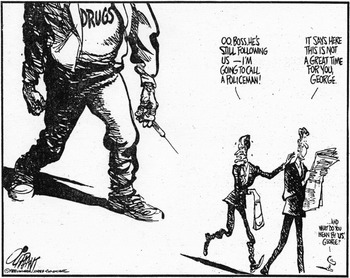
If ideal masculinity is defined in opposition to what is feminine, then ascribing female characteristics to a male candidate is a reliable way to debunk his suitability for the presidential office. Even when there were other options available, cartoonists were apt to choose the female version of a caricature in relation to presidential candidates. When the Iran-Contra scandal haunted the Reagan administration, Vice President Bush attempted to distance himself from the controversy, while several cartoonists countered with the image of Bush as a Reagan cheerleader. Each cartoonist chose to magnify the effect by presenting Bush in a female cheerleader's costume, marked by a pleated skirt, instead of men's slacks. Patrick Oliphant, America's most widely syndicated cartoonist, continued to use a women's dress and a purse as a visual motif throughout George H. W. Bush's campaign and presidency to express displeasure with the administration's policies (Figure 1).

Oliphant sometimes gave Bush a purse to carry to express ridicule. Oliphant © 1988 Universal Press Syndicate. Reprinted with permission. All rights reserved.
Candidates as Heroes
The superhero appears regularly as a metaphor in presidential campaign cartoons, usually by mocking the candidate's attempts or displaying the gap between a candidate's preferred image as a hero, and his ineptitude at realizing the image: Superman's costume just doesn't fit. The more ordinary idea of romantic heroism is also evident in cartoons through such depictions as Renault's (1988) where George H. W. Bush reassures a young lady of his protection while they skate on the thin ice of Reaganomics, or Marlette's (1988) interpretation of a candidate sweeping Southern states on Super Tuesday as Rhett Butler sweeping Scarlet O'Hara off her feet. The romance metaphor is also evident in many cartoons that comment on the relationship between a candidate and the party as that of a suitor or groom and the object of his affection.
Candidates as (Hetero)sexual
In spite of cartoons that use a burlesque frame in presenting candidates as females, in cartoons that use a romance metaphor the candidate is always placed in the role of the man, implicitly reinforcing the hegemonic definition of masculinity as heterosexual and removed from its opposite, the feminine. Sexual orientation actively coincides with paternal and familial norms ubiquitous in society (Ford 2002, 10–1). The theme of paternalistic power relations drove many of the cartoons about the Clintons in the 1992 campaign, in which Hillary was depicted as the powerful half of the prospective presidential team, requiring Bill, by default, to be the weak half.3
Gore's overt demonstration of (hetero)sexuality at the 2000 Democratic Convention inspired a rash of cartoons satirizing not only his passionate embrace of his wife Tipper, but substituting her in cartoons with images of Janet Reno and other recipients of Gore's appreciation. Thus, while cartoons on themes of masculinity may respond directly to real-life candidate performance, they serve as inspirational fodder because the incidents have resonance in the public imagination.Women in Political Roles
Cartoons about women in politics speak to more varied themes, depending on the context of time and situation. Wood (1994) observes three particular themes in media representations of women. First, women are underrepresented, which suggests that “they are unimportant or invisible” (301). Second, women are presented in terms of sex-role stereotypes, which unfairly categorize women. Third, relational aspects between men and women emphasize traditionally divided roles, psychologically consigning women to limited nurturing and support roles. In the case of political cartoons, female portrayals are complicated by the fact that cartooning is overwhelmingly dominated by men.4
The widely recognized work of a few prominent women cartoonists cannot be discounted, but a systematic analysis of gender differences in the cartoonist's perspective remains to be conducted.
Visibility
The relative absence of political women in editorial cartoons may be due, in part, to their under-representation in roles of political leadership, but is also exacerbated by practicalities of cartoon syndication. While some cartoonists do comment visually on local, regional, and statewide concerns, most editorial cartoons focus on national issues, where women leaders are fewer in number, because syndication requires subjects familiar to readers in broad locales. Editorial cartoons focus on members of the current presidential administration (and its aspirants) far more frequently than on other national political actors, such as members of Congress. Yet, even taking this situation into account, the visibility of women in cartoons is mixed. Janet Reno and Madeleine Albright, as members of the Clinton cabinet, and current Secretary of State Condoleezza Rice, have been the most prominently featured political women in contemporary cartoons. However, recent presidential candidates Elizabeth Dole and Carol Moseley Braun were all but ignored by cartoonists during their campaigns, even in comparison to some male non-front runners. Hillary Clinton has a unique political cache and celebrity appeal that has prompted her continued appearance in cartoons since the Clinton White House years, but the syndicated cartoons often relate to her husband and do not generally pertain to her work in the Senate.
First Ladies or candidate wives appear infrequently, but more often than female elected officials in widely circulated cartoons. In terms of the visibility of women, cartoonists follow the current realities of American national politics that center on the president, depicting women who are close to the center of presidential authority, but infrequently depicting either female or male elected officials who occupy realms of power and influence beyond the White House.
Sex Stereotyping and Traditional Roles
That the visibility of women politicians in editorial cartoons is tied to the presidency is true as far back as the 1964 and 1984 campaigns, when Margaret Chase Smith's opposition to Senator Joseph McCarthy and her potential presidential bid, and Geraldine Ferraro's selection as the Democratic vice-presidential candidate, both sparked cartoonists' attention. An examination of relevant cartoons illustrates surprising complexities with regard to sex and role stereotyping. As might be expected of the time preceding the rise of the Second Wave feminist movement, stereotypes abound in cartoons featuring Smith. Despite a distinguished political career, she was often presented in such traditional nurturing or supportive female roles as mother, housekeeper, and teacher. Yet, even the stereotypical cartoon depictions of Smith are complimentary, and offer implicit or explicit praise and respect.5
Granted, the cartoons which form the basis of this claim are from a collection published by the Margaret Chase Smith Library at Maine's Northwood University. It is possible that less flattering cartoons of Smith were published in newspapers, but excluded from the collection. However, the number of cartoons in the published collection, and their deference to the “lady Senator,” suggest that cartoonists took a generally positive view of Smith at this point in her career.
In contrast, Ferraro's visual demonstrations of power in cartoons were almost always framed within the zero-sum balance in her relationship with her (necessarily weak) running-mate, Walter Mondale. Further, the implications for Ferraro's exercise of political power appeared more sinister than Smith's, and warranted disapproval given the contexts, facial cues, and reactions displayed in the cartoons (Miller 1993; Sena 1985). While there may be various reasons for the differences in depiction, the rise of feminism by 1984 may have created a more controversial context for assessing a woman's reach for political power.
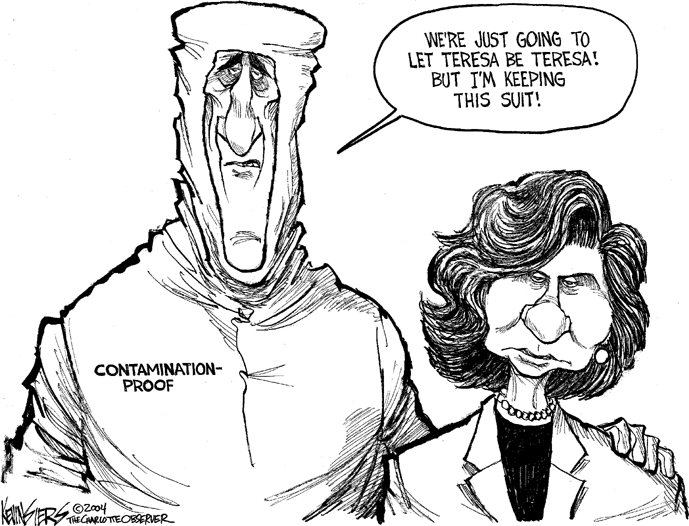
The zero-sum relationship of marriage also is evident when cartoonists take on literal political marriages in their depictions of First Ladies. Traditional sex-role expectations are heightened in these cartoons, as cartoonists routinely “discipline” political wives for transgressing the boundaries of their subordinate roles by speaking out on just about any subject. In the 2004 campaign, the outspoken Teresa Heinz-Kerry became a cartoon subject, unlike the more compliant Laura Bush. As most cartoonists saw it, Heinz-Kerry's candor was a detriment to her husband's campaign (Figure 2), although Kerry was publicly supportive, as Bill Clinton had been of Hillary.

Outspoken political wives are almost always treated negatively in cartoons, even when their husbands aren't. Kevin Siers © North American Syndicate.
Normalizing Political Women
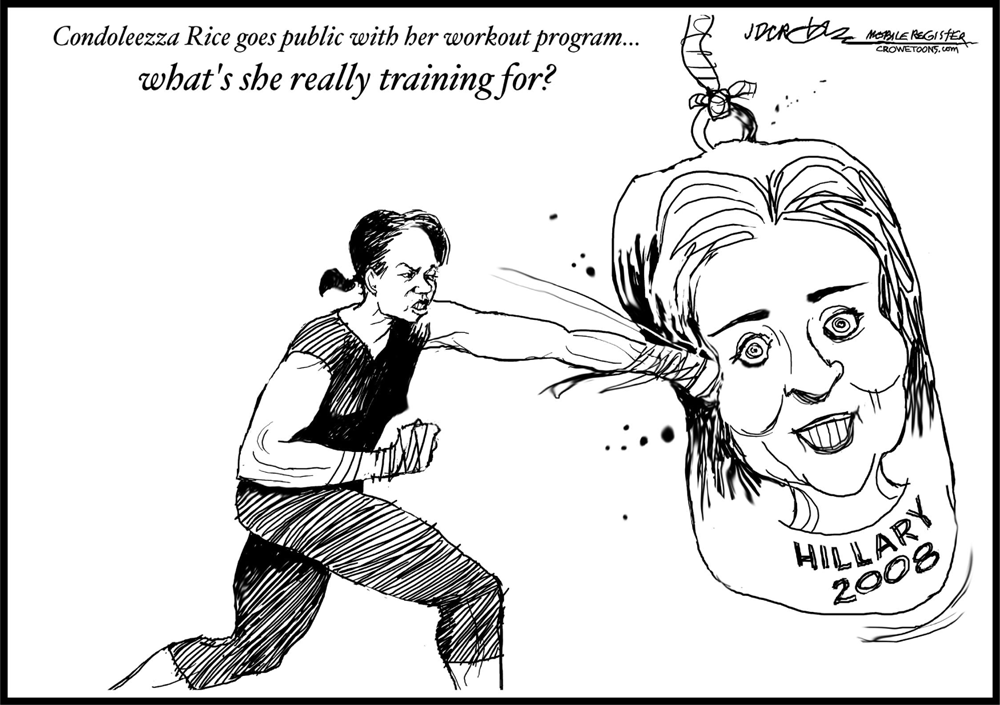
Condoleezza Rice's position on the national and international stage, and her proximity to the president, has commanded recent attention by cartoonists. The notable feature of these cartoons is their neutrality regarding gender ideals or Rice's appearance and selfhood relative to gender. Rice's relationship to war offers opportunities to tie her visually to overt masculine traits (as war itself has long been gendered), but by and large, cartoonists have rejected formulations that echo sex stereotypes in favor of more general topical frames such as “competence.” In reviewing Rice depictions on a popular cartoon web site, the most overtly masculinized image of Rice was offered in the context of a possible presidential contest with Hillary Clinton (Figure 3). In the cartoon, Rice aggressively punches a training bag labeled with Hillary's likeness and “Hillary 2008” as the cartoonists rhetorically asks what Condi is training for in her personal workout program (Crowe 2006). While generalizing from depictions of a female cabinet officer to a female candidate or spouse is risky, the treatment of Condoleezza Rice may suggest future directions for cartoon depictions of presidential campaigns which include viable female candidates.

While women candidates are rarely masculinized in cartoons, it can be a different story for political appointees like Rice. J. D. Crowe, Mobile Press-Register, www.crowetoons.com.
Conclusion
Cartoonists traffic in stereotypes by necessity. Cartoonists rely on social commonplaces in order to convey their points visually and efficiently. But it would be misguided to assume cartoonists use stereotypes and other frames of meaning unthinkingly. As Pulitzer Prize-winning cartoonist Mike Luckovich notes, “There are times when you really have to make a conscious decision about using potential stereotypes” (Hernandez 1994, 14).
As women continue to move toward equity in positions of political leadership, societal expectations about masculinity and presidential leadership will require reformation, and cartoonists' depictions can be expected to follow suit. The rhetorical strategy of invoking a masculine ideal in relation to a woman is a potential minefield that cartoonists are likely unwilling to travel, as few of their recent cartoons about female elected officials invoke either masculinity or femininity as a framing device (Edwards 2000).
Gender is not the only framing device, or topos, used by cartoonists, but given the importance of gender in current American political dynamics, the uses of gendered references as secondary information in cartoons illustrates how editorial cartoons transcend their status as entertainment or political information and operate rhetorically as a reflection of larger contemporary cultural realities.