INTRODUCTION
Marine coastal systems are affected by anthropogenic pressures worldwide and in many regions they have already been significantly altered (Thrush et al., Reference Thrush, Hewitt, Dayton, Coco, Lohrer, Norkko, Norkko and Chiantore2009). In this context the evaluation of the ecological status of marine ecosystems represents a main goal for the ecologists in order to plan monitoring programmes and impact assessments focused on environment conservation (Treweek, Reference Treweek1999). Different stressors often interact in the same area with consequent synergistic or antagonistic effects that may cause patterns of variability of natural marine systems that are difficult to interpret (Chapman et al., Reference Chapman, Underwood and Skilleter1995; Steinbeck et al., Reference Steinbeck, Schiel and Foster2005; Borja et al., Reference Borja, Bricker, Dauer, Demetriades, Ferreira, Forbes, Hutching, Jia, Kenchington, Marques and Zhu2008; Gennaro & Piazzi, Reference Gennaro and Piazzi2011). Thus the assessment of environmental quality is a complex ecological problem that needs the use of suitable ecological indicators and appropriate sampling designs (Benedetti-Cecchi, Reference Benedetti-Cecchi2001; Martinez-Crego et al., Reference Martinez-Crego, Alcoverro and Romero2010).
European strategies currently adopted for assessing and improving the quality of marine and coastal waters (European Commission 2000, 2008) require the identification of suitable bioindicators to effectively reflect environmental changes (Martinez-Crego et al., Reference Martinez-Crego, Alcoverro and Romero2010). Biotic indices developed by using different ecosystem parameters may be able to condense information related to multiple environmental responses to human stressors (Birk et al., Reference Birk, Bonne, Borja, Brucet, Courrat, Poikane, Solimini, van de Bund, Zampoukas and Hering2012; Personnic et al., Reference Personnic, Boudouresque, Astruch, Ballesteros, Blouet, Bellan-Santini, Bonhomme, Thibault-Botha, Feunteun, Harmelin-Vivien, Pergent, Pergent-Martini, Pastor, Poggiale, Renaud, Thibaut and Ruitton2014). Moreover, the concurrent use of multiple descriptors may allow evaluation of synergistic effects related to different sources of disturbance more effectively than surveys utilizing single descriptors or single communities (Borja et al., Reference Borja, Ranasinghe and Weiseberg2009a, Reference Borja, Bald, Franco, Larreta, Muxika, Revilla, Rodríguez, Solaun, Uriarte and Valenciab; Bedini & Piazzi, Reference Bedini and Piazzi2012).
Another major problem in impact assessment studies concerns the sampling designs. Natural assemblages are highly variable in time and in space, and sampling designs have to be suitable to separate human-caused effects from patterns of natural, temporal and spatial variability (Underwood, Reference Underwood1992; Hewitt et al., Reference Hewitt, Thrush and Cummings2001). Beyond-BACI (Before/After-Control/Impact) designs comparing disturbed and control sites before and after the disturbance are considered the most suitable methods to evaluate consequences of human-induced changes (Underwood, Reference Underwood1991, Reference Underwood1992, Reference Underwood1994; Benedetti-Cecchi, Reference Benedetti-Cecchi2001). However, in the absence of ‘before’ data, post-impact studies have been widely used to detect differences between impacted and reference sites through ACI (After-Control/Impact) designs (Chapman et al., Reference Chapman, Underwood and Skilleter1995; Guidetti et al., Reference Guidetti, Fanelli, Fraschetti, Terlizzi and Boero2002; De Biasi et al., Reference De Biasi, Pacciardi and Piazzi2016). This approach utilizes an asymmetrical sampling design with multiple reference sites, in order to separate the effects of impacts from the variability among sites (Terlizzi et al., Reference Terlizzi, Benedetti-Cecchi, Bevilacqua, Fraschetti, Guidetti and Anderson2005; Fraschetti et al., Reference Fraschetti, Gambi, Giangrande, Terlizzi and Danovaro2006; Benedetti-Cecchi & Osio, Reference Benedetti-Cecchi and Osio2007; Martin et al., Reference Martin, Allen and Lowe2012).
In this context, multiple control sites must represent comparable habitats (in terms of biological assemblages, type and slope of the substrate and exposure of waves) to those occurring at the disturbed site; this requires that they are selected in the same geographic area as the disturbed site, but far enough away as to be outside the range of influence of the source of anthropogenic disturbance being examined (Terlizzi et al., Reference Terlizzi, Benedetti-Cecchi, Bevilacqua, Fraschetti, Guidetti and Anderson2005; Benedetti-Cecchi & Osio, Reference Benedetti-Cecchi and Osio2007). Control sites should also occur on both sides of the impacted area, in order to avoid spatial segregation, although in some cases this is not possible (Terlizzi et al., Reference Terlizzi, Benedetti-Cecchi, Bevilacqua, Fraschetti, Guidetti and Anderson2005; Benedetti-Cecchi & Osio, Reference Benedetti-Cecchi and Osio2007; Bacci et al., Reference Bacci, Penna, Rende, Trabucco, Gennaro, Bertasi, Marusso, Grossi and Cicero2016).
The aim of the present study was to evaluate the effectiveness of the application of multiple environmental descriptors through an asymmetrical sampling design to detect possible impacts related to the Costa Concordia event on certain coastal marine habitats. The Costa Concordia shipwreck occurred on a submerged rocky reef near the Giglio Island (Tuscany Archipelago National Park, Italy) in January 2012 and the wreck was removed in July 2014, after the parbuckling and refloating activities that potentially further altered the surrounding environment. Several monitoring studies have been carried out in cases of ships sinking (Nikitik & Robinson, Reference Nikitik and Robinson2003; Dimitrakakis et al., Reference Dimitrakakis, Hahladakis and Gidarakos2014) but the Costa Concordia shipwreck represents an unusual case in the context of the Mediterranean Sea due to the proximity of the wreck to the coast and furthermore, can represent a useful example for the definition of impact assessment biomonitoring protocols in the event of accidents with limited influence in space and time. During the months following the ship disaster, besides the presence of the wreck which could be a source of polluting substances such as fuel and paint residues, or organic pollutants deriving from galley contents, new possible potential impacts may have been introduced, since activities for the removal of the wreckage started, with the installation of anchor fixed structures and a large traffic of workforce and equipment. Two of the main coastal ecosystems of interest in the presence of the were investigated: Posidonia oceanica (L.) Delile meadows and coralligenous habitat (calcareous structures edified by both macroalgae and sessile invertebrates, Ballesteros, Reference Ballesteros2006 and references therein). Both ecosystems are considered among the most relevant marine coastal habitats by international legislation and conventions (UN Barcelona Convention, 1976; European Commission, 1992) and suitable indicators of anthropogenic stress (Hong, Reference Hong1983; Pergent et al., Reference Pergent, Pergent-Martini and Boudouresque1995; Montefalcone, Reference Montefalcone2009; Piazzi et al., Reference Piazzi, Gennaro and Balata2012, Reference Piazzi, Balata and Ceccherelli2016a, Reference Piazzi, La Manna, Cecchi, Serena and Ceccherellib). Posidonia meadows and coralligenous assemblages have been studied using two different ecological indices: PREI (Gobert et al., Reference Gobert, Sartoretto, Rico-Raimondino, Andral, Chery, Lejeune and Boissery2009) and ESCA index (Cecchi et al., Reference Cecchi, Gennaro, Piazzi, Ricevuto and Serena2014; Piazzi et al., Reference Piazzi, Gennaro, Cecchi and Serena2015).
MATERIALS AND METHODS
Study site
The Costa Concordia ship collided with a submerged natural rocky reef close to Giglio Island (Tuscany, Italy), which is a Protected Area of the Tuscan Archipelago National Park and is characterized by species of high ecological and biological interest in accordance with the European Directives.
The Costa Concordia wreck lay on a seabed that goes from 18 m to more than 40 m depth, oriented NE, close to the coastline. The climate condition of the study area is complex because of the particular geographic location of the island that suffers the orographic effects of nearby Corsica and the continent. The worst storms are associated with winds of Sirocco (SE) and Ostro affecting mainly the southern and eastern side of the island.
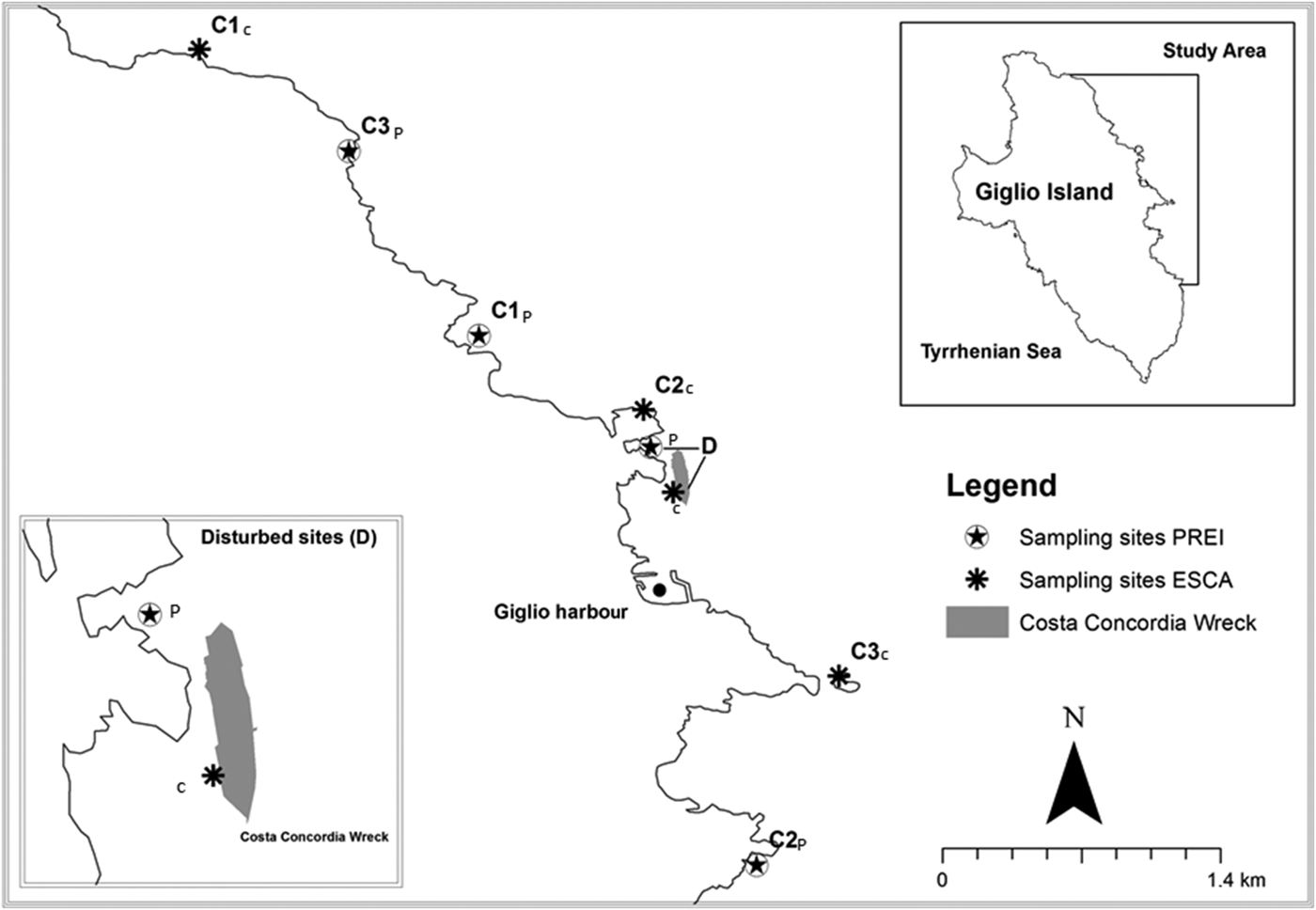
The shipwreck lay over a granitic basement and P. oceanica meadow, while the deeper part of the seabed was characterized by coralligenous assemblages. The shipyard for the parbuckling and refloating activities was built all around the shipwreck (Figure 1).
Map of the study area, Dc, C1c, C2c, C3c coralligenous sampling stations; Dp, C1p, C2p, C3p P. oceanica sampling stations.

The P. oceanica meadow was completely sealed under the wreck but it was still present near the bow and the stern from about 6 to 35 m depth. Coralligenous habitat occurred on the cliff below 30 m depth.
Sampling design and data collection
Coralligenous and P. oceanica sampling surveys were carried out in June and July 2015 in four sites: one Disturbed site (Dp Posidonia sampling site and Dc coralligenous sampling site) and three Control sites (C1p, C2p, C3p Posidonia sampling sites and C1c, C2c, C3c coralligenous sampling sites). Disturbed sites were chosen in relation to the vicinity of the shipyard (source of potential pollution), to the presence of ‘still alive’ P. oceanica meadow and of coralligenous assemblages, and where the presence of the shipyard allowed sampling dives. The proximity to Giglio Porto harbour does not affect the study because it does not represent a source of disturbance, since it is a small marina, mainly characterized by recreational traffic restricted to summertime. The control sites were randomly chosen among those with the same biological assemblages, waves exposure and geomorphological characteristics of the disturbed sites and located a few kilometres away on both sides (North and South) of the wreck (Figure 1). For P. oceanica meadows, in each sampling site three areas of about 400 m2 at 15 m depth were randomly chosen. In each area five shoot density counts were performed in square frames of 0.16 m2 (Panayotidis et al., Reference Panayotidis, Bouderesque and Marcot-Coqueugniot1981), highlighting a considerable error reduction when counts were performed in at least five quadrats (Bacci et al., Reference Bacci, Rende, Rocca, Scalise, Cappa and Scardi2015). Then six orthotropic shoots were sampled and stored at −20°C, pending laboratory examination. In addition, depth and type (Meinesz & Laurent, Reference Meinesz and Laurent1978; Pergent et al., Reference Pergent, Pergent-Martini and Boudouresque1995) of the lower limit of the meadow were assessed along a transect in front of the three areas. Biotic features of shoots were gathered according to Giraud (Reference Giraud1979) and the shoot leaf surface area was calculated. Epiphytes were scratched with a razor blade and biomass of both leaves and epiphytes was evaluated as dry weight after 48 h at 60°C.
For coralligenous assemblages, in each sampling site two areas of about 100 m2 were randomly chosen at 30–35 m depth where communities were developed, 100 m away from each other. In each area 15 photographic samples of 0.2 m2 were obtained by a digital camera (Nikon Coolpix 6000sc). Organisms easily identified in photographic samples were considered as taxa, while those organisms displaying similar morphological features were assembled into morphological groups (Parravicini et al., Reference Parravicini, Micheli, Montefalcone, Villa, Morri and Bianchi2010; Cecchi et al., Reference Cecchi, Gennaro, Piazzi, Ricevuto and Serena2014; Piazzi et al., Reference Piazzi, Cecchi, Serena, Guala, Canovas Molina, Gatti, Morri, Bianchi, Montefalcone, Bouafif, Langar and Ouerghi2014). The percentage cover of the main taxa/morphological groups was evaluated by ImageJ software. The sensitivity level value of each taxon/group refers to the average coverage of the taxon/group calculated among all samples of each site (Cecchi et al., Reference Cecchi, Gennaro, Piazzi, Ricevuto and Serena2014).
Ecological classification
Ecological classification of P. oceanica meadows was performed by PREI (Posidonia oceanica Rapid Easy Index, Gobert et al., Reference Gobert, Sartoretto, Rico-Raimondino, Andral, Chery, Lejeune and Boissery2009), the classification index adopted by Italy in the context of the Water Framework Directive 2000/60/CE (Italian Legislative Decree no. 152/2006). For the calculation of PREI physiographic and structural properties of the meadows were evaluated and analysed, as well as their functional and ecological features. The index includes the calculation of five descriptors: shoot density, shoot leaf surface area, E/L ratio (epiphytic biomass/leave biomass) sampled at 15 m depth; depth and type of the lower limit (progressive, erosive, sharp or regressive). Each of these metrics represents a partial component of the PREI, whose formulation integrates the components in an algorithm (for more details about PREI formulation, refer to Gobert et al., Reference Gobert, Sartoretto, Rico-Raimondino, Andral, Chery, Lejeune and Boissery2009). Reference values (referring to undisturbed conditions) have been factored into the PREI formula, in such a way that PREI already assumes the meaning of an Ecological Quality Ratio (EQR), by providing a measure of the ‘distance’ from those conditions considered to be ‘natural’. In this regard, Reference Conditions (shoot density = 599 shoots m−2; leaf surface area = 310 cm2 shoot−1; E/L = 0; lower limit depth = 38 m) have been modulated on the basis of the Italian national dataset (Bacci et al., Reference Bacci, Rende, Penna, Trabucco, Montefalcone, Cicero and Giovanardi2013).
Ecological classification of coralligenous assemblages was performed through the ESCA index (Ecological Status of Coralligenous Assemblages, Cecchi et al., Reference Cecchi, Gennaro, Piazzi, Ricevuto and Serena2014; Piazzi et al., Reference Piazzi, Gennaro, Cecchi and Serena2015). For the calculation of ESCA, three descriptors were used: (i) ‘sensitivity level‘(SL), based on the cover of different sensitive taxa; (ii) diversity of assemblages, expressed as ‘α-diversity’; (iii) heterogeneity of assemblages, expressed as ‘β-diversity’. For each study site, SL was calculated by adding all values of SL reported for all taxa/groups observed in each photographic sample (Cecchi et al., Reference Cecchi, Gennaro, Piazzi, Ricevuto and Serena2014); α-diversity was defined as the mean number of the main taxa/groups obtained in each photographic sample; β-diversity was evaluated as the mean distance of all photographic samples from centroids calculated by PERMDISP analysis (Primer 6 + PERMANOVA; Anderson, Reference Anderson2006; Anderson et al., Reference Anderson, Ellingsen and McArdle2006). ESCA was expressed as Ecological Quality Ratio (EQR), calculated as the mean of the three EQRS obtained for the assemblage descriptors: EQR = ((EQRSL + EQRα + EQRβ) × 3−1). Individual EQRs were calculated as the ratios between the values of SL, α-diversity and β-diversity, calculated for the study sites and the values obtained for the same descriptors in the Reference Conditions. Reference Conditions referred to Montecristo Island (Cecchi et al., Reference Cecchi, Gennaro, Piazzi, Ricevuto and Serena2014), a pristine site in the northern Tyrrhenian Sea.
The ecological quality status of P. oceanica meadows and coralligenous assemblages was then defined, according to European Directives, in the following five classes: high, good, moderate, poor and bad (European Commission, 2000; Gobert et al., Reference Gobert, Sartoretto, Rico-Raimondino, Andral, Chery, Lejeune and Boissery2009; Piazzi et al., Reference Piazzi, Gennaro, Cecchi and Serena2015).
Data analysis
PERMANOVA analysis based on Euclidean distance of untransformed data was used as univariate test (Anderson et al., Reference Anderson, Gorley and Clarke2008) in order to test any differences between disturbed and control sites for the considered multiple descriptors. Values of the PREI and ESCA indices were analysed through a one-way model PERMANOVA, with Site (4 levels) as fixed factor and partitioned into the contrast of Disturbed versus Controls (D vs C) and the variability among controls (Terlizzi et al., Reference Terlizzi, Benedetti-Cecchi, Bevilacqua, Fraschetti, Guidetti and Anderson2005).
The main P. oceanica descriptors (shoot density, leaf surface and epiphyte/leaves biomass ratio) were analysed through a two-way model PERMANOVA, with Site (4 levels) as fixed factor and Area as random factor nested in Site. The mean square of factor Site was partitioned into two portions: the contrast of Disturbed versus Controls (D vs C) and the variability among controls. PERMANOVA multivariate analysis of variance (Anderson, Reference Anderson2001) based on Bray–Curtis resemblance matrix of untransformed data was performed to analyse the composition and structure of coralligenous assemblages.
For all statistical tests, P values were calculated using the Monte Carlo procedure when the number of permutations was not enough to do a test with reasonable power (Anderson & Robinson, Reference Anderson and Robinson2003; Terlizzi et al., Reference Terlizzi, Benedetti-Cecchi, Bevilacqua, Fraschetti, Guidetti and Anderson2005). Homogeneity of multivariate dispersions was verified with PERMDISP (Anderson, Reference Anderson2006) to test the robustness of PERMANOVA analysis with respect to sample dispersion (Anderson et al., Reference Anderson, Gorley and Clarke2008).
Finally, the SIMPER test was used to evaluate the contribution of taxa/morphological groups that mostly contributed to significant effects on coralligenous assemblages.
Data analyses were performed using the PRIMER 6 + PERMANOVA software (Clarke & Gorley, Reference Clarke and Gorley2006; Anderson et al., Reference Anderson, Gorley and Clarke2008).
RESULTS
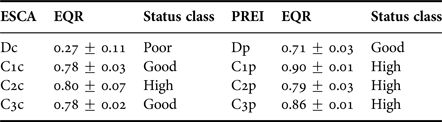
PREI values corresponded to High ecological status in the control sites and Good ecological status in the disturbed site, while ESCA values classified the disturbed site as in Poor ecological status and it varied between High and Good ecological status in the control sites (Table 1). With regard to the control sites, significant differences among sites were detected by PREI while no differences were highlighted by ESCA index (Table 2).
EQR ESCA and PREI values ± SD. Dc, C1c, C2c, C3c coralligenous sampling stations; Dp, C1p, C2p, C3p P. oceanica sampling stations.

ESCA class boundaries High: ≥0.80, Good; 0.6–0.8, Moderate; 0.6–0.4, Poor: 0.4–0.2; Bad: <0.2.
PREI class boundaries High: 1–0.775, Good: 0.774–0.550, Moderate: 0.549–0.325; Poor: 0.324–0.1; Bad: <0.1.
PERMANOVA on values of PREI and ESCA.

D, disturbed site; C, control sites. Significant differences are in bold.
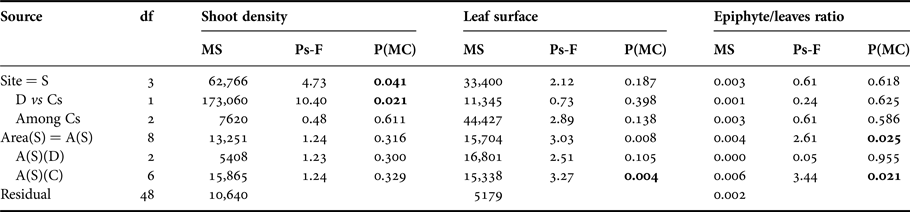
Different types of lower limit were observed between the disturbed site (regressive) and the controls (progressive and sharp) (Table 3). Posidonia oceanica shoot density showed lower values in the disturbed site compared with controls, while no significant effects were observed for leaf surface and epiphyte/leaves biomass ratio (Table 4). Differences among controls were not significant for any descriptor investigated in the analysis (Table 4).
Descriptors of Posidonia oceanica meadows (mean ± SD).

Dp, disturbed site; C1p-2p-3p, control sites.
PERMANOVA on Posidonia oceanica descriptors.

D, disturbed site; C, control sites. Significant differences are in bold.
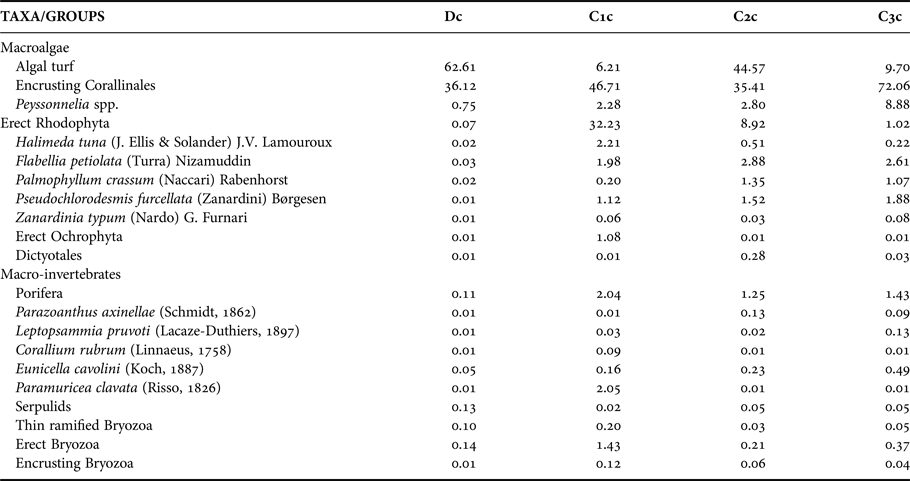
In the control sites, coralligenous assemblages were dominated by encrusting Corallinales and algal turf while erect Rhodophyta were also locally abundant; Halimeda tuna, Flabellia petiolata, Peyssonnelia spp., were widespread with low per cent cover (Table 5). Among the macro-invertebrates, Porifera, erect Bryozoa, Eunicella cavolini and locally Paramuricea clavata were the most abundant taxa/groups (Table 5).
The mean per cent cover of the taxa/groups characterizing coralligenous assemblages.

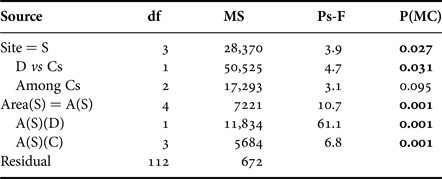
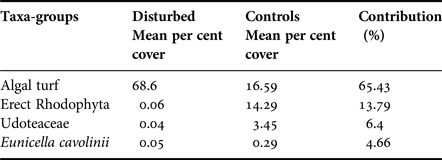
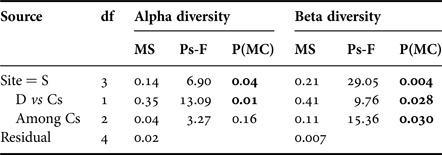
The composition and structure of coralligenous assemblages differed significantly between the disturbed and control sites, while differences among controls were not significant (Table 6). The SIMPER test showed that differences were mostly related to a higher abundance of algal turfs in the disturbed site and a higher abundance of Udoteaceae (Halimeda tuna (J. Ellis & Solander) J.V. Lamouroux and Flabellia petiolata (Turra) Nizamuddin) and erect Rhodophyta and Eunicella cavolini, in the controls (Table 7). Both alpha and beta diversity showed lower values in the disturbed site compared with controls (Table 8).
PERMANOVA on species composition and abundance of coralligenous assemblages.

D, disturbed site; C, control sites. Significant differences are in bold.
SIMPER test on coralligenous assemblages.

PERMANOVA on alpha and beta diversity of coralligenous assemblages.

D, disturbed site; C, control sites. Significant differences are in bold.
DISCUSSION
Although with different responses in terms of ecological classification, both indices detected a lower ecological quality in the disturbed sites compared with the control ones. This finding attests the sensitivity of both P. oceanica and coralligenous habitats to human impacts and their suitability to be used as ecological indicators in cases of both diffuse and local pressure (Gobert et al., Reference Gobert, Sartoretto, Rico-Raimondino, Andral, Chery, Lejeune and Boissery2009; Bacci et al., Reference Bacci, Rende, Penna, Trabucco, Montefalcone, Cicero and Giovanardi2013; Cecchi et al., Reference Cecchi, Gennaro, Piazzi, Ricevuto and Serena2014).
In P. oceanica meadows, shoot density and the lower limit type were the most sensitive descriptors to the studied disturbance, confirming their effectiveness to be used in impact evaluation studies (Pergent et al., Reference Pergent, Pergent-Martini and Boudouresque1995). Shoot leaf surface area, instead, did not differ among sites, reflecting previous results referring to the study area reported in Bacci et al. (Reference Bacci, Penna, Rende, Trabucco, Gennaro, Bertasi, Marusso, Grossi and Cicero2016). Epiphyte biomass also did not show differences between disturbed and control sites. However, significant differences in epiphytic community structure were detected in previous investigations (Bacci et al., Reference Bacci, Penna, Rende, Trabucco, Gennaro, Bertasi, Marusso, Grossi and Cicero2016). The structure of the epiphytic community of P. oceanica leaves, in fact, could be an indicator of multiple impacts while epiphyte biomass is more sensitive to strong nutrient enrichment (Piazzi et al., Reference Piazzi, Balata and Ceccherelli2016a).
In coralligenous habitats, high abundance of algal turf was consistent in the disturbed site, thus differentiating from the controls, where instead erect macroalgae and Eunicella cavolini (Koch, 1887) were dominant. Hence, although the aim of the study was not to identify or measure each temporal pressure acting on the disturbed site, the structure of coralligenous assemblages observed in this area seemed to indicate a kind of local impact, due to nutrient enrichment or sediment increasing, as reported in the literature (Balata et al., Reference Balata, Piazzi, Cecchi and Cinelli2005, Reference Balata, Piazzi and Benedetti-Cecchi2007a, Reference Balata, Piazzi and Cinellib; Piazzi et al., Reference Piazzi, Gennaro and Balata2011, Reference Piazzi, Gennaro and Balata2012). Results of other studies carried out in the context of the Costa Concordia shipwreck excluded serious contamination events or increases in environmental pollution, also due to nutrient enrichment (Regoli et al., Reference Regoli, Pellegrini, Cicero, Benedetti, Gorbi, Fattorini, D'Errico, Di Carlo, Nardi, Gaion, Scuderi, Giuliani, Romanelli, Berto, Trabucco, Guidi, Bernardeschi, Scarcelli and Frenzilli2014). Conversely, significant increase of turbidity due to huge, although temporal, sediment release events was recorded along the entire water column (from the surface to 50 m depth) of the impacted area at different times during the Costa Concordia salvage activities (Casoli et al., Reference Casoli, Ventura, Cutroneo, Capello, Jona-Lasinio, Rinaldi, Criscoli, Belluscio and Ardizzone2017). Moreover, patches of debris and sediments were found to have affected both the shallower and deeper sea bottom, with consequent stress for coralligenous habitats (Casoli et al., Reference Casoli, Ventura, Cutroneo, Capello, Jona-Lasinio, Rinaldi, Criscoli, Belluscio and Ardizzone2017). Therefore it was reasonable to think that some of the negative effects observed in our study on coralligenous assemblages were linked to sediment and debris releases that occurred during the shipwreck removal activities. Turfs are mostly constituted by filamentous species that reproduce asexually and are well adapted to stressed environmental conditions thanks to their ability to quickly recover after disturbance (Airoldi, Reference Airoldi2003; Balata et al., Reference Balata, Piazzi and Rindi2011). On the contrary, in stressed conditions, erect macroalgae and invertebrates reproducing sexually are damaged directly by physical stress, such as high sedimentation rates, and indirectly because they are outcompeted by turfs (Balata et al., Reference Balata, Piazzi and Rindi2011).
Both the shipwreck, and parbuckling and refloating activities may cause different kinds of impact and it is difficult to determine those that mostly have affected the disturbed site. However, also in accordance with Casoli et al. (Reference Casoli, Ventura, Cutroneo, Capello, Jona-Lasinio, Rinaldi, Criscoli, Belluscio and Ardizzone2017), the increase of sedimentation and debris deposition, due to the leakage of fine particles of cement filling the grout bags on which the wreck was laid during the parbukling phase, could represent the main pressure determining differences observed between control and disturbed sites. To confirm this, both the increase of turf and the decrease of alpha and beta diversity in coralligenous assemblages, as well as the decrease of shoot density of P. oceanica meadows, can be related to high levels of sediment load (Manzanera et al., Reference Manzanera, Perez and Romero1995; Terrados et al., Reference Terrados, Duarte, Fortes, Borum, Agawin, Bach, Thampanya, Kamp-Nielsen, Kenworthy, Geertz-Hansen and Vermaat1998; Balata et al., Reference Balata, Piazzi, Cecchi and Cinelli2005, Reference Balata, Piazzi and Rindi2011; Piazzi et al., Reference Piazzi, Gennaro and Balata2012). An increase of sediment resuspension was observed by the authors in the area of the shipwreck (~1 km2). The regressive lower limit at a high depth, with the presence of dead matte, may suggest recent damage, ascribable to the Costa Concordia event. As also discussed in Bacci et al. (Reference Bacci, Penna, Rende, Trabucco, Gennaro, Bertasi, Marusso, Grossi and Cicero2016), more concurrent causes may have led to the differences observed.
Past and present synergistic effects among factors, associated with the structure of the wreck itself, and those related to the removal yard, could have affected the ecological quality status of the area. In this regard, the wreck and the shipyard could have acted as a physical barrier to the natural hydrodynamics of the area, also changing the submerged landscape of the disturbed site with for example the shadow projected by the wreck on the seabed.
Both PREI and ESCA indices showed significant differences between disturbed and control sites, highlighting their effectiveness in detecting different kinds of human pressures. However, an important difference was detected between the response of ESCA and PREI, as ESCA scores differed sharply (i.e. Poor vs High/Good) between disturbed sites and controls compared with the PREI classification. All the three ESCA descriptors showed lower values in disturbed sites than in control ones, confirming the sensitivity of the ESCA index to stress induced by local impacts; on the contrary, the PREI descriptors showed variable responses to the same disturbance, thus appearing less sensitive to the impact of the Costa Concordia event on the meadow.
These findings highlighted the importance of testing the validity and applicability of biological indices in the context of situations and pressures that are different from those originally used for their development and calibration (Diaz et al., Reference Diaz, Solan and Valente2004; Borja et al., Reference Borja, Ranasinghe and Weiseberg2009b), as not all indicators adequately respond to different contexts.
Coralligenous assemblages are particularly sensitive to anthropogenic pressure acting on coastal areas, since they are constituted by organisms, both macroalgae and macro-invertebrates, adapted to spread in stable physical conditions, thus highly sensitive to most anthropogenic causes of stress and disturbance (Montefalcone et al., Reference Montefalcone, Morri, Bianchi, Bavestrello and Piazzi2017). The lower effectiveness of PREI could be related to the type of pressure, which has produced a spatially limited direct damage on the meadow, especially at high bathymetry (lower limits). In addition, P. oceanica meadows, despite their effectiveness as indicators of water quality (Gobert et al., Reference Gobert, Sartoretto, Rico-Raimondino, Andral, Chery, Lejeune and Boissery2009; Lopez y Rojo et al., Reference Lopez y Rojo, Casazza, Pergent-Martini and Pergent2010), normally have higher times of responses and low resilience than macro-invertebrates and macroalgae (Balata et al., Reference Balata, Piazzi, Nesti, Bulleri and Bertocci2010) The better response of ESCA index could also be explained by the closer proximity of the disturbed site to the pressure.
The different response of the two indices to the same pressure highlights the importance of using multiple biological descriptors in monitoring programmes and impact evaluation studies. This finding confirms previous studies, suggesting that the use of data obtained from different biological systems represents the most promising approach for assessing the ecological status of coastal waters (Martinez-Crego et al., Reference Martinez-Crego, Alcoverro and Romero2010; Bedini & Piazzi, Reference Bedini and Piazzi2012). Moreover, only some P. oceanica variables responded to changes in environmental conditions. Thus, the use of appropriate bioindicators should be coupled with that of appropriate descriptors, in order to assess the status of coastal waters.
In conclusion, ecological indices, usually employed in environmental monitoring programmes, could be used in synergy to describe marine ecosystem impacts due to local pressures. The concurrent use of different ecological indices and an asymmetrical sampling design is recommended to detect differences in ecological quality of the disturbed site compared with controls.
ACKNOWLEDGEMENTS
The authors thank the Tuscany Region Administration and the members of the ‘Observatory for the Costa Concordia shipwreck accident’ for the financial and technical support. The authors are grateful to two anonymous reviewers for valuable comments and suggestions to greatly improve the quality of the paper.
FINANCIAL SUPPORT
This work was funded by the Tuscany administration as a part of the ‘Control and monitoring plan of the recovery activities on the marine ecosystem of Giglio Island after the Costa Concordia accident’. L. Piazzi was funded by ‘Desertificazione marina da sovrapascolo di ricci: indagine sulla transizione di stadi stabili bentonici alternativi’ project granted by P.O.R. SARDEGNA F.S.E. 2007–2013 – Obiettivo competitività regionale e occupazione, Asse IV Capitale umano, Linea di Attività l.3.1.