The Norwich Castle Museum collection
In the summer of 2011 Robson was invited by Ms Faye Kalloniatis, Research Associate in Egyptology at the Norwich Castle Museum, UK, to examine four cuneiform tablets recently discovered in the collection of that museum. They comprise a letter and two administrative accounts from the well-known “Mesag archive” or “Umma C” from the Sargonic period (NWHCM 2009.174, NWHCM 2000.102.1, NWHCM 2000.102.2) and a fragment of an unprovenanced Old Babylonian account which had been misidentified as an Amarna tablet (NWHCM 2013.287). Robson invited Zólyomi to study the Sargonic letter, based on her copies and photographs. Zólyomi's edition appears below. Subsequently a fifth tablet was identified, a small day record from Ur III Umma (NWHCM 1878.32.12), which Robson studied on a return visit in January 2014 when she also collated the other tablets.Footnote 1
No information is recorded about any of the tablets in the museum. With the exception of NWHCM 1878.32.12 their accession numbers are retrospective; the museum has not actively collected artefacts of this kind since the 1950s. We will discuss the provenances of NWHCM 2013.287 and 1878.32.12 below, but first briefly review the likely origins of the three Sargonic tablets.
The Hon. Arnold Keppel, son of the 8th Earl of Albemarle (1858–1942), Vice-Lord-Lieutenant of Norfolk (Mosley Reference Mosley1999: I 49), donated a collection of cuneiform tablets to the museum in 1912 (Cripps Reference Cripps2010: 6). A catalogue by the Cambridge Assyriologist C. H. W. Johns, made at that time, lists 44 tablets, 41 of which were from the Sargonic period. The collection was sold to the Liverpool Museum (now the World Museum Liverpool) in 1956, which was rebuilding its collections after sustaining major bomb damage during the blitz of May 1941.Footnote 2 Foster (Reference Foster1982) studied 28 tablets from this collection, dated with the mu-iti system, and assigned them all to the archive labelled as “Umma C” (1982: 7). Cripps (Reference Cripps2010) re-edited all of them.Footnote 3 The Keppel collection in Liverpool contains two Sargonic letters: MCS 9, 251 (= USP 63 [P217419]Footnote 4 ) in Akkadian and MCS 9, 252 (P215523) in Sumerian. Norwich Castle Museum's three Sargonic tablets are also from the Umma C archive. It is therefore highly likely that they were inadvertently excluded from the 1956 sale, perhaps because they had been mislaid in the museum stores.
Mesag reports a murder: NWHCM 2009.174
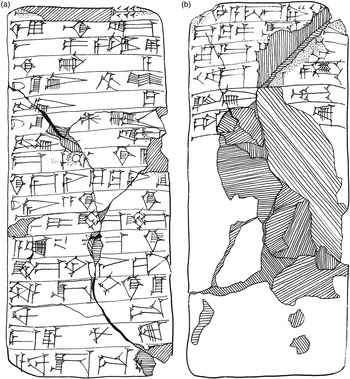
NWHCM 2009.174 is a relatively narrow, ruled tablet with the dimensions 110 × 45 × 18 mm. It is complete but restored from fragments. Its obverse contains 18 lines, its reverse 6 lines. The provenance of the letter is unknown, but the sender, Mesag, names Umma as the place where he is staying in obv. 9–10. A dignitary called Mesag occurs in two Sargonic archives associated with the province of Umma: in the archive labelled “Umma C” by Foster (Reference Foster1982: 79–148), and in the archive labelled “Mesag” or “Sagub” in the literature (Bridges Reference Bridges1981; Salgues Reference Salgues and Barjamovic2011: 253 n3). In the former his title is ensi2 “governor”, while in the latter he is dub-sar “scribe” and sa1 2-du5 “land recorder”. It has been debated whether the two high-ranking persons with the name Mesag are in fact the same person (see Visicato Reference Visicato2000: 111 n51). A seal inscription on a fragmentary tablet from Umma published as UTI 6 3768 (P141765) now provides an argument supporting those who assume that the two persons are identical:Footnote 5
col. i.
-
1. [me]-sag2
-
2. dub-sar
-
3. ensi2
-
4. ummaki
col ii.
-
(three fragmentary lines)
-
“Mesag, the scribe, the governor of Umma; ….”
This seal inscription is the first known text in which Mesag is qualified both as scribe and governor at the same time, thus suggesting strongly that Mesag is indeed “a good example of an ensi as administrator for the crown and ensi as head of his personal estate” as Foster (Reference Foster and Liverani1993a: 30) already conjectured. The Norwich letter was probably written in his capacity as city governor, as it was addressed to the king (meaning, probably, the royal administration), who must be the contemporary king of Akkad, either Naram-Sin or Šar-kali-šarri.Footnote 6
Sumerian letters are notoriously difficult to interpret. In the case of this letter, however, it is not implausible to assume that the letter is related to the so-called “bread and beer” texts (cf. Foster Reference Foster1982: 109–16 [Group C.3.3]; Cripps Reference Cripps2010: 18–22), which record provisions to people associated with the Akkadian military presence in Umma. Foster (Reference Foster1993b: 445) views these texts “as records of food issued to a military force at Umma, including the commanding general (gìr-nita), his aides (sukkal) and staff (diviners, interpreter, physician, clerks) …”. The titles lu2-eme and lu2-tukul appear to be restricted to these texts in Sargonic Umma. The individuals named on the obverse may thus belong to the people whose provisions were recorded on these tablets but were mentioned only by their titles. This would also explain why Mesag sends a report about them to the royal administration.
Obverse
-
1. ⸢lugal⸣-ĝu1 0
-
2. u3-na-dug4
-
3. me-sag2-e
-
4. na-be2-a
-
5. mše3-er-‘a4-num2
-
6. lu2-tukul
-
7. mšu-an-tum
-
8. lu2-eme
-
9. umma(GIŠ.⸢KUŠU2⸣)ki -⸢a⸣
-
10. ki-ĝa2 i3-durunx(KU.KU)-ne2-⸢eš2⸣
-
11. mi3-a-ki-ki
-
12. ⸢dumu?⸣ i-bi2-bi2
-
13. a-su ⸢adab⸣ki
-
14. ne-te-ni-ta
-
15. kar-da-hiki-še3
-
16. ba-ĝen
-
17. ĝe2 6-e nu-zu
-
18. a-ba-da-ĝen⸢en6 ?⸣
Reverse
-
1. ⸢x⸣ di a-gin7 i3-⸢kud⸣-[x]
-
2. ĝeštukul sag3-da ⸢LUL?⸣
-
3. iri-ur ⸢a?-(x)-RU?⸣
-
4. ugux(U.SAG) ⸢ba?⸣-gaz
-
5. lugal-ĝu1 0
-
6. ⸢he2⸣-zu
(rest of surface blank)
Tell my king, this is what Mesag says: “Šer‘anum, the soldier, and Šu-Antum, the interpreter(?), are staying with me (lit. ‘at my place’) in Umma. Yakiki, son(?) of Ibibi, the physician from Adab, left on his own for Kardahi. I, for my part, do not know if anyone else went with him. How should I decide the (following) case? Being hit by a mace, a Lullubean(?) was killed by Iri-ur, .... My king should know of this!”
obv. 5: For this rare personal name cf. CAD Š/3: 102. s.v. šir'ānu “(a word for son)”. It is written as si-ir-‘a4-num2 in MAD 5, 5 obv. 3 (P215333), še-er-‘a4-num2 in Akkadica 25, 8 1 obv. 15 (P100329), MVN 21, 352 rev. 3 (P120589), and UET 3, 1639 rev. i 16 (P137965).
obv. 6: The term lu2-tukul, “man-at-arms”, occurs frequently in the so called “bread and beer” texts of Sargonic Umma; see Cripps (Reference Cripps2010: 21 n36) for its occurrences. See also Schrakamp (Reference Schrakamp2012: 152) for a discussion of the term.
obv. 8: The term lu2-eme, “interpreter(?)”, occurs frequently in Sargonic texts from Umma.Footnote 7 All belong to the “bread and beer” texts, except for MCS 9, 233 (= Cripps Reference Cripps2010, no. 30), which is, however, clearly related to MCS 9, 234 (= Cripps Reference Cripps2010, no. 29), a “bread and beer” text. For the term's meaning see Cripps (Reference Cripps2010: 95, to obv. 12).
obv. 13: For the writing a-su for the more common a-zu, “physician, healer”, see, e.g., DP 579 obv. ii 5 (P221229), DP 586 obv. ii 6 (P221236), Nik 1, 149 obv. ii 4 (P221918). See Foster (Reference Foster1982: 112) for the term's occurrences in the “bread and beer” texts. For a similar writing of the city name Adab, where in the NUN part of the logogram only the heads of the small verticals can be seen forming a horizontal line, see, e.g., Adab 862 rev. 2 (P217550). Adab is attested twice on tablets from the Umma C archive: USP 27 obv. 3 (P217384), MCS 9 234 obv. 8 (P215505).
obv. 14: For writing the reflexive pronoun ni2-te- as ne-te- see BPOA 6, 811 rev. 2. (P210576), Gudea Cyl. B 18: 16, TCL 5, 5674 ii 24 (lugal-ne-te-na) (P131745), and the references in Jagersma (Reference Jagersma2010: 237).
obv. 15: This is probably the earliest attestation of this settlement located in the province of Umma. Its name is written as kar/har/gar3-da-hiki in Ur III texts (cf. Steinkeller Reference Steinkeller, Garfinkle and Molina2013: 391, to l. i 12).
obv. 18: For a-ba in Sandhi writing with the verbal prefix-chain, see PSD A/1: 47 (a-ba C 5).
rev. 1–4: The interpretation offered here for these lines is rather tentative. It is based on the assumption that Mesag was uncertain whether he might judge a case in which the murderer and the victim belonged to different organisations: Iri-ur was subordinated to Mesag, while his victim was a member of the Akkadian military stationed in Umma.
rev. 1: a-gin7, “how”, also occurs in another letter from Mesag, in obv. 7 of BM 140676 (Catagnoti Reference Catagnoti and Marrassini2003: 105–07).
rev. 2: See Cripps (Reference Cripps2010: 20, 31) for the suggestion that the sign is to be read as LUL and may refer to Lullubeans in the “bread and beer” texts. We assume that sag3-da is a LAL-a form followed by a comitative: sag-‘a = da = /sagada/, whose second /a/ is syncopated; see Gudea Statue E 7:22–8:15 for similar, although not syncopated, non-finite verbal forms.
rev. 3: A person called Iri-ur belongs to Mesag's household (see Bridges Reference Bridges1981: 30). If he were meant here, then this letter would provide another argument linking Mesag, the governor, with Mesag, the head of the household in Sagub.
rev. 4: We assume that the meaning of ugux(U.SAG) — gaz is related and similar to saĝ-gaz — ak “to commit murder”.
rev. 6: For similar formulae concluding a letter, cf. Kienast and Volk (Reference Kienast and Volk1995: 81 to 4’–6').
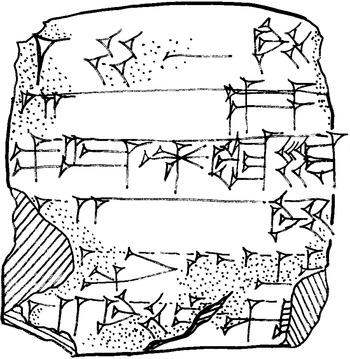
Copy of NCM 2009.174 (obverse and reverse)

A day record of seeding work: NWHCM 2000.102.1
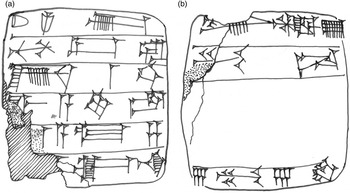
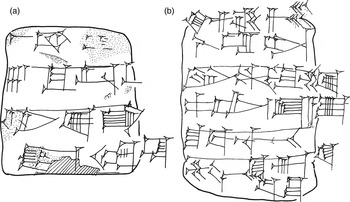
This complete, almost square tablet measures 40 mm wide × 45 mm high × 15 m thick. It has 6 ruled lines on the obverse, 3 on the reverse. Its 2000 accession number means it has no recorded provenance but was catalogued retrospectively during museum refurbishment. It contains a day record of agricultural labour, written in Sumerian, which dates to the Sargonic period, c. twenty-third century b.c. It belongs to the same archive as Foster (Reference Foster1982: 81–82): group C.1a.
Obverse

Reverse

Copy of NCM 2000.102.1 (obverse and reverse)

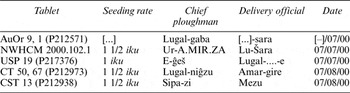
Four tablets discussed by Foster (Reference Foster1982: 81–82) are identical in structure and format to NWHCM 2000.102.1, and were written in the same short period of time (Table 1).
Tablets from Umma Archive C.1a

Obv. 5–6. The name Ur-A.MIR.ZA appears on four other published tablets from Sargonic Umma. In MCS 9, 238 (P215509) and USP 22 (P217379) he is one of a number of royal chief ploughmen (saĝ apin-na lugal) who are in arrears to Mesag the ensi of Umma (Foster Reference Foster1982: 91–93 Group C.2b; Cripps Reference Cripps2010: no. 9). MCS 9, 238, in which Ur-A.MIR.ZA owes 57 gur of grain, is dated in the tenth month of the year (which year is unknown, as the pertinent sign is damaged). In USP 22, whose date is almost entirely missing, he owes 72 gur. In MCS 9, 272 (P215538), undated, Ur-A.MIR.ZA is one of two maškim-administrators overseeing field rentals (Foster Reference Foster1982: 89, Group C.1b; Cripps Reference Cripps2010: no. 5), while in USP 28 (P217385), undated, he receives flour and various brewing ingredients (Foster Reference Foster1982: 106, Group C.3.1). Given that MCS 9, 238 and 272 are both formerly of the Keppel collection held by Norwich Castle Museum, and all belong to Foster's Umma Archive C, it is highly likely that these are all occurrences of the same individual. On the reading of this name see most recently Schrakamp (Reference Schrakamp2012: 148 to Nr. 5 Rs. 4).
Rev. 1. Likewise, the official Lu-Šara is also attested elsewhere in Umma Archive C, from other tablets formerly of the Keppel collection. In MCS 9, 245 (P215516), dated 02/08/23, he is one of many recipients of beer (Foster Reference Foster1982: 109–10, C.3.3.I; Cripps Reference Cripps2010: no. 18). In MCS 9, 261 (P215532) he pays barley as rental on fields in the Guedina district, along with two other men (Foster Reference Foster1982: 82–87, C.1.b; Cripps Reference Cripps2010: no. 2). In the undated account MCS 9, 250 (P215521) he is one of four maškim-officials receiving a single sheep in payment for services related to a finished legal case (Cripps Reference Cripps2010: no. 46; see also Schrakamp Reference Schrakamp2012: 160). Although this tablet is also from the Keppel collection, however, it cannot be definitively linked to Umma.
Rev. 3. As Foster (Reference Foster1982: 82) points out, the seeding is carried out in the autumn for the winter crop, using a seeder plough.
A disbursement of brewing ingredients: NWHCM 2000.102.2
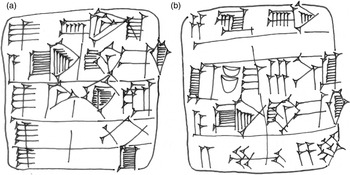
This small, complete tablet is just 23 mm wide by 26 mm high × 12 mm thick, with 5 lines on the obverse, 4 lines on the reverse. The 2000 accession number means that the tablet has no recorded provenance; it was catalogued retrospectively during museum refurbishment. It contains a record in Sumerian of brewing ingredients handed out to a named individual, dating to the Sargonic period. To judge from its contents it too comes originally from Umma Archive C and must have been left behind when the Keppel Collection was sold to Liverpool. The BARIG sign is written with a round stylus. The vertical line running down both obverse and reverse indicates that the transaction has been cancelled.
Obverse

Reverse

Copy of NCM 2000.102.2 (obverse and reverse)

Early Mesopotamian brewing terminology and processes have recently been productively reviewed by Damerow (Reference Damerow2012) and Sallaberger (Reference Sallaberger, Mittermayer and Ecklin2012). First barley (še) or emmer wheat (ziz2) was malted, by letting it sprout. The malt (munu4) was crushed and mixed with water, then added to a sourdough (bappir), also made from coarsely ground barley (groats, niĝ2-ar3-ra). Further water was added along with sweet additives to aid the fermentation process. The solid ingredients of this mash (sumun2) were dried into cakes (titab2), which could be stored long-term. When needed this “dry beer” (dida) was dissolved in water and re-fermented, filtering into a collecting jar below. Likewise, the sourdough could be dried and later reactivated by mixing with flour (zi3) and water (Sallaberger Reference Sallaberger, Mittermayer and Ecklin2012: 325).
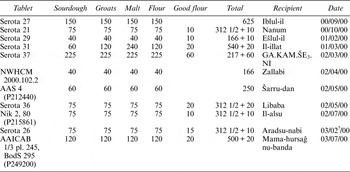
Ten tablets discussed by Foster (Reference Foster1982: 107–08, Group 3.2) are identical in format and structure to this one, and are dated within the same few years (Table 2). None of the personal names in these accounts can be identified in other administrative records of the period.
Tablets from Umma Archive C.3.2

In every case except one (Serota 31), the four brewing ingredients are issued in identical quantities to each other, in multiples of 20 or 25 sila. The total, however, is almost invariably 1/24 more than expected, as already noted by Foster (Reference Foster1982: 108). Only the anomalous Serota 31 has a total which matches the individual entries. Some tablets also note the issuing of relatively small quantities of zi3 sig1 5 “good flour” in no fixed proportion to the other ingredients, which are totalled separately. Damerow (Reference Damerow2012: §5) surveys the very complex evidence from the Ur III period for “conversion factors” to account for the value of different grades of brewing ingredients relative to barley. However, as the terminology and proportions of the commodities concerned are not the same as here, the relationship between these apparently similar accounting practices is not yet clear.
Ur III record of unskilled field labourers: NWHCM 1878.32.12
Complete tablet, measuring 32 mm wide × 36 mm high × 14 mm thick; obverse contains 6 lines, text of reverse completely abraded. There is no recorded provenance in the museum database and the accession date (1878) gives no clue as to the donor. Ur III period, in Sumerian, date missing.
Obverse

Reverse completely abraded
Copy of NCM 1878.32.12 (obverse only; reverse missing)

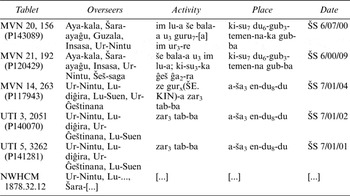
Although the tablet is lacking the reverse, and therefore any information such as the date and purpose of the document, parallels to the obverse can be identified, based on the structure of the information and the personal names it contains. All such parallels are from Ur III Umma (Table 3 below).
Harvest inspection record from Ur III Umma from the years Šu-Suen 6-7

CHEU 49 (P107482), dated Shulgi 48.03.01, is a long list of geme-women and ĝuruš-men assigned to fifteen different overseers, including an Ur-Nintu, Lu-balasaga and Šara-zami (obv. 3–5) at an inspection of making and levelling sheaves (gurum2-ak zar3 tab-ba šu ur3-ra) at the Mušbiana field near Umma. BPOA 6, 1180 (P292372), dated Amar-Suen 04.02.00, is a small tablet of similar size. It assigns nineteen geme 2-women and two sons to an Ur-Nintu as overseer, followed by 3–12 further geme-women to overseers Lugal-emahe, Šara-zami, and Lu-balasaga in an inspection of the threshing floor of the manu-wood field (gurum2-ak ki-su7 a-ša3 ĝešma-nu), also near Umma. In both of these tablets, the names of the other overseers are compatible with the traces of damaged names on NWHCM 1878.32.12.
Slightly later are a group of harvest inspection records from Umma over a six-month period in the years Šu-Suen 6–7. Here Ur-Nintu again appears as an overseer of geme-women in the same sorts of places, but with fellow-overseers whose names do not fit the traces on NWHCM 1878.32.12 quite so well (Table 3).
Even if it is not possible to place NWHCM 1878.32.12 securely within the chronology of this group of tablets, it is nevertheless clear that it is of the same genre and, most likely, archive.
An Old Babylonian silver account: NWHCM 2013.287
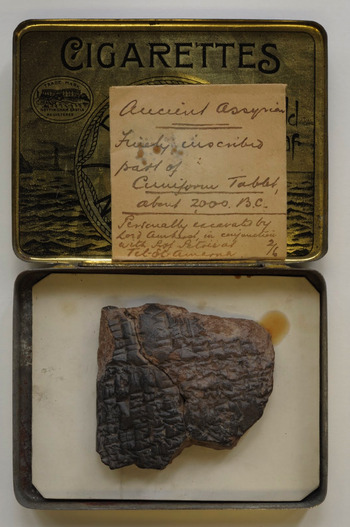
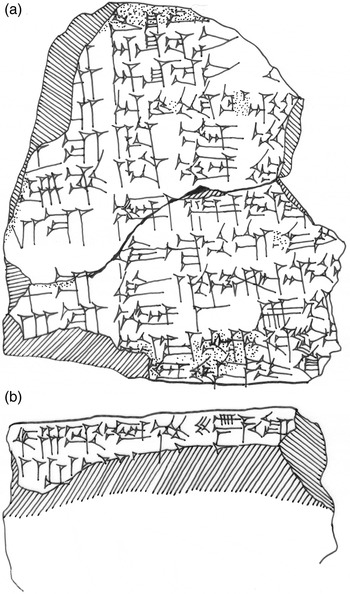
This fragmentary tablet is 57 mm wide × 60* mm high; only the lower half and bottom edge are preserved. There are 12 lines of text on the obverse, 2 lines extant on the reverse. The tablet was discovered in the Anglo-Saxon collection by the Curator of Archaeology, Dr Tim Pestell. It was in a Players Navy Cut cigarette tin and had originally been glued to a cardboard insert, the reverse having been deliberately smoothed down to make a flat surface to take the glue (which has now perished). The handwritten note inside the lid reads:
Ancient Assyrian
Finely inscribed
part of
Cuneiform Tablet,
about 2000. B.C.
Personally excavated by
Lord Amherst in conjunction
with Prof. Petrie at
Tel-El-Amarna. 2/6'
NCM 2013.278’s original storage box

Despite the label on the box (which is probably a sale ticket with purchase price of 2 shillings and sixpence given at the end), this is an informal account of silver from the Old Babylonian period, in Akkadian. To judge from the prosopography, it is probably from seventeenth-century northern Babylonia.
Obverse
start of obverse missing

Reverse

rest of reverse missing
Obverse

Reverse

Copy of NCM 2013.287 (obverse and reverse; most of reverse filed down for glueing)

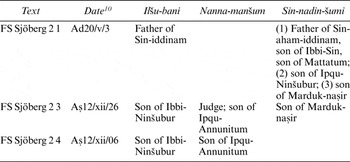
So little of this tablet survives, and the names on it are so common, that it is very hard to situate it within an archival context. According to Archibab, the personal names Awil-Nabium (obv. 9'), Ilšu-bani (obv. 2'–3'), Nanna-manšum (obv. 4'), and Sin-nadin-šumi (obv. 11') co-occur in about a dozen documents from northern Babylonia in the seventeenth century b.c.Footnote 8 However, with the exception of the three tablets from Sippar-Amnanum (Table 4), these clusters appear to be coincidental and do not represent consistent archival co-occurrences of the same individuals.Footnote 9 The name La-šimtum (if we have read it correctly) does not appear in the Archibab database.
Old Babylonian real estate documents from Sippar Amnanum featuring the names Ilšu-bani, Nanna-manšum and/or Sin-nadin-šumi

Cambridge University Library Collection
In early 2013, Dr Jill Whitelock, Keeper of Special Collections at Cambridge University Library, discovered two cuneiform tablets amongst the collection of the British and Foreign Bible Society, which had been placed on deposit with the library. Robson studied the tablets at her invitation.Footnote 11
Receipt of wool: CUL BS Artefacts.14
This complete tablet measures 30 mm wide × 32 mm high × 13 mm thick. There are 4 lines of text on the obverse, 5 on the reverse and 2 on the top. It had been stored in a little fleece-lined cardboard box, labelled “British and Foreign Bible Society — Small Babylonian tablet”, with a small sticker on it marked “6”. The library has no further provenance information about the tablet. The tablet bears an administrative record from the Ur III period, written in Sumerian, almost certainly from the city of Girsu, where the estate administrator Lu-Ninĝirsu is well attested.Footnote 12 It dates to king Amar-Suen's eighth regnal year (2039 b.c).
Obverse

Reverse

Top edge

Copy of CUL BS Artefacts. 14 (obverse and reverse)

A balanced labour account: CUL BS Artefacts.15
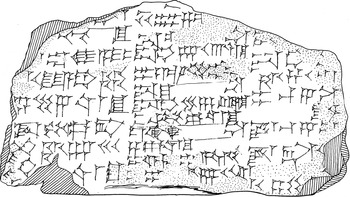
This tablet is the lower half of a three-column tablet and measures 88* mm wide × 52* mm high × 23* thick. The surface of the obverse is very abraded, with 8 + 11 + 7 lines extant in each of the three columns; the reverse is entirely missing. It had been stored by the Bible Society in a flat, square white cardboard box, labelled “Fragment of Samarian Sumerian administrative text, 3rd dynasty of Ur, c. 2000 B.C.” It contains a five-month balanced account of male and female unskilled labour from the grain mill in Girsu, closely paralleled, in all except the numerical values, by HLC 54 + 72, dating to the same months of the forty-seventh to forty-eighth regnal year of Šulgi (2048–2047 b.c.). Formerly of the Haverford Library Collection (Barton Reference Barton1905–14), it is now owned by the Chicago Oriental Institute, museum number A 31741 + 31742a (P109950). Because of the Cambridge tablet's relative illegibility many of the readings in the copy and transliteration below are somewhat tentative and have been restored on the basis of the Chicago tablet, the most recent edition of which is on CDLI.Footnote 13
Obverse, column 1 (// HLC 54 + 72 obv. i 12–15)
start of column missing

Obverse, column 2 (// HLC 54 + 72 ii 7–10, iii 2–4?)
start of column missing

Obverse, column 3
start of column missing

Copy of CUL BS Artefacts 15.