Introduction
The specimens on which this study was based were obtained from Helmut Zibrowius, who published a preliminary report on these stylasterids (Barrier et al., Reference Barrier, Zibrowius, Lozouet, Montenat, Ott d'Estevou, Serrano and Soudet1992). The specimens were collected in the Carboneras region of Spain, located at the northeast side of the Miocene volcanic massif of Cabo de Gata, in the Andalusian region of southeastern Spain. A detailed map of the region is given in Barrier et al. (Reference Barrier, Zibrowius, Lozouet, Montenat, Ott d'Estevou, Serrano and Soudet1992, fig. 1A–C). The formation was dated as Messinian (late Miocene) in age on the basis of foraminifera. The formation has been referred either to the uppermost Tortonian or to the lowest (pre-Evaporitic) Messinian, both part of the late Miocene (H. Zibrowius, personal communication, 2019). This corresponds to a narrow window of age. The reader is referred to Bordet et al. (Reference Bordet, Montenat, Ott d'Estevou and Vachard1982), Montenat et al. (Reference Montenat, Ott d'Estevou and Chapelle1990), Zibrowius et al. (Reference Zibrowius, Barrier, Bouchet, Lozouet, Montenat and Ott d'Estevou1990), Barrier et al. (Reference Barrier, Zibrowius, Lozouet, Montenat, Ott d'Estevou, Serrano and Soudet1992), and Krautworst and Brachert (Reference Krautworst and Brachert2003) for a more complete description and stratigraphy of this complex region. Zibrowius did the preliminary sorting of the thousands of small stylasterid fragments and illustrated 14 morphotypes (Barrier, Reference Barrier, Zibrowius, Lozouet, Montenat, Ott d'Estevou, Serrano and Soudet1992) but did not describe the species. This report describes those 14 species as well as an additional fifteenth species.
On the basis of a study of the sponges, Scleractinia, Stylasteridae, various octocorals, gastropods, stalked crinoids, brachiopods, serpulid polychaetes, and Bryozoa, Barrier et al. (Reference Barrier, Zibrowius, Lozouet, Montenat, Ott d'Estevou, Serrano and Soudet1992) concluded that the Carboneras fossil locality was ‘upper bathyal’ in paleodepth. Depending on what dictionary one consults, the bathyal ranges from 180 to 4,000 m, but most cite 200–2,000 m for this term, the upper bathyal then being about 200–1,000 m. Four of the 15 stylasterid species reported herein are considered to be alive today. Knowing their current depth ranges and assuming that those ranges have not changed in 5 Myr, both tenuous assumptions, the putative depth range for the formation would be 216–640 m. This follows from Calyptopora reticulata Boschma, Reference Boschma1968 not being found shallower than 216 m (Cairns, Reference Cairns2015) and Lepidotheca splendens Cairns, Reference Cairns2015 never being found deeper than 640 m (Cairns, Reference Cairns2015). Regarding the other 11 exclusively fossil species, if the depth ranges of all Recent species in their respective genera are compiled, it results in 95 m being the minimum depth as no Recent species of Conopora Moseley, Reference Moseley1879 is known from shallower than that depth. Thus, I concur that the Carboneras locality represents an upper bathyal fauna living at a paleodepth of approximately 200–600 m.
Chronological review of the fossil Stylasteridae
Table 1 is a comprehensive list of all fossil stylasterid literature records, arranged in stratigraphic order. The following account focuses on the chronology in which the more significant papers described and reported those species.
Records of all fossil Stylasteridae.

References pertaining to column 6 (more complete bibliographic data in References): 1 Barrier et al., Reference Barrier, Zibrowius, Lozouet, Montenat, Ott d'Estevou, Serrano and Soudet1992; 2 Bernecker and Weidlich, Reference Bernecker and Weidlich1990; 3 Boschma, Reference Boschma1951a; 4 Boschma, Reference Boschma1951b; 5 Boschma, Reference Boschma1953; 6 Boschma, Reference Boschma1957; 7 Boschma, Reference Boschma1964; 8 Cairns, Reference Cairns1983b; 9 Cairns, Reference Cairns1983c; 10 Cairns, Reference Cairns1991; 11 Cairns, Reference Cairns1995; 12 Cairns and Grant-Mackie, Reference Cairns and Grant-Mackie1993; 13 Cairns and Lindner, Reference Cairns and Lindner2011; 14 deFrance, Reference deFrance1826; 15 Durham, Reference Durham1942; 16 Eguchi, Reference Eguchi and Kobayashi1954; 17 Eguchi, Reference Eguchi and Eguchi1968; 18 Hall, Reference Hall1893; 19 Hall, Reference Hall1898; 20 Jell et al., Reference Jell, Cook and Jell2011; 21 Nielsen, Reference Nielsen1919; 22 Reuss, Reference Reuss1865; 23 Reuss, Reference Reuss1872; 24 Römer, Reference Römer1863; 25 Sismonda, Reference Sismonda1871; 26 Squires, Reference Squires1958; 27 Squires, Reference Squires1962; 28 Squires, Reference Squires1965; 29 Stolarski, Reference Stolarski1998; 30 Tenison-Woods, Reference Tenison-Woods and Tenison-Woods1880; 31 Tornquist, Reference Tornquist1905; 32 Wells, Reference Wells1977; 33 Zibrowius and Cairns, Reference Zibrowius and Cairns1992; 34 Zibrowius and Voigt, Reference Zibrowius and Voigt1993.
The earliest records of fossil stylasterids were from Eocene to Oligocene European localities (e.g., France, Italy, Germany), the earliest being Distichopora antigua deFrance, Reference deFrance1826 from the Eocene of France. Several other species were described by Römer (Reference Römer1863), Reuss (Reference Reuss1865), and Sismonda (Reference Sismonda1871), many of these names being synonymous, as discussed and illustrated by Boschma (Reference Boschma1951a, Reference Boschmab, Reference Boschma1953, Reference Boschma1957, Reference Boschma1964) and in Table 1. Zibrowius and Cairns (Reference Zibrowius and Cairns1992) also provided a thorough listing of all European fossil records to that date. The next major contribution to fossil stylasterids was the description of eight new species (Table 1) from the early Paleocene (Danian) of Denmark by Nielsen (Reference Nielsen1919); several of these species were also later found from the Danian of northern Germany (Zibrowius and Voigt, Reference Zibrowius and Voigt1993) and France (Montenat and Merle, Reference Montenat and Merle2018). The types of Nielsen's (Reference Nielsen1919) species are deposited at the Geological Museum of Copenhagen and some topotypes exist at the British Museum. Some have been subsequently discussed and/or figured by Cairns (Reference Cairns1983b), Bernecker and Weidlich (Reference Bernecker and Weidlich1990), and Zibrowius and Voigt (Reference Zibrowius and Voigt1993).
The most prolific author of stylasterid taxonomy, Hibrand Boschma, published a benchmark paper (Boschma, Reference Boschma1957) on stylasterids, in which he listed every reference to every stylasterid species, including the fossil species, making it an invaluable resource for literature up to 1957.
Several Neogene species from New Zealand and Chatham Island were described by Squires (Reference Squires1958, Reference Squires1962); these records were summarized and added to by Cairns (Reference Cairns1991) and Cairns and Grant-Mackie (Reference Cairns and Grant-Mackie1993). Four species were alluded to from the Miocene of Japan (Eguchi, Reference Eguchi and Eguchi1968), but only one of these was described, Stylaster chibaensis Eguchi, Reference Eguchi and Kobayashi1954. Wells (Reference Wells1977) reported four species from the late Eocene of Tonga, two of which are transferred to different genera herein.
The 14 late Miocene species from southeastern Spain, which form the basis for this revision, were first alluded to by Zibrowius et al. (Reference Zibrowius, Barrier, Bouchet, Lozouet, Montenat and Ott d'Estevou1990) and later illustrated by Barrier et al. (Reference Barrier, Zibrowius, Lozouet, Montenat, Ott d'Estevou, Serrano and Soudet1992), but none were described or given names.
The first Antarctic species, Conopora mariae Stolarski, Reference Stolarski1998, was reported from the late early Eocene of Seymour Island by Stolarski (Reference Stolarski1998). In supplemental Table 2 of Lindner et al. (Reference Lindner, Cairns. and Cunningham2008), a complete listing of all fossil species is given, the emphasis being on determining paleotemperature and its influence on offshore to onshore migrations. It contains a wealth of information about the ecology of the fossil species. Finally, the most recent reports of fossil stylasterids are of the two oldest species, from the Late Cretaceous of Western Australia (Jell et al., Reference Jell, Cook and Jell2011).
In summary (Table 1), before this study, 32 named and 21 unnamed (unidentified to species, nomina nuda, or junior synonyms) fossil stylasterid species were known. This paper effectively converts 11 of the unnamed species to named species and, with the report of L. splendens, increases the number of named species from 32 to 44 (an increase of 38%), with a corresponding decrease from 21 to eight unnamed species. Four new combinations are suggested, and one taxon identified as a stylasterid is referred to the Bryozoa (Table 1).
Materials and methods
Since all specimens were collected from the same locality and formation, the type locality for all species is the same, as described in the Introduction.
The terminology used in the descriptions is defined and illustrated in Cairns (Reference Cairns2011). Abbreviations used in the text include: BM = British Museum (Natural History); MNHN = Muséum National d'Histoire Naturelle, Paris; NIWA = National Institute of Water & Atmospheric Research, Wellington, New Zealand; SEM = scanning electron microscope; ZMB = Zoologisches Museum, Berlin.
Many stereo views are included of aspects of all species. These should not be considered to be redundant figures, since when properly viewed in stereo, they provide a remarkable appreciation for the three-dimensional morphology of the specimen and help to describe and interpret characters. The reader is urged to view the images in stereo, which, with practice, can be done even without the aid of a stereo viewer. Nonstereo images of the colonies are presented in Figure 1.
(1) Pliobothrus striatus, holotype; (2) Pliobothrus nielseni, holotype; (3) Lepidotheca splendens, MNCNI-42742; (4) Distichopora patula, holotype; (5) Stylaster digitiformis, holotype; (6) Stylaster multicavus, holotype; (7) Calyptopora reticulata, MNCNI-42892; (8) Stenohelia profunda, MNCNI-42899; (9) Conopora verrucosa, MNCNI-42907; (10) Conopora alloporoides, holotype; (11) Crypthelia zibrowii, holotype; (12) Crypthelia ingens, holotype. Scale bar numbers in millimeters.

Repository and institutional abbreviation
All specimens, including SEM stubs, are deposited at the Museo Nacional de Ciencias Naturales, Invertebrate Collection, Madrid, Spain (MNCNI).
Systematic paleontology
Class Hydrozoa Owen, Reference Owen1843
Order Anthoathecata Cornelius, Reference Cornelius1992
Suborder Filifera Kühn, Reference Kühn1913
Family Stylasteridae Gray, Reference Gray1847
Genus Lepidopora Pourtalès, Reference Pourtalès1871
Type species
Errina glabra Pourtalès, Reference Pourtalès1867.
Lepidopora fistulosa new species
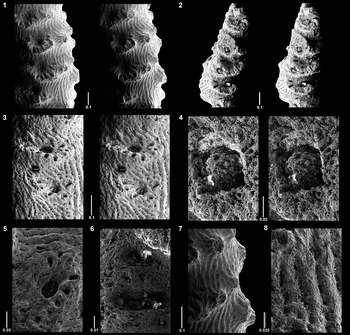
Figure 2.1–2.4
- Reference Barrier, Zibrowius, Lozouet, Montenat, Ott d'Estevou, Serrano and Soudet1992
Lepidopora sp.; Barrier et al., p. 7, fig. 2.1, 2.2.
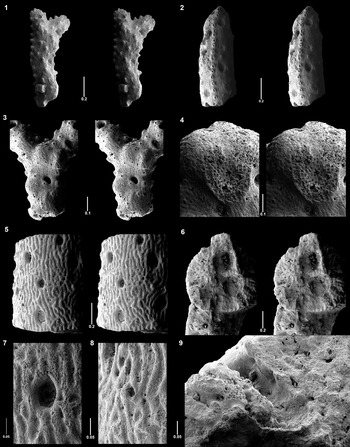
(1–4) Lepidopora fistulosus: (1–3) paratypes; (4) holotype. (1) Dactylopores on branch face; (2) aligned dactylopores on branch edge; (3) a cluster of male ampullae; (4) intact and ruptured female ampullae. (5–9) Paratypes of Pliobothrus striatus: (5) gastropores and striate coenosteum; (6) branch cross section of two male ampullae and a gastropore tube; (7) a gastropore; (8) dactylopores; (9) longitudinal section of a double-chambered gastropore tube. (1–6) Stereo pairs. Scale bar numbers in millimeters.

Holotype
MNCNI-42558 (female), SEM stub 2573 (also figured by Barrier et al., Reference Barrier, Zibrowius, Lozouet, Montenat, Ott d'Estevou, Serrano and Soudet1992 as fig. 2.1), late Miocene (Messinian), Carboneras region, northeast massif of Cabo de Gata, southeastern Spain. Paratypes: 137 fragments, MNCNI-42559–42695, SEM stub 2574 (MNCNI-42696–42698), and stub 2641 (MNCNI-42699–42700), same locality.
Diagnosis
Distinguished from other species in genus by having closely spaced and linearly arranged dactylopores on branch edges as well as nonlinearly placed on branch faces.
Description
Coralla are dichotomously branched (Fig. 2.1) and presumably uniplanar, the largest specimen (the holotype) measuring 15.2 mm long but having no distal branches. Branches are round in cross section but flattened toward their tips. The coenosteum consists of parallel linear strips 0.10–0.11 mm wide, but they are not well enough preserved to determine their microarchitecture. The gastropores are flush with the coenosteum, about 0.3 mm in diameter, and occur uniformly on the branch faces or sometimes directly adjacent to the lateral dactylopore rows (Fig. 2.2). Remnants of broken gastrostyles are rarely found in some gastropore tubes. The conical dactylopore mounds are both unilinearly arranged on the branch edges (Fig. 2.2) and uniformly spaced on the branch faces (Fig. 2.1). These mounds are about 0.25 mm in basal diameter, with an apical pore of about 0.040–0.050 mm diameter and a height of 0.14–0.17 mm. Those occurring on the branch edges occur three per mm and are usually somewhat taller than those on the branch faces. Female ampullae (Fig. 2.4) are large superficial hemispherical mounds up to 1.5 mm in diameter, having a lateral efferent pore about 0.3 mm in diameter. Ruptured female ampullae (Fig. 2.4) are also common, resulting in large depressions in the coenosteum. Male ampullae (Fig. 2.3) are also superficial but much smaller, measuring 0.55–0.65 mm in diameter.
Etymology
From fistulosus (Latin for ‘porous’), in allusion to the many dactylopores present on the branches, occurring both linearly on branch edges and randomly on branch faces.
Remarks
Lepidopora has been reported as a fossil on only one occasion, as Paraerrina sp. by Squires (Reference Squires1962) from the early Miocene of New Zealand. Although similar in colony shape and in having linearly arranged dactylopore mounds (see Cairns and Grant-Mackie, Reference Cairns and Grant-Mackie1993), the dactylopores of the New Zealand specimen are arranged in multiple longitudinal rows, not restricted to the branch edges.
In the Holocene, Lepidopora is known to be a widespread genus represented by 21 species (Cairns, Reference Cairns2015; Schuchert, Reference Schuchert2019), occurring in the amphi-Atlantic, in the western and central Pacific, off South Africa, and in the subantarctic, at depths of 47–2,330 m (Cairns, Reference Cairns2015). Eleven of the 21 species have linearly arranged dactylopore mounds, but Lepidopora fistulosa n. sp. is unique in having additional dactylopores on its branch faces.
Genus Pliobothrus Pourtalès, Reference Pourtalès1868
Type species
Pliobothrus symmetricus Pourtalès, Reference Pourtalès1868.
Pliobothrus striatus new species
Figures 1.1, 2.5–2.9
- Reference Barrier, Zibrowius, Lozouet, Montenat, Ott d'Estevou, Serrano and Soudet1992
Pliobothrus sp. 1; Barrier et al., p. 7, fig. 2.3.
Holotype
MNCNI-42701 (also figured by Barrier et al., Reference Barrier, Zibrowius, Lozouet, Montenat, Ott d'Estevou, Serrano and Soudet1992 as fig. 2.3), late Miocene (Messinian), Carboneras region, northeast massif of Cabo de Gata, southeastern Spain. Paratypes: 15 fragments, MNCNI-42702–42716, SEM stub 2618 (MNCNI-42717) and stub 2619 (MNCNI-42718), same locality.
Diagnosis
Coenosteal strips discrete and broad, bordered by shallow slits.
Description
Coralla are dichotomously branched, terminating in rounded, blunt branch tips (Fig. 1.1) up to 4 mm in distal diameter. The holotype (Fig. 1.1) is a small colony fragment measuring 17.3 mm long that is branched once, the branches round in cross section. The coenosteum consists of discrete strips each 0.16–0.18 mm wide that are sometimes linearly arranged but more commonly anastomose in a reticulate pattern. The strips are separated by broad (about 75 µm wide), shallow slits. The gastropores (Fig. 2.5, 2.7) are flush with the branch surface, uniformly arranged, and usually elliptical, their longer axis parallel to the branch axis, gastropores measuring up to 0.6 mm in greater diameter. Each gastropore leads to a narrow (diameter about 0.3 mm), cylindrical gastropore tube about 0.75 mm long, at the base of which the tube widens into a shallow crescentric chamber up to 0.7 mm in diameter and 0.2 mm in additional depth (Fig. 2.9). Gastrostyles are absent. The conical dactylopore mounds (Fig. 2.8) are also uniformly arranged on the branch surface and usually have a low relief of only about 0.1 mm. They are about 0.25 mm in diameter with an apical pore of 0.11–0.12 mm in diameter. Two size classes of internal ampullae are present. The larger cavities, presumed to be female, are 1.3–1.4 mm in diameter. The smaller, presumptive male, ampullae (Fig. 2.9) are about 1.1 mm in diameter.
Etymology
From striatus (Latin for ‘striped’) in allusion to the continuous coenosteal strips that are bordered by broad shallow slits or furrows.
Remarks
Two fossil species of Pliobothrus have been reported from the early Paleocene (Danian) of Denmark (Table 1), however the stratigraphic distance between Paleocene and late Miocene makes it unlikely that either of the two Pliobothrus species reported herein would be the same as either of those reported earlier.
In the Holocene, Pliobothrus is known from six species (Schuchert, Reference Schuchert2019) that occur from the amphi-North Atlantic, Indonesia, and the eastern Pacific (Galápagos) at depths of 80–1,600 m (Cairns, Reference Cairns1992). Pliobothrus striatus n. sp. is somewhat similar to the type species P. symmetricus Pourtalès, Reference Pourtalès1868 but differs in having continuous shallow coenosteal slits (not discontinuous pores) and in having larger ampullae.
Pliobothrus nielseni new species
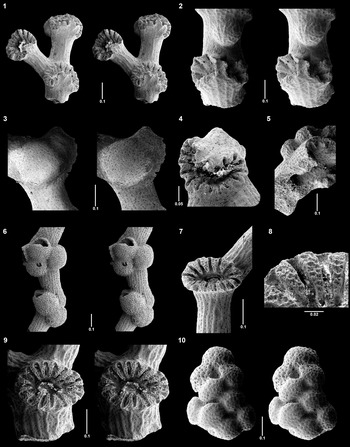
Figures 1.2, 3.1–3.5
- Reference Barrier, Zibrowius, Lozouet, Montenat, Ott d'Estevou, Serrano and Soudet1992
Pliobothrus sp. 2; Barrier et al., p. 7, fig. 2.4.
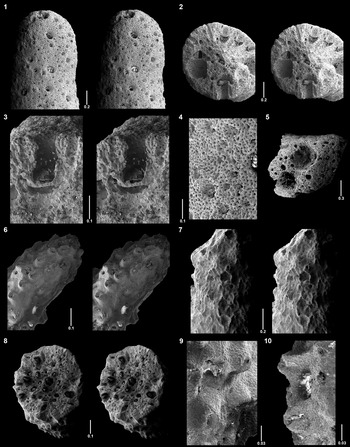
(1–5) Paratypes of Pliobothrus nileseni: (1) branch tip showing gastro- and dactylopores; (2) branch cross section showing male ampullae and several gastropore tubes; (3) longitudinal section of a double-chambered gastropore tube; (4) coenosteal texture; (5) cross section of two female ampullae. (6–10) Lepidotheca splendens, MNCNI-42743: (6) abcauline dactylopore spines; (7) several ruptured male ampullae; (8) branch cross section showing broken gastrostyles; (9, 10) dactylopore spines. (1–3, 6–8) Stereo pairs. Scale bar numbers in millimeters.

Holotype
MNCNI-42719, late Miocene (Messinian), Carboneras region, northeast massif of Cabo de Gata, southeastern Spain. Paratypes: 18 fragments, MNCNI-42720–42737, SEM stub 2620 (MNCNI-42738), stub 2621 (MNCNI-42739–42740), and stub 2637 (MNCNI-42741), same locality.
Diagnosis
Coenosteal strips poorly defined, reticulate in arrangement; female ampullae quite large (up to 2.5 mm in diameter).
Description
The corallum shape is similar to that of Pliobothrus striatus n. sp., equal dichotomous branching with blunt tips (Fig. 3.1), but somewhat more robust. The holotype (Fig. 1.2) is an attached colony 3 cm tall, 9 mm in basal diameter, and 4.5 mm in distal diameter. The coenosteum consists of very poorly defined coenosteal strips 0.6–0.7 mm wide that are arranged in a completely reticulate pattern (Fig. 3.4). Instead of coenosteal slits, the strips are separated by a series of small coenosteal pores 0.04–0.05 mm in diameter. The gastropores (Fig. 3.1) are flush with the branch surface, uniformly arranged, and circular in shape, ranging in diameter from 0.33 to 0.50 mm. Moreover, like Pliobothrus striatus, each gastropore leads to a cylindrical tube (Fig. 3.2, 3.3) about 0.45 mm in diameter and 1.0 mm deep, which opens to a crescentric chamber about 1 mm in diameter and another 0.15 mm deep. The conical dactylopore mounds are uniformly arranged, each about 0.65 mm in diameter with an apical pore diameter of about 0.2 mm and a height of about 0.25 mm. The coenosteum is thus a mixture of three size classes of surface pores: the large flush gastropores, the smaller mounded dactylopores, and the numerous small coenosteal pores (Fig. 3.1). Two size classes of internal ampullae are present. The larger (female) ampullae are 2.4–2.5 mm in diameter (Fig. 3.5), whereas the male ampullae (Fig. 3.2) are only 1.1–1.3 mm in diameter. Although internal, they are often expressed as large superficial coenosteal craters (Fig. 3.5).
Etymology
Named in honor of K. Brünnich Nielsen (1872–1942) for his pioneering work with fossil stylasterids (Nielsen, Reference Nielsen1919), in which he described two species of Pliobothrus from the early Paleocene of Denmark.
Remarks
Compared to the Holocene species, P. nielseni n. sp. is unique in having such poorly defined, reticulate coenosteal strips, conferring a porous aspect to the coenosteum; it is also unique in having such large female ampullae.
Genus Lepidotheca Cairns, Reference Cairns1983b
Type species
Errina fascicularis Cairns, Reference Cairns1983a.
Lepidotheca splendens Cairns, Reference Cairns2015
Figures 1.3, 3.6–3.10
- Reference Cairns2015
Lepidopora splendens Cairns, p. 104, figs. 40K, 56A–M, 57.
Holotype
MNHN IK-2012-14314, Recent, northern Norfolk Ridge, South Pacific, 440 m.
Description
The corallum has equal, dichotomous branching, with blunt, rounded tips; the largest specimen is a fragment 8.7 mm long. The coenosteum is composed of parallel strips about 0.28 mm wide that are covered with narrow imbricate platelets (linear imbricate); occasionally the midline of each strip is ridged. The gastropores are uniformly spaced, flush with the coenosteal surface, and circular to elliptical, the greater axis up to 0.33 mm. The gastropore tube is cylindrical and contains an elongate gastrostyle (Fig. 3.8). The horseshoe-shaped dactylopore spines (Fig. 3.6, 3.9, 3.10) are abcauline in position, with the dactylotomes oriented upward. The uniformly spaced dactylopore spines are about 0.27 mm wide, the dactylotomes measure about 0.06 mm wide, and the height is 0.17–0.24 mm. Dactylostyles were not noted. Only one size class of ampullae were present, measuring 0.5–0.6 mm in diameter; they are partially internal but with an external bulge. Because of the size and the presence of small pores on the top of these ampullae, they are assumed to be male (Fig. 3.7).
Materials
Five fragments, MNCNI-42742, SEM stub 2600 (MNCNI-42743–42745), and stub 2638 (MNCNI-42746), late Miocene (Messinian), Carboneras region, northeast massif of Cabo de Gata, southeastern Spain.
Remarks
Lepidotheca has never been reported in the fossil record. Among the 17 Recent species in the genus (Schuchert, Reference Schuchert2019), the Carboneras specimens are indistinguishable from L. splendens, a species known only from the New Caledonian region of the southwest Pacific Ocean at depths of 200–640 m.
Genus Distichopora Lamarck, Reference Lamarck1816
Type species
Millepora violacea Pallas, Reference Pallas1766.
Distichopora patula new species
Figures 1.4, 4.1–4.5
- Reference Barrier, Zibrowius, Lozouet, Montenat, Ott d'Estevou, Serrano and Soudet1992
Distichopora sp.; Barrier et al., p. 7, figs. 2.5–2.7 (all female colonies).
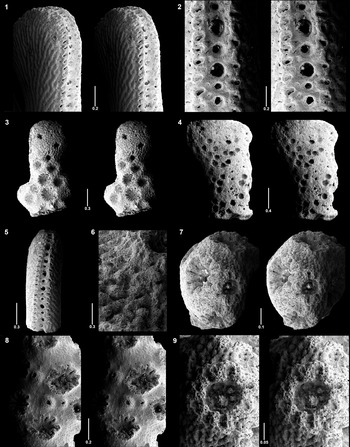
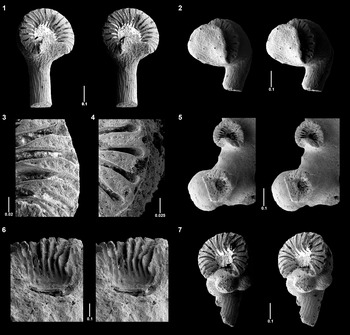
(1–5) Paratypes of Distichopora patula: (1, 2, 5) branch edge showing pore rows; (3) ruptured female ampullae; (4) ruptured male ampullae. (6–9) Paratypes of Stylaster digitiformis: (6) coenosteal texture; (7) blunt branch tip with four cyclosystems; (8) cyclosystems and male ampullae; (9) a cyclosystem showing ring palisade and gastrostyle. (1–4, 7–9) Stereo pairs. Scale bar numbers in millimeters.

Holotype
MNCNI-42747, female (also figured by Barrier et al., Reference Barrier, Zibrowius, Lozouet, Montenat, Ott d'Estevou, Serrano and Soudet1992 as figs. 2–5), late Miocene (Messinian), Carboneras region, northeast massif of Cabo de Gata, southeastern Spain. Paratypes: 92 fragments, MNCNI-42748–42839, SEM stub 2598 (MNCNI-42840), stub 2599 (MNCNI-42841–42842), stub 2639 (MNCNI-42843), and stub 2640 (MNCNI-42844), same locality.
Diagnosis
Narrow coenosteal strips; small male ampullae (0.5–0.6 mm in diameter); female ampullae lack efferent pores.
Description
The corallum has equal, dichotomous branching (Fig. 1.4) with blunt, flattened branch tips, the distal branches up to 6 mm across and only about 2.5 mm thick. The largest specimen (the holotype, Fig. 1.4) is an attached colony 31 mm wide and 13 mm tall with 7 distal branches. The coenosteal strips are 0.2–0.3 mm wide and slightly convex, radiating from the central part of the branch face to the branch edges. Many specimens are orange, which may have been the original color of the corallum. The distichoporine pore rows (Fig. 4.1, 4.2, 4.5) are about 1.1 mm wide; two rows of dactylopore spines enclose a medial row of gastropores that sit in a shallow sulcus. The gastropores are circular and variable in diameter, ranging from 0.15 to 0.30 mm in diameter, 1.5–3.0 occurring per millimeter. The gastropore tubes are quite long (axial), each containing a slender gastrostyle, but their delicate construction did not allow one to be isolated and scanned. The flanking dactylopore spines (Fig. 4.2), which are oriented perpendicular to the gastropore row, are elliptical, the dactylotomes measuring 0.18–0.22 mm long and 0.045–0.055 wide. The superficial, hemispherical female ampullae occur in great abundance on the faces of the corallum, measuring 1.0–1.3 mm in diameter, also often appearing as deep concave craters in the coenosteum (Fig. 4.3). Efferent pores were never detected. The male ampullae are also superficial, densely clustered on the branch faces, and often cratered as well (Fig. 4.4), but much smaller, only 0.5–0.6 mm in diameter.
Etymology
From patulus (Latin for ‘spread out, broad’), in allusion to the colony shape.
Remarks
The genus Distichopora has been reported from the fossil record at least three times (Table 1), as D. antigua deFrance, Reference deFrance1826 (Eocene of France), Distichopora sp. (middle Miocene of Victoria, Australia) (Hall, Reference Hall1898), and D. parairregulare Eguchi, Reference Eguchi and Eguchi1968 (nom. nud.) from the Pliocene of Japan. Distichopora antigua, although frequently cited (see Boschma, Reference Boschma1957), has never been figured or properly described and thus is not possible to compare. Likewise, Hall's (Reference Hall1898) Australian unidentified fragments were not figured or described, which is the same case for Eguchi's (Reference Eguchi and Eguchi1968) D. parairregulare, the latter being an invalid species as well.
Distichopora, consisting of another 25 Holocene species (Schuchert, Reference Schuchert2019) is cosmopolitan in distribution (except for the eastern Atlantic and off continental Antarctica), occurring at depths of 0–1,267 m (Cairns, Reference Cairns2015). Among these Recent species, D. patula n. sp. is most similar to D. yucatanensis Cairns, Reference Cairns1986, a species known only from the western Caribbean at depths of 39–261 m. Points of similarity include colony color, branch shape, gastropore size, dactylopore size and arrangement, and size of female ampullae. Distichopora patula differs only in having narrower coenosteal strips, smaller male ampullae, and the apparent lack of female efferent pores.
Genus Stylaster Gray, Reference Gray1831
Type species
Madrepora rosea Pallas, Reference Pallas1766.
Stylaster (Group A) digitiformis new species
Figures 1.5, 4.6–4.9
- Reference Barrier, Zibrowius, Lozouet, Montenat, Ott d'Estevou, Serrano and Soudet1992
Stylaster sp. 1; Barrier et al., p. 7, fig. 2.11 (male).
Holotype
MNCNI-42845 (male), late Miocene (Messinian), Carboneras region, northeast massif of Cabo de Gata, southeastern Spain. Paratypes: 18 fragments, MNCNI-42846–42863, SEM stub 2605 (MNCNI-42864–42865), stub 2606 (MNCNI-42866), and stub 2631 (MNCNI-42867–42868), same locality.
Diagnosis
Ring palisade well developed, consisting of large amorphous elements; gastropore tube unique in shape: broad above and narrow tubular in region of gastrostyle.
Description
The corallum has equal, dichotomous branching (Fig. 1.5) with blunt branch tips (Fig. 4.7) that are circular in cross section; the distal branches are about 3 mm in diameter. The holotype (Fig. 1.5) is a small, attached male colony having four distal branches and measuring 15.5 mm tall. The coenosteal strips are 0.08–0.10 mm wide, arranged in a reticulate pattern (Fig. 4.6). Gastro- and dactylopores are arranged in well-defined, slightly exsert cyclosystems (Fig. 4.7–4.9) and occur uniformly around all branches (Group A arrangement); they vary from 1.05 to 1.25 mm in diameter. Judging from 24 cyclosystems, the range of dactylopores per cyclosystem is 8–14, average 11.12 (σ = 1.87), and the mode is 11. The gastropores are 0.50–0.75 mm in diameter, opening into a rather capacious upper section that, lower in the fossa, narrows to a diameter of about 0.2 mm, leading to the lower cylindrical cavity in which the gastrostyle sits. Just above the transition from the larger upper cavity to the lower one is a well-developed, discrete ring palisade (Fig. 4.9) composed of 7–9 amorphous elements, each about 0.1 mm wide, not corresponding to the pseudosepta above. The tips of the gastrostyles are easily seen (Fig. 4.9) in most cyclosystems but none could be extracted for SEM imagery. The dactylotomes are uniformly 0.075–0.080 mm wide; the pseudosepta vary from 0.11 to 0.31 mm in outer width. Dactylostyles were not observed. The female ampullae are superficial hemispheres or evidenced as ruptured concavities, each about 0.8 mm in diameter, occurring uniformly on the branch surface. Purported male ampullae are also superficial hemispheres but only about 0.6 mm in diameter, also often present as ruptured concavities (Fig. 4.8) spread across the coenosteal surface.
Etymology
From digitus (Latin for ‘finger’), in allusion to the finger-shaped branches being cylindrical with a blunt rounded tip.
Remarks
Eleven fossil species of Stylaster have been reported in the literature, including nine named and two unnamed species (Table 1). Of these, four belong to Stylaster (Group A sensu Cairns, Reference Cairns1983b), defined as those species having their cyclosystems uniformly arranged on all branch surfaces (Table 1), the group that includes Stylaster digitiformis n. sp. Of those two species that are stratigraphically closest to the Carboneras fauna, one, S. gigas Cairns and Grant-Mackie, Reference Cairns and Grant-Mackie1993 (early Pliocene, New Zealand), differs in having smaller cyclosystems, fewer dactylopores per cyclosystem, massive coralla, and internal ampullae. The second, Stylaster priscus Reuss, Reference Reuss1872 (as redescribed by Boschma, Reference Boschma1953) (Miocene of Austria) differs in having larger and compressed cyclosystems. Both species, as well as S. compressus (Römer, Reference Römer1863) (Oligocene, Germany), also differ from S. digitiformis in having a simple tubular gastropore tube, not as described above. The fourth species, S. milleri Durham, Reference Durham1942 (early Oligocene, Washington), has much smaller cyclosystems, fewer dactylopores per cyclosystem, and may in fact have an encrusting corallum that is more characteristic of the genus Stylantheca.
Among the 89 Holocene species of Stylaster (Cairns, Reference Cairns2015; Schuchert, Reference Schuchert2019), 24 pertain to Group A, a group of species that are found worldwide at depths of 5–1,400 m (Cairns, Reference Cairns1992). Stylaster digitiformis is distinctive in having such well-developed ring palisade elements and a uniquely shaped gastropore tube.
Stylaster multicavus new species
Figures 1.6, 5
- Reference Barrier, Zibrowius, Lozouet, Montenat, Ott d'Estevou, Serrano and Soudet1992
Stylaster sp. 2; Barrier et al., p. 7, fig. 2.12 (holotype), 2.13.
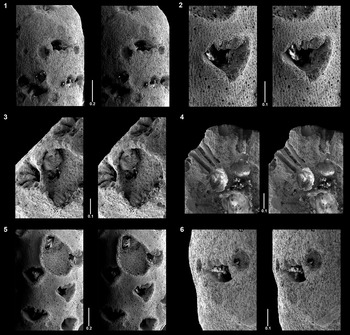
Paratypes of Stylaster multicavus: (1, 2) cyclosystems; (3, 4) linear-imbricate coenosteal texture; (5) several nematopores; (6) a male ampulla; (7) several female ampullae; (8) longitudinal section of a gastropore tube with gastrostyles. (1, 2, 7, 8) Stereo pairs. Scale bar numbers in millimeters.

Holotype
MNCNI-42869 (female), late Miocene (Messinian), Carboneras region, northeast massif of Cabo de Gata, southeastern Spain. Paratypes: 8 fragments, MNCNI-42870–42877, SEM stub 2607 (MNCNI-42878–42879), stub 2608 (MNCNI-42880), and stub 2633 (MNCNI-42881), same locality.
Diagnosis
Cyclosystems diastemate; large, shallow nematopore cavities cover the coenosteum.
Description
The corallum is uniplanar, having a single ascendant branch from which smaller lateral branchlets arise on both sides of the main branch (Fig. 1.6). The female holotype branch fragment (Fig. 1.6) is 13.2 mm tall. The coenosteal strips are arranged in a linear-imbricate manner (Fig. 5.3, 5.4), the strips 0.06–0.08 mm wide, with approximately 75 platelet edges occurring per mm. Round, shallow nematopore depressions (Fig. 5.5) measuring 45–55 µm in diameter are densely packed over the entire coenosteum. Cyclosystems (Fig. 5.1, 5.2) occur in a sympodial arrangement (Group C sensu Cairns, Reference Cairns1983b), their perimeter being elliptical to somewhat irregular, and up to 1.3 mm in greater diameter; an adcauline diastema up to 0.45 mm wide and occupying one-fifth to one-fourth of the perimeter of the cyclosystem is often present. On the basis of 18 cyclosystems, the range of dactylopores per cyclosystem is 8–12, the average is 9.61 (σ = 2.59), and the mode is 10. The gastropore tube appears to be cylindrical, about 0.25 mm in diameter, containing a lanceolate gastrostyle (Fig. 5.8) that is about 0.16 mm in diameter; a ring palisade was not noted. The style bears coarse cylindrical spines about 25–40 µm tall. Dactylotomes are about 0.12 mm wide; pseudosepta range from 0.12 to 0.18 mm wide. Dactylostyles were not observed. The female ampullae (Fig. 5.7) are superficial hemispheres 0.8–0.9 mm in diameter, having a lateral efferent pore of 0.3 mm in diameter. Male ampullae (Fig. 5.6) are smaller superficial mounds 0.45–0.50 mm in diameter.
Etymology
From multi + cavus (Latin for ‘many hollows or depressions’), in allusion to the many nematopore pits that cover the coenosteum.
Remarks
Of the eleven fossil species of Stylaster that have been reported in the literature (Table 1), four belong to Stylaster (Group C sensu Cairns, Reference Cairns1983b), defined as those species having their cyclosystems arranged in an exclusively sympodial manner, the group that includes Stylaster multicavus n. sp. Stylaster multicavus differs from S. cretaceous Jell, Cook, and Jell, Reference Jell, Cook and Jell2011 in having fewer dactylopores per cyclosystem, smaller cyclosystems, and a reticulate-granular coenosteal surface. Although linear imbricate in coenosteal texture and having 11 dactylopores per cyclosystem, the Eocene Stylaster sp. reported by Wells (Reference Wells1977) from Tonga has smaller cyclosystems and ampullae. Although similar to S. chibaensis Eguchi, Reference Eguchi and Kobayashi1954 (Miocene, Japan) (as redescribed by Eguchi, Reference Eguchi and Eguchi1968) in number of dactylopores per cyclosystem and cyclosystem diameter, that species is not described well enough to make a proper comparison. Finally, S. multicavus is also similar to the middle Miocene S. mooraboolensis (Hall, Reference Hall1893) from Victoria, Australia, in almost all features (see redescription by Boschma, Reference Boschma1953), differing primarily in having a slightly higher number of dactylopores per cyclosystem (range = 8–18, average = 12.5, mode = 13), a broader diastema, and dactylopores arranged in a crescent-shaped line. In addition, S. multicavus differs from all four fossil species in having densely concentrated nematopore cavities.
Lacking molecular evidence, which will always be the case for fossil species, it is somewhat daunting to compare a putatively new species of Stylaster to the already 89 described Holocene species. However, assigning this species to Group C sensu Cairns (Reference Cairns1983b) reduces that number to 40 (Cairns, Reference Cairns2015; Schuchert, Reference Schuchert2019), a group of species that are found worldwide at depths of 1–1,244 m (Cairns, Reference Cairns1992). Within this subgroup, Stylaster multicavus is distinctive in having linear-imbricate coenosteal texture, which is shared with 22 of those species. Of those 22, only nine have diastemate cyclosystems, and only one of those, S. polystomos Cairns, Reference Cairns2015, has large concave nematopores. Nonetheless, Stylaster multicavus differs from that species in having considerably larger nematopores and superficial ampullae, in lacking a polychaete commensalism, and in having but one gastrostyle per gastropore.
Stylaster tuberosus new species
Figure 6
- Reference Barrier, Zibrowius, Lozouet, Montenat, Ott d'Estevou, Serrano and Soudet1992
Stylaster sp. 3; Barrier et al., p. 7, fig. 2.14 (holotype).
Stylaster tuberosus: (1, 7) holotype, (2–6, 8) paratypes. (1) Cyclosystems and several coenosteal tubercles; (2, 3, 5) cyclosystems; (4) a gastrostyle; (6) dactylotomes and a pseudoseptum; (7) coenosteal tubercles; (8) linear-imbricate coenosteal texture. (1–4) Stereo pairs. Scale bar numbers in millimeters.

Holotype
MNCNI-42882 (SEM stub 2611), late Miocene (Messinian), Carboneras region, northeast massif of Cabo de Gata, southeastern Spain. Paratypes: 6 fragments, MNCNI-42883–42888, SEM stub 2609 (MNCNI-42889), and stub 2610 (MNCNI-42890–42891), same locality.
Diagnosis
Narrow edges of branches covered with tall, porous, guyot-shaped tubercles (?nematopores).
Description
The corallum is branched, but on the basis of the small fragments available, a colony shape cannot be determined. The holotype is a branch fragment 7.7 mm long. The coenosteal strips are arranged in a linear-imbricate manner (Fig. 6.8), the strips about 0.13 mm wide. Most colonies examined also bear flat-topped (guyot-like) tubercles (?nematopores; Fig. 6.1, 6.7), up to 0.35 mm tall and 0.30–0.33 mm in apical diameter, which are porous; they occur primarily on the narrow edges of the branchlets. The branches are flattened, the cyclosystems arranged in close proximity on the two broad edges of each branch (Fig. 6.1, 6.2). The cyclosystems (Fig. 6.1–6.3, 6.5) are 1.0–1.1 mm wide, bordered abaxially by a crescent-shaped row of dactylopores, the adaxial side a broad diastema occupying as much as half the perimeter of the cyclosystem. On the basis of 11 cyclosystems, the range of dactylopores per cyclosystem is 5–12, the average is 9.18 (σ = 2.18), and the mode is 11. The upper gastropore tube is very short and shallow, leading to an elongate cylindrical tube 0.19–0.23 mm in diameter, which houses a cylindrical gastrostyle (Fig. 6.4). The dactylotomes are ~0.07 mm wide; the pseudosepta (Fig. 6.6) are flush with the coenosteum, not exsert. The female ampullae are superficial hemispheres about 1.1 mm in diameter. Male ampullae were not observed.
Etymology
From tuberosus (Latin for ‘full of lumps or protuberances’), in allusion to its flat-topped coenosteal tubercles.
Remarks
Among the four fossil species (see the preceding and Table 1) belonging to Stylaster Group C sensu Cairns (Reference Cairns1983b), S. tuberosus n. sp. is most similar to S. mooraboolensis (Hall, Reference Hall1893), the illustrations of Boschma (Reference Boschma1953) showing the similarity of the crescent-shaped arrangement of dactylopores within the cyclosystems. Stylaster tuberosus differs only in having a slightly lesser number of dactylopores per cyclosystem and having very large tuberculate nematopore mounds.
As mentioned in the account of Stylaster multicavus n. sp., there are nine Recent species that belong to Stylaster (Group C) and have linear-imbricate coenosteum and diastemate cyclosystems. Some have raised nematopore mounds, but none are as prominent as those of S. tuberosus except for S. spatula Cairns, Reference Cairns1986 (western Atlantic, 384–549 m). Cairns named that species in reference to its tall, apically porous coenosteal projections, which are not unlike those of S. tuberosus. Nonetheless, S. tuberosus differs in having broader coenosteal strips, a lower number of dactylopore per cyclosystem, nonexsert pseudosepta, and larger female ampullae.
Genus Calyptopora Boschma, Reference Boschma1968
Type species
Calyptopora reticulata Boschma, Reference Boschma1968.
Calyptopora reticulata Boschma, Reference Boschma1968
Figures 1.7, 7.1–7.5
- Reference Boschma1968
Calyptopora reticulata Boschma, p. 102, pls. 1–3.
- Reference Cairns1983a
Calyptopora reticulata; Cairns, p. 150, figs. 41A–H, 50A–E.
- Reference Cairns1983b
Calyptopora reticulata; Cairns, p. 430, fig. 19A–I.
- Reference Cairns1991
Calyptopora reticulata; Cairns, p. 68, pls. 53a–g, 54a–h.
- Reference Barrier, Zibrowius, Lozouet, Montenat, Ott d'Estevou, Serrano and Soudet1992
Calyptopora sp.; Barrier et al., p. 7, fig. 2.9, 2.10.
- Reference Cairns and Grant-Mackie1993
?Calyptopora sp. cf. C. reticulata; Cairns and Grant-Mackie, p. 2, 7.
- Reference Cairns2015
Calyptopora reticulata; Cairns, p. 195, figs. 104E, 113A–K, 114.
(1–5) Calyptopora reticulata, MNCNI-42833: (1, 2, 4) cyclosystems with abcauline lids, (2) showing a female ampulla; (3) female ampulla with efferent pore; (5) gastropore tube missing its style, and male ampullae. (6–10) Stenohelia profunda, MNCNI-42900: (6) cluster of female ampullae with efferent pores; (7, 9) cyclosystems; (8) several pseudosepta; (10) cluster of male ampullae. (1–3, 6, 9, 10) Stereo pairs. Scale bar numbers in millimeters.

Holotype
NIWA H-48, Recent, off |Antipodes Islands, 1,335 m.
Description
The colony is branched (Fig. 1.7), but on the basis of the small fragments available, the colony shape cannot be determined; however, larger branches always show a commensalistic worm tube on its posterior side, the porous tube about 2 mm in diameter. The slightly convex coenosteal strips are arranged in a linear-imbricate fashion, the strips about 0.17 mm wide. Small, worn papillae (nematopores?) are common on some specimens. The cyclosystems occur only on the anterior face of the branchlets, but not in a unilinear row. They are highly compressed and sometimes irregular is shape, having a greater diameter of 1.4–1.5 mm. Most cyclosystems have an abcauline lid of variable width (0.3–0.5 mm) that covers part of the gastropore (Fig. 7.1, 7.2, 7.4); occasionally a smaller adcauline lid (Fig. 7.2) fuses with the abcauline one. Unlike Crypthelia lids, dactylopores and pseudosepta occur on these lids. On the basis of 13 cyclosystems, the range of dactylopores per cyclosystem is 12–20, the average is 17.1, and the mode is 16. The gastropore tube is cylindrical, often slightly curved, about 0.4 mm in diameter, and contains a gastrostyle. The dactylotomes are about 0.05 mm wide, whereas the pseudosepta are variable in width, ranging from 0.075 to 0.210 mm wide. The female ampullae (Fig. 7.3) are superficial hemispheres 0.7–1.1 mm in diameter, having a lateral efferent pore about 0.25 mm in diameter. The male ampullae (Fig. 7.5) are smaller (0.55–0.60 mm in diameter) and usually cluster on the posterior side.
Materials
Sixth-four branch fragments, MNCNI-42892, SEM stub 2601 (MNCNI-42893–42894), stub 2602 (MNCNI-42896–42897), and stub 2627 (MNCNI-42898), late Miocene (Messinian), Carboneras region, northeast massif of Cabo de Gata, southeastern Spain.
Remarks
On the basis of almost all characters previously reported, this material is identical to the Recent Calyptopora reticulata, known from Macquarie Island, New Zealand, and north to the northern Norfolk Ridge at 216–2,100 m, except that the living populations have fewer dactylopores per cyclosystem (i.e., a range of 3–13, average of 10.45, and mode of 10) (see Cairns, Reference Cairns2015). Allowing for this variation, it is identified as the Holocene species. Poorly preserved specimens that may be this species are also known from the early Miocene of North Island, New Zealand (Cairns and Grant-Mackie, Reference Cairns and Grant-Mackie1993).
The genus is known from only two species (Cairns, Reference Cairns2015; Schuchert, Reference Schuchert2019), the genus having the same range as indicated for C. reticulata.
Genus Stenohelia Kent, Reference Kent1870
Type species
Allopora maderensis Johnson, Reference Johnson1862.
Stenohelia profunda Moseley, Reference Moseley1881
Figures 1.8, 7.6–7.10
- Reference Moseley1881
Stenohelia profunda Moseley, p. 82, 88, pl. 12, figs. 1–4 [in part: Challenger-23, not station 171].
- Reference Cairns1986
Stenohelia profunda; Cairns, p. 95, figs. 42A–G, 43A–F (complete synonymy).
- Reference Barrier, Zibrowius, Lozouet, Montenat, Ott d'Estevou, Serrano and Soudet1992
Stenohelia sp.; Barrier et al., p. 7, fig. 2.8.
Syntypes
Six syntypes are deposited at the BM, 1880.11.25.182, Recent, off St. Thomas, Virgin Islands, 823 m.
Description
Colonies are uniplanar, equally and dichotomously branched, the distal branches being quite slender (0.75 mm in diameter) and delicate, often narrower than the cyclosystems they support. The coenosteal strips are arranged in a linear-imbricate manner (Fig. 7.6, 7.7), the strips 0.08–0.11 mm wide and having a slightly convex axis; the plates are quite narrow and irregular in disposition. The cyclosystems are unilinearly arranged on the anterior face of the branches and are elliptical (Fig. 7.7, 7.9), 1.2–1.4 mm in greater diameter, the greater axis oriented perpendicular to the branch axis. On the basis of 19 cyclosystems, the range of dactylopores per cyclosystem is 14–18, the average is 15.42 (σ = 2.54), and the mode is 16; there are no diastemas. The gastropore tube is cylindrical and long, curved 90° just beneath the gastropore opening, such that the tip of the gastrostyles is never visible. The gastropore tube is 0.35–0.45 mm in diameter. The dactylotomes are uniformly 0.055 mm wide, whereas the pseudosepta (Fig. 7.8) range from 0.08 to 0.15 mm wide. The upper surface of a pseudoseptum is loculate (Fig. 7.8), the depressions about 0.033 mm in diameter. Female ampullae (Fig. 7.6) are superficial hemispheres 0.95–1.00 mm in diameter, located on the posterior side of the branch adjacent to a cyclosystem; they bear a lateral efferent pore 0.12–0.15 mm in diameter. Male ampullae (Fig. 7.10) are also superficial and clustered on the posterior side of the branch adjacent to the cyclosystems, each measuring 0.75–0.85 mm in diameter; they are somewhat irregular in shape and usually elongate.
Materials
One hundred sixty-seven branch fragments, MNCNI-42899, SEM stub 2603 (MNCNI-42900–42901), stub 2604 (MNCNI-42903–42904), and stub 2632 (MNCNI-42906), late Miocene (Messinian), Carboneras region, northeast massif of Cabo de Gata, southeastern Spain.
Remarks
In the fossil record, Stenohelia has been reported twice. Stenohelia boschmai Wells, Reference Wells1977 was reported from the Eocene of Tonga, but that species is herein transferred to Conopora (Table 1). Zibrowius and Cairns (Reference Cairns1992, p. 24) also report S. maderensis (Johnson, Reference Johnson1862) from the early Pleistocene of Sicily.
There are 13 Recent species of Stenohelia (Cairns, Reference Cairns2015; Schuchert, Reference Schuchert2019), which are cosmopolitan in distribution from depths of 110–2,021 m. The Carboneras specimens are indistinguishable from S. profunda, as redescribed by Cairns (Reference Cairns1986), a species known only from the Lesser Antilles at depths of 159–2,021 m.
Barrier et al. (Reference Barrier, Zibrowius, Lozouet, Montenat, Ott d'Estevou, Serrano and Soudet1992, figs. 2–8) figured a copepod gall on one of their specimens, but that specimen could not be found nor any other specimens with copepod galls.
Genus Conopora Moseley, Reference Moseley1879
Type species
Conopora tenuis Moseley, Reference Moseley1879.
Conopora verrucosa (Studer, Reference Studer1878)
Figures 1.9, 8.1–8.6
- Reference Studer1878
Stylaster verrucosus Studer, p. 635, figs. 6a, b.
- Reference Cairns1983b
Conopora verrucosa; Cairns, p. 490, figs. 21E–H.
- Reference Cairns1991
Conopora verrucosa; Cairns, p. 72, pls. 57e–g, 58a–d (complete synonymy).
- Reference Barrier, Zibrowius, Lozouet, Montenat, Ott d'Estevou, Serrano and Soudet1992
Conopora sp. 2; Barrier et al., p. 7, fig. 2.17.
- Reference Cairns and Grant-Mackie1993
?Conopora laevis; Cairns and Grant-Mackie, p. 7, fig. 17 (early Miocene of New Zealand).
- Reference Cairns and Zibrowius2013
Conopora verrucosa; Cairns and Zibrowius, p. 42, figs. 3D, 27.
- Reference Cairns2015
Conopora verrucosa; Cairns, p. 208, figs. 104J, 121A–E, 122.
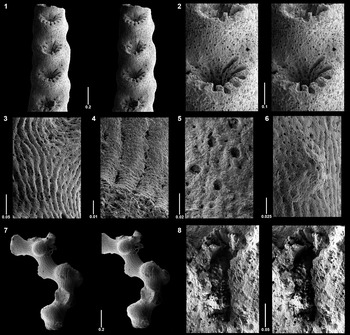
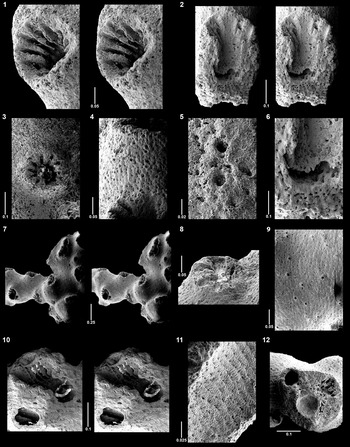
(1–6) Conopora verrucosa, MNCNI-42908: (1, 3) cyclosystems; (2, 6) longitudinal view of double-chambered gastropore tube; (4, 5) coenosteal nematopores. (7–12) Conopora forticula: (7–9, 11) holotype, (10, 12) paratype. (7) Cyclosystems, female ampullae, nematopores; (8) a cyclosystem; (9) nematopores; (10) longitudinal section of a double-chambered gastropore tube; (11) linear-imbricate coenosteal texture; (12) cross section of a male ampulla. (1, 2, 7, 10) Stereo pairs. Scale bar numbers in millimeters.

Holotype
ZMB 1764, Recent, off northeastern North |Island, New Zealand, 1,092 m.
Description
The colonies would appear to be uniplanar with occasional anastomosing branches (Fig. 1.9). The figured specimen (Fig. 1.9) measures 23 mm long and shows an indication of a tube formed by a commensalistic polychaete. Branches are rectangular in cross section, about 3.1 × 2.3 mm, the longer axis oriented perpendicular to the plane of the colony. Although the branches are straight, the cyclosystems are staggered in an alternating fashion on the anterolateral side of the branches (Fig. 1.9). The coenosteal strips are arranged in a linear fashion and are ~0.07 mm wide, but the poor preservation of all fragments does not allow for observation of platelets, if any. The coenosteum is densely covered with small (0.030–0.042 mm in diameter) nematopores (Fig. 8.4, 8.5), some of which are slightly raised on mounds, others sunken as shallow pits. The cyclosystems (Fig. 8.1, 8.3) are circular, slightly raised above the coenosteum, and 1.0–1.3 mm in diameter. On the basis of 14 cyclosystems, the range of dactylopores per cyclosystem is 8–15, the average is 13.64, and the mode is 14; occasionally there is an adcauline diastema resulting in fewer dactylopores per cyclosystem, but usually there is not. The gastropore tube is double chambered (Fig. 8.2, 8.6), the aperture between the chambers about 0.45 mm in diameter; the lower chamber is shallow (only 0.22 mm deep and about 0.55 mm in diameter) with a curved base. The dactylotomes are 0.06–0.08 mm wide; the outer edges of the pseudosepta are about 0.06 mm wide. The female ampullae are irregular superficial swellings but mainly internal, 1.2–1.4 mm in diameter, usually located directly adjacent to cyclosystems. Because efferent pores were never observed, it is probable that they open directly into the gastropore region. Likewise, the male ampullae, which are much smaller (0.60 mm in diameter), are also clustered near cyclosystems, with efferent pores that probably open directly into the gastropore region.
Materials
Seven branch fragments, MNCNI-42907, SEM stub 2612 (MNCNI-42908), stub 2628 (MNCNI-42909), and stub 2636 (MNCNI-42910), late Miocene (Messinian), Carboneras region, northeast massif of Cabo de Gata, southeastern Spain.
Remarks
Records of Conopora occur throughout the Cenozoic (Table 1) from the early Paleocene of Denmark (Nielsen, Reference Nielsen1919) to the Pliocene of Japan (Eguchi, Reference Eguchi and Eguchi1968). Before this publication there were 16 Holocene and three exclusively fossil species known (Cairns, Reference Cairns2015; Schuchert, Reference Schuchert2019). Holocene species are known from the Indo-west Pacific, Antarctic, and subantarctic at depths of 95–2,355 m (Cairns, Reference Cairns2015). The species of Conopora can be arranged in five groups according to the arrangements of their cyclosystems on the branch (see Cairns, Reference Cairns2015), the largest group of eight species belonging to the group having sympodially arranged cyclosystems, which includes C. verrucosa. These Carboneras Conopora are indistinguishable from C. verrucosa, as previously described (see synonymy), differing only in having a slightly higher average number of dactylopores per cyclosystem (13.6 versus 10.4 for Holocene specimens). Conopora verrucosa is widely known from the western Indian Ocean to New Caledonia, including New Zealand, and the subantarctic and Discovery Seamount at depths of 198–2,355 m (Cairns, Reference Cairns2015), and perhaps from the early Miocene of New Zealand (Cairns and Grant-Mackie, Reference Cairns and Grant-Mackie1993).
Conopora forticula new species
Figure 8.7–8.12
- Reference Barrier, Zibrowius, Lozouet, Montenat, Ott d'Estevou, Serrano and Soudet1992
Conopora sp. 1; Barrier et al., p. 7, fig. 2.15, 2.16.
Holotype
MNCNI-42911 (SEM stub 2634), late Miocene (Messinian), Carboneras region, northeast massif of Cabo de Gata, southeastern Spain. Paratype: SEM stub 2635 (MNCNI-4242912), same locality.
Diagnosis
Unifacially arranged cyclosystems; only 9–14 dactylopores per cyclosystem; nematopores 0.04–0.45 mm in diameter.
Description
The colony is uniplanar, the female holotype 10.8 mm wide. Cyclosystems are unifacially arranged, all on the anterior branch side. The coenosteal strips are longitudinally arranged in regular parallel rows (Fig. 8.9, 8.11), each strip 0.060–0.085 mm wide, composed of fine platelets. Numerous nematopores (Fig. 8.9) occur uniformly over the coenosteum and ampullae, measuring 0.040–0.045 mm in diameter; the pores are sometimes slightly raised on low mounds. The cyclosystems are round to irregular in outline (Fig. 8.7, 8.8), measuring 0.9–1.1 mm in greater diameter. On the basis of nine cyclosystems, the range of dactylopores per cyclosystem is 9–14, the average is 11.44 (σ = 1.42), and the mode is 12. The gastropore ring constriction between gastropore chambers is ~0.41 mm in diameter; the lower chamber is almost spherical and about 0.45 mm wide and 0.20 mm deep (Fig. 8.10). The dactylotomes are ~0.055 mm wide; the outer edges of the pseudosepta are usually wider, ~0.13 mm. Female ampullae are large (1.6–1.8 mm in diameter) swellings on the anterior face of the colony (Fig. 8.7); the efferent pore is about 0.27 mm in diameter. The male ampullae (Fig. 8.12) are smaller (0.6–0.8 mm in diameter), hemispherical, and occur on the posterior branch face.
Etymology
From forticulus (Latin diminutive for ‘strong’ or ‘fortified’), in allusion to the numerous defensive nematopores that cover the coenosteum and ampullae.
Remarks
Conopora forticula n. sp. belongs to a group of five other congenerics in having unifacially arranged cyclosystems: C. boschmai (Wells, Reference Wells1977); C. unifacialis Cairns, Reference Cairns1991; C. tenuiramus Cairns and Zibrowius, Reference Cairns and Zibrowius2013; C. beebei Cairns, Reference Cairns2015; and C. cardata Cairns, Reference Cairns2015. It is most similar to C. tenuiramus (known from off South Africa, 146–650 m), the only other species that has nematopore mounds uniformly distributed over its coenosteum and ampullae. Further points of similarity are cyclosystem size and shape and size of both female and male ampullae. Conopora forticula differs in lacking a commensal polychaete tube, having a smaller number of dactylopores per cyclosystem (C. tenuiramus has an average of 16.0 and mode of 15), and having slightly larger nematopores (those of C. tenuiramus being 0.020–0.040 mm in diameter).
Conopora alloporoides new species
Figures 1.10, 9
- Reference Barrier, Zibrowius, Lozouet, Montenat, Ott d'Estevou, Serrano and Soudet1992
Conopora sp. 3; Barrier et al., p. 7, fig. 2.18, 2.19 (holotype).
Paratypes of Conopora alloporoides: (1) blunt branch tip showing cyclosystems and male ampullae; (2) a cyclosystem, linear-imbricate coenosteum, and nematopores; (3) a female ampulla showing efferent pore leading to gastropore tube; (4) longitudinal section of two double-chambered gastropore tubes; (5) cyclosystems and a ruptured female ampulla; (6) male ampulla showing efferent pore leading into gastropore tube. All images are stereo pairs. Scale bar numbers in millimeters.

Holotype
MNCNI-42913, male (figured by Barrier et al., Reference Barrier, Zibrowius, Lozouet, Montenat, Ott d'Estevou, Serrano and Soudet1992, fig. 2.19), late Miocene (Messinian), Carboneras region, northeast massif of Cabo de Gata, southeastern Spain. Paratypes: 100 branch fragments, MNCNI-42914–43013, SEM stub 2613 (MNCNI-43014), stub 2614 (MNCNI-43015), stub 2622 (MNCNI-43016), and stub 2630 (MNCNI-43017), same locality.
Diagnosis
Cyclosystems arranged uniformly on branches; prominent adcauline diastemas.
Description
Colonies would appear to be uniplanar, with equal dichotomous branching, the terminal branches round in cross section and blunt tipped (Fig. 1.10), about 4 mm in diameter. The holotype is a male branch fragment 18.2 mm long. Coenosteal strips are arranged in a linear fashion, probably composed of imbricate platelets (Fig. 9.2), the strips 0.05–0.07 mm wide. The coenosteum is densely covered with shallow nematopore pits 0.05–0.07 mm in diameter (Fig. 9.2), the same width of a coenosteal strip. Cyclosystems are uniformly arranged on all branch surfaces (nonlinear) and are circular, elliptical, or triangular (Fig. 9.2), the latter resulting from a very well-developed diastema; cyclosystems measure 1.1–1.2 mm in diameter. On the basis of 50 cyclosystems, the range of dactylopores per cyclosystem is 3–8, the average is 5.24 (σ = 1.53), and the mode is 5. There is always a well-developed adcauline diastema that occupies up to half of the perimeter of the cyclosystem. The gastropore ring constriction between gastropore chambers (Fig. 9.4) is ~0.25 mm in dimeter; the lower chamber is almost spherical and about 0.55 mm in diameter. The dactylotomes are 0.13 mm in width; the pseudosepta range in width from 0.11–0.17 mm. Female ampullae (Fig. 9.5) are massive (up to 2.0 mm in diameter) and are partially internal and superficial. They always occur adjacent to a cyclosystem as their efferent pore (diameter 0.28 mm) leads directly into the upper gastropore chamber. Male ampullae (Fig. 9.1, 9.6) are entirely internal, having an internal diameter of 0.45–0.55 mm, and also occur adjacent to cyclosystems, their efferent pores also opening into the upper gastropore chamber.
Etymology
Named alloporoides (for its resemblance to Allopora), for the resemblance of its branches and cyclosystem placement to the stylasterid genus Allopora, now synonymized with Stylaster.
Remarks
Four of the 18 known species of Conopora can be grouped as having their cyclosystems arranged uniformly on their branches, as does C. alloporoides n. sp.: C. arborescens Nielsen, Reference Nielsen1919, C. dura Hickson and England, Reference Hickson and England1909, C. gigantea Cairns, Reference Cairns1991, and C. cactos Cairns, Reference Cairns2015. It can be distinguished from all four by having prominent adcauline diastemas. Whereas C. alloporoides is similar to C. cactos in number of dactylopores per cyclosystem, C. cactos differs in having smaller cyclosystems and apical female efferent pores. C. alloporoides is similar to C. dura in having male efferent pores that open into the gastropore tube, but C. dura also differs in having more (average 12.2) dactylopores per cyclosystem. Conopora alloporoides is more similar to C. tetrastichopora Cairns, Reference Cairns1991 (New Zealand Norfolk Ridge, 680–759 m) than to any of these four, similar in shape of its diastemate cyclosystem, number of dactylopores per cyclosystem, coenosteal nematopores, and ampullae efferent pores that open into the gastropore tube. Conopora tetrastichopora, however, differs in having linearly arranged cyclosystems and much smaller female ampullae (only 0.7–0.9 mm in diameter).
Genus Crypthelia Milne Edwards and Haime, Reference Milne Edwards and Haime1849
Type species
Crypthelia pudica Milne Edwards and Haime, Reference Milne Edwards and Haime1849.
Crypthelia zibrowii new species
Figures 1.11, 10
- Reference Barrier, Zibrowius, Lozouet, Montenat, Ott d'Estevou, Serrano and Soudet1992
Crypthelia sp. 1; Barrier et al., p. 7, fig. 2.20 (holotype).
Paratypes of Crypthelia zibrowii: (1, 2) lidded cyclosystems; (3, 4) pseudosepta; (5) cyclosystem with female ampulla and efferent pore; (6) longitudinal section of double-chambered gastropore tube; (7) cyclosystem surrounded by several male ampullae. (1, 2, 5–7) Stereo pairs. Scale bar numbers in millimeters.

Holotype
MNCNI-43018, male, late Miocene (Messinian), Carboneras region, northeast massif of Cabo de Gata, southeastern Spain. Paratypes: 28 branch fragments, MNCNI-43019–43046, SEM stub 2615 (MNCNI-43047–43048), stub 2616 (MNCNI-43050), stub 2617 (MNCNI-43051), stub 2625 (MNCNI-43052–43053), and stub 2629 (MNCNI-43054), same locality.
Diagnosis
Ampullar formula B1-C1; large, shallow nematopore pits occur on coenosteum and lid; cyclosystem small (1.6–1.9 mm in diameter).
Description
The colonies are uniplanar, delicate (cyclosystems greater in diameter than distal branches), and dichotomously branched; the holotype (Fig. 1.11) is 17.1 mm long, supporting 11 cyclosystems. Coenosteal strips are linear imbricate in arrangement, the strips ranging from 0.04 to 0.09 mm wide. Shallow nematopore pits occur uniformly over the coenosteum and lids (Fig. 10.2), each 0.03–0.04 mm in diameter. Cyclosystems are circular and linearly arranged on the anterior face (unifacial, Fig. 1.11), measuring 1.6–1.9 mm in diameter. On the basis of 24 cyclosystems, the range of dactylopores per cyclosystem is 16–24, the average is 19.04 (σ = 2.94), and the mode is 20. The cyclosystem lid is relatively narrow (3–4 times the width of a pseudoseptum) and short, when intact covering only 10%–20% of the gastropore (Fig. 10.1), and is tilted slightly upward. Occasionally, a secondary lid will originate from the abcauline side of the cyclosystem and even fuse with the larger adcauline lid. The spherical upper gastropore chamber (Fig. 10.6) is 0.7–0.8 mm in diameter, the ring constriction about 0.5 mm in diameter, and the flattened, lower chamber about 0.85 mm wide but only about 0.1 mm deep. The dactylotomes are 0.06–0.07 mm wide. The pseudosepta are equal in length and range from 0.08 to 0.18 mm in outer width (Fig. 10.3, 10.4). They have a slightly concave upper surface, each pseudoseptum usually bearing a shallow, circular nematopore about 0.06 mm in diameter on its upper outer surface (Fig. 10.4). The female ampullae (Fig. 10.5) are massive (up to 2.2 mm in diameter) spheres located in the posterior region of the cyclosystem lid and in the lid; their efferent pores open under the lid directly into the upper gastropore chamber and measure about 0.25 mm in diameter (B1 arrangement female ampullae sensu Cairns, Reference Cairns2015). The male ampullae (Fig. 10.7) are also superficial and encircle the cyclosystems, each about 0.65 mm in diameter. Their efferent pores are apical and measure about 0.07 mm in diameter (C1 arrangement of male ampullae sensu Cairns, Reference Cairns2015). The ampullar formula is thus B1-C1.
Etymology
Named in honor of Helmut W. Zibrowius, who originally distinguished the taxa included in this report (Barrier et al., Reference Barrier, Zibrowius, Lozouet, Montenat, Ott d'Estevou, Serrano and Soudet1992).
Remarks
Only one Crypthelia has been reported from the fossil record, C. vetusta Wells, Reference Wells1977, from the late Eocene of Tonga. Aside from its much earlier age, it differs from both species reported herein by having smaller cyclosystems (1.00–1.75 mm in diameter) and fewer dactylopores per cyclosystem (10–17). It is very similar to the Recent C. pudica Milne Edwards and Haime, Reference Milne Edwards and Haime1849.
Crypthelia, consisting of another 47 Recent species, has a cosmopolitan distribution (except for off continental Antarctica) at depths of 85–2,789 m (Cairns, Reference Cairns2015), making it one of the most speciose of stylasterid genera. To facilitate identification, Cairns (Reference Cairns2015) relied heavily on the presence or absence of polychaete commensalism and the ampullar formula. In addition to C. zibrowii, the ampullar formula B1-C1 is shared with only six of the 49 Crypthelia species: C. parapolypoma Cairns, Reference Cairns2015, C. crassa Cairns, Reference Cairns2015, C. robusta Cairns, Reference Cairns1991, C. modesta Cairns, Reference Cairns2015, C. cassiculata Cairns, Reference Cairns2015, and C. deforgesi Cairns, Reference Cairns2015. It is most similar to C. modesta, the only one of the six to also have large nematopore pits on its coenosteum, lid, and pseudosepta. Nonetheless, C. zibrowii can be distinguished from that species by having smaller cyclosystems (those of C. modesta are up to 2.9 mm in diameter), pseudosepta of equal length (those of C. modesta are unequal), and a nonlipped cyclosystem edge. Crypthelia modesta is known from New Caledonia at 120–509 m.
Crypthelia ingens new species
Figures 1.12, 11
- Reference Barrier, Zibrowius, Lozouet, Montenat, Ott d'Estevou, Serrano and Soudet1992
Crypthelia sp. 2; Barrier et al., p. 7, fig. 2.21, 2.22.
Paratypes of Crypthela ingens: (1, 2) two cyclosystems with female ampullae; (3) pseudosepta; (4) a female ampulla covered with shallow nematopore pits; (5) longitudinal section of a double-chambered gastropore tube. (1, 2, 5) Stereo pairs. Scale bar numbers in millimeters.

Holotype
MNCNI-43055, male, late Miocene (Messinian), Carboneras region, northeast massif of Cabo de Gata, southeastern Spain. Paratypes: 15 branch fragments, MNCNI-43056–43070, SEM stub 2623 (MNCNI-43071), and stub 2624 (MNCNI-43072), same locality.
Diagnosis
Ampullar formula B1-A2; cyclosystem diameter quite large (up to 3.8 mm); nematopore pits large (up to 0.13 mm in diameter).
Description
Colonies are uniplanar, robust, and dichotomously branched; the holotype (Fig. 1.12) is a branch fragment 16.7 mm long containing seven cyclosystems. The coenosteal strips are linear imbricate (Fig. 11.2), the strips about 0.09 mm wide, and the platelets quite narrow. Large (up to 0.13 mm in diameter), shallow nematopore pits are common on the coenosteum and lids (Fig. 11.4). Cyclosystems are circular in shape and confined to the anterior face (unifacial, Fig. 1.12), and are quite large, measuring 2.8–3.8 mm in diameter. On the basis of only seven cyclosystems, the range of dactylopores per cyclosystem is 22–24, the average is 23.14 (σ = 0.69), and the mode is 23. The cyclosystem lid is large and horizontal, covering 90%–100% of the cyclosystem (Fig. 11.1, 11.4); female lids containing ampullae are massive, whereas male lids containing ampullae are almost flat. The upper gastropore chamber is spherical, the ring constriction about 0.6 mm in diameter, and the lower chamber elliptical, up to 1.1 mm in diameter and about 0.45 mm deep (Fig. 11.5). The dactylotomes are consistently 0.15–0.16 mm wide. Pseudosepta are equal in length, slender, 0.11 mm at their outer edge, and only about 0.023 mm at their inner edge; their upper faces are slightly concave (Fig. 11.3) but are too small to have nematopore pits. The female ampullae (Fig. 11.1, 11.2, 11.4) are massive (up to 2.9 mm in diameter) superficial spheres located in the posterior region of the cyclosystem wall and within the lid; their efferent pores are presumed to open under the lid directly into the upper gastropore chamber (B1 arrangement of ampullae sensu Cairns, Reference Cairns2015). Male ampullae are also superficial, two or three occurring within the lid structure, and have their efferent pores (measuring 0.07 mm in diameter) opening below the lid (A2 arrangement of the ampullae sensu Cairns, Reference Cairns2015), resulting in an ampullar formula of B1-A2.
Etymology
From ingens (Latin for ‘large, huge’), in allusion to the large size of the cyclosystems.
Remarks
The A2 arrangement of male ampullae (see the preceding) is relatively rare, shared by C. ingens n. sp. and only four of the 49 described species of Crypthelia: C. pudica Milne Edwards and Haime, Reference Milne Edwards and Haime1849; C. trophostega (Fisher, Reference Fisher1938); C. laevigata Cairns, Reference Cairns2015; and C. spiralis Cairns, Reference Cairns2015. The ampullar formula of B1-A2 is unique within the genus. Crypthelia ingens is also distinctive in having one of the largest cyclosystem diameters of any species, except for C. gigantea Fisher, Reference Fisher1938, and in having such large nematopore pits.
Eleven specimens, originally thought to represent an undescribed species closely related to C. zibrowii, were eventually considered to represent intraspecific variation. They differ in having slightly smaller cyclosystems (1.4–1.5 mm in diameter) and a slightly elliptical cyclosystem perimeter, but differ mostly in having a broad, low, thin cyclosystem lid that covers almost all of the cyclosystem. All other characters being the same, it is probably ill advised to use the extent of the cyclosystem lid as a discriminating character as this delicate structure is often broken and/or missing.
Acknowledgments
H. Zibrowius did the initial sorting of the specimens and encouraged me to do this study. I also thank C.M. Santos Mazorra (MNCN) for the loan of the specimens. R. Ford constructed the Photoshop figures.