Extant research addressing the ideological normalization of populist radical right parties in Europe has paid a great deal of attention to how populist supporters respond to populist incumbents. Yet, the way populist supporters use party cues when populist parties govern remains an overlooked issue. The present study argues that populist supporters engage in motivated reasoning – that is, biased information processing in order to bolster party attachments – more intensely than their non-populist counterparts. Bridging the literature on populism in power and the large body of research on partisan bias, I use data from the European Social Survey to show that populist supporters are significantly more prone to positive economic assessments when their party governs. I also provide evidence that positive economic assessments increase more with partisanship intensity and exposure to political information for populist supporters than for non-populist supporters. Results therefore suggest that populist messages magnify partisans’ propensity to rely on party cues rather than on non-partisan information sources. This study helps understand the mainstreaming of populist parties by highlighting that populist supporters do not respond differently from ordinary partisans when their parties are in office, although they respond more intensely since populist rhetoric is more strongly biased against conflicting information sources.
How populist supporters take cues from populist parties in office
A great deal of scholarship has investigated the protest component of populist party support, with populist identifiers being pictured as primarily fueled by political discontent (e.g., Rooduijn, van der Brug, et al., Reference Rooduijn2016; Spruyt et al., Reference Spruyt2016). This approach draws on the idea that populist identifiers differ from ordinary partisans in that their political identity is not only negative (Medeiros and Noël, Reference Medeiros and Noël2014; Mayer, Reference Mayer2017) but above all antagonistic, driven by a basic rejection of the party system as a whole. Meléndez and Rovira Kaltwasser (Reference Meléndez and Rovira Kaltwasser2019) typically report that citizens holding strong populist attitudes develop an anti-establishment political identity.
This raises the issue of how populist identifiers process information when their party holds power. As populist parties prioritized respectability over radicality and wrestled with the problem of their anti-establishment image when entering governing coalitions (Van Spanje, Reference Van Spanje2011; Krause and Wagner, Reference Krause and Wagner2021), increasing attention has been devoted to how populist supporters handle populist parties in office. Extant research convincingly emphasizes that populist supporters take cues from populist incumbents, in line with conventional models of how partisans incorporate information in political judgment and choice (Morisi and Wagner, Reference Morisi and Wagner2021; Van Kessel et al., Reference Van Kessel2021). Typically, when their party governs, populist supporters dissociate them from other established institutions in order to protect their anti-establishment identity (Castanho Silva, Reference Castanho Silva2019).Footnote 1 Scholars have also demonstrated that the more populist parties are institutionally integrated and able to influence incumbent governments, the better they are at stabilizing their voter bases from one election to the next (Akkerman and de Lange, Reference Akkerman and de Lange2012; Voogd and Dassonneville, Reference Voogd and Dassonneville2018). Some populist voters thus maintain strong partisan allegiances, even when mainstream parties try to accommodate their preferences (Chou et al., Reference Chou2021).
Still, little work has been conducted on the underlying mechanisms, beginning with how populist supporters use party cues to express their views when their party governs. The present study argues that no different from ordinary partisans – although more intensely than them – populist partisans engage in partisan motivated reasoning, a mechanism that can be defined as biased information processing meant to bolster one’s partisan identity (Lodge and Taber, Reference Lodge and Taber2013; Bolsen et al., Reference Bolsen2014). For this purpose, I rely on the typical case of partisan bias in economic judgments. There is mounting evidence that economic assessments do not simply mirror the current state of the economy, but also include a partisan component in that citizens incorporate economic information in ways that preserve their partisan allegiances (Campbell et al., Reference Campbell1960). Partisan gaps in how people view their country’s economic situation provide a prime example of partisan motivated reasoning. Due to selective exposure and selective judgment resulting from congruence and disconfirmation biases (Groenendyk, Reference Groenendyk2013; Leeper and Slothuus, Reference Leeper and Slothuus2018), citizens who identify with political parties in office hold more positive views of the economic situation while supporters of the opposing parties are less positive, irrespective of the actual state of the economy and performance of incumbent parties (see, among many, Bartels, Reference Bartels2002; Enns et al., Reference Enns2012).
Partisan bias in economic evaluations is so entrenched that it overrides social disagreement (Robison, Reference Robison2020) and information countering partisan predispositions (Ramirez and Erickson, Reference Ramirez and Erickson2014), even in the case of adverse exogenous shocks. When their favorite party presides over economic downturns, partisans rationalize new targets of blame (Bisgaard, Reference Bisgaard2015), or adapt their personal narratives about the way the economy works (Anson, Reference Anson2017). Clearly, core partisans have stronger incentives to engage in biased information processing to promote positive attachment to government parties (Green et al., Reference Green2002; Bankert et al., Reference Bankert2017). Those with weaker commitments rather use partisanship as a cognitive shortcut to simplify information processing (Kam, Reference Kam2005; Petersen et al., Reference Petersen2013). Consequently, strong supporters of government parties deviate more starkly from objective economic conditions than strong supporters of opposition parties (Lavine et al., Reference Lavine2012).
How populist rhetoric shapes partisan bias in economic assessments
Whereas the canonical approach recognizes the value of partisanship as a functional heuristic (Dalton, Reference Dalton, Oscarsson and Holmberg2020), scholars have harbored suspicions about populist communicators as relevant cue-givers for informed democratic choices (see, e.g., Nai et al., Reference Nai2022). Populist leaders are, in particular, prone to use mis- and disinformation strategies to shield partisans from discordant information and to incite them to uncritically follow party cues (Hameleers, Reference Hameleers2021a). Investigating how populist supporters update their beliefs when populist parties hold power is critical for democratic accountability.
There is a broad consensus that the populist rhetoric shapes political identities by triggering ingroup bias and negativity bias. While conveying a conception of politics as a moral conflict between a homogeneous, virtuous people and a corrupt elite (A. Akkerman, Mudde, et al., Reference Akkerman2014; Van Kessel, Reference Van Kessel2015), populist communicators frame policy issues as mirroring radical and irreconcilable oppositions of interests and identities, thereby dramatically amplifying ingroup homogeneity and intergroup differences that lead to ingroup favoritism and outgroup hostility (e.g., Schulz et al., Reference Schulz2018; Hameleers Reference Hameleers2021b). Likewise, populist rhetoric prompts a negativity bias by combining negative campaigning strategies and emotional appeals based on negative emotions (Wirz, Reference Wirz2018; Gerstlé and Nai, Reference Gerstlé and Nai2019). As a result, populist supporters are more inclined to experience feelings of anger which lead them to process information in a superficial way, with a strong reliance on heuristic processing, and to spread misinformation consistent with their preferred party (Morisi and Wagner, Reference Morisi and Wagner2021).
It also follows from the above that populist supporters easily agree with the issue positions that populist communicators suggest. Two factors are key for the impact of populist messages on issue agreement. First, as explained by Bos and et al. (Reference Bos2020), populist communicators rely on a populist identity framing strategy by which ingroup cues (i.e., related to ‘the people’) and outgroup cues (i.e., related to the political elites) are made salient to persuade and to mobilize their supporters. Since reference groups are a significant source of influence, especially when differing messages collide, using in-group cues produces issue agreement. By the same token, populist messages framing policy issues as threats caused by the political elites are more likely to persuade populist supporters. This is the case for economic issues: Populists persuasively communicate their economic views in a way that individuals can relate to by claiming to design economic policies for those who feel abandoned by the political establishment. Second, when engaging in persuasive strategies that revolve around anti-establishment messages, populist communicators are inclined to prime anti-intellectualism and make it more salient in information processing. Anti-elite rhetoric speaks directly to those holding anti-intellectual predispositions and incites them to display lower levels of agreement with expert sources, thus fueling partisan motivated reasoning (Merkley, Reference Merkley2020).
Within this framework, I contend that populist supporters express warmer economic views when their party holds power, in a similar but more intense way than other partisans because populist rhetoric fosters ideology-driven information processing. Populist incumbents usually have poor economic records (Funke et al., Reference Funke2020). Yet, the news is rife with examples of populist leaders exaggerating the experience of adverse economic change to give credit to the narrative that the system is rigged, if not exaggerating their own economic record or claiming non-record economic figures are record, in order to deliver on their promises of protecting national businesses and (native) employment, and regulating globalization and the financial elite. Drawing on anti-(neo)liberal narratives is part of their confrontational economic rhetoric that caters to citizens who hold strong populist attitudes and who perceive mainstream news media as a biased vessel for hostile elite opinions (Schulz et al., Reference Schulz2018). What further distinguishes populist communicators – and far-right populist communicators in particular – is that they use partisan disinformation and misinformation strategies to position themselves against experts and delegitimize information sources that contradict their views (Hameleers, Reference Hameleers2020a; Reference Hameleers2021a; Egelhofer et al., Reference Egelhofer2022), with the useful side effect of blurring their negative economic records. Most notably, when prioritizing the people’s truth and common sense at the expense of empirical evidence (Hameleers, Reference Hameleers2020b), populist communicators are inclined to prime anti-establishment predispositions to question the accuracy of government statistics and other authoritative economic information sources (Merkley, Reference Merkley2020; Bakker et al., Reference Bakker2021). When they are in office, this usually takes place within a comprehensive strategy by which populist incumbents change the content of their rhetoric to reassure their coalition partners and replace their general anti-establishment appeal by anti-establishment appeals targeted at actors who are easier to oppose (T. Akkerman et al., Reference Akkerman2016; Krause and Wagner, Reference Krause and Wagner2021).
All in all, there are strong grounds to anticipate that when their parties govern, populist supporters are exposed to party cues inciting them to process biased economic information. Thus, populist supporters will hold more positive evaluations of the national economic situation than non-populist supporters, especially if they strongly identify with the populist parties in office (i.e., because core supporters have stronger motivations to engage in motivated reasoning). This complies with scholars stressing that the influence of party cues is magnified in a biased information environment, since individuals have less opportunities to compare their economic beliefs with dissonant information (Matthews and Pickup, Reference Matthews and Pickup2019). Subjective economic perceptions then less closely track objective economic conditions (Carlin et al., Reference Carlin2021). As mentioned above, partisans tend to seek political information that confirms their prior beliefs. It follows that partisans who receive more political information are more prone to reach congenial political conclusions. Therefore, when populist parties hold power, it is also plausible that the larger the amount of political information populist supporters receive, the more they will be exposed to politically charged misinformation and prompted to develop a positive outlook on the economy.
Hypotheses
To substantiate these assumptions, three hypotheses are articulated. Following studies showing the effects of populist rhetoric on information processing, the baseline hypothesis is that populist supporters engage more intensely in partisan motivated reasoning as a result of biased party cues.
HYPOTHESIS 1 (biased party cues): Party supporters hold more positive views about the economy when their party is v. is not in office (a); this gap in economic assessments is larger for populist party supporters than non-populist party supporters (b).
Consistent with research emphasizing that partisan motivated reasoning is a function of partisanship intensity, I also posit that the mechanism implied by H1 is more pronounced when populist supporters strongly identify with governing parties:
HYPOTHESIS 2 (biased party cues reinforced by partisanship): Core party supporters assess the economy more positively when their party is v. is not in office (a); this tendency is more pronounced for core populist party supporters than for core non-populist party supporters (b).
Finally, as an additional test of motivated partisanship, I argue that exposure to political information increases the impact of party cues in such a way that:
HYPOTHESIS 3 (biased party cues reinforced by partisanship and political information): When their party is v. is not in office, core party supporters assess the economy more positively when they receive a large quantity of political information (a); this tendency is more pronounced for core populist party supporters than for core non-populist party supporters (b).
Data, case selection and variables
This study uses data collected between 2002 and 2018 by the European Social Survey (ESS),Footnote 2 a major cross-sectional survey research program in Europe. The ESS documents both partisanship direction and strength by asking respondents which party (if any) they feel close to, as well as how close they feel to that party (Online Appendix 1). First, at the individual level, I computed a variable to disentangle populist supporters from non-populist supporters. The coding was based on The PopuList, one of the most comprehensive sources for classifying populist parties in Europe (Rooduijn, Kessel, et al., Reference Rooduijn2019) Respondents were considered populist when they declared themselves close to a party labeled as populist (Online Appendix 2).Footnote 3
Then, I refined the coding of party identifiers by discriminating respondents depending on whether or not their party was in government when the survey was conducted. To this end, I retrieved information about cabinet composition from ParlGov (Döring and Regel, Reference Döring and Regel2019). The resulting explanatory variable consists of the five following categories: supporters of non-populist opposition parties (n = 24404), supporters of non-populist government parties (n = 27299), supporters of populist opposition parties (n = 8688), supporters of populist government parties (n = 8882), and non-partisans (i.e., respondents not close to any party) (n = 82384).
Given the theoretical objective of comparing populist supporters when their parties are v. are not in government, I focused on the eleven countries in which populist parties have held power at least once since 2002. Without doubt, these countries differ in terms of party systems and institutional features. Some patterns nonetheless emerge. Populist parties have joined coalition governments as junior partners in most cases (30 out of 43). Populist parties governing as senior partners or on their own are less common. Arguably, populist parties that join coalition governments on a regular basis and/or hold the prime minister position may attract voters that are different from voters of ostracized populist parties that never govern. Yet, according to studies showing that partisan bias is equally distributed among the political spectrum (Ditto et al., Reference Ditto2019), it is unlikely that marginalized populist supporters are immune from motivated partisanship. As mentioned above, cognitive research on partisanship indicates that biased assessments vary mainly with the volume of information individuals are exposed to (Matthews and Pickup, Reference Matthews and Pickup2019). For this reason, I also addressed the effects of political information with an ESS item measuring the time that respondents spend watching political news on television.
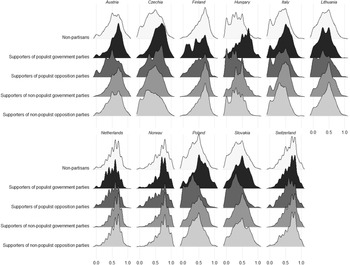
The dependent variable captures the extent to which respondents are satisfied with the present state of the economy. It refers to a standard sociotropic evaluation of the economy, whereby respondents gauge the overall national economic performance (Okolikj and Hooghe, Reference Okolikj and Hooghe2022). The initial 10-point scale was scaled to run from 0 (extremely dissatisfied) to 1 (extremely satisfied). Figure 1 presents descriptive results at the country level. In almost all countries, supporters of populist government parties turn out to be more satisfied with the economy than supporters of populist opposition parties (see also Appendix 3).
Cross-national variations in satisfaction with the economy among party supporters.
Note: Density plots show the respective distributions of levels of satisfaction with the economy across countries and partisan groups.

Modeling strategy and results
I conducted multilevel linear regression analyses with individuals nested in country-years, as well as country and years fixed effects, to account for the cross-sectional structure of the data and the limited number of units at the country level (Schmidt-Catran and Fairbrother, Reference Schmidt-Catran and Fairbrother2016). Models (fully presented in Appendix 4) regress on economic assessments with the explanatory variable described above, while controlling for a number of factors that likely shape the relationship between partisanship and economic judgments at the individual level. Most notably, models control for support for economic redistribution and nativism which are significant drivers of radical left and radical right populist voting (A. Akkerman, Zaslove, et al., Reference Akkerman2017; Goovaerts et al., Reference Goovaerts2020). At the macrolevel, growth, unemployment and inflation were included to control for countries’ macroeconomic performance.Footnote 4
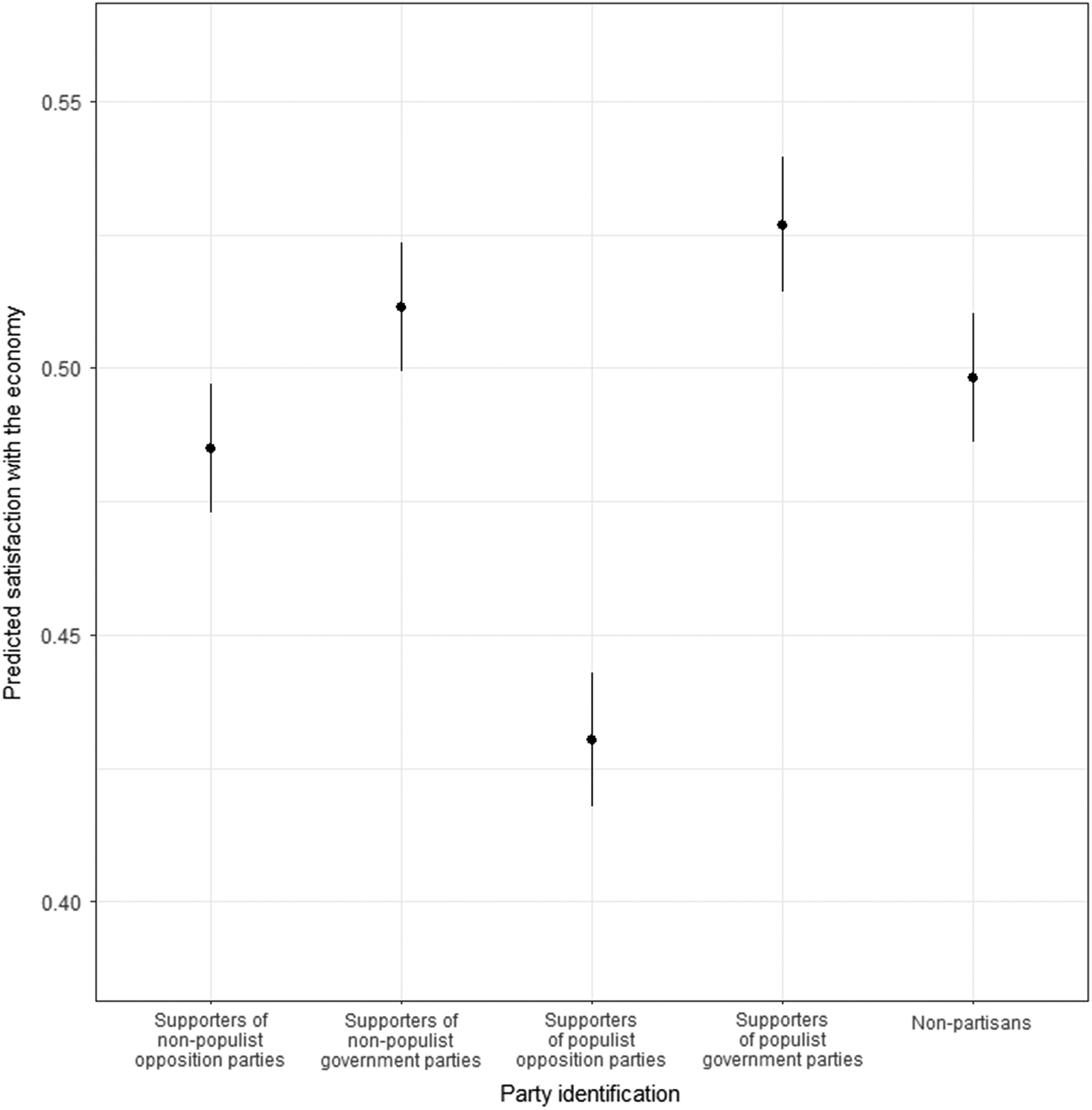
Model 1 addresses H1 by comparing partisan gaps in economic assessments. Figure 2, derived from the model, plots the differential effect of partisanship on economic assessments for supporters of populist and non-populist parties. It shows that both partisan groups express warmer economic views when their parties hold power (H1a) and that the gap in economic assessments is larger for populist party supporters than for their non-populist counterparts (H1b). Contrast analysis between marginal means lends additional empirical credence to the baseline hypotheses. Supporters of non-populist government parties are significantly more satisfied with the economy than supporters of non-populist opposition parties (0.0264; P < 0.0001). This is even more pronounced for supporters of populist government parties compared to supporters of populist opposition parties (0.0965; P < 0.0001) (Appendix 5).
Partisan gaps in economic assessments among party supporters.
Note: Figure shows estimated marginal means across partisan groups, with 95 percent confidence intervals (Model 1).

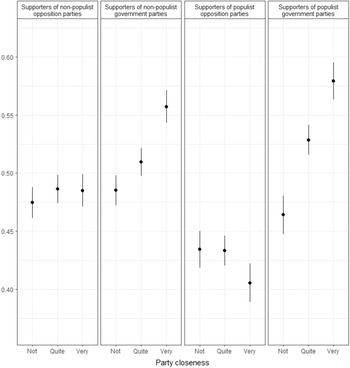
To gauge H2, a second model was performed with an interaction term between partisan groups and strength of partisanship. Estimates are displayed in Fig. 3. In line with what was anticipated, partisan bias in economic evaluations increases with partisanship intensity for non-populist and populist supporters alike (H2a). But compared to their non-populist counterparts, strong populist supporters express warmer (colder) views on the economy when their party is (is not) in office (H2b). As a result, the gap (in terms of predicted probabilities) between weak and strong supporters of government parties is almost twice as large for populists (around 0.12, that is, a 12-percent difference) as for non-populists (0.07). Conditional contrast analysis corroborates H2b. The difference (between the means) between strong supporters of populist government parties and strong supporters of populist opposition parties is significant (0.1735; P < 0.001). The difference between strong supporters of non-populist government parties and strong supporters of non-populist opposition parties is also significant but much smaller in magnitude (0.0721; P < 0.001) (Appendix 5).
Partisan gaps in economic assessments among party supporters, conditioning on partisanship intensity.
Note: Figure displays estimated marginal means from the interaction between partisan groups and strength of partisanship, with 95 percent confidence intervals (Model 2).

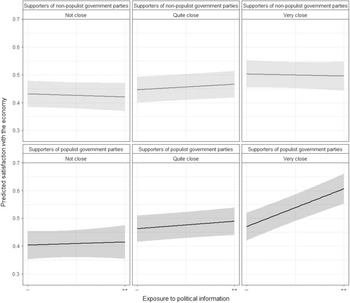
Finally, a three-way interaction was computed by adding exposure to political news to the interaction between partisan groups and strength of partisanship (Model 3). Figure 4 compares the impact of political information on populist and non-populist supporters when their parties govern (H3). Contrary to what was expected, exposure to political information has no significant effect on how core supporters of non-populist governments in office perceive the economic situation (H3a). Obviously, receiving more information is not enough to trigger more partisan responses from core supporters of non-populist parties when their party governs (see also Appendix 6). This could be due to the fact that they are also exposed to non-partisan and possibly discordant messages about the state of the economy. Yet, just as anticipated, strong populist supporters single out with much warmer economic views as the volume of political information increases. According to Model 3, the impact of exposure to political information on core party supporters is significantly stronger when they support populist incumbents than when they support non-populist incumbents (0.02; P < 0.005) (Appendix 3). The more core populist supporters are informed, the more they are affected by partisan messages and accordingly engage in motivated reasoning (H3b) (Fig. 4).
Influence of political information on partisan gaps in economic assessments.
Note: Figure plots the conditional effects of exposure to political news on the interaction between supporters of government parties and strength of partisanship, with 95 percent confidence intervals (Model 3).

Conclusion and discussion
Although caution is required with causal claims in the absence of panel or experimental data, this research provides evidence suggesting that populist parties in office send biased economic cues that induce strong partisan motivated reasoning, most notably for their core supporters. It contributes to the literature by casting light on a powerful individual-level mechanism by which populist incumbents may remain attractive to populist supporters. This is noteworthy given that populist parties usually fail to deliver economically, and that most European populist parties have entered multiparty coalitions which are known to harm anti-establishment images (Krause and Wagner, Reference Krause and Wagner2021).
Scholars sometimes disagree on whether partisanship is an expressive identity reinforced by motivated reasoning, or a running tally of party performance, ideological beliefs and support for party issue stances. Some have tried to reconcile the two views by arguing that partisan motivated reasoning is both a matter of reaching conclusions consistent with party identifications and a matter of making accurate evaluations (Groenendyk, Reference Groenendyk2013). Even if partisan goals often win out over accuracy goals, partisan motivated reasoning is sensitive to external conditions that put political loyalties under strain. Typically, when a party is unable to deliver benefits to the public, its supporters rely more on objective criteria and assess the economy irrespective of their usual partisan cues (Lavine et al., Reference Lavine2012). Results hint to the fact that populist incumbents can successfully exploit party cues to trump their poor economic performance. This way, populist incumbents can make it difficult for populist supporters to achieve accurate economic judgments. Still, ordinary partisans have been found to update their economic perceptions alternatively through partisan consistency motivations in times of economic prosperity, and through accuracy motivations in times of economic recession (Stanig, Reference Stanig2013; Bailey, Reference Bailey2019). Whether or not populist supporters conform to the same pattern would be a worthwhile topic for future investigation.
Results speak to the debate over motivated partisanship as leading to a misrepresentation of interests if citizens follow party cues that do not mirror their beliefs. Research would do well to examine how populist parties (re)shape their anti-establishment appeal when in power and how it accounts for why (core) populist supporters (strongly) engage in motivated reasoning. The way populist incumbents manage to make anti-establishment salient and downplay the importance of unbiased sources, while also limiting the political cost of antagonizing their coalition partners and misrepresenting the economy, could also be further investigated to better understand how motivated partisanship can fuel the mainstreaming of populist parties.
Supplementary material
The supplementary material for this article can be found at https://doi.org/10.1017/S1755773923000206.
Data accessibility statement
All data and code required to reproduce the main analyses reported in this study are available on https://osf.io/u3hjc/ Or DOI: 10.17605/OSF.IO/U3HJC.
Acknowledgments
I gratefully acknowledge the journal editors and the three anonymous reviewers for their suggestions on the earlier version of this research note.