Understanding the spatial and temporal distribution of patterns in material culture has always been of central importance to archaeological inference (Binford Reference Binford1965; Dunnell Reference Dunnell1971; McKern Reference McKern1939; Thomas Reference Thomas1894; Willey and Phillips Reference Willey and Phillips1958; Willey and Sabloff Reference Willey and Sabloff1993). Since the mid-twentieth century, radiocarbon dating has played a vital role in building archaeological chronologies worldwide (Libby Reference Libby1955), and accelerator mass spectrometry dates and Bayesian modeling have led to what many describe as a continuing radiocarbon revolution (Bayliss Reference Bayliss2009). As a baseline for the explanation of variation in material culture, one must first establish a detailed understanding of the spatiotemporal distribution of material culture. This issue is particularly important in cases where large-scale regional similarities may mask local variation. In these cases, archaeologists often downplay local variation by focusing on shared regional material culture. Such is the case with Hopewell ceremonialism in eastern North America, while similar arguments can be made for the archaeology of Clovis, Adena, or Mississippian. As Charles recently lamented, there is a widely held “conception (or at least presentation) of Hopewell as a uniform and singular entity in which any temporal and spatial variation in the manifestations of the phenomenon is largely ignored” (2012:471). Although studies of Hopewell variation exist (e.g., Charles Reference Charles and Beck1995; Clay Reference Clay2014; Emerson et al. Reference Emerson, Farnsworth, Wisseman and Hughes2013; Struever Reference Struever, Caldwell and Hall1964; Wright Reference Wright2014), we should pay more attention to what could have been a dynamic and ever-changing process of Hopewell ceremonialism. To do so, I analyze temporal and spatial variation in one element of Hopewell material culture, chipped-stone bladelets. Drawing on published reports, as well as on an extensive review of unpublished survey reports, I present a Bayesian analysis of radiocarbon-dated, bladelet-bearing features from across Ohio in order to examine spatiotemporal variation in the use of this diagnostic artifact. Results highlight previously unrecognized variation in the timing of bladelet use throughout Ohio.
Hopewell
The term Hopewell refers to an archaeological horizon during the Middle Woodland period of eastern North America, one characterized by dispersed settlements, horticultural subsistence, earthwork construction, elaborate mortuary ceremonialism, and long-distance exchange networks known as the Hopewell Interaction Sphere (Abrams Reference Abrams2009; Caldwell Reference Caldwell1955; Charles Reference Charles and Pauketat2012; Dancey Reference Dancey, Pauketat and Loren2005; Sieg and Hollinger Reference Sieg, Hollinger, Applegate and Mainfort2005; Struever Reference Struever, Caldwell and Hall1964). While Hopewellian manifestations were present throughout the Eastern Woodlands, the core area of cultural expression was along the major rivers of south and central Ohio. Through extensive trade networks, groups along these rivers obtained materials such as copper from the Lake Superior region, marine shells from the Gulf Coast, obsidian from the Yellowstone Plateau of Wyoming, and mica from the Appalachian Mountains (Abrams Reference Abrams2009; Bernardini and Carr Reference Bernardini, Carr, Carr and Case2005; Boulanger et al. Reference Boulanger, Lattanzi, Roush and Glascock2017; Dancey Reference Dancey, Pauketat and Loren2005). These materials were crafted into elaborate display objects and used in ceremonial gatherings at earthworks and mound centers. The earthworks were often constructed in geometric shapes such as circles, squares, octagons, or combinations of the three. Hilltop enclosures, which appear to follow the natural contour of elevated ridges but which may have been built upon anthropogenically modified terrain, are also common (Connolly Reference Connolly, Dancey and Pacheco1996). Outside of the earthworks, groups lived in small dispersed settlements subsisting by hunting, gathering, and cultivating seed crops (Dancey and Pacheco Reference Dancey, Pacheco, Dancey and Pacheco1997; Kanter et al. Reference Kanter, Pacheco, Perucchio, Burks, Redmond and Genheimer2015; Pacheco, Burks, and Wymer Reference Pacheco, Burks and Wymer2005, Reference Pacheco, Burks and Wymer2009; Pacheco and Dancey Reference Pacheco, Dancey, Charles and Buikstra2006).
Hopewell Bladelets
In addition to exotic raw materials and monumental constructions, a distinctive and widespread Hopewell artifact is the bladelet (Greber, Davis, and DuFresne Reference Greber, Davis and DuFresne1981; Pi-Sunyer Reference Pi-Sunyer and Prufer1965). However, despite their frequency and importance for recognizing the Hopewell horizon, few formal analyses of their spatial and temporal distribution exist.
Hopewell bladelets have a length-to-width ratio of at least two to one, roughly parallel margins, and a triangular, trapezoidal, or prismoidal cross section (Greber, Davis, and DuFresne Reference Greber, Davis and DuFresne1981; Miller Reference Miller2015; Pi-Sunyer Reference Pi-Sunyer and Prufer1965). They are produced from high-quality, colorful, and often heat-treated cherts. In Ohio, these often include Flint Ridge chert from central Ohio, Harrison County chert (also known as Indiana Hornstone or Wyandotte) from southern Indiana, and Knox chert from Tennessee. Bladelets of Flint Ridge chert from central Ohio not only are found throughout the state but have been recovered far into the Southeast from sites in Tennessee, North Carolina, and Georgia (Kay and Mainfort Reference Kay and Mainfort2014; Keith Reference Keith, Wright and Henry2013; Kimball Reference Kimball1992; Wright Reference Wright2014). Numerous Flint Ridge bladelets have also been recovered in the Havana Hopewell heartland of the Illinois River valley (Emerson et al. Reference Emerson, Farnsworth, Wisseman and Hughes2013; Farnsworth and Atwell Reference Farnsworth and Atwell2015; Nolan and Bainter Reference Nolan and Bainter2004). After examining metric variation and production errors among the bladelet assemblage at the Turner Workshop, Nolan, Seeman, and Theler (Reference Nolan, Seeman and Theler2007) concluded that bladelets were not made by specialists. Ohio Hopewell bladelets were rarely retouched, and even more rarely hafted, while used for a wide range of tasks (Miller Reference Miller2014a, Reference Miller2015). Functional analysis indicates that bladelets in Ohio were used in a generalized manner as butchery, cutting, scraping, perforating, drilling, and incising tools (Miller Reference Miller2014a, Reference Miller2015; Yerkes Reference Yerkes, Gräslund, Knutson, Knutson and Taffinder1990, Reference Yerkes1994, Reference Yerkes2009). Essentially, archaeologists have documented their use in nearly all productive tasks expected of stone tools outside of heavy-duty woodworking and projectile use. They have also documented their generalized nature at both earthworks and habitation sites, although bladelets were employed in craft production at some earthworks (Miller Reference Miller2015). Thus, use for a wide range of tasks and manufacture by nonspecialists characterize the Ohio Hopewell bladelet industry as a standardized, but not a specialized, one (Miller Reference Miller2014a; Nolan, Seeman, and Theler Reference Nolan, Seeman and Theler2007; Yerkes Reference Yerkes1994).
Many argue that the function of Hopewell bladelets extended beyond their use as processing or manufacturing tools to elements of reciprocal exchange (Braun Reference Braun, Renfrew and Cherry1986; Hofman Reference Hofman, Johnson and Morrow1987; Reid Reference Reid and Johnson1976; Yerkes Reference Yerkes and Parkinson2002, Reference Yerkes2003) or mortuary preparation (Jefferies Reference Jefferies, Charles and Buikstra2006; Odell Reference Odell1994; Seeman Reference Seeman, Brose and Greber1979; Walthall Reference Walthall, Dickens and Ward1985). For example, Odell (Reference Odell1994) argues that differences in the use-wear on bladelets between Smiling Dan and Napoleon Hollow in the lower Illinois River valley indicate that bladelets were used in mortuary preparation at Napoleon Hollow and took on special symbolic meaning in the process. Byers (Reference Byers, Charles and Buikstra2006, Reference Byers2011, Reference Byers2015) expands this reasoning to argue that bladelets were preferred over flakes in ritual contexts within earthworks and elsewhere. In these contexts, cultural belief prescribed that bladelets could only be used for one task, according to Byers. To Byers, outside of the ritual context, bladelets could have been used interchangeably with expedient flake tools because bladelets lost their symbolic significance. On the other hand, use-wear evidence indicates that while bladelets were often used for one task, there are examples of bladelets being reused for additional activities (Miller Reference Miller2014a, Reference Miller2015; Yerkes Reference Yerkes1994). In addition, testing the symbolic reasoning behind someone choosing a bladelet or a flake 2,000 years ago will prove difficult. Although based on a small sample, the fact that bladelets were more often associated with female burials at four mound centers in the lower Illinois River valley (Leigh Reference Leigh, Charles, Leigh and Buikstra1988:202–203) suggests that bladelet use was gendered.
Two morphologically distinct types of Hopewell bladelets have been identified in the archaeological record. Centered in the Illinois River valley, Havana Hopewell bladelets tend to be longer and wider and have larger platforms than Ohio bladelets (Greber, Davis, and DuFresne Reference Greber, Davis and DuFresne1981; Pi-Sunyer Reference Pi-Sunyer and Prufer1965). The variation is likely due to differences in production technique. Montet-White (Reference Montet-White1968) argued that the direct predecessor of Hopewell blade core technology emerged from an Archaic period bifacial technique in the Illinois River valley. This so-called Cobden technique was a flexible technology used through the Early Woodland period to produce blades, flakes, and preforms resulting in irregular cores (Montet-White Reference Montet-White1968:28). With the beginning of the Middle Woodland period, Montet-White saw the Cobden technique replaced by the distinctive Fulton technique in the central and lower Illinois Valley. The Fulton technique is a highly inflexible technology used to produce bladelets from large, loaf-shaped prepared cores. Harkness (Reference Harkness1982) describes Ohio Hopewell bladelet cores as largely conical Goslin cores from which knappers removed bladelets through soft hammer or pressure flaking. Similar to the bladelets themselves, Ohio Hopewell bladelet cores tend to be smaller than Havana Hopewell bladelet cores.
The timing of the emergence and decline of the Hopewell bladelet industry generally coincides with the larger Hopewell horizon or Hopewell Interaction Sphere, which spread throughout the Eastern Woodlands sometime between 200 BC and AD 400. However, after examining bladelets from Twenhafel, a mound center and habitation site in the Mississippi Valley of southern Illinois, Morrow (Reference Morrow, O'Brien and Dunnell1998) argued that a bladelet industry existed before and after the introduction and decline of Hopewell pottery at the site. Other studies in Illinois (e.g., Fortier Reference Fortier2000; Odell Reference Odell1994:117) failed to replicate this, finding direct correlation between the rise and fall of Hopewell Interaction Sphere items and Hopewell bladelets. No similar studies currently exist in Ohio. As most explanations for the rise and decline of bladelet technology place the tool's purpose in some aspect of Hopewell ceremonialism (i.e., craft production, exchange, or mortuary preparation), a fine-grained chronology of relevant dates for the technology is essential.
Methodology
While blade industries were present at various times throughout the prehistory of eastern North America (Parry Reference Parry and Carr1994), the distinctive style and materials used for Hopewell bladelets make them readily identifiable. As such, archaeologists use them to identify Middle Woodland Hopewell components at surface-collected sites (e.g., Dancey and Pacheco Reference Dancey, Pacheco, Dancey and Pacheco1997). But no formal examination of the temporal span of the bladelet industry in Ohio has been undertaken to verify this relationship. Here I present a Bayesian radiocarbon analysis examining the rise and fall of bladelets in Ohio. While modern political boundaries obviously did not exist in prehistory, Ohio's state boundaries are marked by physiographic features that would have been important in prehistory. On the southern border is the Ohio River; Hopewellian remains rarely occur to the south in Kentucky. Much of the northern portion of the state is bounded by Lake Erie. In between, the major river valleys examined here (Little Miami, Licking, Muskingum, Scioto, Huron, and Cuyahoga) are all contained within the state's boundaries.
The Bayesian analysis utilizes the software OxCal version 4.2 (Bronk Ramsey Reference Bronk Ramsey2009a; Bronk Ramsey and Lee Reference Bronk Ramsey and Lee2013) and the IntCal 13 14C calibration curve (Reimer et al. Reference Reimer, Bard, Bayliss, Beck, Blackwell, Ramsey, Buck, Cheng, Edwards, Friedrich, Grootes, Guilderson, Haflidason, Hajdas, Hatté, Heaton, Hoffmann, Hogg, Hughen, Kaiser, Kromer, Manning, Niu, Reimer, Richards, Scott, Southon, Staff, Turney and van der Plicht2013). Bayesian analysis calculates the posterior probability distributions of a sequence of dates in conjunction with some level of prior, or a priori, knowledge input from the researcher (Bronk Ramsey Reference Bronk Ramsey2009a). After defining the parameters and inputting the data, the OxCal software calculates the start and end date ranges for each sequence or phase at 68.2% and 95.4% confidence intervals, as well as a median age for each range based on the assumption that the 14C dates are drawn from a sample within a normal distribution. A further strength of the analysis is that it can identify dates as outliers and minimize their impact through outlier modeling (Bronk Ramsey Reference Bronk Ramsey2009b). Individual dates and overall models with an Agreement Index (Amodel) greater than 60 are generally assumed to be unproblematic.
The two most widely used Bayesian models are sequences and phases (Bronk Ramsey Reference Bronk Ramsey2009a). Sequence analysis applies to dates excavated in stratigraphic order or other events that presumably proceed in a chronological series. Sequence analysis determines the degree to which the dates form a chronological progression while also reducing the error range of each date. A phase analysis assesses the relationship between dates for which no internal order or stratigraphy can be assumed, such as a group of dates within the same depositional level. However, assessment of the temporal relationships between two or more phases is sometimes possible based on the occurrence of certain a priori parameters. Phases may be contiguous, sequential, or overlapping. The boundaries between contiguous phases directly adjoin one another with no temporal gap in between. Sequential phases occur one after the other but with a potential chronological gap in between. In overlapping phases, their order is not known, and one may start before the other ends.
It would be ideal to directly date bladelets from carbonized residue deposited on the artifacts, as is often applied to ceramics (e.g., Berstan et al. Reference Berstan, Stott, Minnitt, Ramsey, Hedges and Evershed2008; Nakamura et al. Reference Nakamura, Taniguchi, Tsuji and Oda2011; Taché and Hart Reference Taché and Hart2013). While some stone tools may retain protein residues or starch grains, the organic material necessary for accelerator mass spectrometry 14C dating is rarely present. One feasible approach to generating a 14C database would be to use all dates from sites that contain bladelets in their assemblage. However, we obtain a more accurate picture by using dates obtained from discrete features that contain bladelets within their fill. This approach addresses the potential for dating the reoccupation of sites by groups without bladelets (including the possibility of non-bladelet-producing Hopewell groups) or the circular logic of only selecting Middle Woodland dates from these sites. After identifying dates meeting these criteria, I conservatively applied chronometric hygiene protocols (e.g., Nolan Reference Nolan2012; Pettitt et al. Reference Pettitt, Davies, Gamble and Richards2003; Wilmhurst et al. Reference Wilmhurst, Hunt, Lipo and Anderson2011). These protocols included two criteria: the rejection of dates with error ranges >100 years as well as those obtained prior to 1970. Due to this sample selection procedure, I assume that any remaining anomalous dates, or outliers, are of the t-type, in which the sample dated is unrelated to the event intended to be dated (Bronk Ramsey Reference Bronk Ramsey2009b), such as more recent carbonized material introduced into older deposits through bioturbation. Dates fitting this description are examined individually below.
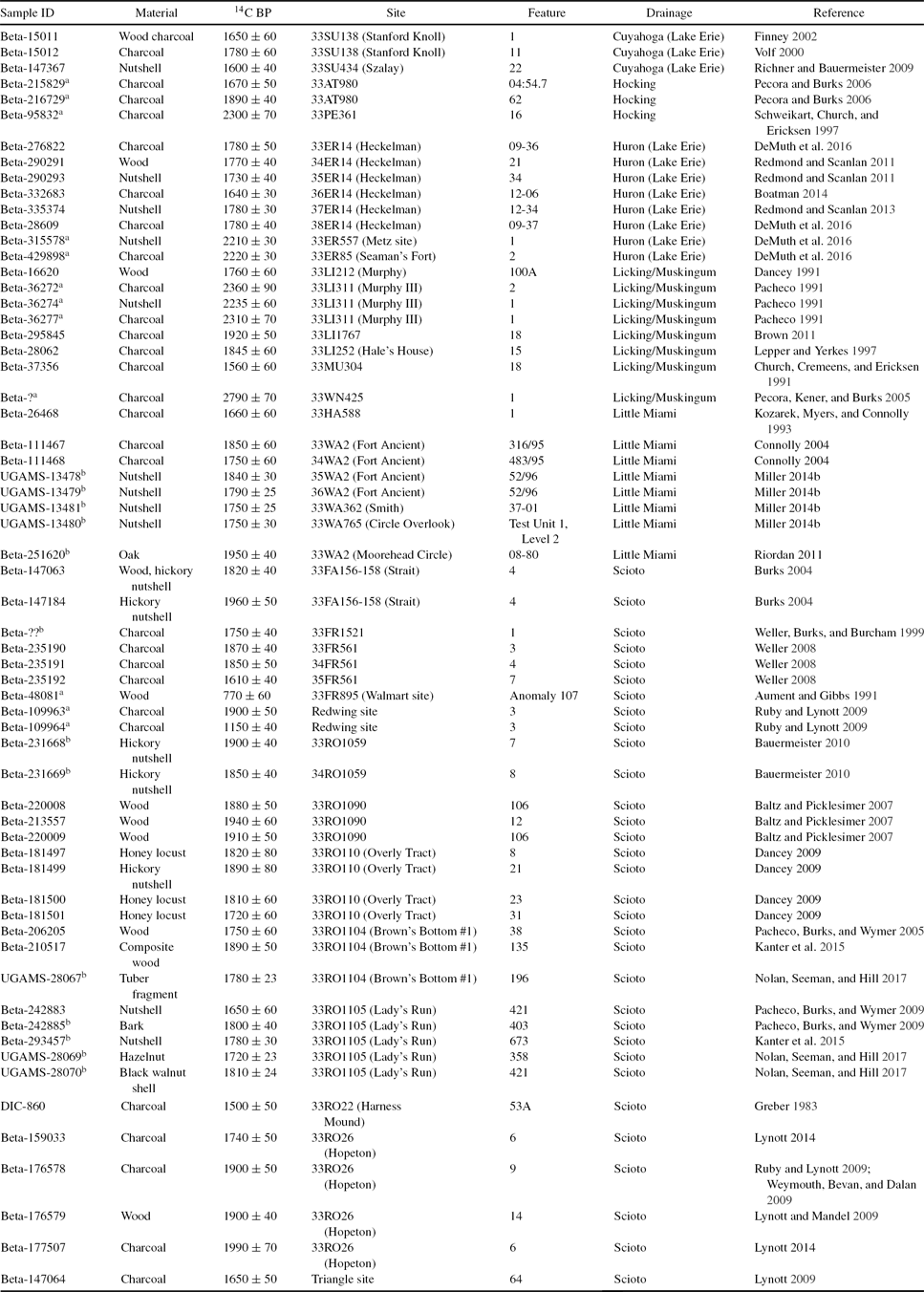
The statewide database of 14C dates includes those published in articles, books, theses, dissertations, and compliance survey reports on file at the State Historic Preservation Office in Columbus, Ohio. Features that included a 14C date and contained one or more bladelets in their artifact inventory were included in this analysis. I evaluated photos or line drawings in the original reports to confirm the analyst's ability to identify Hopewell bladelets. Application of this procedure identified 62 14C dates from 57 features at 31 sites throughout Ohio (Table 1). The calibrated 2σ range of all dates obtained from features with Hopewell bladelets spans from 1123 cal BC to cal AD 1387 (Supplemental Table 1). This date range is highly incongruent with the current understanding of the timing of the rise and fall of the Hopewell Interaction Sphere and other technological developments in the Eastern Woodlands, which raises two possibilities. Either there is a need to drastically revise the current understanding of the technological and related cultural elements of Ohio and probably eastern North American prehistory, or simply plotting the calibrated distributions of radiocarbon dates associated with Hopewell bladelets yields unsatisfactory results that seemingly greatly overestimate the span during which this technology was in use. Occam's razor suggests that the latter is far more likely, as several outliers are undoubtedly present in this large collection of dates from many different sources.
Radiocarbon Data.

a Eliminated from the final analysis. See the text for reasoning.
b Accelerator mass spectrometry.
Defining the Model and Identifying Outliers
Radiocarbon dates were grouped into phases based on their occurrence within different watersheds (Figure 1). The 62 14C dates came from 31 sites located in the watersheds of six different rivers (Table 1). Only three dates were identified from the Hocking River valley. These dates are widely separated in time and therefore do not provide an informative picture of bladelet use in the area. Thus, the Hocking Valley is omitted from the current analysis. Due to a similarly small sample, 14C dates from the Cuyahoga River valley were combined with those from the Huron River valley into one Lake Erie watershed phase. Therefore, the analysis contains four phases. An overlapping phase model was used in this case so that no prior assumption about the spread of the technology from one region to another was included; this allows for the possibility that bladelets were introduced into new regions before their use in other regions ended.
Map of Ohio showing watersheds and sites containing dated features with Hopewell bladelets: (1) 33SU138; (2) 33SU434; (3) 33AT980; (4) 33PE361; (5) 33ER14; (6) 33ER557; (7) 33ER85; (8) 33LI212; (9) 33LI311; (10) 33LI1767; (11) 33LI252; (12) 33MU304; (13) 33WN425; (14) 33HA588; (15) 33WA2; (16) Moorehead Circle; (17) 33WA362; (18) 33WA765; (19) 33FA156-158; (20) 33FR1521; (21) 33FR561; (22) 33FR895; (23) Redwing; (24) 33RO1059; (25) 33RO1090; (26) 33RO110; (27) 33RO1104; (28) 33RO1105; (29) 33RO22; (30) 33RO26; (31) Triangle.

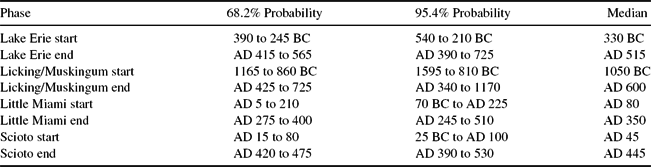
A model that includes all 14C dates sorted into four phases, as described above, produced an acceptable Agreement Index score of 80.0 (see Supplemental Text for R code). Only one 14C date, from the Scioto Valley (Beta-48081, A = 19.7), was flagged as an outlier. The excavators also identified this date as “spurious” (Aument and Gibbs Reference Aument and Gibbs1991:83). The material was recovered from a pit with an “irregular oval shape” in plan view (maximum dimensions 140 × 68 cm), 22 cm in depth, with a “squared basin” shape in profile (Aument and Gibbs Reference Aument and Gibbs1991:78). Numerous bladelets, including 20 complete specimens made from Flint Ridge chert, represent the only temporally diagnostic artifacts recovered from the feature. Other materials recovered from this feature were fire-cracked rock, burned bone, ceramics, and chipped stone debitage. The ceramics were all grit-tempered body sherds, too small and eroded to be further evaluated. The carbon sample submitted for radiocarbon dating was composed of “scattered charred wood fragments” (Aument and Gibbs Reference Aument and Gibbs1991:80). In retrospect, Aument and Gibbs note that some of the wood may actually have been “recent corn plant remains” (1991:83). Thus, multiple lines of evidence suggest that Beta-48081 is an outlier and should be removed from the model. The removal of Beta-48081 results in the next most recent date (Beta-109964, A = 43.7) being flagged as an outlier.
The stepwise identification and removal of outliers results in the six most recent 14C dates being omitted from the model before a result with no outliers is produced. The resulting boundary end (68% probability: cal AD 250 to 330; 95.4% probability: cal AD 170 to 380; median: cal AD 290) is substantially earlier than the original modeled result (see Table 2). In each case, the Amodel value is well above 60, indicating that “there is no problem with the model as a whole (and therefore no samples need be rejected)” (Bronk Ramsey Reference Bronk Ramsey2009b:1025). Several issues may be at play here in the Scioto Valley. One is that several of the dates may be spurious, as Beta-48081 was determined to be. Another potential confounding factor is that there may have been variation in the termination of the use of bladelets throughout the river valley.
Results of the Four-Phase Bayesian Analysis.

Note: Dates are rounded to the nearest five years; two outliers from the Scioto Valley were removed.
Given the obvious issues with Beta-48081, it seems safe to assume that this is an outlier and should be removed. The next most recent date, Beta-109964, was run on a sample of wood charcoal from a midden feature at the Redwing site outside of the Hopeton earthworks in Ross County. Another sample of wood charcoal from this midden feature (Beta-109963) returned a date of 1900 14C BP (Table 1). These two samples are significantly different as calculated in Calib 7.0.4. It is unclear why two significantly different dates were obtained from the same feature. The excavators Ruby and Lynott (Reference Ruby, Lynott and Lynott2009:113) note that while the midden contained only diagnostic Middle Woodland artifacts (bladelets and ceramics), Late Woodland Jack's Reef points were recovered from the site during surface survey. Thus, they attribute the more recent date to the intrusion of materials related to the later occupation. Rather than rejecting Beta-109964 and retaining Beta-109663 simply because the former does not fit the accepted range for “the construction and use of Hopewellian earthworks in the Scioto region” (Ruby and Lynott Reference Ruby, Lynott and Lynott2009:113), I eliminated both dates until this issue can be resolved. Since there are so many dates from the Scioto River valley, if one or both of these are part of a larger pattern, similar dates will emerge at other sites.
Because no similarly obvious material or contextual issues are associated with the other four most recent dates in the Scioto phase, they are retained and produce an improved Agreement Index (Amodel = 87.1). The results of this analysis are presented in Table 2 and Figure 2 (see Supplemental Figures 1–4 for plots of all probability distributions associated with each phase).
Plot of the start and end ranges (with median date [+] and 68% and 95% confidence intervals) for each of the four phases in the initial Bayesian analysis.

Further Refinements
In their current state, these phases suggest that a drastic revision of the temporal range of bladelet use in Ohio is necessary. However, while the OxCal Agreement Index is useful for identifying outliers through statistical analysis, it cannot take context or material dated into account. Due to the nature of the analysis in which features, rather than Ohio Hopewell bladelets directly, are dated, I undertook further analysis to identify additional potential t-type outliers in the database before making such a grand claim. I took a pragmatic approach to this process by examining the probability plots of 14C dates in each phase. The majority of 14C dates in each phase overlapped substantially at 2σ, generally covering the first several centuries AD. Dates that were substantially older or more recent, whose probability distributions did not overlap with the core group of 14C dates at 2σ, were flagged for further analysis (as seen in Supplemental Figures 1–2). This procedure resulted in the identification of four older 14C dates from the Licking/Muskingum phase (Beta-?, Beta-36272, Beta-36274, and Beta-36277) and two older 14C dates from the Lake Erie phase (Beta-429898, Beta-315578). Recall that more recent 14C dates from the Scioto phase (Beta-109964 and Beta-48081) have already been identified as outliers. None was identified in the Little Miami phase.
In the Licking/Muskingum phase there is a gap in the 2σ calibrated ranges from about 140 to 40 cal BC that produces two distinct groups of four 14C dates each that do not overlap at 2σ (Supplemental Figure 2). The more recent group of dates more closely conforms to traditional conceptions of the temporal span of Hopewell. The early group of dates cannot be rejected simply because they fall outside of this time frame. However, several lines of evidence call these dates into question and invite caution before using these to drastically rethink the temporal position of Hopewell bladelet technology. Careful reading of the stratigraphy of features at Murphy III suggests that the dates and bladelets are actually from different features. Pacheco (Reference Pacheco1991) notes that there is an Early Woodland component (lacking bladelets) at the site with a similar footprint to the Middle Woodland component (with bladelets). Charcoal was collected “from the bottom” of Features 1 and 2, while bladelets were recovered from the upper fill (Pacheco Reference Pacheco1991:5). In other words, “Early Woodland features were partially filled with the trash of the later more extensive Middle Woodland occupation” (Pacheco Reference Pacheco1991:5). This later (Hopewell) material is likely associated with Feature 5, a cylindrical flat-bottomed pit that overlaps Feature 2 (Pacheco Reference Pacheco and Pacheco1996:27). With these dates (Beta-36272, Beta-36274, and Beta-36277) eliminated, the oldest date, Beta-?, a wood charcoal sample (Pecora, Kener, and Burks Reference Pecora, Kener and Burks2005), is an obvious outlier. Along with Hopewell bladelets and a Middle Woodland projectile point (Lowe cluster), 33WN425 yielded Late Archaic (Motley cluster), Early Woodland (Kramer), and Late Woodland/late prehistoric (Madison) points along with substantial historic overburden. The site is intriguing, but the high probability of contamination with older charcoal casts enough doubt on the date to warrant its elimination from consideration until further evidence suggests otherwise.
Outside of the four early dates from the Licking/Muskingum Valley, only two radiocarbon ages from the entire state are earlier than 2000 14C BP. These are from Metz (Beta-351578) and Seaman's Fort (Beta-429898) in the Huron River valley, included in the Lake Erie phase (Table 1 and Supplemental Figure 1). Once again, these two dates may signal an early use of Hopewell bladelets. Overall, 11 14C dates from the Lake Erie watershed are included in this analysis. Outside of the two dates from Metz and Seaman's Fort, the oldest radiocarbon age is 1780 14C BP (Table 1). The probability curves of these nine other dates all substantially overlap with one another, yet there is no overlap with the two early dates from Metz and Seaman's Fort (Table 1 and Supplemental Figure 1). In other words, there is a gap of about 300 years between the extreme ends of the 2σ ranges (Beta-315578 and Beta-15012) of these two groups of dates (Supplemental Table 1). Pairwise comparison of each of the Lake Erie phase dates with the next most recent or older date (see Supplemental Figure 1 for the time-progressive order of dates) using the “Test Sample Significance” tool in Calib 7.0.4 indicates that the only significant difference occurs between Beta-315578 and Beta-15012. All of the other dates are statistically the same as the next older or more recent date in the sequence.
Several possibilities may account for this. One is that the two early dates are t-type outliers, where the deposition of the dated material is unassociated with the deposition of the bladelets. A second possibility is that bladelet use occurred at these sites quite early, with the radiocarbon gap due to the abandonment of bladelet technology for around 300 years before it came into use again during the Middle Woodland. This would mean that bladelet technology originated in northern Ohio before the groups there abandoned bladelet use at the time groups in the southern half of the state adopted the technology, only for bladelets to be readopted by their originators in northern Ohio a few centuries later. Alternatively, bladelet use may have continued throughout this time, with no dated samples obtained from this era. This possibility also seems unlikely given that, of all four phases, the Lake Erie phase contains the second-highest number of dates. The most parsimonious explanation is that these two early dates are simply outliers. Both of these sites have substantial Early Woodland components. For example, based on diagnostic ceramic types recovered from feature fill, 48 Early Woodland features have been excavated at Metz, in comparison to just two Middle Woodland features (DeMuth et al. Reference DeMuth, Boatman, Young, Edgerly, Gross and Edwards2016:Table 1). This is not to say that bladelets cannot occur in Early Woodland contexts, only that there is a (probably greater) chance for comingling of remains through repeated construction and the associated disturbance at the sites. This interpretation is more in line with directly dated human bone recovered from burials in Hopewell mounds in the Lake Erie region (Redmond Reference Redmond2007), none of which returned radiocarbon ages prior to 1950 14C BP (Figure 3). Similarly, gaps of this magnitude in other regions (Scioto and Licking/Muskingum) all resulted from radiocarbon outliers. As noted earlier, it would be ideal to directly date bladelets via adhered carbonized residue, as is often done with ceramics. In the absence of this possibility, the next best alternative is to date features with bladelets in their fill. A potential pitfall of this approach is that sometimes not all carbonized material in a feature's fill will be related to the period in which bladelets were used. That is what likely occurred at Metz and Seaman's Fort. Further support for this interpretation is presented below.
Plot of probability distributions obtained on human bone from Hopewell burials in the Lake Erie region (data from Redmond Reference Redmond2007) and those from features containing bladelets.

Results
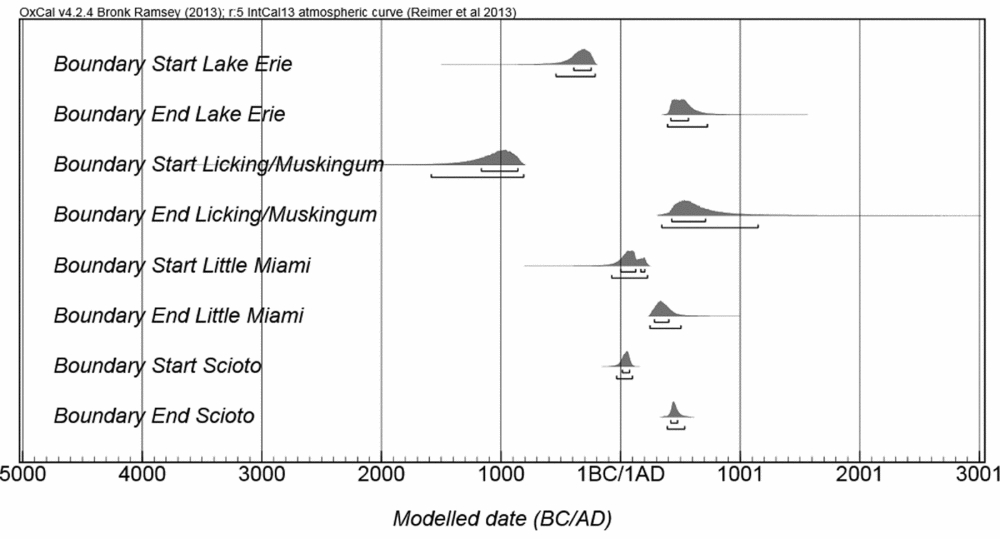
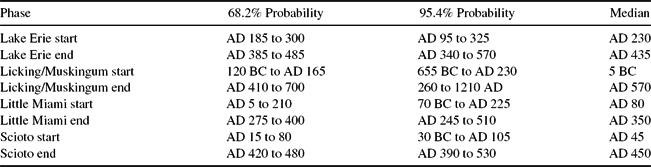
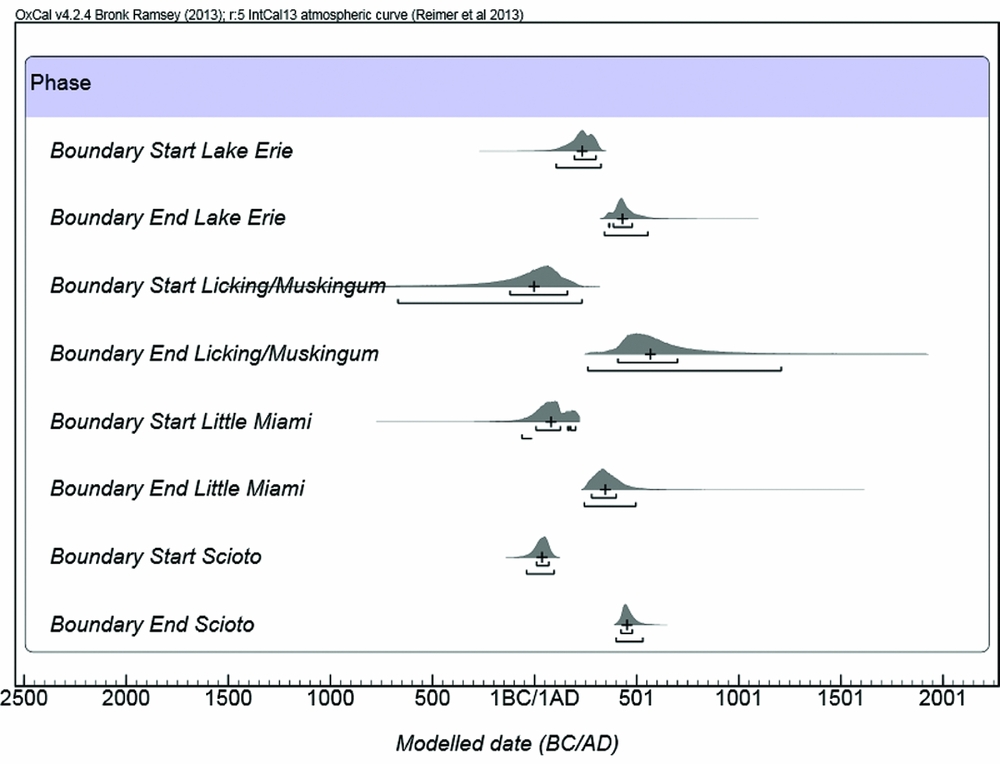
The results of the four modified phases are presented in Table 3 and Figure 4 (see Supplemental Figures 5–8 for plots of all probability distributions associated with each phase). A comparison of the modeled start ranges and median start dates for each phase suggests that bladelets may occur earliest in the Licking/Muskingum Valley. However, interpretation is hampered by the wide error ranges, due to low numbers of 14C dates, associated with the Licking/Muskingum phase. Ultimately, more dates are needed from this region to create a more compact chronology. The large sample from the Scioto Valley provides strong evidence that bladelets were present by the early first century AD. Bladelets were present in the Little Miami Valley at this time or soon after. The start date for the Lake Erie watershed is clearly later than for the other phases, perhaps by as much as a couple of centuries.
Results of the Revised Four-Phase Bayesian Analysis.

Note: Dates are rounded to the nearest five years.
Plot of the start and end ranges (with median date [+] and 68% and 95% confidence intervals) for each of the four phases in the final Bayesian analysis.

The end of bladelet use may have occurred first in the Little Miami Valley. The modeled end dates for the Scioto Valley and the Lake Erie watershed are similar. In the Licking/Muskingum, bladelets use may have continued after declining everywhere else in the state, but again, interpretation of this phase is hindered by large error ranges. Thus, I interpret the general progression of bladelet technology as beginning in the Licking/Muskingum, Scioto, and Little Miami Valleys, with the possibility for the earliest appearance in the Licking Valley. After a lull of as many as 200 modeled years, bladelets were in use by groups in northern Ohio. Bladelet use may have ended earliest in the Little Miami, followed by the Scioto and Lake Erie basin. Bladelet use may have extended the longest in the Licking/Muskingum Valley.
Discussion
Determining the timing of Ohio Hopewell bladelet use is not an easy task. One interpretation of the dates and the Bayesian analysis is that bladelets were in use for ~1,500 years, from approximately 500 cal BC to cal AD 1000 (95.4% probability). However, scrutiny of the dated materials and their contexts suggests that many abnormally early or more recent dates are problematic. The removal of these dates from the final Bayesian 14C analysis provides a clearer and more reliable view of bladelet use in Ohio.
At one level, the results indicate that Hopewell bladelets in Ohio are indeed diagnostic of the Middle Woodland period, approximately cal AD 1–450 or 500 (95.4% probability), as has long been assumed (but see below for variations in how the temporal boundaries of Hopewell and Middle Woodland have been defined). More importantly, the Bayesian analysis provides insight into previously unrecognized temporal variation in Hopewell material culture. In the Licking/Muskingum and Scioto Valleys, bladelet technology was in use essentially through the entirety of the Middle Woodland. Small variations in modeled start ranges for these two regions reflect a quick spread of this technology after its introduction. There is evidence that the period of bladelet use in the Little Miami Valley may have begun later and ended earlier than in the two watersheds to the east. The most striking result is the late initial appearance of bladelets at sites in northern Ohio. If this modeled gap of a century or two is an accurate reflection of prehistoric reality, then it presents some interesting questions about the time-transgressive relationship between the northern and southern portions of the state.
When paired with previous research about the construction of Hopewell earthworks, the results have important implications for refining our understanding of the spread of Hopewell ceremonialism. In Ohio, few Hopewell earthworks have been investigated to allow accurate understanding of the timing of their construction and use (Greber Reference Greber, Jeske and Charles2003). Part of the issue is that it is difficult to obtain carbonized material associated with specific construction events for these earthen monuments. Thus, start dates for Ohio Hopewell ceremonialism range from 200 cal BC (e.g., Griffin Reference Griffin1967), to 100 cal BC (e.g., Byers Reference Byers2004; Charles Reference Charles and Pauketat2012; Griffin Reference Griffin and Jennings1983; Stothers, Pratt, and Shane Reference Stothers, Pratt, Shane, Brose and Greber1979), to cal AD 1 (e.g., Abrams Reference Abrams2009; Lynott Reference Lynott2014; Seeman Reference Seeman and Pacheco1996). The end of Ohio Hopewell is variously cited as cal AD 300 (e.g., Griffin Reference Griffin and Jennings1983), cal AD 350 (e.g., Seeman Reference Seeman and Pacheco1996), cal AD 400 (e.g., Byers Reference Byers2004; Charles Reference Charles and Pauketat2012), cal AD 500 (e.g., Stothers, Pratt, and Shane Reference Stothers, Pratt, Shane, Brose and Greber1979), or cal AD 600 (i.e., 1470 BP; Greber Reference Greber, Jeske and Charles2003). However, the Bayesian results presented here are part of a growing body of evidence that 50 cal BC to cal AD 1 may be the most likely start for Ohio Hopewell. For example, Emerson et al. note that the “earliest known example of Scioto Hopewell mound ceremonialism” (2013:56) occurs at the Tremper mound and enclosure in the lower Scioto Valley, which they have dated to 1990 ± 70 BP (60 cal BC–cal AD 85 at 1σ; Emerson et al. Reference Emerson, Hughes, Farnsworth, Wisseman and Hynes2005). The two most thoroughly dated Hopewell earthwork construction sequences—Hopeton and Pollock—were built well after 100 BC. Based on analysis of 22 14C dates from contexts associated with earthwork construction at Hopeton, Lynott (Reference Lynott2014:112) favors a weighted average of cal AD 91–259 for the span of the initial to final stages of construction of the earthwork. At Pollock, a hilltop enclosure in the Little Miami Valley, Riordan (Reference Riordan1995) identified a construction sequence that began in the first half of the first century cal AD and concluded in the late second century cal AD based on 15 14C dates. In fact, Riordan (Reference Riordan and Pacheco1996:250) questions whether any Ohio hilltop enclosures were constructed prior to 100 cal BC and, in fact, posits that the construction of all Ohio hilltop enclosures most likely postdates cal AD 1. Finally, Greber (Reference Greber, Jeske and Charles2003:97) notes that the “majority” of all Ohio Hopewell–affiliated dates fall within ±280 years of 1750 14C BP, placing the start of Ohio Hopewell at about 30 cal BC.
The above discussions focus on Hopewell in the southern half of Ohio. While Stothers, Pratt, and Shane (Reference Stothers, Pratt, Shane, Brose and Greber1979) placed the beginning of Hopewell in northern Ohio at 100 cal BC, Greber notes that the majority of dates from northeastern Ohio fall “toward the latter end of the Hopewell era” (Reference Greber, Jeske and Charles2003:100). After spending six seasons investigating Heckelman, one of the major Woodland hilltop enclosures in northern Ohio, Redmond has concluded that the Early Woodland non-Hopewell occupation ended by 3 cal BC and the site was not reoccupied again until “after cal AD 200 by one or more social groups marked by a material culture closely resembling Ohio Hopewell” (Reference Redmond2016:47). Both Greber's regional overview and Redmond's site chronology conform to the final results presented above, in which bladelets were not in the Lake Erie region until after cal AD 200. Taking them as a whole, it is interesting to note that the earliest dates from Hopewell mounds and earthworks largely correlate with the beginning of the phases presented here.
If earthwork construction and bladelet production in Ohio began in the period between 50 cal BC and cal AD 1, then the correlation with important developments along the Illinois River at this time cannot be ignored. There is strong evidence that the group of materialized practices archaeologists now identify as Hopewell emerged in the central Illinois River valley between 200 and 100 cal BC and subsequently spread to the lower Illinois River valley, via human migration, by 50 cal BC (Buikstra and Charles Reference Buikstra, Charles, Ashmore and Knapp1999; Charles Reference Charles and Pauketat2012; Griffin Reference Griffin1967; King, Buikstra, and Charles Reference King, Buikstra and Charles2011). One defining characteristic of the early Hopewell occupations in the lower Illinois River valley is evidence for “direct contact with Ohio Hopewellian communities” (Farnsworth and Atwell Reference Farnsworth and Atwell2015:208). This material evidence includes copper ear spools, Altamaha shell pendants, expanded-center bar gorgets, copper axes, and a copper-cone-decorated costume, in addition to Hopewell bladelets made of Ohio Flint Ridge chert recovered at lower Illinois River valley sites (Farnsworth and Atwell Reference Farnsworth and Atwell2015). Numerous bladelets and bladelet cores of Ohio Flint Ridge chert have been reported from ritual staging areas near the Bedford, Montezuma, and Elizabeth Mounds along the western bluff line of the lower Illinois River valley (Emerson et al. Reference Emerson, Farnsworth, Wisseman and Hughes2013:62; Farnsworth and Atwell Reference Farnsworth and Atwell2015:201). Farther north in the central Illinois River valley, Flint Ridge bladelets occur at the Whitnah Village site associated with the Sister Creeks mounds (Nolan and Bainter Reference Nolan and Bainter2004). At essentially this same time in Ohio, numerous effigy pipes made of Sterling pipestone from near the Rock River in northwestern Illinois were deposited at Tremper Mound in the Scioto Valley (Emerson et al. Reference Emerson, Farnsworth, Wisseman and Hughes2013).
Conclusion
The results presented here place the earliest bladelets at sites in Ohio at about the same time as the early Hopewell sites containing Flint Ridge chert bladelets in the lower Illinois River valley. A further point of interest is that the earliest median start date for the phases is in the Licking/Muskingum Valley, home to the Flint Ridge quarries, and not the traditionally defined core area of Ohio Hopewell in the Scioto Valley. It is possible, then, that the desire for Flint Ridge chert by groups in the lower Illinois River valley may have played a role in spreading Hopewell ceremonialism to Ohio.
Dating the end of Hopewell in Ohio proves to be more problematic. Part of the reason is that it is possible that Hopewell earthworks continued to be used even after the final stages of wall construction. However, the issue extends beyond the earthworks, as demonstrated by the issues with outliers at the end of the Scioto phase presented above. Greber's (Reference Greber, Jeske and Charles2003) upper boundary of 1470 14C BP is later than the median end date of most of the phases presented here, although the Licking/Muskingum phase is comparable. While there is considerable overlap at 95%, the median end dates for the phases presented here are separated by more than 200 modeled years (Table 3). Thus, any of the dates from cal AD 300 to 500 may be acceptable for the end of Hopewell. Perhaps this can be explained by Dancey's (Reference Dancey and Pacheco1996) assertion that a great deal of variation in lifestyles was present in Ohio at this time. It may be necessary to examine dates at a finer scale than the overall watershed to thoroughly understand this variation.
Acknowledgments
Brent Eberhard, archaeology survey and data manager at the State Historic Preservation Office–Ohio History Connection, provided invaluable guidance in locating the reports and radiocarbon dates that formed the core of this project. We presented an early version of the analysis at the 2016 Midwest Archaeological Conference in Milwaukee, Wisconsin. The following individuals were generous enough to share unpublished dates or additional contextual information: Ann Bauermeister, Glen Boatman, Bill Dancey, Paul Pacheco, Brian Redmond, and Bob Riordan. Without their cooperation, this project would not have been possible. Ken Farnsworth and Brad Koldehoff reminded me of the early occurrence of Ohio Flint Ridge bladelets in Illinois. Three anonymous reviewers provided suggestions to improve the strength and clarity of my arguments.
Data Availability Statement
The OxCal programming code is included in the Supplemental Materials. Further information on the Ohio Archaeological Inventory and the survey reports cited here can be obtained from the State Historic Preservation Office–Ohio History Connection.
Supplemental Materials
Supplemental materials are linked to the online version of this article, which is accessible via the Society for American Archaeology member log-in at https://doi.org/10.1017/aaq.2017.64.
Supplemental Text. Code for OxCal Models.
Supplemental Figure 1. Plot of probability distributions for all dates from the Lake Erie phase.
Supplemental Figure 2. Plot of probability distributions for all dates from the Licking/Muskingum phase.
Supplemental Figure 3. Plot of probability distributions for all dates from the Little Miami phase.
Supplemental Figure 4. Plot of probability distributions for dates from the Scioto phase, with those from Redwing and 33FR895 excluded as noted in the text.
Supplemental Figure 5. Plot of probability distributions for dates from the final version of the Lake Erie phase.
Supplemental Figure 6. Plot of probability distributions for dates from the final version of the Licking/Muskingum phase.
Supplemental Figure 7. Plot of probability distributions for the final version of the Little Miami phase.
Supplemental Figure 8. Plot of probability distributions for the final version of the Scioto phase.
Supplemental Table 1. Calibrated 14C dates from Table 1.