I. INTRODUCTION
With the extensive application of radar detection in military affairs and the rapid development of electronic devices, microwave absorbers have always been a hot subject of current research owing to their high absorption capacity in reduction of radar signature of weapons and equipment as well as in control of electromagnetic interference and pollution among electronic devices. The research of efficient microwave absorbing materials for preventing harmful electromagnetic wave (EW) pollution and stealth capability of weaponry has the vital significance. Reference Liu, Bai, Huang, Li, Ma, Guo, He, Lin, Gao and Chen1–Reference Yan, Pang, Li, Vajtai, Xu, Ren, Wang and Li5 To date, ferrites, metallic magnets, dielectric ceramics, conductive polymer as well as their hybrids play a leading role in microwave absorbing materials. However, the defects including high density, phase instability, corrosion, low absorption capacity, and narrow absorption band have greatly restricted such materials’ practical application in microwave absorption (MA). Reference Sun, Zou, Wang, Wang, Jiang and Li6,Reference Zhang, Wang, Cao, Wei, Liang, Guo and Cao7 Generally, an ideal microwave absorbing materials usually with the desired properties include high MA capacity, broad absorption bandwidth, thin thickness, low density, good thermal stabilities, and flexible mechanical strength, etc. Reference Zhao, Zhang, Wang, Xi, Cao, Wang, Yang and Du8 The behavior of a microwave absorbing material mainly depends on its dielectric loss, magnetic loss, and impedance matching characteristic. Reference Cao, Yang, Song, Zhang, Wen, Jin, Hou and Yuan9 As for nonmagnetic materials, dielectric loss closely refers to the attenuation mechanism of the MA. Dielectric loss always includes conduction loss and relaxation loss, and they are influenced by conductivity and polarization, respectively. Reference Yang, Cao, Zhang, Su, Shi, Wang, Yuan and Cao10 In general, the conductivity is derived from the intrinsic conduction and hopping conduction of the materials, and the hopping conduction dominates the conductivity. Reference Lu, Cao, Shi, Fang, Yang, Hou, Jin, Wang, Yuan and Cao11 The polarization is mainly resulted from functional groups, defects as well as interfaces between the different components. Reference Wang, Lu, Cao, Wen and Cao12–Reference Liu, Cao, Jin, Yuan, Zhang and Cao14 Moreover, the temperature dependence of conductivity and polarization, thermally harsh environment must be considered in the process of designing absorbing materials. Reference Wen, Cao, Lu, Cao, Shi, Liu, Wang, Jin, Fang and Wang15 Comparing with the common traditional absorbing material, composite materials based on carbon (carbon black, carbon nanotubes, graphite, carbon fiber, graphene, etc.) with unique microstructures and extraordinary properties are often designed as absorbing materials to improve the MA capacity as well as the performance of electromagnetic interference shielding. Reference Fan, Luo, Zhang, Zhou and Wei16–Reference Cao, Song, Hou, Wen and Yuan20
Graphene, as a relative new type of two-dimensional carbon material, has been regarded as the basic construction material for most carbon-based materials. Reference Rao, Sood, Subrahmanyam and Govindaraj21,Reference Zhu, Murali, Cai, Li, Suk, Potts and Ruoff22 Owing to its unique structure, graphene is provided with a series of outstanding intrinsic chemical and physical features, such as ultrathin thickness, low density, greater interface, strong mechanical strength (∼1 TPa), high electrical and thermal conductivity, large aspect ratios, large surface area (2675 m2/g), and optical transmittance. Reference Fang, Zha, Kang, Lu, Cui and Li23–Reference Wang, Zhang, Liu, Xie, Ding, Wang, Chu, Gao, Ren, Yuan, Zhang, Wang and Di26 These excellent properties make graphene or graphene-based materials very promising for various practical applications like electronics, optics, electrochemical energy conversion and storage, solar energy harvesting, batteries, supercapacitors, fuel cells, charge-storage devices, absorber, and so on. Reference Avouris, Chen and Perebeinos27–Reference Zhu, Yang, Wang, Mo, He, Sun, Di, Yuan, Ding and Ding36 Moreover, recent years, graphene have attracted lots of attentions for its potential application in MA, the attractive potential properties of graphene for microwave absorbing performance is probably attributed to the following reasons. First, the ultrathin thickness and optical transmittance property of graphene can not only decrease the density of the microwave absorbing materials, but also weaken the skin effect effectively. Second, the resonance effect resulted from the layered and high porous morphology as well as the high specific surface area could be very beneficial to the absorption and attenuation of the microwave. Third, the interfacial polarization caused by the large interface also can be helpful for the absorption of the microwave. Fourth, the electronic dipole polarization relaxation of functional groups and defects polarization relaxation resulted from the oxygen containing functional groups and some defects that are introduced by the chemical oxidation and reduction preparation method are in favor of MA. Finally, the excellent electrical conductivity and high dielectric constant of graphene can result in a remarkable conduction loss effect in the MA process. Reference Chen, Xu, Ma, Ren and Cheng37–Reference Shen, Zhai and Zheng40 Thus, graphene-based materials are considered as one of the most suitable materials for improving MA properties in the future.
However, the MA application of mono-graphene material is always limited by its high conductivity, poor dispersion in matrix, and limited loss mechanism. Reference Kong, Yin, Yuan, Zhang, Liu, Cheng and Zhang41–Reference Ren, Wu, Lu, Chen, Zhu, Gao, Cao, Li and Ouyang43 Therefore, designing graphene-based materials through the incorporation of other materials with special complementary absorption properties or preparing the graphene materials with other structure are necessary for improving MA performance of graphene. Research on this subject is also the current development trend. Thus, a variety of literature about microwave absorbing materials based on graphene were reported and increased gradually in recent years. Reference Durmus, Durmus and Kavas44–Reference Kang, Chu, Zhang, Li, Jiang, Cheng and Li51 In this paper, we reviewed and discussed the absorption properties of different microwave absorbing materials based on graphene in detail. Also, we provided our viewpoint to the current challenges and the key issues to the development of graphene-based microwave absorbing materials in the future.
II. MAIN KINDS OF GRAPHENE-BASED MICROWAVE ABSORBING MATERIALS
In general, graphene, that is, graphene nanosheets is the general terms of mono-layer graphene, bilayer graphene, and few-layer graphene. As the name implies, the mono-layer graphene comprise only a hexagonal lattice that are arranged with a 2D layer of sp 2-hybridized carbon atoms, and so on. In addition, the discovery of graphene also derived some graphene derivates at the same time, such as graphene oxide and reduced graphene oxide (RGO). As for graphene oxide (GO), it is usually synthesized through an oxidation process of the expanded graphite powders, and there are lots of oxygen-containing groups in graphene oxide, such as hydroxyl and epoxide groups. Based on the prepared graphene oxide, after removing oxygen groups from graphene oxide through the process of reduction, a kind of graphene-like material namely RGO can be obtained. As a kind of the chemically modified graphene, RGO is most important for its structure and properties, which are similar to pristine graphene. In recent years, with the rising attraction and in-depth study of graphene, graphene derivates and novel microwave absorbing materials, various graphene-based absorbing materials including of graphene nanosheets-based materials, graphene oxide-based materials, and RGO-based materials have been exploited and studied. According to the different types of the components that complexed with graphene nanosheets or graphene derivates, we can divide graphene-based microwave absorbing materials into six categories, namely graphene-based magnetic metal nanocomposites, graphene-based ferrite composites, graphene-based polymer composites, graphene-based ceramic composites, graphene-based multicomponent composites, and graphene-based carbon material. Additionally, with the exploitation of various graphene-based materials, many synthesis methods of the graphene-based materials were provided, such as hydrothermal method, co-precipitation method, sol–gel method, in situ polymerization, solution blending method, melt blending method, pressureless sintering method, and the combination of different methods were often used for the preparation of graphene-based materials. Reference Fan, Luo, Zhang, Zhou and Wei16,Reference Bhattacharya, Dhibar, Hatui, Mandal, Das and Das52–Reference Singh, Ohlan, Pham, Balasubramaniyan, Varshney, Jang, Hur, Choi, Kumar and Dhawan57
A. Graphene-based magnetic metal nanocomposites
Graphene-based magnetic metal nanocomposites are graphene-based composite materials that combined graphene or graphene derivates and magnetic metal nanoparticles (always are typical magnetic metals, such as Fe, Co, Ni, and their alloys, etc. Reference Yan, Wang, Han, Ren, Liu and Li58–Reference Chen, Deng, Zhu, Chen, Sun, Ma and Yang60 ) as well as their advantages together. With the high dielectric constant of graphene and the magnetic properties of metal nanostructures, the interfacial interaction between magnetic metal nanoparticles and graphene would make graphene show some novel electromagnetic properties and high MA capacity. Reference Giovannetti, Khomyakov, Brocks, Karpan, Van den Brink and Kelly61–Reference Lee, Balasubramanian, Weitz, Burghard and Kern64
Based on the previous theoretical and experimental studies, Pan et al. Reference Pan, Zhu, Ma, Sun and Yang65 explored a facile one-step phase-controlled method for the preparation of Co nanoparticles grown on graphene networks. The characterizations of the synthesized samples under different reaction conditions showed that the Co nanoparticles with uniform size and high dispersion [hexagonal close-packed cobalt (α-Co) nanocrystals and face-centered cubic cobalt (β-Co) nanospheres] have been successfully embedded into graphene nanosheets (GNs). With the unique electrical properties of the cross-linked GNs and the excellent electromagnetic match in their microstructure, the prepared Co/GN nanocomposites showed higher MA capacity than the corresponding Co nanocrystals or GN, especially for the nanocomposites of GN and α-Co nanocrystals (the reflection loss is −47.5 dB at 11.9 GHz with the thickness of 2.0 mm). In another work, Zhao et al. Reference Zhao, Zhang, Wang, Xi, Cao, Wang, Yang and Du8 first synthesized magnetic graphene-coated Fe nanocomposites (Fe/G) by a catalyst-free method (hydrothermal method combined with reduction reactions). With the distinct dielectric properties that resulted from the charge transfer at Fe–graphene interface in the nanocomposites as well as the good magnetic property, Fe/G showed excellent MA performance. The minimum RL of the composites was about −45 dB at 7.1 GHz with the thickness of 3.0 mm and the maximum effective bandwidth can be 4.4 GHz with the thickness of 2.0 mm, which is wider than other Fe-based coated composites.
In addition to Fe and Co, nickel also has attracted much attention for its microwave absorbing potential. However, the traditional electroless deposition technique for the preparation of graphene/Ni composites can’t meet the industry demand due to its intrinsic disadvantages, such as poor stability of solution, high cost, and complicated operation process. Therefore, to avoid the traditional preparation problems, Fang et al. Reference Fang, Zha, Kang, Lu, Cui and Li23 exploited a direct electrochemical deposition method for the deposition of nickel nanoparticles on graphene nanosheet. Based on this method, the obtained nickel nanoparticles with uniform size were deposited on the surface as well as inside the graphene interspace and the nickel-coated graphene composites with excellent absorption capacity exhibited a wide absorption band as broad as 5 GHz.
Additionally, as a kind of magnetic metal alloy which possesses large saturation magnetization, high conductivity and high Curie temperature, FeCo alloys are more favorable for constructing graphene-based magnetic nanoparticle hybrid for efficient MA. Therefore, Li et al. Reference Li, Feng, Du, Bai, Fan, Zhang, Peng and Li66 exploited a novel FeCo/graphene hybrid for lightweight and highly efficient microwave absorbing material. The FeCo/graphene hybrid was synthesized based on the chemical conversion of CoFe2O4/graphene oxide (GO) hybrids under H2/NH3 atmosphere, and the CoFe2O4/GO hybrids were prepared via a simple one-pot polyol route. The experiment results revealed that the minimum reflection loss (RL) of FeCo/graphene hybrids was −40.2 dB at 8.9 GHz with a thickness of 2.5 mm. The remarkable enhancement in MA performance of the composites may be due to the fact that the synergistic effect of the high magnetic of metallic FeCo and high conductivity of the low-density graphene as well as the significant improvement in both permeability and permittivity.
B. Graphene-based ferrite composites
Actually, as mentioned above, graphene-based magnetic metal nanocomposites can really be excellent microwave absorbing materials due to the relative high microwave permeability and good stability under high temperature conditions, but the susceptibility to corrosion, large dielectric constant and bad frequency spectrum property of the magnetic metal nanocomposites limits the practical application of the graphene-based magnetic metal nanocomposites severely. Decorating graphene with uncorruptible ferrite is another attractive way of fabricating novel graphene-based materials for MA. The graphene-based ferrite composites possess rich chemical/physical properties as well as a possible synergistic effect arising from the combination of graphene and inorganic magnetic metallic composites nanoparticles. Hence, lots of graphene-based inorganic nanoparticles ferrite composites with superior properties and high MA performance have been reported in recent years. Reference Durmus, Durmus and Kavas44,Reference Ma, Li, Zhao, Liu, He and Shi67–Reference Wang, Gao, Wan, Lin, Yang and Qin71
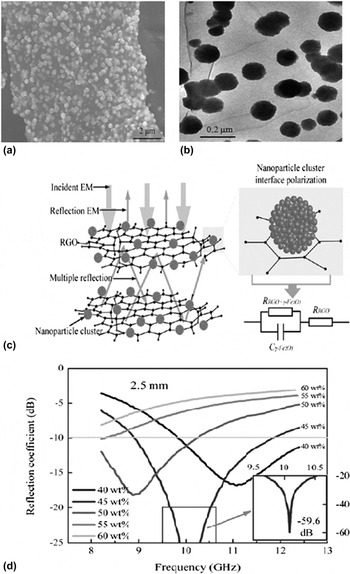
Kong et al. Reference Kong, Yin, Zhang, Yuan, Li, Ye, Cheng and Zhang72 provided a solvothermal method to synthesize the two-dimensional hybrids of RGO nanosheets which surface-modified by γ-Fe2O3 colloidal nanoparticle clusters. The morphology characterizations, possible MA mechanism and the reflection coefficient (RC) of γ-Fe2O3/RGO hybrids with thickness of 2.5 mm as a function of frequency are shown in Fig. 1. From Fig. 1(d), we can see that the minimum RC of the hybrids with the thickness of 2.5 mm was −59.65 dB. The excellent EW absorption performance and broad effective absorption bandwidth can be attributed to the interfacial polarization within nanoparticle clusters and conductivity loss of RGO result from the unique microstructure of maghemite colloidal nanoparticle clusters assembled on RGO. Additionally, Zhang et al. Reference Zhang, Tian, Wang, Luo, Hu, Shen and Xie73 synthesized a binary composite which is composed of RGO and NiO via a facile pyrolyzation process. The MA performance revealed that the synthesized RGO/NiO composites exhibited prominently high MA capacity in the frequency range of 2–18 GHz mainly contributed to the dielectric loss caused by the dipole polarizations of the composites. The absorption band of RL values below −10 dB for the lightweight RGO/NiO composites was 6.7 GHz with a thickness of 3.0 mm, broader than many other microwave absorbing materials reported before. Thus, there is no reason to believe that the high-performance RGO/NiO composites can be an ideal material that with practical application for MA.
The SEM (a) image and TEM (b) image of γ-Fe2O3/RGO hybrids. (c) Schematic illustration of possible MA mechanisms and resistor–capacitor circuit model in the γ-Fe2O3/RGO hybrids. (d) RC of γ-Fe2O3/RGO hybrids/paraffin composite with thickness of 2.5 mm as a function of frequency.

Also, in a recent corresponding work, Zong et al. Reference Zong, Huang, Wu, Zhao, Wang and Sun74 exploited a one-pot hydrothermal route method to prepare RGO/CoFe2O4 composites which used supercritical water instead of a chemical reducing agent for the reduction of GO, the reduction of GO happened along with the formation of the CoFe2O4 crystals. The as prepared RGO/CoFe2O4 composites exhibited remarkably higher MA capacity than the pure RGO and CoFe2O4 nanoparticles. Based on the calculated dielectric tangent loss and magnetic tangent loss of the composite, it is indicated that the MA mechanism of the composites was mainly due to the dielectric loss. The maximum RL of RGO/CoFe2O4 composites was −47.9 dB at 12.4 GHz and the effective absorption bandwidth corresponding to RL below −10 dB can be 5.0 GHz with the thickness of 2.0 mm. With the property of high MA performance under thin thickness, it is believed that RGO/CoFe2O4 composites could be an excellent microwave absorber for some military stealth application.
The conventional magnetic absorbing materials in fact can exhibit distinct MA performance under ordinary conditions, but the application of those materials under high temperatures is always a problem due to the loss magnetic properties and consequently microwave absorbing properties. High temperatures may cause serious damage to magnetic absorbing materials, and the problem is especially serious for military stealth materials that are used for radar cross section reduction. Reference Peng, Chen and Chang75–Reference Zhang, Zhang, Zhang, Zhang, Liu, Li, Liao, Zhao and Zhang77 The heat which is generated on the surface of aircrafts, bombers, rockets, and hyper-velocity missiles due to friction can usually result in high temperatures, and leads to certain damages or destruction of microwave absorbing materials. Herein, Zhang et al. Reference Zhang, Yu, Hu, Li, Wu, Wang, Li, Sun and Chen78 developed a simple thermochemical reaction for the preparation of iron oxides/RGO composites which could be applied in the EW absorption in high temperature (up to 800 °C). According to the characterization of the obtained samples under different temperatures, the authors demonstrated that GO and RGO sheets were important in regulating the phase transition from α-Fe2O3 to Fe3O4 via γ-Fe2O3, and the samples possess much better EW absorption properties than the mixture of separately prepared Fe3O4 with RGO. The effective complementarity of the complex permittivity and permeability is considered to be the cause of high absorption capacity of the composites. Such research provides a way for the fabrication of excellent microwave absorbing materials applied under high temperatures.
C. Graphene-based polymer composites
In most cases, magnetic metal nanoparticles and ferrite have conventionally been applied as microwave absorbing materials mainly due to their magnetic loss properties for a long time even until now. However, the disadvantages of the metal-based composites such as heavy weight and weak corrosion resistance severely restricted their development of the practical MA application. While, compared with the typical metallic materials, polymer composites possess more advantages including low density, flexible, resistant to corrosion, and low-cost, etc. Thus, conductive polymers matrix-based composites as well as some polymer-based microwave absorbing materials have attracted more and more attention in recent years. Reference Li, Huang, Du, He, Lin, Gao, Ma, Li, Chen and Eklund79–Reference Joo and Epstein84
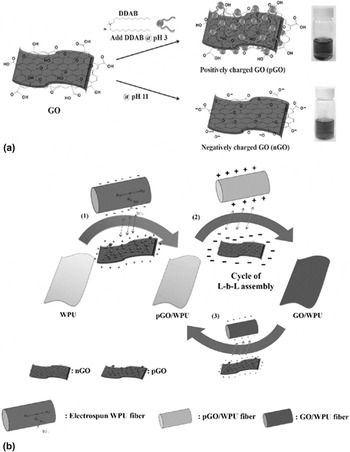
Hsiao et al. Reference Hsiao, Ma, Liao, Wang, Li, Huang, Yang and Liang85 provided a novel layer-by-layer assembly method to fabricate a flexible and low density RGO/water-borne polyurethane composites (RGO/WPU) with which high MA capacity. The detailed preparation process of the RGO/WPU composites can be seen in Fig. 2, WPU fiber here is used as the matrix that possesses a large surface area but low density. The obtained lightweight and flexible RGO/WPU composites with a thin thickness of 1.0 mm exhibited high electrical conductivity and excellent MA capacity (more than 91.2%) in the X-band region. The excellent MA performance of the composites is probably due to the high electrical conductivity and the completeness of the networks of electrical conduction. Additionally, nitrile butadiene rubber (NBR) is a favorable microwave absorbing matrix that with the properties of light-weight, corrosion resistance, chemical stability and high tensile strength, Singh Bai et al. Reference Singh, Shukla, Patra, Saini, Jani, Vadera and Kumar86 studied the MA performance of RGO as filler in NBR matrix. The stacks of RGO flakes can well result in a unique dihedral angle structure, and the microwaves suffer multiple reflections from the dihedral angles that can generate efficient attenuation microwave. The RL values <−10 dB of the composites over a wide frequency band ranged from 7.5 to 12 GHz with the thickness of 3 mm, and the minimum RL values was −57 dB at 9.6 GHz with only 10% RGO.
The detailed preparation process of the r-GO/WPU composites. (a) Schematic representation of the procedure used to prepare the segments used in L-b-L assembly. (b) Schematic representation of the cycle of L-b-L assembly of pGO and nGO on the WPU fiber.

According to the previous research, although graphene can be well dispersed in many polymer matrix, and the MA capacity of the composites are usually excellent with the unique structures and special synergistic effects of the composites, but many polymers themselves actually have a very weak MA performance. However, it is quite different from polyaniline (PANI), PANI itself is a microwave absorbing polymer that possesses the properties of conductive loss, diverse structure, and unique doping mechanism. Reference Wu, Ting, Wang, Yang and Tsai87–Reference Lee, Song, Jang, Oh, Epstein and Joo91 Thus, it is believed that the combination of graphene and PANI can be an outstanding microwave absorbing material. Chen et al. Reference Chen, Meng, Zhou, Tian, Shan, Zhu, Xu, Jiang, Wang, Hui, Wang, Lu and Gou92 therefore introduced a one-step intercalation polymerization of aniline inside the expanded graphite to synthesize graphene/PANI hybrids. The prepared graphene/PANI hybrids with low concentration of graphene exhibited enhanced MA capacity, the bandwidth for the effective absorption can be 5.3 GHz with the thickness of 3.5 mm. The prominent MA capacity of the composites is mainly because of the better impedance match caused by the defects and hybridizing points polarization relaxation.
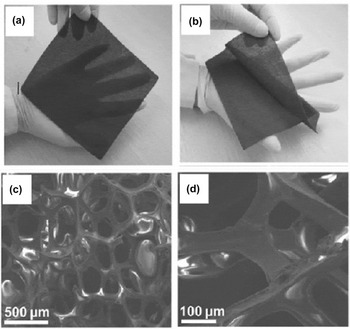
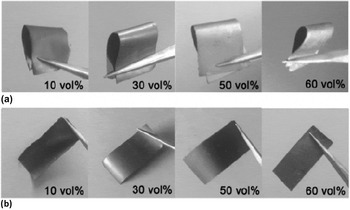
Moreover, to obtain the lighter weight and flexible materials for practical MA application, Chen et al. Reference Chen, Xu, Ma, Ren and Cheng93 exploited a lightweight and highly conductive graphene/poly(dimethyl siloxane) (PDMS) foam composites for high-performance MA application. The foam composites synthesized by a one-step process shows a density as low as ∼0.06 g/cm3, about 20 times smaller than the common solid polymer composites. The optical and SEM photos of the flexible graphene/PDMS foam composites can be seen in Fig. 3. The foam composites showed obvious enhanced MA capacity of 500 dB cm3/g with the graphene loading <0.8 wt% mainly due to the multiple reflection and absorption of the incident microwaves inside the foam. In a corresponding work, Song et al. Reference Song, Cao, Lu, Bi, Wang, Liu, Yuan and Fan94 synthesized ultralight multilayer graphene/polymer composite films in sandwich structures for effective electromagnetic interference shielding through the MA process. The optical photos of the flexible bent films (a) and free-standing films after bending (b) are shown in Fig. 4. The as synthesized polymeric graphene films with good mechanical flexibility and unique sandwich structures exhibited excellent electromagnetic shielding effect, the optimized shielding effectiveness reached 27 dB. Such results provide great opportunities for the designing of efficient microwave absorbing coatings with low density polymeric graphene materials.
The optical and SEM photos of the flexible graphene/PDMS foam composites.

The optical photos of the flexible bent films (a) and free-standing films after bending (b).

D. Graphene-based ceramic composites
Both magnetic metal materials and conductive polymer, the high temperature resistance of most of them are not very well, the main issue with the graphene-based materials provided above is the stability under severe conditions. This drawback may lead to damage or destruction of the microwave absorbing materials. Compared with magnetic metal materials and polymers, some ceramic materials (there are mainly silicon carbide, aluminum silicate, aluminum oxide, boron nitride, silicon nitride, zinc oxide, etc.) which with extraordinary intrinsic properties including high corrosion resistance, electrical insulation, and superior thermal stability not only exhibit excellent MA performance, but also can be applied under some severe conditions. Reference Ramirez, Osendi, Miranzo, Belmonte, Figueiredo, Castro-Beltrán and Terrones95–Reference Li, Zhang, Yin, Feng and Li100 Ceramic materials are the main components of multi-band absorbing materials and it is possible to realize some goals by the control of microstructure and electromagnetic parameters with such intrinsic advantages. Based on the outstanding properties of graphene and ceramic materials, quite a few graphene-based ceramic composites for MA were prepared and studied.
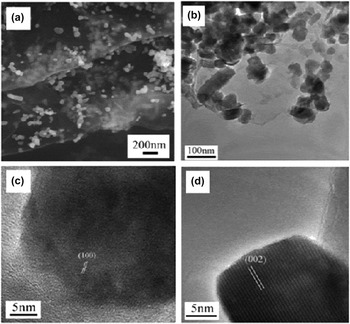
To improve the absorption capacity and broaden the effective absorption band of ZnO materials, Zhang et al. Reference Zhang, Lu and Li101 combined crystalline ZnO particles and graphene together through a two-step method, namely aqueous-solution process and calcinations process. The typical microstructure of ZnO/graphene composites is shown in Fig. 5. As we can see in Fig. 5, the unique structure of the as synthesized ZnO/graphene looks like a sandwich. Thus, the multi-interface polarization in the microstructure between the ZnO particles and graphene sheets can be generated and the proper electromagnetic match of the composites can be improved. Thanks to the unique structure of the ZnO/graphene composites, the composites with the thickness of 1.5–5.0 mm exhibited a broader effective absorption band than many other materials. The inspired result of the combination of ZnO particles and graphene indicate that graphene-based ceramic composites can be a kind of promising microwave absorbing materials for practical application.
Typical morphology and structure of ZnO particle decorated graphene composites: (a) SEM, (b), (c), and (d) HRTEM.

Significantly, to further improve the mechanical properties and high temperature resistance of the microwave absorbing materials, GNs/Al2O3 ceramics with enhanced mechanical and electromagnetic properties were prepared by Qing et al. Reference Yuchang, Qinlong, Fa and Wancheng102 according to the previous study of GNs–BaTiO3 ceramics. The mechanical properties and absorption capacity of the ceramics have been significantly improved though the addition of GNs. With a small loading (2.0 vol%) of GNs could lead to a 63.2% and 48.4% improvement of the flexural strength and fracture toughness compared with the pure Al2O3 ceramic, respectively. The minimum RL value of −48.6 dB at 10.6 GHz at 200 °C can be obtained for the GNs/Al2O3 ceramics. The enhanced mechanical properties as well as the excellent MA capacity revealed that the GNs/Al2O3 ceramics could be an ideal candidate for high performance microwave absorbing materials in the whole X-band under the temperatures range from 25 to 400 °C.
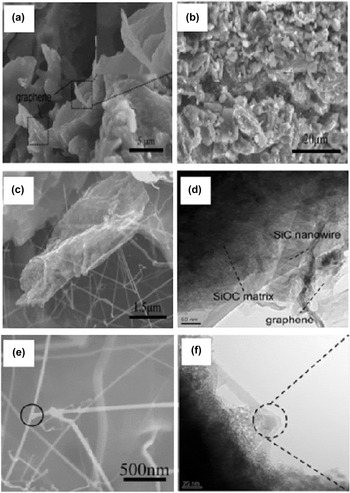
Furthermore, as an important semiconductor material with high temperature structural, SiC nanowire which with extraordinary properties such as thermal stability, chemistry resistivity and adjustable electronic conductivity, is an excellent microwave absorbing materials at high temperatures. Besides that, the high surface-to-volume ratio of the SiC nanowire has the advantages similar to CNTs which are benefit for MA. In a recent work, RGO-incorporated SiOC ceramics with the in situ grown SiC nanowires were prepared by Han et al. Reference Han, Yin, Duan, Ren, Zhang and Cheng103 via a simple solution method and polysiloxane-derived process. The hierarchical microwave absorbing material with the one-dimensional SiC nanowires grown on the surface of two-dimensional graphene was obtained, and the typical microstructure of G/SiOC ceramics with 3 wt% GO loading and the connected SiC nanowires in G/SiOC composites are shown in Fig. 6. The hierarchical structure of graphene and SiC nanowires exhibited a competitive microwave attenuation capability, which could be explained by the stacking faults and joined points in SiC nanowires, defects and residual functional groups in rGO, and the conductive network. The composites with 3 wt% GO resulted in excellent MA performance with the RCmin of −69.3 dB, which is the highest reported value for polymer-derived ceramics based absorbing materials. What’s more, the graphene-based ceramic composites with 2 wt% GO still exhibited efficient MA under high-temperature environment, the RCmin reached −50.13 dB at 11.67 GHz with a thickness of 2.3 mm at 673 K, and, the effective absorption bandwidth covered about 93% of the whole X-band (ranging from 8.2 to 12.1 GHz) with the thickness of 2.65 mm. The high absorption capacity of G/SiOC composites with the in situ grown SiC nanowires under normal conditions as well as high-temperatures also give inspiration for the practical MA applications of graphene-based ceramic composites.
SEM images of the as-prepared G/SiOC ceramic with 3 wt% GO (a–c); (d) the TEM image of G/SiOC ceramic with 3 wt% GO; (e) SEM images of joined SiC nanowires; (f) the TEM image of joined SiC nanowires.

E. Graphene-based multicomponent composites
As mentioned above, considering of the relative single absorbing mechanism of graphene, many studies have been reported on the MA behaviors of the graphene-based binary composites owing to the outstanding properties arising from the incorporation of graphene with an active second phase (such as magnetic metal powders, ferrites, conducting polymers and ceramics, etc.). Just like the binary composites based on graphene, the combination of graphene with other different components has also attracted broad research interests for the exploitation of multi-functional graphene-based multicomponent composites. Reference Chen, Xiang, Li, Qian, Xiao and Xu104–Reference Liu, Huang and Sun107
More recently, Zhang et al. Reference Zhang, Wang, Wei, Guo and Cao108 exploited a novel RGO/CuS/polyvinylidene fluoride (PVDF) ternary composite for the application of MA. The RGO/CuS nanocomposites was synthesized by one step in situ growth method and the simple hot-press procedure was used for the preparation of the RGO/CuS/PVDF composites. With the interface polarization, orientational polarization, and Debye dipolar relaxation in the ternary system, the RGO/CuS/PVDF composites shows outstanding absorption property. With a filler loading of 5 wt%, the composites achieved the RLmin of −32.7 dB at 10.7 GHz with the thickness of 2.5 mm. Additionally, another ternary composites that consisted of branching-like polypyrrole (PPy) and CoFe2O4 nanoparticles on graphene were synthesized by Liu et al. Reference Liu, Huang and Zhang109 The ternary composites showed high MA performance due to the extraordinary magnetic of CoFe2O4 nanoparticles and the multi-interfaces in the composites arising from the existing interfacial polarization in the ternary system. The RLmin of the GN@PPy@CoFe2O4 was −50.8 dB at 14.5 GHz and the effective absorption bandwidths below −10 dB was 4.2 GHz with a thickness of 1.5 mm. Such result suggested that the MA capacity of the GN@PPy@CoFe2O4 was better than GN@PPy, GN@CoFe2O4, GN–Fe3O4, GN–Co3O4, GN–CoFe2O4, and RGO–PPy–NiFe2O4. Reference Ma, Li, Zhao, Liu, He and Shi67,Reference Liu, Huang, Wang, Zong and Zhang69,Reference Liu, Huang and Zhang106,Reference Zong, Huang, Wu, Zhao, Wang and Sun110
In addition, to obtain the lightweight graphene-based multicomponent composites, in a recent work, Shen et al. Reference Shen, Zhai, Tao, Ling and Zheng111 exploited a lightweight, and multifunctional ternary foam used for MA that composed of polyetherimide (PEI), graphene (G), and Fe3O4. The novel high-performance PEI/G@Fe3O4 foam with low density of about 0.28–0.40 g/cm3, superparamagnetic behavior and low thermal conductivity were prepared by a phase separation method. The result showed that the prepared PEI/G@Fe3O4 foam with G@Fe3O4 loading of 10 wt% exhibited excellent MA of ∼41.5 dB/(g/cm3) over a frequency range of 8–12 GHz owing to the improved impedance matching, microwave attenuation and multiple reflections. In another corresponding work, Li et al. Reference Li, Huang and Chen112 synthesized a lightweight sandwich-structured composite that composed of graphene, Ni and C via a facile one-pot method. With the multi-interfaces and double junctions between graphene, Ni particles and carbon coatings, graphene@Ni@C composites showed a minimum RL value of −34.2 dB with a thickness of only 1.6 mm.
Besides the ternary composites prepared above, novel graphene-based ternary composites without magnetic property also have drawn a great attention. Recently, a novel three-dimensional (3D) hybrid based on graphene, carbon nanotubes, and poly(dimethyl siloxane) (PDMS) were fabricated by Kong et al. Reference Kong, Yin, Yuan, Zhang, Liu, Cheng and Zhang113 The minimum value of RC the three-dimensional (3D) composites (CNT/G-PDMS) with the CNTs/graphene hybrids loading of 5 wt% and thickness of 2.75 mm can be −55 dB at 10.1 GHz. The excellent absorption of the CNT/G-PDMS composites could be mainly attributed to the interfacial polarization in heterogeneous interface of the different components.
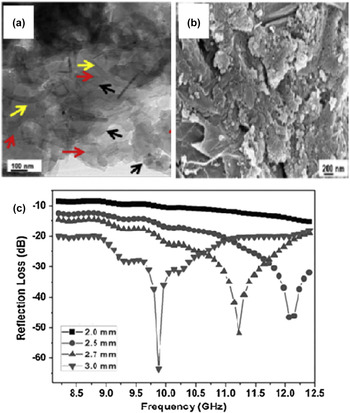
In addition to the graphene-based multi-component composites mentioned above, to further improve the MA capacity of the graphene-based materials, some other special graphene-based composites were also exploited by some researchers. Lei Wang et al. Reference Wang, Zhu, Yang, Wang, Qin, Zhao and Zhang114,Reference Wang, Huang, Li, Chen and Sun115 synthesized two kinds graphene-based multicomponent microwave absorbing materials, graphene@Fe3O4@C@PANI and graphene@Fe3O4@SiO2@PANI. The two composites both exhibited hierarchical structures and high MA performance. According to the calculated RL values, the effective absorption bandwidths of the two composites were both as broad as 5.8 GHz. With the superior performance and broad absorption bandwidth, it is believed that such hierarchical structural graphene-based materials will be developed into an attractive microwave absorbing materials for practical applications. In another work, Bhattacharya et al. Reference Bhattacharya, Dhibar, Kundu, Hatui and Das116 fabricated a novel bi-functional graphene-based composites which composed of graphene (Gr), TiO2 coated CNT (Ti@CNT), Fe3O4, and polyaniline (PANI). The obtained Gr/Ti@CNT/Fe3O4/PANI composite showed superior MA performance and excellent electrochemical property. Figure 7 shows the HRTEM and FESEM images as well as the RL cures of the Gr/Ti@CNT/Fe3O4/PANI composites. The result revealed that the minimum RL value of the Gr/Ti@CNT/Fe3O4/PANI composites could be −63.57 dB at 9.88 GHz with a thickness of 3.0 mm. Moreover, the Gr/Ti@CNT/Fe3O4/PANI composites could be used in high temperatures due to the enhanced the thermal stability. Thus, it is believed that the exploitation of such graphene-based composites can be a promising way for the development of excellent microwave absorbing materials.
HRTEM image (a) and FESEM image (b) of Gr/Ti@CNT/Fe3O4/PANI. (c) Reflection loss versus frequency plot of Gr/Ti@CNT/Fe3O4/PANI with different thickness.

F. Graphene-based carbon material
Besides the graphene-based microwave absorbing composites mentioned above, recently, graphene-based carbon materials which are consisted of carbon materials only have also attracted widely attentions in the application of MA.
As a well-known carbon material, poor graphitization level of amorphous carbon nanosphere exhibits many superior advantages. The resistivity of such carbon nanospheres can be easily adjusted by adjusting the annealing temperature. Also, the conductive loss and polarization loss can be ruled out for the graphene/carbon composite since the identical electronegativity value and less defects on graphene. In addition, the graphene/carbon composite also possesses the unique properties, such as lightweight and high chemical stability features. Thus, the study of graphene/carbon composites has been considered as a promising way to prepare tunable microwave absorber. Hualiang Lv et al. Reference Lv, Guo, Zhao, Zhang, Zhang, Ji and Xu117 synthesized a tunable microwave absorbing material by loading carbon nanospheres on graphene via a simple liquid phase approach under wet-chemical conditions. In comparison to the poor attenuation behavior carbon spheres prepared at various temperatures and graphene, a huge improvement can be found for GN/CS composites as compared with pure carbon spheres and graphene. At 1.5–3.0 mm, the RLmin values of GN/CS samples prepared at various temperatures (600–800 °C) are all less than −10 dB. In particular, the RLmin value of GN/CS-800 is up to −28.1 dB with the thickness of 1.5 mm, which is much better than other similar carbon absorbers. Besides, the optimal absorption frequency of these GN/CS samples is tunable and the frequency of minimum reflection loss value can be ranged in a given frequency via adjusting the graphitization degree of carbon sphere. This improved RLmin value and adjustable feature can be attributed to the current attenuation theory. Briefly, the free electrons on graphene can turn the incoming electromagnetic energy into current energy, and the carbon spheres on graphene acted as the resistor can loss the electric energy which is similar to Joule’s law. Thus, it is believed that graphene/carbon nanosphere composites have a great potential application in tunable and lightweight MA field.
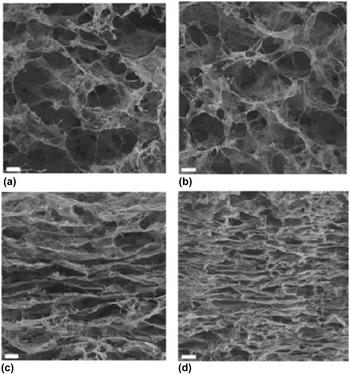
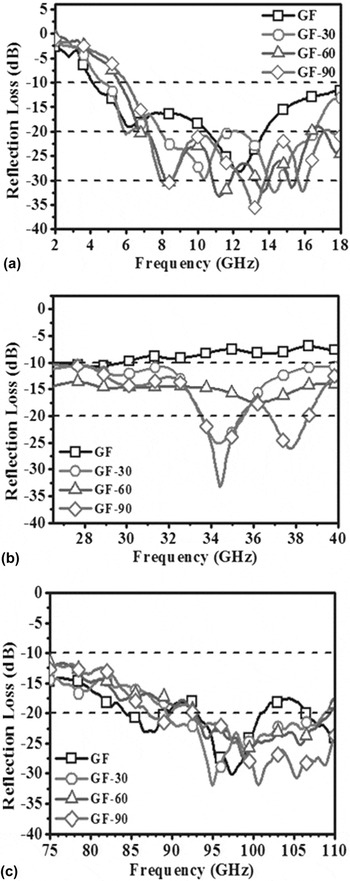
More recently, Zhang et al. Reference Zhang, Huang, Zhang, Chang, Xiao, Chen, Huang and Chen118 provided a simple and low-cost method for the preparation of ultralight and highly compressible graphene foam (GF) for MA. The cross-sectional SEM images of the GF can be seen in Fig. 8. With the 3D conductive network in the foam structure, the GF exhibited a distinctly enhanced MA performance with the absorption bandwidth covered 80.9% of the overall bandwidth (2–18, 26.5–40, and 75–110 GHz). Furthermore, the absorption performance can be adjusted simply by physically compress of the foam material. Particularly, after a 90% compressive strain of the GF (1.0 mm thickness), it can reach a broader bandwidth of 60.5 GHz, covering 93.8% of the total bandwidth, about 70% wider than the best available microwave absorbing material that reported previously (Fig. 9 showed the RL curves for the GF under different compressive strains). In addition, the weight of the GF after 90% compressive strain is really ultralight. However, the GF with the density of only 14 mg/cm3 showed an extraordinary MA capacity which was as high as 2.2 × 10⁵ dB cm2/g, such result is over two orders of magnitude higher than those reported best available microwave absorbing materials. The superior properties of the GF actually provide a potential strategy for the exploitation of graphene-based microwave absorbing materials with the characteristic of “thin, width, light, strong”. However, the mechanical strength of the GF is really not flexible, so the challenge that we must solve next is how to improve the mechanical strength of this material.
The cross-sectional SEM images of the GFs under different compressive strains (a) GF, (b) GF-30, (c) GF-60, and (d) GF-90. The scale bar is 20 µm.

The RL curves for the GFs under different compressive strains are shown in (a) 2–18; (b) 26.5–40, and (c) 75–110 GHz.

III. CONCLUSION AND OUTLOOK
Based on the above generalization of the graphene-based microwave absorbing materials, it can be concluded that the application of graphene and graphene-based materials in the field of MA has been more and more extensive, and the research of the graphene-based microwave absorbing materials is indeed a very attractive work. In theory, graphene has been considered as a promising microwave absorbing material due to its low density, extremely large surface area, ultrathin thickness, large aspect ratios, greater interface, and optical transmittance. In practice however, lots of efforts are still needed to turn the ideal MA candidate into real practical materials. The most important and essential problem should be how to fabricate high-performance graphene-based microwave absorbing materials with the properties including “thin, width, light, strong” and flexible mechanical strength in a large scale through a cost-effective process.
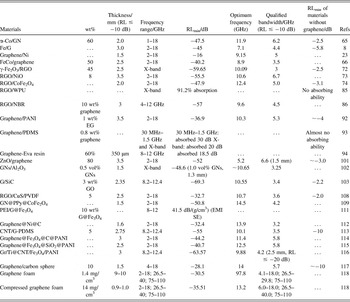
As mentioned above, until now, as for the preparation method of the graphene-based materials, liquid phase method is more favorable to the preparation of powder microwave absorber that including graphene-based magnetic metal nanocomposites and graphene-based ferrite composites. Such composites always used as absorber in microwave absorbing materials. The solution blending method, melt blending method as well as in situ polymerization method should be more suitable for the preparation of the graphene-based polymer composites. Then, graphene-based ceramic composites as a kind of materials that widely used under high temperatures, the pressureless sintering method is often applied for the preparation of such composites. Finally, the combinations of different methods are more popular for the preparation of graphene-based multicomponent composites. Compared with the absorption performance (listed in Table I) and the microwave absorbing behaviors of the different graphene-based materials that we mentioned above, it can be seen that most of the graphene-based microwave absorbing materials showed excellent absorption performance with different advantages. The graphene-based magnetic metal nanocomposites and graphene-based ferrite composites with broad absorption band are widely used as absorber in MA coatings. In addition, the graphene-based ceramic composites are mainly used under the severe high temperature conditions, and the graphene-based foamed material is an ultralight microwave absorbing material that with high absorption performance.
MA behaviors of different graphene-based materials.

Graphene and graphene-based materials have great potential for practical military and civilian application in EW absorption as well as shielding. The main problem is to make full use of the excellent intrinsical properties of graphene, especially its low density, high surface area, large interface and optical transmittance, etc., and to improve the synergistic effect of the composites arising from the graphene and other components which with outstanding properties. Hence, the design and preparation of novel graphene-based materials with high absorption performance, low density, high temperature, and corrosion resistance should be an important research work in the future. Researchers should exploit different microwave absorbing materials which with special characteristics for different application environments. For example, as graphene can improve the corrosion resistance property greatly due to the good encapsulation structure of the metal, maybe we can fabricate some graphene-based materials that with excellent corrosion resistance property for marine applications. Also, researchers can give full play to the properties of light weight, high specific surface area of graphene and exploit ultralight graphene-based absorbing material that just composed of carbon but without any other magnetic metals. In addition, the graphene-based microwave absorbing materials that with the multi-function of high MA, heat insulation and shielding, load bearing such as graphene aerogels, can be full of research significance. Moreover, the exploitation of graphene-based absorbing materials that with the integration function of absorption and loading properties also will be an attractive research.