



%20--%3e%3c!DOCTYPE%20svg%20PUBLIC%20'-//W3C//DTD%20SVG%201.0//EN'%20'http://www.w3.org/TR/2001/REC-SVG-20010904/DTD/svg10.dtd'%3e%3csvg%20version='1.0'%20id='Layer_1'%20xmlns='http://www.w3.org/2000/svg'%20xmlns:xlink='http://www.w3.org/1999/xlink'%20x='0px'%20y='0px'%20width='64px'%20height='64px'%20viewBox='5.5%20-3.5%2064%2064'%20enable-background='new%205.5%20-3.5%2064%2064'%20xml:space='preserve'%3e%3cg%3e%3ccircle%20fill='%23FFFFFF'%20fill-opacity='0'%20cx='37.785'%20cy='28.501'%20r='28.836'/%3e%3cpath%20fill='%23595959'%20d='M37.441-3.5c8.951,0,16.572,3.125,22.857,9.372c3.008,3.009,5.295,6.448,6.857,10.314%20c1.561,3.867,2.344,7.971,2.344,12.314c0,4.381-0.773,8.486-2.314,12.313c-1.543,3.828-3.82,7.21-6.828,10.143%20c-3.123,3.085-6.666,5.448-10.629,7.086c-3.961,1.638-8.057,2.457-12.285,2.457s-8.276-0.808-12.143-2.429%20c-3.866-1.618-7.333-3.961-10.4-7.027c-3.067-3.066-5.4-6.524-7-10.372S5.5,32.767,5.5,28.5c0-4.229,0.809-8.295,2.428-12.2%20c1.619-3.905,3.972-7.4,7.057-10.486C21.08-0.394,28.565-3.5,37.441-3.5z%20M37.557,2.272c-7.314,0-13.467,2.553-18.458,7.657%20c-2.515,2.553-4.448,5.419-5.8,8.6c-1.354,3.181-2.029,6.505-2.029,9.972c0,3.429,0.675,6.734,2.029,9.913%20c1.353,3.183,3.285,6.021,5.8,8.516c2.514,2.496,5.351,4.399,8.515,5.715c3.161,1.314,6.476,1.971,9.943,1.971%20c3.428,0,6.75-0.665,9.973-1.999c3.219-1.335,6.121-3.257,8.713-5.771c4.99-4.876,7.484-10.99,7.484-18.344%20c0-3.543-0.648-6.895-1.943-10.057c-1.293-3.162-3.18-5.98-5.654-8.458C50.984,4.844,44.795,2.272,37.557,2.272z%20M37.156,23.187%20l-4.287,2.229c-0.458-0.951-1.019-1.619-1.685-2c-0.667-0.38-1.286-0.571-1.858-0.571c-2.856,0-4.286,1.885-4.286,5.657%20c0,1.714,0.362,3.084,1.085,4.113c0.724,1.029,1.791,1.544,3.201,1.544c1.867,0,3.181-0.915,3.944-2.743l3.942,2%20c-0.838,1.563-2,2.791-3.486,3.686c-1.484,0.896-3.123,1.343-4.914,1.343c-2.857,0-5.163-0.875-6.915-2.629%20c-1.752-1.752-2.628-4.19-2.628-7.313c0-3.048,0.886-5.466,2.657-7.257c1.771-1.79,4.009-2.686,6.715-2.686%20C32.604,18.558,35.441,20.101,37.156,23.187z%20M55.613,23.187l-4.229,2.229c-0.457-0.951-1.02-1.619-1.686-2%20c-0.668-0.38-1.307-0.571-1.914-0.571c-2.857,0-4.287,1.885-4.287,5.657c0,1.714,0.363,3.084,1.086,4.113%20c0.723,1.029,1.789,1.544,3.201,1.544c1.865,0,3.18-0.915,3.941-2.743l4,2c-0.875,1.563-2.057,2.791-3.541,3.686%20c-1.486,0.896-3.105,1.343-4.857,1.343c-2.896,0-5.209-0.875-6.941-2.629c-1.736-1.752-2.602-4.19-2.602-7.313%20c0-3.048,0.885-5.466,2.658-7.257c1.77-1.79,4.008-2.686,6.713-2.686C51.117,18.558,53.938,20.101,55.613,23.187z'/%3e%3c/g%3e%3c/svg%3e)
%20--%3e%3c!DOCTYPE%20svg%20PUBLIC%20'-//W3C//DTD%20SVG%201.0//EN'%20'http://www.w3.org/TR/2001/REC-SVG-20010904/DTD/svg10.dtd'%3e%3csvg%20version='1.0'%20id='Layer_1'%20xmlns='http://www.w3.org/2000/svg'%20xmlns:xlink='http://www.w3.org/1999/xlink'%20x='0px'%20y='0px'%20width='64px'%20height='64px'%20viewBox='5.5%20-3.5%2064%2064'%20enable-background='new%205.5%20-3.5%2064%2064'%20xml:space='preserve'%3e%3cg%3e%3ccircle%20fill='%23FFFFFF'%20fill-opacity='0'%20cx='37.637'%20cy='28.806'%20r='28.276'/%3e%3cg%3e%3cpath%20fill='%23595959'%20d='M37.443-3.5c8.988,0,16.57,3.085,22.742,9.257C66.393,11.967,69.5,19.548,69.5,28.5c0,8.991-3.049,16.476-9.145,22.456%20C53.879,57.319,46.242,60.5,37.443,60.5c-8.649,0-16.153-3.144-22.514-9.43C8.644,44.784,5.5,37.262,5.5,28.5%20c0-8.761,3.144-16.342,9.429-22.742C21.101-0.415,28.604-3.5,37.443-3.5z%20M37.557,2.272c-7.276,0-13.428,2.553-18.457,7.657%20c-5.22,5.334-7.829,11.525-7.829,18.572c0,7.086,2.59,13.22,7.77,18.398c5.181,5.182,11.352,7.771,18.514,7.771%20c7.123,0,13.334-2.607,18.629-7.828c5.029-4.838,7.543-10.952,7.543-18.343c0-7.276-2.553-13.465-7.656-18.571%20C50.967,4.824,44.795,2.272,37.557,2.272z%20M46.129,20.557v13.085h-3.656v15.542h-9.944V33.643h-3.656V20.557%20c0-0.572,0.2-1.057,0.599-1.457c0.401-0.399,0.887-0.6,1.457-0.6h13.144c0.533,0,1.01,0.2,1.428,0.6%20C45.918,19.5,46.129,19.986,46.129,20.557z%20M33.042,12.329c0-3.008,1.485-4.514,4.458-4.514s4.457,1.504,4.457,4.514%20c0,2.971-1.486,4.457-4.457,4.457S33.042,15.3,33.042,12.329z'/%3e%3c/g%3e%3c/g%3e%3c/svg%3e)
1. Introduction
The Magnetism in Massive Stars (MiMeS) spectropolarimetric survey determined that the incidence of globally organized surface magnetic fields in nearby O-type stars is less than 10% (Grunhut et al. Reference Grunhut2017; Petit et al. Reference Petit2019). The MiMeS survey observed about 100 O-type stars between the zero-age main-sequence (ZAMS) and terminal-age main-sequence and found that the majority of confirmed magnetic O-type stars lie close to the ZAMS (
 $\log g\approx4.0$
). The rarity of magnetic detections in O-type bright giants and supergiants may be due to fossil-field decay (Fossati et al. Reference Fossati2016) or to detection biases due to decreasing surface field strength as the stellar radius expands (Petit et al. Reference Petit2019). The O-type bright giant 63 Oph (O8 II((f)),
 $V=6.2$
mag) was identified as a magnetic candidate based on MiMeS observations, but there were insufficient data to confirm the star’s magnetic status (Grunhut et al. Reference Grunhut2017). Barron et al. (Reference Barron, Wade, Holgado and Simón-Díaz2025) report a magnetic detection in 63 Oph from spectropolarimetric observations obtained with ESPaDOnS at the Canada-France-Hawaii-Telescope (CFHT). We determined physical properties for 63 Oph and studied the star’s spectral and photometric variability.
2. Physical Properties
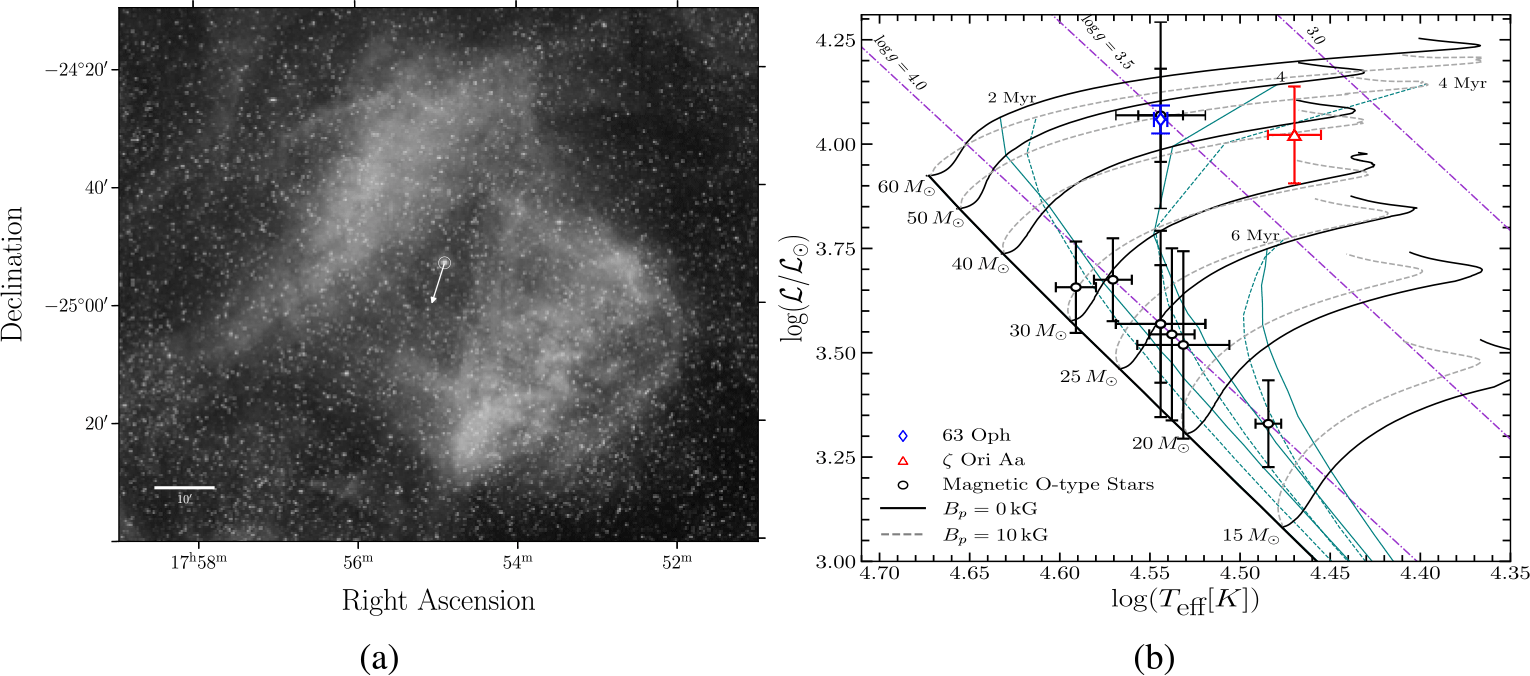
63 Oph is located in the Galactic plane surrounded by the striking but poorly studied ring nebula Sh 2-22 (Lozinskaya et al. Reference Lozinskaya, Larkina and Putilina1983; Fig. 1a). We adopted a distance of
 $d=1082.3^{+119.6}_{98.2}$
pc (Bailer-Jones et al. Reference Bailer-Jones, Rybizki, Fouesneau, Mantelet and Andrae2018) in our analysis. Using IACOB-GBAT (Simón-Díaz et al. Reference Simón-Díaz, Castro, Herrero, Puls, Garcia and Sabín-Sanjulián2011) and FASTWIND models (Puls et al. Reference Puls, Urbaneja, Venero, Repolust, Springmann, Jokuthy and Mokiem2005) we derived the following spectroscopic parameters:
 $\log L=5.29\pm0.09\,L_{\odot}$
,
 $T_{\mathrm{eff}}=35.0\pm0.3$
kK,
 $\log g_{\mathrm{corr}}=3.51\pm0.03$
,
 $R_{\mathrm{spec}}=12.0\pm1.2\,R_{\odot}$
and
 $M_{\mathrm{spec}}=17\pm4\,M_{\odot}$
. We modelled the O iii
 $\lambda5592$
line using IACOB-BROAD (Simón-Díaz & Herrero Reference Simón-Díaz and Herrero2014) to derive
 $v_{\mathrm{eq}}\sin i=48\pm5$
km s
 $^{-1}$
and
 $v_{\mathrm{mac}}=101\pm5$
km s
 $^{-1}$
. Figure 1b shows the location of 63 Oph in the spectroscopic Hertzsprung-Russell Diagram (sHRD) with magnetic evolutionary tracks from Keszthelyi et al. (Reference Keszthelyi2022). The evolutionary radius and mass implied by the tracks are
 $R_{\mathrm{evol}}\sim20\,R_{\odot}$
and
 $M_{\mathrm{evol}}\sim48\,M_{\odot}$
which are in tension with their spectroscopically derived counterparts. While 63 Oph overlaps with the strongly magnetic Of?p stars HD 108 and HD 191612 in the sHRD, there are crucial distinctions in 63 Oph’s properties.
a). SuperCOSMOS H
 $\alpha$
image of 63 Oph and the surrounding nebula Sh 2-22. b). Location of 63 Oph and the confirmed magnetic O-type stars in the sHRD (
 $\mathscr{L}=T_{\mathrm{eff}}^{4}/g$
). Adapted from Barron et al. (Reference Barron, Wade, Holgado and Simón-Díaz2025).

3. Magnetic Detection
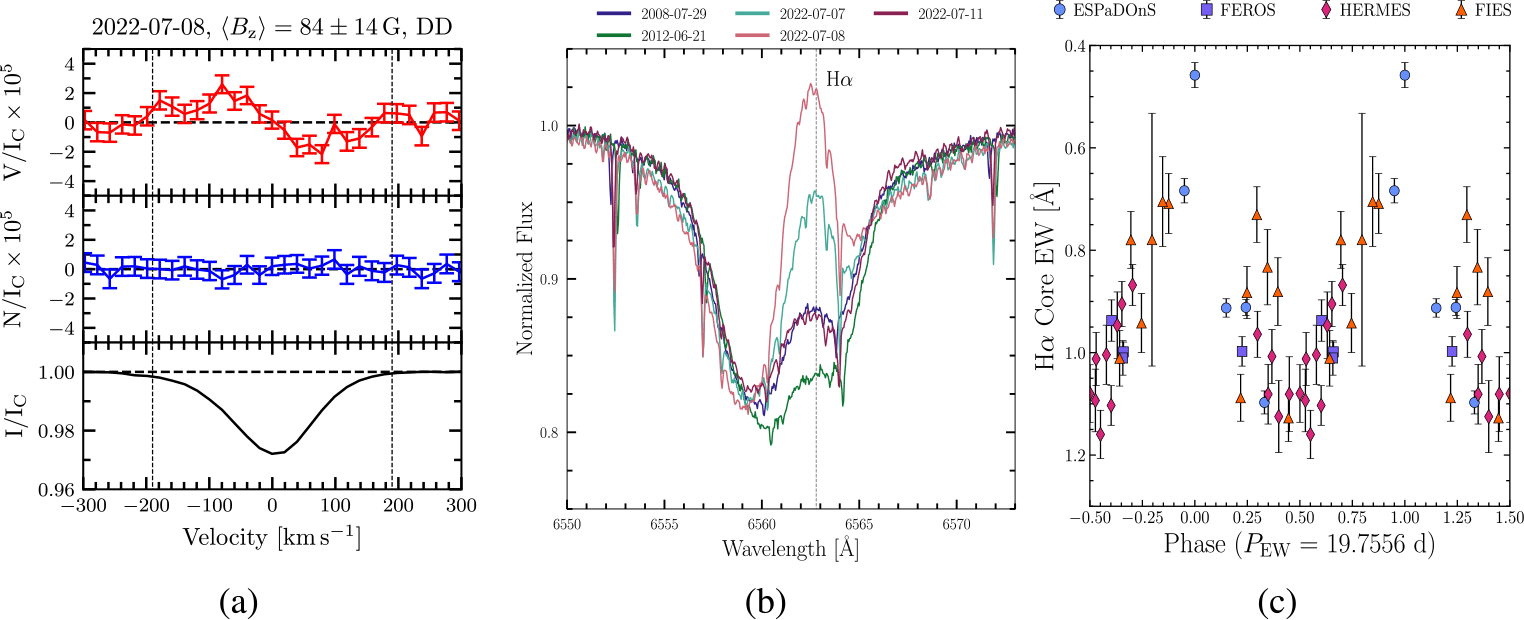
We obtained three high signal-to-noise observations of 63 Oph with the ESPaDOnS spectropolarimeter at CFHT in 2022. We applied the least-squares deconvolution (LSD) method (Donati et al. Reference Donati, Semel, Carter, Rees and Collier Cameron1997) to the spectra, generating unpolarized LSD Stokes I, circularly polarized LSD Stokes V and a diagnostic N profiles. A magnetic signature was definitely detected in the LSD Stokes V profile of the 2022-07-08 observation (Fig 2a) with a false alarm probability of
 $1.06\times10^{-10}$
and a mean longitudinal field strength of
 $\langle B_{z}\rangle = 84\pm14$
G. The
 $\langle B_{z}\rangle$
measurement sets a conservative lower bound on the dipolar field strength of
 $B_{\mathrm{p}}\geq300\pm50$
G.
a). LSD Stokes V (top, red), N (middle, blue) and I (bottom, black) profiles for 63 Oph (2022-07-08). b). Variability of H
 $\alpha$
in the ESPaDOnS spectra. The peak emission corresponds to the magnetic detection. c). H
 $\alpha$
line-core EWs phased to the best fitting period of
 $\approx19.8$
d and shown over two cycles. Adapted from Barron et al. (Reference Barron, Wade, Holgado and Simón-Díaz2025).

4. Spectral and Photometric Variability
We performed a spectroscopic and photometric variability analysis look for evidence of a rotating magnetosphere and a binary companion. We analyzed 30 additional FEROS, FIES and HERMES spectra. We found no clear evidence of a binary companion in radial-velocity (RV) measurements. Line-profile variability is observed in the H
 $\alpha$
and H
 $\beta$
lines (Fig. 2b), and a significant
 $\approx19.8$
d period is detected in both H
 $\alpha$
and H
 $\beta$
line-core equivalent-width (EW) measurements (Fig. 2c). We analyzed archival time-series photometry from ground based ASAS-SN observations, as well as space based Hipparcos and K2 observations. No significant frequencies were detected above the intrinsic stochastic low-frequency noise level.
5. Conclusions
We have confirmed that 63 Oph is a magnetic O-type star from ESPaDOnS spectropolarimetric observations. We attribute the
 $\approx 19.8$
d variability detected in the H
 $\alpha$
and H
 $\beta$
line-core EWs to be due to a rotating circumstellar magnetosphere. 63 Oph does not exhibit the clear photometric rotational modulation, strong H
 $\alpha$
emission and slow rotation observed in the strongly magnetic Of?p stars. This suggests that 63 Oph’s magnetic field is weaker than those of HD 108 and HD 191612. We hypothesize that 63 Oph is a rare transitional object that bridges the gap between strongly magnetic O-type stars early in their main-sequence evolution and the weakly magnetic O-type supergiants like
 $\zeta$
Ori Aa. No signature of a binary companion is detected in RV measurements or time-series photometry.
6. Future Work
Additional spectroscopic observations of 63 Oph should be obtained to confirm the proposed
 $19.8$
d rotation period. Magnetic measurements over the full rotation are needed to reconstruct the magnetic topology and fully constrain
 $B_{\mathrm{p}}$
. O-type stars with similar spectral characteristics to 63 Oph should be investigated to identify additional magnetic candidates (Holgado et al. Reference Holgado2018). A recent study of the massive O-O star binary HD 148937 suggests that the magnetic component and surrounding bipolar nebula was generated through a merger process (Frost et al. Reference Frost2024). Considering these results, further investigation of 63 Oph’s surrounding nebula is warranted, and may provide further understanding of the star’s evolutionary history.
Supplementary material
To view supplementary material for this article, please visit https://doi.org/10.1017/S1743921325103839.
 α
 L=Teff4/g
 α
 α
 ≈19.8


 Open access

