Introduction
On 16 November 1721, King John V farmed out the Portuguese tobacco monopoly to De Bruijn & Cloots, a Dutch trading house established in Lisbon, after a competitive auction at the royal palace sometime in October. Under the agreement, De Bruijn and Cloots and their partner Arnaldo van Zeller, a merchant of Dutch origin, were assigned the exclusive right to sell Brazilian tobacco in the domestic market for a period of three years (1722–1724) in exchange for paying the royal treasury an annual fee of 720 million réis.Footnote 1 In fiscal terms, this sum made the tobacco monopoly the single most valuable source of income for the Portuguese state, accounting for almost one-fifth of its total revenue.Footnote 2
Originally from Amsterdam, Willem de Bruijn and Paulo Cloots emerged on the Lisbon business scene in 1713, and their decision to farm the tobacco monopoly marked the beginning of their interaction with the Portuguese Crown. As stated in a letter to the merchant banking firm Jean-Baptiste & Egidio Cloots of Amsterdam, this decision was taken after careful consideration and under the assumption that the tobacco business would yield one billion réis annually. The prospect of amassing a significant fortune and of forging close bonds with the royal court, thus creating an opportunity to consolidate the firm's business in Lisbon, were incentives that De Bruijn & Cloots could not forego. They hoped in this way to be able to “repatriate blessed” within a few years.Footnote 3 The tobacco monopoly proved, however, to be a high-risk business and ultimately caused the collapse of the firm as, upon completion of a second contract (1725–1727), the Dutch partners faced insolvency. Despite efforts to repay the outstanding debts to the state treasury and to fellow merchants, Willem de Bruijn and Paulo Cloots decided subsequently to flee the country in 1741. As a result, their business archive was confiscated, while Arnaldo van Zeller, who chose not to leave the country, was thrown into jail.
De Bruijn, Cloots, and Van Zeller's assumption that a fortune could be amassed through tax farming was not unreasonable. Being assigned the right to collect royal revenues could be a lucrative business and a significant source of private wealth, provided that the total revenue outweighed the combined total of the annual fee payable to the treasury and the collection costs. Although the rates of profit-taking varied significantly and depended on a number of variables, not least on favourable economic circumstances, micro-level analyses suggest that fiscal intermediation tended to yield higher investment returns than trading activities.Footnote 4 These assertions have been highlighted for most early modern monarchies, where tax farming was widely used to collect revenue.Footnote 5 In the case of Portugal, opportunities to farm taxes expanded as a result of the Brazilian gold mining cycle (1695–1780), which inflated fiscal revenues both in the metropole and the empire, thus expanding the conditions under which the monarchy and businessmen could share fiscal income. Within the framework of a colonial monopoly, tax farming in the colonial offshoots was reserved for Portuguese vassals, whereas no such barrier existed in mainland Portugal. An in-depth study for the late eighteenth century showed that foreign merchants were not excluded from this activity in Portugal and that the domestic tobacco monopoly, where income was routinely raised through tax farmers from 1702 onwards, was also available to foreign businessmen.Footnote 6 Of the twenty general tobacco tax farms leased between 1702 and 1755, nine were awarded to business consortia headed by foreign merchants.Footnote 7 King John V's decision to transfer the right to collect the tobacco excises to a Dutch partnership in 1722 was not, therefore, unparalleled.
While the tobacco monopoly may have been open to foreigners because it applied exclusively to domestic consumption, it equally well encapsulated the political economy of the Portuguese empire, which sought to reconcile colonial and metropolitan interests and, as such, to strike a balance between colonial and fiscal objectives.Footnote 8 On the one hand, and in an effort to reinforce economic integration between the colony and the mother country, interests of colonial planters and overseas traders came together in 1649, when Brazilian tobacco became the exclusive source of supply to the monopoly. By then, domestic cultivation in Portugal was prohibited, while colonial production was also encouraged by legislation that banned imports of Spanish and Virginian tobacco. As a result, the domestic tobacco tax farmers depended exclusively on the raw product cultivated in the area around Bahia (Salvador) and on their producer prices, which were persistently high until the 1730s.Footnote 9 On the other hand, given the steady flow of Brazilian tobacco that was shipped to the African coast as part of the slave trade, the government also intervened to reconcile Bahian and metropolitan interests by requiring the higher-quality tobacco to be supplied to the mother country, whereas tobacco of lesser quality was to be shipped to the African markets. A further attempt to reconcile conflicting interests of planters, overseas traders, and domestic tax farmers took the form of price controls, whereby a price ceiling was imposed on producers, albeit with limited success.Footnote 10 Portugal proved, nevertheless, to be more successful than Spain or France in developing a tobacco supply able to satisfy both the domestic and the re-export markets and to afford the state a significant source of revenue.Footnote 11 In doing so, the Portuguese state established the institutional rules within which tobacco tax farmers operated, as well as the boundaries within which net profits could be obtained: in addition to the mandatory supply of Brazilian tobacco, this was a monopoly with administered retail prices to ensure the collection of the excise tax on domestic tobacco consumption.
Despite these strict institutional rules, the tobacco monopoly is depicted in the historiography of eighteenth-century Portugal as a clear case of a monopolistic rent closely linked to the empire and which allowed a clique of tax farmers to accumulate massive wealth.Footnote 12 By the late eighteenth century, these tax farmers were able to reap high profits of around 20 percent, thus signalling their ability to exploit the opportunities offered by a state-owned monopoly.Footnote 13 However, this depiction does not tally with evidence from earlier decades, when cases of success among tobacco tax farmers alternated with those of clamorous failure, suggesting that, at that time, the state was able to internalize part of the profits accruing to the tax farmers. Not surprisingly, running the tobacco monopoly in this earlier phase was seen as a risky and demanding business, a perception that is probably best mirrored in the fact that the wealthiest Lisbon merchants did not venture into farming it until after 1765.Footnote 14 A recent study has made a significant contribution by positing that organizational changes and an increase in per capita tobacco consumption both played a key role in explaining the exorbitant profits reaped by tax farmers in the late 1700s.Footnote 15
By examining how the two tobacco tax farms held by De Bruijn, Cloots, and Van Zeller operated from 1722 to 1727, this article brings together, on the one hand, research on the relationship between state and business groups through a monopolistic rent provided by the empire and, on the other hand, a growing literature discussing institutional and economic variables, as well as human agency, in bankruptcies in early modern Europe.Footnote 16 The article aims to achieve two goals. The first is to shed light on the perspective of the Dutch tax farmers, highlighting why they chose to incur the risks of managing a nationwide sales monopoly and the business model they implemented to maximize profits and mitigate risks, while the second is to examine the general and specific reasons behind their ultimate downfall. I argue that, despite the organizational innovations they introduced and that led them to exploit interconnected businesses, the partners were unable to overcome the negative effects of conjunctural and contingent factors that temporarily squeezed the domestic consumption of tobacco.
This inquiry into the failure of De Bruijn & Cloots makes use of the firm's business archive, which is currently held in the Portuguese National Archive of Torre do Tombo. Consisting of approximately fifty volumes, it comprises merchant account books, correspondence, and diaries covering the period from 1713 to 1741.Footnote 17 Given its size and range, it is in all likelihood the most complete and integrated surviving archive of a merchant house operating in Portugal in the first half of the eighteenth century.Footnote 18 The collection has not previously been explored by scholars, and this article is among the first efforts to reconstruct the story of this Dutch firm, its large-scale international business operations, and its dealings with the Portuguese Crown.Footnote 19 This inquiry into the firm's failure also uses quantitative data compiled by the Tobacco Board, the bureaucratic overseer of the monopoly (Junta da Administração do Tabaco).
The article is structured as follows. The first section highlights the role Lisbon played in European and global trade throughout the first few decades of the eighteenth century so as to understand why the Portuguese capital was an attractive place for foreign merchants to settle. The second section examines the establishment of the firm De Bruijn & Cloots in Lisbon, looking into the partners’ family connections in Amsterdam and Antwerp, as well as the firm's initial years of business activity. The final section outlines the main features of the tobacco monopoly and the business model the Dutch partners designed for their two consecutive tax farms, before exploring the results they achieved and discussing the reasons for their downfall.
Portuguese Foreign and Colonial Trade in the First Half of the Eighteenth Century
Lisbon developed into a leading port city during the first five decades of the eighteenth century owing to its role as a trading centre in European and global trade. The city's increasing importance as a port was rooted in the growth of colonial trade, pushed by the discovery of Brazilian gold in the final years of the seventeenth century. This gold rush prompted unprecedented migration flows to the colony, which in turn bolstered the colonial market. In the framework of long-standing mercantilist policies, it is hardly surprising then that Brazil became Portugal's leading overseas market from the early 1700s, representing 80 to 90 percent of the homeland's colonial trade.Footnote 20 Trade surpluses with the colony translated into massive inflows of gold being unloaded in Lisbon throughout the eighteenth century, with an estimated worth of 271 billion réis (equivalent to around seventy-five million pounds sterling), of which an estimated 70 percent was transferred to other parts of Europe to offset the Portuguese foreign trade deficits, given that demand from the colonial market far outstripped the capacity of Portugal's domestic industries.Footnote 21
While Brazilian gold was a driving force, Lisbon's development as a major European port also needs to be understood within the legal framework of Portuguese colonial trade, which reserved a special role for the capital city. Since 1649, when trade flows with the three major Brazilian ports (Bahia, Pernambuco, and Rio de Janeiro) were placed under a compulsory convoy system of protection, Lisbon had been strengthening its role as a hub of colonial merchandise.Footnote 22 This feature was added to an exclusive trade system that had been in place since 1591 and that was explicitly extended to include commercial relations with Brazil in 1605.Footnote 23 While it may be true that, under the diplomatic treaties established in the context of Portugal's war with Spain (1641–1668), foreign merchants—more specifically the English—were allowed some degree of direct participation in the Brazilian trade, foreigners’ access to the colonial market was gradually limited against the backdrop of the Brazilian gold cycle. However, like the Spanish trade with the Americas, the Portuguese colonial trade was porous enough to permit interloping by foreign merchants.Footnote 24 There were also other reasons Lisbon was an attractive place for settlement in the first half of the eighteenth century. Home to around 140,000 inhabitants in 1700, it was not only the largest city in Portugal, but also the wealthiest, owing to its role as the administrative capital of the kingdom and empire, as well as being the seat of the royal court. It was therefore the preferred seat of the major noble households and the place where significant shares of seigneurial revenues accrued, while also being home to the most important trading houses. Substantial revenues flowed to and were spent in the capital, which thus played a significant role in shaping the domestic market.Footnote 25
As a result of this openness, Lisbon attracted many newcomers from other countries. Although settlement by foreigners was not a new phenomenon, historiographical insights point to an increase in the number of English, Dutch, Italians, French, and Germans residing in Lisbon at this particular juncture.Footnote 26 In 1730, the English merchant community, comprising around thirty to forty trading houses, some of which were very wealthy, was the largest both in number and trading volumes. Although less numerous than the French merchants, the Dutch probably came second to the English in terms of their involvement in Portuguese foreign and colonial trade, mainly as a result of diplomatic agreements signed in 1661 and 1669.Footnote 27 The favourable legal and political privileges accorded to the Dutch had prompted merchant communities to settle in Lisbon and Porto, while the diplomatic and commercial agreements of 1703 and 1705 during the Spanish War of Succession further expanded Dutch-Portuguese commercial relations. Indeed, the Treaty of 1705 granted the Dutch the same competitive advantages accorded to the English for imports of woollen textiles.Footnote 28 While the Dutch may not have been able to fully exploit these advantages, given that, by 1729, Britain accounted for an overwhelming share (67 percent) of Portugal's estimated trade deficit,Footnote 29 this new diplomatic and institutional framework created favourable conditions for the Dutch to conduct business activities, an assertion that is supported by the 25 percent increase in the number of ships sailing from Amsterdam and calling at Lisbon.Footnote 30
Given that no in-depth study of this subject has yet been conducted for the first half of the eighteenth century, we lack detailed information on the size of the Dutch merchant community in Lisbon, as well as on its share in Portuguese foreign trade. The extant primary sources from before 1755 show an estimated nine to twelve Dutch trading houses to have operated concurrently, of which perhaps a handful were from well-off wholesalers, mainly engaged in mercantile intermediation between Portugal and Europe. On the eve of the arrival of De Bruijn & Cloots in Lisbon, the most prominent Dutch trading houses belonged to Jan van Zeller (1660–1734) and Anthony Cremer. The former was born in Amsterdam and established himself as a businessman in Porto in the late seventeenth century before moving to Lisbon, where he eventually became resident minister of the King of Prussia (1717–1734).Footnote 31 Born in Ootmarsum, Anthony Cremer took up residence in Lisbon during the Spanish War of Succession as commissioner of the admiralty and was most notably in charge of overseeing the logistical support provided to the Dutch and allied war fleets in the port of Lisbon.Footnote 32 The families became linked through marriage when Van Zeller's eldest daughter, Catarina Sofia, married Anthony Cremer. Upon their arrival in Lisbon towards the end of December 1712, Willem de Bruijn and Paulo Cloots were warmly welcomed by a vibrant merchant community.Footnote 33
The Firm De Bruijn & Cloots in Lisbon
Closely connected through personal and business ties to the merchant banking firm of Jean-Baptiste and Paulo Jacomo Cloots in Amsterdam, Willem de Bruijn and Paulo Cloots set up an independent merchant house in Lisbon. Although the terms of their partnership are yet to be fully understood, their establishment in Lisbon clearly seems to have been part of a wider strategy of the Amsterdam firm to expand business operations in the Iberian Peninsula. The rise of the Cloots family dates back to Paulo Cloots (1633–1705), a Catholic burgher originally from Maastricht who married Catherina de Pret, from a well-off Antwerp family, in 1662. Among their offspring, Jean-Baptiste (1670–1747) and Paulo Jacomo (1672–1725) fared particularly well and managed to further the family's economic and social rise. The success of their firm rested in a wide and international network of business partners and agents. In the 1710s, the scale of their business connections encompassed Hamburg, London, Antwerp, Paris, Nantes, Madrid, Cadiz, Genoa, and Venice.Footnote 34 The connection to Antwerp deepened in 1717, when Paulo Jacomo settled in the city after marrying his cousin Jeanne de Pret, sister of the famous merchant banker Jacomo de Pret.Footnote 35 The latter was made a baron in 1719 in return for financial services provided to the emperor Charles VI and later became one of the first investors in the Ostend Company, founded in 1722.Footnote 36 A third brother, Egidio Cloots, took up residence in Cadiz, probably in the early 1700s, thus expanding the family's network to the Iberian Peninsula.Footnote 37
In the case of Lisbon, the family connection was ensured by a nephew, Paulo Cloots. Born on 24 November 1690, he was taken under his uncles’ wing at an early age, following the premature death of his father Thomas Cloots (1663–1699). As Paulo had not yet completed his training when he arrived in Lisbon at the age of twenty-two, Willem de Bruijn, the other partner, served as head of the Lisbon firm. Willem de Bruijn had also been born into a family of merchants in Amsterdam, probably in 1687. Before moving to Lisbon, he worked as a business clerk in Amsterdam at the comptoir of the Cloots in Amsterdam, where he honed his mercantile skills and developed his networks of contacts.Footnote 38
Throughout their first years of operations in the Portuguese capital, De Bruijn and Cloots not only traded for their own account, but also served as commission agents for other foreign merchant firms, as was common practice in the eighteenth century.Footnote 39 Like most of their countrymen, they took on the traditional role of intermediaries in importing mostly Northern European goods and re-exporting Portuguese domestic and colonial goods. They handled a wide range of commodities, including wool, olive oil, sugar, tobacco, tea, naval supplies, and all sorts of fabrics. They were also involved in shipping and financial activities, thanks to their wide international network. On the eve of their involvement in the state's finances, their business connections extended to Archangel, Hamburg, London, Bristol, Amsterdam, Antwerp, Paris, Nantes, La Rochelle, Bayonne, Lyon, Bilbao, Madrid, Badajoz, Seville, Cadiz, Turin, Genoa, and Livorno, while their domestic market comprised dealings with merchants in Porto, the second largest city in Portugal, as well as in Beja, Elvas, and Estremoz (in the southern province of Alentejo). While wholesale trade may have been their main activity, De Bruijn & Cloots also developed a network of connections with Portuguese merchants in Lisbon and Brazil, through whom they could interlope in the protected colonial markets.Footnote 40
By March 1721, the firm was firmly rooted in the Lisbon business scene and the Dutch community, as can be seen from Paulo Cloots’ marriage to Maria Luísa van Zeller (1705–1777), daughter of Jan van Zeller.Footnote 41 Later that year Willem de Bruijn and Paulo Cloots entered into partnership with Arnaldo van Zeller, Paulo Cloots’ brother in-law, to farm the tobacco monopoly. Even though the terms of their partnership agreement are not known, all the indications suggest that Arnaldo held only a minor share in the tobacco farm. Yet his association brought added value because of the wide-reaching family and business ties the Van Zeller family had in the city of Porto, which De Bruijn and Cloots were planning to make use of.Footnote 42 Indeed, it was common knowledge among businessmen that running a monopoly with nationwide scope demanded a well-established network in the second largest city of Portugal. Thus by teaming up with Arnaldo van Zeller, De Bruijn and Cloots followed the standard practice of previous tax farm holders by including businessmen connected to Porto.Footnote 43
The Portuguese Tobacco Monopoly
When De Bruijn, Cloots, and Van Zeller took over the tax-farming contract, the Portuguese tobacco monopoly (estanco do tabaco) was governed by institutions that had been established in the 1670s, while the introduction of the estanco dated back to 1634.Footnote 44 Against the background of financial hardship that marked the final years of Habsburg rule in Portugal, the monopoly was designed as an exclusive right for the processing and retail sale of Brazilian tobacco in the domestic market (including the Atlantic islands of Madeira and the Azores). Fuelled by a rampant increase in imports from the colony, tobacco sales expanded quickly over the following decades. However, their importance to the treasury did not become decisive until 1674.Footnote 45 This was when the central government, under financial pressure because of growing military and diplomatic expenditure, decided to impose an extraordinary levy of 200 million réis on the final consumer price of tobacco. This novelty called for institutional changes. Soon after, therefore, the Tobacco Board (Junta da Administração do Tabaco) was formed and entrusted with the task of organizing distribution to the wholesale and retail outlets and also overseeing the collection of the tobacco excise tax.Footnote 46 Under the jurisdiction of the Junta, several other institutions emerged in Lisbon, such as a separate customs house (Alfândega do Tabaco), a warehouse for storing tobacco rolls (Jardim do Tabaco) and a royal factory for processing and packing for distribution. Three decades later, four other factories in Porto, Madeira (Funchal), and the Azores (Terceira and S. Miguel) were also processing tobacco leaves into snuff.Footnote 47 To ensure the tobacco excise was collected across the domestic market, the Junta divided the monopoly into portions, taking the comarcas de provedoria as the basic territorial unit for that purpose.Footnote 48 Each of these units was then subleased to local businessmen (comarqueiros), who went on to sell retail licences to smaller operators (estanqueiros). Under the governance of the Junta, revenues from tobacco rose significantly from 32 million réis in 1674 to 290 million réis in 1681.
The tobacco excise tax was further increased in 1700 in order to raise money to fund defence expenditure, as the Spanish succession crisis meant the prospects of a new war in Europe loomed large. By then, King Pedro II had also decided to farm out the tobacco monopoly of mainland Portugal and the islands of Madeira and Azores to businessmen. This was done under a legal contract that was awarded by public tender and usually went to the highest bidder, provided the latter had adequate collateral to back the fixed fee. From then on, a general-farmer (contratador-geral) ran the monopoly. This involved managing the royal factories and overseeing the sub-farming of the comarcas, under the supervision of the Tobacco Board. Under this new arrangement, the value of the contract increased almost twofold between 1702 and 1721.Footnote 49 The open competition between bidders clearly benefitted the Crown and, by the latter date, the rent the contract generated accounted for nearly 20 percent of the state's total fiscal revenue.
The new institutional framework that governed the monopoly from 1674 onwards went hand in hand with a set of procedures that were already in place when De Bruijn, Cloots, and Van Zeller became general-farmers. These procedures began with the unloading of the Brazilian tobacco rolls (rolos), bound in leather casings, in the port of Lisbon, from where they were taken to the Alfândega do Tabaco for counting and registration before being stored in the royal tobacco warehouse.Footnote 50 Once there, the general-farmer selected the rolls needed to supply the domestic market. The chosen rolls were then brought back to the customs house for weighing and for assessing the intrinsic value and amount of duties to be paid, and subsequently sent to the royal factory. Most of the processing involved grinding the leaves into snuff, with only a small proportion remaining in the form of leaf. The factory also handled the distribution by dispatching snuff and dried leaves to the regional sub-farmers and the rolls to the other royal factories for processing.
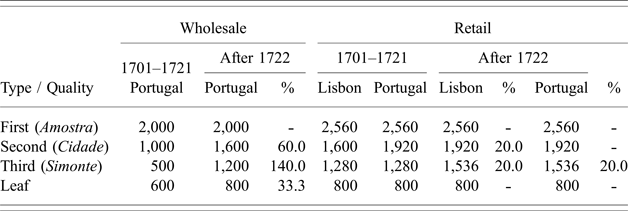
To ensure the collection of the tobacco excise, and after the transformation process, prices were administered both at the wholesale (grosso) and retail (miúdo) levels, thus setting the boundaries within which the general-farmer and sub-farmers could derive their profits. Wholesale and retail prices both varied, depending on which of the four types of tobacco the products were classified as: the three quality-related grades of snuff (amostra, cidade, and simonte) and leaf. Prices were first regulated in 1701, and increased again when De Bruijn, Cloots, and Van Zeller undertook their first general farm. A royal decree enacted in August 1721 and that came into effect in January 1722 resulted in a rise in both wholesale and retail prices, on a varying scale. Depending on the grade quality, wholesalers were subjected to increases of between 33.3 percent and 140 percent on tobacco bought at the royal factories, and this significantly eroded their gross profit margins. In the case, for example, of the cheapest and most frequently consumed type of snuff (simonte), gross margins fell by approximately two-thirds despite the increase in the retail price. Consumers also faced an increase of 20 percent in the price of third-grade quality tobacco, while the decision to standardize prices across the country especially hit consumers in Lisbon, who had previously enjoyed the privilege of paying less for second-grade quality tobacco (Table 1).
Tobacco Prices per Pound (réis)

Source: ANTT, JAT, bundle 30.
Having successfully bid for the contract, Willem de Bruijn and his partners were given the exclusive right to sell tobacco in the domestic market and on the Atlantic islands of the Azores and Madeira. In exchange for this right, they had to pay an annual fee of 720 million réis in monthly instalments of 46 million réis, supplemented by quarterly instalments of 42 million réis. The Dutch partners also undertook to pay the operating costs, which mainly comprised the costs of purchasing the raw product and the manufacturing costs incurred by the five royal manufactures. As part of the trade-off negotiated with the Crown, the partnership also received various economic benefits, which were typically granted to the monopoly holders. These comprised firstly the exclusive right to supply the Spanish tobacco monopoly, using earnings derived from re-exporting approximately nine hundred thousand to one million pounds of tobacco annually, and secondly, and more importantly, the prerogative each year to dispatch a ship to Brazil outside the convoy system.Footnote 51 Besides bypassing the intermediation of tobacco traders, this prerogative created opportunities for better prices, owing to the lack of competition, both when selling domestic and European commodities and when buying colonial goods.Footnote 52 Furthermore, it represented an opportunity for the Dutch tobacco tax farmers to openly participate in the Portuguese colonial trade. De Bruijn & Cloots consequently expected gross revenues from the monopoly and the interconnected businesses to yield a total of one billion réis annually. These high expectations led them to offer an additional 120 million réis on top of the lease price for the previous contract (1719–1721) in an effort to outbid the competition and secure the monopoly.Footnote 53 In doing so, their decision entailed certain additional risks, given that a state monopoly with administered prices meant that successfully managing the contract depended on being able to tailor operating costs to the expected revenues or on being able to increase sales. However, it was impossible to foresee how consumers would react to the 20 percent increase in retail prices due to come into effect in January 1722.
In late 1721, the partners took various managerial decisions on operating the monopoly, based on the three business segments into which it was divided: raw material acquisition, processing, and distribution. With regard to processing the leaves into snuff, one of their first concerns was to decide on management of the royal factories in Lisbon and Porto. The Lisbon factory was of paramount importance, not only because it acted as the sole buyer of Brazilian tobacco and it was from that factory that raw materials were distributed to the other four royal factories (Porto, Madeira, Terceira, and S. Miguel), but also because it was responsible for producing the highest share of snuff distributed in the domestic market. As for the factory in Porto, its relevance derived from the role it played in processing and distributing tobacco consumed in the northern regions of the country. The partners appointed managers (administradores) to run day-to-day operations in both factories, while responsibility for supervision was divided among the partners. De Bruijn and Cloots took on responsibility for managing the Lisbon factory and entrusted Arnaldo van Zeller with day-to-day management of the Porto factory and the monopoly in the northern districts. Van Zeller was nevertheless regularly monitored by his partners.Footnote 54
In the distribution segment, and following standard practices, the Dutch resorted both to subleasing and to directly exploiting the twenty-one units into which mainland Portugal was divided for the purpose of the monopoly.Footnote 55 They sub-farmed twelve units and kept the remaining nine under direct exploitation, which involved appointing administradores closely monitored by the partners. It is hardly surprising that Lisbon and Porto were included in this latter group as these two cities represented a major share of domestic market sales. The southern districts of Alentejo and Algarve, where De Bruijn & Cloots had already established a network of correspondents, were also managed through administradores. Whether subleased or directly run, the territorial units were regularly supplied with snuff or leaves dispatched by land, river, or sea. In return for these advances, sub-farmers had to make monthly payments to the Dutch contractors, as stipulated in the subleasing agreements, while the local managers channelled the net revenue from the tobacco sales. Delays in receiving these payments or, even worse, defaults by sub-farmers were undoubtedly one of the risks involved in running the monopoly.
If in both the manufacture and distribution segments the partners followed standard practices, they proved innovative in the raw material acquisition. Their innovation was to vertically integrate the supply chain, which they achieved by teaming up with a Portuguese merchant, through whom they imported large quantities of tobacco to undercut the intermediation of tobacco importers.Footnote 56 Despite this innovative business model, turnover from tobacco sales fell short of the partnership's expectations at the end of the first contract. Sales dropped across the country as consumers reacted negatively to the hike in the price of simonte, consumption of which accounted for approximately 74 percent of the market. Meanwhile sales in the northern districts contracted further as a result of some two hundred thousand pounds of tobacco being dumped in late 1721, a few weeks before the expected increase in retail prices.Footnote 57 Although this illegal practice had also affected farmers in the past, it attained an unusually high level in 1722, representing 23 percent of the tobacco injected annually into the domestic market from the Lisbon factory.Footnote 58 Since consumers reacted by building up stocks of the lower-priced tobacco, the Dutch clearly seem to have faced an overflowing and stagnant market from the start of their first contract.
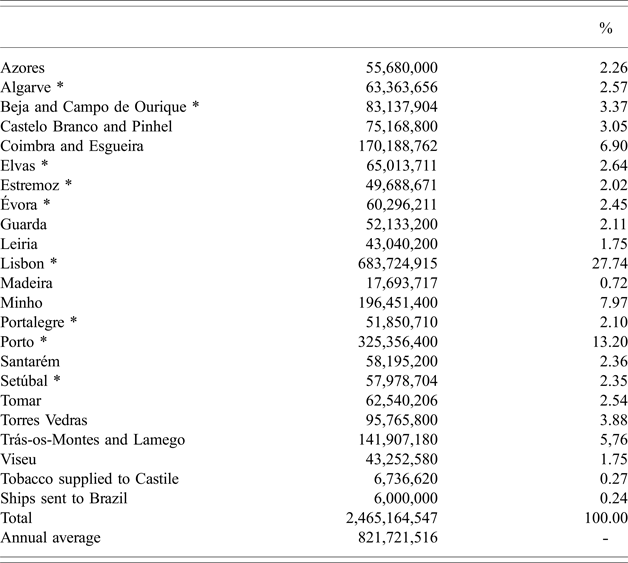
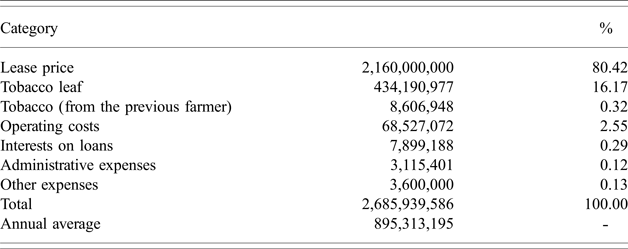
As turnover from sales fell short of their expectations, it became even more evident that the lease price that they had offered was disproportionate and had led to serious problems. Indeed, the partners declared a huge loss of two hundred and eighty million réis at the end of the first contract. According to the statement of income and expenditure presented to the Tobacco Board, the monopoly yielded annual turnover of around 821 million réis, which was insufficient to cover the lease price and the operating expenses of around 895 million réis (Tables 2 and 3).
Gross Revenue from Tobacco Monopoly, 1722–1724 (réis)

Source: BNP, bk. 235, fols. 23–24v.
*Territorial units administered directly by the Dutch partners.
Operating Costs of Tobacco Monopoly, 1722–24 (réis)

Source: BNP, bk. 235, fols. 23–24v.
The accuracy of this financial statement still needs to be verified by cross-checking with the firm's accounts, especially because the reported revenues of the interconnected businesses (the tobacco supplied to Spain and the licenced ships to Brazil) must surely be understated. The total losses are therefore likely to have been lower than reported. Nevertheless, the partners complied with the terms of the agreement and paid the lease price in full. How the partners covered the losses has still to be investigated, but they are likely to have used a combination of earnings generated from operating the businesses connected to their tobacco monopoly, such as importing and re-exporting tobacco, and the cargoes sent to Brazil through the licensed ships on the one hand and, on the other hand, borrowings from their international network and from the local network in which they had become entwined.
Having squared the accounts relating to the first contract, De Bruijn, Cloots, and Van Zeller negotiated a second three-year contract, albeit with a reduced annual fee of 680 million réis.Footnote 59 By accepting a lower fee, the Crown thus acknowledged that the rise in retail prices and the dumping of stocks in late 1721 had adversely affected the Dutch partnership. As for the partners, undertaking a second farming of the tobacco monopoly was regarded as a means to recoup the financial loss they had incurred under the first contract. This was because even though the costs and the risks of running the monopoly were high, it provided them with a steady stream of revenue that could be used to pay off debts and to stay in business. Moreover, as stated earlier, benefits inherent to the position of tax farmers provided added sources of profit, on which the contractors were also counting as a means to offset the losses previously incurred. However, the burden of these losses weighed on the partners and they entered the second contract in 1725 in a position of financial stress.
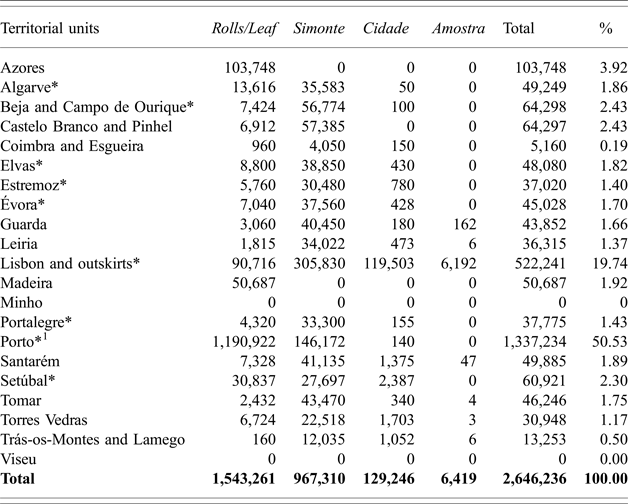
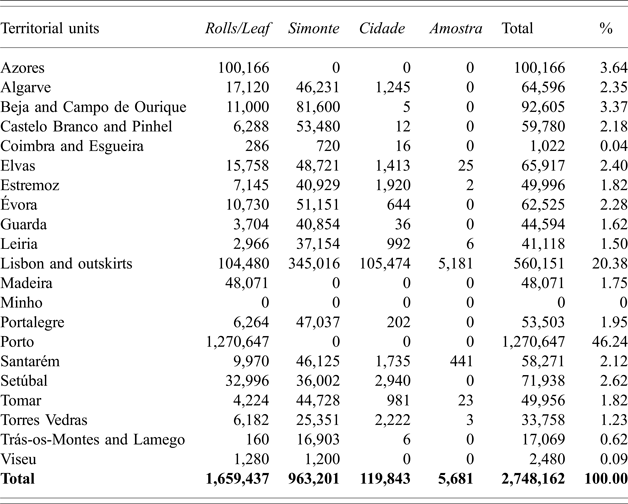
In the absence of a statement of income and expenditure for the second contract, the volumes of tobacco distributed by the Lisbon factory both in 1722–1724 and 1725–1727 provide insight into the comparative level of sales (Tables 4 and 5).Footnote 60
Tobacco Distributed by the Lisbon Factory, 1722–1724 (lbs)

Source: ANTT, JAT, bk. 85.
*Territorial units administered directly by the Dutch partners.
1 Porto received the bulk of the tobacco leaf to be transformed and distributed among the northern territorial units (Minho, Trás-os-Montes, Viseu, Coimbra, and Esgueira).
Tobacco Distributed by the Lisbon Factory, 1725–1727 (lbs)

Source: ANTT, JAT, bk. 57.
A comparison between the first and second contracts displays a positive variation of 3.8 percent of the tobacco distributed by the Lisbon factory, with consumption in Lisbon and in the southern districts resuming during the second period. How this translated into revenue actually collected by the Dutch, however, is a different matter. From what can be gathered from the correspondence, remittances from the administrators in the southern districts arrived regularly, but the same cannot be said for the northern districts, where sub-farmers were chronically late in making payment or even defaulted because of having to operate under the lower profit margins resulting from the new wholesale prices in 1722 (Table 1). Adjusting to these new circumstances required either higher sales volumes or lower distribution costs, which was difficult to achieve on a regional scale without changes in how the sub-farmers organized their business. As payment problems mounted in the northern districts, tensions within the partnership increased, with De Bruijn and Cloots holding Arnaldo van Zeller responsible for not monitoring the sub-farmers effectively. Given the increasing financial constraints in the second contract, with liabilities carried over from the previous contract and with credit also becoming increasingly difficult to obtain as 1727 drew to a close, a regular inflow of revenue from the monopoly was of paramount importance.
By August of that year, the Dutch partners were struggling to meet the monthly payments to the royal treasury, and the relationship between them came to a head when Paulo Cloots moved to Porto in an effort to collect the debts from the sub-farmers.Footnote 61 The final rift between the three occurred in November 1727, when Van Zeller informed the authorities of his partners’ intention to flee the country, leaving him to account for the debts owed not only to the royal treasury, but also to other businessmen in Lisbon.Footnote 62 As a result, De Bruijn, Cloots, and Van Zeller were put under house arrest, only to be released a few days later.Footnote 63 Albeit short, their imprisonment was taken as a sign of financial hardship, and their business reputation suffered accordingly.Footnote 64 As the damaging news spread quickly across the European marketplaces, their creditors demanded to be paid in full, which made it increasingly difficult for the Dutch to meet the final instalments under the monopoly contract.
Upon completion of the second tax farm, De Bruijn, Cloots, and Van Zeller were given time to settle their account with the royal treasury, as was customary, and went on to collect debts from regional sub-farmers through both judicial and extra-judicial means. By May 1730, however, they still owed 140 million réis. In an attempt to settle the debts, they filed a petition, requesting the Board of Tobacco to accept deductions totalling one hundred million réis and to discharge them from responsibility for the remainder.Footnote 65 Although this request was denied, the authorities could not confiscate the partners’ assets as long as cases involving debts payable to them were still pending in the courts. Therefore, De Bruijn and Cloots were able to stay in business for the time being and later went on to reduce their outstanding debts. By 1741, however, these still amounted to eighty million réis, an exorbitant amount for any business. Heavily burdened by these debts, as well as by debts to other merchants, the firm's business operations in Lisbon became increasingly difficult. Moreover, the Dutch were well aware that, under the existing legal framework, any debts to the state treasury incurred by partnerships for the purpose of tax farming would continue to exist until paid in full. This meant that they would also automatically be transferred to heirs in the event of a partner's death.Footnote 66 Seeing no prospect of any improvement, Willem de Bruijn and Paulo Cloots consequently chose to flee the country. Their remaining assets, including receivables still pending in the courts, were seized shortly afterwards, and Arnaldo van Zeller, who chose not to flee, was arrested. His imprisonment lasted until 1742, when he was released on bail, following the acknowledgement that the judgements in the pending court cases would cover a substantial amount of the remaining debts.Footnote 67
Although spectacular, the failure of the Dutch partnership was not unique. Three of the six merchant partnerships that had previously taken on the tobacco farm ended up bankrupt and, as recent scholarly work has shown, three more—including De Bruijn, Cloots, and Van Zeller—failed in the years to 1755.Footnote 68 Successfully running this state-owned monopoly, where prices were administered and fixed monthly instalments had to be paid, depended on a series of variables, including the business decisions taken by the general-farmers to organize sales on a nationwide scale and to monitor the agents (administrators and sub-farmers) in order to minimize the risks of defaulting on the monthly payments. Although an in-depth survey of the general and specific reasons that led to six of the thirteen general tobacco tax farmers failing in the first half of the eighteenth century has yet to be made, poor business decisions, mismanagement, and lack of capital seem to have been some of the common factors. These, however, do not fit the case of the Dutch partnership, as their contemporaries commonly acknowledged.Footnote 69 On the contrary, the insertion of De Bruijn and Cloots into the transnational networks and their state-of-the-art business and accounting skills would seem to have equipped them with some of the qualities needed in order to succeed. Moreover, their approach to the monopoly was innovative in that, in an effort to maximize profits, they had introduced an organizational change by vertically integrating the supply chain, while the high number of territorial units they directly exploited in the distribution segment was intended to mitigate risks derived from principal-agent problems. The reasons for their failure must consequently be sought elsewhere.
From the outset, the success of the Dutch consortium's endeavours was compromised by the excessive annual fee the partners offered to pay the royal treasury for the monopoly. Pinpointing the reasons for this miscalculation relative to the monopoly's gross yield and, as such, to the level of tobacco consumption in the Portuguese market is not an easy task, given the lack of details on the bidding process and the backstage negotiations accompanying it in late 1721. Lack of market information could be a possible explanation, were it not for the fact that, as the bureaucratic overseer of the monopoly, the Tobacco Board was kept regularly informed of the volumes of raw material supplied to the factory of Lisbon and the quantities of snuff and dried leaves distributed to the wholesale and retail outlets, as well as the value of the regional licences and sub-farms. Moreover, after almost ten years of successfully operating in Lisbon, and thanks to a network of local fellow merchants, including, by their own admission, an agent they kept at the royal court, De Bruijn and Cloots at least had access to the available market information. They were probably also acquainted with a rumour circulating among tobacco traders in the mid-1710s, according to which the tobacco tax farm had been overvalued.Footnote 70 In the competitive tender for the farm, the Dutch partners nevertheless offered to pay 20 percent on top of the previous lease price, thus signalling their intention to outbid their competitors and secure the business for themselves. Such a push needs first and foremost to be understood against the backdrop of the newly set prices that were due to be enforced from January 1722, and which certainly translated into higher bids overall. Secondly, and perhaps more importantly, the Dutch partnership, unlike previous monopoly holders and the other bidders, had an integrated view of the tobacco tax farm and aimed to fully exploit its interconnected businesses. Not only did they expect to draw profits from the annual ship they could send to Brazil and from the exclusive right to supply Brazilian tobacco to Spain, but they also aimed to use their position as tax farmers to gain advantages over competitors, both in the importing and re-exporting of tobacco, and so further boost their revenue. This integrated view led the Dutch consortium to estimate the whole range of business activities under the tobacco monopoly at one billion réis, an amount that they were confident would cover the lease price offered, as well as the operating costs, and still leave a surplus. This ultimately led them to outbid their direct competitors and to overlook the risks of running the monopoly against the background of an increase in retail prices.
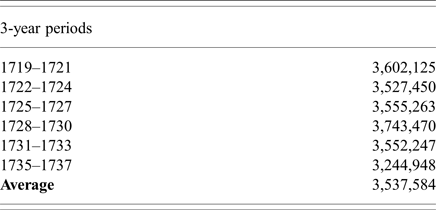
Consumers responded to the increased prices by reducing consumption at a rate that the Dutch partners had not foreseen. In the absence of data on quantities of tobacco consumed during the previous farm, the extent to which demand contracted has to be derived from estimates of the annual per capita consumption, which show consumption falling from 0.58 pounds (1719–1721) to 0.49 pounds (1722–1724).Footnote 71 Consumption later resumed, pushed by growth in Lisbon and all the comarcas directly exploited by De Bruijn, Cloots, and Van Zeller. However, consumption patterns continued to remain relatively low until the 1750s, especially compared to other European countries, and this worked against any tobacco tax farmer seeking to drive up profits by increasing the level of sales.Footnote 72 The quantities of raw material supplied to the Lisbon factory between 1719 and 1737 are also indicative of a market in which consumption levels fluctuated within a narrow band (Table 6).
Tobacco Leaf Bought for the Lisbon Factory, 1719–1737 (lbs)

Sources: ANTT, JAT, bks. 2, 6–7, 13, 17, 20.
As the resumption of demand in 1725–1727 and the lower lease price alone were barely sufficient to make up for the losses incurred under the first contract, the question of how the partnership fared in exploiting the businesses connected to the tobacco monopoly has to be addressed if we are to gain an overall understanding of the reasons for its failure. While a comprehensive quantitative assessment is limited by the fact that some of the corresponding accounting ledgers are missing or have become damaged beyond repair, indications can nevertheless be gathered from the sources, and these point to mixed results from these interconnected businesses. The partners proved successful at interloping in the Brazilian tobacco trade, given that they were able to secure the supply of 70 percent of the raw material processed in the Lisbon factory between 1722 and 1727. Moreover, they used this dominant share in the import business and their preferential right to select tobacco rolls at the royal tobacco warehouse to become major re-exporters, with 3.1 million pounds of tobacco being re-exported to various markets, mainly to Italian port cities and to Spain, during their six years as contractors.Footnote 73 Profits derived from these activities, however, may have been squeezed by an upward trend in producer prices that lasted until the 1730s, at a time when prices were falling elsewhere in Europe.Footnote 74 As for the annual licensed ship to Brazil, exploiting this privilege proved to be tricky. Despite the partners’ efforts to obtain information about market conditions in Salvador (Bahia), where tobacco was procured, matching supply to demand was difficult and, more often than not, the market was overstocked when the ship arrived shortly after the annual fleet.Footnote 75 As a result, turnover was slow and invested capital remained tied up for years, while opportunistic behaviour from agents based in Salvador brought added risks, a common complaint among Portuguese and foreign merchants in their dealings with Brazil.Footnote 76
Concluding Remarks
Aiming simultaneously to achieve both fiscal and colonial goals, the Portuguese tobacco monopoly imposed a number of constraints on tax farmers, thus turning management of this monopoly into a risky and demanding venture. High investments had to be made, both to cover operating costs and to fulfil the commitments to the state treasury, while a high degree of coordination and monitoring of sales was also paramount for the successful outcome of the contract. More importantly, given that retail prices were administered, the net profits accruing to tax farmers depended on their being able to adjust operating costs relative to the contract price or on being able to increase gross revenues through higher tobacco sales. In the late 1700s, both determinants worked in favour of the clique of businessmen who were able to successfully run the monopoly and extract exorbitant profits. This was not the case, however, for De Bruijn, Cloots, and Van Zeller.
The Dutch partners combined an extensive international network, from which they could draw capital, with an innovative business organization geared not only to more efficient monitoring of sales, but also to obtaining profits from interconnected businesses. Although aware that retail prices would increase, they pushed up the contract price to an economically dangerous level in an effort to outbid their competitors and secure the contract for themselves. In doing so, they clearly overlooked the risks of running the monopoly in an environment of higher retail prices, probably because the partners were confident that they could generate additional earnings from their organizational innovations and from exploiting the businesses interconnected with their tobacco activities. However, the scale of their business model demanded high levels of investment and, although this aspect still needs to be further investigated, earnings from both the Portuguese Atlantic trade and tobacco re-exports must have fallen short of the partners’ expectations. After the financial losses incurred under the first contract, and despite the lower annual fee and better sales performance under the second contract, the partners faced liquidity problems and difficulties in raising short-term credit, especially as the second contract drew to a close. By examining the management and outcome of the two tobacco contracts entered into by De Bruijn, Cloots, and Van Zeller, this article has shown how, in a competitive bidding context for a monopolistic rent, miscalculation of the future revenue streams and unfavourable economic circumstances combined to result in the tax farmers’ failure.
Abbreviations
- ADL:
Arquivo Distrital de Lisboa
- ANTT:
Arquivo Nacional da Torre do Tombo, Lisbon
- BNP:
Biblioteca Nacional de Portugal
- JAT:
Junta da Administração do Tabaco
- RPL:
Registos Paroquiais de Lisboa