I. INTRODUCTION
Since carbon nanocones (CNCs) have similar structures and properties to those of carbon nanotubes (CNTs), applications of such nanomaterial have developed considerably in recent years.Reference Tagmatarchis1 On the initial research in CNCs, Ge and SattlerReference Ge and Sattler2 proposed that there are five types of such nanomaterial each having a particular apex angle. Krishnan et al.Reference Krishnan, Dujardin, Treacy, Hugdhl, Lynum and Ebbesen3 later demonstrated the existence of the five types of CNCs and showed that they have apex angles of 19.2, 38.9, 60, 84.6, and 112.9°, respectively. Using transmission electron microscopy, synchrotron x-ray, and electron diffraction, Naess et al.Reference Naess, Elgsaeter, Helgesen and Knudsen4 observed wall structures and morphologies of the five types of CNCs. Similar to CNTs, CNCs can also be classified as single-walled and multiwalled CNCs according to the number of layers comprising the nanomaterial.Reference Iijima, Yudasaka, Yamada, Bandow, Suenaga, Kokai and Taskahashi5–Reference Zhang, Jiang and Wang7 With plasma-assisted approaches, mass growth of CNC arrays can be accomplished.Reference Tsakadze, Levchenko, Ostrikov and Su8,Reference Levchenko, Ostrikov, Long and Xu9 In addition to the common CNCs (having closed tips), open-tip CNCs (with their tips truncated) could be attainedReference Terrones, Hayashi, Muñoz-Navia, Terrones, Kim, Grobert, Kamalakaran, Dorantes-Davila, Escudero, Dresselhaus and Endo10,Reference Endo, Kim, Hayashi, Fukai, Oshida, Terrones, Yanagisawa, Higaki and Dresselhaus11 under proper control of synthetic conditions. The open-tip CNCs were shown to have similar structures and the same apex angles as their closed-tip counterparts.Reference Ekşioğlu and Nadarajah12
Owing to the special cone-shape structure of CNCs, practical applications of CNCs have been explored greatly in recent years. Because the tips of CNCs can offer high resolution and great intensity, CNCs are much appropriate for scanning probe tips,Reference Chen, Chen, Gapin, Jin, Yuan and Liou13,Reference Sripirom, Noor, Koehler and Schulte14 nanoindentation,Reference Hsieh, Chen, Chen, Chen and Hwang15 and electron field emitters.Reference Yu and Zheng16 Besides, CNCs also have potential in developing hydrogen-storage materials, since they have a favorable feature for hydrogen adsorption.Reference Adisa, Cox and Hill17,Reference Liao18 Using this nanomaterial as a promising thermal rectifierReference Yang, Zhang and Li19 for practical phononic devices is another application of CNCs. Because of these promising applications, researchers have paid great attention to investigate the mechanical behaviors of CNCs. For example, Jordan and CrespiReference Jordan and Crespi20 utilized molecular dynamics (MD) simulations to study mechanical chiral inversion of CNCs compressed by a spherical indenter on their tips. Tsai and FangReference Tsai and Fang21 inspected the nucleation, thermal stability, and nanomechanics of CNCs. Buckling and postbuckling behaviors of open-tip CNCs having an apex angle of 19.2° were investigated by Liew et al.Reference Liew, Wei and He22 They also examined mechanical properties of the CNCs subjected to tension.Reference Wei, Liew and He23
In recent years, Liao et al.Reference Liao, Cheng and Lin24 studied tensile and compressive behaviors of open-tip CNCs under axial strains. Influences of temperature, cone height, and apex angle on the behaviors were examined in the study. Fakhrabadi et al. utilized the methods of molecular mechanics and MD, respectively, to investigate elastic and buckling propertiesReference Fakhrabadi, Khani, Omidvar and Rastgoo25 as well as mechanical characterizationReference Fakhrabadi, Dadashzadeh, Norouzifard and Allahverdizadeh26 of CNCs. Yan et al.Reference Yan, Liew and He27 used a mesh-free computational framework for the study of buckling behaviors of open-tip CNCs with different apex angles. Later, they used a quasi-continuum approach to explore buckling and postbuckling behaviors of open-tip CNCs with an apex angle of 19.2° under bending.Reference Yan, Liew and He28 In a recent study, LiaoReference Liao29 inspected buckling behaviors of open-tip CNCs at elevated temperatures. Influences of cone height and apex angle on buckling mode shapes of the CNCs at elevated temperatures were examined in the study.
While there is considerable achievement in studies of mechanical behaviors of CNCs, studies on mechanical behaviors of CNCs with defects (such as vacancy defects) are deficient. This topic is very important as the practical applications of CNCs are explored largely. Moreover, similar to CNTs, defects in CNCs can appear at the stage of their growth/purificationReference Andrews, Jacques, Qian and Dickey30 as well as during their device production and can be created deliberately by chemical treatments or by irradiation to achieve desired functionalities.Reference Pierard, Fonseca, Konya, Willems, Van Tendeloo and Nagy31–Reference Cooper, Cohen, Barber and Wagner33 Therefore, it is worthy to understand influences of defects on mechanical behaviors of CNCs. In contrast to the plentiful studies on mechanical behaviors of CNTs with defects, such as the studiesReference Sammalkorpi, Krasheninnikov, Kuronen, Nordlund and Kaski34–Reference Sharma, Chandra, Kumar and Kumar37 for example, investigations on this topic for CNCs are rare in the available literature. To fill in this deficiency and provide some information for the practical applications of CNCs, this study extended the author's previous studiesReference Liao, Cheng and Lin24,Reference Liao29 to examine influences of vacancy defects on buckling behaviors of open-tip CNCs. Effects of vacancy location and temperature on the buckling behaviors were inspected in this study. The simulation method of this study is explained in the following section.
II. SIMULATION METHOD
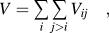
This study used MD simulations for investigating buckling behaviors of open-tip CNCs under axial compression. Since the Tersoff bond-order potentialReference Tersoff38,Reference Tersoff39 has been applied very well in investigations on CNC systems,Reference Tsai and Fang21,Reference Liao, Cheng and Lin24,Reference Liao29 it was also used in this study to model interactions of carbon atoms in the CNCs. The Tersoff bond-order potential can be expressed asReference Tersoff38,Reference Tersoff39
 $$V = \mathop\sum\limits_i {\mathop\sum\limits_{j > i} {{V_{ij}}\quad {\rm{,}}} }$$
in which, V is the potential energy of the CNC system; V ij is the bond energy between atoms i and j, which can be written as
 $${V_{ij}} = {f_{\rm{c}}}\left( {{r_{ij}}} \right)\left[ {{V_{\rm{R}}}\left( {{r_{ij}}} \right) + {b_{ij}}{V_{\rm{A}}}\left( {{r_{ij}}} \right)} \right]\quad {\rm{,}}$$
where V R(r ij) and V A(r ij) represent, respectively, the repulsive and the attractive energies between atoms i and j, f c(r ij) is a smooth cutoff function, and r ij represents the distance between atoms i and j. The function b ij is the bond order for atoms i and j. It is the key feature of the Tersoff potential. Complete expressions for the above functions and the corresponding parameters can be attained from Ref. Reference Tersoff39.
With the potential functions described above, interaction forces among carbon atoms in the CNC system can be calculated from the gradient of the potential functions. Equations of motion for the CNC system can then be attained. By integrating the equations of motion, evolution of each carbon atom could be obtained, from which buckling behaviors of the CNC system can be examined. For integrating the equations of motion, Gear's fifth predictor–corrector algorithmReference Rapaport40 with a time step of 1 fs (10−15 s) was used in this study. Moreover, NVT (canonical, constant number of atoms, volume, and temperature) ensembles were utilized during the simulations and the velocity rescaling methodReference Haile41 was used as a thermostat to maintain the system at the prescribed temperature.
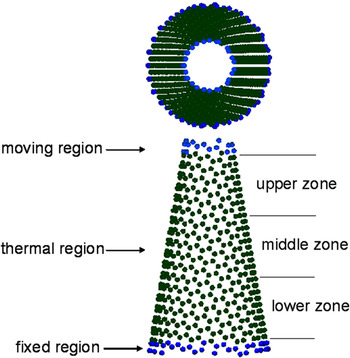
For investigating influences of vacancy location on buckling behaviors of open-tip CNCs using the MD simulations, a simulation model was created before starting the MD simulations. Figure 1 depicts the simulation model of this study, where front and top views of the simulation model for a single-walled open-tip CNC with an apex angle of 19.2° and cone height of 40 Å were displayed. In this model, the CNC was divided into three regions including moving, thermal, and fixed regions. Both the moving (the top) and the fixed (the bottom) regions have a height of a 20th (1/20) of the total height of the CNC. The fixed region was placed to model the fixture applied on the CNC during application of axial compression. Atoms in the fixed region were completely constrained during the simulations. The moving region was devised for applying the axial compression on the CNC. In this study, the axial compression was applied and controlled by a downward axial displacement of the moving region. Thus, atoms in the moving region were only allowed to move downward, and motions in other directions were restrained. For more stable simulation results, the moving region was set to move gradually at a very small constant speed of 1 m/s. The thermal (the middle) region of the simulation model was designed as a thermostat. Velocities of atoms in this region were rescaled via the velocity rescaling method to control the system temperature retaining at the prescribed temperature. It should be noted that atoms in both the fixed and the moving regions were not affected by any interatomic force, but they can apply interatomic forces on atoms in the thermal region.
Front and top views of the simulation model.

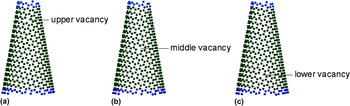
To inspect influences of vacancy location on buckling behaviors of the CNC, the middle region (namely, the strained region) was partitioned into the upper, middle, and lower zones. Each zone has a height of three tenths of the total height of the CNC. For discussing the influences of vacancy location, a vacancy defect was designed in the middle of the half front wall of each zone. This results in an upper vacancy defect, a middle vacancy defect, and a lower vacancy defect, respectively, in the CNC, as displayed in Fig. 2. It should be noted that to examine effects of the height of the vacancy defect on the buckling behaviors, the vacancy defects were created by removing an atom near the midway point rather than the centroid of the half front wall of each zone (as depicted in Fig. 2).
Locations of the vacancy in the studied CNCs. (a) Upper vacancy, (b) middle vacancy, and (c) lower vacancy. Only half of the atoms are displayed to show the vacancy location.

With the three models of the vacancy-defect CNCs shown in Fig. 2 and the model for the perfect CNC (without any vacancy defect), the MD simulations were carried out on the four models. By comparing the results of these models, influences of vacancy location on buckling behaviors of the CNCs could be evaluated. Before the simulations, the CNCs were subjected to structure relaxation to eliminate artificial constraints established during the construction of the simulation models. After this procedure, constraints were imposed on the fixed and the moving regions. The axial compression was then applied, and the MD simulations initiated. Data during the simulations were collected and analyzed to inspect influences of vacancy location on buckling behaviors of the CNCs.
III. RESULTS AND DISCUSSION
A single-walled open-tip CNC with an apex angle of 19.2° was investigated in this study. The CNC has a cone height of 40 Å, a top diameter of 8 Å, and a bottom diameter of 22 Å. To examine influences of vacancy defects on buckling behaviors of the CNC, a perfect (without any vacancy defect) model consisting of 770 carbon atoms, and three models with a upper vacancy defect, a middle vacancy defect, and a lower vacancy defect, respectively, in the CNC (as shown in Fig. 2) were inspected. To understand the effects of temperature on the buckling behaviors, three temperature conditions of 100, 300, and 500 K were considered in the study.
It is worthy to note that the CNC with an apex angle of 19.2° was examined in this study, though it has lower statistical distribution (namely, has lower abundance) than that with an apex angle of 38.9 or 60°.Reference Krishnan, Dujardin, Treacy, Hugdhl, Lynum and Ebbesen3 The reason for this selection is based on the consideration of antibuckling ability (or structural rigidity) of the CNCs. From the studies on mechanical behaviors of CNCs with the same cone height, it was observed that Young's modulus and natural frequencies of the CNCs decrease with increasing the apex angle.Reference Fakhrabadi, Khani, Omidvar and Rastgoo25,Reference Fakhrabadi, Dadashzadeh, Norouzifard and Allahverdizadeh26 Antibuckling ability (namely, the critical strain and the critical load) of the CNCs was also found to decrease with the increase of the apex angle.Reference Liao, Cheng and Lin24–Reference Fakhrabadi, Dadashzadeh, Norouzifard and Allahverdizadeh26,Reference Liao29 Owing to this tendency, the CNC with an apex angle of 19.2° might be a promising nanomaterial for practical applications. As a result, researchers have paid much attention to this nanomaterial.Reference Hsieh, Chen, Chen, Chen and Hwang15,Reference Liao18,Reference Liew, Wei and He22,Reference Yan, Liew and He28 Since antibuckling ability is a property critically concerned for applications of CNCs in nanoindentationReference Hsieh, Chen, Chen, Chen and Hwang15 and because the CNC with an apex angle of 19.2° has the greatest antibuckling ability among the five types of CNCs, this CNC was selected as the target for the present study to provide some useful information for its application in nanoindentation systems. Investigations into the influences of vacancy defects on buckling behaviors of the CNC with another apex angle for other applications could also be conducted in a similar way and were not discussed in this study.
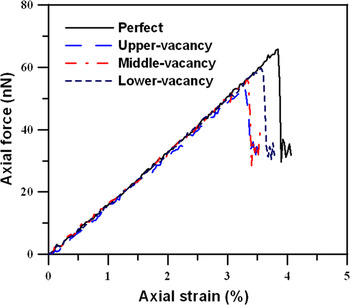
Figure 3 plots the axial compressive force versus the axial compressive strain for the perfect and the vacancy-defect CNCs at a temperature of 300 K. The axial compressive strain was determined from the ratio of the displacement of the moving region to the height of the thermal region (namely, the strained region). The axial compressive force was calculated by summing the forces acting on atoms in the strained region by atoms in the moving region. Only the forces in the axial direction were considered in the calculations. For each CNC, the compressive force was found to grow linearly with the compressive strain up to a critical strain after which the compressive force had a sudden drop. Buckling of the CNCs occurred just beyond this critical state. The critical strains for the perfect, upper-vacancy, middle-vacancy, and lower-vacancy CNCs are 3.84, 3.29, 3.32, and 3.57%, respectively. The corresponding critical loads (buckling loads) are 65.8, 54.0, 56.2, and 59.7 nN, respectively. It was noticed that a vacancy in the upper zone and in the middle zone of the CNC has comparable degree of degradation in the critical strain and in the critical load of the CNC. However, the degree of degradation for a vacancy in the lower zone is much lower than that in the upper zone and in the middle zone. The same behaviors were also observed at the temperatures of 100 and 500 K.
Axial compressive force versus axial compressive strain for the perfect and the vacancy-defect CNCs at a temperature of 300 K.

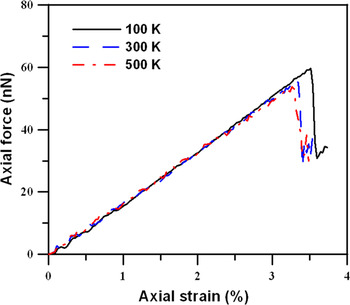
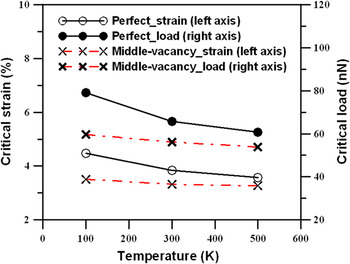
For temperature effects on buckling behaviors of the CNCs, Fig. 4 displays the axial compressive force versus the axial compressive strain for the middle-vacancy CNC at the three temperatures. The critical strain and the critical load were noticed to decrease with the growth of the temperature. The decrease is ascribed to the larger kinetic energy of the CNC at a higher temperature. As the temperature grew, apparent oscillation was also observed in the curves for the compressive force. The apparent oscillation in these curves is resulted from the larger kinetic energy and greater oscillating motion of the CNC at the higher temperature. Similar buckling behaviors were also found for the perfect, the upper-vacancy, and the lower-vacancy CNCs. The temperature effects could also be observed from Fig. 5, where the critical strain and the critical load for the perfect and the middle-vacancy CNCs at the three temperatures were plotted. From the figure, it was also noticed that the temperature effects on the perfect CNC are more obvious than those on the middle-vacancy CNC. This indicates that the perfect CNC is much sensitive to the change in temperature than the middle-vacancy CNC. Besides, degradation in the critical strain of the middle-vacancy CNC was found to decrease with the growth of the temperature. The decrease in degradation with the growing temperature also occurred in the curves for the critical load. Namely, the antibuckling ability of the middle-vacancy CNC degrades evidently at a lower temperature, but the degree of degradation decreases as the temperature grows. These findings also occurred in the cases of the upper-vacancy and the lower-vacancy CNCs. The decrease in degradation of the antibuckling ability with the growing temperature was also found in the study of CNTs with a vacancy defect.Reference Xin, Han and Yao35
Axial compressive force versus axial compressive strain for the middle-vacancy CNC at the three temperatures.

Critical strain and critical load for the perfect and the middle-vacancy CNCs at the three temperatures.

It should be noted that the purpose for examining temperature effects on buckling behaviors of the CNCs with vacancy defects is to understand the degree of degradation in the antibuckling ability (resulting from existence of the defects) as the temperature grows. From the above observation, it was noticed that influences of temperature on the antibuckling ability of the perfect CNC are more obvious than that of the vacancy-defect CNCs (refer to Fig. 5). Namely, reduction in the antibuckling ability owing to temperature growth diminishes as the CNCs have vacancy defects. In addition, for the vacancy-defect CNCs, degradation in the antibuckling ability is much apparent at a lower temperature, but it decreases as the temperature grows. The above observations are important for applications of the CNCs because, in practice, vacancy defects often exist in the CNCs.
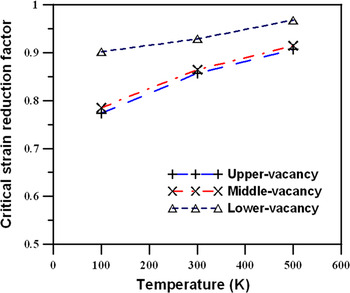
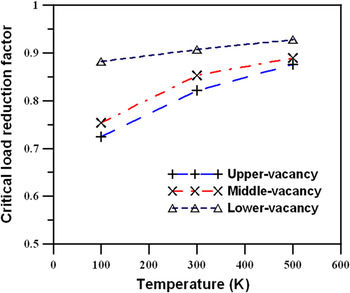
To further understand the degree of degradation in the antibuckling ability of the three vacancy-defect CNCs, Figs. 6 and 7 show the critical strain reduction factor (R ε) and the critical load reduction factor (R F), respectively, for the vacancy-defect CNCs at the three temperatures. The critical strain reduction factor (R ε) and the critical load reduction factor (R F) are defined by the following expressions
 $${R_\varepsilon }{\rm{\ }} = {\rm{\ }}{{{\varepsilon _{{\rm{cr\_vacancy}}}}} \mathord{\left/ {\vphantom {{{\varepsilon _{{\rm{cr\_vacancy}}}}} {{\varepsilon _{{\rm{cr\_perfect}}}}}}} \right. \kern-\nulldelimiterspace} {{\varepsilon _{{\rm{cr\_perfect}}}}}}\quad {\rm{,}}$$
 $${R_{\rm{F}}}{\rm{\ }} = {\rm{\ }}{{{F_{{\rm{cr\_vacancy}}}}} \mathord{\left/ {\vphantom {{{F_{{\rm{cr\_vacancy}}}}} {{F_{{\rm{cr\_perfect}}}}}}} \right. \kern-\nulldelimiterspace} {{F_{{\rm{cr\_perfect}}}}}}\quad {\rm{,}}$$
where εcr_vacancy and εcr_perfect are, respectively, the critical strains of the vacancy-defect CNC and the perfect CNC, while F cr_vacancy and F cr_perfect are the critical loads of the vacancy-defect CNC and the perfect CNC, respectively. From Figs. 6 and 7, it confirms the previous discussion that the upper-vacancy CNC and the middle-vacancy CNC have comparable degree of degradation in the critical strain and in the critical load, whereas the middle-vacancy CNC has lower degradation in the antibuckling ability than the above two CNCs. Moreover, it was observed that the critical strain reduction factor and the critical load reduction factor increase with the growth of the temperature. This implies that influences of vacancy defects on buckling behaviors of the CNCs are not evident as the temperature grows. It seems that a higher temperature could make the vacancy-defect CNCs more flexible to release the internal stresses during the action of the axial compression. As a result, the influences of vacancy defects diminished as the temperature grows. It was also noticed by comparing the results of Figs. 6 and 7 that the critical strain reduction factor for each case is greater than the corresponding critical load reduction factor. Namely, degradation in the critical strain of the vacancy-defect CNC is lower than that in the critical load. The above findings could provide some information about influences of vacancy defects on buckling behaviors of the CNCs and are beneficial to their practical applications.
Critical strain reduction factor for the vacancy-defect CNCs at the three temperatures.

Critical load reduction factor for the vacancy-defect CNCs at the three temperatures.

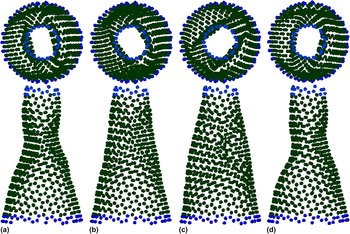
Regarding buckling modes of the CNCs, Fig. 8 displays the front and the top views of the buckling mode morphologies for the perfect and the vacancy-defect CNCs at a temperature of 300 K. The buckling mode morphology of each CNC was obtained at the axial compressive strain just beyond its critical strain and having an axial compressive force dropping abruptly to a local minimum. Namely, the buckling mode morphology was taken from the first collapsing structure of each CNC after imposing the axial compression. The corresponding compressive strain at which the buckling mode occurred is shown in the parenthesis of each buckling mode morphology. From the front view of Fig. 8(a), it was noticed that the perfect CNC buckles near the middle of the CNC and exhibits a shrinking/swelling shape. The shrinking/swelling buckle mode shape could also be observed from the top view of the corresponding buckling mode morphology. Because of the shrinking and swelling deformation at the buckling of the CNC, the initial (unstrained) inner circular boundary of the CNC (see Fig. 1) was compressed in a certain direction and stretched in the corresponding perpendicular direction. Therefore, it showed a noncircular shape (having flat portions) in the buckling mode morphology. This demonstrates the shrinking/swelling buckle mode shape of the CNC.
Front and top views of the buckling mode morphologies for the perfect and the vacancy-defect CNCs at a temperature of 300 K. (a) Perfect CNC (3.90%), (b) upper-vacancy CNC (3.37%), (c) middle-vacancy CNC (3.40%), and (d) lower-vacancy CNC (3.68%). Values in the parentheses denote the corresponding axial compressive strain at which the buckling modes occurred.

From Figs. 8(b)–8(d), it was found that all the upper-vacancy, the middle-vacancy, and the lower-vacancy CNCs also exhibit a shrinking/swelling shape. The upper-vacancy CNC buckled near the location of the upper vacancy, and the middle-vacancy CNC buckled very close to the location of the middle vacancy. On the contrary, the lower-vacancy CNC buckled near the middle of the CNC rather than near the location of the lower vacancy. The buckling point far from the location of the lower vacancy is ascribed to the greater rigidity of the lower zone as compared with the middle zone of the CNC. This greater rigidity results from the nonuniform radius along the CNC's cone axis. Because of the greater rigidity, the lower zone is much stiff to resist buckling occurred in this zone. Thus, the lower-vacancy CNC buckled near the middle of the CNC rather than close to the location of lower vacancy. Besides, it was also observed that all the CNCs (including the perfect and the vacancy-defect CNCs) exhibited a shrinking/swelling buckling mode shape at the other two temperatures (100 and 500 K).
IV. CONCLUSIONS
Influences of vacancy defects on buckling behaviors of open-tip CNCs have been examined in this study by the MD simulations. Effects of vacancy location and temperature on the buckling behaviors were inspected in the study. To discuss the influences of vacancy defects, perfect and three vacancy-defect CNCs (including the upper-vacancy, the middle-vacancy, and the lower-vacancy CNCs) were investigated, and their buckling behaviors were compared. From the results of the study, it was noticed that the upper-vacancy and the middle-vacancy CNCs have comparable degree of degradation in the critical strain and in the critical load, whereas the lower-vacancy CNC has lower degradation in the critical strain and in the critical load than the above two CNCs. Besides, the degradation in the critical strain of the vacancy-defect CNC was observed to be lower than that in the critical load.
It is noteworthy that open-tip CNCs with a single vacancy were investigated in this study. It is not easy to use the results of this study to predict quantitatively the buckling properties (the critical strain and the critical load) for the CNCs with multiple vacancies in multiple locations. This is because, as in the investigations for CNTs,Reference Eftekhari, Mohammadi and Khoei36,Reference Sharma, Chandra, Kumar and Kumar37 the dependence of mechanical properties and the number of defects are not in a simple relation. More data are required for quantitative prediction of the buckling properties for the CNCs with multiple vacancies. This issue is worthy of future research. However, to qualitatively predict the properties, the above findings regarding the influences of defect location on the buckling properties might be applied to the investigations for the CNCs with multiple vacancies.
Regarding the effects of temperature, the critical strain and the critical load were found to decrease with the growth of the temperature. The temperature effects on the perfect CNC are more evident than those on the vacancy-defect CNCs. It was also noticed that the degradation in the antibuckling ability of the CNCs is apparent at a lower temperature, but the degradation decreases as the temperature grows. In addition, all the CNCs (including the perfect and the vacancy-defect CNCs) exhibited a shrinking/swelling buckling mode shape at each studied temperature. Existence of the vacancies did not change the buckling mode shape of the CNCs.
Because investigations on this topic are scarce in the literature, the present study might provide some information about influences of vacancy defects on buckling behaviors of the open-tip CNCs. This information is beneficial to applications of the CNCs.
ACKNOWLEDGMENTS
The author gratefully acknowledges the support provided to this research by the Ministry of Science and Technology of Taiwan under Project Grant No. NSC 103-2923-E-006-004-MY3. The author also thanks the editor and referees for their helpful recommendations to make this study more readable.