Introduction
Consumption of residue-free food is a key issue in the effort to minimize ecological and health damage. Hence, health authorities of different countries have developed regulations that limit the maximal permitted levels of pesticide residues (Maximal Residue Limit – MRL), that is, the maximum residual limit of the active chemical component of the pesticide, in various agricultural products (European Union, 2019; US Environmental Protection Agency, 2019). Each authority publishes its regulations in its own proprietary database which yields, on a global scale, a ‘Tower of Babel’ of pesticide regulations. Farmers, who have to decide which pesticide to use against a particular crop-damaging pest, need to take into account these regulations, in addition to application instructions and financial considerations. However, the fact that these data are stored in different locations, sometimes using different terminology or different languages, makes it difficult to gather the data and requires that farmers are familiar with the variety of terms used, which consequently hampers the efficiency and effectiveness of the decision-making process.
Such challenges can be overcome by using an ontology, which is a formal representation of domain knowledge that can be interpreted by computers (Chandrasekaran et al., Reference Chandrasekaran, Josephson and Benjamins1999). In other words, ontologies formally define the entities (concepts) of a domain, their attributes and the relationships among them in a computer-interpretable way. Thus, ontologies have become a major tool for domain knowledge representation and a core component of many knowledge management systems, decision support systems (DSSs) and other intelligent systems (Chandrasekaran et al., Reference Chandrasekaran, Josephson and Benjamins1999; Noy and McGuinness, Reference Noy and McGuinness2001; Yu et al., Reference Yu, Thom, Tam, Meersman and Tari2005; Bose and Sugumaran, Reference Bose, Sugumaran, Kulkarni, Power and Sharda2007; Delir Haghighi et al., Reference Delir Haghighi, Burstein, Zaslavsky and Arbon2013).
Ontologies, being a formal explicit description of domain knowledge, can be used for various tasks: knowledge deduction (Kim and Beck, Reference Kim and Beck2006), sharing conceptual schemata of data and allowing data interoperability between applications and databases (Gruber, Reference Gruber1993), reuse of domain knowledge (Noy and McGuinness, Reference Noy and McGuinness2001; Roussey et al., Reference Roussey, Soulignac, Champomier, Abt and Chanet2010) and extraction of data over the Web via the Semantic Web (Berners-Lee et al., Reference Berners-Lee, Hendler and Lassila2001; W3C 2006). To support these tasks, several ontology-related standards and tools have been developed (Berners-Lee et al., Reference Berners-Lee, Hendler and Lassila2001; W3C 2006).
The increasing use of ontologies is also seen in agriculture (Zhang et al., Reference Zhang, Wang and Wang2002; Chang et al., Reference Chang, Xian, Li, Nagatsuka and Ninomiya2008; Beck et al., Reference Beck, Morgan, Jung, Grunwald, Kwon and Wu2010; Roussey et al., Reference Roussey, Soulignac, Champomier, Abt and Chanet2010; Song et al., Reference Song, Wang, Ying, Yang and Zhang2012; Li et al., Reference Li, Kang, Cheng, Li, Ji, Wang and Chen2013; Liao et al., Reference Liao, Li and X2015; Tomic et al., Reference Tomic, Drenjanac, Hoermann and Auer2015; Chougule et al., Reference Chougule, Jha, Mukhopadhyay, Satapathy, Bhateja and Joshi2016; Kragt et al., Reference Kragt, Pannell, McVittie, Stott, Vosough Ahmadi and Wilson2016), where they are used for various purposes such as sharing of agricultural knowledge among farmers around the world (and in different languages) (AGROVOC Thesaurus; Chang et al., Reference Chang, Xian, Li, Nagatsuka and Ninomiya2008; Maliappis, Reference Maliappis, Sicilia and Lytras2009), creating semantic inter-operability of agricultural systems (Goumopoulos et al., Reference Goumopoulos, Kameas and Cassells2009; Aqeel-ur and Zubair, Reference Aqeel-ur and Zubair2011; Tomic et al., Reference Tomic, Drenjanac, Hoermann and Auer2015) and supporting farmer decisions (Gaire et al., Reference Gaire, Lefort, Compton, Falzon, Lamb, Taylor, Blomqvist and Groza2013). This trend is not surprising, given that agriculture is a knowledge-centric field that covers many areas of expertise, worldwide practices and technologies, and concepts that are often designated by different names with similar meaning (Palavitsinis and Manouselis, Reference Palavitsinis, Manouselis and Sicilia2014; Liao et al., Reference Liao, Li and X2015) that are fragmented across different systems (Janssen et al., Reference Janssen, Porter, Moore, Athanasiadis, Foster, Jones and Antle2017).
In the context of pest control, several studies have used ontologies to facilitate efficient knowledge extraction and best practices. For example, Beck et al. (Reference Beck, Kim and Hagan2005) created a crop-pest ontology to foster accurate retrieval of publications and educational resources. Maliappis (Reference Maliappis, Sicilia and Lytras2009) and Liao et al. (Reference Liao, Li and X2015) used an ontology that covers, among other things, the crop-pest domain in order to integrate crop-cultivation knowledge from different independent information systems to support farmers in their daily tasks. However, the schemata of the ontologies used in previous studies remained undescribed. Li et al. (Reference Li, Kang, Cheng, Li, Ji, Wang and Chen2013) developed an ontology for representing crop cultivation standards and practices in China, which included pesticides and pest-control activity concepts. However, the crop cultivation standard ontology was focused on pest-control activities (e.g. pesticide application timing, application method/equipment, dosage) rather than on selecting which products to use, when and how much they should be used, while taking into account pesticide regulations in different countries. Song et al. (Reference Song, Wang, Ying, Yang and Zhang2012) discussed the advantages of using an ontology for the integration of agricultural knowledge and illustrated an example of such an ontology by focusing on tomatoes and including such concepts as crop, pest and pesticides and such relationships as kills (pesticides, pests) and damages (pest, plants). However, they did not discuss pest-control regulations and treatments.
The primary goal of the current research is to develop a pest-control ontology, including both the ontology schema (i.e. types of entities and the relationships among them) and instances (specific pests, pesticides, manufacturers, etc.). The ontology is aimed at facilitating the integration of information on pesticide use and pest-control regulations coming from multiple sources and represented by different terminologies over the Web, thereby addressing the ‘Tower of Babel’ problem mentioned above. The ontology plays a central role in a Web-based application, intended to provide better decision support for farmers deciding which pesticide products to use and how to apply them for different pests and crops, while taking into account pesticide regulations in the destination countries to which the crops are exported. Furthermore, the proposed ontology can be used by other applications and other ontologies, which can refer to it.
In order to demonstrate the potential of the proposed ontology and its applicability to pest-control decision support, a single crop – pepper – is used. Pepper is a suitable case as more than 0.60 of the crop is exported to Russia, European Union countries and the USA. Each of these destinations has its own MRL levels (Table 1), requiring the farmer to consider not only the Israeli MRL regulations but also three additional sets of regulations. Furthermore, the selection of a suitable pesticide to treat pepper pests is complicated, as there are 66 different pesticides (manufactured by 45 different manufacturers) used in Israel.
Maximal Residue Limit (MRL) databases

PPIS, Plant Protection and Inspection Services; USA, United States of America; EU, European Union.
A review of the existing literature on agricultural ontologies reveals that most of the studies that propose agricultural ontologies are lacking a clear ontology development method and, more importantly, explicit evaluation procedures (a summary of studies and whether they include a development and/or evaluation method appears in Goldstein et al., Reference Goldstein, Fink and Ravid2019). This is undesirable because, without well-structured development and evaluation processes, it is difficult to consider the value of ontologies to research and practice. Moreover, it is difficult to rely on such ontologies and share them on the Semantic Web or between semantic-aware applications. Thus, a secondary goal of the current research is to present a generic and comprehensive method for developing and evaluating agricultural ontologies. This method is demonstrated through the development and evaluation of the current pest-control ontology.
Materials and methods
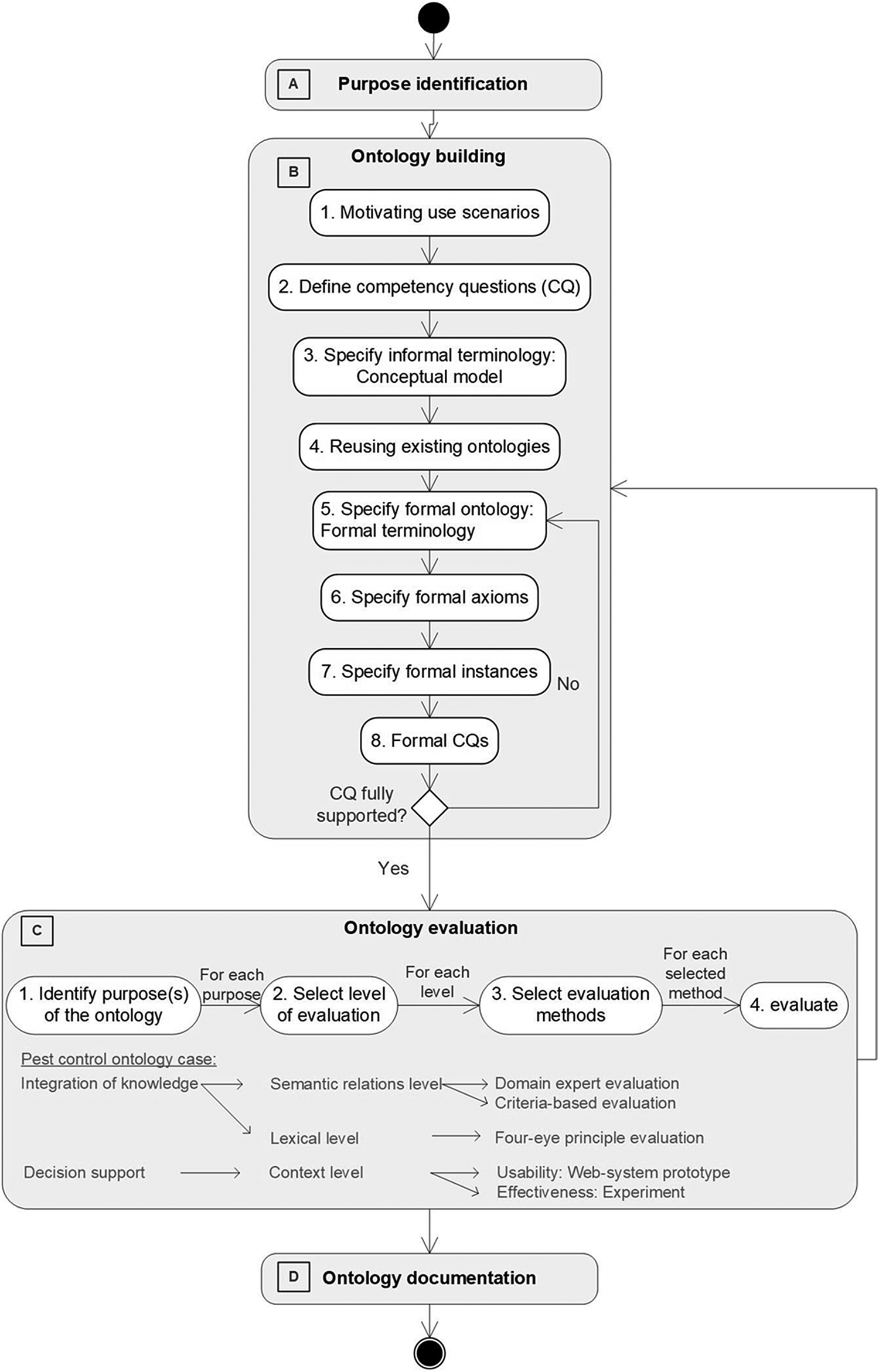
The method used in the current study to develop the pest-control ontology integrated several well-known methods for ontology development. It was based mainly on a method proposed by Uschold and King (Reference Uschold and King1995), which includes four phases: purpose identification, ontology building, evaluation and documentation. However, these phases were extended based on additional ontology development methods (Grüninger and Fox, Reference Grüninger and Fox1995; Noy and McGuinness, Reference Noy and McGuinness2001; Fernández-López and Gómez-Pérez, Reference Fernández-López and Gómez-Pérez2002; De Nicola et al., Reference De Nicola, Missikoff and Navigli2009) and based on evaluation methods (Brank et al., Reference Brank, Grobelnik and Mladenić2005; Yu et al., Reference Yu, Thom and Tam2007), as described in the following sub-sections. The development method is presented in Fig. 1.
Ontology development method.

Purpose identification
In this phase (Fig. 1(a)), the goals of the ontology and its intended uses were defined. A clear and simple definition of the purpose would help other possible users locate the ontology and would facilitate the reuse of the ontology by others in the future. The definition should also include prospective users and platform constraints (if they exist) and specify who will maintain the ontology.
Ontology building
In this phase (Fig. 1(b)), the ontology was built using the following steps proposed by Grüninger and Fox (Reference Grüninger and Fox1995). The first step (Fig. 1(b).1) was to define possible use scenarios (e.g. problems encountered by prospective users that could benefit from the ontology or its applications). Once the scenarios were defined, informal competency questions (CQs) were designed in the second step (Fig. 1(b).2). Competency questions are those that should be answered by the ontology. Furthermore, the CQs can demonstrate that the ontology (or ontology extension) is indeed required and not already answered by existing ontologies. The CQs can be used subsequently to demonstrate the expressiveness of the ontology, by showing that it is possible to answer the CQs using the ontology objects and constrains (Noy and McGuinness, Reference Noy and McGuinness2001). Next, an informal terminology of the ontology was specified (Fig. 1(b).3), using a graphical conceptual model (specifically, a Unified Modelling Language (UML) class diagram, as recommended by De Nicola et al., Reference De Nicola, Missikoff and Navigli2009). Once informal terms were identified, similar concepts in other ontologies were investigated (Fig. 1(b).4). It is always worth considering the reuse of existing ontologies and sometimes it is even inevitable, as is the case when interaction with other applications is required (Noy and McGuinness, Reference Noy and McGuinness2001). The Semantic Web, which is recommended for publishing agricultural ontologies, simplifies the task of reusing existing ontologies.
Once concepts from existing ontologies had been mapped, the ontology was formalized (Fig. 1(b).5) through selecting a suitable ontology language and an ontology editor. Corcho et al. (Reference Corcho, Fernández-López and Gómez-Pérez2003) reviewed and compared existing ontology tools and languages, from which the language and editor can be selected. In order to specify formally the current ontology schema, to create its instances and to define constraints and logic inference rules (Fig. 1(b).6), the Web Ontology Language (OWL), which is the de facto standard for specifying ontologies in the Semantic Web, was used. Protégé (Noy and McGuinness, Reference Noy and McGuinness2001) was used as the ontology editor, since it supports OWL. Finally, it should be possible to specify the CQs using the ontology (Fig. 1(b).7). If this is not the case, the ontology should be adjusted to include any missing concepts or relationships and remove redundant ones.
Ontology evaluation
In this phase (Fig. 1(c)), the ontology was evaluated. To select appropriate evaluation methods for a given ontology, it was important to account for the purpose of the ontology (Fig. 1(c).1). Based on the ontology purpose, the aspects (levels) of the ontology that should be evaluated were determined (Fig. 1(c).2) and, consequently, the evaluation methods that should be used (Brank et al., Reference Brank, Grobelnik and Mladenić2005; Yu et al., Reference Yu, Thom and Tam2007) were also determined (Fig. 1(c).3). The ontology was then evaluated using each one of the selected methods (Fig. 1(c).4). A detailed framework for matching evaluation methods to agricultural ontologies is presented in Goldstein et al. (Reference Goldstein, Fink and Ravid2019).
According to the framework, when the purpose of the ontology is knowledge integration, it requires evaluation of the lexical-vocabulary-data level to ensure that the vocabulary used by the ontology is sufficient, and evaluating the semantic relations level to ensure that there are no semantic ambiguities among concepts from different sources (Brank et al., Reference Brank, Grobelnik and Mladenić2005). When the purpose of the ontology is to provide decision support, it requires evaluation of the context level, that is, the application that uses the ontology.
To evaluate the semantic relations level, criteria-based evaluation is commonly used. Delir Haghighi et al. (Reference Delir Haghighi, Burstein, Zaslavsky and Arbon2013) and Yu et al. (Reference Yu, Thom and Tam2007) discuss possible criteria, for example:
• Clarity – the ontology should effectively and objectively communicate the definitions of terms.
• Coherence – the ontology should support inferences that are consistent with the definitions and have no contradictions.
• Minimal encoding bias – the conceptualization should be independent of the particular encoding that is used as possible.
• Conciseness – definitions should be clear and unambiguous, yet expressed in a few words.
• Completeness – the ontology captures all that is known about the real world in a finite structure.
A gold-standard approach has also been used in the literature for semantic relations evaluation in several areas; however, to the best of the current authors' knowledge, no relevant gold standards exist for pest-control ontologies.
A common way of evaluating an ontology with respect to the context level is to examine the usability of the ontology and the effectiveness of the application that uses it with respect to achieving its goals (Brank et al., Reference Brank, Grobelnik and Mladenić2005). Since in the current study, the ontology is aimed at decision support, the context-level evaluation was aimed at validating the usability and effectiveness of the Web application using the ontology for supporting decisions. This was done by comparing the decision-making process of prospective users with and without the system in an experiment.
Evaluation of the lexical-vocabulary-data level usually involves comparisons with various sources of data (Brank et al., Reference Brank, Grobelnik and Mladenić2005) to validate the correctness of the concepts used. This process was further enhanced by using a ‘four eye principle’, where the correctness of each concept definition was validated by another individual. Furthermore, criteria-based evaluation (e.g. the completeness criterion) was used for evaluating the lexical-vocabulary-data level (Yu et al., Reference Yu, Thom and Tam2007; Delir Haghighi et al., Reference Delir Haghighi, Burstein, Zaslavsky and Arbon2013). The application of these evaluation methods, as well as of the purpose identification and ontology building procedures, is demonstrated in the Results section.
Ontology documentation
Once the ontology is evaluated and found satisfactory, it should be documented to facilitate effective knowledge sharing (Uschold and King, Reference Uschold and King1995). Thus, in the ontology documentation phase (Fig. 1(d)), the ontology, its underlying assumptions and meta-model were documented by describing them formally using OWL and by their publication in the current paper.
Results
Purpose identification
The outcomes of the purpose identification stage have already been summarized in the Introduction section. In short, the purposes were to capture knowledge on pesticides for controlling pests that damage different crops, to serve as the knowledge base of a pest-control Web application and to facilitate the reuse of concepts from existing ontologies while being available for reuse by other ontologies.
Ontology building
Motivating scenarios for the pest-control ontology
The need to support pest-control decisions had been raised in several meetings with the pest-control guides working at the Plant Protection and Inspection Services (PPIS) of the Israeli Ministry of Agriculture and Rural Development. From these meetings, motivating scenarios were derived, including the case of a farmer who discovers that crops are damaged by a pest and needs to decide which pesticide to use, the required quantity to apply and the latest day it can be used before harvesting without exceeding the MRL of the chemical on the particular crop. Another case was of a farmer who exports products abroad and is thus required to follow not only local regulations but also the pesticide application regulations in the target countries. In particular, the farmer needs to know, for each of these countries, whether the pesticide is permitted for use (based on its active chemicals and whether they are permitted) and the permitted MRL level (Table 1). Usually, language barriers are affecting the process, as the information on pesticide use regulations in different countries is provided in different languages.
Competency questions
The following questions are examples of informal CQs that were derived from the motivating scenarios:
• Which pesticide to use against which pest and for which crop?
• What is the appropriate dosage of pesticide for a particular pest and crop?
• How many days before harvest the last pesticide treatment may be applied so that the MRL of the active substance is not exceeded?
• What is the active chemical substance of a particular pesticide?
• What is the MRL of a particular active substance applied on a particular crop in a particular country?
• What is a pesticide/crop/chemical substance called in a particular country?
Specify informal terminology
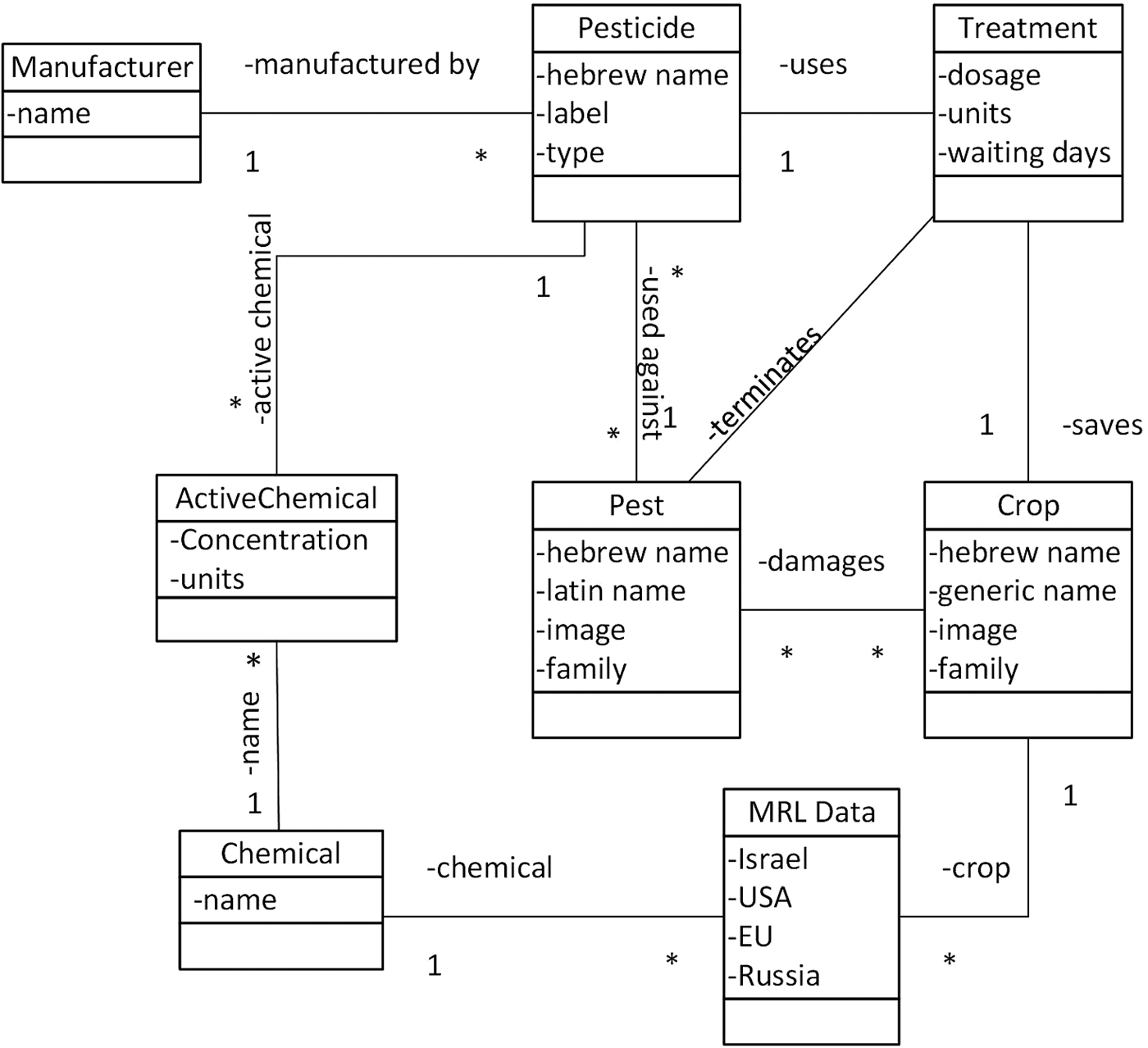
Based on meetings with PPIS pest-control experts and the derived CQs described above, as well as Web resources provided by PPIS, the following concepts for describing the different types of ontology objects were identified. Three core concepts of the ontology were Pest, Pesticide and Crop. The concept Treatment was added to capture a relationship between these three core concepts – to describe how the pesticide should be applied on a particular crop that is damaged by a particular pest (e.g. the required pesticide dosage). Such an intermediary concept is required because the triple form of subject–predicate–object, used for specifying ontologies, allows the description of binary relationships only (i.e. relationships between only two objects). An additional concept that should be included in the current ontology is the MRL. The ontology should specify the permitted levels in different countries, namely Israel, the USA, European Union (EU) countries and Russia. The concepts identified and their relationships are illustrated in the UML class diagram in Fig. 2.
A class diagram of the informal conceptual model.

Reusing existing ontologies
Given the conceptual model developed in the previous section, in this step existing ontologies were surveyed to investigate whether they include similar concepts that could be reused. According to the review of existing agricultural ontologies, no ontology included the knowledge required to answer the CQs. While a few ontologies referred to pest-control activities (Song et al., Reference Song, Wang, Ying, Yang and Zhang2012; Li et al., Reference Li, Kang, Cheng, Li, Ji, Wang and Chen2013), they did not include the knowledge of pesticide usage regulations in different countries. In addition to the literature specified in the Introduction, different registries of published ontologies were surveyed in search of ontologies that include similar concepts to those currently identified. The survey revealed there are ontologies that already include some of the core concepts of the ontology under discussion: two such ontologies are the AGROVOC linked open data and DBpedia. AGROVOC is a multilingual thesaurus maintained by the Food and Agriculture Organization (FAO) of the United Nations, which is now published as linked data on the Semantic Web; it includes definitions and properties of pests, crops and chemicals in 17 different languages. These definitions can be reused and support the integration of information that is represented in different languages. DBpedia is a pivotal ontology in the Semantic Web, with the highest number of concepts and links to other ontologies. Being extracted from Wikipedia, it provides millions of concepts (Things), among which are pests and crops. DBpedia and AGROVOC are interlinked; thus, existing crops, pests and chemicals as defined in these ontologies were reused and linked to concepts in the current ontology.
Specify formal terminology
The formal terminology was developed based on the CQs, informal terminology and relevant concepts in other ontologies. Its specification was an iterative process that included several iterations of changes, based mainly on discussions and input from pest-control specialists.
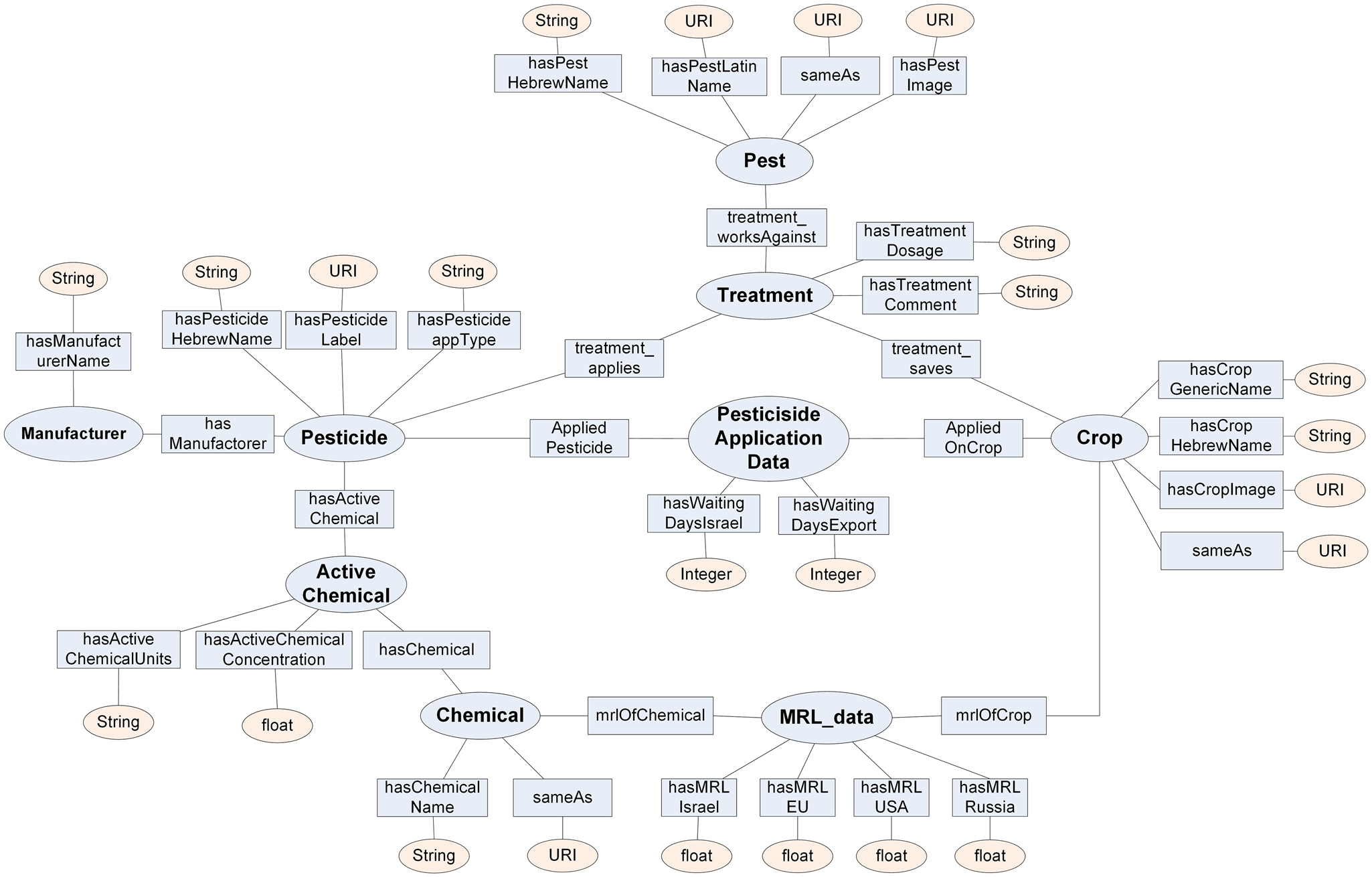
The schema of the ontology is depicted in Fig. 3. It includes the following classes:
• Crop: a cultivated plant such as fruits, vegetables or grains.
• Pest: an insect or an animal that attacks and damages a Crop.
• Pesticide: a substance used for terminating a Pest that harms a Crop.
• ActiveChemical: the active chemical material of a Pesticide, including its concentration and its units of measurement. A Pesticide can have more than one active chemical. The ActiveChemical is linked to the class Chemical, which refers to the chemical material definition in AGROVOC.
• Manufacturer: the company that produces the Pesticide. Each Pesticide is made by a Manufacturer.
• Treatment: the application of a Pesticide on a particular Pest to save a particular Crop. The treatment is characterized by the required quantity for application and application comments.
• MRLData: a class that includes the permitted MRL values of a Chemical and a Crop in different countries.
• PesticideApplicationData: a class that represents the pesticide application instructions for each crop. In particular, it includes the minimum number of days a farmer has to wait after applying a particular Pesticide on a particular Crop before its harvest. For each Crop and Pesticide, there are two values: waiting days for the local (Israeli) market and waiting days for export. Of course, if the ontology is used in other countries, these two values should be adapted to the country's regulations.
(Colour online). The pest-control ontology schema.

Specify formal axioms
The schema defined different constraints on ontology concepts and their relationships (axioms). For example, the following axiom asserts that an individual cannot be of more than one of the specified classes:
DisjointClasses(:ActiveChemical :Crop :MRL_Data :Manufacturer :Pest :Pesticide :Treatment :PesticideApplicationData).
Another example is the following axiom, which defines the property ‘hasManufacturer’:
ObjectProperty(:hasManufacturer domain(:Pesticide) range(:Manufacturer) inverseOf(:manufactures)).
Based on this definition, it is possible to assert automatically (using Protégé) that the individuals defined in the ontology comply with this axiom (e.g. if it is specified that Mustang is manufactured by Adama Agan, then Mustang has to be of type Pesticide and Adama Agan has to be of type Manufacturer) and to infer additional knowledge (e.g. if pesticide X is manufactured by manufacturer Y, then manufacturer Y manufactures pesticide X).
Specify formal instances
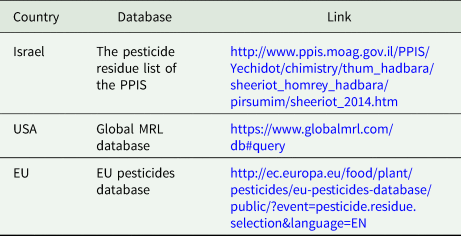
The instances (i.e. Individuals) of the ontology were created based on data from the various websites, described in Table 2. As a first step, to demonstrate the potential of the proposed ontology and its applicability to pest-control decision support, a single crop – pepper – was used. Consequently, the ontology includes all pests (9), pesticides (66) and treatments (76) that are relevant for pepper in Israel. The process of adding additional crops to the ontology is straightforward.
Data sources for the ontology instances

PPIS, Plant Protection and Inspection Services; MRL, Maximal Residue Limit.
To add all relevant individuals (class instances) to the ontology, a semi-automated approach was used: when possible, data were automatically retrieved from where they were stored online and transformed to the appropriate OWL knowledge representation. When automatic extraction was not possible (e.g. for data on treatments, pesticides and MRL regulations), data were collected manually by 15 students who had completed a course on knowledge management and ontologies into a ‘flat-table’ structure. After collecting the data, each student was assigned to validate data collected by another student. To ensure that correct values were entered, the students were graded on their work. A proprietary computer program was used subsequently to transform the flat-table data into the appropriate OWL definitions based on the schema of the ontology, which was created in Protégé.
All the definitions were merged into a single OWL file, which is continuously edited and extended using Protégé. The ontology currently includes a total of 2469 axioms. The resulting OWL ontology in RDF/XML syntax is available at: http://www.pesticidesontology.com/pestcontrol.owl.
Specify formal competency questions
Once a formal ontology is specified, it should be possible to formalize the CQs. It is easy to see that all of the CQs can be formalized and answered using the ontology. For example, the first two CQs (‘Which pesticide to use against which pest and for which crop?’ and ‘What is the appropriate dosage of pesticide for a particular pest and crop?’) were formalized using the following SPARQL query:
PREFIX pest: <http://www.pesticidesontology.com/pestcontrol.owl#>
SELECT ?pesticide ?dosage ?units ?pest ?crop
WHERE {
?treatement pest:treatment_worksAgainst ?pest.
?treatement pest:treatment_applies ?pesticide.
?treatement pest:treatment_saves ?crop.
?treatement pest:hasTreatmentDosage ?dosage.
?treatement pest:hasTreatmentDosageUnits ?units.
}
Ontology evaluation
The proposed pest-control ontology is intended to serve two purposes: (1) integration of knowledge from different sources and concepts from other ontologies to provide a pest-control knowledge base, and (2) support of pest-control decisions. Thus as discussed in the Materials and methods section, the current evaluation focused on the semantic relations level, the context level and the lexical vocabulary level.
Semantic relations evaluation
An initial evaluation of the ontology schema (which is related to the semantic relations level) was conducted during the ontology building phase, where the proposed schema was presented to domain experts and their advice and comments were requested. One change that was made as a result was to differentiate between local waiting days and export waiting days (until then, there was just a general property of waiting days). Another change was to define the waiting days under PesticideApplicationData, which describes a relationship between Pesticide and Crop, and not under Treatment, which also relates to Pest.
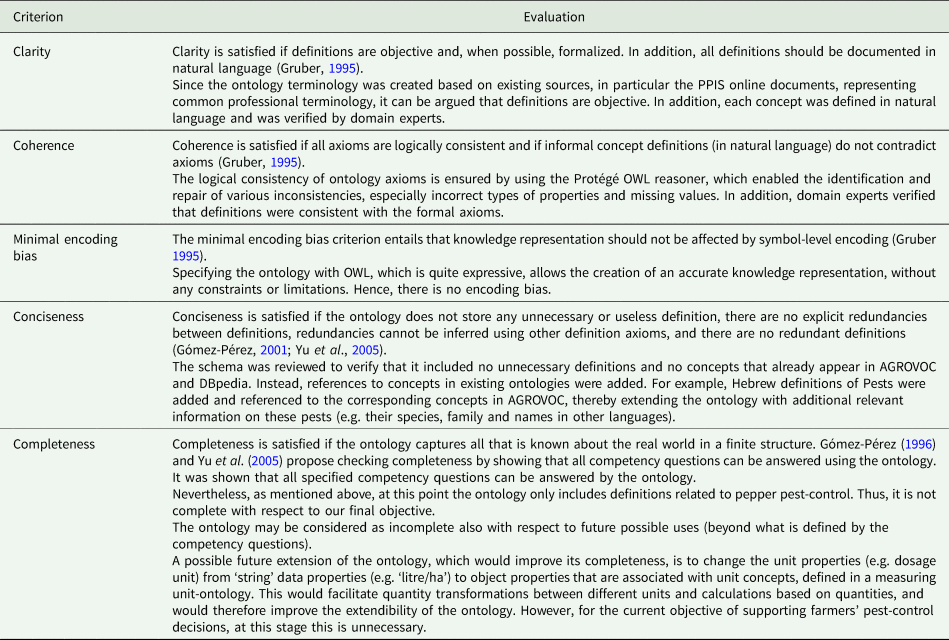
Subsequently, a criteria-based evaluation was applied. Specifically, the following criteria were used: Clarity, Coherence, Minimal encoding bias, Conciseness and Completeness. The evaluated criteria appear in Table 3. It should be noted that some of the criteria are also relevant to the lexical level (as indicated in the second column).
Criteria-based evaluation of the semantic relations and lexical levels

Context-level evaluation
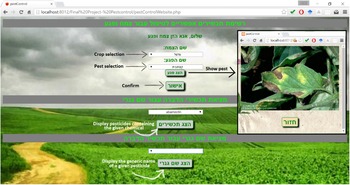
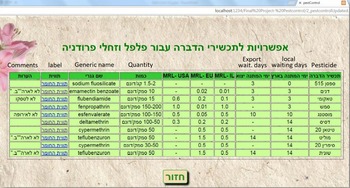
The context-level evaluation was aimed at validating the usability and effectiveness of the ontology for supporting pesticide usage decisions via a Web-based application. A prototypical Web-based application that is based on the proposed pest-control ontology was developed for supporting pesticide-usage decisions. The user selects a crop (so far only pepper is supported) and a pest name and is presented with a list of suitable pesticides, ordered in an increasing order of local waiting days before harvest. Besides waiting days, for each pesticide, the application also presents treatment data, the active chemicals and their corresponding MRL levels in Israel, EU countries and the USA. In addition, the user can select a generic pesticide name (i.e. a chemical) and find all pesticides containing it and vice versa – select a pesticide and find its generic name. Example screenshots of the application interfaces are presented in Figs A1 and A2 in Appendix A.
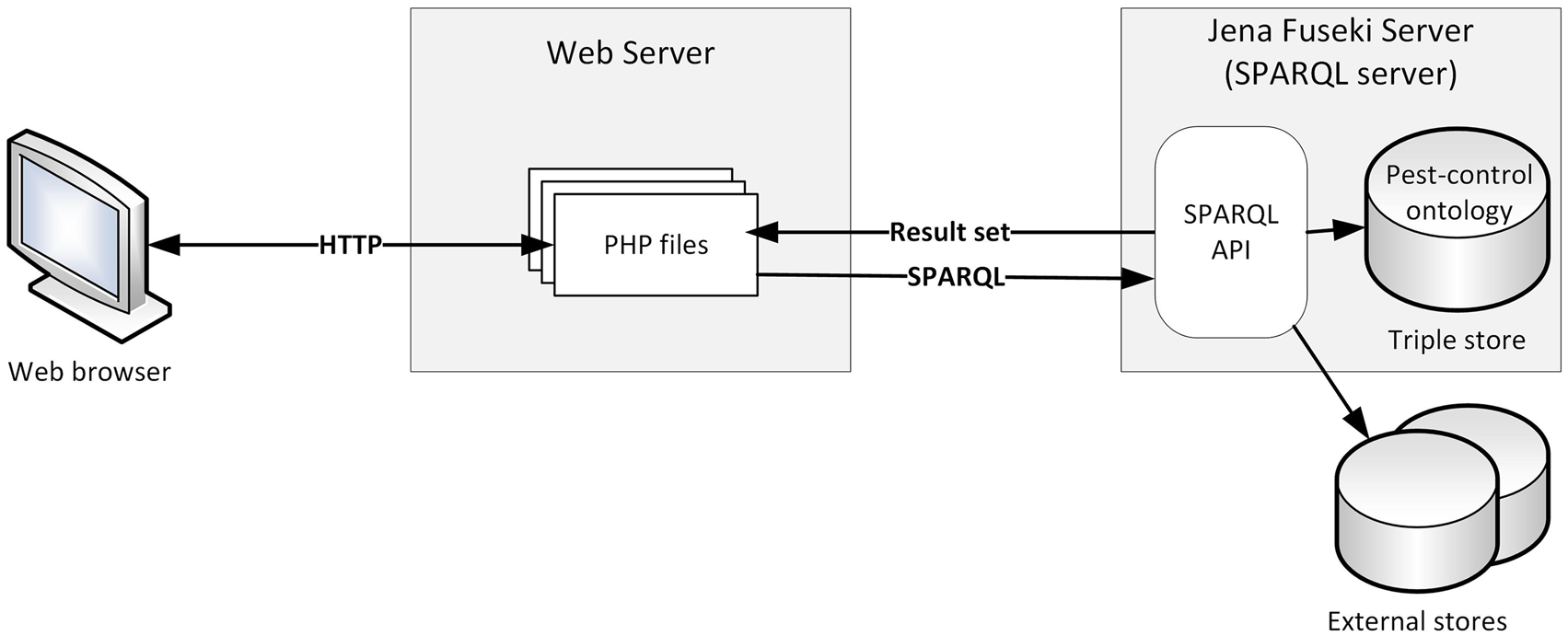
Figure 4 shows the architecture of the system, including a web browser from which the user interacts with the system, a Web server running a PHP application that, based on user requests, defines and executes SPARQL queries to retrieve information from the pest-control ontology as well as from other external ontologies. The ontology was uploaded to a triple store that runs on Apache Jena Fuseki Server (https://jena.apache.org). Query results are sent back to the user and presented on the browser.
Pest-control Web application architecture.

The application demonstrates the advantages of using Semantic Web ontologies; not only does it allow linking of concepts that are defined in different databases over the Web but it also allows the reuse of concepts defined in other ontologies. For example, the images of pests are taken from DBpedia and hierarchical menus of crops and pests allowing the rapid location of the required pest or crop are constructed based on the broader and narrower properties (skos:broader, skos:narrower) defined in AGROVOC, which links the concepts with their broader and narrower definitions.
The application developed demonstrates the usability of the ontology. An experiment was performed to evaluate the effectiveness of the ontology-based application. Ten participants were given two simple tasks: (1) find the pesticide with the lowest number of waiting days for the local market and for export that is suitable for treating pepper infested with Aphid (plant lice); and (2) find whether pepper with an MRL of 0.3 for the chemical Pymetrozine could be exported to the USA. The participants were first asked to perform the two tasks without the application, using a given set of websites containing all the data on MRL and treatments, and then again using the developed application. Durations of the performed tasks were measured for the two cases (with and without the new application). The results showed that the application improved user performance significantly. Without the application, five out of ten participants were not able to complete the tasks within 15 min and the other five completed the tasks in 5–10 min; with the application, all participants were able to complete both tasks in less than 1.5 min.
Lexical-level evaluation
While evaluation of the lexical-vocabulary level usually involves comparisons with various sources of data, such evaluation is redundant in the current case as the ontology was built on the basis of existing online data sources (see the Specify formal terminology section). Nevertheless, because part of the concepts such as treatments, MRL data and links to other ontologies were manually defined, a verification of the correctness of these concepts was required. To do that, the ‘four eyes principle’ was applied. According to the ‘four eyes principle’, each set of concepts defined by one individual was assigned to another individual to check the correctness of definitions. This evaluation verified that concepts were correctly inserted. Evaluation criteria that are relevant to the lexical level appear in Table 3.
Discussion
Ontologies are a powerful tool for representing domain knowledge and, thus, a growing number of knowledge management systems and DSS are based on ontologies. In the current research, a pest-control ontology was developed to serve as the knowledge base of a web-based application for pest-control decision support. The ontology allows not only easy integration and reuse of information from multiple sources over the Web but also accounting for the semantics of concepts that may be defined using different terminology or even in different languages. Furthermore, it enables the inference of new knowledge. The ontology is important for supporting farmers' decisions, such as which pesticide to use against which pest in order to protect a particular crop and how to apply the pesticide in order to meet regulations of different countries. The ontology developed reuses existing knowledge defined in DBpedia and in AGROVOC. For example, concepts that represent Pest and Crop are connected to their parallel concepts in AGROVOC, where they are defined in 17 languages. As a result, it is easy to translate knowledge about pest control to other languages.
The contribution of the current research is threefold: first, a pest-control ontology that carries both theoretical and practical implications was developed. On the one hand, it contributes to the existing literature on pest-control ontologies (Beck et al., Reference Beck, Kim and Hagan2005; Maliappis, Reference Maliappis, Sicilia and Lytras2009; Li et al., Reference Li, Kang, Cheng, Li, Ji, Wang and Chen2013; Liao et al., Reference Liao, Li and X2015) by adding concepts that have not been covered thus far. On the other hand, the proposed ontology satisfies design criteria (e.g. clarity, coherence and minimal encoding bias), which make it suitable for sharing and interoperation. In addition, the specification in OWL allowed publication of the ontology on the Semantic Web and allows it to be referenced by other ontologies and applications, and to be reused for other purposes (e.g. automatic calculations of MRL levels and waiting days, managing actual pesticide application events or connecting knowledge on diseases and pesticides). Of course, before that, the current prototypical ontology should be extended to represent additional crops.
Second, an ontology-based Web application that effectively supports farmers' pest-control decisions has been developed. The effectiveness of the application has been shown in an experiment, in which prospective users were given two tasks and their performance without and with the developed system was measured. It was shown that by using the pest-control application, user performance improved significantly. As discussed above, using ontology and Semantic-Web-based technologies provides several advantages with respect to the current objective of supporting pest-control decisions.
Third, a method for ontology development and evaluation was presented and demonstrated comprehensively in the case of a pest-control ontology. The method extends ideas from existing ontology development methods, in particular the methods by Uschold and King (Reference Uschold and King1995) and Grüninger and Fox (Reference Grüninger and Fox1995), as well as evaluation methods (Brank et al., Reference Brank, Grobelnik and Mladenić2005; Yu et al., Reference Yu, Thom and Tam2007). With the growing use of ontologies and the Semantic Web for developing agricultural systems, clear and structured methods for ontology development and evaluation become increasingly important. Furthermore, as revealed by the literature review, most of the studies that develop agricultural ontologies do not present the method of development and, even worse, do not discuss how the developed ontologies were evaluated, making it difficult to share and reuse them. The current work thus narrows this gap in the literature of agricultural ontologies by proposing a development and evaluation method that can be followed by other studies.
While important design criteria of the pest-control ontology are met (as discussed in the Ontology evaluation section), the criterion of completeness has yet to be met. First, the developed system is a prototype intended to demonstrate the feasibility and potential of using an ontology for pesticide decision support. While at this stage the ontology focuses deliberately on just one crop, pepper, it can be applied straightforwardly to include other crops. In the future, the developed prototype will be extended to include additional crops. Second, the ontology currently includes MRL regulations of Israel, EU countries and the USA. In the future, the ontology will also be extended to include other countries. It should be noted that the ontology schema is already suitable for supporting additional crops and MRL regulations, and that adding these to the ontology is quite simple. The developed system is intended for use in the PPIS.
Financial support
This study was funded by the Israeli Ministry of Agriculture and Rural Development, Grant number 458-0603/l3
Conflict of interest
None.
Ethical standards
Not applicable.
Appendix A
The pest-control Web-application
Figure A1 shows a screenshot of the system's homepage (including English annotations for Hebrew labels), where the user selects a crop and a pest, which can be also displayed, as seen in the small right window. Pressing the ‘confirm’ button leads the user to the page depicted in Fig. A2, displaying the list of suitable pesticides, ordered by the required number of waiting days before harvest. For each pesticide, its application data are presented along with other relevant information. In addition, a link to the pesticide label is provided to the user. On the homepage, the user can also select a generic pesticide name (chemical) and find all pesticides containing it and the other way around – select a pesticide and find its generic name.
(Colour online). Pest-control application homepage with annotations.

(Colour online). A list of suitable pesticides (right column) for selected crop and pest, along with additional relevant data (from right to left): local waiting days, export waiting days, MRL-Israel, MRL-EU, MRL-US, quantity, generic name (active chemical), label and comments. MRL, Maximal Residue Limit; EU, European Union; USA, United States of America.