Cost-effectiveness analyses are increasingly being used in policy making. It is, therefore, important that the methods used for the analysis are correct and consistent. According to the theories of welfare economics, the outcome of the analysis should represent individual health preferences; that is, it should express individuals' utility. The most common outcome measure is probably the quality-adjusted life-year (QALY). However, there is still some controversy over the choice of analytical methods. One issue is where to place the costs of production loss due to morbidity. Some have argued that these costs are included in the outcome measure QALY (Reference Gold, Siegel, Russel and Weinstein8;Reference Weinstein, Siegel and Garber19), while others argue that they are not included, and should, therefore, be added to the costs in the analysis (Reference Brouwer, Koopmanschap and Rutten3;Reference Meltzer and Johannesson11). As the recommendations about this matter differ, it is difficult to compare different analyses and it may also be difficult to know what is included in an analysis.
This issue is, therefore, related to the capacity and ability of QALY to include changes due to expected income, an aspect which is still insufficiently studied (Reference Brouwer, Meerding, Lamers and Severens4). It is also related to the question of how much of the societal productivity loss an individual will consider in their valuations. The existence of insurance and compensating systems in the society means that the income loss considered by individuals may misrepresent the true societal loss (Reference Brouwer and Rutten5).
Some studies have explored the capacity of QALY to incorporate income (Reference Brouwer, Meerding, Lamers and Severens4;Reference Krol, Brouwer and Sendi9;Reference Meltzer, Weckerle and Chang12;Reference Myers, McCabe and Gohmann13;Reference Richardson and Olsen16–Reference Sendi and Brouwer18), but the question is far from settled. For example, income may be considered when direct methods such as standard gamble (SG) or time trade-off (TTO) are used to value health states, while indirect methods (such as use of the EuroQol instrument, the EQ-5D) may have less capacity to incorporate effects caused by income. Sculpher and O'Brien (Reference Sculpher and O'Brien17) argue that income may also affect the valuation when indirect methods are used, because it may affect individuals when they complete instruments measuring health states, and, furthermore, when the health states are being valued. However, this has not been tested empirically.
The purpose of this study was to empirically explore whether individuals take their expected income into consideration when directly valuing predefined health states. The intention was to help determine how to handle the productivity costs due to morbidity in a cost-effectiveness analysis.
METHOD
Subjects and Procedure
Students at Linköping University in Linköping, Sweden, were asked to complete a questionnaire, including presentations of four hypothetical health states, using two valuation methods, TTO and a rating scale (RS). The questionnaires were handed to the students at the end of a class, and were completed and handed in before the students left the room. Some students (an unknown number) chose not to answer the questionnaire as they were free to leave the classroom. The participating students were randomly assigned to two groups, answering different versions of the questionnaire. Students in the first group (the non-income group) were asked to value the four hypothetical health states; income was not mentioned. The students in the other group (the income group) were asked to value the same health states, but were explicitly asked to consider their expected income in relation to the health states. The students were not informed about the purpose of the study or about the different versions of the questionnaire.
Both groups answered a few follow-up questions at the end of the questionnaire; the students in the non-income group were asked whether they had thought of their expected income when they valued the health states, while the students in the income group were instead asked whether the instruction to consider their expected income had affected their valuations.
The students in the non-income group were then asked to re-value the health states, this time with explicit instructions to take expected income into consideration, so that comparisons of the valuations could be made both between the two groups and within the non-income group, before and after explicit instructions to consider expected income. A description of the procedure is presented in Supplementary Figure 1 (which can be viewed online at www.journals.cambridge.org/thc).
The reason why students were chosen was that they generally have low, and similar, incomes, but with increasing expected incomes in the future. To detect a difference in the QALY weight of 0.10 (standard deviation [SD] = 0.2) with a statistical power of 80 percent, both groups needed a sample size of at least seventy students each.
The EQ-5D Health States
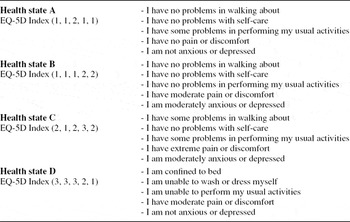
The questionnaire included four different health states (labeled A–D and presented in Table 1), which were described using the EQ-5D (Reference Rabin and de Charro15). The EQ-5D is a generic instrument for measuring health-related quality of life. It classifies health states in five dimensions of health, viz. mobility, self-care, usual activities, pain/discomfort, and anxiety/depression. Every dimension covers three levels, viz. no problems, moderate problems, and major problems. Values of the health states have already been estimated; the most commonly used values are those made by an average sample in the UK, using TTO (Reference Dolan6).
Details of the Health States Used in the Questionnaire

The order in which the health states appeared in the questionnaire was randomly assigned, in four groups, as it was believed that the students may change their thinking about some of the questions after valuing some health states. The health states were chosen to illustrate a variety of health states, some of which may affect income more than others. The health states were, furthermore, chosen so that comparisons could be made with earlier studies from the UK (Reference Dolan6) and Sweden (Reference Björk and Norinder1).
Expected Income
Students asked to consider expected income were told to assume a specific gross income per month at full health; they were asked to state how they thought the four health states would affect this income. The reason why a specific income was given was that it may have been too difficult for the students to imagine their own expected income for the following 10 years. Four different levels of income were tested, but each student only had one income level to consider. The specified gross monthly income levels at full health were SEK20,000, SEK25,000, SEK30,000 and SEK35,000 (a range of approximately €2,200–3,800 or US$3,300–5,800).
Valuation Methods
With the TTO method, respondents are asked to choose between living a certain number of years in a certain health state, and living a reduced number of years in full health. Time trade-off was used for valuing all four health states; the students could choose between living 10 years in each of health states A–D, and living for a shorter period in full health.
With the RS method, respondents are asked to mark their valuations on a scale. A visual analogue scale (VAS) is often used for this purpose. A VAS has well-defined end points, normally ranging from worst imaginable health to best imaginable health. Our questionnaire included a VAS with the end points mentioned above for each of the four health states.
Statistical Methods
The characteristics of the two groups were compared using t-tests (for comparing age) and chi-squared tests (for comparing sex and study courses). The valuations made by the non-income group and the income group using TTO and an RS were compared using independent-samples t-tests. The valuations made by the non-income group, before and after explicit instructions to consider expected income, were compared using paired samples t-tests. In all tests, the significance level was set at p < .05. Statistical calculations were performed using SPSS 14.0 for Windows (SPSS Inc., Chicago, IL).
RESULTS
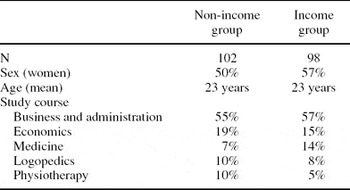
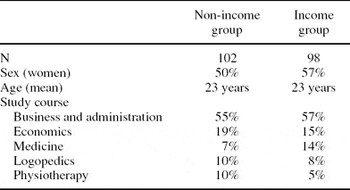
Two hundred students, 54 percent of whom were women, answered the questionnaires. Their mean age was 23 years (range, 18–43 years), and 90 percent were <26 years old. The majority of the students were studying business and administration. The two groups did not differ significantly from each other in any variable. The characteristics of the two groups are presented in Table 2.
Characteristics of the Groups
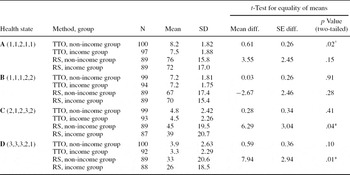
The mean values for the health states for both groups are presented in Table 3 together with comparisons of the mean valuations. Health state A generated the highest mean value, and the other health states received lower values, with a gradual decrease from the highest to the lowest value, as expected from earlier studies. For state A, the groups differed in their valuations made using the TTO method. For states C and D, the groups differed in their valuations made using the RS method. Being the only health state not to show significant differences between the two groups, state B was also the only health state that did not include problems within the dimension of “usual activities.” The health state showing the largest differences between the RS valuations of the two groups was state D, the only health state in which the students were assumed to be completely unable to perform their usual activities.
Mean Valuations of the Health States and Independent-Sample t-Tests for Equality of Means between the Non-income Group and the Income Group

*Significant; p < .05
SD, standard deviation; SE, standard error; RS, rating scale;
TTO, time trade-off.
The students' responses with regard to mean expected incomes in the different health states are presented in Supplementary Table 1 (which can be viewed online at www.journals.cambridge.org/thc) as a percentage of the specified income at full health. For example, if the specified income at full health was SEK25,000 and the student expected an income at SEK20,000 at health state A, this is calculated as 80 percent. The expected income in health state A–D was 73 percent, 82 percent, 47 percent, and 30 percent, respectively, of the income at full health. Although health state A was valued preferentially over the other health states, it had a larger effect on expected income than did health state B. The expected incomes in health states C and D were less than half of the specified maximal income.
Among the students in the non-income group, 96 percent stated in response to the follow-up question of the questionnaire that they had not thought about their expected income when they valued the health states. In the income group, 40 percent believed that thinking about their expected income had affected their valuations of the health states. The most common explanation for how income affected the valuations was that a lower expected income may lead to a decreased quality of life, resulting in lower values for some health states.
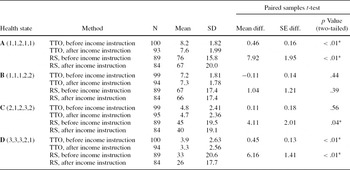
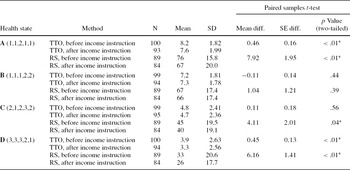
Table 4 presents a comparison of the valuations made by the non-income group, before and after explicit instructions to take expected income into consideration. This group was the one that first valued the health states with no instructions to consider income, and afterward, valued the health states again, this time with the explicit instruction to consider their expected income. The differences between the means were similar to those between the non-income group and the income group. However, more of the differences were significant, such as the RS value of health state A and the TTO value of health state D.
Mean Valuations of the Health States and Paired-Sample t-Tests for Equality of Means between Valuations Made before and after Explicit Instructions to Consider Income, in the Non-income Group
* Significant; p < .05.
SD, standard deviation; SE, standard error; RS, rating scale;
TTO, time trade-off.
DISCUSSION
In this study, we tested whether students take their expected income into consideration when valuing hypothetical health states. The results showed that unless income was explicitly mentioned, the students did not seem to consider their expected income in the valuations; 96 percent of students in the non-income group stated that they had not considered income. Nevertheless, the valuations made by the two groups differed for some of those health states assumed to affect expected income. In the income group, 40 percent of students stated that expected income in the different health states was of importance in their valuations, suggesting that there are income effects that were not captured in the non-income group. The two different valuation methods, however, showed partly different results. Our findings are strengthened by the similar results from the two comparison methods used in this study. However, as the valuations for some health states did not differ between the groups, this could indicate that some students included parts of their affected income in the valuations also when income was not explicitly mentioned.
The results from our study can be compared with some other studies. A study with a similar approach was undertaken by Myers et al. (Reference Myers, McCabe and Gohmann13), who investigated whether undergraduate students automatically consider morbidity costs in their health state valuations using SG. They found that students who were informed about the morbidity costs valued the health states lower than did students who were not informed about these costs. This result is in line with the findings of our study, even though different valuation methods were used. Another study with a similar design was performed by Krol et al. (Reference Krol, Brouwer and Sendi9), who found that VAS valuations of health states made by respondents from the general public did not differ significantly between two groups, one of which was explicitly asked to consider income effects, and the other which was asked not to consider income effects. This result is in contrast to our results; however, the lack of differences between the groups may have been an effect of the way the questions were asked. When respondents are explicitly instructed to exclude income effects, they may be more likely to start thinking about them. Sendi and Brouwer (Reference Sendi and Brouwer18) found that when income effects were not asked for, the majority of respondents did not take them into consideration when valuing health states using a VAS. Meltzer et al. (Reference Meltzer, Weckerle and Chang12) studied whether people with blindness or severe back pain considered financial effects in their TTO values of their own current health states, and found that the majority did not consider them, even when financial effects were specifically mentioned. Marra et al. (Reference Marra, Lynd, Esdaile, Kopec and Anis10) found that preference-based indirect utility indices (HUI3 and SF-6D) varied with income independently of disease severity, which could indicate that individuals do include their income in the valuations. Even though there are some variations in the results of these studies, it does seem that most individuals do not include expected income in their valuations when income is not specifically mentioned.
The mean VAS values in the non-income group were fairly similar to those found in earlier studies conducted in the UK (Reference Dolan6) and Sweden (Reference Björk and Norinder1). The mean TTO values were also similar to the values from the UK Index Tariff (Reference Dolan6) for health states A and B, but for health states C and D, the values in our study were higher than those in the UK study. However, it is important to remember that the samples were based on different populations in different countries, which could possibly explain the differences in the valuations. Another reason may be that negative TTO values were not possible in the present study.
Time trade-off has previously been shown to give consistent values among a general population (Reference Dolan, Gudex, Kind and Williams7) and to be more similar, compared with other valuation methods, to individuals' ranking of different health states (Reference Bleichrodt and Johannesson2). An RS is often easier to understand than TTO, and so may, in some cases, produce more accurate valuations (Reference Parkin and Devlin14). However, using an RS has theoretical disadvantages in that the respondent does not need to make a choice between different alternatives. Using these two methods, income should theoretically not affect the values in the same way. When valuing the health states using an RS with best/worst imaginable health states as end points, income should not be considered. When TTO is used the focus is instead on individuals' preferences for the health states, and in this case income may be of importance. These theoretical aspects may not be reflected in the results of the practical application of the methods, but they may explain the variation in the results between the two methods. In this study, the RS seemed to be more sensitive to capturing the valuation differences between the two groups, even though the tendencies in the RS and TTO valuations were in the same direction. Both of the methods used in this study, however, value health states that are described in terms of health-related quality of life (using the EQ-5D). If the students had valued health states described in wider terms, such as general quality of life, both TTO and an RS may have been better able to capture income effects.
The dimensions within the EQ-5D instrument that have previously been discussed as the most likely to be affected by income are “usual activities” and “anxiety/depression” (Reference Sculpher and O'Brien17). The results of the present study seem to lend support to this idea, at least for the dimension of “usual activities.” All health states with any problems in this dimension showed lower values when income was considered than when income was not mentioned. However, the relationship between the severity of health states and their effect on expected income is probably not linear. As long as a health state does not affect working capacity, there may not be any income changes, while more severe health states may affect both work capacity and career options. In addition, the social security system in Sweden ensures that there is a minimum income, and so most of the students will have assumed an income above zero, even in the absence of work capacity. This also indicates that the expected income losses faced by individuals are not equal to the societal loss. Even if individuals consider their expected income when valuing health states, there may still be productivity costs that should be considered in the cost-effectiveness analysis. It would, therefore, be preferable not to include any income effects in the outcome measure, and instead add the cost of the production loss on the cost side of the analysis.
The TTO method includes one or more hypothetical situations, which could be difficult to relate to in themselves; the requirement to further relate to the expected income of these hypothetical health states could make the questions even more difficult to answer. The RS method can also be difficult to use for hypothetical health states. Approximately 10 percent of the students commented that the questions were difficult to understand, particularly the question of considering their expected income. Furthermore, students may not be representative of the general population. In general, students may have more or less realistic expectations on future incomes compared with individuals who are already working. Students' perhaps unrealistic expectations on income should, however, not have any major impact on whether they automatically consider income in their valuations or not, but rather an impact on their expected income level. The income levels that were used in this study are common in Sweden among those who have recently entered the labor force, but may not reflect the students' actual expected incomes.
The results could also have been affected by the fact that the students who were asked to consider their expected income were provided with additional information compared with the other group. This could have made them more sensitive to expected income effects related to the health states than they otherwise would have been. Furthermore, in the comparison of the values made by the non-income group, before and after explicit instructions to consider income, there may be a bias as the students were provided with more information the second time around. This may also be the reason why the differences between the values were slightly stronger in this test compared with the differences found between the non-income group and the income group.
The results of this study show that, as long as income is not mentioned, most individuals do not seem to consider their expected income when they value health states. This indicates that productivity costs due to morbidity are not captured within individuals' health state valuations. These findings, therefore, suggest that productivity costs due to morbidity should be included as a cost in cost-effectiveness analyses in order for the analysis to have a societal approach. However, some of the students in the non-income group may have considered parts of their incomes in their valuations, and this could, therefore, lead to double counting when productivity costs are included. Finding valuation methods that are not affected by individuals' income would, therefore, be of importance in the use of cost-effectiveness analyses.
CONTACT INFORMATION
Thomas Davidson, MS (Thomas.davidson@ihs.liu.se), PhD Candidate, Lars-Åke Levin, PhD (Levin@ihs.liu.se), Associate Professor, Center for Medical Technology Assessment, Department of Medical and Health Sciences, Linköping University, 581 83 Linköping, Sweden