


1. Introduction
Let K (or
 $(K,|\cdot|)$
) be an algebraically closed field (of arbitrary characteristic) that is complete with respect to a non-trivial and non-archimedean absolute value
 $|\cdot|$
. A subset B in K is called a K-closed disk if
 \begin{equation*} B=B(a,r)\;:\!=\;\{z\in K\;:\;|z-a|\le r\}\end{equation*}
for some
 $a\in K$
and some
 $r\ge 0$
; by the strong triangle inequality
 $|z+w|\le\max\{|z|,|w|\}$
for any
 $z,w\in K$
, the diameter
 $\textrm{diam}\,(B(a,r))$
of B(a,r) in
 $(K,|\cdot|)$
equals r, and we have
 $B(a,r)=B(b,r)$
for any
 $b\in B(a,r)$
. When
 $\textrm{diam}\;B>0$
, a K-closed disk B is in fact clopen as a subset in
 $(K,|\cdot|)$
.
By the strong triangle inequality again, for any two K-closed disks B, B
′, if
 $B\cap B'\neq\emptyset$
, then either
 $B\subset B'$
or
 $B\supset B'$
.
1·1. Berkovich projective line
The Berkovich projective line
 $\mathsf{P}^1=\mathsf{P}^1(K)$
is the Berkovich analytification (a compact augmentation) of the (classical) projective line
 $\mathbb{P}^1=\mathbb{P}^1(K)=K\cup\{\infty\}$
(see the foundational Berkovich [Reference Berkovich3]). As a set,
 $\mathsf{P}^1$
is almost identified with the set of all K-closed disks; each singleton
 $\{a\}=B(a,0)$
in
 $K=\mathbb{P}^1\setminus\{\infty\}$
is identified with the type I point
 $a\in K\subset\mathsf{P}^1$
, and each K-closed disk B satisfying
 $\textrm{diam}\;B\in|K^*|$
(resp.
 $\textrm{diam}\;B\in\mathbb{R}_{>0}\setminus |K^*|$
) is identified with a type II (resp. type III) point
 $\xi$
in
 $\mathsf{P}^1$
(then we also write
 $B=B_{\xi}$
and
 $\xi=\xi_B$
). The remaining point
 $\infty\in\mathbb{P}^1\subset\mathsf{P}^1$
is also a type I point in
 $\mathsf{P}^1$
, and the set of all other remaining points in
 $\mathsf{P}^1$
is exactly the set
 $\mathsf{H}^1_{\textrm{IV}}$
of all type IV points in
 $\mathsf{P}^1$
. The Berkovich upper half space is
 \begin{equation*} \mathsf{H}^1=\mathsf{H}^1(K)\;:\!=\;\mathsf{P}^1\setminus\mathbb{P}^1=\mathsf{H}^1_{\textrm{II}}\cup\mathsf{H}^1_{\textrm{III}}\cup\mathsf{H}^1_{\textrm{IV}}\quad(\text{a disjoint union}),\end{equation*}
where
 $\mathsf{H}^1_{\textrm{II}}$
(resp.
 $\mathsf{H}^1_{\textrm{III}}$
) is the set of all type II (resp. type III) points in
 $\mathsf{P}^1$
. By the above alternative for two intersecting K-closed disks, the inclusion relation among K-closed disks extends to a (partial) ordering
 $\prec$
on
 $\mathsf{P}^1$
so that for any
 $\xi,\xi^\prime\in\mathsf{P}^1\setminus(\{\infty\}\cup\mathsf{H}^1_{\textrm{IV}})$
,
 $\xi\prec\xi^\prime$
if and only if
 $B_{\xi}\subsetneq B_{\xi^{{\scriptscriptstyle\prime}}} $
, that
 $\infty$
is the unique maximum element in
 $(\mathsf{P}^1,\prec)$
, that
 $K\cup\mathsf{H}^1_{\textrm{IV}}$
coincides with the set of all minimal elements in
 $(\mathsf{P}^1,\prec)$
, and that for any
 $\xi,\xi^\prime\in\mathsf{P}^1$
, there is the minimum element
 $\xi^{\prime\prime}$
in
 $(\mathsf{P}^1,\prec)$
satisfying both
 $\xi\preceq\xi^{\prime\prime}$
and
 $\xi^\prime\preceq\xi^{\prime\prime}$
, which we denote by
 $\xi\wedge\xi^\prime$
. For any
 $\xi,\xi^\prime\in\mathsf{P}^1$
, the (closed) interval
 $[\xi,\xi^\prime]$
is defined as
 $[\xi,\xi^\prime]=\{\xi^{\prime\prime}\in\mathsf{P}^1\;:\;\xi\preceq\xi^{\prime\prime}\preceq\xi^\prime\}$
if
 $\xi\preceq\xi^\prime$
, and is defined as
 \begin{equation*} [\xi,\xi']=[\xi,\xi\wedge\xi']\cup[\xi\wedge\xi',\xi']\end{equation*}
in general. For every
 $\xi\in\mathsf{P}^1$
, the direction space
 $T_{\xi}\mathsf{P}^1$
of
 $\mathsf{P}^1$
at
 $\xi$
is the set of all germs
 $\overrightarrow{\xi\xi^\prime}$
of (left half open) intervals
 $(\xi,\xi^\prime]=[\xi,\xi^\prime]\setminus\{\xi\}$
,
 $\xi^\prime\in\mathsf{P}^1\setminus\{\xi\}$
. Setting
 \begin{equation*} U_{\overrightarrow{v}}=U_{\xi,\overrightarrow{v}}\;:\!=\;\bigl\{\xi'\in\mathsf{P}^1\setminus\{\xi\}\;:\;\overrightarrow{\xi\xi'}=\overrightarrow{v}\bigr\}\quad\text{for each }\overrightarrow{v}\in T_{\xi}\mathsf{P}^1,\end{equation*}
the family
 $\{U_{\xi,\overrightarrow{v}}\;:\;\xi\in\mathsf{H}^1_{\textrm{II}},\overrightarrow{v}\in T_{\xi}\mathsf{P}^1\}$
is a quasi open basis of the (so called weak) topology of
 $\mathsf{P}^1$
;
 $\mathsf{P}^1$
is indeed a compact, connected, uniquely arcwise connected and Hausdorff topological space. For every
 $\xi\in\mathsf{P}^1$
and every
 $\overrightarrow{v}\in T_{\xi}\mathsf{P}^1$
,
 $U_{\overrightarrow{v}}$
is a component of
 $\mathsf{P}^1\setminus\{\xi\}$
(and
 $\partial(U_{\overrightarrow{v}})=\{\xi\}$
), and any component of
 $\mathsf{P}^1\setminus\{\xi\}$
is written as
 $U_{\overrightarrow{v}}$
by a unique
 $\overrightarrow{v}\in T_{\xi}\mathsf{P}^1$
. Both
 $\mathbb{P}^1$
and
 $\mathsf{H}^1_{\textrm{II}}$
are (non-empty and) dense in
 $\mathsf{P}^1$
, and so are
 $\mathsf{H}^1_{\textrm{III}}$
and
 $\mathsf{H}^1_{\textrm{IV}}$
if they are non-empty.
The (affine) diameter function
 $\textrm{diam}\;:\;\xi\mapsto \textrm{diam}\;(B_{\xi})$
on
 $\mathsf{P}^1\setminus(\{\infty\}\cup\mathsf{H}^1_{\textrm{IV}})$
extends to an upper semicontinuous function
 $\mathsf{P}^1\to[0,+\infty]$
so that
 $\textrm{diam}\;(\infty)=+\infty$
, that
 $\mathsf{H}^1=\{\xi\in\mathsf{P}^{1}\;:\;\textrm{diam}\;\xi\in(0,+\infty)\}$
, and that the restriction
 $\textrm{diam}\;|[\xi,\xi^\prime]$
is continuous for any
 $\xi,\xi^\prime\in\mathsf{P}^1$
. For references and more details, see Section 2.
1·2. Uniformly perfect subsets in
 $\mathsf{P}^1$

The Berkovich affine line is
 \begin{equation*} \mathsf{A}^{\!1}=\mathsf{A}^{\!1}(K)=\mathsf{P}^1\setminus\{\infty\}=U_{\overrightarrow{\infty 0}}.\end{equation*}
Let us call an open subset A in
 $\mathsf{P}^1$
a (non-degenerating and finite open Berkovich) concentric annulus in
 $\mathsf{A}^{\!1}$
if
 $A=A(\xi,\xi^\prime)\;:\!=\;U_{\overrightarrow{\xi\xi^\prime}}\cap U_{\overrightarrow{\xi^\prime\xi}}$
for some
 $\xi,\xi^\prime\in\mathsf{H}^1$
satisfying
 $\xi\prec\xi^\prime$
, and the modulus of A is defined by
 \begin{equation*} \operatorname{mod}A\;:\!=\;\log\bigl(\textrm{diam}\;(\xi')/\textrm{diam}\;\xi\bigr)\in\mathbb{R}_{>0}.\end{equation*}
For a subset E in
 $\mathsf{P}^1$
, we say a concentric annulus
 $A=A(\xi,\xi^\prime)$
in
 $\mathsf{A\!}^1$
separates E if
 \begin{equation*}A\subset\mathsf{P}^1\setminus E,\quad E\cap(\mathsf{P}^1\setminus U_{\overrightarrow{\xi\xi^\prime}})\neq\emptyset\quad\text{and}\quad E\cap(\mathsf{P}^1\setminus U_{\overrightarrow{\xi^\prime\xi}})\neq\emptyset,\end{equation*}
and say E has the bounded moduli property for its separating annuli if
 \begin{equation}\sup\bigl\{\operatorname{mod}A\;:\;A\text{ is a concentric annulus in }\mathsf{A}^{\!1} \text{ separating }E\bigr\}<+\infty,\end{equation}
adopting the convention
 $\sup\emptyset=0$
.
See (2·3) for a coordinate-free formulation of (1·1). In non-archimedean setting, the condition (1·1) for a non-empty compact subset E in
 $\mathsf{P}^1$
itself does not imply the perfectness of E (since
 $\textrm{diam}\;\xi>0$
for
 $\xi\in\mathsf{H}^1$
). The following stronger notion than that of a perfect subset in
 $\mathsf{P}^1$
is a non-archimedean counterpart to that which has been well studied in complex analysis/dynamics (see, e.g, the survey [Reference Sugawa20]).
Definition 1·1. A subset E in
 $\mathsf{P}^1$
is uniformly perfect if E not only is perfect, i.e., is non-empty and compact and has no isolated points in
 $\mathsf{P}^1$
, but also has the bounded moduli property for its separating annuli.
In Section 4, we see that the bounded moduli property of a compact subset E in
 $\mathsf{P}^1$
for its separating annuli is equivalent to a potential theoretic (non-infinitesimal) lower capacity density property of E (see Theorem 3 in Section 4), and then in Section 5, we see that those equivalent properties imply a Hölder continuity (uniformly at any point of
 $(\partial D)\cap\mathbb{P}^1$
) of the logarithmic potential
 $p_{\xi_0,\nu_{\xi_0,E}}$
on
 $\mathsf{P}^1$
of the (unique) equilibrium mass distribution
 $\nu_{\xi_0,E}$
on E with respect to any point
 $\xi_0$
in a component D of
 $\mathsf{P}^1\setminus E$
, or equivalently, that of the generalised Green function
 $G_{\xi_0,E}$
on
 $\mathsf{P}^1$
associated to E with respect to
 $\xi_0\in D$
(see Theorem 4 in Section 5). Here we adopt the following definition.
Definition 1·2. (logarithmic potential) For every
 $\xi_0\in\mathsf{P}^1$
and every positive Radon measure
 $\nu$
on
 $\mathsf{P}^1$
, the logarithmic potential of
 $\nu$
on
 $\mathsf{P}^1$
with respect to
 $\xi_0$
(or with pole
 $\xi_0$
when
 $\xi_0\in\mathbb{P}^1$
) is the function
 \begin{equation*}p_{\xi_0,\nu}(\!\cdot\!)\;:\!=\;\int_{\mathsf{P}^1}\log[\cdot,\xi']_{\xi_0}\nu(\xi')\;:\;\mathsf{P}^1{\to}[{-}\infty,+\infty].\end{equation*}
Here, the function
 $(\xi,\xi^\prime)\mapsto[\xi,\xi^\prime]_{\xi_0}$
on
 $\mathsf{P}^1\times\mathsf{P}^1$
is the generalised Hsia kernel on
 $\mathsf{P}^1$
with respect to
 $\xi_0$
(see Subsection 2·2 below).
1·3. Non-archimedean dynamics and the principal results
The analytic action on
 $\mathbb{P}^1$
of a rational function
 $h\in K(z)$
extends analytically (so continuously) to that on
 $\mathsf{P}^1$
. If in addition
 $\deg h>0$
, then this extended analytic action on
 $\mathsf{P}^1$
of h preserves the types I, II, III or IV of points in
 $\mathsf{P}^1$
and is surjective, open and fiber-discrete.
For a rational function
 $f\in K(z)$
of degree
 $d>1$
, the Berkovich Julia set
 $\mathsf{J}(f)$
is the set of all points
 $\xi\in\mathsf{P}^1$
such that
 \begin{equation*}\bigcap_{U\;:\;\text{open in }\mathsf{P}^1\text{ containing }\xi}\biggl(\bigcup_{n\in\mathbb{N}}f^n(U)\biggr)=\mathsf{P}^1\setminus E(f),\end{equation*}
where the classical exceptional set
 $E(f)\;:\!=\;\{a\in\mathbb{P}^1\;:\;\#\bigcup_{n\in\mathbb{N}}f^{-n}(a)<\infty\}$
of f is at most countable (and
 $\#E(f)\le 2$
if in addition K has characteristic 0), and the Berkovich Fatou set
 $\mathsf{F}(f)$
is defined by
 $\mathsf{P}^1\setminus\mathsf{J}(f)$
, so that
 $\mathsf{J}(f)$
and
 $\mathsf{F}(f)$
are respectively compact and open in
 $\mathsf{P}^1$
. In fact,
 $\mathsf{J}(f)$
is a non-empty compact (and nowhere dense) subset in
 $\mathsf{P}^1$
, and both
 $\mathsf{J}(f)$
and
 $\mathsf{F}(f)$
are totally invariant under f in that
 \begin{equation*} f^{-1}(\mathsf{J}(f))=\mathsf{J}(f) \quad\text{and}\quad f^{-1}(\mathsf{F}(f))=\mathsf{F}(f).\end{equation*}
Identifying
 $\textrm{PGL}(2,K)$
with the linear fractional transformations group on
 $\mathbb{P}^1$
, both
 $\mathsf{J}(f)$
and
 $\mathsf{F}(f)$
are also
 $\textrm{PGL}(2,K)$
-equivariant in that for every
 $h\in\textrm{PGL}(2,K)$
,
 \begin{equation*} \mathsf{J}(h\circ f\circ h^{-1})=h(\mathsf{J}(f))\quad\text{and}\quad\mathsf{F}(h\circ f\circ h^{-1})=h(\mathsf{F}(f)).\end{equation*}
For references, see Section 2.
We say f has a potentially good reduction if
 $f^{-1}(\xi)=\{\xi\}$
for some
 $\xi\in\mathsf{H}^1$
(and then
 $\mathsf{J}(f)=\{\xi\}$
), and otherwise, we say f has no potentially good reductions. Indeed,
 $\mathsf{J}(f)$
has no isolated points (so
 $\mathsf{J}(f)$
is perfect) if and only if f has no potentially good reductions.
Our first principal result is the following non-archimedean counterpart to Eremenko [Reference Eremenko4], Hinkkanen [Reference Hinkkanen8] and Mañé–da Rocha [Reference Mañé and da Rocha13] in complex dynamics.
Theorem 1. Let K be an algebraically closed field that is complete with respect to a non-trivial and non-archimedean absolute value. Then for every rational function
 $f\in K(z)$
of degree
 $>1$
, f has no potentially good reductions if and only if the Berkovich Julia set
 $\mathsf{J}(f)$
is uniformly perfect.
In particular, if f has no potentially good reductions, then
 $\mathsf{J}(f)$
has the (non-infinitesimal) lower capacity density property, as mentioned above. Theorem 1 is shown in Section 3.
A component of
 $\mathsf{F}(f)$
is called a Berkovich Fatou component of f. Our second principal result is the following uniform regularity of the boundary of any Berkovich Fatou component of f.
Theorem 2. Let K be an algebraically closed field that is complete with respect to a non-trivial and non-archimedean absolute value, and let
 $f\in K(z)$
be a rational function on
 $\mathbb{P}^1$
of degree
 $>1$
. Then for every Berkovich Fatou component D of f and every
 $\xi_0\in D$
, there are
 $\alpha>0$
and
 $\delta_0\in(0,1]$
such that
 \begin{equation*} \sup_{a\in(\partial(D_{\xi_0}))\cap\mathbb{P}^1}\sup_{\delta\in(0,\delta_0]}\frac{\sup_{\mathsf{B}_\#(a,\delta)}\bigl(p_{\xi_0,\nu_{\xi_0,\mathsf{P}^1\setminus D}}(\!\cdot\!)-\log\;\mathrm{Cap}_{\xi_0}(\mathsf{P}^1\setminus D)\bigr)}{\delta^\alpha}<+\infty.\end{equation*}
Here
 $ \mathrm{Cap}_{\xi_0}E$
is the logarithmic capacity of a subset E in
 $\mathsf{P}^1$
with respect to
 $\xi_0\in\mathsf{P}^1\setminus E$
(see (5·1)), and
 $\mathsf{B}_\#(a,\delta)$
is the Berkovich chordal closed ball in
 $\mathsf{P}^1$
centered at
 $a\in\mathbb{P}^1$
and of diameter
 $\delta\in(0,1]$
(see Section 2·2).
The assertion in Theorem 2 is clear if f has a potentially good reduction, and follows from Theorem 1 together with Theorems 3 and 4 below if f has no potentially good reductions. Theorem 2 simplifies our former computations in [Reference Okuyama and Stawiska15, Section 4] of
 $p_{\infty,\nu_{\infty,\mathsf{P}^1\setminus D_\infty}}$
, letting
 $D_\infty$
be the Berkovich Fatou component of f containing
 $\infty$
under the normalisation that
 $\infty\in\mathsf{F}(f)$
. This simplification was one of our aims in this paper.
2. Background
For the foundation on non-archimedean dynamics on
 $\mathsf{P}^1=\mathsf{P}^1(K)$
, see [Reference Baker and Rumely1, Reference Benedetto2, Reference Favre and Jonsson5, Reference Favre and Rivera-Letelier7, Reference Thuillier21], and the survey [Reference Jonsson10, Sections 1-4]. In what follows, we adopt notations from [Reference Okuyama14, Sections 2 and 3].
2·1.
$\mathsf{H}^1$
as a hyperbolic space

We begin with continuing the exposition on
 $\mathsf{P}^1$
in Section 1. For every
 $a\in\mathbb{P}^1$
,
 $\#T_a\mathsf{P}^1=1$
. On the other hand,
 \begin{equation*}\mathsf{H}^1_{\textrm{IV}}=\{\xi\in\mathsf{H}^1\;:\;\#T_\xi\mathsf{P}^1=1\}\quad\text{and}\quad\mathsf{H}^1_{\textrm{III}}=\{\xi\in\mathsf{P}^1\;:\;\#T_\xi\mathsf{P}^1=2\}.\end{equation*}
For each
 $a\in\mathbb{P}^1(K)$
, writing
 $a=[a_0\;:\;a_1]$
, where
 $\max\{|a_0|,|a_1|\}=1$
, the point
 $\tilde{a}\;:\!=\;[\tilde{a_0}\;:\;\tilde{a_1}]\in\mathbb{P}^1(k)$
is called the reduction of a modulo
 $\mathcal{M}_K$
, where
 $\mathcal{O}_K=B(0,1)$
is the ring of K-integers,
 \begin{equation*} \mathcal{M}_K=\{z\in K\;:\;|z|<1\}(=U_{\overrightarrow{\xi_g0}}\cap K)\end{equation*}
is the unique maximal ideal of
 $\mathcal{O}_K$
, and
 $k=k_K=\mathcal{O}_K/\mathcal{M}_K$
is the residue field of K. For every
 $\xi\in\mathsf{H}^1_{\textrm{II}}$
, there is a bijection between
 $T_{\xi}\mathsf{P}^1$
and
 $\mathbb{P}^1(k)$
, so that
 $\#T_{\xi}\mathsf{P}^1=\#\mathbb{P}^1(k)>2$
; for the Gauss (or canonical) point
 \begin{equation*} \xi_g\;:\!=\;\xi_{\mathcal{O}_K}\end{equation*}
(
 $\textrm{diam}\;(\xi_g)=1\in|K^*|$
so
 $\xi_g\in\mathsf{H}^1_{\textrm{II}}$
) in
 $\mathsf{P}^1$
, there is a canonical bijection
 $T_{\xi_g}\mathsf{P}^1\ni\overrightarrow{v}\leftrightarrow\tilde{a}\in\mathbb{P}^1(k)$
, where a is any point in
 $U_{\overrightarrow{v}}\cap\mathbb{P}^1(K)$
.
The hyperbolic (or big model) metric
 $\rho$
on
 $\mathsf{H}^1$
is defined as
 \begin{align*}\rho(\xi,\xi')\;:\!=\;&2\log \textrm{diam}\;(\xi\wedge\xi')-\log \textrm{diam}\;\xi-\log \textrm{diam}\;(\xi')\\=&\begin{cases}\log\bigl(\textrm{diam}\;(\xi^\prime)/\textrm{diam}\;\xi\bigr) & (\xi,\xi^\prime\in\mathsf{H}^1,\xi\preceq\xi^\prime),\\\rho(\xi,\xi\wedge\xi^\prime)+\rho(\xi\wedge\xi^\prime,\xi^\prime) & (\xi,\xi^\prime\in\mathsf{H}^1,\text{ in general}). \end{cases}\end{align*}
The Berkovich hyperbolic space
 $(\mathsf{H}^1,\rho)$
is an
 $\mathbb{R}$
-tree having
 $\mathbb{P}^1$
as the ideal (or Gromov) boundary, and the topology of
 $(\mathsf{H}^1,\rho)$
is finer than the relative topology of
 $\mathsf{H}^1$
in
 $\mathsf{P}^1$
. For every
 $\xi\in\mathsf{P}^1$
, the action on
 $\mathsf{P}^1$
of a rational function
 $h\in K(z)$
on
 $\mathbb{P}^1$
of degree
 $>0$
induces the tangent map
 $h_*=(h_*)_{\xi}\;:\;T_{\xi}\mathsf{P}^1\to T_{h(\xi)}\mathsf{P}^1$
so that for every
 $\overrightarrow{v}=\overrightarrow{\xi\xi^\prime}\in T_{\xi}\mathsf{P}^1$
, if
 $\xi^\prime\in\mathsf{P}^1\setminus\{\xi\}$
is close enough to
 $\xi$
, then for any distinct
 $\xi^{\prime\prime},\xi^{\prime\prime\prime}\in[\xi,\xi^\prime]$
, we have
 $\rho(h(\xi^{\prime\prime}),h(\xi^{\prime\prime\prime}))/\rho(\xi^{\prime\prime},\xi^{\prime\prime\prime})\equiv m_{\overrightarrow{v}}(h)$
, where the constant
 $m_{\overrightarrow{v}}(h)\in\{1,\ldots,\deg h\}$
is called the directional local degree of h with respect to
 $\overrightarrow{v}$
, and
 $h_*(\overrightarrow{v})=\overrightarrow{h(\xi)h(\xi^\prime)}$
; moreover,
 \begin{equation}h(U_{\overrightarrow{v}})=\text{either }\mathsf{P}^1\text{ or }U_{h_*(\overrightarrow{v})}.\end{equation}
The hyperbolic metric
 $\rho$
is independent of the choice of a projective coordinate on
 $\mathbb{P}^1$
; indeed,
 $\rho$
is invariant under the restriction to
 $\mathsf{H}^1$
of the (extended analytic) action on
 $\mathsf{P}^1$
of the linear fractional transformations group
 $\textrm{PGL}(2,K)$
. Let us call an open subset A in
 $\mathsf{P}^1$
a (non-degenerating and finite open Berkovich) annulus in
 $\mathsf{P}^1$
if
 \begin{equation*} A=A(\xi,\xi')\;:\!=\;U_{\overrightarrow{\xi\xi^\prime}}\cap U_{\overrightarrow{\xi^\prime\xi}}\quad\text{for some distinct }\xi,\xi'\in\mathsf{H}^1,\end{equation*}
and then the modulus of A is defined as
 \begin{equation*} \operatorname{mod}A\;:\!=\;\rho(\xi,\xi')\in\mathbb{R}_{>0};\end{equation*}
the moduli of annuli are
 $\textrm{PGL}(2,K)$
-invariant and, for any annulus
 $A=A(\xi,\xi^\prime)$
in
 $\mathsf{P}^1$
and any
 $\xi^{\prime\prime}\in[\xi,\xi^\prime]\setminus\{\xi,\xi^\prime\}$
,
 \begin{equation} \operatorname{mod}A=\operatorname{mod}\bigl(A(\xi,\xi'')\bigr)+\operatorname{mod}\bigl(A(\xi',\xi'')\bigr).\end{equation}
Similarly to concentric annuli, for a subset E in
 $\mathsf{P}^1$
, we say an annulus
 $A=A(\xi,\xi^\prime)$
separates E if
 $A\subset\mathsf{P}^1\setminus E$
,
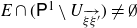 $E\cap(\mathsf{P}^1\setminus U_{\overrightarrow{\xi\xi^\prime}})\neq\emptyset$
, and
 $E\cap(\mathsf{P}^1\setminus U_{\overrightarrow{\xi^\prime\xi}})\neq\emptyset$
, and the condition (1·1) for this E is reformulated as
 \begin{equation} \sup\bigl\{\operatorname{mod}A\;:\;A\text{ is an annulus in }\mathsf{P}^1\text{ separating }E\bigr\}<\infty.\end{equation}
2·2. Chordal metric on
$\mathbb{P}^1$
and the Hsia kernels on
$\mathsf{P}^1$


Let
 $\pi\;:\;K^2\setminus\{(0,0)\}\to\mathbb{P}^1$
be the canonical projection. On
 $K^2$
, let
 $\|(p_0,p_1)\|$
be the maximum norm
 $\max\{|p_0|,|p_1|\}$
. With the wedge product
 $(p_0,p_1)\wedge(q_0,q_1)\;:\!=\;p_0q_1-p_1q_0$
on
 $K^2$
, the (normalised) chordal metric on
 $\mathbb{P}^1$
is defined as
 $[z,w]\;:\!=\;|p\wedge q|/(\|p\|\cdot\|q\|)$
on
 $\mathbb{P}^1\times\mathbb{P}^1$
, where
 $p\in\pi^{-1}(z),q\in\pi^{-1}(w)$
, so that
 \begin{equation*} [z,w]=\frac{|z-w|}{\max\{1,|z|\}\max\{1,|w|\}}\le\max\{1,|z-w|\}\quad\text{on }K\times K\end{equation*}
and that the strong triangle inequality
 $[z,w]\le\max\{[z,w'],[w',w]\}$
for any
 $z,w,w'\in\mathbb{P}^1$
still holds. The topology of
 $(\mathbb{P}^1,[z,w])$
coincides with the relative topology of
 $\mathbb{P}^1$
in
 $\mathsf{P}^1$
. Let us denote by
 $\textrm{diam}_\#S$
the diameter of a (non-empty) subset S in
 $(\mathbb{P}^1,[z,w])$
.
The action on
 $(\mathbb{P}^1,[z,w])$
of a rational function
 $h\in K(z)$
of degree
 $>0$
is
 $1/|\textrm{Res}(h)|$
-Lipschitz continuous, where
 $\textrm{Res}(h)\in[1,+\infty)$
is the homogeneous resultant
 $\textrm{Res}(H_0,H_1)$
of a (non-degenerate homogeneous) lift
 $H=(H_0,H_1)\in(K[X_0,X_1]_{\deg h})^2$
of
 $h(=[H_0\;:\;H_1])$
normalised so that the maximum of the absolute values of all coefficients of
 $H_0,H_1$
equals 1 ([Reference Rumely and Winburn18, Theorem 0.1]). In particular, the action on
 $(\mathbb{P}^1,[z,w])$
of each element
 $m(z)=(az+b)/(cz+d)$
in
 $\textrm{PGL}(2,K)$
, where
 $\max\{|a|,|b|,|c|,|d|\}=1$
, is quasi-isometric in that for any
 $z,w\in\mathbb{P}^1$
,
 $|ad-bc|[z,w]\le[M(z),M(w)]\le |ad-bc|^{-1}[z,w]$
, so in particular the subgroup
 $\textrm{PGL}(2,\mathcal{O}_K)$
in
 $\textrm{PGL}(2,K)$
acts isometrically on
 $(\mathbb{P}^1,[z,w])$
.
The generalised Hsia kernel
 $[\xi,\xi^\prime]_g$
on
 $\mathsf{P}^1$
with respect to
 $\xi_g$
is the unique upper semicontinuous and separately continuous extension to
 $\mathsf{P}^1\times\mathsf{P}^1$
of the chordal metric function [z, w] on
 $\mathbb{P}^1\times\mathbb{P}^1$
. More generally, for each
 $\xi_0\in\mathsf{P}^1$
, the generalised Hsia kernel on
 $\mathsf{P}^1$
with respect to
 $\xi_0$
is defined as
 \begin{equation*}[\xi,\xi']_{\xi_0}\;:\!=\;[\xi,\xi']_g/([\xi,\xi_0]_g[\xi',\xi_0]_g)\quad\text{on }\mathsf{P}^1\times\mathsf{P}^1,\end{equation*}
adopting the convention
 $1/0=0/(0^2)=+\infty$
; indeed, denoting by
 $\xi\wedge_{\xi_0}\xi^\prime$
the unique point in
 $[\xi,\xi^\prime]\cap[\xi,\xi_0]\cap[\xi^\prime,\xi_0]$
for any
 $\xi,\xi^\prime,\xi_0\in\mathsf{P}^1$
(so in particular that
 $\xi\wedge_\infty\xi_0=\xi\wedge\xi^\prime$
), the Gromov product on
 $(\mathsf{H}^1,\rho)$
with respect to a point
 $\xi_0\in\mathsf{H}^1$
is written as
 \begin{equation}\rho(\xi_0,\xi\wedge_{\xi_0}\xi')=-\log[\xi,\xi']_{\xi_0}+\rho(\xi_g,\xi_0)\quad\text{on }\mathsf{H}^1\times\mathsf{H}^1.\end{equation}
The generalised Hsia kernel function
 $[\xi,\xi']_{\xi_0}$
not only satisfies the strong triangle inequality
 \begin{equation*} [\xi,\xi']_{\xi_0}\le\max\bigl\{[\xi,\xi'']_{\xi_0},[\xi'',\xi']_{\xi_0}\bigr\}\quad\text{for any }\xi,\xi'\in\mathsf{P}^1\end{equation*}
(the equality in which holds if
 $[\xi,\xi^{\prime\prime}]_{\xi_0}\neq[\xi^{\prime\prime},\xi^\prime]_{\xi_0}$
), but also is
 $\textrm{PGL}(2,\mathcal{O}_K)$
-invariant in that for every
 $M\in\textrm{PGL}(2,\mathcal{O}_K)$
,
 \begin{equation} [M(\xi),M(\xi')]_{M(\xi_0)}=[\xi,\xi']_{\xi_0}\quad\text{on }\mathsf{P}^1\times\mathsf{P}^1.\end{equation}
Let us denote
 $[\xi,\xi^\prime]_\infty$
also by
 $|\xi-\xi^\prime|_\infty$
, (the restriction to
 $\mathsf{A}^{\!1}\times\mathsf{A}^{\!1}$
of) which is the original Hsia kernel on
 $\mathsf{A}^{\!1}$
and restricts to
 $|z-w|$
on
 $K\times K$
, although
 $\xi-\xi^\prime$
itself is not necessarily defined. For any
 $\xi,\xi^\prime\in\mathsf{A}^{\!1}$
,
 \begin{align} |\xi-\xi'|_\infty\bigl(=\sup\bigl\{|z-z^{\prime}|\;:\;z\in B_{\xi},z^{\prime}\in &B_{\xi^\prime}\bigr\}\quad\text{if }\xi,\xi'\not\in\mathsf{H}^1_{\textrm{IV}}\bigr)\\ &\;\;\;\;=\textrm{diam}\;(\xi\wedge\xi')\ge\max\{\textrm{diam}\;\xi,\textrm{diam}\;(\xi')\}.\end{align}
For every (non-empty) subset S in
 $\mathsf{A}^{\!1}$
, we also set
 \begin{equation*} \textrm{diam}_\infty S\;:\!=\;\sup\bigl\{|\xi-\xi'|_\infty\;:\;\xi,\xi'\in S\bigr\}\in[0,+\infty],\end{equation*}
so in particular that for every
 $\xi\in\mathsf{A}^{\!1}$
,
 $\textrm{diam}\;\xi=\textrm{diam}_\infty\{\xi\}$
.
For every
 $\xi_0\in\mathsf{H}^1$
and every compact subset E in
 $\mathsf{A}^{\!1}$
, noting that
 $\log[\,\cdot\,,\xi_0]_g=-\rho(\xi_g,\,\cdot\wedge_{\xi_g}\xi_0)\ge-\rho(\xi_g,\xi_0)=\log[\xi_0,\xi_0]_g$
on
 $\mathsf{H}^1$
(by (2·4)), we have the uniform comparison
 \begin{equation} \bigl([\xi_0,\xi_0]_g\bigr)^2[\xi,\xi']_{\xi_0}\le |\xi-\xi'|_\infty\le\frac{[\xi,\xi^\prime]_{\xi_0}}{(\inf_E[\,\cdot\,,\infty]_g)^2}\quad\text{on }E\times E\end{equation}
between the kernel functions
 $|\xi-\xi^\prime|_\infty$
and
 $[\xi,\xi^\prime]_{\xi_0}$
restricted to
 $E\times E$
.
For every
 $\xi_0\in\mathsf{A}^{\!1}$
and every
 $r\ge \textrm{diam}\;(\xi_0)$
, set
 \begin{align*} \mathsf{B}(\xi_0,r) & := \{\xi\in\mathsf{A}^{\!1}\;:\;|\xi-\xi_0|_\infty\le r\}\Bigl(=\mathsf{P}^1\setminus U_{\overrightarrow{\xi_{B(z_0,r)}\infty}}=\overline{B(z_0,r)}\quad\text{in }\mathsf{P}^1\\ &\;\;\;\quad\quad\quad\quad\quad\quad\quad\quad \text{writing }B_{\xi_0}=B(z_0,\textrm{diam}\;(\xi_0))\text{ for some }z_0\in K\text{ if }\xi_0\not\in\mathsf{H}^1_{\textrm{IV}}\Bigr).\end{align*}
Similarly, for every
 $a\in\mathbb{P}^1$
and every
 $r\in[0,1]$
, set
 \begin{equation*} \mathsf{B}_\#(a,r)\;:\!=\;\{\xi\in\mathsf{P}^1\;:\;[\xi,a]_g\le r\}\bigl(=\overline{\{z\in\mathbb{P}^1\;:\;[z,a]\le r\}}\quad\text{in }\mathsf{P}^1\bigr),\end{equation*}
which is called a Berkovich chordal closed ball in
 $\mathsf{P}^1$
.
2·3. Classical Julia/Fatou sets and Hsia’s equicontinuity criterion
For a rational function
 $f\in K(z)$
on
 $\mathbb{P}^1$
of degree
 $>1$
, the classical Fatou set of f is defined by the set of all points in
 $\mathbb{P}^1$
at each of which the iterations family
 $f^n\;:\, (\mathbb{P}^1,[z,w])\to(\mathbb{P}^1,[z,w])$
,
 $n\in\mathbb{N}$
, of f is equicontinuous (then this subset is indeed open from the proof of [Reference Kawaguchi and Silverman11, Theorem 23]), and the classical Julia set is by the complement of the classical Fatou set of f in
 $\mathbb{P}^1$
. Then in fact
 $\mathsf{J}(f)\cap\mathbb{P}^1$
and
 $\mathsf{F}(f)\cap\mathbb{P}^1$
coincide with the classical Julia and Fatou sets of f, respectively, and
 $\mathsf{J}(f)\cap\mathbb{P}^1$
still has no isolated points in
 $\mathbb{P}^1$
(otherwise
 $\mathsf{J}(f)\cap\mathbb{P}^1$
must be a singleton in
 $\mathbb{P}^1$
, and in turn
 $\mathsf{J}(f)\cap\mathbb{P}^1\subset E(f)$
, which contradicts
 $E(f)\subset\mathsf{F}(f)$
).
Hsia’s non-archimedean counterpart [Reference Hsia9] to Montel’s so called three points theorem asserts that, if a family
 $\mathcal{F}$
of meromorphic functions on a K-closed disk
 $B=B(a,r)$
,
 $r>0$
, omits more than one point in
 $\mathbb{P}^1$
in that
 $\#(\mathbb{P}^1\setminus\bigcup_{f\in\mathcal{F}}f(B))\ge 2$
, then
 $\mathcal{F}$
is equicontinuous on B regarding each element of
 $\mathcal{F}$
as a continuous mapping from B to
 $(\mathbb{P}^1,[z,w])$
. Let us call this theorem Hsia’s Montel-type two points theorem. For further developments of the Montel-type equicontinuity/normality theorem in non-archimedean and Berkovich (i.e., non-classical) setting, see [Reference Favre, Kiwi and Trucco6, Reference Rodrguez Vízquez17].
3. Proof of Theorem 1
Let
 $f\in K(z)$
be a rational function on
 $\mathbb{P}^1$
of degree
 $d>1$
having no potentially good reductions (otherwise
 $\mathsf{J}(f)$
is a singleton, so is not (uniformly) perfect). The following argument is an adaption of that in [Reference Mañé and da Rocha13], which seems most adaptable to non-archimedean setting among the (independent) originals [Reference Eremenko4, Reference Hinkkanen8, Reference Mañé and da Rocha13].
Suppose to the contrary that
 $\mathsf{J}(f)$
is not uniformly perfect, i.e., that there is a sequence
 $(A_j)$
of (non-degenerating and finite open Berkovich) annuli in
 $\mathsf{P}^1$
separating
 $\mathsf{J}(f)$
such that
 $\lim_{j\to\infty}\operatorname{mod}(A_j)=+\infty$
. Then without loss of generality, we assume that for every
 $j\in\mathbb{N}$
,
 $A_j=A(\xi_j,\xi^\prime_{j})$
, where
 \begin{equation*} \xi_j=\xi_{B(a_j,|z_j|)}\quad\text{and}\quad\xi^\prime_{j}=\xi_{B(a_j,|z^{\prime}_{j}|)}\end{equation*}
for some
 $a_j\in\mathcal{O}_K=B(0,1)$
and some
 $z_j,z^{\prime}_{j}\in K^*$
,
 $|z_j|<|z^{\prime}_{j}|\le 1$
(so in particular
 $\lim_{j\to\infty}|z_j|=0$
); indeed, (i) by (2·2), we assume that
 $\xi_g\not\in A_j$
for every
 $j\in\mathbb{N}$
, and in turn, (ii) by (2·2), the
 $\textrm{PGL}(2,K)$
-invariance of the moduli of annuli in
 $\mathsf{P}^1$
, and the
 $\textrm{PGL}(2,K)$
-equivariance of
 $\mathsf{J}(f)$
, taking a subsequence of
 $(A_j)$
and replacing f(z) with
 $1/f(1/z)$
, if necessary, we also assume that for every
 $j\in\mathbb{N}$
,
 $A_j=A(\xi_j,\xi^\prime_{j})$
for some
 $\xi_j,\xi^\prime_{j}\in\mathsf{H}^1$
satisfying
 $\xi_j\prec\xi^\prime_{j}\preceq\xi_g$
. Finally, (iii) by the density of
 $\mathsf{H}^1_{\textrm{II}}$
in
 $\mathsf{P}^1$
and the continuity of diam on any interval in
 $\mathsf{P}^1$
, we assume that for every
 $j\in\mathbb{N}$
,
 $\xi_j,\xi^\prime_{j}\in\mathsf{H}^1_{\textrm{II}}$
, without loss of generality.
Pick sequences
 $(w_j),(w^{\prime}_{j})$
in
 $K^*$
such that for every
 $j\in\mathbb{N}$
,
 \begin{equation*} \exp\bigl(-\operatorname{mod}(A_j)\bigr)=|z_j/z^{\prime}_{j}|<|w_j|<|w^{\prime}_{j}|< 1\end{equation*}
and that
 $\lim_{j\to\infty}|w^{\prime}_{j}|=\lim_{j\to\infty}|w_j|/|w^{\prime}_{j}|=0$
(so
 $\lim_{j\to\infty}|w_j|=0$
). For every
 $j\in\mathbb{N}$
, since
 $|z_j|<|z^{\prime}_{j}w_j|<|z^{\prime}_{j}w^{\prime}_{j}|<|z^{\prime}_{j}|$
, we have
 \begin{equation} \emptyset\neq\bigl(\mathsf{J}(f)\cap(\mathsf{P}^1\setminus U_{\overrightarrow{\xi_j\xi^\prime_{j}}})\subset\bigr)\mathsf{J}(f)\cap U_{\overrightarrow{\xi_{B(a_j,|z^{\prime}_{j}w_j|)}a_j}},\end{equation}
and then (see Benedetto [Reference Benedetto2, Proposition 12·9])
 \begin{equation}\mathsf{J}(f)\subset f^n(U_{\overrightarrow{\xi_{B(a_j,|z^{\prime}_{j}w_j|)}a_j}})\quad\text{for }n\gg 1.\end{equation}
Let us also pick a subset
 $S\subset\mathbb{P}^1$
such that
 $\#S\ge 3$
as follows; since
 $\sup_{j\in\mathbb{N}}|z^{\prime}_{j}|\le 1$
and
 $\lim_{j\to\infty}|w_j|=0$
, we also have
 \begin{equation}\textrm{diam}_\infty(U_{\overrightarrow{\xi_{B(a_j,|z^{\prime}_{j}w_j|)}a_j}})=\textrm{diam}\;(B(a_j,|z^{\prime}_{j}w_j|))=|z^{\prime}_{j}||w_j|\to 0\end{equation}
as
 $j\to\infty$
. Hence if (a) the sequence
 $(a_j)$
(in
 $\mathcal{O}_K$
) has a limit point in
 $\mathcal{O}_K$
, then by (3·1), (†), and the strong triangle inequality, this limit point is in
 $\mathsf{J}(f)\cap\mathbb{P}^1$
, and then since
 $\mathsf{J}(f)\cap\mathbb{P}^1$
has no isolated points, we can pick
 $S\subset\mathsf{J}(f)\cap\mathbb{P}^1$
such that
 $\#S=3$
. Alternatively if (b) the sequence
 $(a_j)$
(in
 $\mathcal{O}_K$
) has no limit points in
 $\mathcal{O}_K$
, then by (†) and the strong triangle inequality (and the completeness of K), we can fix
 $1\ll j_1<j_2<j_3$
such that
 $U_{\overrightarrow{\xi_{B(a_{j_1},|z^{\prime}_{j_1}w_{j_1}|)}a_{j_1}}}\cap U_{\overrightarrow{\xi_{B(a_{j_2},|z^{\prime}_{j_2}w_{j_2}|)}a_{j_2}}}=\emptyset$
and in turn that
 $(U_{\overrightarrow{\xi_{B(a_{j_1},|z^{\prime}_{j_1}w_{j_1}|)}a_{j_1}}}\cup U_{\overrightarrow{\xi_{B(a_{j_2},|z^{\prime}_{j_2}w_{j_2}|)}a_{j_2}}})\cap U_{\overrightarrow{\xi_{B(a_{j_3},|z^{\prime}_{j_3}w_{j_3}|)}a_{j_3}}}=\emptyset$
, and set
 $S\;:\!=\;\{a_{j_\ell}\;:\;\ell\in\{1,2,3\}\}$
.
Fix
 $L\gg 1$
so that
 $(0<)L^{-1}\cdot\min_{z,w\in S\;:\;\text{distinct}}[z,w]\le \textrm{diam}_\#(\mathsf{J}(f)\cap\mathbb{P}^1)$
and that the action on
 $(\mathbb{P}^1,[z,w])$
of f is L-Lipschitz continuous, and fix
 $c\in(0,L^{-1}\cdot\min_{z,w\in S\;:\;\text{distinct}}[z,w])$
. Then by (3·2), there exists a (unique) sequence
 $(m_j)$
in
 $\mathbb{N}$
tending to
 $\infty$
as
 $j\to\infty$
such that for every
 $j\gg 1$
,
 \begin{align*}
\max_{n\in\{0,1,\ldots,m_j-1\}} & \textrm{diam}_{\#} \bigl(f^n(U_{\overrightarrow{\xi_{B(a_j,|z^{\prime}_{j}w_j|)}a_j}})\cap\mathbb{P}^1\bigr) \lt c\\ & \;\;\;\;\;\;\;\;\;\;\;\;\;\;\; \le \textrm{diam}_\#\bigl(f^{m_j}(U_{\overrightarrow{\xi_{B(a_j,|z^{\prime}_{j}w_j|)}a_j}})\cap\mathbb{P}^1\bigr)\bigl(\lt Lc\lt\min_{z,w\in S\;:\;\text{distinct}}[z,w]\le 1\bigr), \end{align*}
so in particular
 \begin{equation} \#\bigl((f^{m_j}(U_{\overrightarrow{\xi_{B(a_j,|z^{\prime}_{j}w_j|)}a_j}}))\cap S\bigr)\le 1.\end{equation}
Moreover, by the choice of
 $(w_j)$
and
 $(w^{\prime}_{j})$
, for every
 $j\in\mathbb{N}$
, we have
 $U_{\overrightarrow{\xi_{B(a_j,|z^{\prime}_{j}w^{\prime}_{j}|)}a_j}}\setminus U_{\overrightarrow{\xi_{B(a_j,|z^{\prime}_{j}w_j|)}a_j}}\subset A_j$
, which with
 $f(\mathsf{F}(f))\subset\mathsf{F}(f)$
also yields
 \begin{equation} f^{m_j}\bigl(U_{\overrightarrow{\xi_{B(a_j,|z^{\prime}_{j}w^{\prime}_{j}|)}a_j}}\setminus U_{\overrightarrow{\xi_{B(a_j,|z^{\prime}_{j}w_j|)}a_j}}\bigr)\subset f^{m_j}(A_j)\subset\mathsf{F}(f).\end{equation}
We claim that for
 $j\gg 1$
, we still have
 \begin{equation*} \#\bigl((f^{m_j}(U_{\overrightarrow{\xi_{B(a_j,|z^{\prime}_{j}w^{\prime}_{j}|)}a_j}}))\cap S\bigr)\le 1;\end{equation*}
for, in the case (a), the claim holds by (*) and (**) since
 $S\subset\mathsf{J}(f)$
in this case. In the case (b), for
 $j\gg 1$
, by (2·1) and (*), we have
 \begin{equation} f^{m_j}(U_{\overrightarrow{\xi_{B(a_j,|z^{\prime}_{j}w_j|)}a_j}})=U_{(f^{m_j})_*(\overrightarrow{\xi_{B(a_j,|z^{\prime}_{j}w_j|)}a_j})}.\end{equation}
Then
 $f^{m_j}(U_{\overrightarrow{\xi_{B(a_j,|z^{\prime}_{j}w_j|)}a_j}})$
intersects
 $U_{\overrightarrow{\xi_{B(a_{j_\ell},|z^{\prime}_{j_\ell}w_{j_\ell}|)}\xi_{j_\ell}}}$
for at most one of
 $\ell\in\{1,2,3\}$
(by the strong triangle inequality), and then by (2·1), (3·1) and (**) (and the strong triangle inequality), we even have
 \begin{equation} f^{m_j}(U_{\overrightarrow{\xi_{B(a_j,|z^{\prime}_{j}w^{\prime}_{j}|)}a_j}})=U_{(f^{m_j})_*(\overrightarrow{\xi_{B(a_j,|z^{\prime}_{j}w^{\prime}_{j}|)}a_j})}.\end{equation}
Hence, if
 $\#\bigl\{\ell\in\{1,2,3\}\;:\;U_{(f^{m_j})_*(\overrightarrow{\xi_{B(a_j,|z^{\prime}_{j}w^{\prime}_{j}|)}a_j})}\cap U_{\overrightarrow{\xi_{B(a_{j_\ell},|z^{\prime}_{j_\ell}w_{j_\ell}|)}a_{j_\ell}}}\neq\emptyset\bigr\}\le 1$
, then we are done. Otherwise,
 $U_{(f^{m_j})_*(\overrightarrow{\xi_{B(a_j,|z^{\prime}_{j}w^{\prime}_{j}|)}a_j})}\supset U_{\overrightarrow{\xi_{B(a_{j_\ell},|z^{\prime}_{j_\ell}w_{j_\ell}|)}a_{j_\ell}}}$
for more than one of
 $\ell\in\{1,2,3\}$
(by the strong triangle inequality), and then
 \begin{multline*}\emptyset=\mathsf{F}(f)\cap\mathsf{J}(f)\underset{\text{by }({}^{\ast\ast})}{\supset}\bigl(f^{m_j}(U_{\overrightarrow{\xi_{B(a_j,|z^{\prime}_{j}w^{\prime}_{j}|)}a_j}}\setminus U_{\overrightarrow{\xi_{B(a_j,|z^{\prime}_{j}w_j|)}a_j}})\bigr)\cap\mathsf{J}(f)\\\underset{\text{by }({}^{\ast\ast\ast})\&({}^{\ast\ast\ast\ast})}{\supset}\bigl(U_{(f^{m_j})_*(\overrightarrow{\xi_{B(a_j,|z^{\prime}_{j}w^{\prime}_{j}|)}a_j})}\setminus U_{(f^{m_j})_*(\overrightarrow{\xi_{B(a_j,|z^{\prime}_{j}w_j|)}a_j})}\bigr)\cap\mathsf{J}(f)\\\underset{\text{by }(^{\ast})}{\supset}(U_{\overrightarrow{\xi_{B(a_{j_\ell},|z^{\prime}_{j_\ell}w_{j_\ell}|)}a_{j_\ell}}})\cap\mathsf{J}(f)\underset{(3\cdot1)}{\neq}\emptyset\end{multline*}
for at least one of
 $\ell\in\{1,2,3\}$
(the final inclusion in which is also by the strong triangle inequality). This is impossible, and we are also done.
Once the claim is at our disposal, taking a subsequence if necessary, there is
 $S'\subset S$
such that
 $\#S'=2$
and that the family
 \begin{equation*} g_j(z)\;:\!=\;f^{m_j}\bigl(a_j+z^{\prime}_{j}w^{\prime}_{j}z\bigr)\in K(z), \quad j\in\mathbb{N},\end{equation*}
restricted to
 $\mathcal{M}_K=U_{\overrightarrow{\xi_g0}}\cap K$
omits
 $S'$
. Then by Hsia’s Montel-type two points theorem (see Section 2·3), this family
 $\{g_j\;:\;\mathcal{M}_K\to(\mathbb{P}^1,[z,w])\}_{j\in\mathbb{N}}$
is equicontinuous at
 $z=0$
. Consequently, recalling that
 $\lim_{j\to\infty}|w_j/w^{\prime}_{j}|=0$
(from the choice of
 $(w_j),(w^{\prime}_{j})$
), we must have
 \begin{multline*} 0=\lim_{j\to\infty}\textrm{diam}_\#\bigl(g_j(B(0,|w_j/w^{\prime}_{j}|))\bigr) =\liminf_{j\to\infty}\textrm{diam}_\#\bigl(f^{m_j}(U_{\overrightarrow{\xi_{B(a_j,|z^{\prime}_{j}w_j|)}a_j}})\cap\mathbb{P}^1\bigr)\ge c>0,\end{multline*}
which is a contradiction. Now the proof of Theorem 1 is complete.
4. A (non-infinitesimal) lower capacity density property
Let K be an algebraically closed field that is complete with respect to a non-trivial and non-archimedean absolute value
 $|\cdot|$
.
The logarithmic capacity
 $ \mathrm{Cap}_\infty E$
with pole
 $\infty$
of a compact subset E in
 $\mathsf{A}^{\!1}$
(see (5·1) for the definition) equals the transfinite diameter
 \begin{equation*}d^{(\infty)}_\infty E\;:\!=\;\lim_{n\to\infty}\Bigg(\sup_{\xi_1,\ldots,\xi_n\in E}\Bigl(\prod_{i=1}^n\prod_{j\in\{1,\ldots,n\}\setminus\{i\}}\bigl|\xi_i-\xi_j\bigr|_\infty\Bigr)^{\frac{1}{n(n-1)}}\Bigg)\in\mathbb{R}_{\ge 0}\end{equation*}
of E with pole
 $\infty$
(the above limit is a decreasing one); in particular,
 $ \mathrm{Cap}_\infty \emptyset=0$
and
 $ \mathrm{Cap}_\infty E\le \mathrm{Cap}_\infty(E')$
if
 $E\subset E'$
. For every
 $\xi\in\mathsf{A}^{\!1}$
and every
 $r\ge \textrm{diam}\;\xi$
, we have
 \begin{multline*} \mathrm{Cap}_\infty(\mathsf{B}(\xi,r))=r\Bigl(= \mathrm{Cap}_\infty(\{\xi_{B(z_0,r)}\})\\\text{writing }B_{\xi}=B(z_0,\textrm{diam}\;\xi)\text{ for some }z_0\in K\text{ if }\xi\not\in\mathsf{H}^1_{\textrm{IV}}\Bigr).\end{multline*}
More details on potential theory on
 $\mathsf{P}^1$
will be given in Section 5.
Definition 4·1. We say a compact subset E in
 $\mathsf{P}^1$
has the (non-infinitesimal) lower capacity density property (for some
 $c\in(0,1)$
) if there is
 $c\in(0,1)$
such that for every
 $\xi\in E\setminus\{\infty\}$
and every
 $r\in(\textrm{diam}\;\xi,\textrm{diam}_\infty E)$
,
 \begin{equation} \mathrm{Cap}_\infty\bigl(E\cap\mathsf{B}(\xi,r)\bigr)\ge cr.\end{equation}
The following potential theoretic precision/characterisation of compact subsets in
 $\mathsf{P}^1$
having the bounded moduli property for separating annuli (see (1·1)) is a non-archimedean counterpart to the fundamental Pommerenke [Reference Pommerenke16, Theorem 1] in complex analysis.
Theorem 3. Let K be an algebraically closed field that is complete with respect to a non-trivial and non-archimedean absolute value, and let E be a compact subset in
 $\mathsf{P}^1$
. Then E has the bounded moduli property for its separating annuli if and only if E has the (non-infinitesimal) lower capacity density property (for some
 $c\in(0,1))$
.
Among several proofs of [Reference Pommerenke16, Theorem 1] (see the survey [Reference Sugawa20]), the beautiful argument in Pommerenke’s original one seems most adaptable to non-archimedean setting.
Proof of Theorem 3. Let E be a compact subset in
 $\mathsf{P}^1$
, and set
 \begin{equation*}c_E\;:\!=\;\sup\bigl\{\operatorname{mod}A\;:\;A\text{ is a concentric annulus in }\mathsf{A}^{\!1}\text{ separating }E\bigr\}\in\mathbb{R}_{\ge 0}\cup\{+\infty\}.\end{equation*}
 $[\!\Leftarrow\!]$
For any (non-degenerating and finite Berkovich open) concentric annulus
 $A(\xi,\xi^\prime)$
(for some
 $\xi,\xi^\prime\in\mathsf{H}^1$
satisfying
 $\xi\prec\xi^\prime$
) in
 $\mathsf{A}^{\!1}$
separating E and any
 $\textrm{diam}\;\xi<r<r'<\textrm{diam}\;(\xi^\prime)$
(so
 $r'\le \textrm{diam}_\infty E$
), we have
 \begin{equation*} \mathrm{Cap}_\infty\bigl(E\cap\mathsf{B}(\xi,r')\bigr)= \mathrm{Cap}_\infty\bigl(E\cap\mathsf{B}(\xi,r)\bigr)\le \mathrm{Cap}_\infty\bigl(\mathsf{B}(\xi,r)\bigr)=r.\end{equation*}
Hence if E has the (non-infinitesimal) lower capacity density property (for some
 $c\in(0,1)$
), then
 $cr'\le r$
, i.e.,
 $\log(r'/r)\le\log(1/c)$
. Making
 $r\searrow \textrm{diam}\;\xi$
and
 $r'\nearrow \textrm{diam}\;(\xi^\prime)$
, we have
 $\operatorname{mod}(A(\xi,\xi^\prime))\le\log(1/c)$
, so that
 $c_E\le\log(1/c)<+\infty$
.
 $[\!\Rightarrow\!]$
Suppose
 $c_E\in\mathbb{R}_{\ge 0}$
. Fix
 $s\in(0,e^{-c_E})(\subset(0,1))$
, and pick
 \begin{gather*} \xi_0\in E\quad\text{and}\quad r\in\bigl(\textrm{diam}\;(\xi_0),\textrm{diam}_\infty E\bigr).\end{gather*}
To any
 $j\in\mathbb{N}\cup\{0\}$
and any
 $\xi\in E\setminus\{\infty\}$
, we can associate a point
 $[\xi]_j\in E\setminus\{\infty\}$
satisfying
 \begin{align*} \Bigg\{\!\!\begin{array}{ll} & [\xi]_j=\xi \;\;\qquad\qquad\qquad\qquad\qquad\qquad\qquad\qquad \text{if }\textrm{diam}\;\xi\ge e^{-c_E}s^jr, \\[5pt]& [\xi]_j\in E\cap\bigl\{\xi^\prime\in\mathsf{A}^{\!1}\;:\;e^{-c_E}s^jr\le|\xi^\prime-\xi|_\infty\le s^jr\bigr\} \quad \text{if }\textrm{diam}\;\xi < e^{-c_E}s^jr; \end{array} \end{align*}
in the latter case, if
 $\xi\not\in\mathsf{H}^1_{\textrm{IV}}$
, then writing
 $\xi=B(a,\textrm{diam}\;\xi)$
for some
 $a\in K$
, we have
 $\{\xi^\prime\in\mathsf{A}^{\!1}\;:\;e^{-c_E}s^jr\le |\xi^\prime-\xi|_\infty\le s^jr\}=A(\xi_{B(a,e^{-c_E}s^jr)},\xi_{B(a,s^jr)})$
. The case that
 $\xi\in\mathsf{H}^1_{\textrm{IV}}$
, i.e., that
 $\xi$
is the cofinal equivalence class of a non-increasing and nesting sequence
 $(B(a_i,r_i))$
of K-closed disks having the empty intersection, is treated in a similar way.
Then inductively on
 $j\in\mathbb{N}$
, for every
 $j\in\mathbb{N}$
and every
 $(i_1,\ldots,i_j)\in\{0,1\}^j$
, we set
 $a_{i_1,\ldots,i_j,i_{j+1}}\in E\setminus\{\infty\}$
so that
 \begin{align*}
a_{i_1} = \Bigg\{\!\!
\begin{array}{ll}
&\xi_0 & \text{if }i_1=0, \\[5pt]
&[\xi_0]_0\, & \text{if }i_1 = 1
\end{array} \quad \text{and}\quad
a_{i_1, \ldots,i_j,i_{j+1}} = \Bigg\{\!\!
\begin{array}{ll}
& a_{i_1, \ldots,i_j} & \text{if }i_{j+1}=0,\\[5pt]
& [a_{i_1, \ldots,i_j}]_j & \text{if }i_{j+1}=1,
\end{array}
\end{align*}
and for every
 $j\in\mathbb{N}$
, set
 \begin{equation*} E_j\;:\!=\;\bigl\{a_{i_1,\ldots,i_j}\;:\;(i_1,\ldots,i_j)\in\{0,1\}^j\bigr\},\end{equation*}
so that
 $\xi_0\in E_j\subset E_{j+1}$
. For every
 $j\in\mathbb{N}$
, using the strong triangle inequality for the Hsia kernel
 $|\xi-\xi^\prime|_\infty$
repeatedly, we have
 \begin{equation*} \sup_{(i_1,\ldots,i_j)\in\{0,1\}^j}|a_{i_1,\ldots,i_j}-\xi_0|_\infty\le\max\{\textrm{diam}\;(\xi_0),s^0r\}=r,\end{equation*}
so that
 $E_j\subset E\cap\mathsf{B}(\xi_0,r)$
.
For every
 $j\in\mathbb{N}$
and any distinct
 $(i_1,\ldots,i_j),(i^\prime_{1},\ldots,i^\prime_{j})\in\{0,1\}^j$
, writing
 \begin{equation*} \xi=a_{i_1,\ldots,i_j}\quad\text{and}\quad\xi'=a_{i^\prime_{1},\ldots,i^\prime_{j}}\end{equation*}
(in
 $E_j$
) for simplicity, set not only
 \begin{multline*}m_*=m_*(\xi,\xi')\\\;:\!=\;\max\bigl\{m\in\{1,\ldots,j\}\;:\;i_k=i^\prime_{k}\text{ for any }k\in\{1,\ldots,m\}\bigr\}\in\{0,1,\ldots,j-1\}\end{multline*}
(under the convention
 $\max\emptyset=0$
) but also
 \begin{equation*} \xi_*=\xi_*(\xi,\xi')\;:\!=\;\begin{cases} a_{i_1,\ldots,i_{m_*}}=a_{i^\prime_{1},\ldots,i^\prime_{\phantom{1}\!\!\!m_*}}&\text{if }m_*>0,\\ \xi_0 &\text{if }m_*=0\end{cases}\in E_j.\end{equation*}
We claim that
 \begin{equation*} |\xi-\xi'|_\infty>s^{m_*+1}r;\end{equation*}
indeed, replacing
 $(i_1,\ldots,i_j),(i^\prime_{1},\ldots,i^\prime_{j})$
if necessary, we have
 $i_{m_*+1}=0$
and
 $i^\prime_{m_*+1}=1$
, so that
 \begin{equation*} a_{i_1,\ldots,i_{m_*},i_{m_*+1}}=\xi_*\quad\text{and}\quad a_{i^{\prime}_{1},\ldots,i^\prime_{\phantom{1}\!\!\!m_*},i^{\prime}_{m_*+1}}=[\xi_*]_{m_*}.\end{equation*}
If
 $\max\{\textrm{diam}\;(\xi_*),\textrm{diam}\;([\xi_*]_{m_*})\}>s^{m_*+1}r$
, then either
 $\xi=\xi_*$
or
 $\xi^\prime=[\xi_*]_{m_*}$
, and in turn, also using the lower estimate (2·6) of the kernel function
 $|\xi-\xi^\prime|_\infty$
, we have the desired estimate
 \begin{equation*} |\xi-\xi'|_\infty\ge\max\bigl\{\textrm{diam}\;(\xi_*),\textrm{diam}\;([\xi_*]_{m_*})\bigr\}>s^{m_*+1}r\end{equation*}
in this case. Alternatively if
 $\max\{\textrm{diam}\;(\xi_*),\textrm{diam}\;([\xi_*]_{m_*})\}\le s^{m_*+1}r$
, then
 \begin{equation*} \max_{m\in\{m_*+1,\cdots,j-1\}}\max\bigl\{\textrm{diam}\;(a_{i_1,\ldots,i_m}),\textrm{diam}\;(a_{i^{\prime}_{1},\ldots,i^\prime_{\phantom{1}\!\!\!m}})\bigr\}\le s^{m_*+1}r,\end{equation*}
so that also using the strong triangle inequality for the kernel function
 $|\xi-\xi^\prime|_\infty$
repeatedly, we compute
 \begin{multline*} |\xi-\xi_*|_\infty\le\max_{m\in\{m_*+1,\ldots,j-1\}}\bigl|a_{i_1,\ldots,i_m,i_{m+1}}-a_{i_1,\ldots,i_m}\bigr|_\infty\\\le\max_{m\in\{m_*+1,\ldots,j-1\}}\max\bigl\{\textrm{diam}\;(a_{i_1,\ldots,i_m}),s^mr\bigr\}\le s^{m_*+1}r\end{multline*}
and, similarly,
 \begin{equation*}\bigl|\xi'-[\xi_*]_{m_*}\bigr|_\infty\le\max_{m\in\{m_*+1,\ldots,j-1\}}\bigl|a_{i^\prime_{1},\ldots,i^\prime_{\phantom{1}\!\!\!m},i^\prime_{m+1}}-a_{i^\prime_{1},\ldots,i^\prime_{\phantom{1}\!\!\!m}}\bigr|_\infty\le s^{m_*+1}r.\end{equation*}
By the above two estimates and the equality in the strong triangle inequality for the kernel function
 $|\xi-\xi^\prime|_\infty$
, we have
 \begin{multline*}|\xi-\xi'|_\infty=\max\Bigl\{|\xi-\xi_*|_\infty,\bigl|\xi_*-[\xi_*]_{m_*}\bigr|_\infty,\bigl|\xi'-[\xi_*]_{m_*}\bigr|_\infty\Bigr\}\\=\bigl|\xi_*-[\xi_*]_{m_*}\bigr|_\infty\ge e^{-c_E}s^{m_*}r>s^{m_*+1}r,\end{multline*}
which also yields the desired estimate in this case. Hence the claim holds.
Once the claim is at our disposal, for every
 $j\in\mathbb{N}$
and every
 $(i_1,\ldots,i_j)\in\{0,1\}^j$
, we compute
 \begin{align*} &\prod_{(i^\prime_{1},\ldots,i^\prime_{j})\in\{0,1\}^j\setminus\{(i_1,\ldots,i_j)\}}|a_{i_1,\ldots,i_j}-a_{i^\prime_{1},\ldots,i^\prime_{j}}|_\infty\\=&\prod_{m=0}^{j-1}\Bigl(\prod_{(i^\prime_{1},\ldots,i^\prime_{j})\in\{0,1\}^j\setminus\{(i_1,\ldots,i_j)\}\;:\;m_*(a_{i_1,\ldots,i_j},a_{i^\prime_{1},\ldots,i^\prime_{\phantom{1}} \!\!\!\!\phantom{l}_{j} })=m}|a_{i_1,\ldots,i_j}-a_{i^\prime_{1},\ldots,i^\prime_{j}}|_\infty\Bigr)\\>&\prod_{m=0}^{j-1}(s^{m+1}r)^{2^{j-(m+1)}}=s^{\sum_{m=0}^{j-1}(m+1)2^{j-(m+1)}}\cdot r^{2^j-1},\end{align*}
so that, also recalling that
 $E_j\subset E\cap\mathsf{B}(\xi_0,r)$
and
 $\#\{0,1\}^j=2^j$
, we have
 \begin{multline*} \mathrm{Cap}_\infty\bigl(E\cap\mathsf{B}(\xi_0,r)\bigr)=d^{(\infty)}_\infty\bigl(E\cap\mathsf{B}(\xi_0,r)\bigr)\\\ge\limsup_{j\to\infty}\Bigl(\bigl(s^{2^j\sum_{m=0}^{j-1}(m+1)2^{-(m+1)}}\cdot\, r^{2^j-1}\bigr)^{2^j}\Bigr)^{\frac{1}{2^j(2^j-1)}}=\bigl(s^{\sum_{m=0}^\infty\frac{m+1}{2^{m+1}}}\bigr)r=s^2r.\end{multline*}
Hence E has the (non-infinitesimal) lower capacity density property (for
 $c=e^{-2c_E}$
).
5. A uniform Hölder continuity property
Let K be an algebraically closed field that is complete with respect to a non-trivial and non-archimedean absolute value
 $|\cdot|$
.
Let us recall some details on logarithmic potential theory on
 $\mathsf{P}^1$
(see [Reference Baker and Rumely1, Section 6]). Recall that for every
 $\xi_0\in\mathsf{P}^1$
and every positive Radon measure
 $\nu$
on
 $\mathsf{P}^1$
, the logarithmic potential of
 $\nu$
on
 $\mathsf{P}^1$
with respect to
 $\xi_0$
(or with pole
 $\xi_0$
when
 $\xi_0\in\mathbb{P}^1$
) is the function
 \begin{equation*} p_{\xi_0,\nu}(\!\cdot\!)\;:\!=\;\int_{\mathsf{P}^1}\log[\cdot,\xi']_{\xi_0}\nu(\xi')\;:\;\mathsf{P}^1\to[{-}\infty,+\infty]\end{equation*}
(Definition 1·2). If either
 $\xi_0\in\mathsf{H}^1$
or
 $\textrm{supp}\;\nu\subset\mathsf{P}^1\setminus\{\xi_0\}$
, then
 $p_{\xi_0,\nu}$
is strongly upper semicontinuous on
 $\mathsf{P}^1$
in that for every
 $\xi\in\mathsf{P}^1$
,
 $\limsup_{\xi^\prime\to\xi}p_{\xi_0,\nu}(\xi^\prime)=p_{\xi_0,\nu}(\xi)$
, and satisfies
 \begin{equation*}p_{\xi_0,\nu}(\xi_0)=-\log[\xi_0,\xi_0]_g=\max_{\mathsf{P}^1}p_{\xi_0,\nu}.\end{equation*}
If
 $\textrm{supp}\;\nu\subset\mathsf{P}^1\setminus\{\xi_0\}$
, then
 $p_{\xi_0,\nu}$
is not only subharmonic on
 $\mathsf{P}^1\setminus\{\xi_0\}$
but also harmonic on
 $\mathsf{P}^1\setminus(\{\xi_0\}\cup\textrm{supp}\;\nu)$
, and the logarithmic energy of
 $\nu$
with respect to
 $\xi_0$
(or with pole
 $\xi_0$
when
 $\xi_0\in\mathbb{P}^1$
) is defined as
 \begin{equation*} I_{\xi_0,\nu}\;:\!=\;\int_{\mathsf{P}^1}p_{\xi_0,\nu}\nu=\int_{\mathsf{P}^1\times\mathsf{P}^1}\log[\xi,\xi']_{\xi_0}(\nu\times\nu)(\xi,\xi')\in[{-}\infty,+\infty).\end{equation*}
For every subset C in
 $\mathsf{P}^1$
and every
 $\xi_0\in\mathbb{P}^1\setminus C$
, setting
 \begin{equation*} V_{\xi_0}(C)\;:\!=\;\sup_{\nu}I_{\xi_0,\nu}\in[{-}\infty,+\infty),\end{equation*}
where
 $\nu$
ranges over all probability Radon measures on
 $\mathsf{P}^1$
supported by C (under the convention
 $\sup_{\emptyset}={-}\infty$
here), the logarithmic capacity of C with respect to
 $\xi_0$
(or with pole
 $\xi_0$
when
 $\xi_0\in\mathbb{P}^1$
) is
 \begin{equation} \mathrm{Cap}_{\xi_0}(C)\;:\!=\;\exp\bigl(V_{\xi_0}(C)\bigr)\in\mathbb{R}_{\ge 0}.\end{equation}
For every compact subset E in
 $\mathsf{P}^1$
and every
 $\xi_0\in\mathbb{P}^1\setminus E$
, if
 $ \mathrm{Cap}_{\xi_0}(E)>0$
, then the following Frostman-type properties hold; there is a unique probability Radon measure
 $\nu$
on
 $\mathsf{P}^1$
, which is called the equilibrium mass distribution on E with respect to
 $\xi_0$
(or with pole
 $\xi_0$
when
 $\xi_0\in\mathbb{P}^1\setminus E$
) and is denoted by
 $\nu_{\xi_0,E}$
, such that
 $\textrm{supp}\;\nu\subset E$
and that
 $I_{\xi_0,\nu}=V_{\xi_0}(E)$
; then denoting by
 $D_{\xi_0}=D_{\xi_0,E}$
the component of
 $\mathsf{P}^1\setminus E$
containing
 $\xi_0$
, we have
 $\textrm{supp}\;(\nu_{\xi_0,E})\subset\partial(D_{\xi_0})$
,
 \begin{gather*}p_{\xi_0,\nu_{\xi_0,E}}\ge V_{\xi_0}(E)\text{ on }\mathsf{P}^1,\quad p_{\xi_0,\nu_{\xi_0,E}}>V_{\xi_0}(E)\text{ on }D_{\xi_0},\quad\text{and}\\p_{\xi_0,\nu_{\xi_0,E}}\equiv V_{\xi_0}(E)\text{ on }\mathsf{P}^1\setminus(D_{\xi_0}\cup F),\end{gather*}
and
 $p_{\xi_0,\nu_{\xi_0,E}}$
is continuous at every point in
 $\mathsf{P}^1\setminus F$
, where F is an
 $F_{\sigma}$
-subset in
 $(\partial(D_{\xi_0}))\cap\mathbb{P}^1$
satisfying
 $ \mathrm{Cap}_{\xi_0}(F)=0$
; F could be chosen as
 $\emptyset$
if and only if
 $p_{\xi_0,\nu_{\xi_0,E}}$
is continuous at any point in
 $\partial(D_{\xi_0})$
, and then
 $\textrm{supp}\;(\nu_{\xi_0,E})=\partial(D_{\xi_0})$
. For the details on subharmonic functions on open subsets in
 $\mathsf{P}^1$
, see [Reference Baker and Rumely1, Sections 7 and 8] and [Reference Thuillier21, Section 3].
By the
 $\textrm{PGL}(2,\mathcal{O}_K)$
-invariance (2·5) of the generalised Hsia kernel functions
 $[\xi,\xi^\prime]_{\xi_0}$
on
 $\mathsf{P}^1$
, both the logarithmic capacity
 $ \mathrm{Cap}_{\xi_0}(E)$
of a compact subset E in
 $\mathsf{P}^1$
and the equilibrium mass distribution on E in
 $\mathsf{P}^1$
with respect to
 $\xi_0\in\mathsf{P}^1\setminus E$
are
 $\textrm{PGL}(2,\mathcal{O}_K)$
-invariant/equivariant in that for every
 $\xi_0\in\mathsf{P}^1\setminus E$
and every
 $M\in\textrm{PGL}(2,\mathcal{O}_K)$
,
 \begin{equation*} \mathrm{Cap}_{M(\xi_0)}(M(E))= \mathrm{Cap}_{\xi_0}E\end{equation*}
and, if in addition
 $ \mathrm{Cap}_{\xi_0}E>0$
, then
 $\nu_{M(\xi_0),M(E)}=M_*(\nu_{\xi_0,E})$
on
 $\mathsf{P}^1$
.
In computation, the so called Perron method is useful (see [Reference Thuillier21, Section 3·1·3]). For every
 $\xi_0\in\mathsf{H}^1$
, every
 $\overrightarrow{v}\in T_{\xi_0}\mathsf{P}^1$
, and every compact subset E in
 $U_{\overrightarrow{v}}$
, the zero-one extremal function
 \begin{multline*}\xi\longmapsto h(\xi;\ E,U_{\overrightarrow{v}})\;:\!=\;\sup\bigl\{u(\xi)\;:\;u\text{ is subharmonic on }U_{\overrightarrow{v}},\, u|E\le 0,\,\text{and }u< 1\text{ on }U_{\overrightarrow{v}}\bigr\}\\:\;U_{\overrightarrow{v}}\to[{-}\infty,1)\end{multline*}
for E with respect to
 $U_{\overrightarrow{v}}$
is not only harmonic on
 $U_{\overrightarrow{v}}\setminus E$
but also
 $\equiv 0$
on the union of E and all components of
 $(U_{\overrightarrow{v}}\cup\{\xi_0\})\setminus E$
not containing
 $\xi_0$
, and the upper semicontinuous regularisation
 $h(\cdot;\,E,U_{\overrightarrow{v}})^*$
of
 $h(\cdot;\,E,U_{\overrightarrow{v}})$
on
 $U_{\overrightarrow{v}}$
is subharmonic on
 $U_{\overrightarrow{v}}$
and coincides with
 $h(\cdot;\,E,U_{\overrightarrow{v}})$
on
 $U_{\overrightarrow{v}}\setminus E$
. On the other hand, similarly, for every compact subset E in
 $\mathsf{P}^1$
and every
 $\xi_0\in\mathsf{H}^1\setminus E$
, if
 $ \mathrm{Cap}_{\xi_0}(E)>0$
, then the function
 \begin{multline*}\xi\longmapsto P_{\xi_0,E}(\xi)\;:\!=\;\sup\bigl\{u(\xi)\;:\;u\text{ is subharmonic on }\mathsf{P}^1\setminus\{\xi_0\},\, u|E\le 0,\\\text{ and }u<-\log[\xi_0,\xi_0]_g-\log \mathrm{Cap}_{\xi_0}(E)\bigr\}\\:\;\mathsf{P}^1\to\bigl[{-}\infty,-\log[\xi_0,\xi_0]_g-\log \mathrm{Cap}_{\xi_0}(E)\bigr)\end{multline*}
is superharmonic on the
 $D_{\xi_0}=D_{\xi_0,E}$
, is harmonic on
 $D_{\xi_0}\setminus\{\xi_0\}$
, and is
 $\equiv 0$
on
 $\mathsf{P}^1\setminus D_{\xi_0}$
, and the upper semicontinuous regularisation
 $P_{\xi_0,E}^*$
of
 $P_{\xi_0,E}$
on
 $\mathsf{P}^1\setminus\{\xi_0\}$
is subharmonic on
 $\mathsf{P}^1\setminus\{\xi_0\}$
; indeed,
 \begin{equation}P_{\xi_0,E}^*\equiv p_{\xi_0,\nu_{\xi_0,E}}-\log \mathrm{Cap}_{\xi_0}(E)\quad\text{on }\mathsf{P}^1,\end{equation}
which is nothing but the generalised Green function
 $G_{\xi_0,E}$
on
 $\mathsf{P}^1$
associated to E with respect to
 $\xi_0$
(or with pole
 $\xi_0$
when
 $\xi_0\in\mathbb{P}^1\setminus E$
).
For every compact subset E in
 $\mathsf{A}^{\!1}$
, every
 $\xi_0\in\mathsf{H}^1\setminus E$
, every
 $a\in E\cap K$
, every
 $t>0$
, and every
 $R>1$
satisfying the following admissibility
 \begin{equation} \mathrm{Cap}_{\xi_0}\bigl(E\cap\mathsf{B}(a,t)\bigr)>0\quad\text{and}\quad\xi_{B(a,\,Rt)}\in[\xi_0,a],\end{equation}
we have not only
 \begin{multline}\frac{P_{\xi_0,E\cap\mathsf{B}(a,\;t)}}{\sup_{U_{\overrightarrow{\xi_{B(a,\,Rt)}a}}}P_{\xi_0,E\cap\mathsf{B}(a,\;t)}}\le h\bigl(\,\cdot\,;\,E\cap\mathsf{B}(a,t),U_{\overrightarrow{\xi_{B(a,\,Rt)}a}}\bigr)\le\frac{P_{\xi_0,E\cap\mathsf{B}(a,\;t)}^*}{P_{\xi_0,E\cap\mathsf{B}(a,\;t)}^*(\xi_{B(a,\,Rt)})}\\\text{on }U_{\overrightarrow{\xi_{B(a,\,Rt)}a}}\end{multline}
(cf. [Reference Siciak19, p.209]) using the maximum principle ([Reference Baker and Rumely1, Proposition 8·14]) for subharmonic functions (on
 $U_{\overrightarrow{\xi_{B(a,\,Rt)}a}}$
), but also
 \begin{multline}P_{\xi_0,E\cap\mathsf{B}(a,\;t)}^*(\xi_{B(a,\,Rt)})+\log \mathrm{Cap}_{\xi_0}\bigl(E\cap\mathsf{B}(a,t)\bigr)\\\Bigl(=p_{\xi_0,\nu_{\xi_0,E\cap\mathsf{B}(a,\;t)}}(\xi_{B(a,\,Rt)})\Bigr)=-\rho(\xi_0,\xi_{B(a,\,Rt)})+\rho(\xi_g,\xi_0)\end{multline}
using the identities (5·2) (applied to
 $E\cap\mathsf{B}(a,t)$
) and
 $\log[\xi_{B(a,\,Rt)},\cdot\,]_{\xi_0}\equiv-\rho(\xi_0,\xi_{B(a,\,Rt)})+\rho(\xi_g,\xi_0)$
on
 $\mathsf{B}(a,t)$
(from (2·4)). The latter (5·5) in particular yields
 \begin{multline}P_{\xi_0,E\cap\mathsf{B}(a,\;t)}^*(\xi_{B(a,\,Rt)})\Bigl(=-2\log \textrm{diam}\;(\xi_0\wedge\xi_{B(a,\,Rt)})+\log \textrm{diam}\;(\xi_0)+\log(Rt)\\+2\log \textrm{diam}\;(\xi_g\wedge\xi_0)-\log 1-\log \textrm{diam}\;(\xi_0)-\log \mathrm{Cap}_{\xi_0}\bigl(E\cap\mathsf{B}(a,t)\bigr)\Bigr)\\\le 2\log\bigl(\textrm{diam}\;(\xi_g\wedge\xi_0)/\textrm{diam}\;(\xi_0)\bigr)+\log\bigl(R/\bigl( \mathrm{Cap}_{\xi_0}(E\cap\mathsf{B}(a,t))/t\bigr)\bigr).\end{multline}
The following uniform Hölder continuity property of the generalised Green function on
 $\mathsf{P}^1$
associated to a non-empty compact subset in
 $\mathsf{P}^1$
satisfying the (non-infinitesimal) lower capacity density condition (4·1) is a non-archimedean counterpart to Lithner [Reference Lithner12] in complex analysis.
Theorem 4. Let K be an algebraically closed field that is complete with respect to a non-trivial and non-archimedean absolute value. Then for every compact subset E in
 $\mathsf{P}^1$
having the (non-infinitesimal) lower capacity density property and every
 $\xi_0\in\mathsf{P}^1\setminus E$
, denoting by
 $D_{\xi_0}=D_{\xi_0,E}$
the component of
 $\mathsf{P}^1\setminus E$
containing
 $\xi_0$
, there are
 $\alpha>0$
and
 $\delta_0>0$
such that
 \begin{equation*}\sup_{a\in(\partial(D_{\xi_0}))\cap\mathbb{P}^1}\sup_{\delta\in(0,\delta_0]}\frac{\sup_{\mathsf{B}_\#(a,\delta)}\bigl(p_{\xi_0,\nu_{\xi_0,E}}(\!\cdot\!)-\log \mathrm{Cap}_{\xi_0}(E)\bigr)}{\delta^\alpha}<+\infty.\end{equation*}
Proof. Pick a compact subset E in
 $\mathsf{P}^1$
, which is for a while not assumed to have the (non-infinitesimal) lower capacity density property, and pick a point
 $\xi_0\in\mathsf{P}^1\setminus E$
. Then by the above
 $\textrm{PGL}(2,\mathcal{O}_K)$
-invariance/equivariance of the kernel function
 $[\xi,\xi^\prime]_g$
, the (positive) logarithmic capacity, and the equilibrium mass distribution on a compact subset in
 $\mathsf{P}^1$
, we assume both
 \begin{equation*} E\subset\mathsf{A}^{\!1}\end{equation*}
and
 $\xi_0\in D_\infty$
, and moreover
 $\xi_0=\infty$
when
 $\xi_0\in\mathbb{P}^1$
, without loss of generality. We even assume
 \begin{equation*} \xi_0\in D_\infty\cap\mathsf{H}^1\end{equation*}
without loss of generality; for, by the strong triangle inequality for the kernel function
 $[\xi,\xi^\prime]_g$
, if
 $\xi_0\in\mathsf{H}^1$
is close enough to
 $\infty$
, then
 $[\xi,\xi^\prime]_{\xi_0}=[\xi,\xi^\prime]_\infty$
on
 $E\times E$
. In the following, we adapt Siciak’s Wiener-type argument in [Reference Siciak19] to non-archimedean setting.
(i) For this
 $\xi_0$
, any
 $t>0$
, any
 $R,r>1$
(
 $R>r$
), and any
 $a\in E\cap K$
satisfying the admissibility (5·3), by the latter inequality in (5·4), the maximum principle for subharmonic functions (on
 $U_{\overrightarrow{\xi_{B(a,\,rt)}a}}$
), (5·5) for R,r, and (5·6), we compute
 \begin{multline}c(t)\;:\!=\;1-\sup_{U_{\overrightarrow{\xi_{B(a,\,rt)}a}}}h\bigl(\,\cdot\,;\,E\cap\mathsf{B}(a,t),U_{\overrightarrow{\xi_{B(a,\,Rt)}a}}\bigr)\\\biggl(\ge 1-\frac{P_{\xi_0,E\cap\mathsf{B}(a,\;t)}^*(\xi_{B(a,\,rt)})}{P_{\xi_0,E\cap\mathsf{B}(a,\;t)}^*(\xi_{B(a,\,Rt)})}=\frac{P_{\xi_0,E\cap\mathsf{B}(a,\;t)}^*(\xi_{B(a,\,Rt)})-P_{\xi_0,E\cap\mathsf{B}(a,\;t)}^*(\xi_{B(a,\,rt)})}{P_{\xi_0,E\cap\mathsf{B}(a,\;t)}^*(\xi_{B(a,\,Rt)})}\\=\frac{-\rho(\xi_0,\xi_{B(a,\,Rt)})+\rho(\xi_0,\xi_{B(a,\,rt)})}{P_{\xi_0,E\cap\mathsf{B}(a,\;t)}^*(\xi_{B(a,\,Rt)})}=\frac{\rho(\xi_{B(a,\,Rt)},\xi_{B(a,\,rt)})}{P_{\xi_0,E\cap\mathsf{B}(a,\;t)}^*(\xi_{B(a,\,Rt)})}\biggr)\\\ge\frac{\log(R/r)}{2\log\bigl(\textrm{diam}\;(\xi_g\wedge\xi_0)/\textrm{diam}\;(\xi_0)\bigr)+\log\bigl(R/\bigl( \mathrm{Cap}_{\xi_0}(E\cap\mathsf{B}(a,t))/t\bigr)\bigr)}.\end{multline}
Remark 5·1. The quantity c(t) above is nothing but (a non-archimedean version of) the Choquet capacity
 $C(E\cap\mathsf{B}(a,t);U_{\overrightarrow{\xi_{B(a,\,Rt)}a}},\mathsf{B}(a,rt))$
of
 $E\cap\mathsf{B}(a,t)$
with respect to
 $\partial(\mathsf{B}(a,rt))=\{\xi_{B(a,rt)}\}$
(see, e.g., [Reference Siciak19, Introduction]).
(ii) Fix
 $R>r>1$
(so
 $r/R\in(0,1)$
), and for every
 $n\in\mathbb{N}$
, set
 \begin{equation*} t_n\;:\!=\;\Bigl(\frac{r}{R}\Bigr)^n.\end{equation*}
Then for every
 $a\in E\cap K$
, every
 $n\in\mathbb{N}$
, and every
 $m\in\mathbb{N}\cup\{0\}$
, by an induction on m, we have
 \begin{equation}h\bigl(\,\cdot\,;\,\mathsf{B}(a,t_n)\cap E,U_{\overrightarrow{\xi_{B(a,\,Rt_n)}a}}\bigr)\le e^{-\sum_{j=0}^m c(t_{n+j})}\quad\text{on }U_{\overrightarrow{\xi_{B(a,\,rt_{n+m})}a}};\end{equation}
indeed, for any subharmonic function u on
 $U_{\overrightarrow{\xi_{B(a,\,Rt_n)}a}}$
satisfying
 $u|(\mathsf{B}(a,t_n)\cap E)\le 0$
and
 $u<1$
on
 $U_{\overrightarrow{\xi_{B(a,\,Rt_n)}a}}$
, we have
 $u=1-(1-u)\le 1-c(t_n)\le e^{-c(t_n)}$
on
 $U_{\overrightarrow{\xi_{B(a,\,rt_n)}a}}=U_{\overrightarrow{\xi_{B(a,\,Rt_{n+1})}a}}$
, which yields not only
 \begin{equation*} h(\cdot;\,\mathsf{B}(a,t_n)\cap E,U_{\overrightarrow{\xi_{B(a,\,Rt_n)}a}})\le e^{-c(t_n)}\quad\text{on }U_{\overrightarrow{\xi_{B(a,\,rt_n)}a}}=U_{\overrightarrow{\xi_{B(a,\,Rt_{n+1})}a}}\end{equation*}
but, together with
 $t_{n+1}\le t_n$
, also
 \begin{multline*}\frac{h\bigl(\,\cdot\,;\,\mathsf{B}(a,t_n)\cap E,U_{\overrightarrow{\xi_{B(a,\,Rt_n)}a}}\bigr)}{e^{-c(t_n)}}\Bigl(\le h\bigl(\,\cdot\,;\,\mathsf{B}(a,t_n)\cap E,U_{\overrightarrow{\xi_{B(a,\,Rt_{n+1})}a}}\bigr)\Bigr)\\\le h\bigl(\,\cdot\,;\,\mathsf{B}(a,t_{n+1})\cap E,U_{\overrightarrow{\xi_{B(a,\,Rt_{n+1})}a}}\bigr)\quad\text{on }U_{\overrightarrow{\xi_{B(a,\,Rt_{n+1})}a}}.\end{multline*}
Now an induction concludes the desired estimate (see [Reference Siciak19, p.212]).
(iii) Also fix
 $n\in\mathbb{N}$
so large that
 $Rt_n<\textrm{diam}\;(\xi_0)(\le \textrm{diam}\;(\xi_0\wedge a)$
for every
 $a\in E\cap K$
); then for every
 $a\in E\cap K$
and every
 $m\in\mathbb{N}\cup\{0\}$
, the latter halves
 \begin{equation*} \xi_{B(a,\,Rt_{n+m})},\xi_{B(a,\,rt_{n+m})}\in[\xi_0,a]\end{equation*}
in the admissibility (5·3) for
 $t=t_{n+m}$
and R,r hold.
To any
 $\delta\in(0,\min\{1,rt_{n+1}\}]$
, let us associate
 $m_\delta\in\mathbb{N}$
such that
 \begin{equation*} \delta\in[rt_{n+m_\delta+1},rt_{n+m_\delta}],\end{equation*}
the lower bound of
 $\delta$
in which is equivalent to the inequality
 \begin{equation*}-(m_\delta+1)\log(R/r)\le-\log\bigl((r/R)^nr\bigr)+\log\delta.\end{equation*}
(iv) Suppose now that the compact subset E (in
 $\mathsf{A}^{\!1}$
under the normalisation in (i)) has the (non-infinitesimal) lower capacity density property, for some
 $c\in(0,1)$
. Then using the latter half of the uniform comparison (2·7) between the kernel functions
 $|\xi-\xi^\prime|_\infty$
and
 $[\xi,\xi^\prime]_{\xi_0}$
on E, we have
 \begin{multline*} c_0\;:\!=\;\inf_{\xi\in E}\inf_{t\in(\textrm{diam}\;\xi,\textrm{diam}_\infty E)}\frac{ \mathrm{Cap}_{\xi_0}(E\cap\mathsf{B}(\xi,t))}{t}\\\Bigl(\ge\inf_{\xi\in E}\inf_{t\in(\textrm{diam}\;\xi,\textrm{diam}_\infty E)}\frac{\bigl(\inf_E[\,\cdot\,,\infty]_g\bigr)^2 \mathrm{Cap}_{\infty}(E\cap\mathsf{B}(\xi,t))}{t}\Bigr)\ge c\cdot\!\bigl(\inf_E[\,\cdot\,,\!\infty]_g\bigr)^2\in(0,\!1)\end{multline*}
and set
 \begin{equation*} \ell=\ell_E\;:\!=\;\frac{1}{2\log\bigl(\textrm{diam}\;(\xi_g\wedge\xi_0)/\textrm{diam}\;(\xi_0)\bigr)+\log(R/c_0)}\in\Bigl(0,\frac{1}{\log(R/c_0)}\Bigr).\end{equation*}
Then for every
 $a\in E\cap K$
, using (5·8) and (5·7), we have
 \begin{multline} h\bigl(\,\cdot\,;\,E\cap\mathsf{B}(a,t_n),U_{\overrightarrow{\xi_{B(a,\,Rt_n)}a}}\bigr)\le\exp\Bigl(-\sum_{j=0}^{m_\delta}\ell\log(R/r)\Bigr)\\=e^{-\ell(m_\delta+1)\log(R/r)} \le \biggl(\frac{1}{(R/r)^nr}\biggr)^{\ell}\cdot\delta^{\ell}\quad\text{on }\mathsf{B}(a,\delta)(\subset U_{\overrightarrow{\xi_{B(a,\,rt_{n+m_{\delta}})}a}}).\end{multline}
(v) Let us complete the proof of Theorem 4. By (5·9) and the former half in (5·4), for any
 $a\in E\cap K$
,
 $P_{\xi_0,E\cap\mathsf{B}(a,\;t_n)}$
is continuous at a, and then so is
 $P_{\xi_0,E}$
since
 $P_{\xi_0,E}\le P_{\xi_0,E\cap\mathsf{B}(a,\;t_n)}$
on
 $\mathsf{P}^1$
. Then recalling the definition of
 $\ell=\ell_E$
, by (5·6), the maximum principle for subharmonic functions (applied to
 $P_{\xi_0,E\cap\mathsf{B}(a,\;t_n)}^*$
, which is
 $\ge P_{\xi_0,E\cap\mathsf{B}(a,\;t_n)}(\ge P_{\xi_0,E})$
, on
 $U_{\overrightarrow{\xi_{B(a,\,Rt_n)}a}}$
), and the former half in (5·4) again, we have
 \begin{multline*} \ell\cdot\bigl(p_{\xi_0,\nu_{\xi_0,E}}-\log \mathrm{Cap}_{\xi_0}(E)\bigr)\Bigl(\le\frac{P_{\xi_0,E}}{P_{\xi_0,E\cap\mathsf{B}(a,\;t_n)}^*(\xi_{B(a,\,Rt_n)})}\Bigr)\\[5pt] \le h\bigl(\,\cdot\,;\,E\cap\mathsf{B}(a,t_n),U_{\overrightarrow{\xi_{B(a,\,Rt_n)}a}}\bigr)\quad\text{on }\mathsf{B}(a,\delta)(\subset U_{\overrightarrow{\xi_{B(a,\,Rt_n)}a}}).\end{multline*}
This with (5·9) completes the proof, recalling the latter half of the uniform comparison (2·7) between the kernel functions
 $|\xi-\xi^\prime|_\infty$
and
 $[\xi,\xi^\prime]_g$
on E again.
Acknowledgements
The author thanks the referee for a very careful scrutiny and invaluable comments. The author was partially supported by JSPS Grant-in-Aid for Scientific Research (C), 19K03541 and (B), 19H01798.


