




Introduction
The economy was the major concern of voters in the 2024 parliamentary election, which resulted in huge losses for the sitting government (Einarsson et al. Reference Einarsson, Harðarson, Helgason, Ólafsson, Önnudóttir and Thórisdóttir2025). All three government parties suffered their worst results in history – the conservative Independence Party (SJFL) obtained 19.4% of the vote, the Progressive Party (FRFL) 7.8%, and the left-socialist Left Greens (VG) only 2.3% and no members elected. For the first time since 1937, no left-socialist party was represented in Parliament. Jointly, in 2024, the government parties obtained 29.5% of the vote compared to 54.3% in 2021.
A new centre-left coalition of three former opposition parties, the Social Democrats (SF), Liberal Reform (VIÐ), and the People’s Party (FLFÓ) was formed on 21 December 2024, three weeks after the election. In the open Icelandic coalition system, it is unusual that no former government parties are included in a new coalition. For the first time in Icelandic history, all three government parties were led by women. The new government had a comfortable parliamentary majority or 36 seats out of 63 in the unicameral Alþingi.
The major aim of the new coalition was to reduce inflation and interest rates, as the government parties had promised during the election campaign. The result was moderate – and disappointing to many. Inflation in December 2025 was 4.5%, compared to 4.8% the previous year (Central Bank of Iceland 2026a). The interest rates of the Central Bank decreased from 8.5% in December 2024 to 7.3% a year later (Central Bank of Iceland 2026b).
However, this did not harm the government seriously in the opinion polls during the year. While support for the government decreased from 69% in January to 55% in December (Gallup 2026), that was not bad compared to all other Icelandic governments since the bank crash of 2008 (Einarsson et al. Reference Einarsson, Harðarson, Helgason, Ólafsson, Önnudóttir and Thórisdóttir2025). More importantly, the joint share of voters intending to vote for one of the government parties remained around 50% through the year (Gallup 2026). However, the fortunes of individual government parties differed.
The Social Democrats, the party of the Prime Minister, had a good year at the opinion polls. For most of the year, the party obtained around 30% of vote intention in the opinion polls, compared to 20.8% in the 2024 election. Liberal Reform (15.8% in 2024) largely held its own during the year (13–16%) but was down to 11% in December. Support for the third government party, the People’s Party, steadily declined during its first year in government – from 11% in January to 6% in December. The party had won a major victory in the 2024 election with 13.8% – a higher proportion than the party had ever obtained in elections or opinion polls since its foundation in 2016. The party has always performed better at elections than in opinion polls – where it always seems to have been systematically under-estimated (Thórisdóttir et al. Reference Thórisdóttir, Helgason, Önnudóttir, Ólafsson and Harðarson2024). The inexperienced government ministers of the party came several times under harsh criticism for non-professional behaviour in office, culminating with the resignation of the Minister for Education and Children (see Government Report). This may have contributed to the declining fortunes of the People’s Party in the opinion polls.
The three opposition parties in Parliament jointly obtained 35 to 39% for most of the year, going up to 44% in December. Their lowest point was in July (33%) after their unpopular filibuster in Parliament (see Issues in national politics). The highpoint at the end of the year was because of a surge in the support for the Centre Party (MF). Having obtained 12.1% in the 2024 election, the party stood at 9 to 11% in all Gallup polls until October when the Centre Party rose to 16% – and obtained 22% in December. To some extent this was at the cost of the other opposition parties. The Independence Party (19.4% in the 2024 election) polled 20–22% for most of the year but was down to 17% in December. The Progressive Party (7.8% in the 2024 election) had polled below that in all Gallup polls in 2025 and was down to 5% in December.
The three left-wing parties that had no members elected in 2024 did not recover in 2025. The Left Greens, the Pirates (Pir), and the Socialist Party (SÓS) polled below the 5% threshold in almost all Gallup polls. Their joint share was around 10% during the year, just as in the 2024 election.
Election report
No elections took place in 2025.
Cabinet report
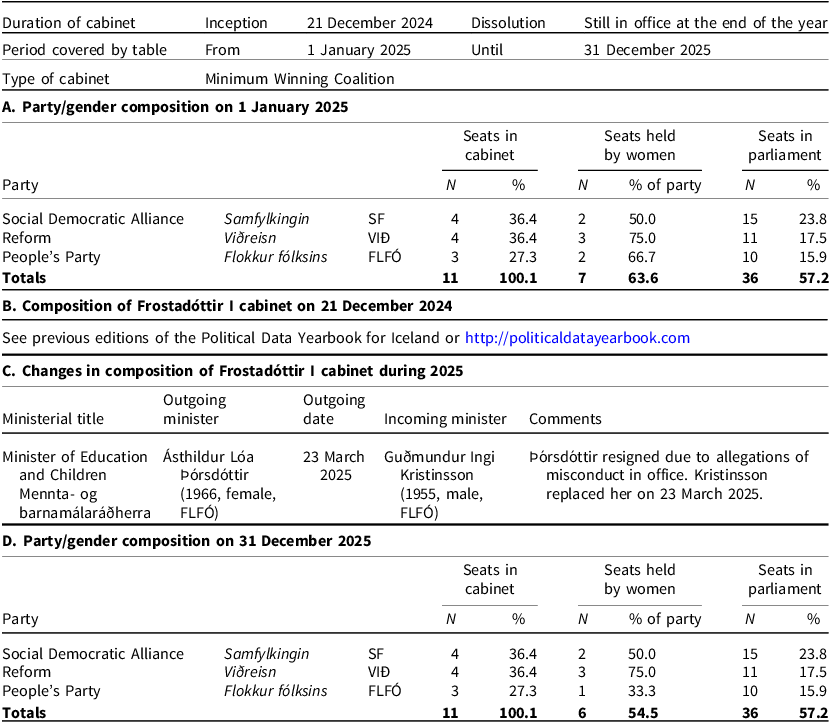
Information on the composition of the Kristrún Frostadóttir I cabinet can be found in Table 1.
Cabinet composition of Kristrún Frostadóttir I in Iceland 2025

Table 1. Long description
The table provides detailed information on the composition of the Kristrún Frostadóttir I cabinet in Iceland for the year 2025. It includes data on the duration of the cabinet, party/gender composition, and changes in the cabinet’s composition during the year. The table is divided into several sections: A, B, C, and D. Section A shows the party/gender composition on 1 January 2025, listing the parties, their seats in the cabinet, seats held by women, and seats in parliament. Section B outlines the composition of the Frostadóttir I cabinet on 21 December 2024. Section C details changes in the composition of the Frostadóttir I cabinet during 2025, including ministerial titles, outgoing and incoming ministers, and comments on the changes. Section D shows the party/gender composition on 31 December 2025, similar to Section A. The table includes specific data points for each section, providing a comprehensive overview of the cabinet’s composition throughout the year.
A minister resigns
In March, the news broke that 35 years ago the Minister for Education and Children, Ásthildur Lóa Þórsdóttir, had borne a child fathered by a minor. The relationship was said to have started when the father was 15 years old and Þórsdóttir 22 (RÚV 2025a). The same day, Þórsdóttir resigned from her ministerial post, having consulted with the three leaders of the government parties. While she claimed she had done nothing wrong, she said that her personal affairs should not be allowed to harm the good work the government was doing (RÚV 2025b).
The affair started when the biological grandmother of Þórsdóttir’s son sent a letter to the Prime Minister, asking for a meeting to discuss the Minister’s past. That meeting never took place. The Prime Minister’s office was accused of misconduct, as it informed Þórsdóttir of the letter and the name of the complainant. The Data Protection Agency later decided that no offence had taken place (Vísir 2025a).
Parliament report
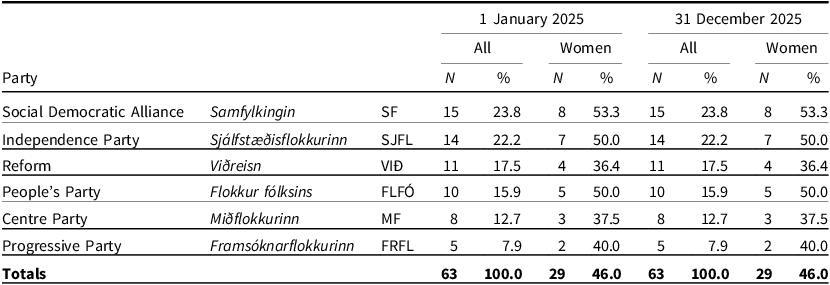
Information on the composition of Parliament can be found in Table 2. No changes in gender composition took place during the year.
Party and gender composition of Parliament (Alþingi) in 2025

Table 2. Long description
The table presents the party and gender composition of Parliament (Alþingi) in 2025. It includes data for two dates: January 1, 2025, and December 31, 2025. The table has six rows and eight columns. The columns are labeled as follows: Party, 1 January 2025 All N, 1 January 2025 All %, 1 January 2025 Women %, 31 December 2025 All N, 31 December 2025 All %, and 31 December 2025 Women %. The rows are labeled with the names of the parties: Social Democratic Alliance, Independence Party, Reform, People’s Party, Centre Party, and Progressive Party. The totals are provided in the last row. Row 1: Social Democratic Alliance, 15, 23.8, 8, 53.3, 15, 23.8, 8, 53.3. Row 2: Independence Party, 14, 22.2, 7, 50.0, 14, 22.2, 7, 50.0. Row 3: Reform, 11, 17.5, 4, 36.4, 11, 17.5, 4, 36.4. Row 4: People’s Party, 10, 15.9, 5, 50.0, 10, 15.9, 5, 50.0. Row 5: Centre Party, 8, 12.7, 3, 37.5, 8, 12.7, 3, 37.5. Row 6: Progressive Party, 5, 7.9, 2, 40.0, 5, 7.9, 2, 40.0. Row 7: Totals, 63, 100.0, 29, 46.0, 63, 100.0, 29, 46.0.
Source: Alþingi website 2026.
Political party report
On 6 January, former Prime Minister Bjarni Benediktsson (male, 1970) announced that he would step down as leader of the Independence Party after 16 years in office. He also resigned as member of Parliament (RÚV 2025c). On 2 March, former Minister of Justice Guðrún Hafsteinsdóttir (female, 1970) was narrowly elected new leader at the party conference, obtaining 51.1% of 1,858 valid votes, beating former Minister for Universities, Industry and Innovation, Áslaug Arna Sigurbjörnsdóttir (female, 1990), with 49.1% (Mbl 2025a). Former Foreign Minister Þórdís Kolbrún Reykfjörð Gylfadóttir (female, 1987) did not (to the surprise of many) stand for the leadership post. She did not seek re-election as deputy leader (DV 2025a). Jens Garðar Helgason MP (male, 1976) was elected deputy leader, beating Diljá Mist Einarsdóttir MP by 53% of valid votes against 43% (Sjálfstæðisflokkurinn 2025).
On 18 October, former Prime Minister Sigurður Ingi Jóhannsson (male, 1962) announced that he would be stepping down as leader of the Progressive Party after 10 years in office. A new leader would be elected at the party conference in February 2026 (RÚV 2025d).
At the Centre Party conference on 12 October, Snorri Másson (male, 1997) was elected deputy leader of the party (RÚV 2025e), a position that had been vacant since 2020. He was a newcomer to politics and first elected as MP in 2024. Másson won by 136 votes, while Ingibjörg Davíðsdóttir MP obtained 64.
At the Socialist Party conference on 24 May, a coup d’état took place when a radical section replaced the sitting leadership (RÚV 2025f). This resulted in a serious split. Sanna Magdalena Mörtudóttir, the party’s spokesperson in the parliamentary elections of 2024 and the Chair of the Reykjavík City Council, would not be a candidate for the party in the municipal elections of 2026 but instead would lead a new left-wing list (Vísir 2025b).
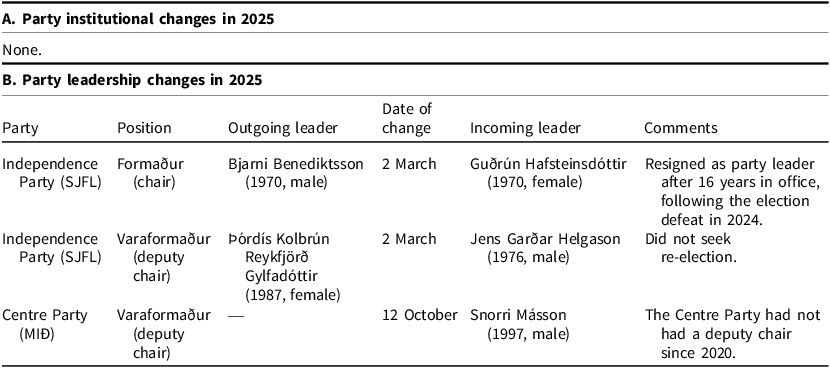
Information on changes in political parties can be found in Table 3.
Party leadership changes in 2025

Table 3. Long description
The table is divided into two sections: A and B. Section A discusses party institutional changes in 2025, noting that there are none. Section B focuses on party leadership changes in 2025, listing the party, position, outgoing leader, date of change, incoming leader, and comments. The table has four columns: Party, Position, Outgoing leader, Date of change, Incoming leader, and Comments. Row 1: Independence Party (SJFL), Formaður (chair), Bjarni Benediktsson (1970, male), 2 March, Guðrún Hafsteinsdóttir (1970, female), Resigned as party leader after 16 years in office, following the election defeat in 2024. Row 2: Independence Party (SJFL), Varaformaður (deputy chair), Pórdís Kolbrún Reykfjörð Gylfadóttir (1987, female), 2 March, Jens Garðar Helgason (1976, male), Did not seek re-election. Row 3: Centre Party (MIÐ), Varaformaður (deputy chair), —, 12 October, Snorri Másson (1997, male), The Centre Party had not had a deputy chair since 2020.
Institutional change report
No changes in 2025.
Issues in national politics
In the beginning of 2025, the new government presented quite an ambitious programme of legislation for the spring session of Parliament. Many bills however never came to a vote. A government bill increasing fees on fisheries quotas instead became the dominant issue. While the current quota system in fisheries would continue, the government claimed that the fishing fees paid by companies had not been correctly calculated in recent years as the fees did not reflect the actual catch value of the commercial stocks. The bill would correct this so that the fishing companies would pay their fair share to the nation. They claimed that after the change, the fishing companies would continue to keep 67% of their profit, while paying 33% to the owner of the fish stocks (Report on fishing fees 2025).
The opposition claimed that this was simply a tax increase that would harm the competitiveness of the fishing sector and seriously harm the fishing industry in small fishing communities in the countryside. The bill had been presented in haste, was ill-prepared, and was based on incorrect calculations (Committee report 2025). The interest organization, Union of Fisheries’ Companies, also strongly fought against the bill, including a controversial advertisement campaign on television (RÚV 2025g).
The opposition in Parliament decided to use a filibuster to avoid the bill coming to a vote. The spring session was extended into the summer. In July, the parliamentary majority finally used a cloture clause in the Parliament Act (Article 71) to end the filibuster, which had lasted for 160 hours – or four working weeks. The filibuster prevented many government bills from becoming law, including bills on immigration that the opposition supported.
Alþingi has for decades suffered from a tradition of filibusters (Bernódusson Reference Bernódusson2016). The longest filibuster in the 20th century was the debate on Icelandic membership of the European Economic Area (EEA) in 1993, which lasted for 101 hours (or 12 working days) before the bill was passed. A similar bill was debated for 8 hours in the Austrian parliament, 14 ½ hours in Sweden, 2 days in Finland, and 3 days in Norway (Stephensen Reference Stephensen2019).
Before a change in the Parliament Act in 2007, a filibuster could not last forever. While there were no limits on the length of speeches in the 2nd debate, each member was only allowed to speak twice. A filibuster thus consisted of the opposition making long speeches – the record was a 10-hour-long speech in 1998. The rules meant that a filibuster would eventually come to an end – without using the cloture clause of the Parliament Act.
A change in the Parliament Act in 2007 put a limit on the length of speeches, while limits on the number of speeches made by each member were abolished. Now a filibuster consisted of many short speeches instead of a few long ones. In the following years, three debates lasted more than 100 hours – on Icesave 2009 (135 hours), on the EU’s third energy package 2019 (147 hours), and on a bill on foreigners 2023 (104 hours). In the end, however, all three bills came to a vote and were passed without using the cloture vote clause of the Parliament Act. Since the foundation of the republic in 1944, government majorities had been very reluctant to use Article 71 to break filibusters or limit the length of discussion. It was only used in 1947 (to end an eight hours debate on inflation measures), in 1949 (on North Atlantic Treaty Association (NATO) membership when beforehand the discussion had been limited to three hours), in 1959 (on the finance bill after a few hours debate), and in 1989 (to further limit the length of speeches at the end of a night meeting) (Hardarson Reference Hardarson2022). According to former Speaker of the Alþingi, Birgir Ármannsson, the use of Article 71 was seriously considered (behind the scenes) several times in the 21st century, while such a proposal was never made (Gímaldið 2026).
In July 2025, no end of the filibuster on the fishing fees bill was in sight. The opposition simply claimed it would continue until the end of the session. Finally, the parliamentary majority decided, at the suggestion from Speaker Þórunn Sveinbjarnardóttir, to end the filibuster by using the cloture vote clause. The bill was passed, and the session ended.
The opposition was furious, claiming that this use of ‘the nuclear option’ was a serious violation of the rights of the minority in Parliament – which in the future would lead to such conflicts that Parliament would be unworkable (Mbl 2025b). The Speaker had acted as Speaker of the majority, not Speaker of the whole Alþingi. The majority claimed that they only had used ‘the democratic option’ to prevent an absolute veto power of the minority (Vísir 2025c). In the autumn session of 2025, no serious filibusters took place. Several government bills were re-introduced and passed.
A Gallup poll late in July (after the end of the parliamentary session) found that the bill on fishing fees was supported by 65% of voters, while 24% were opposed. While the support was lower in the countryside than in the capital area, 57% of voters in the countryside supported the bill, while 28% opposed. Two-thirds of voters supported the use of Article 71, while a quarter opposed (DV 2025b).
Foreign policy and geopolitical developments became increasingly important in 2025. The cornerstones of Icelandic foreign policy have been NATO membership (since 1949) and a bilateral defence agreement with the U.S (since 1951) – along with an associate membership of the EU through the EEA agreement (1994). In her report to Alþingi, Foreign Minister Gunnarsdóttir discussed increasing worries in Iceland concerning the weakening of the international system that has been in place since World War II and increasing disrespect for international law and free trade. She called for a closer cooperation with Europe and emphasised the need for a fresh look in the ongoing revision of Icelandic Security Policy, broadly supported by most political parties. Iceland would continue to strongly support Ukraine and criticise human rights violations in Gaza (Foreign Minister’s Report 2025).
The Icelandic worries were clearly related to President Trump’s policies on tariffs, trade wars, doubts about NATO, his threats to annex Greenland. In July, von der Leyen visited Iceland and praised the Icelanders for strengthening their cooperation with the EU. When the centre-left government was formed in 2024, it had promised to hold a referendum on continued negotiations with the EU on Icelandic full membership (halted in 2013) no later than in 2027. Now it was discussed to speed this up and hold the referendum in 2026 (Politico 2026).
The use of the clause on cloture vote was the most significant event in Icelandic politics in 2025. It was a major change in de facto parliamentary procedures and might lead to the end of the most extreme filibusters in the Alþingi, which far exceed delaying tactics in other West European parliaments. However, some highly controversial issues are waiting in 2026, for instance, a government resolution on a referendum on continued negotiations on Icelandic membership of the EU. Will the opposition again try to block voting on that proposal – and in that case, how will the majority respond?
Data availability statement
The data that support the findings of this study are available upon reasonable request.

 Open access

