Introduction
Approximately 7.0 million ha of mungbean [Vigna radiata (L.) Wilczek] is cultivated worldwide with the production of 5.3 million tonnes mainly in South and Southeast Asia. India is the largest producer, followed by Myanmar and Thailand (Nair and Schreinemachers, Reference Nair, Schreinemachers, Nair, Schafleitner and Lee2020). It is a crucial pulse crop and rich in essential sources of nutrients for diets. It provides easily digestible proteins, carbohydrates, fatty acids, vitamins, iron and zinc. In Thailand, the potential mungbean yield is in the range of 719–825 kg/ha (Office of Agricultural Economics, 2019). However, mungbean production is constrained by various factors and susceptibility to pests and diseases or weakness to environments. Of the diseases, Cercospora leaf spot (CLS) and powdery mildew (PM) are the most serious in Thailand.
CLS is caused by Cercospora canescens Ellis & Martin (Chand et al., Reference Chand, Pal, Singh, Kumar, Singh and Chowdappa2015). The outbreak of this disease during the rainy season can lead to losses of 50–97% of the yield if there is no protection (AVRDC, 1984; Iqbal et al., Reference Iqbal, Ghafoor, Basak and Malik1995; Chand et al., Reference Chand, Singh, Pal, Kumar and Kumar2012; Nair et al., Reference Nair, Pandey, War, Hanumantharao, Shwe, Alam, Pratap, Malik, Karimi, Mbeyyagala, Douglas, Rane and Schafleitner2019). PM is caused by Sphaerotheca phaseoli. The infection can reduce yields by more than 50% in the cool-dry growing season (Khajudparn et al., Reference Khajudparn, Wongkaew and Tantasawat2010). In Thailand, the mungbean genotypes resistant to CLS or PM have been identified, namely M5-22, M5-25 and V4718 that are resistant to CLS and M5-10, V4718, V4758 and V4785 resistant to PM (Wongpiyasatid et al., Reference Wongpiyasatid, Chotechuen, Hormchan and Srihuttagum1999; Khajudparn et al., Reference Khajudparn, Wongkaew and Tantasawat2010). In addition, the CLS resistance in the V4718 line is controlled by a single dominant gene (Chankaew et al., Reference Chankaew, Somta, Sorajjapinun and Srinives2011; Tantasawat et al., Reference Tantasawat, Poolsawat, Arsakit and Papan2020). The PM resistance in the V4718, V4758 and V4785 lines is also controlled by a single dominant gene with a non-allelic relationship (Khajudparn et al., Reference Khajudparn, Wongkaew and Tantasawat2010), which is beneficial for developing new resistant varieties.
The combination of marker-assisted backcrossing (MABC) and marker-assisted gene pyramiding is widely used in molecular plant breeding. When marker-assisted gene pyramiding is used through MABC, it allows several genes to combine into an elite variety simultaneously, and improved lines still have a similar genetic background to this elite variety. Therefore, improved varieties have a broad-spectrum resistance to pests or diseases, and their phenotypic characters are similar to those of the recurrent parent, especially as they can reduce the time required for breeding programs (Collard and Mackill, Reference Collard and Mackill2008). In addition, tightly linked markers have been identified for CLS and PM resistance genes using quantitative trait loci (QTL) analysis. Yundaeng et al. (Reference Yundaeng, Somta, Chen, Yuan, Chankaew and Chen2020) developed one functional marker from a candidate gene for CLS resistance (TATA-binding-protein-associated factor 5) in the resistant line V4718. The closest markers linked to the CLS resistance gene were also identified in a cross between the CN72 and V4718 lines (Arsakit et al., Reference Arsakit, Papan, Tharapreuksapong and Tantasawat2017; Papan et al., Reference Papan, Chueakhunthod, Poolsawat, Arsakit, Tharapreuksapong and Tantasawat2021). Moreover, Poolsawat et al. (Reference Poolsawat, Kativat, Arsakit and Tantasawat2017) identified markers linked to a major QTL conferring PM resistance in the CN72 × V4718 cross. The marker associated with PM resistance in a cross between the CN72 and V4785 lines was also found (Tantasawat et al., Reference Tantasawat, Poolsawat, Kativat, Arsakit, Papan, Chueakhunthod and Pookhamsak2021). These markers linked to resistance genes are useful for improving mungbean varieties for resistance to CLS and PM. Furthermore, if CLS and PM resistance genes are pyramided into cultivated mungbean varieties, they may simultaneously enhance resistance to both diseases, providing broad-spectrum and durable resistance.
This study aimed to assess the frequency desired recombinants and proportion of recurrent parent genome (RPG) recovered and to evaluate CLS and PM resistance coupled with agronomic traits of the pyramided backcross (BC) lines for potential commercialization in the near future.
Materials and methods
Plant materials and breeding scheme
The recurrent parent, namely KING, is a high-yielding mungbean variety originated in Australia with large seeds and resistance to PM, but it is susceptible to PM and CLS when grown in Thailand (Chueakhunthod et al., Reference Chueakhunthod, Jinagool, Meecharoen, Khwanman, Pattanaram, Jantarat, Palaphon, Ngampongsai and Tantasawat2020). While the donor parent D2 (67A × 27B) × (71B × 14C)-2 developed in School of Crop Production Technology at Suranaree University of Technology was obtained from double-crosses between recombinant inbred lines (RILs) of three populations [CN72 × V4758 (A), CN72 × V4718 (B) and CN72 × V4785 (C)] containing a CLS resistance gene and two PM resistance genes. Three resistant lines (V4718, V4758 and V4785) and the recurrent parent KING were obtained from the World Vegetable Center (WORLDVEG) in Taiwan. These resistant lines have high yields and seeds per pod, but their seed size is small.
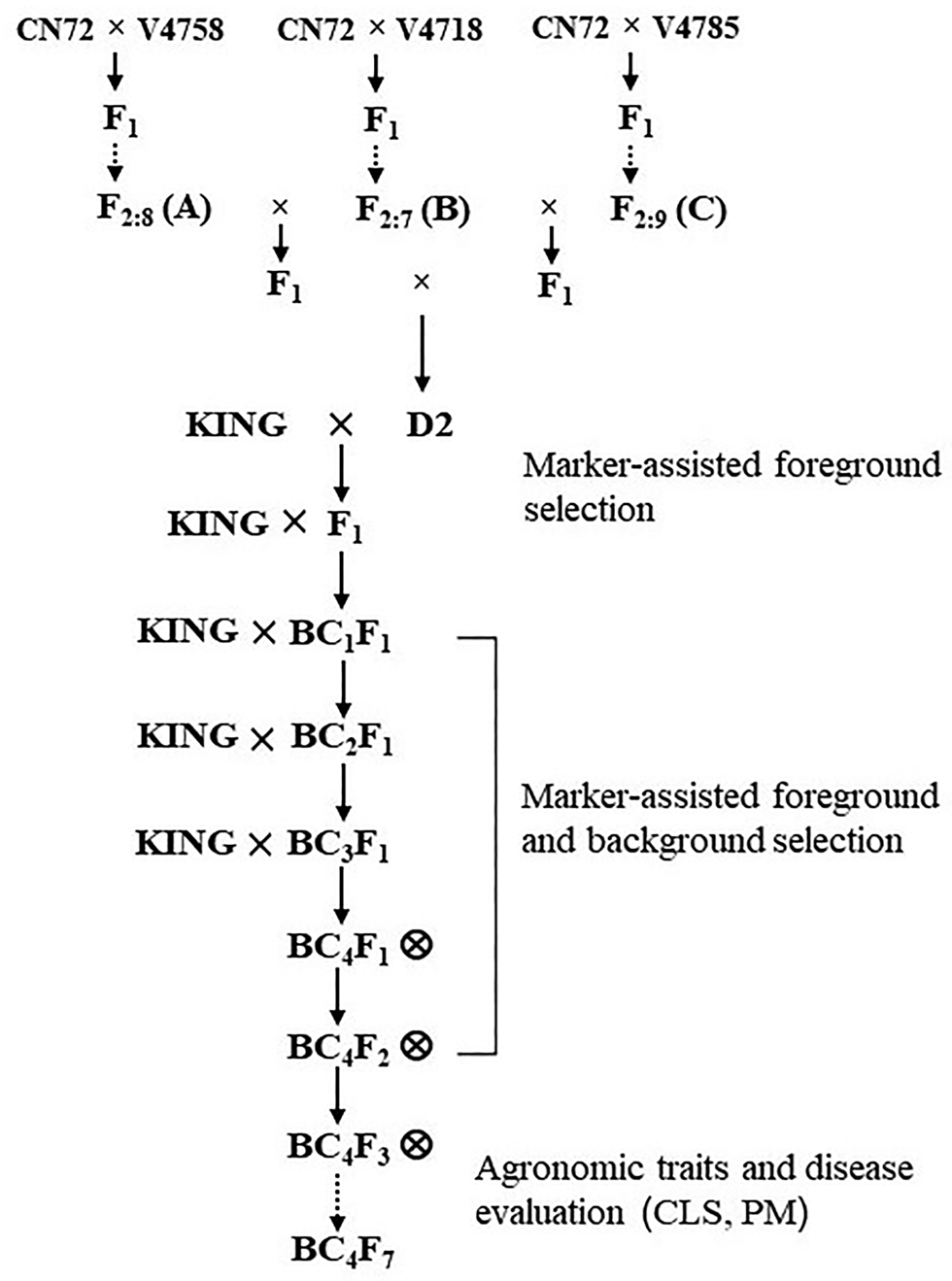
For the MABC scheme, the recurrent parent KING was crossed with the donor parent D2 to generate F1 plants, which were further backcrossed to the recurrent parent KING. MABC was followed up to BC4F1 generation. Only desirable plants with all the resistance loci were advanced to the next generation. Selfing of BC4F1 was then performed and continued until BC4F7 generations. In brief, foreground selection was used to select F1 until BC4F5 to identify heterozygous plants in F1 to BC4F1 generations and homozygous plants in BC4F2 to BC4F5 generations for all three target resistance genes. In contrast, background selection was used in BC1F1 to BC4F2 generations to achieve high RPG recovery (Fig. 1). In addition, the non-segregation of markers in BC4F4 to BC4F5 was also confirmed with foreground selection to ensure that the BC lines had all three resistance genes in homozygosity.
Schematic workflow for pyramiding Cercospora leaf spot (CLS) and powdery mildew (PM) resistance genes into mungbean variety KING through marker-assisted backcrossing (MABC).

DNA extraction and polymerase chain reaction (PCR) amplification
Healthy young leaves were used for the extraction of total DNA using a modified CTAB extraction protocol (Lodhi et al., Reference Lodhi, Ye, Weeden and Reisch1994). The PCR reaction mixture of inter-simple sequence repeat (ISSR) and ISSR-anchored resistance gene analogue (ISSR-RGA) markers was prepared in a 20 μl reaction mix containing 150 ng of DNA template, 1 × buffer [50 mm KCl, 10 mm Tris-HCl, (pH 9.1) and 0.01% Triton™ X-100], 3.5 mm MgCl2, 250 μm of each deoxyribonucleotide triphosphate (dNTP), 1 unit of Taq DNA polymerase, 0.4 μm of ISSR primer and 1 μm of RGA primer (only ISSR-RGA marker). At the same time, the reaction mix of simple sequence repeat (SSR) and expressed sequence tag (EST)-SSR (EST-SSR) markers contained 150 ng of DNA template, 1 × buffer [50 mm KCl, 10 mm Tris-HCl, (pH 9.1) and 0.01% Triton™ X-100], 2 mm MgCl2, 0.2 mm of each dNTP, 1 unit of Taq DNA polymerase and 0.5 μm each of forward and reverse primers in a volume of 20 μl. Details of the primer sequence used for marker-assisted foreground and background selection are presented in Table 1–3. PCR amplification and visualization of PCR products were carried out according to Poolsawat et al. (Reference Poolsawat, Kativat, Arsakit and Tantasawat2017) for ISSR and ISSR-RGA markers, Arsakit et al. (Reference Arsakit, Papan, Tharapreuksapong and Tantasawat2017) for SSR marker and Chen et al. (Reference Chen, Wang, Wang, Liu, Blair and Cheng2015) for EST-SSR marker.
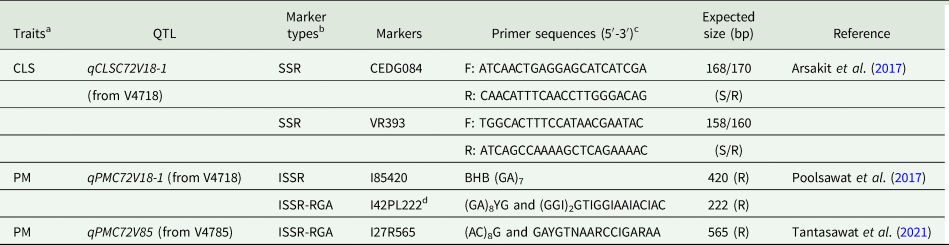
Markers used for foreground selection of a Cercospora leaf spot (CLS) resistance gene and 2 powdery mildew (PM) resistance genes in marker-assisted backcrossing

a CLS, Cercospora leaf spot; PM, powdery mildew.
b SSR, simple sequence repeat; ISSR, inter-simple sequence repeat; ISSR-RGA, ISSR-anchored resistance gene analogue.
c B = C, G, T; H = A, C, T; I = inosine; N = A, G, C, T; R = A, G; Y = pyrimidines (C, T).
d I42P222 derived from the resistant line (V4718) was used instead of I42P229, which linked to a susceptible allele of a susceptible variety (CN72).
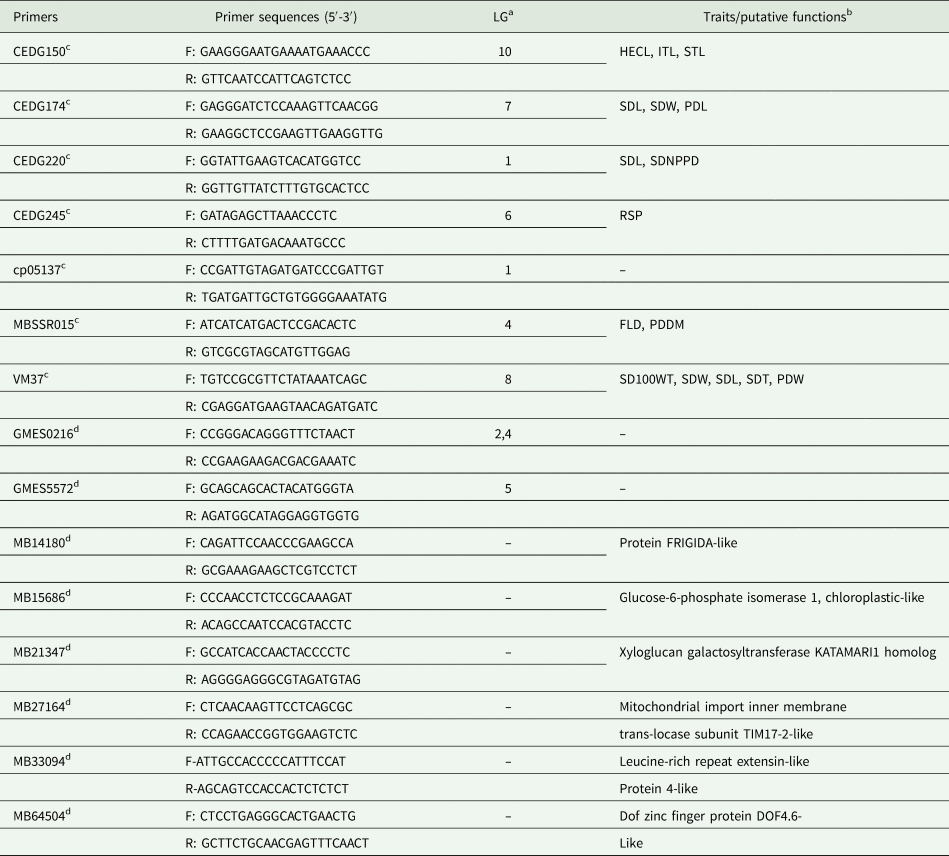
Polymorphic simple sequence repeat (SSR) and expressed sequence tag-SSR (EST-SSR) markers used for background selection

a LG, linkage group.
b FLD, Days to first flower; HECL, Hypocotyl plus epicotyl length; ITL, Internode length; PDL, Pod length; PDDM, Days to maturity of first pod; PDW, Pod width; RSP, Rate of shattered pods; SDL, Seed length; SDW, Seed width; SDNPPD, Number of seeds/pod; SD100WT, 100-seed weight; SDT, Seed thickness; STL, Stem length.
c SSR markers.
d EST-SSR markers.
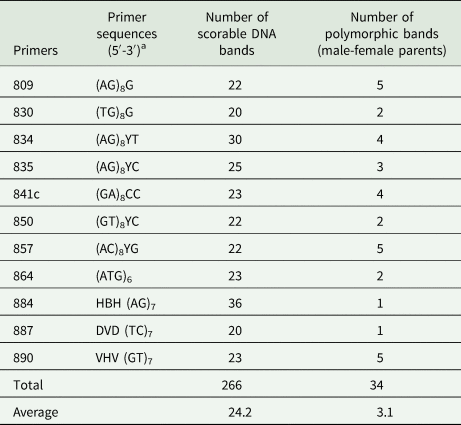
Inter-simple sequence repeat (ISSR) markers used for background selection

a B = C, G, T; D = A, G, T; H = A, C, T; V = A, C, G; Y = pyrimidines (C, T).
Foreground and background selection
Five markers linked to the QTL controlling CLS and PM resistance genes were used for foreground selection (Table 1). Of these, two SSR markers (VR393 and CEDG084) were closest to the QTL controlling CLS resistance in the V4718 line with a distance of 4 and 6 cm, respectively (Arsakit et al., Reference Arsakit, Papan, Tharapreuksapong and Tantasawat2017). In addition, I85420 (ISSR marker) and I42PL222 (ISSR-RGA marker) were closest to the QTL conferring resistance to PM in the V4718 line with a distance of 9 and 13 cm, respectively (Poolsawat et al., Reference Poolsawat, Kativat, Arsakit and Tantasawat2017). While I27R565 (ISSR-RGA marker) was linked to PM resistance in the V4785 line at 10 cm (Tantasawat et al., Reference Tantasawat, Poolsawat, Kativat, Arsakit, Papan, Chueakhunthod and Pookhamsak2021). The donor parent D2 containing a CLS resistance gene from the V4718 line and two PM resistance genes from the V4718 and V4785 lines possessed similar DNA banding patterns as those of the resistant lines V4718 and V4785, which are sources of CLS and PM resistance. All of these foreground markers were polymorphic between KING and the D2 line. Therefore, these five markers were used for foreground selection in each generation. For background selection, a total of 37 SSR and EST-SSR markers associated with domestication-related traits and other putative protein functions or unknown functions in mungbean, i.e. days to first flowering, hypocotyl plus epicotyl length, pod width, seed width, 100-seed weight, stem length, protein FRIGIDA-like etc. (Isemura et al., Reference Isemura, Kaga, Tabata, Somta, Srinives, Shimizu, Jo, Vaughan and Tomooka2012; Chen et al., Reference Chen, Wang, Wang, Liu, Blair and Cheng2015) were used. In addition, 11 ISSR primers developed from the University of British Columbia that are well distributed throughout the mungbean genome were also included for a parental polymorphism survey. Of the 37 SSR and EST-SSR markers, 15 were found to be polymorphic between both parents and were assigned as Set A (Table 2). In contrast, the 34 polymorphic fragments amplified by 11 ISSR primers were classified as Set B (Table 3). For data analysis, all polymorphic bands were scored as allele sizes at each locus for SSR and EST-SSR markers, while polymorphic ISSR markers were scored as present/absent in the DNA bands. Similarity coefficients between BC progenies and their parents were computed using Jaccard's coefficient through NTSYSpc version 2.1 (Rohlf, Reference Rohlf2000).
Evaluation of CLS and PM resistance and agronomic traits under field conditions
In order to evaluate resistance levels to CLS and PM and agronomic traits in the field, the BC4F4 to BC4F7 pyramided lines, parental lines (KING, V4718, V4758 and V4785) and check var. KPS1 and SUT1 were grown in several seasons and locations during 2019–2021. A randomized incomplete block design with two to four replications depending on seasons and locations was performed. Briefly, in a growing season without any disease outbreak, they were grown in December 2019–February 2020 at Suranaree University of Technology (SUT) Farm, Muang district, Nakhon Ratchasima province (latitude: 14°52′N, longitude: 102°00′E, altitude: 226 m). Each genotype was sown in a single row 2 m long with spacing of 0.2 and 0.5 m intra-row and inter-row, respectively. Three plants per hill were maintained (ca. 30 plants per row) and also in December 2020–March 2021 at Pak Thong Chai District, Nakhon Ratchasima province (latitude: 14°39′N, longitude: 102°07′E, altitude: 227 m). Each line was sown in two rows 6 m long with spacing of 0.2 and 0.5 m intra-row and inter-row, respectively. Three plants per hill were maintained (ca. 90 plants per row).
All genotypes were grown during the wet season in July 2020–September 2020 at SUT Farm, Muang district, Nakhon Ratchasima province and Chai Nat Field Crops Research Center Supphaya district, Chai Nat province (latitude: 15°09′N, longitude: 100°10′E, altitude: 19 m), which were subject to a CLS outbreak. Each genotype was planted in two rows of 6 m long with spacing of 0.2 and 0.5 m intra-row and inter-row, respectively, and three plants per hill were maintained (ca. 90 plants per row). CLS severity was observed at 65 days after planting (DAP) using a scoring system described by Chankaew et al. (Reference Chankaew, Somta, Sorajjapinun and Srinives2011). The scale of CLS severity was divided into three categories (resistance = 1.0–2.5, moderate resistance = 2.6–3.4 and susceptibility = 3.5–5.0). In a growing season with a PM outbreak, the genotypes were grown at SUT farm during the cool-dry season in November 2020–February 2021. Each genotype was grown in two rows of 6 m long with spacing of 0.2 m intra-row and 0.5 m inter-row, and three plants per hill were maintained (ca. 90 plants per row). The observation of PM severity was scored at 65 DAP using a scoring system described by Khajudparn et al. (Reference Khajudparn, Wongkaew and Tantasawat2010). The observations of resistance levels were divided into four categories (resistance = 1.0–3.0, moderate resistance = 3.1–4.5, moderate susceptibility = 4.6–6.0 and susceptibility = 6.1–9.0). In addition, the susceptible variety CN72 was sown around the experimental blocks as a source of both disease inoculums in each season. With regard to agronomic traits, nine traits consisting of the number of days to flowering, days to maturity, plant height, clusters per plant, pods per plant, pod length, seeds per pod, 100-seed weight and yield per plant were recorded from ten randomly selected plants from the middle row of each block. The techniques for agronomic trait measurement were described by Chai Nat Field Crops Research Center (2018) and Chueakhunthod et al. (Reference Chueakhunthod, Jinagool, Meecharoen, Khwanman, Pattanaram, Jantarat, Palaphon, Ngampongsai and Tantasawat2020). Analysis of ANOVA was performed for each agronomic trait in each season/location following a randomized incomplete block design. The mean comparisons of each agronomic trait were conducted by Tukey's HSD test at a significance level of 5%. Calculation procedures were carried out using Statistix 8 (Analytical Software, Tallahassee, FL, USA). In addition, standard error (S.E.) was also calculated.
Results
Foreground and background selection
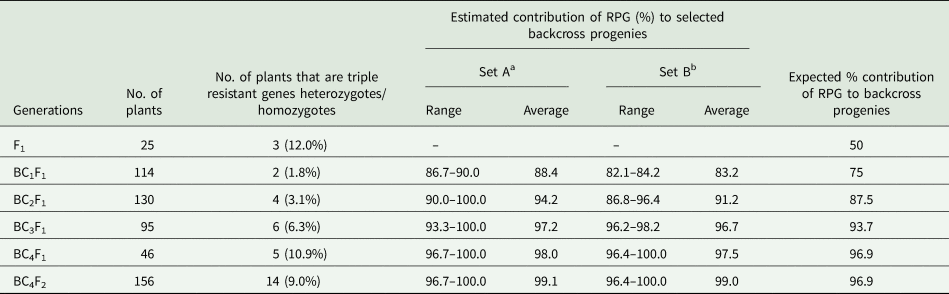
Initially, all five markers linked to a CLS and two PM resistance genes were observed to be polymorphic between the donor and recurrent parents and could be applicable in marker-assisted selection (MAS) for pyramiding CLS and PM resistance genes into the mungbean variety KING (Table 1). These markers were used in MABC from F1 to BC4F5 generations. Moreover, the genetic backgrounds of the putative resistant plants were evaluated with two different sets of markers (Tables 2 and 3) in BC1F1-BC4F2 generations. In each generation, the plants having marker loci linked to the three target genes with high RPG recovery were advanced to the next generation. The results are presented in Table 4.
Number of triple resistant gene heterozygotes or homozygotes and the recovery of recurrent parent genome (RPG)

a SSR and EST-SSR markers (15 polymorphic markers).
b ISSR markers (34 polymorphic loci).
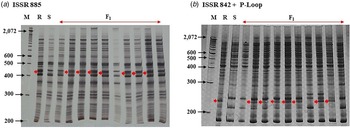
In brief, 25 F1 plants were generated by crossing the KING and D2 lines and were further confirmed by means of five markers linked to CLS and PM resistance (Fig. 2). Three out of 25 plants contained heterozygous alleles based on all marker loci (12.0%). These marker-positive plants were backcrossed to the recurrent parent KING to produce the BC1F1 seeds.
Colour online. Marker-assisted foreground selection for PM resistance in F1 generation using inter-simple sequence repeat (ISSR) 885 primer (I85420 marker) (a) and ISSR 842 + P-Loop primers (I42PL222 marker) (b). M = 100 bp DNA ladder, R = donor resistant parent (V4718), S = susceptible recurrent parent (KING). An arrow shows the markers linked to powdery mildew (PM) resistance in the V4718.

In BC1F1 generation, a total of 114 BC1F1 progenies were screened, and two BC1F1 plants were found to be heterozygous for all marker loci (1.8%). When background selection was carried out, the percentages of RPG recovery of the two marker positive plants based on both sets of markers were 82.1–90.0% with an average of 88.4 and 83.2% for Sets A and B, respectively. RPG recovery of both BC1F1 plants was higher than expected (75.0%). These marker positive plants were backcrossed to the recurrent parent KING to produce BC2F1 seeds.
In BC2F1 generation, a total of 130 BC2F1 progenies were generated, of which four BC2F1 plants (3.1%) possessed the bands of all target markers in heterozygous conditions. These four BC2F1 plants were subjected to background selection. They showed the presence of 86.8–100.0% of RPG recovery with an average of 94.2 and 91.2% for Sets A and B, respectively, which was higher than expected (87.5%). Of these four plants, three BC2F1 plants that showed high RPG recovery were backcrossed to KING to produce BC3F1 seeds.
In BC3F1 generation, out of 95 BC3F1 plants, six BC3F1 plants (6.3%) were heterozygous for all marker loci. When background selection was performed with two marker sets, the RPG recovery ranged from 93.3 to 100.0% with an average of 97.2 and 96.7% for Sets A and B, respectively. Among these, five BC3F1 plants had a higher RPG recovery than expected (93.7%), and these were backcrossed to the recurrent parent to produce BC4F1 seeds.
In BC4F1 generation, five out of 46 BC4F1 progenies (10.9%) were identified as heterozygotes for all marker loci. These selected plants were then subjected to background selection. RPG recovery based on all sets of markers ranged from 96.4 to 100.0% with an average of 98.0 and 97.5% for Sets A and B, respectively. Two out of five plants were found to have the maximum recovery of RPG (up to 98.2–100.0%), which was higher than expected (96.9%). All of these marker-positive plants were selfed to produce BC4F2 seeds.
In BC4F2 generation, when 156 BC4F2 progenies were screened, it was found that 14 BC4F2 plants (9.0%) possessed homozygous alleles for SSR markers and heterozygous /homozygous alleles for ISSR and ISSR-RGA markers. The background selection of these 14 BC4F2 progenies exhibited the presence of 96.4–100.0% RPG recovery with an average of 99.1 and 99.0% for Sets A and B, respectively. In addition, seven out of 14 BC4F2 progenies possessed the maximum RPG recovery (100.0% in all two marker sets), while the expected RPG recovery was only 96.9%. However, all 14 promising plants were still selected to produce BC4F3 seeds.
Confirmation of homozygosity for all marker loci linked to the three target genes
In BC4F3 generation, a total of 14 BC4F3 lines were grown in one row per line, 20–30 plants per row without foreground selection, and seeds from 33 individual plants with good performance were harvested separately. Of these, 15 BC4F4 lines that had shown good performance in the field condition were confirmed by evaluating the marker segregation in 20 randomly selected plants per BC line. Only one out of 15 lines, namely H3, possessed all five marker loci in all 20 plants (not segregated). Moreover, two additional BC lines (H4 and J3) with all five marker loci were found in some of the 20 plants, and these were also selected. These three BC lines were again confirmed for the presence of five markers in BC4F5 generation. Only the H3 and H4 lines possessed all marker loci in all 20 plants (not segregated), confirming that these BC lines had homozygous alleles for all marker loci. When the J3 line was found to have segregated at some marker loci, this line was not used for any further experiments. These H3 and H4 lines were evaluated for CLS and PM resistance and agronomic traits in the field conditions together with their parents and check varieties in different locations, seasons and years.
Comparison of agronomic traits and disease resistance under field conditions
Under no disease outbreak
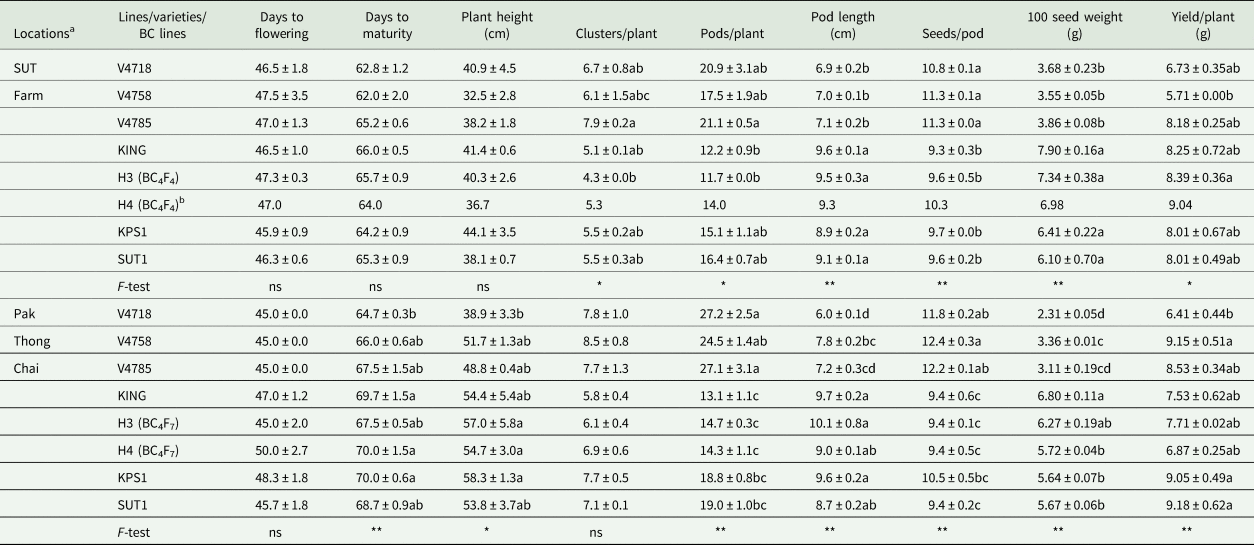
In a growing season without any disease outbreak, two different generations (BC4F4 and BC4F7) of pyramided BC lines, their parents, and check varieties, KPS1 and SUT1 were evaluated for yield performances and agronomic traits during the winter for 2 years at two locations. BC4F4 generation was evaluated in December 2019–February 2020 at SUT Farm, while BC4F7 generation was evaluated in December 2020-March 2021 at Pak Thong Chai. The yield performance analysis was significantly different (P < 0.05 or P < 0.01) among the pyramided BC lines, their parents and the check varieties in both environments (Table 5). In December 2019–February 2020 at SUT Farm, the highest yield per plant was observed in the H3 line, which was higher than the donor parent V4758, but was not different from the recurrent parent KING, the donor parents V4718 and V4785, as well as the check varieties. Meanwhile, both pyramided BC lines were not significantly different from all parental lines and the check varieties except the V4718 when evaluated in December 2020–March 2021 at Pak Thong Chai. A significant variation was found between the pyramided BC lines, their parents and the check varieties in pods per plant, pod length, seeds per pod and 100-seed weight in both environments (P < 0.05 or P < 0.01). On the contrary, differences in clusters per plant, days to maturity, and plant height were only observed in December 2019–February 2020 at SUT Farm and in December 2020–March 2021 at Pak Thong Chai (P < 0.05 or P < 0.01), respectively (Table 5). Only days to flowering was not significantly different in either environment (P > 0.05). 100-seed weight of the pyramided BC lines and the recurrent parent KING was significantly higher than the three donor parents in both environments. The three donor parents had higher seeds per pod than the pyramided BC lines and the recurrent parent KING in both environments. However, the H3 line tended to have greater pod length and 100-seed weight than the check varieties in both environments. In addition, the H3 lines had all agronomic traits similar to the recurrent parent KING in both locations, while the H4 line showed seven out of eight agronomic traits similar to the recurrent parent KING at Pak Thong Chai (only 100-seed weight was lower than the recurrent parent KING) (Table 5).
Comparison of eight agronomic traits between parental lines and pyramided backcross (BC) lines and check varieties under field conditions without any disease outbreak

Means ± s.e. in the same column with different letters are significantly different (P < 0.05) based on Tukey's HSD test.
a At SUT Farm, they were grown in December 2019-February 2020. At Pak Thong Chai, they were grown in December 2020-March 2021.
b BC line that had only one replication.
* = significant difference at 0.05 probability level. ** = significant difference at 0.01 probability level. ns = non significance.
Under warm-wet growing season for CLS evaluation
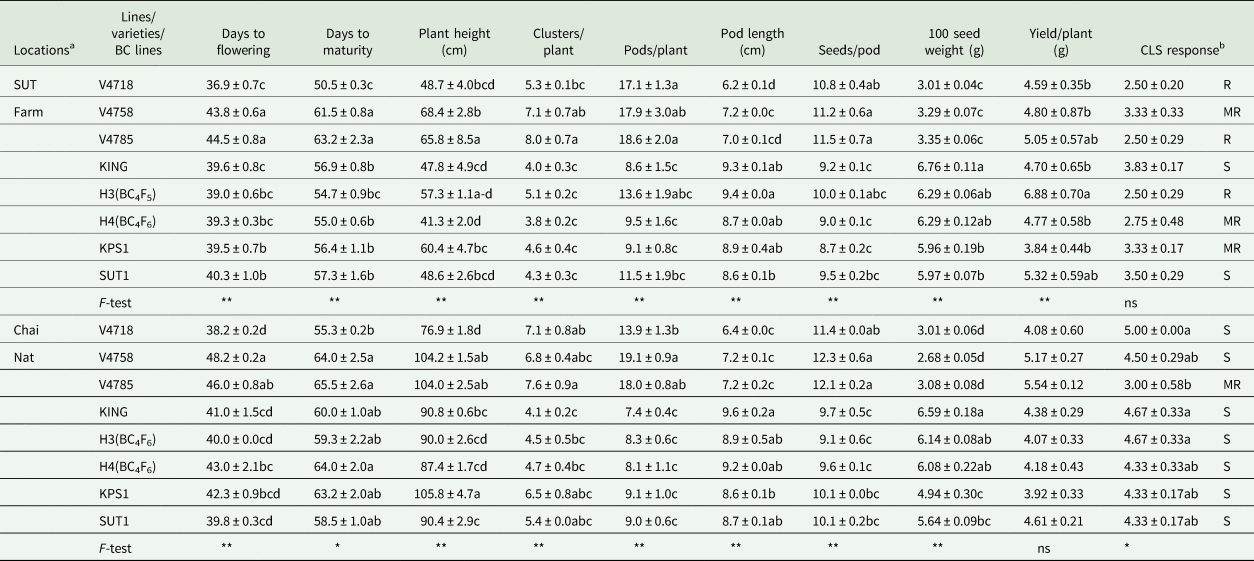
In a growing season with a CLS outbreak, two different generations (BC4F5 and BC4F6) of the pyramided BC lines, their parents, and the check varieties, KPS1 and SUT1, were evaluated for yield performances, agronomic traits, and CLS response in July 2020–September 2020 at two different locations. In this season, the H3 line was evaluated in BC4F5 and BC4F6 generations at SUT Farm and Chai Nat Field Crops Research Center, respectively. Meanwhile, the H4 line was evaluated in BC4F6 generation at both locations. The CLS response was found to be significantly different among mungbean genotypes (P < 0.05) at Chai Nat Field Crops Research Center but was not significant at SUT Farm (Table 6). At SUT Farm, we found that the H3 and H4 lines were resistant and moderately resistant to CLS with a score of 2.50 and 2.75, respectively. The disease scores of these BC lines were comparable to that of the V4718, the donor of the CLS resistance gene (2.50). In comparison, the recurrent parent KING was identified as susceptible to CLS with a score of 3.83. The check variety SUT1 and KPS1 were susceptible and moderately resistant to CLS, respectively at this location. At Chai Nat Field Crops Research Center where a CLS outbreak was more severe, all genotypes were found to be susceptible to CLS including the V4718 line, except for the V4785 line, which was moderately resistant to CLS (Table 6). The significant differences (P < 0.05 or P < 0.01) were observed for days to flowering, days to maturity, plant height, clusters per plant, pods per plant, pod length, seeds per pod and 100-seed weight at both locations, while yield per plant was found to be significant only at SUT Farm (Table 6). The highest yield per plant at SUT Farm was observed in the H3 line (6.88 g), which was higher than the parental lines (27–33%) and the check varieties (23–44%). Meanwhile, the yield per plant of the H4 line (4.77 g) was not significantly different from the parental lines and the check varieties. When comparing yield performance between without any disease outbreak and CLS outbreak, yield performance of the pyramided BC lines, their parents, and the check varieties was decreased up to 15–55% and 30–54% at SUT Farm and Chai Nat Field Crops Research Center, respectively. In addition, the recurrent parent KING and the pyramided BC lines had higher pod length and 100-seed weight than those of the donor parents at both locations. Two pyramided BC lines and the recurrent parent KING had earlier days to flowering than the V4758 at both locations. In addition, both BC lines had all agronomic traits similar to the recurrent parent KING at both locations except yield per plant of the H3 line, which was higher than the recurrent parent KING at the SUT Farm. We also found that the H3 line not only had slightly higher pods per plant and seeds per pod than the check variety KPS1 but also had a tendency for higher clusters per plant, pods per plants and seeds per pod than the recurrent parent KING at SUT Farm (Table 6).
Comparison of eight agronomic traits between parental lines and pyramided backcross (BC) lines as well as check varieties under field conditions with a Cercospora leaf spot (CLS) outbreak

Means ± s.e. in the same column with different letters are significantly different (P < 0.05) based on Tukey's HSD test.
a They were grown in July 2020-September 2020 at SUT Farm, Nakhon Ratchasima, and Chai Nat Field Crops Research Center, Chai Nat.
b CLS response; 1.0–2.5 = resistant (R), 2.6–3.4 = moderately resistant (MR) and 3.5–5.0 = susceptible (S).
* = significant difference at 0.05 probability level. ** = significant difference at 0.01 probability level. ns = non significance.
Under cool-dry growing season for PM evaluation
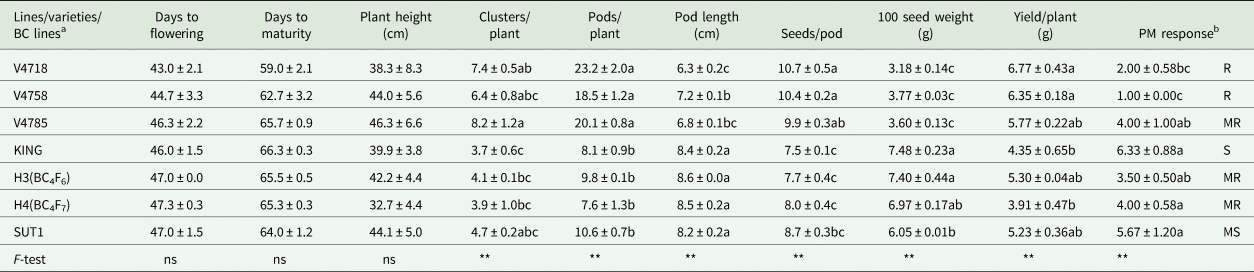
In a growing season with a PM outbreak, two different generations (BC4F6 for the H3 line and BC4F7 for the H4 line) of the pyramided BC lines, their parents, and the check variety SUT1 were evaluated for yield performance, agronomic traits and PM response during November 2020-February 2021 at SUT Farm. PM response was found to be significantly different among mungbean genotypes (P < 0.01) at the SUT farm. We found that the H3 and H4 lines were moderately resistant to PM with a score of 3.50 and 4.00, respectively. PM resistance of the donor parents was resistant and moderately resistant to PM with a score of 1.00, 2.00 and 4.00 for the V4758, V4718 and V4785 lines, respectively. KING was identified as susceptible to PM with a score of 6.33. The check variety SUT1 was moderately susceptible to PM (5.67) (Table 7). When we analysed the variations in yield performance and agronomic traits, the highly significant differences (P < 0.01) were observed for clusters per plant, pods per plant, pod length, seeds per pod, 100-seed weight and yield per plant (Table 7), whereas days to flowering, days to maturity, and plant height were not (P > 0.05). The yield per plant of both BC lines was 5.30 and 3.91 g for the H3 and H4 lines, respectively, which were not significantly different from that of the recurrent parent KING (4.35 g). However, the H3 line tended to have a higher yield than the recurrent parent KING (18.0%). In this season, the yield performance of most mungbean genotypes was reduced up to 15–51% compared to under no disease outbreak. In addition, the pyramided BC lines and the recurrent parent KING had greater pod length and 100-seed weight but lower pods per plant and seeds per pod than those of the donor parents. They also had a tendency for lower clusters per plant than those of the donor parents. The H3 and H4 lines had all agronomic traits similar to the recurrent parent KING. In addition, the H3 line also had a higher 100-seed weight than the check variety SUT1.
Comparison of eight agronomic traits between parental lines and pyramided backcross (BC) lines as well as check varieties under field conditions with powdery mildew (PM) outbreak

Means ± s.e. in the same column with different letters are significantly different (P < 0.05) based on Tukey's HSD test.
a They were grown in November 2020-February 2021 at SUT Farm, Nakhon Ratchasima.
b PM response; 1.0–3.0 = resistant (R), 3.1–4.5 = moderately resistant (MR), 4.6–6.0 = moderately susceptible and 6.1–9.0 = susceptible (S).
** = significant difference at 0.01 probability level. ns = non significance.
Discussion
In breeding programmes, pyramiding multiple resistance genes into a single genotype can provide broad-spectrum and durable resistance. However, using conventional breeding to pyramid multiple genes and select for several traits simultaneously can be difficult, especially for disease resistance of which the presence of one, two, or multiple resistance genes cannot be differentiated. Recently, MAS has become a critical element for the conventional breeding method by helping plant breeders select multiple desirable traits without the confounding effects of the environment. When applied to backcrossing, it is called MABC, which allows simultaneous selection for desirable traits (foreground selection) and fast recovery of RPG (background selection). In this study, we used this strategy to pyramid a CLS resistance gene and two PM resistance genes into a high-yielding mungbean variety KING so that selection for both CLS and PM resistance can be accomplished year-round without the requirement of suitable environments for disease outbreaks. Besides, it also allows pyramiding two PM resistance genes from different sources into the same variety, which may provide broad-spectrum and/or more durable resistance. Similarly, this strategy has also been successfully used to transfer gene (s)/QTL for disease resistance in several legume crops including common bean, chickpea and soybean (Garzón et al., Reference Garzón, Ligarreto and Blair2008; Carneiro et al., Reference Carneiro, dos Santos and Leite2010; Varshney et al., Reference Varshney, Mohan, Gaur, Chamarthi, Singh, Srinivasan, Swapna, Sharma, Singh, Kaur and Pande2014; Maranna et al., Reference Maranna, Verma, Talukdar, Lal, Kumar and Mukherjee2016). However, before using markers linked to resistance genes in MAS, they should be validated in an independent population to identify polymorphisms (Tembo et al., Reference Tembo, Sibiya, Tongoona and Tembo2017).
When five markers associated with CLS and PM resistance were verified for DNA polymorphisms between the recurrent parent (KING) and donor parent (D2), it was found that all of them were polymorphic and that they could be used for foreground selection. Although these five markers were identified in different crosses (CN72 × V4718 or CN72 × V4785), they can be used successfully in the KING × D2 cross because the D2 line was the double-cross of RILs from the crosses between the CN72 and V4718, V4758 and V4785 lines, thereby the CLS and PM resistance genes were the same. Our results confirmed the usefulness of utilizing marker (s) linked to the desirable trait (s) in crosses with different recurrent parents if polymorphisms exist. Among these five markers, two were codominant SSR markers (VR393 and CEDG084), flanking the QTL controlling CLS resistance in the CN72 × V4718 cross, two were dominant ISSR and ISSR-RGA markers (I85420 and I42PL222), flanking the QTL conferring resistance to PM in the cross between the CN72 and V4718 lines, and one was a dominant ISSR-RGA marker (I27R565) associated with PM resistance in the cross between the CN72 and V4785 lines (Arsakit et al., Reference Arsakit, Papan, Tharapreuksapong and Tantasawat2017; Poolsawat et al., Reference Poolsawat, Kativat, Arsakit and Tantasawat2017; Tantasawat et al., Reference Tantasawat, Poolsawat, Kativat, Arsakit, Papan, Chueakhunthod and Pookhamsak2021).
For background selection, we screened a total of 37 SSR and EST-SSR markers but found that only 15 of them were polymorphic between the KING and D2 lines (40.5%). Among these, six polymorphic SSR markers were reported to be linked to domestication-related traits, i.e. seed length, seed width, pod length, pod width, 100-seed weight or seeds per pod and located on linkage groups (LGs) 1, 4, 6, 7, 8 and 10 (Isemura et al., Reference Isemura, Kaga, Tabata, Somta, Srinives, Shimizu, Jo, Vaughan and Tomooka2012). Meanwhile, another nine polymorphic SSR and EST-SSR markers reported to be related to other putative protein functions and unknown functions were located on LGs 1, 2, 4 and 5 (Isemura et al., Reference Isemura, Kaga, Tabata, Somta, Srinives, Shimizu, Jo, Vaughan and Tomooka2012; Chen et al., Reference Chen, Wang, Wang, Liu, Blair and Cheng2015). The number of polymorphic SSR and EST-SSR markers obtained from this study may be lower than those in other studies, which have reported using 26–241 polymorphic loci for background selection (Divya et al., Reference Divya, Robin, Rabindran, Senthil, Raveendran and Joel2014; Miah et al., Reference Miah, Rafii, Ismail, Puteh, Rahim and Latif2015; Pradhan et al., Reference Pradhan, Nayak, Mohanty, Behera, Barik, Pandit, Lenka and Anandan2015; Ahmed et al., Reference Ahmed, Rafii, Ismail, Juraimi, Rahim, Tanweer and Latif2016; Arunakumari et al., Reference Arunakumari, Durgarani, Satturu, Sarikonda, Chittoor, Vutukuri, Laha, Nelli, Gattu, Jamal, Prasadbabu, Hajira and Sundaram2016; Xiao et al., Reference Xiao, Luo, Wang, Guo, Liu, Zhou, Zhu, Yang and Chen2016; Krishna et al., Reference Krishna, Surender and Reddy2017; Yadawad et al., Reference Yadawad, Gadpale, Hanchinal, Nadaf, Desai, Biradar and Naik2017; Baliyan et al., Reference Baliyan, Malik, Rani, Mehta, Vashisth, Dhillon and Boora2018; Jamaloddin et al., Reference Jamaloddin, Durga Rani, Swathi, Anuradha, Vanisri, Rajan, Krishnam Raju, Bhuvaneshwari, Jagadeeswar, Laha, Prasad, Satyanarayana, Cheralu, Rajani, Ramprasad, Sravanthi, Arun Prem Kumar, Aruna Kumari, Yamini, Mahesh, Sanjeev Rao, Sundaram and Sheshu Madhav2020; Kumar et al., Reference Kumar, Rani, Anshu and Tayalkar2021). These results may be due to the number of markers and genetic variation of the parents used. Therefore, the additional 34 polymorphic fragments amplified by 11 ISSR primers, which were randomly distributed throughout the genome, were also used to cover more chromosomal regions of the genome. Using all of these 49 polymorphic fragments/loci, 96.4–100.0% RPG was recovered in the two pyramided BC lines. Interestingly, one of the two pyramided BC lines (H3) displayed RPG recovery of 100.0 and 98.2% for Sets A and B respectively. Similarly, Sundaram et al. (Reference Sundaram, Vishnupriya, Biradar, Laha, Reddy, Rani, Sharma and Sonti2008) also suggested that background selection with approximately 50 polymorphic SSR markers in conjunction with four generations of backcrossing is sufficient for the recovery of grain yield and other characteristics of the recurrent parent while transferring a resistance gene or a trait of interest. These results demonstrate that background selection with these polymorphic marker loci facilitated the recovery of the RPG from BC4 generation, accelerating the backcrossing, which can reduce at least two generations of backcrossing in breeding programs, thereby leading to time and cost savings.
The combinations between phenotypic selection and marker-assisted background selection have long been reported to be effective for breeding programs (Gopalakrishnan et al., Reference Gopalakrishnan, Sharma, Anand Rajkumar, Joseph, Singh, Bhat, Singh and Mohapatra2008). Therefore, we also evaluated the yield performance and agronomic traits of these two pyramided BC lines, their parents, and the check varieties under field conditions in several seasons, years and locations. Both pyramided BC lines displayed some levels of resistance to both CLS and PM in comparison to the recurrent parent KING, and they exhibited seven out of eight agronomic traits similar or superior to those of the recurrent parent KING. A tendency for higher clusters per plant and pods per plant may be inherited from the donor parents. However, pod length and 100-seed weight of both pyramided BC lines were lower than the recurrent parent KING in one-two environments. These may stem from the low number of the selected BC lines used for evaluating field performances, resulting in slightly lower levels of a few traits in our pyramided BC lines in some environments, especially 100-seed weight. In addition, in each generation of backcrossing, using the stringent phenotypic selections and background selection based on markers may allow more efficient RPG recovery than using only markers, especially in the case of a limited number of polymorphic markers available for background selection. This agrees with Miah et al. (Reference Miah, Rafii, Ismail, Puteh, Rahim and Latif2015), who recommended that using background selection coupled with visual selection led to increasing the recovery of RPG. In a growing season without any disease outbreaks, yield performance of both pyramided BC lines was not significantly different from that of the recurrent parent KING, whereas under conditions of CLS and PM outbreaks, one of these BC lines (H3) not only had a higher yield performance than the recurrent parent KING (18–32%) but also tended to have higher 100-seed weight than the check varieties KPS1 and SUT1, possessing a larger seed size than other varieties commonly grown in Thailand, in all environments. Moreover, we also found that the grain yield of most mungbean genotypes was decreased up to 15–55% and 15–51% under CLS and PM outbreaks, respectively. The highest reduction of grain yield (30–54%) was observed at Chai Nat Field Crops Research Center. This location not only had high CLS severity but was also affected by heavy rain and virus infection, possibly from severe uncontrollable insect infestation. However, other environmental factors may also contribute to yield reduction. Our results confirmed that using foreground and background selection in MAS is efficient for improving mungbean variety. Both pyramided BC lines not only exhibited higher levels of resistance to CLS and PM than the recurrent parent KING but also had seven out of eight agronomic traits similar or superior to those of the recurrent parent KING.
Conclusion
We successfully pyramided CLS and PM resistance genes from the donor parent into a high-yielding mungbean variety KING using the MABC technique by selecting five markers linked to CLS and PM resistance genes for foreground selection and 15 polymorphic SSR and EST-SSR and 34 polymorphic ISSR loci for background selection. Our pyramided BC4F2 progenies had a high RPG recovery up to 96.4–100.0%, depending on the marker set, indicating the effectiveness of marker-assisted background selection in accelerated backcrossing. The pyramided BC lines, namely H3 and H4, displayed moderate resistance to PM, one of which (H3) was also resistant to CLS, while the H4 line was moderately resistant to CLS. We found that the H3 line had all agronomic traits similar or superior to the recurrent parent KING at all environments. Interestingly, the H3 line tended to have higher pods per plant, clusters per plant, seeds per pod and yield per plant than KING. Therefore, this line can be potentially developed into a new resistant variety in the future.
Acknowledgements
The World Vegetable Center, Taiwan, is gratefully acknowledged for providing the seeds of the V4718, V4758, V4785 and KING. The authors would also like to Chai Nat Field Crops Research Center, Thailand, for facilitating the experiment of agronomic and yield performance evaluation of the BC lines. We also thank Mr. Peter Charles Bint for proofreading the manuscript.
Financial support
This work was supported by the Agricultural Research Development Agency (Public Organization), Suranaree University of Technology (SUT) and Thailand Science Research and Innovation (TSRI).
Conflict of interest
The authors declare there are no conflicts of interest.
Ethical standards
Not applicable.