Introduction
Cognitive models of depression, such as schema theories (Beck, Reference Beck1967, Reference Beck1976) and associative network models (e.g. Bower, Reference Bower1981), emphasize the role of dysfunctional cognitive structures and cognitive biases in virtually all aspects of information processing, including perception, attention and memory, in the onset and maintenance of this disorder. In a meta-analysis, Beck & Perkins (Reference Beck and Perkins2001) demonstrated that depressed patients attend selectively to, and have better memory for, schema-congruent than schema-incongruent information. Moreover, depressed individuals exhibit better recall for depression-specific than for neutral stimuli (Moritz et al. Reference Moritz, Gläscher and Brassen2005) and recall more negative than positive stimuli (Matt et al. Reference Matt, Vasquez and Campbell1992; Gotlib et al. Reference Gotlib, Krasnoperova, Yue and Joormann2004b). In contrast, non-depressed individuals recall more positive than negative material (Matt et al. Reference Matt, Vasquez and Campbell1992). In the directed forgetting task depressed participants showed retrieval facilitation for to-be-forgotten negative words than for positive material, whereas this effect did not appear in clinically anxious patients and healthy controls (Power et al. Reference Power, Dalgleish, Claudio, Tata and Kentish2000). In a go/no-go task depressed patients made more omission errors during happy than sad word blocks and required more time to respond to happy than to sad words, whereas healthy controls needed more time to respond to sad than to happy words (Erickson et al. Reference Erickson, Drevets, Clark, Cannon, Bain, Zarate, Charney and Sahakian2005).
Using the emotional dot-probe task, attentional biases to depression-specific words have been found consistently in individuals with anxiety disorder (e.g. Gotlib & McCann, Reference Gotlib and McCann1984; Mogg et al. Reference Mogg, Mathews and Eysenck1992, Reference Mogg, Bradley and Williams1995; Mathews et al. Reference Mathews, Ridgeway and Williamson1996; Gotlib et al. Reference Gotlib, Kasch, Traill, Joormann, Arnow and Johnson2004a, Reference Gotlib, Krasnoperova, Yue and Joormannb). In contrast, for currently depressed patients, a bias for negative words is generally found only if the stimuli are presented for 1000 ms or longer (e.g. Gotlib & Cane, Reference Gotlib and Cane1987; Mogg et al. Reference Mogg, Bradley and Williams1995; Bradley et al. Reference Bradley, Mogg and Lee1997; Gotlib et al. Reference Gotlib, Kasch, Traill, Joormann, Arnow and Johnson2004a, Reference Gotlib, Krasnoperova, Yue and Joormannb). Other studies using dot-probe tasks indicate that depressed individuals do not exhibit the attentional bias for positive stimuli that was found in healthy participants (e.g. Gotlib et al. Reference Gotlib, McLachlan and Katz1998). Given these findings, Bradley et al. (Reference Bradley, Mogg and Lee1997) suggested that depression might not be associated with an initial orienting bias towards negative stimuli, but rather, once that information has become the focus of attention depressed participants might have greater difficulties in disengaging their attention from it. Consistent with this hypothesis, studies demonstrated a content-specific bias to sad faces presented for 1000 ms in acutely depressed participants, but not in patients with generalized anxiety disorder (Bradley et al. Reference Bradley, Mogg and Lee1997; Gotlib et al. Reference Gotlib, Kasch, Traill, Joormann, Arnow and Johnson2004a, b). With neuropsychological tests of memory and planning ability Murphy et al. (Reference Murphy, Sahakian, Rubinsztein, Michael, Rogers, Robbins and Paykal1999) showed an affective bias for negative stimuli and impairment in the ability to shift the focus of attention in patients with depression. Furthermore, Mogg et al. (Reference Mogg, Millar and Bradley2000) observed no bias in clinically depressed participants who also met criteria for generalized anxiety disorder. Overall, only a few studies examining attentional biases to sad faces in clinically depressed patients have excluded patients with a diagnosis of co-morbid anxiety disorder (Gotlib et al. Reference Gotlib, Kasch, Traill, Joormann, Arnow and Johnson2004a, Reference Gotlib, Krasnoperova, Yue and Joormannb; Joormann & Gotlib, Reference Joormann and Gotlib2007).
The Stroop task (Stroop, Reference Stroop1935) assesses attentional interference; biases to threatening stimuli in this task are well documented for participants diagnosed with anxiety disorders (Mogg et al. Reference Mogg, Bradley, Williams and Mathews1993). Interference effects in depressed patients, however, are reported less consistently. Although attentional interference to depression-specific words has been demonstrated in some studies examining participants with current depression (e.g. Gotlib & McCann, Reference Gotlib and McCann1984; Gotlib & Cane, Reference Gotlib and Cane1987), other studies found no association between reaction time and depression in the emotional Stroop task (Gilboa & Gotlib, Reference Gilboa and Gotlib1997).
Most of the findings described above were obtained in currently depressed patients, whereas little is known about cognitive biases following recovery from a depressive episode. Beck (Reference Beck1967, Reference Beck1976) postulated that cognitive patterns are stable and, therefore, that cognitive biases should also be evident in formerly depressed patients. The fact that almost 80% of individuals diagnosed with depression experience more than one depressive episode (Boland & Keller, Reference Boland, Keller, Gotlib and Hammen2002) supports this assumption. Initial studies suggested that increased vulnerability for recurrent depressive episodes in formerly depressed individuals is associated with depression-specific schemas (Segal et al. Reference Segal, Gemar and Williams1999), dysfunctional patterns of thought (e.g. Gilboa & Gotlib, Reference Gilboa and Gotlib1997; McCabe et al. Reference McCabe, Gotlib and Martin2000) and with depression-specific memory biases (Hedlund & Rude, Reference Hedlund and Rude1995; Gotlib et al. Reference Gotlib, Gilboa, Sommerfeld and Davidson2000; Joormann & Gotlib, Reference Joormann and Gotlib2007). Other studies, however, have not found evidence for cognitive biases in formerly depressed patients (Blackburn et al. Reference Blackburn, Jones and Lewin1986; Gotlib & Cane, Reference Gotlib and Cane1987).
In sum, for currently depressed individuals consistent support has been obtained for negative biases in memory; the evidence for attentional biases, however, has been mixed. Because nearly all of these studies used only one task to assess biases, it is difficult to determine whether inconsistent results are attributable to differences among tests, study designs or participant groups. Additionally, only few studies conducted thorough diagnosis of depressed participants to exclude co-morbid anxiety disorders (Gotlib et al. Reference Gotlib, Kasch, Traill, Joormann, Arnow and Johnson2004a, Reference Gotlib, Krasnoperova, Yue and Joormannb; Joormann & Gotlib, Reference Joormann and Gotlib2007), which appear to be associated with different patterns of cognitive biases. Finally, it is unclear whether these biases continue operating after remission from a depressive episode and, thus, constitute a risk factor for symptom recurrence.
Asthma is a common chronic respiratory disease that is associated with recurrent episodes of cough, bronchoconstriction and breathlessness, leading to reduced quality of life (Global Initiative for Asthma, 2007). Depression is a highly prominent co-morbid condition in asthma patients (Zielinski & Brown, Reference Zielinski and Brown2003). Reported prevalence rates reach up to 41%, which is not only higher than in healthy participants, but also higher than in other conditions such as arthritis or heart disease (Dunlop et al. Reference Dunlop, Lyons, Manheim, Song and Chang2004). Goodwin et al. (Reference Goodwin, Fergusson and Hoorwood2004) examined adolescents and young adults and demonstrated that the relationship between asthma and depressive symptoms may reflect effects of common factors like exposure to childhood adversity rather than a direct causal link. Depression in asthma is related to worse course of disease, including more hospitalizations, higher oral corticosteroid intake, elevated symptoms and functional disability as well as work absence (Allen et al. Reference Allen, Hickie, Gandevia and McKenzie1994; Stein et al. Reference Stein, Cox, Afifi, Belik and Sareen2006; Kullowatz et al. Reference Kullowatz, Kanniess, Dahme, Magnussen and Ritz2007). Several studies have demonstrated that negative emotions are associated with decreased lung function in asthma patients (Ritz et al. Reference Ritz, Steptoe, De Wilde and Cosat2000; Ritz & Steptoe, Reference Ritz and Steptoe2000; von Leupoldt & Dahme, Reference von Leupoldt and Dahme2005; von Leupoldt et al. Reference von Leupoldt, Ehnes and Dahme2006). The reasons for the high prevalence of depression in asthma are still unknown; unfortunately, few studies have gone beyond simply describing rates of co-morbidity to examine this association. It is possible, however, that patients with asthma exhibit cognitive biases for sad stimuli similar to those found in patients with depression, which may constitute a risk factor for the development of depressive symptoms.
In the present study we examined whether formerly depressed individuals and patients with asthma exhibit cognitive biases similar to those observed in currently depressed individuals. In addition, we compared these groups with healthy participants. Three different cognitive tests were used to study different aspects of information processing: selective perception, attention and recall.
Method
Participants
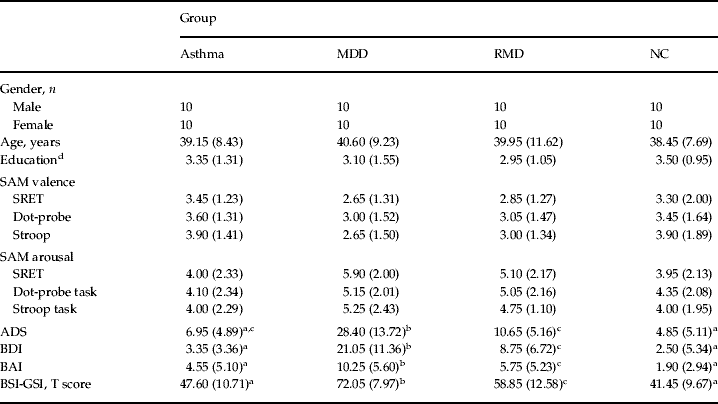
Four groups of participants were examined: 20 patients diagnosed with current major depressive disorder (MDD), 20 participants with at least one diagnosed depressive episode in their lifetime who were currently remitted (RMD), 20 participants with physician-diagnosed asthma without current or former depression and 20 healthy non-psychiatric controls (NC) (Table 1). To ensure the homogeneity of the group of MDD participants, they were recruited from a medical and psychosomatic hospital at the beginning of their in-patient stay. RMD and NC participants were recruited by local newspaper advertisements and flyers posted at the University of Hamburg. Asthma patients were recruited from an out-patient Pulmonary Research Institute. Participants were included in the MDD group if they met the Diagnostic and Statistical Manual of Mental Disorders, 4th edition (DSM-IV; Saß et al. Reference Saß, Wittchen and Zaudig1996) criteria for a current major depressive episode. Participants were included in the RMD group if they met DSM-IV criteria for a past major depressive episode. To confirm full recovery from depression, participants in the RMD group underwent a structured interview based on the DSM-IV (Joormann & Gotlib, Reference Joormann and Gotlib2007). They were asked for the degree of depressive symptoms they experienced during the previous 8 weeks using guidelines recommended by the National Institute of Mental Health Collaborative Program of the Psychobiology of Depression (e.g. Keller et al. Reference Keller, Lavori, Mueller, Endicott, Coryell, Hirchfeld and Shea1992): 8 consecutive weeks with no more than two symptoms of no more than a mild degree. MDD and RMD participants were excluded in case of severe head trauma, learning disabilities, current/past anxiety disorders, psychotic symptoms, bipolar disorder, alcohol or substance abuse within the previous 12 months, and asthma symptoms. Current antidepressive medication in MDD and RMD participants was no exclusion criteria (MDD, n=2; RMD, n=6). Similar exclusion criteria were used for the asthma and healthy control groups. Participants with physician-diagnosed asthma were included when presenting mild to moderately severe asthma according to guidelines of the Global Initiative for Asthma (2007). Asthma patients were excluded if meeting criteria for current or former depression. The four groups were matched for age, gender and level of education. All participants gave informed consent and the local ethics committee approved the study protocol.
Demographic and clinical characteristics of the sample

MDD, Major depressive disorder; RMD, remitted depressed; NC, non-psychiatric healthy controls; SAM, Self-Assessment Manikin (dimensions valence and arousal); SRET, Self-Referential Encoding and Incidental Recall Task; ADS, Allgemeine Depressionsskala; BDI, Beck Depression Inventory; BAI, Beck Anxiety Inventory; BSI, Brief Symptom Inventory; GSI, Global Severity Index.
Values are given as mean (standard deviation) unless otherwise indicated.
a,b,c Different superscripts within rows indicate significant group differences (p⩽0.05).
d Education was assessed on a four-point scale, with higher numbers representing a higher level of education.
Diagnostic assessment
The Structured Clinical Interview for DSM-IV (SCID, German adaptation; Wittchen et al. Reference Wittchen, Zaudig and Fydrich1997) was used to confirm presence or absence of current or former depressive episodes and any other Axis I disorders. A trained psychologist conducted the interview. Prior to SCID administration, participants completed the German versions of the Beck Depression Inventory (BDI, German adaptation; Hautzinger et al. Reference Hautzinger, Bailer and Worall1994), the Beck Anxiety Inventory (BAI;Margraf & Ehlers, Reference Margraf and Ehlers2007), the Center for Epidemiological Studies Depression Scale (Allgemeine Depressionsskala, ADS; Hautzinger & Bailer, Reference Hautzinger and Bailer1993) and the Brief Symptom Inventory (BSI; Franke, Reference Franke2000) to assess the severity of acute symptoms of depression, anxiety and other psychological symptoms.
Stimuli for information processing tasks
Self-referential encoding and incidental recall task (SRET)
A set of 20 depressotypic, 20 socially threatening, 20 physically threatening and 50 positive adjectives was derived from previous studies of information processing in depression (Gotlib et al. Reference Gotlib, Kasch, Traill, Joormann, Arnow and Johnson2004a, Reference Gotlib, Krasnoperova, Yue and Joormannb). Additional adjectives were selected from the Handbook of German Affective Word Norms (Hager & Hasselhorn, Reference Hager and Hasselhorn1994). All words were matched for valence and arousal. Five psychologists and psychotherapists rated the German stimulus words with regard to relevance for depression, social and physical threat and positive emotions. With at least a 4:1 agreement, words were included in the appropriate category.
Emotion face dot-probe task
Similar to previous studies (Gotlib et al. Reference Gotlib, Kasch, Traill, Joormann, Arnow and Johnson2004a; Joormann & Gotlib, Reference Joormann and Gotlib2007), a set of 20 photographs of faces of people posing sad, happy and neutral expression was used from the MacArthur Face Stimuli Set (http://www.macbrain.org/faces/index.htm). From this validated set of 646 photos with faces exhibiting different facial expressions (Tottenham et al. Reference Tottenham, Borscheid, Ellertsen, Marcus and Nelson2002), an equal number of male and female faces that each posed a neutral, happy and sad expression were selected for the current study, as well as an equal number of faces of different ethnicities.
Emotional Stroop task
Three sets of 24 words matched for length, frequency and word class were used: depression-specific, positive and neutral words (eight words per category). The words were chosen from previous studies examining cognition and emotion (e.g. Gotlib & McCann, Reference Gotlib and McCann1984; Bradley & Mathews, Reference Bradley and Mathews1988; Gotlib et al. Reference Gotlib, Kasch, Traill, Joormann, Arnow and Johnson2004a, Reference Gotlib, Krasnoperova, Yue and Joormannb). The German version of the word lists was validated and successfully applied in a previous study examining attentional and memory biases in depression and social phobia (Rinck & Becker, Reference Rinck and Becker2005).
Procedure
In the first session participants completed clinical interviews and questionnaires. In a second session 2 h later, they completed the information-processing tasks presented on a notebook [screen 15.4 inches (39.1 cm)] in the same fixed order (SRET, dot-probe task, Stroop test) to ensure that verbal and non-verbal tasks were alternated and that no retroactive interference would occur on the incidental recall task. Each test consisted of a practice and a test trial. Micro Experimental Laboratory (MEL) software (e-prime v. 1.1; Psychology Software Tools, Inc., USA) and a response box with a MEL voice-activated microphone were used for stimulus presentation and recording of response accuracy/latency. Recent studies demonstrated that an initial mood induction is necessary to detect cognitive biases in formerly depressed participants (Gilboa & Gotlib, Reference Gilboa and Gotlib1997; McCabe et al. Reference McCabe, Gotlib and Martin2000). Before each task we, therefore, presented one of three picture sets, each including 12 pictures of sad scenes (each picture presented for 10 s). Pictures were selected from the International Affective Picture System (Lang et al. Reference Lang, Bradley and Cuthbert1999), which is a validated instrument for emotion induction (Bradley & Lang, Reference Bradley, Lang, Lane and Nadel2000) and includes normative ratings for valence (pleasant–unpleasant) and arousal (high–low). After each picture series, participants rated their current mood on the affective dimensions of valence and arousal using the Self-Assessment Manikin (Lang et al. Reference Lang, Sidowski, Johnson and Williams1980). The participants completed the tasks after practice trials in the absence of the experimenter.
SRET
Each trial started with the phrase ‘Describes me?’ presented for 500 ms and after a pause of 250 ms one of the stimuli words was presented in randomized order. By pressing an appropriate key labelled with ‘yes’ or ‘no’ participants indicated whether the displayed word described them. Then the word disappeared and the next ‘Describes me?’ followed. With the second part of the SRET participants were asked to recall as many words as possible from the previous self-referential encoding task within 3 min, regardless of whether or not they endorsed the words as self-descriptive.
Emotion face dot-probe task
Each of the 20 happy and 20 sad faces were paired with a neutral face of the same actor. These 40 pairs of pictures were presented in randomized order four times (each time 1000 ms), for a total of 160 trials. Each trial started with a fixation cross (1000 ms). When the pictures disappeared, a dot was presented either on the side where the emotional face or the neutral face had been presented before. Participants had to indicate via pressing a key labelled with ‘right’ or ‘left’ the location of the dot as quickly and accurately as possible. With equal probability both the emotional face of the same actor and the dot appeared in the left or right position.
Emotional Stroop task
Following the presentation of a fixation cross (500 ms) and a subsequent pause (500 ms) the words of the three sets were presented in random order and assigned randomly to appear in red, green, blue and yellow. Participants were instructed to name only the colour of the word and to ignore its meaning. The latencies from stimulus presentation to the participants' colour-naming responses, which activated the offset of the word, were recorded by the MEL voice-activated microphone and response box.
Measures
SRET
The bias score was calculated as the number of originally endorsed and subsequently recalled words from each content category, divided by the total number of words endorsed and recalled (Gotlib et al. Reference Gotlib, Krasnoperova, Yue and Joormann2004b). Reaction time is another index of cognitive biases (Gotlib et al. Reference Gotlib, Kasch, Traill, Joormann, Arnow and Johnson2004a, Reference Gotlib, Krasnoperova, Yue and Joormannb), and was calculated by the mean latency to make a decision for the words in each content category.
Emotion face dot-probe task
The dot-probe bias score was calculated by subtracting the mean probe detection times for probes appearing in the same position as the emotional face from the mean probe detection times for probes appearing in a different position than the emotional face. Positive values of this bias score indicate a shift of attention towards the spatial location of emotional faces relative to matched neutral faces, and negative values indicate a shift of attention away from the spatial location of emotional faces relative to matched neutral faces (Mogg et al. Reference Mogg, Bradley and Williams1995).
Emotional Stroop task
Bias scores were calculated by subtracting the mean reaction time for words in the neutral words condition from the mean reaction time for words in each emotional condition. Higher scores indicated greater interference and, thus, greater cognitive bias (Gotlib et al. Reference Gotlib, Kasch, Traill, Joormann, Arnow and Johnson2004a).
Analyses
Group means for bias scores in all three tasks were analysed with repeated-measures analyses of variance (ANOVAs). To achieve comparability with previous studies (Gotlib et al. Reference Gotlib, Kasch, Traill, Joormann, Arnow and Johnson2004a, Reference Gotlib, Krasnoperova, Yue and Joormannb), these ANOVAs were followed by Fisher's least significance difference post-hoc tests. All analyses were calculated with SPSS 15.0 software (SPSS Inc., USA) using a significance level of p<0.05.
Results
Demographic and clinical characteristics
Group characteristics are presented in Table 1. The four groups did not differ with respect to age [F(3, 79)=0.20, p<1], education [F(3, 79)=0.68, p<1] and female:male ratio. As expected, the four groups differed in clinical variables. One-way ANOVAs yielded effects for groups in the ADS [F(3, 79)=34.74, p<0.001], BDI [F(3, 79)=27.10, p<0.001], BAI [F(3, 79)=10.38, p<0.001] and BSI-Global Severity Index (GSI) [F(3, 79)=27.79, p<0.001]. Post-hoc tests indicated that the MDD group scored higher on each of these measures compared with the RMD, NC and asthma groups (BAI, p<0.05, all others, p<0.001). The RMD group exhibited higher scores than the NC in the ADS, BDI, BAI and BSI-GSI (all p<0.05) and higher scores than the asthmatics in the BDI and BSI-GSI (both p<0.05), but lower scores than the MDD group (all p<0.001). However, neither participants of the asthma group nor of the RMD and the NC groups reached the clinically relevant cut-off scores for depression and anxiety (Table 1). Analyses of valence ratings after the affective picture series using a 4 (diagnostic group)×3 (mood induction series) ANOVA yielded an effect for the three mood inductions across all groups [F(2, 152)=3.13, p<0.05]. Valence was lowest before the SRET task and highest before the Stroop task (Table 1). No effects were obtained for arousal ratings.
Group differences in cognitive tasks
SRET
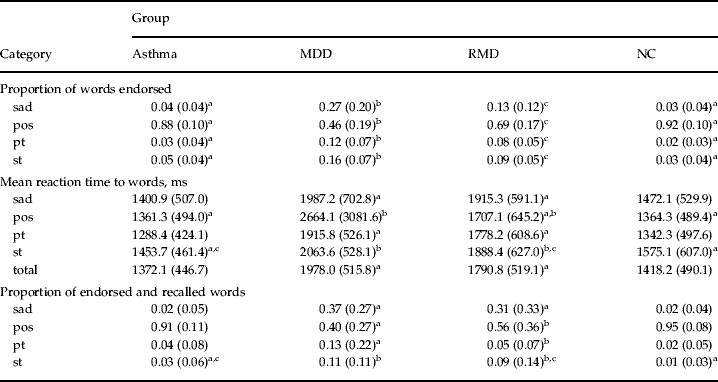
To analyse the SRET bias we conducted two separate analyses, because the proportions necessarily sum to 1.0, which prevents inclusion of all four emotion categories in a single ANOVA. For the three categories of endorsed and subsequently recalled words the 4 (diagnostic group)×3 (negative emotion category) repeated-measures ANOVA yielded an interaction of diagnostic group and negative emotion category [F(6, 152)=5.40, p<0.001], and an effect for emotional category [F(2, 152)=15.02, p<0.001] as well as for diagnostic group [F(3, 76)=26.51, p<0.001]. Post-hoc tests showed that both the MDD and RMD groups recalled more endorsed sad words than socially and physically threatening words (all p<0.05), whereas the NC and asthma groups did not differ with respect to all three negative categories (Table 2). Post-hoc tests of the emotion main effect indicated that across all groups a higher proportion of sad than social (p<0.001) and physically threatening endorsed words (p<0.05) were recalled, with social and physically threatening words not differing from each other. Post-hoc tests of the group main effect revealed that the MDD and RMD groups recalled more endorsed negative words than the NC and asthma groups (all p<0.001). The MDD group showed a stronger bias to negative adjectives than the RMD group (p<0.05).
Bias scores on the SRET

SRET, Self-Referential Encoding and Incidental Recall Task; MDD, major depressive disorder group; RMD, remitted depressed group; NC, non-psychiatric healthy control group; sad, depression-specific words; pos, positive words; pt, physically threatening words; st, socially threatening words.
Values are given as mean (standard deviation).
a,b,c Different superscripts within rows indicate significant group differences (p⩽0.05).
The one-way ANOVA conducted on positive adjectives yielded an effect for diagnostic group [F(3, 76)=26.42, p<0.001]. Post-hoc tests revealed that both the MDD and RMD groups recalled a lower proportion of endorsed positive words than the NC and asthma groups (both p<0.001), which did not differ from each other. The RMD group recalled more endorsed positive words than the MDD group (p<0.05).
Reaction times for self-referential decisions were analysed with a 4 (diagnostic group)×3 (emotion category) repeated-measures ANOVA, which yielded a main effect for diagnostic group [F(3, 76)=7.17, p<0.001]. Post-hoc tests demonstrated that both the MDD group (p<0.001) and the RMD group (p<0.05) required more time to decide than the NC and asthma groups, which did not differ from each other (Table 2).
Emotion face dot-probe task
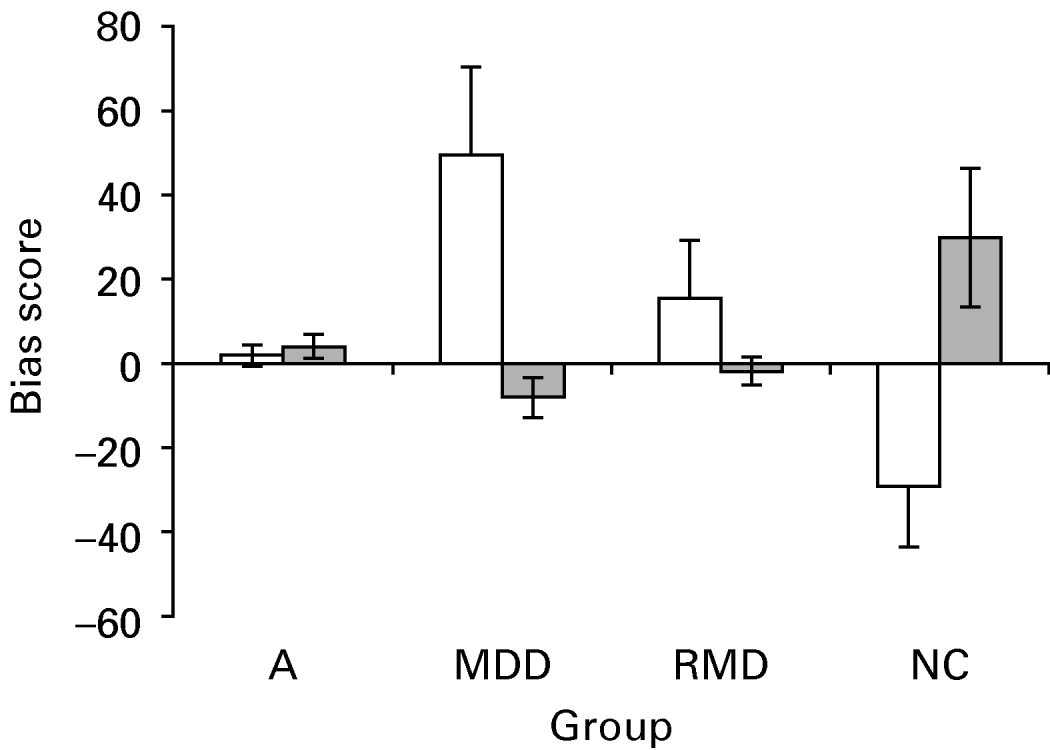
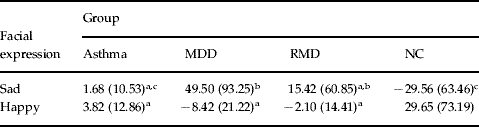
A 4 (diagnostic group)×2 (emotion category) repeated-measures ANOVA yielded an interaction of diagnostic group and emotion category [F(3, 76)=5.95, p=0.001] (Fig. 1). As expected, post-hoc tests demonstrated that both the MDD (p<0.001) and RMD groups (p<0.05), which did not differ from each other, were faster in detecting the dot probes behind sad faces than the NC group (Table 3). Moreover, the MDD participants demonstrated a higher bias score for sad faces than the asthma group (p<0.05), which in turn did not differ from the NC group. Post-hoc tests for happy faces indicated that the NC group showed a higher bias towards happy faces than the MDD group, RMD group and the asthma group (all p<0.05), which did not differ from each other.
Attentional bias for sad (□) and happy ( ) faces presented for 1 s for asthmatic (A), currently depressed (MDD), remitted depressed (RMD) and non-psychiatric control (NC) groups. Values are means, with standard errors represented by vertical bars.

Bias scores on the emotional face dot-probe task

MDD, major depressive disorder group; RMD, remitted depressed group; NC, non-psychiatric healthy control group.
Values are given as mean (standard deviation).
a,b,c Different superscripts within rows indicate significant group differences (p⩽0.05).
Because group differences on attentional bias measures do not indicate which, if any, of the groups shows a bias (see Gotlib et al. Reference Gotlib, McLachlan and Katz1988), one-sample t tests were conducted comparing attentional bias scores with zero within each group. A positive bias significantly differing from zero indicates a bias towards sad/happy faces; a negative bias score indicates a bias away from sad/happy faces. A bias score that is not significantly different from zero indicates no bias for sad/happy faces. The analyses revealed that the attentional bias score for the MDD group towards sad faces was positive and significantly different from zero [t(19)=2.37, p<0.05] while the bias score for happy faces was negative and significantly different from zero [t(19)=–1.77, p<0.05]. The NC group showed an opposite bias, i.e. away from sad faces [t(19)=–2.08, p<0.05] and towards happy faces [t(19)=1.81, p<0.05]. For the RMD and asthma groups the attentional bias score for both sad and happy faces did not differ significantly from zero (both p>0.05).
Emotional Stroop task
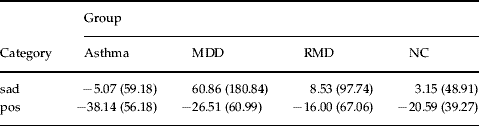
A 4 (diagnostic group)×2 (emotion category) repeated-measures ANOVA yielded only a main effect of emotion category [F(1, 76)=14.34, p<0.001]. Post-hoc tests revealed that across all groups bias scores were greater for depression-specific words than for positive words, that is, all groups needed more time to name the colour of the depression-specific words than the positive words (p<0.05) (Table 4).
Bias scores on the emotional Stroop task

MDD, major depressive disorder group; RMD, remitted depressed group; NC, non-psychiatric healthy control group; sad, depression-specific words; pos, positive words.
Values are given as mean (standard deviation).
Discussion
By using three different cognitive tasks, the present study demonstrated depression-specific cognitive biases in currently, but also formerly, depressed participants compared with healthy control participants. Contrary to our expectations, asthma patients did not show biases to negative stimuli. We first discuss the results of each task individually, followed by an integration of the findings and their implications for research on depression-specific cognitive biases.
SRET
As expected, compared with healthy controls and asthmatics, both currently and formerly depressed participants perceived themselves in a more negative and less positive manner as quantified by better recall of negative words and being significantly slower in making a decision whether the words described themselves or not. Although less pronounced in the formerly depressed group, both depressive groups recalled less positive and more negative words they had endorsed before. No difference in the SRET task was observed between the healthy control and asthma groups, which argues against the existence of a memory bias in asthma. Most importantly, depression-specific endorsement and recall could be observed even after recovery from a depressive episode, thus replicating previous findings in currently depressed patients (Gotlib et al. Reference Gotlib, Krasnoperova, Yue and Joormann2004b). Previous studies examining decision latencies on the SRET have yielded mixed results. Gotlib et al. (Reference Gotlib, Krasnoperova, Yue and Joormann2004b) could not demonstrate differences in the processing speed of emotional words between depressed patients, individuals with social phobic disorder and non-depressed individuals. Other investigators reported that clinically depressed patients were faster in evaluating negative words compared with non-depressed controls (Kuiper & MacDonald, Reference Kuiper and MacDonald1982; Bradley & Mathews, Reference Bradley and Mathews1988; Dozois & Dobson, Reference Dozois and Dobson2001).
Emotion face dot-probe task
We also observed the expected attentional bias for sad faces in currently depressed participants and a bias away from happy faces in the currently depressed participants while, in contrast, the healthy control group selectively attended to happy faces but avoided attending to the sad faces. Most importantly, the formerly depressed participants demonstrated a comparable attentional bias for sad faces. Our results, therefore, not only replicate previous findings of an attentional bias for sad faces in current depression (Gotlib et al. Reference Gotlib, Kasch, Traill, Joormann, Arnow and Johnson2004a), but are also in line with the few studies that have investigated biases in remitted patients (Joormann & Gotlib, Reference Joormann and Gotlib2007). Moreover, Gotlib et al. (Reference Gotlib, Kasch, Traill, Joormann, Arnow and Johnson2004a, Reference Gotlib, Krasnoperova, Yue and Joormannb) could demonstrate that this attentional bias is depression specific because it was absent in participants with anxiety disorders. However, some previous studies did not find attentional biases for negative material in currently depressive patients (Mogg et al. Reference Mogg, Bradley and Williams1995), when stimuli were presented for 500 ms instead of 1000 ms. In addition, the use of words instead of emotional faces might have led to different results (Gilboa & Gotlib, Reference Gilboa and Gotlib1997; Hedlund & Rude, Reference Hedlund and Rude1995). In this regard, interpersonal stimuli such as faces seem better suited for examining information processing, because the important function of social interaction for the improvement in depressive symptoms is well documented (Gotlib & Hammen, Reference Gotlib and Hammen1992). Rinck & Becker (Reference Rinck and Becker2005) used a visual search task to examine depression-related biases in selective attention and found no evidence for enhanced detection of depression-related words in clinically depressed participants. However, they found that depression-related words were more distracting for the depressed than for the non-depressed participants. The asthma patients demonstrated a weaker bias to happy faces than healthy controls in the emotional dot-probe task. In addition, they did not significantly differ from the currently and formerly depressed groups. However, they allocated their attention like the healthy control group, that is, they did not look away from the happy faces as observed in the depressed persons, which argues against an attentional bias in asthma.
Emotional Stroop task
Contrary to our expectations, the four groups did not differ in their latency of colour naming. This contrasts with previous studies demonstrating a bias to negative stimuli after mood induction in currently depressed individuals (Scher et al. Reference Scher, Ingram and Segal2005). However, other studies were unable to find depression-specific interference in this task (Gotlib et al. Reference Gotlib, Kasch, Traill, Joormann, Arnow and Johnson2004a). The differences might be explained by findings that both positive and negative words interfere with colour naming (Ruiz-Caballero & Bermudez, Reference Ruiz-Caballero and Bermudez1997), if the following word is a word with oppositional content, e.g. a positive word following a negative word.
The present study demonstrates that depression-specific cognitive patterns of information processing are not only a feature of acute depressive episodes, but are also present after recovery from depression. In contrast to most previous studies (e.g. Mogg et al. Reference Mogg, Bradley, Williams and Mathews1993; Bradley et al. Reference Bradley, Mogg and Lee1997), this was confirmed using tasks that assess different aspects of information processing. Although less pronounced than currently depressed patients, formerly depressed persons described themselves more negatively and less positively and recalled more negative and less positive words compared with healthy participants. In addition, the formerly depressed participants differed from the healthy controls by attending selectively to sad faces while avoiding happy faces, which was comparable with the currently depressed group. However, the formerly depressed persons did not show a bias to sad faces like in other studies (Joormann & Gotlib, Reference Joormann and Gotlib2007). This difference is difficult to explain and might be related to the antidepressive medication status in some individuals of the formerly depressed group because antidepressant drug administration increases the processing of positive emotional stimuli in healthy and depressed participants (Harmer, Reference Harmer2008; Tranter et al. Reference Tranter, Bell, Gutting, Harmer, Healy and Anderson2009). However, because a bias for negative stimuli could clearly be demonstrated in the formerly depressed group in other tests of the present study, it might be speculated that possible medication effects have different impacts on different cognitive tests, which clearly requires future research. A strength of the present study is that in contrast to most former studies all participants underwent a sound diagnostic procedure with both categorical (SCID) and dimensional (BDI, BAI, ADS, BSI) instruments to exclude any co-morbid anxiety or other mental disorder. This procedure allows attributing the observed specificity effects to current and former depression without confounding co-morbidities. However, because the currently depressive patients were recruited in a psychosomatic hospital, we cannot exclude the possibility that currently depressed out-patients might show different cognitive biases.
Our findings in the SRET and emotional dot-probe task suggest a stable depression-specific pattern of information processing and support cognitive theories of depression (Beck, Reference Beck1967, Reference Beck1976; Ingram, Reference Ingram1984; Teasdale, Reference Teasdale1988). These theories postulate that depression-related schemata are trait-dependent and are activated by corresponding mood, which increases vulnerability for depression. Consistent with these models, the present results provide an explanation for the high risk of recurrent depressive episodes that has consistently been demonstrated (Angst, Reference Angst, Montgomery and Rouillon1992; Wittchen, Reference Wittchen, Lieb, Pfister and Schuster2000). However, our findings of depression-specific information processing biases in formerly depressed persons cannot unambiguously be interpreted as causal factors for the development of depressive episodes. It is still possible that these biases are consequences of a preceding acute depressive episode as emphasized in the ‘scar hypothesis’ (Lewinsohn et al. Reference Lewinsohn, Steinmetz, Larson and Franklin1981). In other words, it is unclear whether vulnerability for depression is caused by biased information processing being already present before the onset of a first depressive episode or whether these biases are leftover scars from experiencing the previous depressive episode. Unfortunately, such causal relationships can only be tested in large-scale prospective studies and not with a remission design. However, Joormann & Gotlib (Reference Joormann and Gotlib2007) recently demonstrated that a high-risk group of never-depressed daughters of depressed mothers exhibited depression-specific information processing in the emotion face dot-probe task. This observation suggests that depression-specific information processing can be present without the experience of an initial depressive episode. Studies on neural substrates of mood-congruent biases suggest that medial and orbital-prefrontal regions may play an important role in mediating the interaction between mood and cognition in affective disorders (Elliot et al. Reference Elliot, Runbinsztein, Sahakian and Dolan2002). Furthermore, it was shown that allelic variations in the promoter region of the serotonin transporter gene (5-HTTLPR) are associated with the processing of positive and negative affective material (Roiser et al. Reference Roiser, Muller, Clark and Sahakian2007; Fox et al. Reference Fox, Ridgewell and Ashwin2009), which might constitute neurobiological target mechanisms for pharmacological interventions (Harmer, Reference Harmer2008).
Consistent with cognitive theories of depression (Beck, Reference Beck1967, Reference Beck1976; Ingram, Reference Ingram1984; Teasdale, Reference Teasdale1988), the present findings emphasize therapeutic options to prevent a relapse of depressive episodes in addition to the treatment of acute depression. They underline the importance of including interventions aimed at changing patterns of depression-specific cognitive processing such as elements from cognitive–behavioural programmes. For example, primarily cognitive therapies employing cognitive reorganization have been shown to be more effective than pharmacological or other therapeutic interventions at long-term follow-up in patients with depression (e.g. Hautzinger & de Jong-Meyer, Reference Hautzinger and de Jong-Meyer1996) and considerably reduced the risk of recurrent depressive episodes (e.g. Blackburn et al. Reference Blackburn, Jones and Lewin1986). Moreover, in the emotion dot-probe test formerly depressed patients demonstrated a depression-specific pattern of attending to faces, which are important cues in interpersonal interactions. This is in line with previous studies showing that interpersonal functioning remained impaired even after recovery from depression (Joiner, Reference Joiner, Gotlib and Hammen2002). In addition, Gotlib & Hammen (Reference Gotlib and Hammen1992) emphasized that depressed individuals' readiness to perceive and attend to negative aspects of their social surroundings contributes to decreased levels of social support, thus leading to more depressive symptoms in a vicious circle. Interventions aimed at improving interpersonal interactions by focusing on positive and supportive social cues might thus be an important therapeutic element.
Contrary to our expectations, neither in self-description and recall nor in response times and attention to faces could we find pronounced differences between asthma patients and healthy controls. Thus, our findings argue against the presence of depression-like cognitive processing in asthma as an explanation for the high co-morbidities with depression (Zielinski & Brown, Reference Zielinski and Brown2003). It might be speculated that such biased cognitive processing is only present in subgroups of asthma patients, for example, those with more severe forms of the disease, which were not included in the present study. Following this lead, Serrano et al. (Reference Serrano, Plaza, Sureda, de Pablo, Picado, Bardagí, Lamela and Sanchis2006) demonstrated that in patients with a history of near-fatal asthma attacks, alexithymia is more frequent compared with patients without near-fatal asthma. Alternatively, patterns of information processing might change in the course of disease with a longer experience of asthma or a correlation could exist between the point of asthma onset and cognitive changes. For example, Miranda et al. (Reference Miranda, Busacker, Balzar, Trudeau and Wenzel2004) showed that an asthma onset before the age of 12 years is associated with more asthma symptoms than a later asthma onset. Future studies are clearly required to answer these questions and should include more severe forms of asthma or different disease durations. In addition, it was interesting to examine whether cognitive biases in asthma patients recovering from depression are different than in formerly depressed participants without asthma. However, the differences among the asthma group and both depressive groups in the present study emphasize that the obtained information processing biases in the latter groups do not result per se from the experience of a disease condition, but are rather depression-specific.
Acknowledgements
This study was supported by a grant of the German Research Foundation (DFG) to A.v.L. (LE-1843/8-1). We thank Eni Becker und Mike Rinck for providing the stimuli for the emotional Stroop task, Matthias Burisch for additional statistical advice, Michael Hettich for assistance in recruiting the currently depressed participants in the Psychosomatic Hospital Bad Bramstedt, Eszter Schoell for commenting on the manuscript and all our participants.
Declaration of Interest
None.