Introduction
Colombia experienced an armed conflict lasting over 60 years. This conflict began with armed confrontations between government forces and left-wing guerrillas and has expanded in the last three decades to include drug cartels, paramilitary, and other criminal groups. 1 Aggressions against rural communities include torture, massacres, rape, forced displacement, and kidnaping 1 - Reference Reyes 3 to gain control of vast areas of land for their natural resources and to provide routes for trafficking illegal substances. 1 , Reference Reyes 3
Historically, the Colombian Pacific Coast region (comprising the departments of Chocó, Valle del Cauca, Cauca, and Nariño) has suffered from social exclusion, violence, and poverty. For decades, communities living in this region have been exposed to the horror of the armed conflict in the absence of governmental presence and support. Here, the conflict has included massacres and displacements such as those that occurred in Naya in 2001 (37 killed and more than 500 displaced) and in Bojayá in 2002 (119 killed and around 6,000 displaced).Reference Bolaños 4 - Reference Sanchez, Bello-Albarracín, Riaño-Alcala, Pulido, Orjuela-Villanueva and Chaparro-Pacheco 6 Over 150,000 individuals from minority populations, mostly Afro-Colombians, have been displaced to Buenaventura (Valle del Cauca) and Quibdó (the capital of Chocó), the two largest cities in the Pacific Coast. 7
These cities are also two of the poorest and most violent cities in Colombia, among municipalities over 100,000 inhabitants. Both cities have few mental health treatment facilities or psychosocial programs for victims of violence and torture, despite the fact that Colombian legislation mandates appropriate psychosocial treatment for victims. 8 , 9 Although the Colombian government has promoted the generation of psychosocial treatment programs for victims of the internal armed conflict in recent years, there has been little progress.Reference Portilla-Benavides and Correa 10 Only two studies have explored the psychological symptoms in these communities. One study described the symptoms of survivors of the Bojayá massacreReference Londoño, Correa and Patiño 11 while the other investigated survivors from different parts from the west-southern region, including some Afro-Colombians from the Pacific Coast. 12 These studies describe the presence of posttraumatic stress syndrome and major depression symptoms, as well as anxiety and suicidal thoughts among individuals exposed to the armed conflict.Reference Londoño, Correa and Patiño 11 , 12 However, they provide limited information on how displaced Afro-Colombians survivors view the problems resulting from torture and violence.
The purpose of this study was to describe, from their own perspective, the psychosocial problems and mental health needs of the Afro-Colombian victims of torture living in Buenaventura and Quibdó. This included their understanding of the causes of these problems, along with what people currently do and what they think should be done to address these problems.
The data from this study were later used to develop locally adapted instruments to assess psychosocial and mental health constructsReference Bolton 13 - Reference Poudyal, Bass, Subyantoro, Jonathan, Erni and Bolton 18 and locally adapted interventions to address those problems. These formed the basis of a subsequent trialReference Bonilla-Escobar, Fandiño and Gutierrez 19 (manuscript in preparation) to screen individuals with reported mental health symptoms and to evaluate the effectiveness of the designed intervention.
Methods
This qualitative study was conducted based on methods previously used with vulnerable populations.Reference Bolton and Tang 15 , Reference Betancourt, Speelman, Onyango and Bolton 17 , Reference Poudyal, Bass, Subyantoro, Jonathan, Erni and Bolton 18 The study was conducted from February through March of 2011 and was approved by the Human Ethical Committee Board (CIREH) Universidad del Valle, Colombia (approval number: 014-011). The study was conducted in collaboration with the National Association of Displaced Afro Colombians (AFRODES), a local nongovernmental organization that works for Afro-Colombia’s displaced individuals’ rights, and Heartland Alliance International (Chicago, Illinois USA).
Three qualitative interviewing methods were used: free-list interviews, key-informant interviews, and focus group discussions. In each city, 12 staff from AFRODES were trained and supervised in the conduct of the free-list and the key-informant interviews. The training included research ethics, including confidentiality. Training and data collection were done in Buenaventura, and a week later in Quibdo.
Interviewers worked in pairs, one person leading the interview and the other as primary recorder. Interviewer pairs could swap roles between (but not during) interviews.
Three supervisors from AFRODES each supervised and supported two pairs of interviewers. Supervisors knew the neighborhoods and the locations in which interviewees could be found and were known to community leaders. Supervisors were in direct contact with the research leader and were responsible for interview schedules, correct technique, and the safety of interviewees, interviewers, or supervisors. Supervisors collected and reviewed interview transcripts after each interview, sometimes sending interviewers back to the respondent for any missing information. All interviews were conducted in Spanish, the native language of these communities. All participants provided written informed consent.
Free-List Interviews
A convenience sample of respondents, individuals recognized by the community to be knowledgeable about the problems of those who had experienced or witnessed torture, was selected to generate free lists. Most respondents were torture or violence survivors, balanced by gender. Each free-list respondent generated four free lists: (1) What are all the problems of persons who have been affected by torture or violence? (2) What are the tasks and activities that people do to take care of themselves? (3) What are the tasks and activities that people do to take care of their families? and (4) What are the tasks and activities that people do to contribute to their communities?
Interviewers probed for as many responses as possible. These were entered onto a separate free-list recording form for each question, along with a brief description of each response provided by the respondent.
After completing the free lists, each respondent was asked to identify people in their community knowledgeable about the mental health problems mentioned in the lists. The respondents were also asked to provide contact information so they could be contacted later as potential key informants.
Analysis of free-list interviews was carried out by the AFRODES interviewers and supervisors, under the direction of local researchers. The problem lists were analyzed first by combining all problems mentioned in all interviews into a single summary list, including how many respondents mentioned each problem. Similarly, all the responses from the three function free lists were condensed into a single list. Then, the supervisors reviewed all summary lists (problems and function) for responses that used different wording but had the same meaning. Where found, responses and the number of respondents who gave them were combined, keeping the wording that was clearest.
The free-list analysis was used to identify potential mental health problems for the more in-depth key-informant interviews. Selection criteria were:
1. The problem was related to thoughts, feelings, or relationships;
2. The problem could likely be addressed by an existing evidence-based intervention provided by community members using available resources;
3. Many respondents mentioned the problem; and
4. The apparent severity of the problem, based on the brief descriptions and what is currently known about it.
Focus Groups
Following the free-list interviews, a focus group session on functioning was conducted in each city. Focus group sessions were led by a supervisor from the local research team. Participants were selected in the same way as respondents from the free-list interviews with none of the free-list respondents participating. The focus groups were asked the same three function questions as the free-list respondents to expand on the free-list data. The analysis of the focus group was done in the same way as the free-list data.
Key-Informant Interviews
The potential mental health problems selected from the free-list data were the subjects of the key-informant interviews. Causes, effects, symptoms, and solution to the selected problems were explored in more detail in these interviews. Key informants were individuals from the community said by free-list respondents to be particularly knowledgeable about these problems and who were willing and able to talk at length. Health practitioners and community workers, and other professionals who might respond on the basis of their training, were excluded as the goal was to capture the community perspective.
The same teams of two interviewers from the free-list interviews conducted the key-informant interviews with one person interviewing and the other writing down the responses.
Key informants were asked to tell all they know about each of the selected problems. For each problem, interviewers were instructed to probe to obtain as much information as possible on:
1. The nature of each problem, including a description of symptoms and effects;
2. The causes of each problem;
3. What people currently do about each problem; and
4. What people think could/should be done about each problem.
Key informants were intended to be interviewed at least twice because a single interview is often not sufficient in time (they normally lasted one hour) for them to cover all information, and because informants often think of new information after the first interview. However, both in Buenaventura and Quibdó, several key informants only agreed to be interviewed once because they had to travel to other areas during interview days, or because they had to work during daytime hours (the only period in which interviewers were allowed to visit the neighborhoods, as suggested by the AFRODES team, due to security reasons).
For the analysis, interviewers worked in four teams (one for each mental health problem the key informants were asked about), reviewing each interview to abstract relevant information and classifying responses according to the nature (eg, symptoms), causes and effects of problems, and what people currently do about it and what should be done. Each team produced a table with a list of these responses and how many key informants gave each response. As in the free-list analysis, when two or more responses had the same meaning, the team selected the wording that was the clearest and combined the total number of participants providing that response.
All results from the three qualitative methods were translated into English by the local institution researchers in order to discuss the results with non-Spanish speaking members of the research team.
Results
Free-List Interviews
Twenty-four (12 men; 12 women) free-list interviews were completed in Buenaventura. In Quibdó, 29 free list interviews (15 men; 14 women) were completed. The focus group in Buenaventura included four women and three men, and the focus group in Quibdo included three women and two men. In both cities, respondents’ ages ranged from 20-70 years. A review of the data separately by city did not find much variation, therefore researchers decided to combine the data from both.
The mental health and psychosocial problems identified during the free-lists interviews were grouped in the following categories (fragments from interviewees’ responses are presented below):
1. Mental health problems, referred to as problems of the soul and the heart:
a. Excessive rumination over the past traumatic events and their effects on their lives; and
b. Features of depression and anxiety (including sadness, fear, anger, resentment, and hopelessness) resulting from the perceived impact of those events on their lives, particularly reduced function and poverty.
“...la persona no podía moverse, de noche los veía haciendo cosas, y mantenía como viendo lo que estaba haciendo con su muchacho” (...the person could not move, during the night she would see them doing things, she kept seeing what they were doing to her boy).
“No salíamos porque tenía miedo... yo me acompleje muy feo” (we would not go out because I was scared… I became terribly withdrawn).
2. Problems with adaptation to new social context:
a. Adaptation difficulties to the new social context, intolerance, and lack of communication with neighbors; and
b. Fear due to insecurity and violence in new environment.
“Sobrevivir en una ciudad donde uno no conoce a nadie, ni tiene uno los medios de trabajá, es muy difícil, a mi si me dio muy difícil” (Surviving in a city where nobody knows you, or where one does not have the ways to work, is very difficult, it has been very very difficult).
“Llego a mi barrio a mi casa, leo el periódico, salgo, me cuentan o veo las noticias y otra vez se me vuelve a caer el mundo, entonces creo que es complejo porque la situación de violencia y de conflicto en Buenaventura es permanente” (I get to my neighborhood, my house, I read the newspaper, go out, people tell me or I see the news and once again my world falls apart, then I see it is complex because the violent and conflict situation in Buenaventura is a permanent one).
3. Problems related to the current situation:
a. Lack of assistance from government; and
b. Unemployment and poverty.
“Tienen todas las necesidades básicas insatisfechas, hoy están aquí, mañana en otra parte” (they all have unmet basics needs, one day they are here, tomorrow they are somewhere else).
The four most frequently reported problems in each city were selected for key-informant interviews. In Buenaventura, the four problems included: Fear (in Spanish: Miedo), Psychological Trauma (Trauma), Sadness (Tristeza), and Violence (Violencia). The team of researchers decided to include Violence as one of the problems given the fact that it was frequently reported and because of the interest in further exploring participants’ thoughts on how it was related to mental health problems. In Quibdó, the four problems were: Fear (Miedo), Psychological Trauma (Trauma), Suffering (Sufrimiento), and Resentment (Resentimiento). The results of the analysis of the function activities from the free list and focus groups are available from the authors upon request.
Key-Informant Interviews
In Buenaventura, a total of 17 key informants (14 women; three men) were interviewed. Approximately one-half (n=9) were interviewed only once; seven were interviewed twice and one was interviewed three times. In Quibdó, a total of 15 key informants (seven women; eight men) were interviewed. Less than one-half (n=6) were interviewed only once; eight were interviewed twice and one was interviewed three times. The results are presented separately for each problem.
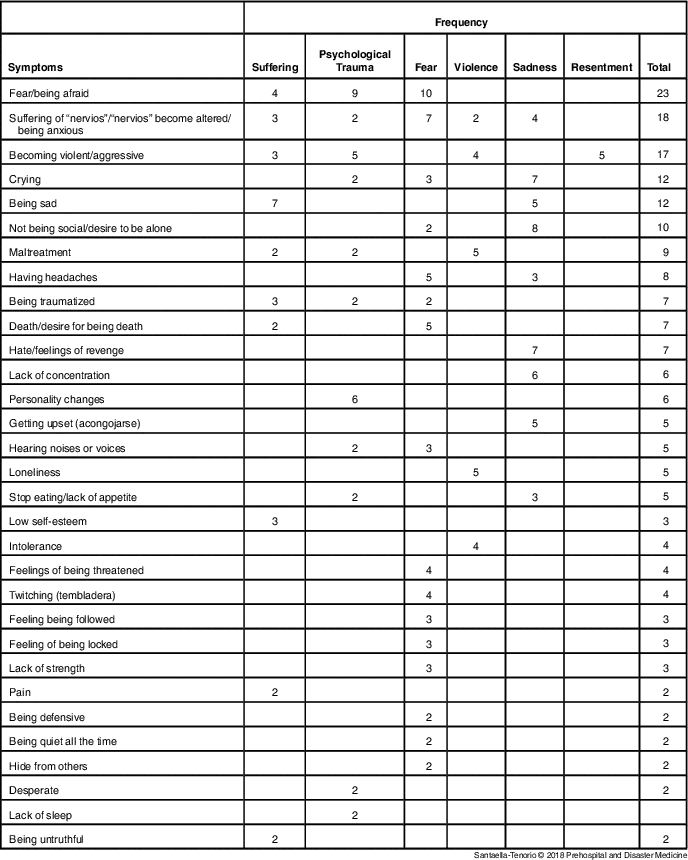
Fear/Being Afraid (Miedo) was characterized as a problem associated with continuous feelings of anxiety (with diverse physical manifestations), desire for being alone/isolation, and in Quibdó, with feelings of being followed, trapped, or threatened.
Key informants described characteristics of Psychological Trauma (Trauma) to include symptoms related to significant distress, changes in behaviors/attitudes such as not eating or sleeping, being confused and becoming violent/aggressive, and signs of alteration of thought process and content (delusions: hearing voices or noises). Informants described these symptoms as the results of experiencing traumatic events.
Symptoms of Sadness (Tristeza) were described as emotional alterations that included crying continuously, being upset, wanting to be alone, a depressive mood, anxiety, and suicidal thoughts. Informants reported that sadness was a common feeling associated with remembrances of the places they used to live and things they used to do before being displaced.
Suffering (Sufrimiento) was described as having characteristics in common with sadness, including emotional difficulties such as depressive mood, anxiety, low self-esteem, and suicidal thoughts.
Resentment/Bitterness (Resentimiento) was a problem characterized by feelings of hate and anger, rooted in social injustice and exclusion from society.
Violence (Violencia), characterized by delinquency and lack of opportunities, was commonly reported as a current problem. Violence was described as a continuous cause of distress and was associated with feelings of isolation, marginalization, insecurity, and emotional distress.
Respondents in both cities frequently mentioned that people seemed to be ashamed of having these problems and were usually afraid to talk to other people about their feelings and difficulties apparently due to social stigma. Respondents also talked about people avoiding talking about their problems, as they feared that members of illegal groups present in neighborhoods might hear about this and decide to attack or extort them. The problems that were selected to be the focus of the key-informant interviews were also often reported as symptoms, effects, or causes of other problems. The related symptoms for each of the problems explored in the key-informant interviews are presented in Table 1.
Symptoms and Signs of Problems Affecting People Suffering from Selected Problems (n=32)

Causes of these problems were described in similar ways in both cities. Respondents blamed many of the problems on violence and insecurity represented by displacement, death, abuse, life threats, and drug trafficking. They also described other causes based on social injustice represented by poverty, unemployment, and lack of opportunities. Respondents often mentioned that individuals had a hard time keeping up with their daily normal life, given that they were unable to forget past traumatic experiences.
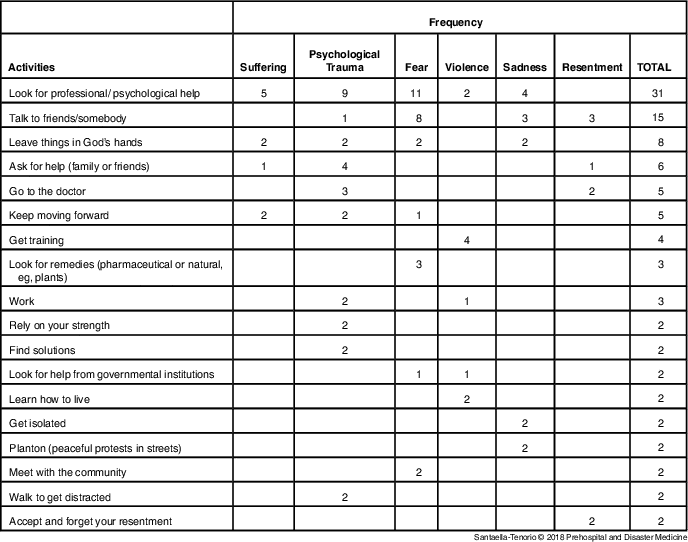
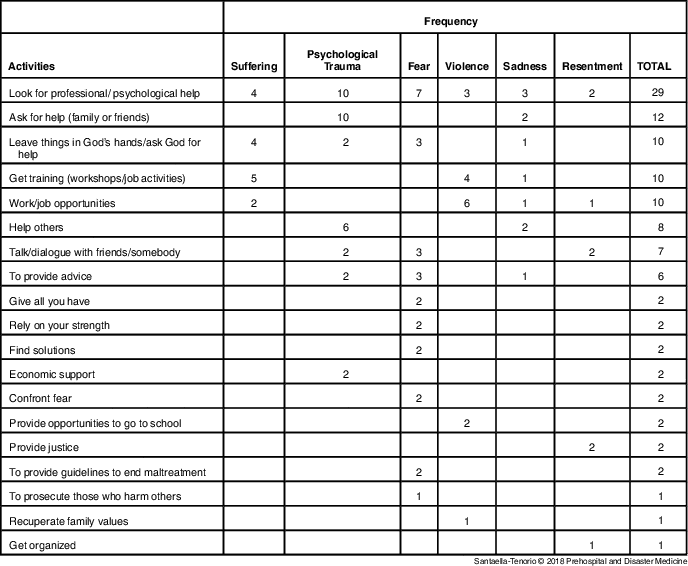
The most common solutions were finding professional/psychological help, talking to friends and family, and relying on God’s help. Others solutions included working, joining workshops in which people are trained in different task or jobs, and being part of community activities that promote socialization and strengthen community networks. A list of coping activities and solutions offered by the study respondents are included in Tables 2 and 3.
What People Can Do to Cope with Torture/Violence related Problems (n=32)

Things that Could be Done to Assist Torture/Violence Survivors with related Problems (n=32)

Discussion
This study aimed to describe common problems of victims of torture and violence from the perspective of those living in the two major urban areas in the Pacific Coast region. This included local descriptions of these problems, their symptoms, effects and causes of these problems, as well as coping activities and alternative solutions. This study used a qualitative methodology previously used in other cultures.Reference Bolton 13 - Reference Poudyal, Bass, Subyantoro, Jonathan, Erni and Bolton 18
In the free-list interviews, the most common reported problems were Fear and Psychological Trauma. Both were characterized by trauma symptoms and features of depression and anxiety, as previously described for western and non-western civilian populations,Reference Bolton 13 - Reference Poudyal, Bass, Subyantoro, Jonathan, Erni and Bolton 18 including political violence survivors in Colombia.Reference Londoño, Correa and Patiño 11 , 12 , Reference Pineda, Guerrero, Pinilla and Estupinan 20 The problems that were explored were highly inter-related. Fear was linked with intrusive thoughts and continuously being alert, which could also be part of re-experiencing traumatic experiences, but may also reflect the current situation in both cities where insecurity and violence remain common. Two other problems, Sadness and Suffering, have overlapping characteristics with features of trauma symptoms and features of depression, anxiety, and grief. Being sad was reported as a symptom of Suffering, suggesting how close related these two constructs are in both cities. Additional symptoms in Suffering, not shared with Sadness, included anger, pain, untruthfulness, and being traumatized, which may be related to a phase of sorrow after experiencing traumatic experiences and may be specific to this problem. These problems identified in both cities were similar to those described in a study with survivors of the armed conflict in the area of Bojayá, Chocó, in which trauma-related symptoms and features of depression were frequently observed among victims.Reference Londoño, Correa and Patiño 11
Resentment was a problem identified in Quibdó. Resentment towards society was characterized by anger and a profound sense of injustice due to discrimination and lack of opportunities and unemployment. Resentment, as explained by the interviewees, is related to affective difficulties that may turn into aggressions toward society, neighbors, and also against the person. A similar characterization of Resentment has been described among torture survivors in other regions.Reference Bolton, Michalopoulos, Ahmed, Murray and Bass 16 In addition, one major concern for treatment of traumatic experiences of torture survivors in Buenaventura is the previous and current exposure to violence in neighborhoods. Violence was the fourth most frequent problem reported in this city. It is likely that torture victims are exposed to new traumatic experiences and that symptoms reported are the results of past and recent events. Studies on therapeutic strategies should take into account the continuous re-exposure to traumatic experiences and stressors that likely influence all possible intervention outcomes.
Coping activities and solutions suggested by interviewees were based on psychological treatment, indicating that individuals acknowledge psychological therapy as a potentially acceptable solution for torture and violence survivors. Other coping activities included leaving things in God’s hands. The spiritual experience, which could work as a form of cognitive optimism,Reference Cherewick, Kohli and Remy 21 may improve growth and recovery among victims through the acceptance and assimilation of traumatic experiences. In addition, other activities included asking for help and getting trained in different activities, indicating the importance of social support and of engagement in activities that could be both a source of distraction and a relief to economic hardship.
The data from this study served to adapt western mental health instruments to better reflect mental health problems and symptoms according to local cultural constructs and language. The results also suggested a need for an intervention that would cover the overlapping characteristics of the reported disorders; specifically, a transdiagnostic intervention such as the Common Element Treatment Approach (CETA).Reference Murray, Dorsey and Haroz 22 This approach may include components aiming at improving mental health conditions of individuals by: (1) encouraging them to face feared and avoided memories through gradual exposure; (2) promoting cognitive reprocessing, cognitive coping, and behavioral activation; and (3) providing safety skills and techniques for relaxation.
Limitations
A potential limitation of this study is that the sample size prevents exploration of the data separately by city. However, similarities in the problems identified, how people understand these problems, and suggested solutions were observed in both settings. This study also focused on problems of survivors living in the two major urban areas of the Colombian Pacific Coast. It is uncertain whether these findings apply to other populations of Afro-Colombians survivors (eg, those living in rural areas).
Conclusions
This qualitative study provided rich information about the mental health problems of Afro-Colombian victims of violence in two communities located in the Colombian Pacific Coast region. Symptoms and effects of the problems selected were found to be similar to trauma symptoms and features of depression and anxiety frequently found in populations of torture survivors and victims of violence in different western and non-western cultures. The battery of symptoms was used to adapt western instruments that were used to screen participants into a psychosocial intervention designed with and implemented by a local nongovernmental organization under the supervision of the research team. The descriptions of problems and potential solutions for them, which were also obtained in this qualitative study, were used to define the intervention components that seemed most likely to be effective in reducing the symptoms among torture survivors in this region.