INTRODUCTION
In severely competitive and uncertain environments, in order to survive and grow, enterprises tend to adopt strategies between competition and cooperation, and they have co-opetition relationships, which form competitive interactions. Co-opetition was proposed by Brandenburger and Nalebuff (Reference Brandenburger and Nalebuff1996), and refers to cooperation in competition. The relationship among firms is not simply competition or cooperation, as the two might exist simultaneously (Brandenburger & Nalebuff, Reference Brandenburger and Nalebuff1996; Baruch & Lin, Reference Baruch and Lin2012; Hung & Chang, Reference Hung and Chang2012; Mantena & Saha, Reference Mantena and Saha2012; Peng, Pike, Yang & Roos, Reference Peng, Pike, Yang and Roos2012; Ritala, Reference Ritala2012; Bouncken & Kraus, Reference Bouncken and Kraus2013; Chen & Hao, Reference Chen and Hao2013; Pellegrin-Boucher, Le Roy & Gurau, Reference Pellegrin-Boucher, Le Roy and Gurau2013; Teng & Huang, Reference Teng and Huang2013; Tomlinson & Fai, Reference Tomlinson and Fai2013). The essence of co-opetition is to realize the complementary use of the advantageous elements of the businesses, enhance competitiveness of both sides, and thus, contribute to the establishment and consolidation of both their competitive positions in the market; therefore, joint action between firms is very important. The co-opetition strategy is a complementary business mindset, and its approach is to try to expand market opportunity, rather than compete for a market of a fixed scope. Such a strategy is of substantial help for small and medium enterprises.
Co-opetition is the strategy commonly adopted by small-scale firms (Levy, Loebbecke & Powell, Reference Levy, Loebbecke and Powell2003; Morris, Koçak & Özer, Reference Morris, Koçak and Özer2007; Gnyawali & Park, Reference Gnyawali and Park2009). When two companies cooperate in some competitive business activities, the co-opetition strategy will exist. Previous research on the co-opetition strategy mostly focused on alliance governance (Hung & Chang, Reference Hung and Chang2012; Chen & Hao, Reference Chen and Hao2013). Different from previous research, this study tries to probe into factors behind organizations’ adoption of co-opetition strategies from the resource-based view. When firms have heterogeneous internal resources, they can construct competitive advantage (Barney, Reference Barney1991; Peteraf, Reference Peteraf1993). When competitive advantage is based on organizational unique resources and capacities, in order to maintain a position in the market, enhance core capacity, and avoid the competition of rivals, the organization tends to launch competitive action. In other words, they are more likely to adopt a competitive strategy and actions. In addition, when organizations cannot totally obtain internal resources, they must exchange with other organizations or other people with related resources in the environment (Lambe & Spekman, Reference Lambe and Spekman1997). Cooperation can supplement the shortage of resources in an organization and establish competitive advantage. From the perspective of resources, when organizations can keep their unique resources from other organizations’ acquisition, and realize that their position will not be influenced by resource sharing, it will enhance cooperation (Morris, Koçak & Özer, Reference Morris, Koçak and Özer2007). In other words, when adopting the co-opetition strategy, enterprises will evaluate the sufficiency of their resources. The essence of co-opetition is to realize the complementary use of the advantageous elements of the businesses, enhance competitiveness of both sides, and thus, contribute to the establishment and consolidation of both their competitive positions in the market; therefore, joint action between manufacturers is very important. The co-opetition strategy is a complementary business mindset, and its approach is to try to expand market opportunity, rather than compete for a market of a fixed size. Such a strategy is of substantial help for small and medium enterprises.
Regarding subjects, this study selected small and medium accounting firms as the target. In comparison to international or large-scale accounting firms, the non-auditing market in small and medium accounting firms of Taiwan is in monopolistic competition. CPAs (Certified Public Accountant) of small and medium-sized accounting agencies often have unique professional competences, which are displayed in non-audit services. Therefore, they can provide clients with more professional services. Since accountants have different specialties, their services are different. They resemble heterogeneous products in monopolistic competition firms. The competitive strategy adopted by accounting firms in the non-auditing market tends to be co-opetition, which is particularly true for small and medium local accounting firms. When accounting agencies provide customers with services of heterogeneous characteristics, they still have some pricing power. In this case, the accounting agencies will adopt a price competition strategy in order to enhance revenues or performance. If the accounting agency is subjected to the competition of accounting agencies of homogenous characteristics, for the consideration of alternative service, it will adopt the non-price competition strategy in order to enhance business revenues or performance. Second, co-opetition relationships among accounting firms is not usually based on contracts or agreements, but tend to be ambiguous. Adoption of the co-opetition strategy usually relies on trust among accountants; hence, trust is a critical moderator for both sides of co-opetition. It is necessary to determine how trust enhances or reduces co-opetition, and its moderating effect. Finally, this study attempts to determine if the performances of different co-opetition strategies are significantly different, for use as reference for practical operations of small and medium accounting firms.
THEORY AND HYPOTHESES
Resource characteristics and co-opetition strategies
From the resource-based view, organizations or individuals with more resources and better skills have greater competitive advantages; hence, they tend to adopt competitive strategies in competition. According to the resource-based view, organizations or individuals in possession of the expertise heterogeneity are likely to develop their competitive advantages, and therefore, are very much inclined to adopt competitive strategies to boost their competition status and core capabilities to preempt attacks of their counterparts.
Compared with the audit market, the growth of the non-audit service is much higher than that of the general audit service. It is because non-audit service, as opposed to the traditional one, can generate more profits (Read & Tomczyk, Reference Read and Tomczyk1992; Frankel, Johnson & Nelson, Reference Frankel, Johnson and Nelson2002; Chen, Reference Chen2012). However, broadening or launching more diversified non-audit service requires more expertise and skills. Competitive advantages can be established only when accountants or accounting agencies are equipped with differential non-audit services (Johnson & Scholes, Reference Johnson and Scholes2002). As far as the audit market is concerned, accounting agencies in possession of differential expertise and skills are more likely to adopt competitive strategies. For example, they would offer diversified professional services or develop new ones to obtain trust and attract clients in hopes of boosting revenues. Additionally, they may also rely on their price advantage in the competition by undercutting their competitors or targeting the high-end market. The accounting agencies with differential expertise can construct competitive advantages by providing unique professional services and relying on market monopolies.
The non-audit services small and medium-sized accounting agencies provide are more like monopolistic competition. The agencies have differential products, and there are plenty of companies and a large number of clients on the market. The expertise the accountants possess has such high heterogeneity that business clients can make a distinction between each accountant, which is so-called monopolistic market power. In practice, with respect to the adoption and implementation of strategic behavior, the accounting agencies with professional heterogeneity tend to adopt competitive strategies to consolidate their competition status and enhance their core abilities in hopes of leaving their counterparts behind and boost organizational performance. Therefore, the study offers the following hypotheses:
Hypothesis 1a: If the heterogeneity degree of non-audit service provided by small and medium-sized accounting agencies is higher, it is more likely to adopt price competitive action strategies.
Hypothesis 1b: If the heterogeneity degree of non-audit service provided by small and medium-sized accounting agencies is higher, it is more likely to adopt the competitive strategy of non-price competitive action.
To acquire complementarity resources, scholars believe that building coalition relations or adopting cooperation strategies may be of help. According to Chung, Singh and Lee (Reference Chung, Singh and Lee2000), resource complementarity is one of the driving factors for strategic coalition. Companies in possession of complementarity resources are liable to enter into strategic coalition partnership. Harrison, Hitt, Hosjisson and Ireland (Reference Harrison, Hitt, Hosjisson and Ireland2001) indicated that the combined effects of complementarity resources are bigger than those of similar resources, and complementarity resources can be obtained through merger and acquisition or strategic coalition. Some organizations will adopt cooperation strategies in order to acquire complementarity resources, especially tacit knowledge. Hughes and Weiss (Reference Hughes and Weiss2007) suggested that coalition relations may be of competitive nature originally, and each business may have a very different management style and organizational culture. However, both parties should not attempt to obliterate the differences. Instead, they should make use of their respective advantages and resources to offset each other’s weaknesses and create value. Moreover, they should cross the boundaries of organizational structures and take the initiative to enter into cooperation relationship.
The literature also suggests a positive correlation between resource complementarity and cooperation strategies (Lin, Yang & Arya, Reference Lin, Yang and Arya2009; Deitz, Tokman, Richey & Morgan, Reference Deitz, Tokman, Richey and Morgan2010). The dependence of an organization on the environment is subject to resource rarity and its ability to obtain the resources. It is an important motivated factor for an organization adopting cooperation strategies to obtain rare and complementarity resources in hopes of boosting its own resources or filling its resource gaps. When an organization cannot access the needed resources from within and external resources are complementary, it has to trade with other people or organizations in possession of the resources. That is, it is more likely to adopt cooperation strategies of joint actions.
In the audit market, many accounting agencies are inclined to expand or launch more diversified non-audit services to broaden customer base. Nevertheless, the accounting agency itself is unable to achieve that due to insufficiency or lack of expertise. If the needed resources have high levels of complementarity, accounting agencies are inclined to cooperate with their counterparts to obtain them. For example, they may work with a partner to serve clients or contract out services to supplement their insufficient expertise. In practice, when accountants have higher needs for expertise complementarity of non-audit services, they are more likely to adopt cooperation strategies. Considering the theoretical literature, the research study proposes the following hypothesis:
Hypothesis 2: When small and medium-sized accounting agencies have higher needs for expertise complementarity, they are more likely to adopt cooperation strategies of joint actions.
Co-opetition strategies and performance
The relationship between companies is not confined to either competition or cooperation, but rather it can be a combination of both competition and cooperation, or so called co-opetition (Brandenburger & Nalebuff, Reference Brandenburger and Nalebuff1996; Bengtsson & Kock, Reference Bengtsson and Kock2000; Luo, Reference Luo2005; Peng & Bourne, Reference Peng and Bourne2009; Wu, Choi & Rungtusanatham, Reference Wu, Choi and Rungtusanatham2010). In a co-opetition relationship, companies create value through cooperation and acquire value through competition. To create value, companies cannot achieve it by themselves; they have to rely on each other. To create value, companies must unite with clients, suppliers, employees and other organizations or individuals. That is one of the ways to develop new markets and expand current ones. According to Morris, Koçak and Özer (Reference Morris, Koçak and Özer2007), co-opetition is a strategy used by small-sized companies. The strategy of co-opetition takes place when both companies conduct some kind of cooperation while competing with each other in a few business activities.
Whatever kind of co-opetition strategies a company adopts, they will affect the company’s organizational performance. Whether it is a competition strategy or a cooperation one, the strategy will have a significant benefit to an organization’s competitive advantages. A company needs to rely on competition to acquire the constant flow of profits (Wernerfelt & Karnani, Reference Wernerfelt and Karnani1987). The cooperation mechanism between organizations would have a positive influence on performance (Wernerfelt & Karnani, Reference Wernerfelt and Karnani1987). Also, the cooperation would be beneficial to the formation of relational rent (Dyer & Singh, Reference Dyer and Singh1998). Bengtsson and Kock (Reference Bengtsson and Kock2000) believed that in a co-opetition relationship, when the activities two companies conduct have a wide distance from the end consumers, the companies tend to adopt cooperation strategies. When the activities are close to the end consumers, the companies are inclined to adopt competition strategies. The factors for consideration are either performance or profits. Gnyawali and Park (Reference Gnyawali and Park2009) thought that small and medium-sized enterprises adopting co-opetition strategies are more likely to achieve economies of scale and reduce uncertainties and risks. In other words, in the framework of co-opetition, co-opetition strategies would affect organizational performance; and adopting competition or cooperation strategies is considered a means of boosting performance.
In the audit market, small and medium-sized accounting agencies cannot compete against international large sized ones in terms of scale and operation. Subject to market segmentation, the co-opetition relationships among small and medium-sized accounting agencies would take place. In addition, adopting both types of co-opetition strategies would also affect the performance of agencies. In terms of operating agencies, accountants would adopt competition strategies and cooperation ones simultaneously to boost organizational performance. Generally, the competition strategies adopted by accountants include price and non-price competition strategies while the cooperation ones include interacting with bookkeeping firms, forming strategic alliance with law firms, partnering with competitors, and participating in union activities. Nevertheless, in terms of the implementation of competition strategies, most accountants would prefer non-price competition strategies since price competition strategies are forbidden in the Ethical Code of Conduct for Professional Accountants. That is, accountants would prefer actions beneficial to augmenting professional status, enhancing core capabilities and constructing professional images in the competition. Still, a few accountants would cut prices to compete because the punishment for breaking the ethical code is not too severe. As for conducting cooperation strategies, field observations have shown that joint actions are being seen more often. Accountants also prefer to cooperate with their counterparts; these joint actions are to make up for the gap and inadequacy of their own expertise, and they are beneficial to improving performance. In practice, accountants would adopt both competition and cooperation strategies, which is just a proportional matter. However, the strategies adopted are related to improvement of performance. Accordingly, the research study proposes the following hypotheses:
Hypothesis 3a: In a co-opetition relationship, the competition strategies of price competition adopted by small and medium-sized accounting agencies have a positive influence on organizational performance.
Hypothesis 3b: In a co-opetition relationship, the competition strategies of non-price competition adopted by small and medium-sized accounting agencies have a positive influence on organizational performance.
Hypothesis 4: In a co-opetition relationship, the cooperation strategies of joint actions adopted by small and medium-sized accounting agencies have a positive influence on organizational performance.
Moderating effects of trust
With trust, a party that is trusted will respond to the other in a sincere manner (Manolova, Gyoshev & Manev, Reference Manolova, Gyoshev and Manev2007). In other words, because of trust, they will not hurt each other or the relationship. Thus, trust can be treated as a kind of mechanism (Williamson & Craswell, Reference Williamson and Craswell1993), relationship (Granovetter, Reference Granovetter1985) or moderator in an organization.
When the organization itself has more unique resources or capabilities, or has the advantage of expertise, it is more beneficial to build competitive advantages (Newbert, Reference Newbert2007); therefore, it is more inclined to adopt competition. In the audit market, if an accounting firm has unique expertise or skills to offer clients different services, it will tend to take price or non-price competition to recruit businesses in order to increase business and performance. In co-opetition relationships, trust between the partners will moderate the competitive behaviors of the accounting agencies, as trust is confidence in the fulfillment of commitment, fairness and good intentions (Morgan & Hunt, Reference Morgan and Hunt1994; Dyer & Chu, Reference Dyer and Chu2000; Lane, Salk & Lyles, Reference Lane, Salk and Lyles2001), and allows an enterprise to realize that partners are reliable and honest (Tsai, Reference Tsai2000). Therefore, trust will prevent the partners from hurting each other (Korgzynski, Reference Korgzynski2000). Competitive behavior can be moderated due to the high degree of trust in partners and the unwillingness to hurt the relationship. In other words, for accounting agencies with a high degree of expertise heterogeneity, the competition strategy should be adopted. However, by the moderating the high degree of partner trust, the competition behavior is significantly weakened. Therefore, the following hypotheses were proposed:
Hypothesis 5a: Partner trust negatively moderates the relationship between expertise heterogeneity and price competitive action.
Hypothesis 5b: Partner trust negatively moderates the relationship between expertise heterogeneity and non-price competitive action.
When two parties’ different resources and capacities are combined, complementary resources can result in benefits (Helfat & Peteraf, Reference Helfat and Peteraf2003; Kim & Finkelstein, Reference Kim and Finkelstein2009). Therefore, when the resources required by an organization are the complementary resources of others, or when organizations must acquire lacked resources from the external world, it tends to adopt the cooperative strategy of joint action. In emerging markets, enterprises tend to rely on complementary knowledge to achieve the strategic goals of the two parties (Fang, Reference Fang2011). In the auditing market, when an accountant office lacks unique professional knowledge or skills, and they must acquire such professional knowledge from other accountant offices, or need the support and assistance of partners in other offices, a high degree of trust among the partners enhances such joint action (Joshi & Stump, Reference Joshi and Stump1999). Expertise complementarity results in cooperation among offices, as they require techniques from each other. Trust results in mutual dependency between accountant offices, as trust is the bridge between the two parties. Trust is based on benevolence (Mayer, Davis & Schoorman, Reference Mayer, Davis and Schoorman1995). Gambetta (Reference Gambetta1988) suggested that when two parties trust each other, they recognize the benevolent actions of each other, and neglect the possible malicious intent, thus, they achieve cooperation. Therefore, a high degree of trust leads to two parties’ cooperation (Das & Teng, Reference Das and Teng1998; Rousseau, Sitkin, Burt & Camerer, Reference Rousseau, Sitkin, Burt and Camerer1998; Deitz et al., Reference Deitz, Tokman, Richey and Morgan2010), as they believe that others are able to satisfy their needs (Mcknight & Chervany, Reference Mcknight and Chervany2002), which can effectively lower transaction costs (Zaheer & Venkatraman, Reference Zaheer and Venkatraman1995; Das & Teng, Reference Das and Teng1998; Zaheer, McEvily & Perrone, Reference Zaheer, McEvily and Perrone1998; Dyer & Chu, Reference Dyer and Chu2003).
Therefore, accountant offices with the intention to create complementary benefits must be based on trust. For accountant offices that need external complementary expertise, when adopting joint strategy, the relation and intensity between expertise complementarity and joint action are reinforced by a high degree of trust. Hence, this study proposes the following hypothesis.
Hypothesis 6: Partner trust positively moderates the relationship between expertise complementarity and joint action.
METHODS
Measures
The definitions of each variable are provided as follows, and question items are attached in the Appendix.
Expertise heterogeneity
The concept of expertise heterogeneity derives from that of resource heterogeneity, meaning accountants in accounting agencies have expertise heterogeneity or professional skills. As far as the evaluation of expertise heterogeneity is concerned, the variable is approached with the concept of Herfindal-Hirschman Index, or HHI (Michel & Hambrick, Reference Michel and Hambrick1992; Sherer, Reference Sherer1995; Blau, Reference Blau1997; Hitt, Bierman, Shimizu & Kochhar, Reference Hitt, Bierman, Shimizu and Kochhar2001). Therefore, the research study takes into consideration accountants’ own expertise to calculate heterogeneity. Through accountants’ self reports, the study evaluates the percentage of accountants’ own expertise and calculates the expertise heterogeneity with HHI concept. The evaluation formula is as follows:
 $$H=1{\minus}\mathop{\sum}\limits_{i=1}^n {p_{i}^{2} } $$
where H is the expertise heterogeneity; p the percentage (%) each accountant has in their own professional field; CPAs were required to assess the proportions of the professional and expertise fields (11 items) of non-audit service by self-report; n accountants’ professional fields (n=1–11); the fields include tax administrative relief, inheritance and gifting tax planning, cross-strait tax planning, multangular trade, goodwill assessment, corporation M&A, establishment and management of OBU, ERP management, transfer pricing, internal control and other fields.
H value is between zero and one; the higher the H value, the higher the heterogeneity.
Expertise complementarity
The concept of expertise complementarity derives from that of resource complementarity (Dyer & Singh, Reference Dyer and Singh1998; Sarker, Echambadi, Cavusgil & Aulakh, Reference Sarker, Echambadi, Cavusgil and Aulakh2001), meaning that an accounting agency’ cooperation partner provides expertise and skills which meet the agency’s needs and are able to fill the resource gap. Expertise complementarity means two parties combine individual professional knowledge to carry out strategic goals and make profits; therefore, they each require the other’s professional resources. However, expertise heterogeneity can fulfill strategic goals without others’ cooperation. It is the most significant difference. The research study uses six question items to evaluate expertise complementarity.
Partner trust
For accounting agencies, partner trust means the extent to which an accounting agency can trust its counterparts (Lai, Lee & Hsu, Reference Lai, Lee and Hsu2009). The research study uses six question items to evaluate partner trust.
Competitive action
The so-called competitive action for accounting agencies includes price competitive action and non-price one, which are explained in the following:
Price competitive action
Any competition through setting prices or undercutting competitors is called price competitive action. The research study uses three question items to evaluate the price competitive action, including reasonably priced margins, fee pricing lower than competitors, and discounts for regular customers. Respondents need to check the three items to report their adoption status, 70% of whom shows great preference for adoption while ten percent of whom does not.
Non-price competitive action
Except for price competition, any competition through quality, warranty and service is called non-price competition. The research study uses four question items to evaluate non-price competitive action, including offering more quality professional service, providing a wider variety of professional service, actively expanding new service, and giving a more reliable guarantee. Respondents report their adoption status by checking the four items. Seven points indicate great preference for adoption, while one shows great preference for no adoption.
Joint action
For accounting agencies, joint action refers to interactive action accomplished mutually by exchanging information and sharing knowledge with cooperation partners for a specific strategic goal (Zaheer & Venkatraman, Reference Zaheer and Venkatraman1995). The research study uses six question items to evaluate joint action.
Performance
In small and medium-sized accounting agencies, the earnings and performance of non-audit service can be regarded as the outcome of each accountant’s hard work. Whether the non-audit service can succeed or fail mostly hinges on each accountant’s expertise or capacity. Accordingly, the performance in the research study is actually the performance each accountant gives in the field of non-audit service. The research study develops four indicators to evaluate performance, including the percentage the revenues of non-audit service account for in the overall revenues of the service, the growth rates of non-audit service, the expected growth rates of non-audit service, and overall satisfaction level of the earned profits of non-audit service. The formulae are illustrated respectively as follows:
-
(1). Non-audit service revenue percentage (%)=non-audit service revenue/total service revenue
-
(2). Non-audit service growth percentage (%)=non-audit service revenue last year/(non-audit service revenue last year−non-audit service revenue the year before last year)
-
(3). Non-audit service expected growth percentage (%)=non-audit service revenue this year/(non-audit service revenue this year−non-audit service revenue last year)
-
(4). Overall satisfaction levels of non-audit service earnings: measured with Likert scale; seven means ‘totally agree’ while one means ‘totally disagree.’ In other words, the higher the points, the higher the overall satisfaction levels of non-audit service earnings.
Control variables
This study treats working ages, organizational size, and partners’ prior experience as control variables. The working ages refers to the duration of practicing business by the CPA. The computation of the working ages is the log of years of practicing business by the CPA. Organizational size is treated as a key factor of alliance participation (Hagedoorn & Schakenraad, Reference Hagedoorn and Schakenraad1994; Simonin, Reference Simonin1997), and organizational size also influences competitive activities (Ferrier, Smith & Grimm, Reference Ferrier, Smith and Grimm1999). Organizational size may influence the decision making of the co-opetition strategy model in this study, and is included as a control variable. The computation of organizational size is the log of all the practitioners of the accounting agency. Two parties’ prior experience will influence cooperation (Sampson, Reference Sampson2005). In order to avoid the effect of partners’ prior experience on the co-opetition strategy model, this study includes it as a control variable. A Likert scale was applied in the measurement of the partners’ previous cooperative experience intensity degree; where 7 points represents considerably frequent cooperation in the past, while 1 point represents there is no cooperative experience.
Sample and procedure
Accounting agencies in Taiwan can be divided into two types, namely sole proprietorship and partnership. The research study regards small and medium-sized accounting agencies as research objects, and considers those associate accountants adopting co-opetition strategies and interacting with other agencies as the major test objects. Since the success and failure of each accounting agency in the field of non-audit service relies on the expertise and resources of associate accountants, the capacity of each accountant is tantamount to the capacity of an organization; that is, associate accountants are the real face of accounting agencies. Before conducting the formal questionnaire surveys, pretest must be implemented in advance to ensure the fit of question items. In the stage of pretest, the research study chooses 50 associate accountants to conduct the survey. The results of pretest indicate that the Cronbach’s α of each construct is above 0.8, and all of the question items are applicable for the ensuing research and analysis. At the formal questionnaire survey stage, the questionnaire survey was conducted twice. The questionnaire survey was mainly conducted by mail. CPAs not answering the mail were reminded by telephone. First, the questionnaires and letters of introduction were mailed (including e-mail) to the respondents. Three weeks later, they were reminded by telephone, and questionnaires and letters of introduction were sent again to those that did not respond in order to improve the questionnaire recovery rate (Dilman, Reference Dilman1978). The research study adopts convenience sampling and distributes and collects surveys through the researcher’s social network. For example, during the research, the researcher has asked for the assistance of directors of the accountants’ union, which ensured a smooth process of distributing and collecting surveys. In terms of the surveys collected, there are 225 valid copies, excluding those with incomplete answers. With regard to the representativeness of the samples, the research study conducts an evaluation of the effects of non-response. Therefore, through the comparison of the first batch (those who respond earlier) collected and the second batch (those who respond later) can the deviation of non-respondents be assessed (Armstrong & Overton, Reference Armstrong and Overton1977). According to Armstrong and Overton (Reference Armstrong and Overton1977), T-test is used to assess the characteristics of those responding earlier and those responding later, such as agency size and annual sales. When the level of significance is above 5%, there is no significant difference between those responding earlier and those responding later in terms of agency size and annual revenues.
Based on the characteristics of sampling structure, 79.6% of the 225 sampling copies is male, and 20.4% is female. In terms of the work experience, those working under 10 years account for 9%, those working between 10 and 20 years account for 52%, and those working more than 20 years account for 39%. Based on the recovered samples, the difference from the CPA industrial structural characteristics is not significant. Therefore, regardless of the effect of non-response assessment or recovered sample structure, the research samples of this study are considerably representative.
RESULTS
Descriptive statistics analysis
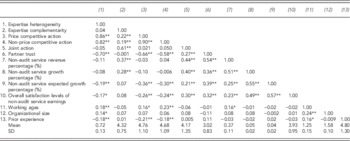
There were 225 valid samples retrieved in the formal questionnaire survey. The Pearson correlation analysis and descriptive statistical results are as shown in Table 1. The correlation coefficients between some variables are high, for example, resource heterogeneity and competitive actions (0.86 and 0.82, respectively). The high degree of correlation between independent variables may result in multi-collinearity. To test the co-linearity problem, Variance Inflation Factor and Condition Index were used. According to the test results, Variance Inflation Factor values were below 10, while Condition Index values were below 30, suggesting that there is no problem of multi-collinearity between variables (Neter, Kutner, Nachtsheim, and Wasserman, Reference Neter, Kutner, Nachtsheim and Wasserman1996).
Descriptive statistics and correlation analysis

Notes: n=225.
*p<.05; **p<.01.
Common method variance test
When participants fill in variables or measurements, there can be single source bias, and common method variance might exist (Podsakoff & Organ, Reference Podsakoff and Organ1986; Avolio, Yammarino & Bass, Reference Avolio, Yammarino and Bass1991; Podsakoff, MacKenzie, Lee & Podsakoff, Reference Podsakoff, MacKenzie, Lee and Podsakoff2003). In order to avoid this situation, this study adopted confidential interviews and reverse item design. In addition, this study conducted a post hoc test of common method variance using Harman’s single-factor analysis (Podsakoff & Organ, Reference Podsakoff and Organ1986). After conducting non-rotated factor analysis on all items, a total of eight factors were obtained (80.26% cumulative explanatory power). Factor 1 only had 35.31% variance, which was lower than the 50% standard. Since no single factor resulted in significant variance, common method variance in this study was not serious (Mossholder, Bennett, Kemery & Wesolowski, Reference Mossholder, Bennett, Kemery and Wesolowski1998).
Confirmatory factor analysis
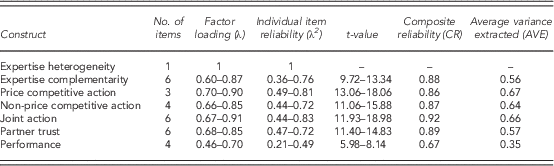
As indicated in Table 2, the individual reliability (λ2) values of observable variables are between 0.21 and 0.83, which have crossed the threshold, 0.20, proposed by Bentler and Wu (Reference Bentler and Wu1993). All of the t-values in the loadings of each construct are above the significant level, 1.96. All of the observable variables with regard to the factor loadings (λ) of their latent variables are between 0.46 and 0.91. These values have crossed the threshold, 0.45, proposed by Bentler and Wu (Reference Bentler and Wu1993). Therefore, the scale of this study had a certain degree of convergent validity.
Individual item reliability, composite reliability and average variance extracted
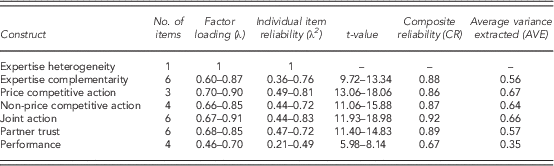
As indicated in Table 2, in terms of the composite reliability of the six constructs, the values are between 0.67 and 0.92, suggesting the constructs have reliability. With regard to the average variance extracted, five of the six constructs are more than 0.5, including resource complementarity (AVE=0.56), price competitive action (AVE=0.67), non-price competitive action (AVE=0.64), joint action (AVE=0.66) and partner trust (AVE=0.57), which explains the values contributed by the observable values of the five constructs outweigh those contributed by the deviation. The average variance extracted of the performance construct is 0.35 only, indicating 65% of the variance comes from measurement error. However, according to Table 2, factor loadings of manifest variables in performance meet the standard requirements (between 0.46 and 0.70); individual reliability of manifest variables meets the standard requirements (between 0.21 and 0.49); t-values are above the significant level, 1.96 (between 5.98 and 8.14); the composite reliability of their constructs is 0.67, also achieving the standard, 0.6. Although the average variance extracted does not meet the required standard, the construct can still be considered valid according to Fornell and Larcker (Reference Fornell and Larcker1981).
Model test and hypothesis test
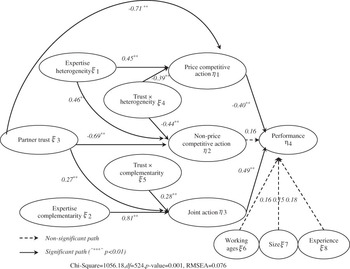
The relationship of the latent variables in the theoretical model is indicated in Figure 1. The common goodness of fit index examining the overall model includes (a) goodness of fit index (b) adjusted goodness of fit index, (c) comparative fit index, (d) normed fit index, (e) non-normed fit index and (f) incremental fit index. When these index values are above 0.9, the fit of the model can be considered good (Bagozzi & Yi, Reference Bagozzi and Yi1988).
Hypothesized model

Judging by the analysis results of the theoretical model, the value of χ2/df is 2.016. When χ2/df is below 3, the model can be considered having a parsimonious fit. It is considered reasonably fit when RMSEA=0.076. With regard to the overall model fit criteria, when GFI=0.95 and AGFI=0.91, which meet the requirement of 0.9 respectively, the model can be considered having a good fit. With respect to the comparative model fit criteria, when NFI=0.91, NNFI=0.94, CFI=0.95, IFI=0.95, and RFI=0.90, which meet the requirement of 0.9, the model can be considered having a good fit. In the parsimonious model fit criteria, when PNFI=0.82, which is above 0.50, the model is said to have a parsimonious fit. Therefore, the theoretical model has a great fit index.
As the moderating variable of this model is a continuous variable, rather than a class variable, the practice of verifying interacting variables, as recommended by Kenny and Judd (Reference Kenny and Judd1984), to introduce phantom variables was applied in this study. In other words, another latent variable ξ4 was added into the model in order to reflect the interaction between ξ1 and ξ3. Latent variable ξ4 was the multiplication of the observable variables of ξ1 and ξ3, while ξ5 is the multiplication of the observable variables of ξ2 and ξ3. The model is added with two variables, including the interaction item of partner trust and expertise heterogeneity (ξ4), and partner trust and professional complementary interaction item (ξ5). After the formation of the new latent variables, the model estimation is then made.
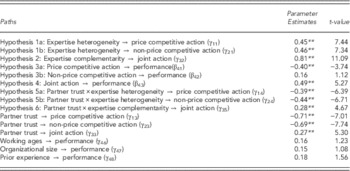
According to the analysis results, the proposed theoretical model in the research study has a great fit index (Figure 1), and indicated in Table 3 is the analysis results of its path coefficients. The path relationships concerning the hypotheses in the research study include (1) expertise heterogeneity has a significantly positive influence on price competitive action (γ11=0.45; p<.01) and non-price competitive action (γ21=0.46; p<.01); (2) expertise complementarity has a significantly positive influence on joint action (γ32=0.81; p<.01); (3) price competitive action has a significantly negative influence on performance (β41=−0.40; p<.01); (4) joint action has a significantly positive influence on performance (β42=0.49; p<.01); (5) the interacting variable of partner trust and expertise heterogeneity has a significantly negative influence on price competitive action (γ32=−0.39; p<.01) and non-price competitive action (γ32=−0.44; p<.01); (6) the interacting variable of partner trust and expertise complementarity has a significantly positive influence on joint action (γ32=0.28; p<.01); (7) non-price competitive action has no significant influence on performance. Although the path coefficient does not meet the significant standard, there still exists a positive correlation.
Parameter estimates for structural equations model

Note: **p<.01.
Direct and indirect effect analysis
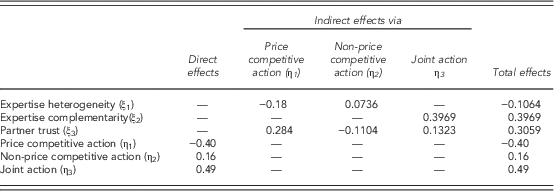
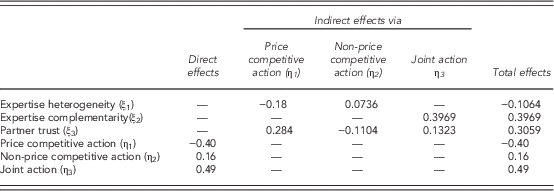
Indicated in Table 4 are the effects each latent variable has on non-audit service performance. The direct effect joint action has on non-audit service performance is 0.49 while the indirect effect that expertise complementarity has on non-audit service performance through joint action is 0.3969, which suggests the total effects expertise complementarity has on non-audit service performance are less than those it has on joint action. Finally, by comparing the influence each latent variable has on non-audit service performance, the research study finds that joint action has a bigger influence than price competitive action and non-price competitive action.
Results of direct and indirect analysis of performance
Cluster analysis and analysis of variance
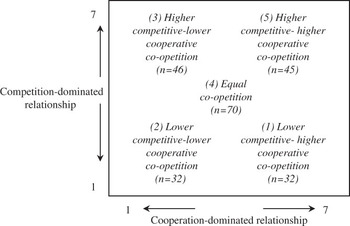
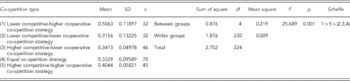
When the number of observable values (number of samples and number of questionnaires) or data are high (number of samples of observable values is more than 200), we should establish the number of cluster in advance. The research study uses K-means methods of cluster analysis to conduct classification. As indicated in Figure 2, based on the two strategic variables, competitive action and joint action, the research study divides accountants’ co-opetition strategies into five types, namely (1) lower competitive-higher cooperative co-opetition strategy, (2) lower competitive-lower cooperative co-opetition strategy, (3) higher competitive-lower cooperative co-opetition strategy, (4) equal co-opetition strategy (5) higher competitive-higher cooperative co-opetition strategy. By one-way analysis of variance, this study attempts to determine if there is significant difference in performance of accountants adopting different co-opetition strategies. As indicated in Table 5, the results suggest there does exist a significant difference among accountants adopting different strategies (F=25.689, p<.01). In terms of posteriori comparisons, Scheffe’s test is adopted to examine whether there is a difference among different types of co-opetition strategies. After the examination of Scheffe’s test, the results are indicated in Table 5: the performance of low competitive-high cooperative co-optition strategy is the highest, followed by that of high competitive-high cooperative one. There is no significant difference between high competitive-low cooperative co-optition strategy, equal co-opetition strategy and low competitive-low cooperative co-optition strategy. Low competitive-high cooperative co-opetition strategy can result in maximum performance, meaning that specialties of small and medium accounting firms are not diverse and they must cooperate with other accountants in order to create higher performance. In addition, high competitive-low cooperative co-opetition strategy is the strategy adopted by monopolistic competition firms which produce heterogeneous products with unique characteristics. Since accountants’ specialties are heterogeneous, accounting firms have partial price fixing capacity. Accountants can adopt price competition. However, since specialty substitution is high, they mostly adopt non-price competition.
Co-opetition types of small and medium-sized accounting agencies

Results of co-opetition types and performance differences

Note: n=225.
CONCLUSIONS AND IMPLICATIONS
Conclusions
According to the findings, the conclusions are as follows: (1) the influence expertise heterogeneity has on co-opetition strategies. When the competitive advantage comes from an organization’s unique resources and capacities for the sake of strengthening its market status and preempting its competitors, it is very likely for the organization to become an initiator of competitive action. That is, it is more likely to adopt competitive strategies and action. The research study has found that expertise heterogeneity has a significantly positive influence on price competitive action and non-price competitive action, which suggests that if accounting agencies possess unique and heterogeneous expertise, they tend to adopt price competitive action and non-price competitive action to strengthen their competitive advantages and establish their market position and target competition as opposed to their counterparts. Adopting non-price competitive action is more effective than adopting price competitive action. (2) The influence expertise complementarity has on co-opetition strategies. When an organization cannot obtain the required resources from within and external resources happen to complement its own, the organization has to trade with others in possession of the needed resources. Therefore, it is likely to adopt cooperation strategies of joint action. The research study has found that expertise complementarity has a significantly positive influence on joint action, which suggests that when the expertise accounting agencies require has complementarity, the agencies tend to adopt joint action to fill the resource gaps. (3) The influence competitive action has on performance. The research study has found that price competitive action has a significantly negative influence on performance, which is in conflict with the study’s expectation. The research study was anticipating that price competitive action would have a positive influence on performance, but the results indicate otherwise, which suggests that accounting agencies should avoid adopting price competitive action. The adoption of price competitive action would upset non-audit service market and unsettle its current prices; over the long haul, there would be no profits in the market. Therefore, avoiding price competitive action is more likely to boost organizational performance. On the other hand, non-price competitive action has no significant influence on performance. The results do not support the hypothesis proposed by the study. Although non-price competitive action does not have a significant influence on performance, the results have found both have positive correlation, which meets the expectation of the study. Hence, in terms of the two competitive actions, price competitive action has a significantly negative influence on performance while there is a positive correlation between non-price competitive action and performance. The conclusion suggests price competitive action would have an adverse influence on performance while non-price competitive action seems to have no adverse influence. (4) The influence joint action has on organizational performance. The research study has found that joint action has a positive influence on performance, which suggests that accounting agencies must improve their cooperation relationship and adopt joint action to serve clients so that they have a chance of boosting performance. Since the threat of competition in the environment has a limited influence on the comprehension of expertise knowledge, accountants in face of market competition and client requests must use not only their own expertise to the fullest effect but take joint action with other accountants to compensate for their inadequacy. By so doing can they have the effect of one plus one equaling more and raise their performance. (5) In the past, scholars believed that after the generation of trust, the trustee would be willing to show goodwill as a response (Ring & Van de Ven, Reference Ring and Van de Ven1992; Gulati, Reference Gulati1995; Zaheer, McEvily & Perrone, Reference Zaheer, McEvily and Perrone1998; Manolova, Gyoshev & Manev, Reference Manolova, Gyoshev and Manev2007). The research study has found that partner trust would weaken the formation of price competitive action and non-price competitive action; meanwhile, it would strengthen the formation of joint action. (6) Finally, the research study divides co-opetition strategies into five types, namely higher competitive-higher cooperative co-opetition, lower competitive-higher cooperative co-opetition, higher competitive-lower cooperative co-opetition, equal co-opetition, and lower competitive-lower cooperative co-opetition. The analysis results show that there is a significant difference in the performance of the five types, among which lower competitive-higher cooperative co-opetition has the highest performance.
Theoretical contribution
The co-opetition theory explains the phenomenon in transactions according to the Game Theory. Based on the co-opetition framework, as proposed by Brandenburger and Nalebuff (Reference Brandenburger and Nalebuff1996), many studies have explored the concept of co-opetition. For instance, Child and Faulkner (Reference Child and Faulkner1998) discussed the interactions of four combinations of competition and cooperation. Lado, Boyd and Hanlon (Reference Lado, Boyd and Hanlon1997) indicated the syncretic model of rent-seeking behavior, which is different from the perspective of competition, Robbins and Finley (Reference Robbins and Finley1998) elaborated upon the combination of competition and cooperation. Bengtsson and Kock (Reference Bengtsson and Kock2000) indicated three types of co-opetition relationships. Luo (Reference Luo2005) explored the types of co-opetition in units of international enterprises. Hence, this study proposes co-opetition strategy types of the accounting industry, and suggests a theoretical contribution to the research context of types of co-opetition. In addition, there are few empirical studies (Li, Liu & Liu, Reference Li, Liu and Liu2011; Hung & Chang, Reference Hung and Chang2012); hence, based on the resource-based view, this study probes into the cause and effect of co-opetition strategy adoption in small and medium accounting firms. The conclusions of this study contribute to empirical research on co-opetition.
Managerial implications
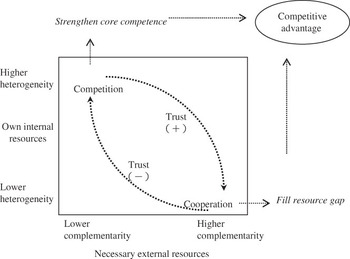
As indicated in Figure 3, the construct of the matrix includes two dimensions: own internal resources and necessary external resources. The vertical axis is to examine whether one’s own internal resources have heterogeneity, and the horizontal axis is to examine whether necessary external resources have complementarity. Accounting agencies can decide on a co-opetition strategy beneficial for accountants to make a strategic judgment, based on their resource characteristics. Strategies are a means to achieve a certain purpose, and they are concerned with the arrangements of important resources. Hence, implementation of different co-opetition strategies has to rely on one’s own or necessary resource characteristics. For example, when an accounting agency’s own expertise heterogeneity is very low, it can seek for expertise complementarity and support from more trustworthy agencies to meet clients’ needs. By so doing, it can complement its expertise inadequacy and jointly serve clients for the deliverance of higher performance. On the contrary, when an accounting agency’s own expertise heterogeneity is high, and it can serve clients on its own, then it may consider adopting non-price competition strategies. For example, it can accommodate clients’ needs with more professional service to create performance, instead of adopting cut-throat price competition strategies.
The relationships between resource characteristic and co-opetition strategy

Acknowledgements
We thank Dr. Timothy O’Shannassy and the anonymous reviewers for their helpful comments and suggestions.
Appendix: Survey items
Each variable is measured with Likert scale. The agreement levels, from the highest to the lowest, can be divided into seven scales, with corresponding points for each scale. Seven means ‘totally agree’ while one means ‘totally disagree.’